
Psalms 55:2

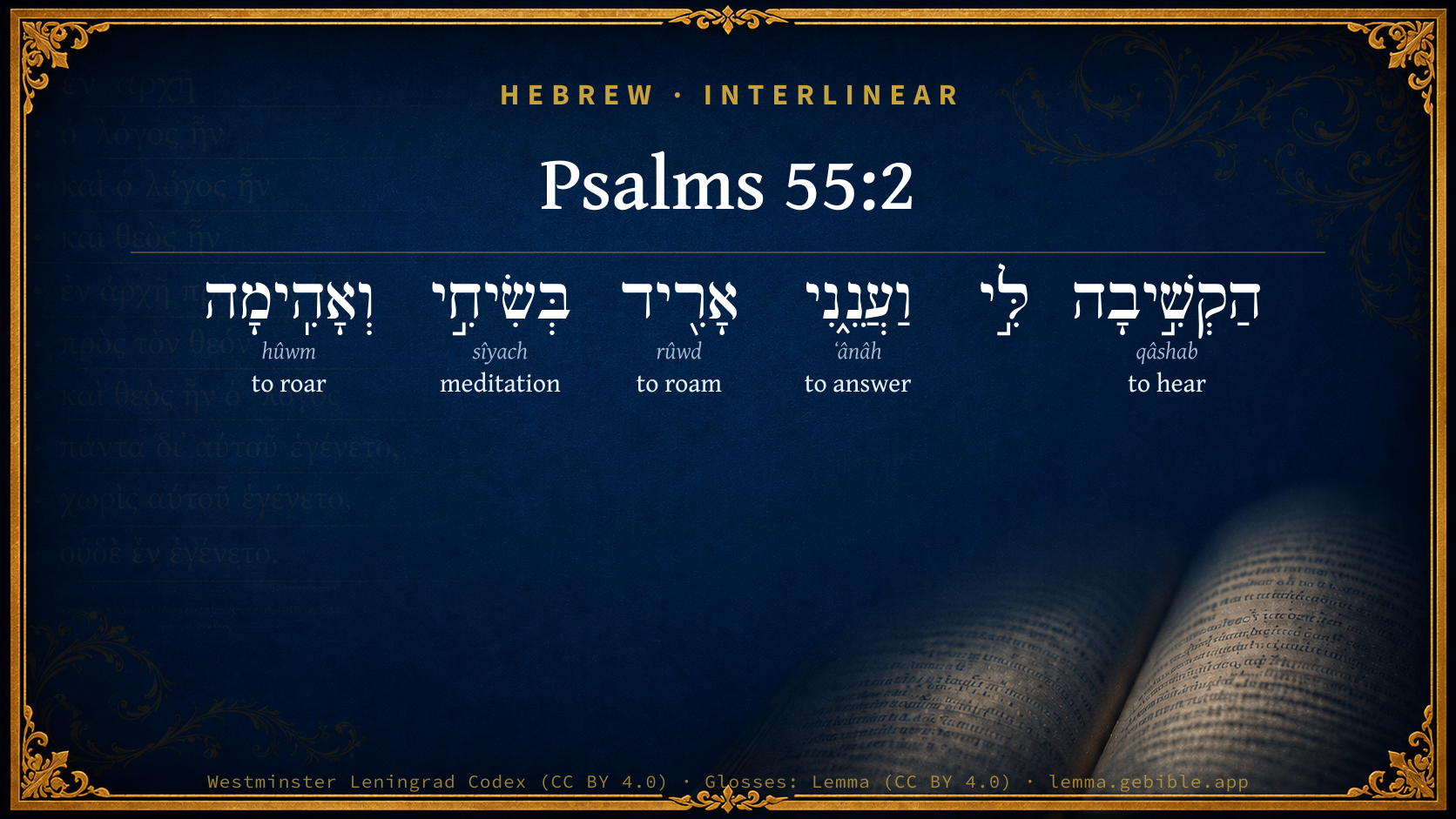
Hebrew (Westminster Leningrad Codex) Psalms 55:2 appears in the Hebrew Old Testament. The text above is from the Westminster Leningrad Codex. Each word links to its Strong’s number, a concise gloss, and parsing drawn from the Open Scriptures Hebrew Bible morphology. Click any word for its full Brown-Driver-Briggs (BDB) entry.
Download image
Cite this verse

Psalms 55:2 (World English Bible). Public Domain. Lemma interlinear Bible study tool, https://lemma.gebible.app/v/psalms/55/2.

Show BibTeX & RIS
BibTeX
RIS
English Translation
Attend to me, and answer me. I am restless in my complaint, and moan,
World English Bible · Public Domain
Download a study sheet

One document with this verse’s original text, its word-by-word gloss line, the meaning frame, cross-references with their text, attributed commentary, and full source and license credits — printable, and it pastes into notes with its structure intact.

This verse Autodidact and up

Study sheet (.html) Plain text (.txt)

A passage Seminary Student

Up to 50 verses in one chapter. A passage sheet keeps up to 6 commentary sources and 12 cross-references per verse, in the order this page ranks them, and says so on the sheet whenever that leaves anything out. Ask for a single verse and you get the Autodidact verse sheet above.

Everything on this page stays free to read, with no account — the sheet is a download of what is already on screen, not access to it.

Want to remove ads? Support Godless Engineer
Compare translations 3

The same verse in 3 English versions, stacked beneath the original-language interlinear above. Click any original word for its lexicon entry.

Each is an independent rendering of the whole verse — the interlinear is not word-aligned to these translations.

Highlighted words mark where these versions differ — a whole-verse word diff, not a word-by-word alignment.

  • World English Bible Public Domain
    Attend to me, and answer me. I am restless in my complaint, and moan,
  • King James Version Public Domain
    Attend unto me, and hear me: I mourn in my complaint, and make a noise;
  • unfoldingWord Literal Text CC BY-SA 4.0
    Attend to me and answer me. I am restless in my complaint, and let me moan

unfoldingWord Literal Text — © unfoldingWord, licensed CC BY-SA 4.0. Word-aligned USFM3 via Door43 (git.door43.org/unfoldingWord/en_ult).

Versions to compare (up to 4)

3 of 4 selected

Show all 18 translations

Every available English version of this verse, each an independent rendering of the whole verse.

  • World English Bible Public Domain
    Attend to me, and answer me. I am restless in my complaint, and moan,
  • Berean Standard Bible Public Domain
    Attend to me and answer me. I am restless in my complaint, and distraught
  • Majority Standard Bible Public Domain
    Attend to me and answer me. I am restless in my complaint, and distraught
  • King James Version Public Domain
    Attend unto me, and hear me: I mourn in my complaint, and make a noise;
  • American Standard Version (1901) Public Domain
    Attend unto me, and answer me: I am restless in my complaint, and moan,
  • Revised Version (1885) Public Domain
    Attend unto me, and answer me: I am restless in my complaint, and moan;
  • Geneva Bible (1599) Public Domain
    Hearken vnto me, and answere me: I mourne in my prayer, and make a noyse,
  • Douay-Rheims (1899) Public Domain
    Hear, O God, my prayer, and despise not my supplication:
  • Young's Literal Translation Public Domain
    Attend to me, and answer me, I mourn in my meditation, and make a noise,
  • Literal Standard Version CC BY-SA 4.0
    Attend to me, and answer me, || I mourn in my meditation, and make a noise,
  • Unlocked Literal Bible CC BY-SA 4.0
    Pay attention to me and answer me; I have no rest in my troubles
  • unfoldingWord Literal Text CC BY-SA 4.0
    Attend to me and answer me. I am restless in my complaint, and let me moan
  • Darby Bible Public Domain
    Attend unto me, and answer me: I wander about in my plaint, and I moan aloud,
  • World Messianic Bible Public Domain
    Attend to me, and answer me. I am restless in my complaint, and moan
  • Webster's Bible Public Domain
    \\55:1\\To the chief Musician on Neginoth, Maschil, A Psalm of David. Give ear to my prayer, O God; and hide not thyself from my supplication.
  • Free Bible Version CC BY-SA 4.0
    Please listen, and give me an answer. I'm terribly troubled by my problems! I'm frantic!
  • Bible in Basic English Public Domain
    Give thought to me, and let my prayer be answered: I have been made low in sorrow;
  • JPS Tanakh (1917) Public Domain
    (55-3) Attend unto me, and hear me; I am distraught in my complaint, and will moan;

Literal Standard Version (2020), Covenant Press — licensed CC BY-SA 4.0. Text via the HelloAO Bible API (eBible.org). Unlocked Literal Bible (unfoldingWord) — licensed CC BY-SA 4.0. Text via the HelloAO Bible API (eBible.org). unfoldingWord Literal Text — © unfoldingWord, licensed CC BY-SA 4.0. Word-aligned USFM3 via Door43 (git.door43.org/unfoldingWord/en_ult). Free Bible Version, Dr. Jonathan Gallagher — licensed CC BY-SA 4.0. Text via the HelloAO Bible API (eBible.org).

Word by word

More ways to search: Search by grammar → Find every occurrence → Compare this word →

Practice this passage: Drill this verse → Learn its vocabulary →

About this verse

These counts appear in no published source. They are computed here, from the morphology-tagged text and Lemma’s own curated glosses. What Lemma adds →

6
words
5
distinct lemmas
Wisdom
section

Notable vocabulary

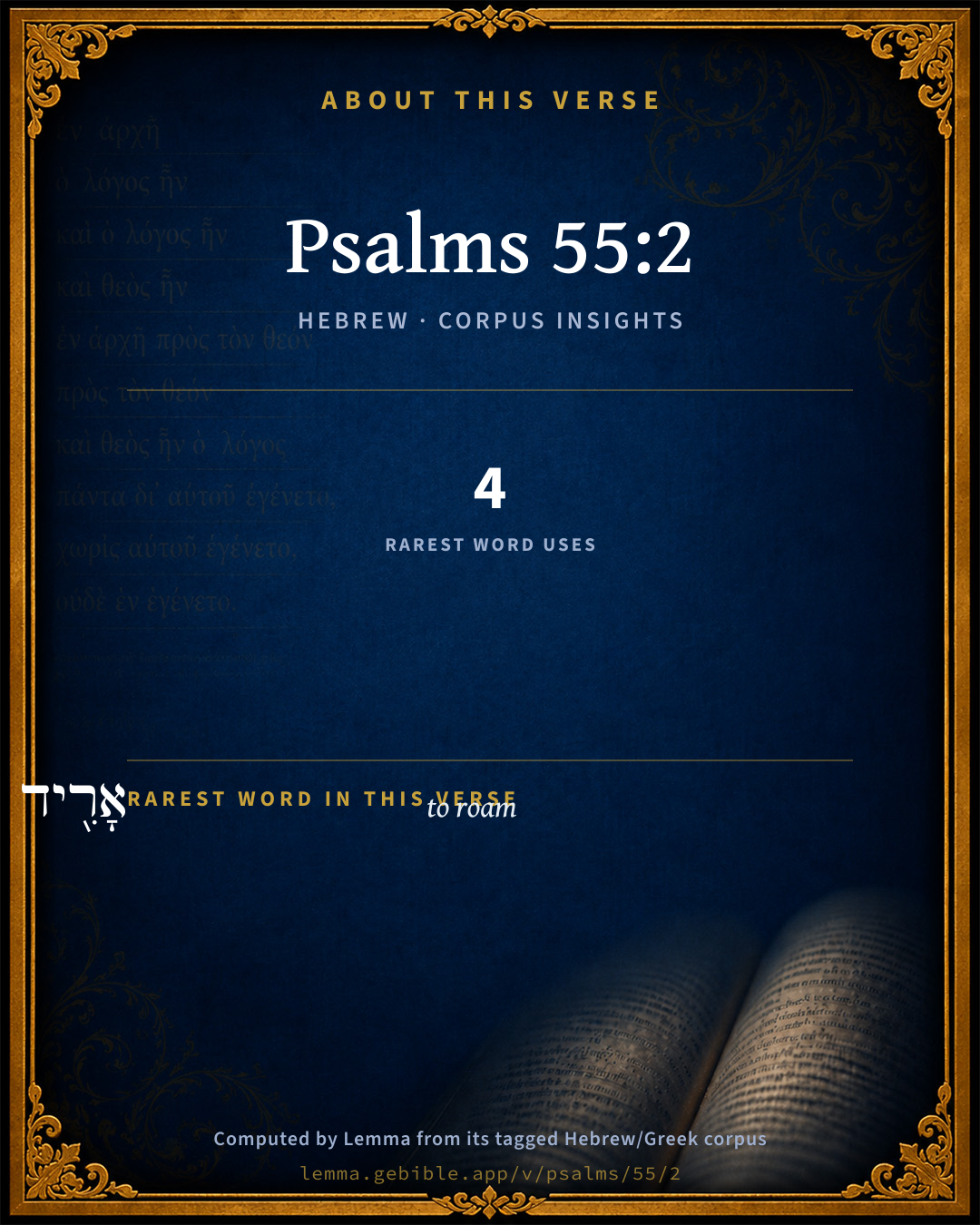
The rarest word here is אָרִ֖יד to roam H7300 — appearing just 4 times in the whole Hebrew Bible.

Shared distinctive vocabulary

אָרִ֖יד to roam H7300 occurs in 4 verses of the Hebrew Bible. Also found in:

Grammatical profile

  • 4 verbs
  • 1 noun
  • 1 preposition

Verb forms

  • הַקְשִׁ֣יבָה Hiphil · Imperative
  • וַעֲנֵ֑נִי Qal · Imperative
  • אָרִ֖יד Hiphil · Imperfect
  • וְאָהִֽימָה Hiphil · Cohortative

Hebrew & Septuagint length

In English translation the verse runs 14 words from the Hebrew and 15 from the Septuagint (LXX English) — closely comparable.

A rough comparison of the two English renderings, which tokenize alike — not a word-level alignment.

Word counts can differ between the Hebrew and the Greek without any difference in meaning — e.g. the Hebrew direct-object marker אֵת has no separate Greek word, and Greek often adds the article ὁ.

Cross-references

10

Topical passages linked to Psalms 55:2 in the Treasury of Scripture Knowledge — connected by theme and wording, ordered by reader-vote popularity; previews shown in the World English Bible.

  • Isaiah 38:14 Like a swallow [or] a crane, so did I chatter; I did moan as a dove; my eyes fail [with looking] upward: Lord, I am oppressed, be my collateral.
  • Psalms 66:19 But most assuredly, God has listened. He has heard the voice of my prayer.
  • Psalms 77:3 I remember God, and I groan. I complain, and my spirit is overwhelmed. Selah.
  • Psalms 64:1 Hear my voice, God, in my complaint. Preserve my life from fear of the enemy.
  • Isaiah 59:11 We roar all like bears, and moan sore like doves: we look for justice, but there is none; for salvation, but it is far off from us.
  • Psalms 38:6 I am pained and bowed down greatly. I go mourning all day long.
  • Psalms 43:2 For you are the God of my strength. Why have you rejected me? Why do I go mourning because of the oppression of the enemy?
  • Psalms 102:9–10 For I have eaten ashes like bread, And mixed my drink with tears,
  • Psalms 13:1–2 How long, Yahweh? Will you forget me forever? How long will you hide your face from me?
  • Psalms 32:3 When I kept silence, my bones wasted away through my groaning all day long.

Cross-references courtesy of OpenBible.info (CC BY 4.0).

Hebrew and Greek witnesses Masoretic Hebrew ↔ Greek Septuagint

The same verse in the two great witnesses to the Old Testament, shown verse-for-verse.

You’re reading Greek Psalm 54 (Hebrew Psalm 55). The Septuagint counts the superscription, so verse numbers can differ from the Hebrew — chapter-level alignment, not verse-by-verse. Numbering follows Rahlfs.

These are two independent witnesses, not word-aligned to each other, and the Septuagint is shown in lemma (dictionary) form.

Hebrew Psalms 55:2 Masoretic · Westminster Leningrad Codex

הַקְשִׁ֣יבָה לִּ֣י וַעֲנֵ֑נִי אָרִ֖יד בְּשִׂיחִ֣י וְאָהִֽימָה

Attend to me, and answer me. I am restless in my complaint, and moan,

World English Bible · Public Domain

Greek LXX Greek Psalm 54:2 Septuagint · lemma form

ἐνωτίζομαι ὁ θεός ὁ προσευχή ἐγώ καί μή ὑπερὁράω ὁ δέησις ἐγώ

Attend to me, and listen to me: I was grieved in my meditation, and troubled;

LXX2012 (modern English Septuagint) · Public Domain

Hebrew: Westminster Leningrad Codex (CC BY 4.0). Greek: Septuagint (public domain); English from LXX2012 (modern English Septuagint) (Public Domain). How the Septuagint differs from the Hebrew →

Commentary

Notes on Psalms 55:2 from classic Christian and Jewish commentators (each source and its license shown beneath its notes). The classic Christian expositions comment on the surrounding passage and are grouped to its opening verse, so a note may address several verses; the Jewish commentaries on the Tanakh (Rashi and others) are per-verse, so they appear only where the commentator wrote on this verse.

Lemma curates 59 commentaries, every one of them public domain or Creative Commons licensed, each selected and text-cleaned for this edition rather than reprinted as found. About our sources →

Trapp's Complete Commentary

John Trapp

Psa 55:2 Attend unto me, and hear me: I mourn in my complaint, and make a noise;

Ver. 2. Attend unto me, and hear me] Heb. answer me, that is, grant me deliverance from this death which threateneth me. This is his sense, as appeareth by the sequel; though at present he could not instance, but only beggeth audience.

I mourn in my complaint] Heb. I toss this way and that way; I am so much troubled ut meipsum lamentando huc et illuc versare, et mire agitare cogar. Prae dolore moveo me nunc huc nunc illuc (Campensis).

And make a noise] Plungo, et perstrepo. Of our Saviour it is said, that, being in an agony, he prayed more earnestly; he bent, as it were, all his nerves, and set up his note, Luk 22:44.

John Trapp, A Commentary or Exposition upon All the Books of the Old and New Testament (1647–1656) — public domain. Text from a community e-Sword module.

J. A. Alexander on Psalms

Joseph Addison Alexander

3. (Psa 55:2). Hearken to me and answer me; I will give loose to my thought, and I will make a noise. The first verb means to attend, especially to one speaking, to listen, to hearken. See above, on Psa 5:2; Psa 10:17; Psa 17:1. Answer or hear, in the sense of of receiving a prayer favourably. See above, on Psa 3:4; Psa 38:15. The literal translation of the next words is, I will suffer to wander itt my thinking, i.e. I will let my mind wander, or my thoughts rove as they will. He is resolved not only to think freely but to express his thoughts aloud. The same use of the Hebrew verb occurs in Mic 2:12. The thinking or meditation here meant is reflection on his sufferings, to which the Hebrew verb is specially applied. With the whole verse, and with this clause in particular, compare Job 7:11.

Joseph Addison Alexander, The Psalms Translated and Explained (1850) — public domain. Text from a community e-Sword module.

Jamieson, Fausset & Brown

Robert Jamieson, A. R. Fausset & David Brown

The terms of the last clause express full indulgence of grief.

Jamieson, Fausset & Brown — Commentary Critical and Explanatory on the Whole Bible (1871) — public domain (CC PDM 1.0). Text via the HelloAO Bible API.

Adam Clarke's Commentary

Verse 2. I mourn in my complaint] בשיחי besichi, in my sighing; a strong guttural sound, expressive of the natural accents of sorrow.

And make a noise] I am in a tumult - I am strongly agitated.

Adam Clarke's Commentary on the Bible (1810–1826) — public domain. Text from a community e-Sword/MySword module.

Ellicott's Commentary for English Readers

(2) I mourn.—A verb found in this form only in three other passages, always with the idea of restlessness—e.g., Gen_27:40, of the roving life of a Bedouin; Jer_2:31, of moral restlessness; Hos_12:1, of political instability. Here it may either indicate that bodily restlessness which often serves as an outlet of grief:

“Hard mechanic exercise,

Like dull narcotics, numbing pain,”

or the distracted state of the mind itself.

And make a noise.—Better, and must roar, the form of the verb expressing the compulsion which the sufferer feels to give vent to his feelings in groans and murmurs. (See Note on Psa_42:5.)

A Bible Commentary for English Readers, edited by Charles John Ellicott (1878–1897) — public domain. Text from a community e-Sword module.

The Cambridge Bible for Schools and Colleges

gen. ed. J. J. S. Perowne

2. hear me] Answer me.

I mourn &c.] Render, I am restless in my complaint, and am distracted (R.V. moan). A word used in Gen_27:40 of a roving life, in Jer_2:31 of impatience of restraint (R.V. break loose), is here applied to the restlessness of a distracted mind.

The Cambridge Bible for Schools and Colleges (gen. ed. J. J. S. Perowne; Cambridge University Press, 1878–1918) — public domain. Text from a community e-Sword module.

John Gill's Exposition

Attend unto me, and hear me,.... So as to answer, and that immediately and directly, his case requiring present help;

I mourn in my complaint; or "in my meditation" (p); solitary thoughts, and melancholy views of things. Saints have their complaints, on account of their sins and corruptions, their barrenness and unfruitfulness, and the decay of vital religion in them; and because of the low estate of Zion, the declining state of the interest of Christ, and the little success of his Gospel; and they mourn, in these complaints, over their own sins, and the sins of others, professors and profane, and under afflictions temporal and spiritual, both their own and the church's. Christ also, in the days of his flesh, had his complaints of the perverseness and faithlessness of the generation of men among whom he lived; of the frowardness, pride and contentions of his disciples; of the reproaches, insult, and injuries of his enemies; and of the dereliction of his God and Father; and he often mourned on account of one or other of these things, being a man of sorrows and acquainted with griefs;

and make a noise; not only with sighs and groans, but in so loud a manner as to be called roaring; see Psa 22:1.

(p) "in meditatione mea", Montanus, Junius & Tremellius, Piscator, Cocceius, Gejerus, Michaelis; so Ainsworth.

John Gill's Exposition of the Whole Bible (1746–1763) — public domain (CC PDM 1.0). Text via the HelloAO Bible API.

Albert Barnes' Notes on the Bible

Attend unto me, and hear me - This also is the language of earnest supplication, as if he was afraid that God would not regard his cry. These varied forms of speech show the intense earnestness of the psalmist, and his deep conviction that he must have help from God.

I mourn - The word used here - רוד rûd - means properly to wander about; to ramble - especially applied to animals that have broken loose; and then, to inquire after, to seek, as one does “by running up and down;” hence, to desire, to wish. Thus in Hos 11:12 - “Judah runs wild toward God,” - in our translation, “Judah yet ruleth with God.” The word occurs also in Jer 2:31, “We are lords” (margin, have dominion); and in Gen 27:40, “When thou shalt have the dominion.” It is not elsewhere found in the Scriptures. The idea here seems not to be to mourn, but to inquire earnestly; to seek; to look for, as one does who wanders about, or who looks every way for help. David was in deep distress. He looked in every direction. He earnestly desired to find God as a Helper. He was in the condition of one who had lost his way, or who had lost what was most valuable to him; and he directed his eyes most earnestly toward God for help.

In my complaint - The word here employed commonly means speech, discourse, meditation. It here occurs in the sense of complaint, as in Job 7:13; Job 9:27; Job 21:4; Job 23:2; Psa 142:2; 1Sa 1:16. It is not used, however, to denote complaint in the sense of fault-finding, but in the sense of deep distress. As the word is now commonly used, we connect with it the idea of fault-finding, complaining, accusing, or the idea that we have been dealt with unjustly. This is not the meaning in tills place, or in the Scriptures generally. It is the language of a troubled, not of an injured spirit.

And make a noise - To wit, by prayer; or, by groaning. The psalmist did not hesitate to give vent to his feelings by groans, or sobs, or prayers. Such expressions are not merely indications of deep feeling, but they are among the appointed means of relief. They are the effort which nature makes to throw off the burden, and if they are without complaining or impatience they are not wrong. See Isa 38:14; Isa 59:11; Heb 5:7; Mat 27:46.

Albert Barnes' Notes on the Bible (1834–1885) — public domain. Text from a community e-Sword/MySword module.

Matthew Poole's English Annotations

For my misery is very great, and forceth tears and bitter cries from me.

Matthew Poole's English Annotations on the Holy Bible (1683–1685) — public domain. Text from a community e-Sword/MySword module.

The Treasury of David

Charles H. Spurgeon

Ver. 2. Attend unto me, and hear me. This is the third time he prays the same prayer. He is in earnest, in deep and bitter earnest. If his God do not hear, he feels that all is over with him. He begs for his God to be a listener and an answerer.

I mourn in my complaint, and make a noise. He gives a loose to his sorrows, permits his mind to rehearse her griefs, and to pour them out in such language as suggests itself at the time, whether it be coherent or not. What a comfort that we may be thus familiar with our God! We may not complain of him, but we may complain to him. Our rambling thoughts when we are distracted with grief we may bring before him, and that too in utterances rather to be called

a noise than language. He will attend so carefully that he will understand us, and he will often fulfil desires which we ourselves could not have expressed in intelligible words. "Groanings that cannot be uttered, "are often prayers which cannot be refused. Our Lord himself used strong crying and tears, and was heard in that he feared.

Ver. 2. I mourn. As one cast down with sorrow, making a doleful noise. Henry Ainsworth, 1662.

Ver. 2. I mourn, etc. A mourning supplicant shall neither lose his prayers nor his tears; for, I mourn, is brought for a reason of his hope that God shall attend and hear him. David Dickson.

Ver. 2. I mourn in my complaint. The literal translation of these words is, I will suffer to wander in my thinking; i.e., I will let my mind wander, or my thoughts rove as they will. J. A Alexander.

Ver. 2. In my complaint. Saints have their complaints on account of their sins and corruptions, their barrenness and unfruitfulness, and the decay of vital religion in them, and because of the low estate of Zion, the declining state of the interest of Christ, and the little success of his gospel; and they mourn, in these complaints, over their own sins, and the sins of others, professors and profane, and under afflictions temporal and spiritual, both their own and the church's. Christ also in the days of his flesh, had his complaints of the perverseness and faithlessness of the generation of men among whom he lived; of the frowardness, pride, and contentions of his disciples; of the reproaches, insult, and injuries of his enemies; and of the dereliction of his God and Father; and he often mourned on account of one or other of these things, being a man of sorrows and acquainted with griefs. John Gill.

Ver. 2. In my complaint. The word here employed commonly means discourse, meditation. It here occurs in the sense of complaint, as in Job 7:13 9:27 21:4 23:2 Ps 142:2 1Sa 1:16. It is not used, however, to denote complaint in the sense of fault finding, complaining, accusing, or the idea that we have been dealt with unjustly. This is not the meaning in this place or in the Scriptures generally. It is the language of a troubled, not of an injured spirit. Albert Barnes, 1868.

Ver. 2. In confession, when the soul melts into a holy shame and sorrow for the sins he spreads before the Lord, he feels a holy smart and pain within, and doth not act a tragical part with a comical heart. Chrysostom saith, "To paint tears is worse than to paint the face." Here is true fervency, I mourn in my complaint and make a noise. There may be fire in the pan when there is none in the piece; a loud wind but no rain with it. David made a noise with his voice, and mourned in his spirit. William Gurnall, 1617-1679.

Ver. 2. The Great Hearer.

I. What address shall we present to him?

II. What sort of attention do we desire?

III. How shall we secure it?

IV. What is the reflex duty on our part? To attend and

hear him.

Ver. 2. (second clause). Allowable complaining.

I. Not of God but to God.

II. Mainly of ourselves.

III. Of the world as against God and right.

IV. Ever with holy grief, and not selfish vexation.

Psalms 55:3*

Charles H. Spurgeon's The Treasury of David (1869–1885) — public domain. Psalms only. Text from a community e-Sword/MySword module.

Whedon's Commentary on the Bible

Daniel D. Whedon

2. I mourn in my complaint—I wander about in my complaint. As one who has lost his way, I go up and down in meditative grief. The word rendered “mourn” signifies to wander, to roam about. “Here it is used of the restless tossing to and fro of the mind filled with cares and anxieties.”—Perowne.

Make a noise—I groan, and cannot repress my cry of pain. The Hiphil form of the verb gives the sense of compulsion, “I am forced to cry out,” I have no power to repress my complaint.

Daniel D. Whedon (gen. ed.), Commentary on the Old and New Testaments (1874–1909) — public domain. Text from a community e-Sword module.

The Pulpit Commentary

Attend unto me, and hear me. A very special need is indicated by these four petitions to be heard (vers. 1, 2). I mourn in my complaint, and make a noise; rather, I wander in my musing, and moan aloud. "I wander," i.e. "from one sad thought to another" (Kay); and, unable to constrain myself, I give vent to meanings. Orientals are given to open displays of their grief (Herod., 8:99; Aeschylus, "Persae," passim).

The Pulpit Commentary (1880–1919), ed. H.D.M. Spence-Jones & Joseph S. Exell — public domain. Text from a community e-Sword module.

Lesson kit

Teaching starters — assembled from the data on this page, not authored interpretation. Every prompt links to the verse data it draws on. Edit before teaching.

Psalms, in the Wisdom, opens this verse with 6 words (5 distinct Hebrew lemmas). Its most distinctive word is rûwd (“to roam”). A historical commentator’s framing appears above. Read the whole chapter for the surrounding context.

Discussion questions

  1. How does “to roam” (rûwd) shape what this verse is saying?
  2. Genesis 27:40 shares the word «to roam» with this verse. How do the two illuminate each other?
  3. The translations on this page render this verse differently — a whole-verse word diff, not a word-by-word alignment. What might account for the different wordings?
  4. The verb «הַקְשִׁ֣יבָה» is Hiphil Imperative. How does its form color the action?
  5. Reading how Trapp's Complete Commentary and J. A. Alexander on Psalms read this verse, where do the two commentators agree and where do they part?

Things to notice

Reading settings

Reading text

Shown beneath each verse's original-language words.

Old Testament
Old Testament edition

Read the OT as the Masoretic Hebrew (MT) or the Greek Septuagint (LXX).

English shown for the Greek Septuagint (in the Hebrew ↔ Greek comparison).

Comparing translations? Open the Compare panel on any verse page to stack up to four side by side.