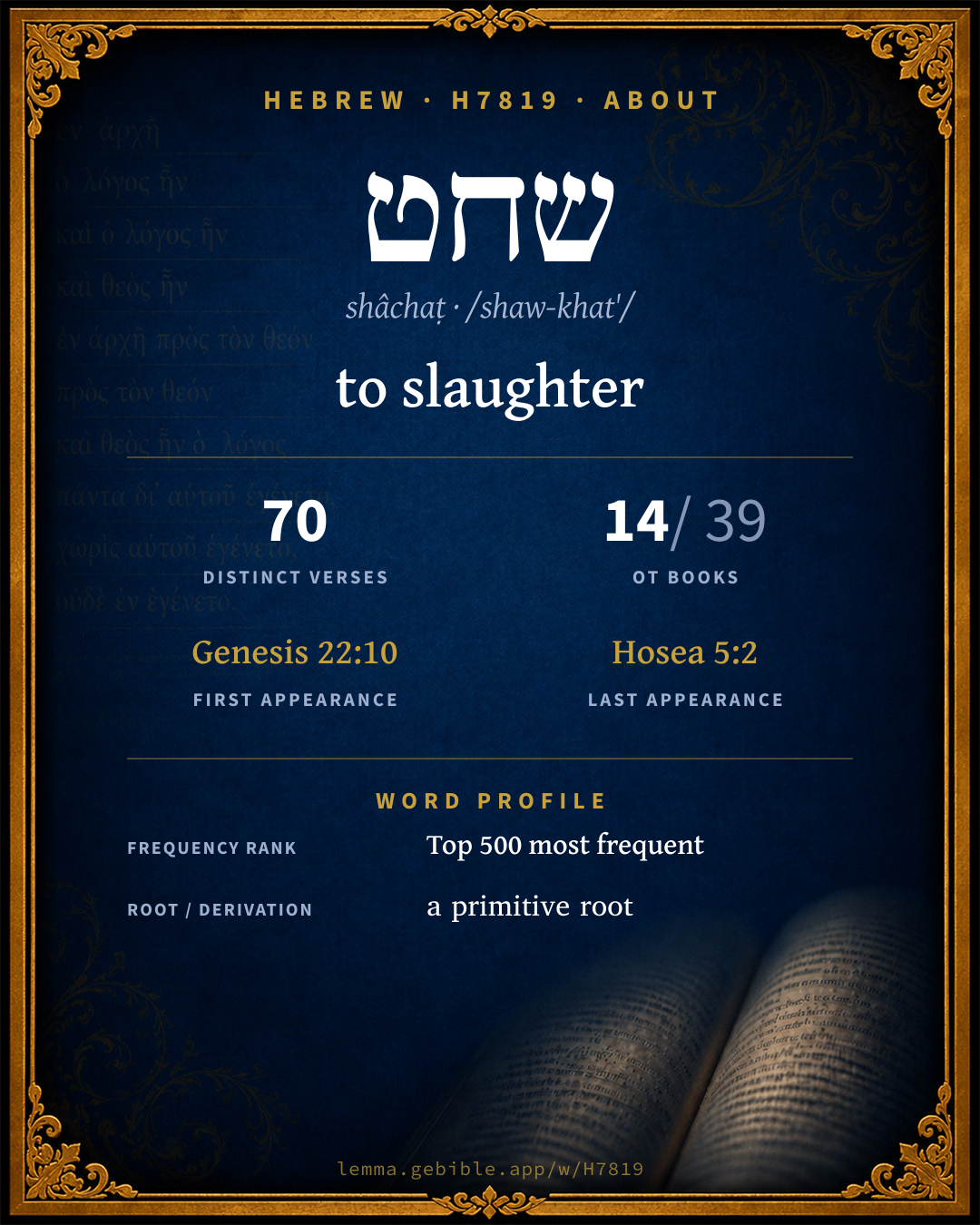
שָׁחַט
to slaughter
‘to slaughter’ is one of 2 main senses fuller range ↓
Full lexicon entry — Brown-Driver-Briggs (BDB)
From Brown-Driver-Briggs (BDB)
Where this word appears
See every Qal verb in the Hebrew Bible →
Grammar key — what these labels mean
Part of speech
- Verb
- An action or state-of-being word.
Noun type
- Common
- A common noun — a general class of person, place, or thing (“king,” “city,” “water”), not a specific name.
Stem
- Qal
- The basic, simple active stem — the plain form of the verb (“he wrote”). Here: ‘beast for food 1 S 14’
- Niphal
- Usually the simple passive or reflexive of the Qal (“he was written”).
Form
- Sequential Perfect
- A perfect with prefixed waw continuing a preceding imperfect or command (waw-consecutive perfect).
- Sequential Imperfect
- An imperfect with prefixed waw — the standard past-narrative form (waw-consecutive imperfect).
- Imperfect
- An incomplete, ongoing, or future action (“he will / would write”).
- Imperative
- A direct command (“write!”).
- Infinitive Construct
- A bound verbal noun, frequently with prepositions (“to write / in writing”).
- Participle Passive
- A verbal adjective expressing action received (“written”).
- Perfect
- A completed action or state — Hebrew marks aspect (completeness) more than strict tense (“he wrote”).
- Participle Active
- A verbal adjective expressing ongoing or characteristic action (“writing / one who writes”).
- Infinitive Absolute
- An unbound verbal noun, often intensifying or standing in for a finite verb.
State
- Absolute
- The independent form of a noun, not bound to a following word.
- Construct
- A noun bound to a following noun in a possessive / “of” relationship (the construct chain).
Person
- 3rd Person
- The one spoken about (“he / she / it / they”).
- 2nd Person
- The one addressed (“you”).
Gender
- Masculine
- Grammatically masculine.
- Feminine
- Grammatically feminine.
- Common
- Either gender — not distinguished for this form.
Number
- Singular
- One.
- Plural
- More than one (in Hebrew, generally three or more).
Grammatical forms 23 distinct
- Verb, Qal, Sequential Perfect, 3rd Person, Masculine, Singular 17 times (21%)
- Verb, Qal, Sequential Imperfect, 3rd Person, Masculine, Plural 15 times (18%)
- Verb, Qal, Sequential Imperfect, 3rd Person, Masculine, Singular 12 times (15%)
- Verb, Qal, Imperfect, 3rd Person, Masculine, Singular 6 times (7%)
- Verb, Qal, Imperfect, 3rd Person, Masculine, Plural 5 times (6%)
- Verb, Qal, Sequential Perfect, 2nd Person, Masculine, Singular 3 times (4%)
- Verb, Qal, Infinitive Construct 3 times (4%)
- Verb, Qal, Imperative, 2nd Person, Masculine, Plural 2 times (2%)
+15 more forms (19 occurrences)
Parsed forms decoded from the imported morphology (morphhb / Westminster Leningrad Codex — WLC text public domain, morphhb tagging CC BY 4.0), counted across 82 parsed occurrences — not distinct verses.
Every verse where H7819 appears — 70 distinct verses across 14 books. Click any verse to open its interlinear word-by-word view. Verse text shown in the World English Bible for context — . Each verse’s Hebrew form is shown with its reference; the English is not keyword-highlighted, since the data carries no word-level English alignment. Use “Compare translations” on any verse to read it across multiple English versions. This concordance covers the Hebrew Bible; Septuagint (Greek Old Testament) occurrences are not indexed here.
Genesis 2 verses
Exodus 6 verses
- Exodus 12:6 וְ/שָׁחֲט֣וּ conj + Qal wpf 3cp and you shall keep it until the fourteenth day of the same month; and the whole assembly of the congregation of Israel shall kill it at evening.
- Exodus 12:21 וְ/שַׁחֲט֥וּ conj + Qal impv 2mp Then Moses called for all the elders of Israel, and said to them, "Draw out, and take lambs according to your families, and kill the Passover.
- Exodus 29:11 וְ/שָׁחַטְתָּ֥ conj + Qal wpf 2ms You shall kill the bull before Yahweh, at the door of the tent of meeting.
- Exodus 29:16 וְ/שָׁחַטְתָּ֖ conj + Qal wpf 2ms You shall kill the ram, and you shall take its blood, and sprinkle it around on the altar.
- Exodus 29:20 וְ/שָׁחַטְתָּ֣ conj + Qal wpf 2ms Then you shall kill the ram, and take some of its blood, and put it on the tip of the right ear of Aaron, and on the tip of the right ear of his sons, and on the thumb of their right hand, and on the big toe of their right foot, and sprinkle the blood on the altar round about.
- Exodus 34:25 תִשְׁחַ֥ט Qal impf 2ms "You shall not offer the blood of my sacrifice with leavened bread; neither shall the sacrifice of the feast of the Passover be left to the morning.
Leviticus 30 verses
- Leviticus 1:5 וְ/שָׁחַ֛ט conj + Qal wpf 3ms He shall kill the bull before Yahweh. Aaron's sons, the priests, shall present the blood and sprinkle the blood around on the altar that is at the door of the Tent of Meeting.
- Leviticus 1:11 וְ/שָׁחַ֨ט conj + Qal wpf 3ms He shall kill it on the north side of the altar before Yahweh. Aaron's sons, the priests, shall sprinkle its blood around on the altar.
- Leviticus 3:2 וּ/שְׁחָט֕/וֹ conj + Qal wpf 3ms + sfx pers 3ms He shall lay his hand on the head of his offering, and kill it at the door of the tent of meeting: and Aaron's sons the priests shall sprinkle the blood on the altar round about.
- Leviticus 3:8 וְ/שָׁחַ֣ט conj + Qal wpf 3ms and he shall lay his hand on the head of his offering, and kill it before the tent of meeting: and Aaron's sons shall sprinkle its blood on the altar round about.
- Leviticus 3:13 וְ/שָׁחַ֣ט conj + Qal wpf 3ms and he shall lay his hand on its head, and kill it before the tent of meeting; and the sons of Aaron shall sprinkle its blood on the altar round about.
- Leviticus 4:4 וְ/שָׁחַ֥ט conj + Qal wpf 3ms He shall bring the bull to the door of the Tent of Meeting before Yahweh; and he shall lay his hand on the head of the bull, and kill the bull before Yahweh.
- Leviticus 4:15 וְ/שָׁחַ֥ט conj + Qal wpf 3ms The elders of the congregation shall lay their hands on the head of the bull before Yahweh; and the bull shall be killed before Yahweh.
- Leviticus 4:24 וְ/שָׁחַ֣ט יִשְׁחַ֥ט conj + Qal wpf 3ms Qal impf 3ms He shall lay his hand on the head of the goat, and kill it in the place where they kill the burnt offering before Yahweh. It is a sin offering.
- Leviticus 4:29 וְ/שָׁחַט֙ conj + Qal wpf 3ms He shall lay his hand on the head of the sin offering, and kill the sin offering in the place of burnt offering.
- Leviticus 4:33 וְ/שָׁחַ֤ט יִשְׁחַ֖ט conj + Qal wpf 3ms Qal impf 3ms He shall lay his hand on the head of the sin offering, and kill it for a sin offering in the place where they kill the burnt offering.
- Leviticus 6:25 תִּשָּׁחֵ֨ט תִּשָּׁחֵ֤ט Niphal impf 3fs Niphal impf 3fs "Speak to Aaron and to his sons, saying, 'This is the law of the sin offering: in the place where the burnt offering is killed, the sin offering shall be killed before Yahweh. It is most holy.
- Leviticus 7:2 יִשְׁחֲטוּ֙ יִשְׁחֲט֖וּ Qal impf 3mp Qal impf 3mp In the place where they kill the burnt offering, he shall kill the trespass offering; and its blood he shall sprinkle on the altar round about.
- Leviticus 8:15 וַ/יִּשְׁחָ֗ט conj + Qal wimpf 3ms He killed it; and Moses took the blood, and put it on the horns of the altar round about with his finger, and purified the altar, and poured out the blood at the base of the altar, and sanctified it, to make atonement for it.
- Leviticus 8:19 וַ/יִּשְׁחָ֑ט conj + Qal wimpf 3ms He killed it; and Moses sprinkled the blood on the altar round about.
- Leviticus 8:23 וַ/יִּשְׁחָ֓ט conj + Qal wimpf 3ms He killed it; and Moses took some of its blood, and put it on the tip of Aaron's right ear, and on the thumb of his right hand, and on the great toe of his right foot.
- Leviticus 9:8 וַ/יִּשְׁחַ֛ט conj + Qal wimpf 3ms So Aaron drew near to the altar, and killed the calf of the sin offering, which was for himself.
- Leviticus 9:12 וַ/יִּשְׁחַ֖ט conj + Qal wimpf 3ms He killed the burnt offering; and Aaron's sons delivered the blood to him, and he sprinkled it on the altar round about.
- Leviticus 9:15 וַ/יִּשְׁחָטֵ֥/הוּ conj + Qal wimpf 3ms + sfx pers 3ms He presented the people's offering, and took the goat of the sin offering which was for the people, and killed it, and offered it for sin, like the first.
- Leviticus 9:18 וַ/יִּשְׁחַ֤ט conj + Qal wimpf 3ms He also killed the ox and the ram, the sacrifice of peace offerings, which was for the people: and Aaron's sons delivered to him the blood, which he sprinkled on the altar round about,
- Leviticus 14:5 וְ/שָׁחַ֖ט conj + Qal wpf 3ms The priest shall command them to kill one of the birds in an earthen vessel over running water.
- Leviticus 14:6 הַ/שְּׁחֻטָ֔ה ptcl def.art + Qal ptcp.pass fs As for the living bird, he shall take it, and the cedar wood, and the scarlet, and the hyssop, and shall dip them and the living bird in the blood of the bird that was killed over the running water.
- Leviticus 14:13 וְ/שָׁחַ֣ט יִשְׁחַ֧ט conj + Qal wpf 3ms Qal impf 3ms He shall kill the male lamb in the place where they kill the sin offering and the burnt offering, in the place of the sanctuary; for as the sin offering is the priest's, so is the trespass offering. It is most holy.
- Leviticus 14:19 יִשְׁחַ֥ט Qal impf 3ms "The priest shall offer the sin offering, and make atonement for him who is to be cleansed because of his uncleanness: and afterward he shall kill the burnt offering;
- Leviticus 14:25 וְ/שָׁחַט֮ conj + Qal wpf 3ms He shall kill the lamb of the trespass offering. The priest shall take some of the blood of the trespass offering and put it on the tip of the right ear of him who is to be cleansed, and on the thumb of his right hand, and on the big toe of his right foot.
- Leviticus 14:50 וְ/שָׁחַ֖ט conj + Qal wpf 3ms He shall kill one of the birds in an earthen vessel over running water.
- Leviticus 14:51 הַ/שְּׁחוּטָ֔ה ptcl def.art + Qal ptcp.pass fs He shall take the cedar wood, and the hyssop, and the scarlet, and the living bird, and dip them in the blood of the slain bird, and in the running water, and sprinkle the house seven times.
- Leviticus 16:11 וְ/שָׁחַ֛ט conj + Qal wpf 3ms "Aaron shall present the bull of the sin offering, which is for himself, and shall make atonement for himself and for his house, and shall kill the bull of the sin offering which is for himself.
- Leviticus 16:15 וְ/שָׁחַ֞ט conj + Qal wpf 3ms "Then he shall kill the goat of the sin offering, that is for the people, and bring his blood within the veil, and do with his blood as he did with the blood of the bull, and sprinkle it on the mercy seat, and before the mercy seat:
- Leviticus 17:3 יִשְׁחַ֜ט יִשְׁחַ֔ט Qal impf 3ms Qal impf 3ms Whatever man there is of the house of Israel, who kills an ox, or lamb, or goat, in the camp, or who kills it outside the camp,
- Leviticus 22:28 תִשְׁחֲט֖וּ Qal impf 2mp Whether it is a cow or ewe, you shall not kill it and its young both in one day.
Numbers 3 verses
- Numbers 11:22 יִשָּׁחֵ֥ט Niphal impf 3ms Shall flocks and herds be slain for them, to suffice them? or shall all the fish of the sea be gathered together for them, to suffice them?
- Numbers 14:16 וַ/יִּשְׁחָטֵ֖/ם conj + Qal wimpf 3ms + sfx pers 3mp Because Yahweh was not able to bring this people into the land which he swore to them, therefore he has slain them in the wilderness.
- Numbers 19:3 וְ/שָׁחַ֥ט conj + Qal wpf 3ms You shall give her to Eleazar the priest, and he shall bring her forth outside of the camp, and one shall kill her before his face:
Judges 1 verse
1 Samuel 3 verses
- 1 Samuel 1:25 וַֽ/יִּשְׁחֲט֖וּ conj + Qal wimpf 3mp They killed the bull, and brought the child to Eli.
- 1 Samuel 14:32 וַ/יִּשְׁחֲטוּ conj + Qal wimpf 3mp and the people flew on the spoil, and took sheep, and oxen, and calves, and killed them on the ground; and the people ate them with the blood.
- 1 Samuel 14:34 וּ/שְׁחַטְתֶּ֤ם וַ/יִּשְׁחֲטוּ conj + Qal wpf 2mp conj + Qal wimpf 3mp Saul said, Disperse yourselves among the people, and tell them, Bring me here every man his ox, and every man his sheep, and kill them here, and eat; and don't sin against Yahweh in eating with the blood. All the people brought every man his ox with him that night, and killed them there.
1 Kings 1 verse
2 Kings 3 verses
- 2 Kings 10:7 וַֽ/יִּשְׁחֲט֖וּ conj + Qal wimpf 3mp It happened, when the letter came to them, that they took the king's sons, and killed them, even seventy persons, and put their heads in baskets, and sent them to him to Jezreel.
- 2 Kings 10:14 וַֽ/יִּשְׁחָט֞וּ/ם conj + Qal wimpf 3mp + sfx pers 3mp He said, Take them alive. They took them alive, and killed them at the pit of the shearing-house, even two and forty men; neither left he any of them.
- 2 Kings 25:7 שָׁחֲט֖וּ Qal pf 3cp They killed the sons of Zedekiah before his eyes, and put out the eyes of Zedekiah, and bound him in fetters, and carried him to Babylon.
2 Chronicles 6 verses
- 2 Chronicles 29:22 וַֽ/יִּשְׁחֲטוּ֙ וַ/יִּשְׁחֲט֣וּ וַֽ/יִּשְׁחֲטוּ֙ conj + Qal wimpf 3mp conj + Qal wimpf 3mp conj + Qal wimpf 3mp So they killed the bulls, and the priests received the blood, and sprinkled it on the altar: and they killed the rams, and sprinkled the blood on the altar: they killed also the lambs, and sprinkled the blood on the altar.
- 2 Chronicles 29:24 וַ/יִּשְׁחָטוּ/ם֙ conj + Qal wimpf 3mp + sfx pers 3mp and the priests killed them, and they made a sin-offering with their blood on the altar, to make atonement for all Israel; for the king commanded [that] the burnt offering and the sin-offering [should be made] for all Israel.
- 2 Chronicles 30:15 וַ/יִּשְׁחֲט֣וּ conj + Qal wimpf 3mp Then they killed the Passover on the fourteenth [day] of the second month: and the priests and the Levites were ashamed, and sanctified themselves, and brought burnt offerings into the house of Yahweh.
- 2 Chronicles 35:1 וַ/יִּשְׁחֲט֣וּ conj + Qal wimpf 3mp Josiah kept a Passover to Yahweh in Jerusalem: and they killed the Passover on the fourteenth [day] of the first month.
- 2 Chronicles 35:6 וְ/שַׁחֲט֖וּ conj + Qal impv 2mp Kill the Passover, and sanctify yourselves, and prepare for your brothers, to do according to the word of Yahweh by Moses.
- 2 Chronicles 35:11 וַֽ/יִּשְׁחֲט֖וּ conj + Qal wimpf 3mp They killed the Passover, and the priests sprinkled [the blood which they received] of their hand, and the Levites flayed them.
Ezra 1 verse
Isaiah 3 verses
- Isaiah 22:13 וְ/שָׁחֹ֣ט conj + Qal inf.abs and behold, joy and gladness, killing oxen and killing sheep, eating flesh and drinking wine: let us eat and drink, for tomorrow we shall die.
- Isaiah 57:5 שֹׁחֲטֵ֤י Qal ptcp.act mp cs you who inflame yourselves among the oaks, under every green tree; who kill the children in the valleys, under the clefts of the rocks?
- Isaiah 66:3 שׁוֹחֵ֨ט Qal ptcp.act ms He who kills an ox is as he who kills a man; he who sacrifices a lamb, as he who breaks a dog's neck; he who offers an offering, [as he who offers] pig's blood; he who burns frankincense, as he who blesses an idol. Yes, they have chosen their own ways, and their soul delights in their abominations:
Jeremiah 4 verses
- Jeremiah 9:8 שוחט שָׁח֛וּט Qal ptcp.act ms Qal ptcp.pass ms Their tongue is a deadly arrow; it speaks deceit: one speaks peaceably to his neighbor with his mouth, but in his heart he lays wait for him.
- Jeremiah 39:6 וַ/יִּשְׁחַט֩ שָׁחַ֖ט conj + Qal wimpf 3ms Qal pf 3ms Then the king of Babylon killed the sons of Zedekiah in Riblah before his eyes: also the king of Babylon killed all the nobles of Judah.
- Jeremiah 41:7 וַ/יִּשְׁחָטֵ֞/ם conj + Qal wimpf 3ms + sfx pers 3mp It was so, when they came into the midst of the city, that Ishmael the son of Nethaniah killed them, [and cast them] into the midst of the pit, he, and the men who were with him.
- Jeremiah 52:10 וַ/יִּשְׁחַ֧ט שָׁחַ֥ט conj + Qal wimpf 3ms Qal pf 3ms The king of Babylon killed the sons of Zedekiah before his eyes: he killed also all the princes of Judah in Riblah.
Ezekiel 6 verses
- Ezekiel 16:21 וַֽ/תִּשְׁחֲטִ֖י conj + Qal wimpf 2fs that you have slain my children, and delivered them up, in causing them to pass through [the fire] to them?
- Ezekiel 23:39 וּֽ/בְ/שַׁחֲטָ֤/ם conj + prep + Qal inf.cs + sfx pers 3mp For when they had slain their children to their idols, then they came the same day into my sanctuary to profane it; and, behold, thus have they done in the midst of my house.
- Ezekiel 40:39 לִ/שְׁח֤וֹט prep + Qal inf.cs In the porch of the gate were two tables on this side, and two tables on that side, to kill thereon the burnt offering and the sin-offering and the trespass-offering.
- Ezekiel 40:41 יִשְׁחָֽטוּ Qal impf 3mp Four tables were on this side, and four tables on that side, by the side of the gate; eight tables, whereupon they killed [the sacrifices].
- Ezekiel 40:42 יִשְׁחֲט֧וּ Qal impf 3mp There were four tables for the burnt offering, of hewn stone, a cubit and a half long, and a cubit and a half broad, and one cubit high; whereupon they laid the instruments with which they killed the burnt offering and the sacrifice.
- Ezekiel 44:11 יִשְׁחֲט֨וּ Qal impf 3mp Yet they shall be ministers in my sanctuary, having oversight at the gates of the house, and ministering in the house: they shall kill the burnt offering and the sacrifice for the people, and they shall stand before them to minister to them.
Hosea 1 verse
About this entry
At a glance — auto-summarized from this page’s data, not written by a person. Every figure links to its source below. This summary describes the numbers; it doesn’t interpret them.
At its core, שחט (shâchaṭ) means “to slaughter.” The King James Version usually renders it “slew,” while modern versions prefer “slaughter” (Berean Standard Bible) and “he shall slaughter” (unfoldingWord Literal Text) — see the renderings breakdown. With 70 verses in 14 books, it is a moderately common word in the Hebrew Bible. Its uses concentrate in Leviticus (43% of all occurrences). Not a single-sense word: explore its full sense range. Dig into 70-verse concordance and the renderings breakdown below.
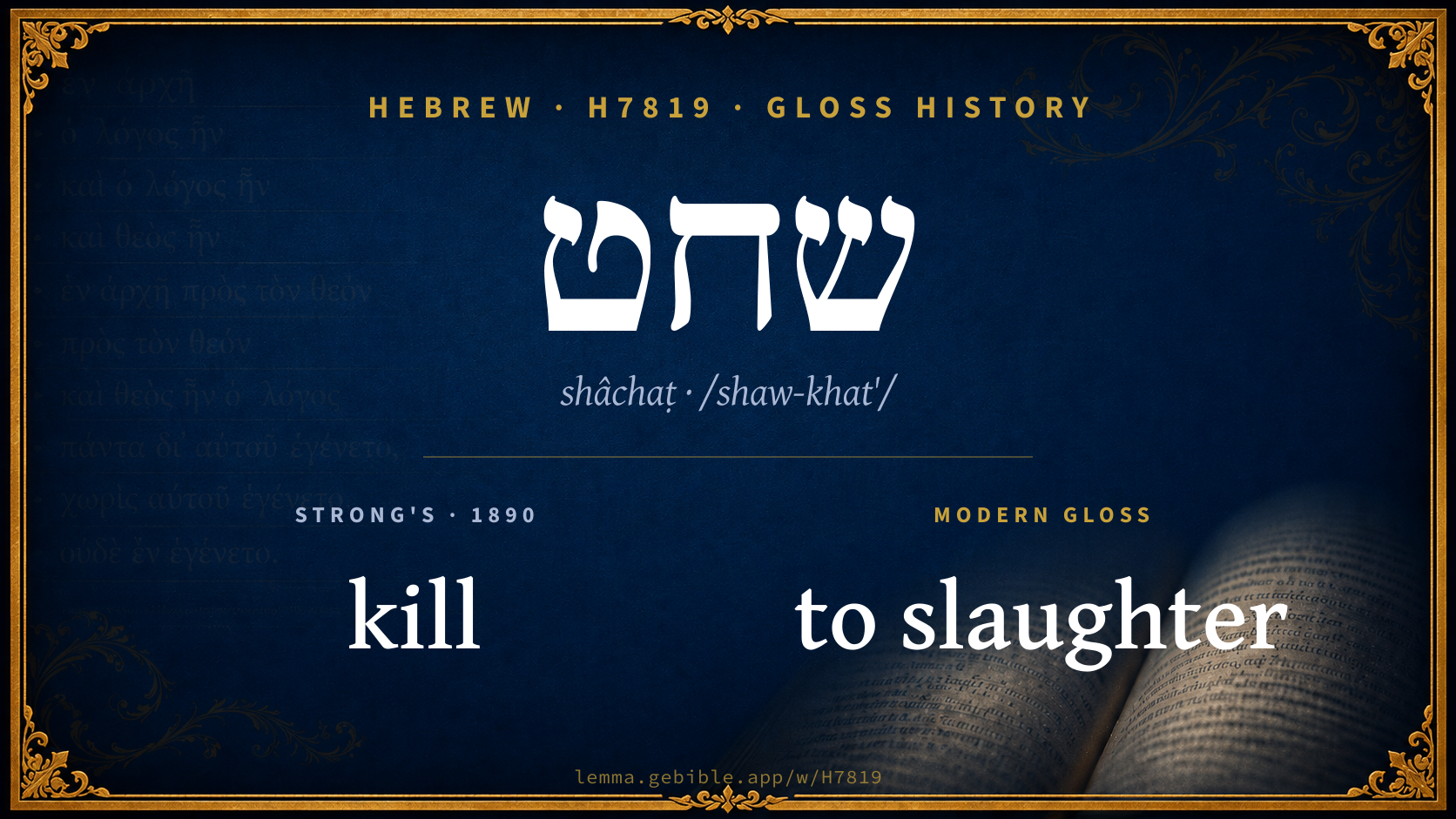
Gloss history
Strong's 1890 vs modern scholarship
About this word
Strong's H7819 catalogs a Hebrew word from the Hebrew Old Testament.
These counts are not copied from any lexicon or concordance. They are computed here, from the morphology-tagged Hebrew Old Testament. What Lemma adds →
- 70
- distinct verses
- The word appears in 70 distinct verses.
- 14 / 39
- OT books
- The word appears in 14 of 39 Old Testament books.
- #487
- by frequency
- Top 500 most frequent Hebrew words (rank 487 of 8,640 Hebrew words by occurrence).
View all 70 occurrences in the concordance →
Most concentrated in
- Leviticus 30 verses 43%
- Exodus 6 verses 9%
- 2 Chronicles 6 verses 9%
By section of the Old Testament
By traditional corpus
Conventional, traditional groupings — biblical authorship is debated, so this is a traditional corpus grouping, not an authorship claim. Each share is this word’s portion of its verses in that division of the Hebrew canon. Each figure is a share of the word’s 70 distinct verses.
- Torah (Pentateuch) 41 verses · 59%
- Prophets (Nevi'im) 22 verses · 31%
- Writings (Ketuvim) 7 verses · 10%
How translations render this word
Counts come from each version’s own published word-to-Strong’s tagging or interlinear alignment — an approximate guide to how each version renders this word, not a word-level alignment the data otherwise carries. Because each total is that version’s own tagged count, the per-version totals vary from one another and need not match the appearance or distinct-verse counts above. These counts may also differ from a printed concordance because Lemma counts each distinctly tagged rendering and does not collapse phrase taggings into a single head-word total. This is a fixed set of word-tagged versions (KJV, ASV, BSB, ULT) and does not change with the reading translation you choose elsewhere. Each version’s license is shown beside its name below (and on Sources).
BDB lists this Strong’s number as 2 distinct words (homographs). Each count above pools all of them and is not split by sense — see the Senses section below. A low-frequency rendering may belong to a different one of those words, not the primary meaning.
- King James Version†: Slew 12×, Kill 7×, He shall kill 6×
- American Standard Version†: Kill 9×, Slew 9×, They killed 7×
- Berean Standard Bible†: Slaughter 15×, Slaughtered 13×, They slaughtered 7×
- unfoldingWord Literal Text†: He shall slaughter 17×, They slaughtered 12×, Slaughter 7×
King James Version Public Domain
Renders H7819 across 81† tagged occurrences — most commonly:
Plus 30 renderings that appear only once — usually multi-word phrases or single function words the recovered tagging swept in, not distinct renderings.
American Standard Version Public Domain
Renders H7819 across 81† tagged occurrences — most commonly:
Plus 32 renderings that appear only once — usually multi-word phrases or single function words the recovered tagging swept in, not distinct renderings.
Berean Standard Bible Public Domain
Renders H7819 across 80† tagged occurrences — most commonly:
Plus 25 renderings that appear only once — usually multi-word phrases or single function words the recovered tagging swept in, not distinct renderings. Not rendered by a distinct English word in 1 further occurrence.
unfoldingWord Literal Text CC BY-SA 4.0
Renders H7819 across 89† tagged occurrences — most commonly:
Plus other, less common renderings. Plus 23 renderings that appear only once — usually multi-word phrases or single function words the recovered tagging swept in, not distinct renderings.
Senses in the full BDB
Hebrew verbs can shift meaning by stem (binyan): Qal is the basic action, Niphal is often passive or reflexive, Piel often intensifies or makes it factitive, and Hiphil is typically causative. The senses below are grouped under the stem BDB assigns to each.
What do BDB’s symbols mean?
BDB uses these scholarly abbreviations:
| Symbol | Meaning |
|---|---|
| 𝔊 | the Septuagint (the ancient Greek translation, LXX) |
| 𝔙 | the Vulgate (the Latin translation) |
| 𝔖 | the Syriac version (the Peshitta) |
| 𝔗 | the Targum (the Aramaic translation) |
| ψ | the Psalms |
| √ | root (the underlying root or stem) |
| ‖ | parallel passage (a synonymous or contrasted parallel) |
| † | the dagger: every passage where the word occurs is cited |
The 6 senses and sub-senses the full Brown-Driver-Briggs lexicon distinguishes for this word, in lexicon order (not ranked by frequency), with BDB’s own verbatim wording and sub-sense lettering. Shown in Hebrew script with BDB’s own scholarly abbreviations. The condensed entry is in the Lexicon Entry tab. See also the Forms in the corpus table below.
שחט I slaughter, beat (orig. beat, flay? cf. Assyrian šaḫâṭu, flay, take off dress
Qal
- Pf. 3 ms. שׁ׳ Je 39:6 +, sf. וּשְׁחָטוֹ consec. Lv 3:2, etc.; Impf. 3 ms. יִשְׁחַט Lv 4:24 +, 2 fs. וַתִּשְׁחֲטִי Ez 16:21, 3 mpl. sf. וַיִּשְׁחָט֫וּהוּ Ju 12:6; Imv. mpl. שַׁחֲטוּ Ex 12:21; 2 Ch 35:6; Inf. abs. שָׁחֹט Is 22:13; cstr. לִשְׁחֹט Gn 22:10, -וֹט Ez 40:39, sf. שַׁחֲטָם (Ges§ 64 a) Ez 23:39; Pt. act. שׁוֹחֵט Is 66:3, etc.; pass. שָׁחוּט 1 K 10:16 +, etc.;—slaughter: e.g. Jeremiah 39:6
- 1. beast for food 1 S 14:32, 34(×2); Is 22:13 (‖ הָרַג), cf. Lv 17:3(×2), for blood Gn 37:31 (E). e.g. 1 Samuel 14:32
- 2. us. (51 times; Hex chiefly P, 38 times) term. techn. of killing sacrifice (BJacobZAW xvii (1897), 51), 1 S 1:25; Ex 29:11; 34:25 (J), Lv 1:5, 11; 4:24; 9:8; Nu 19:3; 2 Ch 29:22(×2), 24 +; abs. Ez 40:41 (אֶל loc.); bird Lv 14:5, 6, 50, 51; beast in illicit sacrifice Is 66:3; c. acc. of sacrifice (עוֹלָה, אָשָׁם, חַטָּאת, etc.) Ez 40:39 (אֶל loc.), v 42; 44:11; Lv 4:24; 7:2; 14:13 +; passover lamb †Ex 12:6, acc. הַפֶּסַח †v 21; 2 Ch 30:15; 35:1, 6, 11; Ezr 6:20. e.g. 1 Samuel 1:25
- 3. slaughter pers. Ju 12:6 1 K 18:40; 2 K 10:7, 14 (אֶל loc.), 2 K 25:7 = Je 39:6a = 52:10a; Je 39:6b = 52:10b; 41:7; י׳ subj. Nu 14:16 (JE); in human sacrifice Gn 22:10 (E), to false gods Ez 16:21; 23:39; Is 57:5. e.g. Judges 12:6
- 4. pt. pass. = beaten, hammered, זָהָב שָׁחוּט 1 K 10:16, 17 = 2 Ch 9:15a, 16, of shekels 2 Ch 9:15b; so also Je 9:7 Qr חֵץ שָׁחוּט (> Kt שׁוֹחֵט) hammered (i.e. sharpened) arrow. e.g. 1 Kings 10:16
Niphal
- Impf. 3 ms. יִשָּׁחֵט Nu 11:22 (J) be slaughtered for food (subj. beast); 3 fs. תִּשָּׁחֵט Lv 6:18(×2) (P) be slain, of sacrifice. e.g. Numbers 11:22
שחט II (Qal Inf. cstr. Köi. 263) doubtful word
Senses from the full Brown-Driver-Briggs lexicon (Brown, Driver, Briggs; Oxford 1906 — public domain), digitized via Sefaria, supplemented by the OpenScriptures HebrewLexicon (CC BY 4.0). Full attribution on Sources.
Word origin
I. vb. slaughter, beat (orig. beat, flay? cf. Assyrian šaḫâṭu, flay, take off dress; Arabic سَحَطَ slay (but ح = ḫ; is this loan-word in Arabic?); NH = BH, especially in ritual);—
I. n.f. (Qal Inf. cstr. Köi. 263) doubtful word;—וְשׁ׳ שֵׂטִים הֶעְמִיקוּ Ho 5:2 RV (cf. AV) the revolters are gone deep in slaughtering [‘Opferschlächterei’ Köii 1. 590, n. 1], Ew Now (formerly), Che in corrupting (read then שַׁחֲתָה); We Now GASm Marti שַׁחַת הַשִּׁטִּים have made deep the pit of Shiṭṭim (as place of idolatry).
— Brown-Driver-Briggs (Oxford 1906, public domain), digitized via Sefaria, supplemented by the OpenScriptures HebrewLexicon (CC BY 4.0). See Sources.
Origin: a primitive root
Jastrow Dictionary
A second Hebrew/Aramaic lexicon for comparison, covering Aramaic and post-biblical (Talmudic, Targumic, Midrashic) usage that the biblical-Hebrew BDB does not. Matched by lemma rather than by Strong’s number, so a lemma may carry more than one Jastrow headword (shown separately below), and the entries cover usage well beyond the Bible.
שָׁחַט I
- to draw, stretch. Part. pass. שָׁחוּט. Y. Yoma IV, 41ᵈ top (expl. זהב שׁחוט, I Kings X, 17) שהיה משוך כשעוה it was drawn out like wax; Cant. R. to III, 10; Yoma 45ᵃ שנטוה כחוט it was spun like a thread; Ḥull. 30ᵇ. Ib. (to prove that in slaughtering you must draw the knife over the animal’s throat and not chop) אין ושחט אלא ומשך וכ׳ v’shaḥaṭ (Lev. I, 5) means and ‘he shall draw’, and so it says zahab shaḥuṭ (v. supra) and also ḥets shaḥuṭ (Jer. IX, 7; Keri שוחט). e.g. 1 Kings 10:17
שָׁחַט II
- to cut the throat, esp. to slay an animal by cutting the throat according to ritual laws. Ḥull. I, 1 הכל שׁוֹחֲטִין וכ׳ all persons are fit to do the ritual slaughtering, and their act is legal, except &c.; וכולן ששָׁחֲטוּ וכ׳ and all those (mentioned as unfit), if they cut under the supervision of others &c. Ib. II, 3 היה שׁוֹחֵט והתיז וכ׳ if he was cutting (drawing the knife across the throat, v. preced.) and cut the head off with one movement. Ib. 1 השוחט … ושנים וכ׳ if one cuts one organ (windpipe or gullet, v. סִימָן) of a bird, and two &c.; ib. עד שיִשְׁחוֹט וכ׳, v. וָרִיד; a. fr.—Part. pass. שָׁחוּט; f. שְׁחוּטָה &c. Nidd. 15ᵃ שור ש׳ לפניך the ox lies slaughtered before thee, i.e. the evidence is before you. Ḥull. 95ᵃ בְּשַׂר ש׳ meat of an animal ritually cut, opp. בשר נבלה; a. fr.
- to be cut, killed according to ritual. Ib. 9ᵃ עד … במה נִשְׁחֲטָה, v. חֲזָקָה. Ib. נשחטה הרי היא וכ׳ if it has been properly slaughtered, it is presumed to be permitted until &c.; a. fr.
- to cause to slaughter. Ib. V, 4 בארבע … מַשְׁחִיטִין את הטבח וכ׳ at these four periods we force the butcher to slaughter (provide meat); Erub. 81ᵇ
שְׁחַט
- —[Targ. O. Num. XI, 32 ed. Vien., v. שְׁטַח.]—Ḥull. 28ᵃ sq. היכי נעביד נִשְׁחֲטֵיה … קשְׁחִיט how shall we proceed? shall we cut it and then examine (the gullet)? Maybe it was cut at a perforated spot. Meg. 7ᵇ שַׁחֲטֵיה לר׳ וכ׳ he cut R. Zera’s throat; a. fr.—Part. pass. שְׁחִיט, v. supra. Ḥull. 4ᵃ הוה ש׳ שפיר was properly cut.
- to be cut. Gitt. 69ᵇ
שָׂחַט
- , v. סָחַט
A Dictionary of the Targumim, the Talmud Babli and Yerushalmi, and the Midrashic Literature (Marcus Jastrow; London, Luzac, 1903) — Public Domain. Digitized via Sefaria. Digitized via Sefaria. Full attribution on Sources.
Forms in the corpus
The 66 distinct written forms H7819 takes in the Hebrew Bible, most frequent first — each parse links to that stem’s occurrences in the concordance. Hebrew forms include their vowel points and cantillation, so a single lemma takes many written forms.
The 60 most common forms are shown; 6 rarer forms follow in the full concordance.
Same root — word family
Other BDB entries built from the same root as H7819, grouped by Strong’s listed origin. These share a root / origin per the lexicon — not necessarily a shared meaning. Each links to that word’s own entry.
Derived from this word
Compare all same-root words → They share a root, not necessarily a meaning.
Septuagint verse parallels
This word appears in 69 verses that also exist in the Greek Old Testament (Septuagint), out of the 70 Hebrew verses it occurs in. You can read those verses in Greek by switching the Old Testament edition to the Septuagint.
Read these verses in the Septuagint
- Genesis 22:10
- Exodus 12:6
- Leviticus 1:5
- Numbers 11:22
- Judges 12:6
- 1 Samuel 1:25
- 1 Kings 18:40
- 2 Kings 10:7
- 2 Chronicles 29:22
- Ezra 6:20
- Isaiah 22:13
- Jeremiah 9:8
This is a verse-level parallel only — the same verses exist in both the Hebrew and Greek Old Testaments. No word-level Hebrew↔Greek correspondence is claimed: the data carries no such alignment, so no Greek word is shown as this Hebrew word’s translation. Coverage is not total — the Septuagint omits the deuterocanon and renumbers the Psalms, so some Hebrew verses have no direct Greek parallel.