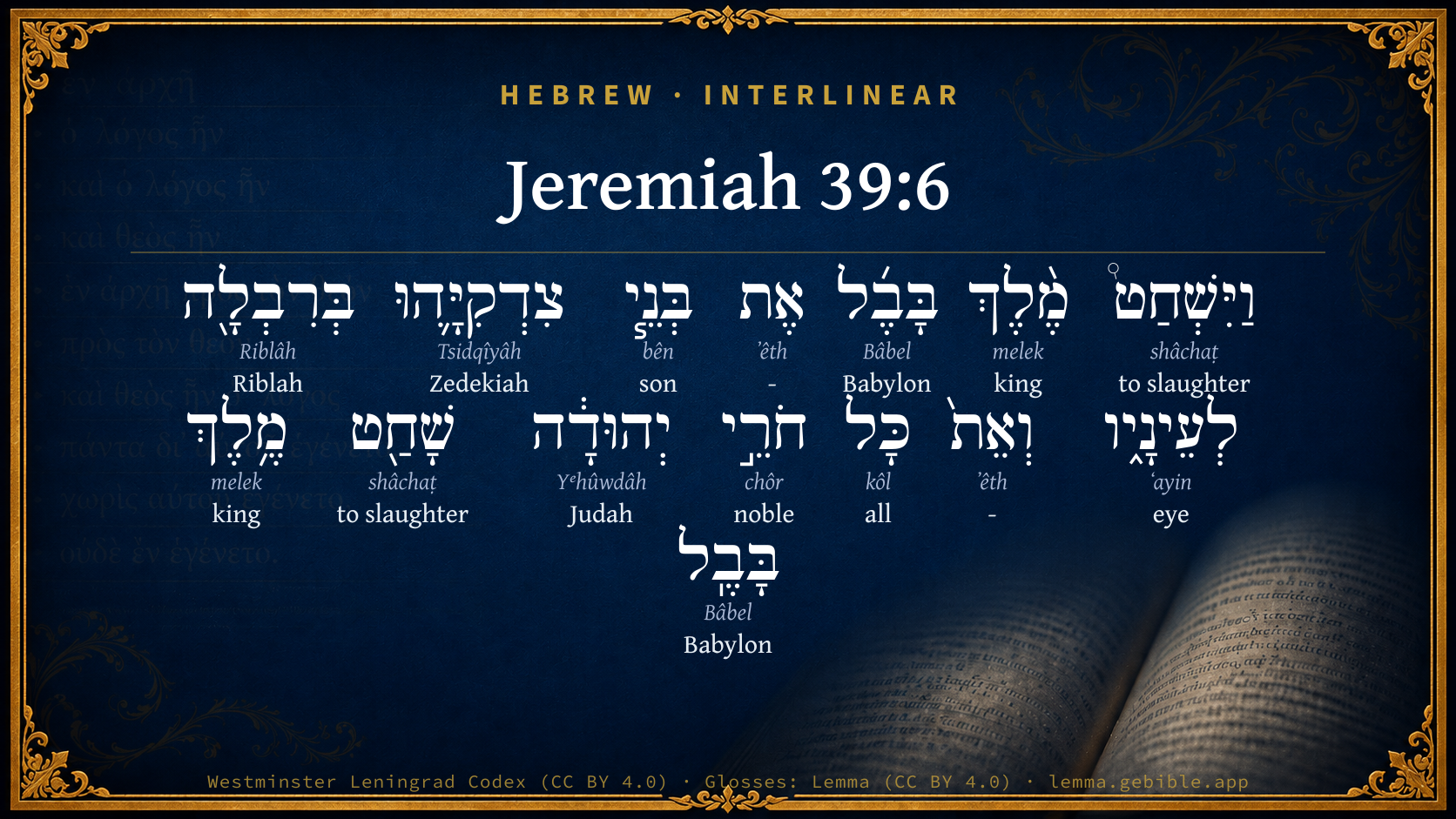
Jeremiah 39:6

Hebrew (Westminster Leningrad Codex) Jeremiah 39:6 appears in the Hebrew Old Testament. The text above is from the Westminster Leningrad Codex. Each word links to its Strong’s number, a concise gloss, and parsing drawn from the Open Scriptures Hebrew Bible morphology. Click any word for its full Brown-Driver-Briggs (BDB) entry.
Download image
Cite this verse

Jeremiah 39:6 (World English Bible). Public Domain. Lemma interlinear Bible study tool, https://lemma.gebible.app/v/jeremiah/39/6.

Show BibTeX & RIS
BibTeX
RIS
English Translation
Then the king of Babylon killed the sons of Zedekiah in Riblah before his eyes: also the king of Babylon killed all the nobles of Judah.
World English Bible · Public Domain
Download a study sheet

One document with this verse’s original text, its word-by-word gloss line, the meaning frame, cross-references with their text, attributed commentary, and full source and license credits — printable, and it pastes into notes with its structure intact.

This verse Autodidact and up

Study sheet (.html) Plain text (.txt)

A passage Seminary Student

Up to 50 verses in one chapter. A passage sheet keeps up to 6 commentary sources and 12 cross-references per verse, in the order this page ranks them, and says so on the sheet whenever that leaves anything out. Ask for a single verse and you get the Autodidact verse sheet above.

Everything on this page stays free to read, with no account — the sheet is a download of what is already on screen, not access to it.

Want to remove ads? Support Godless Engineer
Compare translations 3

The same verse in 3 English versions, stacked beneath the original-language interlinear above. Click any original word for its lexicon entry.

Each is an independent rendering of the whole verse — the interlinear is not word-aligned to these translations.

Highlighted words mark where these versions differ — a whole-verse word diff, not a word-by-word alignment.

  • World English Bible Public Domain
    Then the king of Babylon killed the sons of Zedekiah in Riblah before his eyes: also the king of Babylon killed all the nobles of Judah.
  • King James Version Public Domain
    Then the king of Babylon slew the sons of Zedekiah in Riblah before his eyes: also the king of Babylon slew all the nobles of Judah.
  • unfoldingWord Literal Text CC BY-SA 4.0
    The king of Babylon slaughtered Zedekiah’s sons before his own eyes at Riblah. He also slaughtered all the noblemen of Judah.

unfoldingWord Literal Text — © unfoldingWord, licensed CC BY-SA 4.0. Word-aligned USFM3 via Door43 (git.door43.org/unfoldingWord/en_ult).

Versions to compare (up to 4)

3 of 4 selected

Show all 18 translations

Every available English version of this verse, each an independent rendering of the whole verse.

  • World English Bible Public Domain
    Then the king of Babylon killed the sons of Zedekiah in Riblah before his eyes: also the king of Babylon killed all the nobles of Judah.
  • Berean Standard Bible Public Domain
    There at Riblah the king of Babylon slaughtered the sons of Zedekiah before his eyes, and he also killed all the nobles of Judah.
  • Majority Standard Bible Public Domain
    There at Riblah the king of Babylon slaughtered the sons of Zedekiah before his eyes, and he also killed all the nobles of Judah.
  • King James Version Public Domain
    Then the king of Babylon slew the sons of Zedekiah in Riblah before his eyes: also the king of Babylon slew all the nobles of Judah.
  • American Standard Version (1901) Public Domain
    Then the king of Babylon slew the sons of Zedekiah in Riblah before his eyes: also the king of Babylon slew all the nobles of Judah.
  • Revised Version (1885) Public Domain
    Then the king of Babylon slew the sons of Zedekiah in Riblah before his eyes: also the king of Babylon slew all the nobles of Judah.
  • Geneva Bible (1599) Public Domain
    Then the King of Babel slewe the sonnes of Zedekiah in Riblah before his eyes: also the King of Babel slewe all the nobles of Iudah.
  • Douay-Rheims (1899) Public Domain
    And the king of Babylon slew the sons of Sedecias, in Reblatha, before his eyes: and the king of Babylon slew all the nobles of Juda.
  • Young's Literal Translation Public Domain
    And the king of Babylon slaughtereth the sons of Zedekiah, in Riblah, before his eyes, yea, all the freemen of Judah hath the king of Babylon slaughtered.
  • Literal Standard Version CC BY-SA 4.0
    And the king of Babylon slaughters the sons of Zedekiah, in Riblah, before his eyes, indeed, the king of Babylon has slaughtered all the nobles of Judah.
  • Unlocked Literal Bible CC BY-SA 4.0
    The king of Babylon slaughtered Zedekiah's sons before his own eyes at Riblah. He also slaughtered all the noblemen of Judah.
  • unfoldingWord Literal Text CC BY-SA 4.0
    The king of Babylon slaughtered Zedekiah’s sons before his own eyes at Riblah. He also slaughtered all the noblemen of Judah.
  • Darby Bible Public Domain
    And the king of Babylon slaughtered the sons of Zedekiah in Riblah before his eyes, and the king of Babylon slaughtered all the nobles of Judah;
  • World Messianic Bible Public Domain
    Then the king of Babylon killed Zedekiah’s sons in Riblah before his eyes. The king of Babylon also killed all the nobles of Judah.
  • Webster's Bible Public Domain
    Then the king of Babylon slew the sons of Zedekiah in Riblah before his eyes: also the king of Babylon slew all the nobles of Judah.
  • Free Bible Version CC BY-SA 4.0
    The king of Babylon had Zedekiah's sons killed as Zedekiah watched, and he also executed all of Judah's leaders there in Riblah.
  • Bible in Basic English Public Domain
    Then the king of Babylon put the sons of Zedekiah to death before his eyes in Riblah: and the king of Babylon put to death all the great men of Judah.
  • JPS Tanakh (1917) Public Domain
    Then the king of Babylon slew the sons of Zedekiah in Riblah before his eyes; also the king of Babylon slew all the nobles of Judah.

Literal Standard Version (2020), Covenant Press — licensed CC BY-SA 4.0. Text via the HelloAO Bible API (eBible.org). Unlocked Literal Bible (unfoldingWord) — licensed CC BY-SA 4.0. Text via the HelloAO Bible API (eBible.org). unfoldingWord Literal Text — © unfoldingWord, licensed CC BY-SA 4.0. Word-aligned USFM3 via Door43 (git.door43.org/unfoldingWord/en_ult). Free Bible Version, Dr. Jonathan Gallagher — licensed CC BY-SA 4.0. Text via the HelloAO Bible API (eBible.org).

Word by word

More ways to search: Search by grammar → Find every occurrence → Compare this word →

Practice this passage: Drill this verse → Learn its vocabulary →

בְּרִבְלָ֖ה
Riblâh
H7247
“in/at · Riblah”
Preposition + Noun, Proper
Part of Speech
Preposition + Noun
Type
Proper
Full BDB Definition

Origin: from an unused root meaning to be fruitful

TWOT: None

Riblah = "fertility" - a place on the eastern boundary of Israel - a town in the land of Hamath on the great road between Babylon and Palestine
  1. וַיִּשְׁחַט֩ shâchaṭ H7819 “and · to slaughter” Conjunction + Verb, Qal, Sequential Imperfect, 3rd Person, Masculine, Singular
  2. מֶ֨לֶךְ melek H4428 “king of” Noun, Common, Masculine, Singular, Construct
  3. בָּבֶ֜ל Bâbel H894 “Babylon” Noun, Proper
  4. אֶת ʼêth H853 “-” Particle, Direct Object
  5. בְּנֵ֧י bên H1121 “sons of” Noun, Common, Masculine, Plural, Construct
  6. צִדְקִיָּ֛הוּ Tsidqîyâh H6667 “Zedekiah” Noun, Proper
  7. לְעֵינָ֑יו ʻayin H5869 “to/for · eyes · his” Preposition + Noun, Common, Both, Dual, Construct + Suffix, Personal, 3rd Person, Masculine, Singular
  8. וְאֵת֙ ʼêth H853 “and · -” Conjunction + Particle, Direct Object
  9. כָּל kôl H3605 “all of” Noun, Common, Masculine, Singular, Construct
  10. חֹרֵ֣י chôr H2715 “nobles of” Noun, Common, Masculine, Plural, Construct
  11. יְהוּדָ֔ה Yᵉhûwdâh H3063 “Judah” Noun, Proper
  12. שָׁחַ֖ט shâchaṭ H7819 “to slaughter” Verb, Qal, Perfect, 3rd Person, Masculine, Singular
  13. מֶ֥לֶךְ melek H4428 “king of” Noun, Common, Masculine, Singular, Construct
  14. בָּבֶֽל Bâbel H894 “Babylon” Noun, Proper

About this verse

These counts appear in no published source. They are computed here, from the morphology-tagged text and Lemma’s own curated glosses. What Lemma adds →

15
words
11
distinct lemmas
Prophets
section

Notable vocabulary

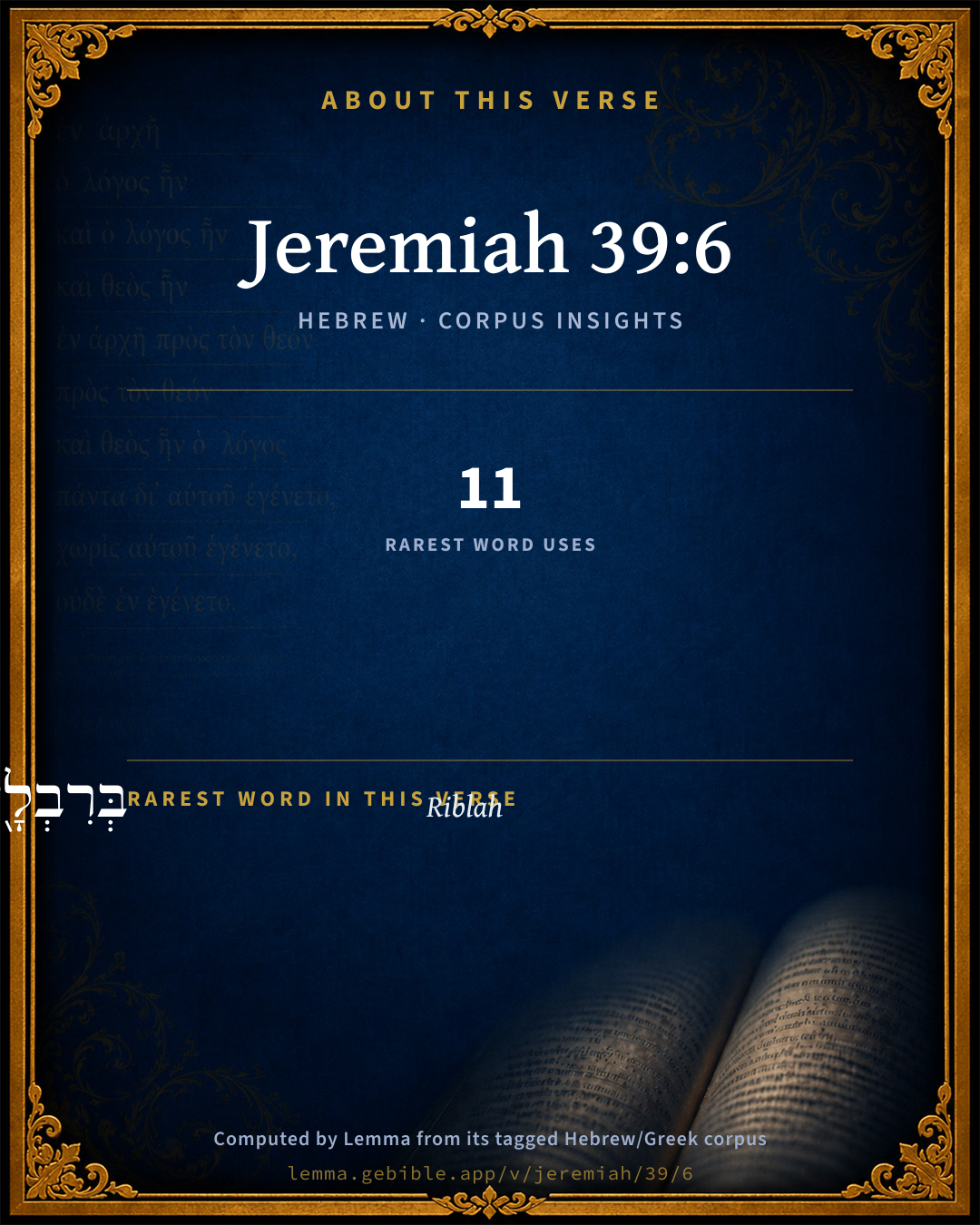
The rarest word here is בְּרִבְלָ֖ה Riblah H7247 — appearing just 11 times in the whole Hebrew Bible.

Shared distinctive vocabulary

בְּרִבְלָ֖ה Riblah H7247 occurs in 11 verses of the Hebrew Bible. Also found in:

Grammatical profile

  • 2 verbs
  • 11 nouns
  • 2 particles

Verb forms

  • וַיִּשְׁחַט֩ Qal · Sequential Imperfect
  • שָׁחַ֖ט Qal · Perfect

Repetition

Words recur within this verse — often emphatic in Hebrew:

  • וַיִּשְׁחַט֩ to slaughter H7819 ×2
  • מֶ֨לֶךְ king H4428 ×2
  • בָּבֶ֜ל Babylon H894 ×2

Cross-references

12

Topical passages linked to Jeremiah 39:6 in the Treasury of Scripture Knowledge — connected by theme and wording, ordered by reader-vote popularity; previews shown in the World English Bible.

  • Jeremiah 52:10 The king of Babylon killed the sons of Zedekiah before his eyes: he killed also all the princes of Judah in Riblah.
  • Deuteronomy 28:34 so that you shall be mad for the sight of your eyes which you shall see.
  • 2 Kings 25:7 They killed the sons of Zedekiah before his eyes, and put out the eyes of Zedekiah, and bound him in fetters, and carried him to Babylon.
  • Jeremiah 21:7 Afterward, says Yahweh, I will deliver Zedekiah king of Judah, and his servants, and the people, even such as are left in this city from the pestilence, from the sword, and from the famine, into the hand of Nebuchadrezzar king of Babylon, and into the hand of their enemies, and into the hand of those who seek their life: and he shall strike them with the edge of the sword; he shall not spare them, neither have pity, nor have mercy.
  • Jeremiah 24:8–10 As the bad figs, which can't be eaten, they are so bad, surely thus says Yahweh, So will I give up Zedekiah the king of Judah, and his princes, and the residue of Jerusalem, who remain in this land, and those who dwell in the land of Egypt,
  • Jeremiah 34:19–21 the princes of Judah, and the princes of Jerusalem, the eunuchs, and the priests, and all the people of the land, who passed between the parts of the calf;
  • Genesis 21:16 She went and sat down opposite him, a good way off, about a bow shot away. For she said, "Don't let me see the death of the child." She sat over against him, and lifted up her voice, and wept.
  • Genesis 44:34 For how will I go up to my father, if the boy isn't with me? Lest I see the evil that will come on my father."
  • 2 Kings 22:20 Therefore, behold, I will gather you to your fathers, and you shall be gathered to your grave in peace, neither shall your eyes see all the evil which I will bring on this place. They brought the king word again.
  • 2 Chronicles 34:28 Behold, I will gather you to your fathers, and you shall be gathered to your grave in peace, neither shall your eyes see all the evil that I will bring on this place, and on the inhabitants of it. They brought back word to the king.
  • Esther 8:6 for how can I endure to see the evil that shall come to my people? or how can I endure to see the destruction of my relatives?
  • Isaiah 13:16 Their infants also shall be dashed in pieces before their eyes; their houses shall be rifled, and their wives ravished.

Cross-references courtesy of OpenBible.info (CC BY 4.0).

Hebrew and Greek witnesses Masoretic Hebrew ↔ Greek Septuagint

The same verse in the two great witnesses to the Old Testament, shown verse-for-verse.

These are two independent witnesses, not word-aligned to each other, and the Septuagint is shown in lemma (dictionary) form.

Hebrew Jeremiah 39:6 Masoretic · Westminster Leningrad Codex

וַיִּשְׁחַט֩ מֶ֨לֶךְ בָּבֶ֜ל אֶת בְּנֵ֧י צִדְקִיָּ֛הוּ בְּרִבְלָ֖ה לְעֵינָ֑יו וְאֵת֙ כָּל חֹרֵ֣י יְהוּדָ֔ה שָׁחַ֖ט מֶ֥לֶךְ בָּבֶֽל

Then the king of Babylon killed the sons of Zedekiah in Riblah before his eyes: also the king of Babylon killed all the nobles of Judah.

World English Bible · Public Domain

Greek LXX Structure differs

In the Septuagint, Jeremiah is about an eighth shorter than the Hebrew and arranges its material differently — the Oracles Against the Nations (Hebrew chapters 46–51) appear in the middle of the Greek book, after 25:13. Because the chapter and verse boundaries do not line up, a verse-for-verse comparison with the Hebrew is not shown.

A verse-for-verse comparison isn’t shown here because the chapters and verses don’t line up. Switch to the LXX edition with the MT / LXX toggle above to read the Greek directly.

Hebrew: Westminster Leningrad Codex (CC BY 4.0). Greek: Septuagint (public domain); English from a public-domain English Septuagint. How the Septuagint differs from the Hebrew →

Targum (Aramaic paraphrase)

1

The Targum is the ancient Jewish Aramaic paraphrase of the Hebrew Scriptures — an interpretive translation, not the Hebrew text itself. Onkelos (literal) and Pseudo-Jonathan (expansive) render the Torah, and Jonathan the Prophets. Coverage is partial: where no permissively-licensed English translation exists for a verse, only the Aramaic is shown. This is verse-level text, not a word-by-word alignment to the Hebrew.

  1. Targum Jonathan Prophets (Joshua–Malachi)
    וּנְכֵיס מַלְכָּא דְבָבֶל יַת בְּנֵי צִדְקִיָה בְּרִבְלָה לְעֵינוֹהִי וְיַת כָּל רַבְרְבֵי יְהוּדָה נְכַס מַלְכָּא דְבָבֶל:

    (no public-domain English translation for this verse)

    Targum Jonathan — Aramaic: “Mikraot Gedolot” (public domain). English: “Sefaria Community Translation” (CC0 1.0 (public-domain dedication)); “London "Chaldee Paraphrase," 1871” (public domain). Text via Sefaria.

Commentary

Notes on Jeremiah 39:6 from classic Christian and Jewish commentators (each source and its license shown beneath its notes). The classic Christian expositions comment on the surrounding passage and are grouped to its opening verse, so a note may address several verses; the Jewish commentaries on the Tanakh (Rashi and others) are per-verse, so they appear only where the commentator wrote on this verse.

Lemma curates 59 commentaries, every one of them public domain or Creative Commons licensed, each selected and text-cleaned for this edition rather than reprinted as found. About our sources →

Trapp's Complete Commentary

John Trapp

Jer 39:6 Then the king of Babylon slew the sons of Zedekiah in Riblah before his eyes: also the king of Babylon slew all the nobles of Judah.

Ver. 6. See on 2Ki 25:6-7.

John Trapp, A Commentary or Exposition upon All the Books of the Old and New Testament (1647–1656) — public domain. Text from a community e-Sword module.

Tyndale Open Study Notes

Tyndale Open Resources

39:6 Zedekiah’s last sight was the slaughter of his sons and all the nobles of Judah. Their slaughter ensured that Zedekiah’s rule could never continue.

Tyndale Open Study Notes — © Tyndale Open Resources, licensed CC BY-SA 4.0. Text via the HelloAO Bible API.

Jamieson, Fausset & Brown

Robert Jamieson, A. R. Fausset & David Brown

slew . . . sons . . . before his eyes--previous to his eyes being "put out" (Jer 39:7); literally, "dug out." The Assyrian sculptures depict the delight with which the kings struck out, often with their own hands, the eyes of captive princes. This passage reconciles Jer 32:4, "his eyes shall behold his eyes"; with Eze 12:13, "he shall not see Babylon, though he shall die there."

slew all . . . nobles-- (Jer 27:20).

Jamieson, Fausset & Brown — Commentary Critical and Explanatory on the Whole Bible (1871) — public domain (CC PDM 1.0). Text via the HelloAO Bible API.

John Calvin's Commentaries

It is probable that Nebuchadnezzar continued in that pleasant city while Jerusalem was attacked, for he would not endure the weariness of a long siege, and he also wished to be far away from danger. It was enough for him that his generals, of whom mention is made, fought under his banner. Nebuchadnezzar then was beyond the reach of danger, and yet he filled the Jews with terror, because he did not return home, or to the principal seat of government, but remained in the neighborhood; for the Antioch of Syria was not far from Judea.

The Prophet now tells us how cruelly Nebuchadnezzar acted towards Zedekiah. It was surely a sad spectacle to see a king, who had been before in repute, who was of a noble family, who was a type of Christ, lying prostrate at the feet of a proud conqueror. But much more bitter to him than this, was to see his own sons killed before his eyes. It would have been better for him to die a hundred times than to be compelled to witness that slaughter. He was, however, compelled to do so. And then, that all hope might be cut off, all those who excelled in dignity and power were slain. For under the name princes, Jeremiah generally in-eluded the chief men; so that all who had any name among the people were killed. It was a horrible carnage! not only the king’s sons were slain, but all who were capable of restoring the city and the land to a better condition. Thus Nebuchadnezzar wished to take away every hope, by putting to death the royal family and all the nobles. It afterwards follows —

John Calvin's Commentaries (1540-1563) — public domain. Text from the Calvin Translation Society English edition (1840s-50s) via the Christian Classics Ethereal Library (ccel.org). Calvin's coverage is partial (roughly two-thirds of the Bible); uncommented books and verses are honest gaps, never fabricated. The 19th-century editor's footnotes and remarks are omitted so the notes are faithfully Calvin's own voice.

Ellicott's Commentary for English Readers

(6) The sons of Zedekiah.—The history of Eastern monarchies presents us with many examples of this refinement of cruelty, notably in the case of (Eobazus under Darius (Herod. Iv. 84), and Pythius under Xerxes (Herod, vii. 39). The slaughter of the “nobles” probably included most of those whom we have seen in Jer_36:12, and elsewhere.

A Bible Commentary for English Readers, edited by Charles John Ellicott (1878–1897) — public domain. Text from a community e-Sword module.

John Gill's Exposition

Then the king of Babylon slew the sons of Zedekiah in Riblah before his eyes,.... Not with his own hands, but gave orders to do it: these must be very young, at least some of them; since Zedekiah at this time was but thirty two years of age. This must be a dreadful spectacle for him to behold; and the consideration must be cutting, that it was owing to his own obstinacy in not taking the advice of the Prophet Jeremiah to surrender to the Chaldeans, whereby he and his family would have been saved, Jer 38:17;

also the king of Babylon slew all the nobles of Judah; who did not come over to the Chaldean army and surrender themselves; such who advised the king to stand out to the last, and who fled, and were taken with him; as many of them as fell into the hands of the king of Babylon. Jarchi says those were the sanhedrim, who loosed Zedekiah from his oath to Nebuchadnezzar.

John Gill's Exposition of the Whole Bible (1746–1763) — public domain (CC PDM 1.0). Text via the HelloAO Bible API.

Matthew Poole's English Annotations

Thus the stubbornness of this prince and his nobles proved the ruin of his family, and of themselves, and of the whole people. The nobles were great authors of this mischief, and brought Zedekiah into that obstinacy which he showed to the prophet’s admonitions and exhortations, upon them, therefore, a more exemplary punishment is taken. The Hebrew calls the nobles white men, either from their white garments, or from that candour of spirit which should be found in persons of their quality.

Matthew Poole's English Annotations on the Holy Bible (1683–1685) — public domain. Text from a community e-Sword/MySword module.

unfoldingWord translationNotes

Door43 World Missions Community

slaughtered Zedekiah's sons before his own eyes

The eyes are a synecdoche for the whole person. The reader should also understand that others probably helped the king of Babylon kill Zedekiah's sons. AT: "forced Zedekiah to watch as the king's soldiers killed Zedekiah's sons" (See: Synecdoche)

he put out Zedekiah's eyes

"the king's men made Zedekiah blind." Use the common words for making a person blind. It is not clear that the king of Babylon took Zedekiah's eyes out of his head. The reader should also understand that others probably helped the king of Babylon make Zedekiah blind.

translationWords

slaughter

noble

Judah

bind

bronze

unfoldingWord translationNotes — © Distant Shores Media and the Door43 World Missions Community, licensed CC BY-SA 4.0. Source: git.door43.org/Door43/en_tn.

Rashi

Rabbi Shlomo Yitzchaki (Rashi)

and...all the nobles of Judah These are the Sanhedrin, because they had annulled the oath.

Rashi on the Tanakh — English translations: “The Judaica Press complete Tanach with Rashi, translated by A. J. Rosenberg” (CC BY 4.0); “Pentateuch with Rashi's commentary by M. Rosenbaum and A.M. Silbermann, 1929-1934” (public domain); “The Metsudah Tanach series, Lakewood, N.J” (CC BY 4.0); and “The Book of Joshua, Metsudah Publications, 1997” (CC BY 4.0). Text via Sefaria.

Lesson kit

Teaching starters — assembled from the data on this page, not authored interpretation. Every prompt links to the verse data it draws on. Edit before teaching.

Jeremiah, in the Prophets, opens this verse with 15 words (11 distinct Hebrew lemmas). Its most distinctive word is Riblâh (“Riblah”). A historical commentator’s framing appears above. Read the whole chapter for the surrounding context.

Discussion questions

  1. How does “Riblah” (Riblâh) shape what this verse is saying?
  2. How does Numbers 34:11, which shares the word «Riblah», read alongside this verse?
  3. What does the repetition of “to slaughter” (2× in this one verse) do in this verse?
  4. The translations on this page render this verse differently — a whole-verse word diff, not a word-by-word alignment. What might account for the different wordings?
  5. «וַיִּשְׁחַט֩» is a Qal Sequential Imperfect verb. How does that grammatical form shape the action described?
  6. Compare how Trapp's Complete Commentary and Tyndale Open Study Notes read this verse. Where do they agree or differ?

Things to notice

  • These translations choose different wording for 8 words in this verse.
  • “to slaughter” occurs 2× in this single verse.
  • 11 distinct Hebrew lemmas span 15 words in this verse.

Reading settings

Reading text

Shown beneath each verse's original-language words.

Old Testament
Old Testament edition

Read the OT as the Masoretic Hebrew (MT) or the Greek Septuagint (LXX).

English shown for the Greek Septuagint (in the Hebrew ↔ Greek comparison).

Comparing translations? Open the Compare panel on any verse page to stack up to four side by side.