
Ezekiel 16:21

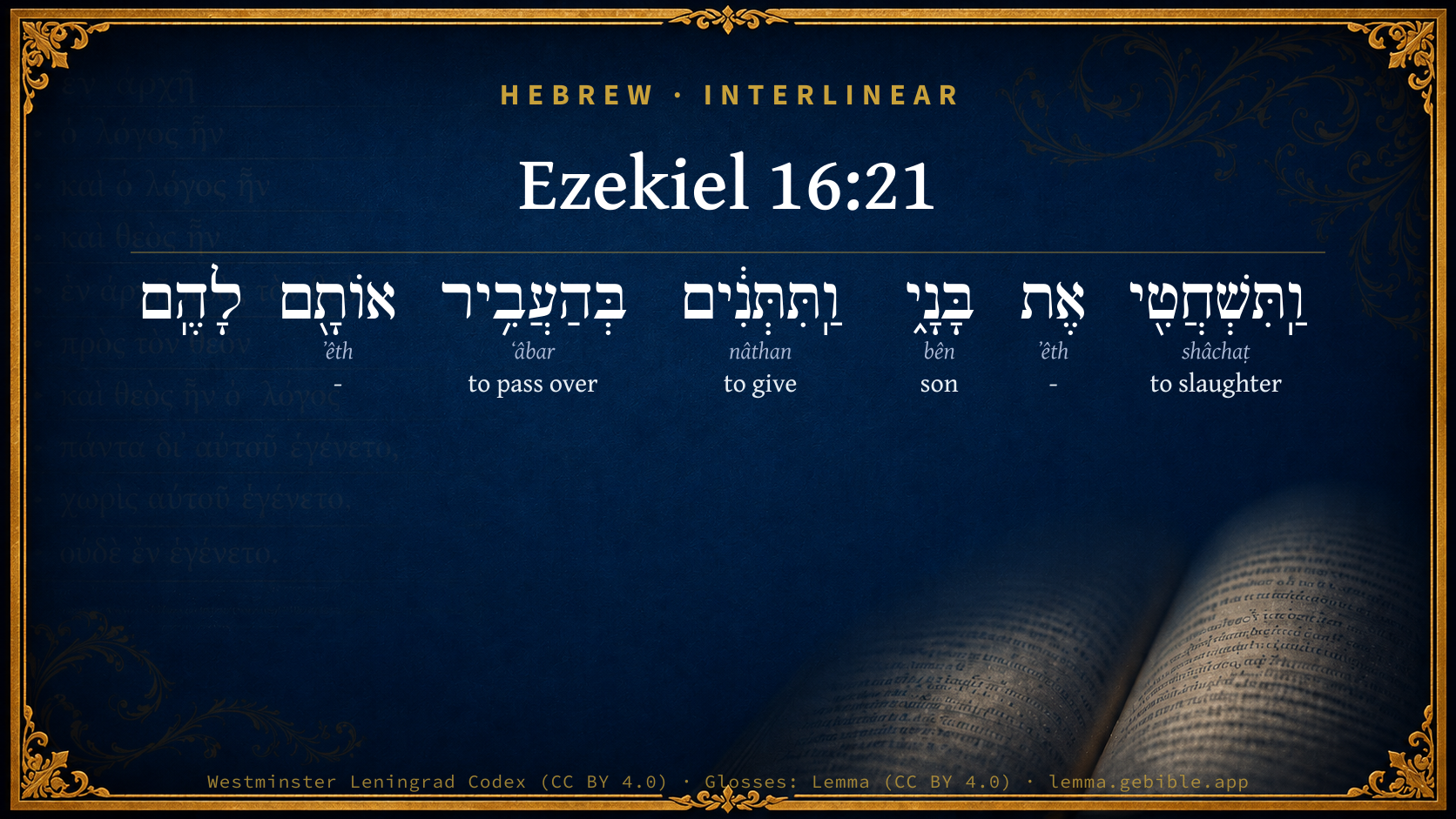
Hebrew (Westminster Leningrad Codex) Ezekiel 16:21 appears in the Hebrew Old Testament. The text above is from the Westminster Leningrad Codex. Each word links to its Strong’s number, a concise gloss, and parsing drawn from the Open Scriptures Hebrew Bible morphology. Click any word for its full Brown-Driver-Briggs (BDB) entry.
Download image
Cite this verse

Ezekiel 16:21 (World English Bible). Public Domain. Lemma interlinear Bible study tool, https://lemma.gebible.app/v/ezekiel/16/21.

Show BibTeX & RIS
BibTeX
RIS
English Translation
that you have slain my children, and delivered them up, in causing them to pass through [the fire] to them?
World English Bible · Public Domain
Download a study sheet

One document with this verse’s original text, its word-by-word gloss line, the meaning frame, cross-references with their text, attributed commentary, and full source and license credits — printable, and it pastes into notes with its structure intact.

This verse Autodidact and up

Study sheet (.html) Plain text (.txt)

A passage Seminary Student

Up to 50 verses in one chapter. A passage sheet keeps up to 6 commentary sources and 12 cross-references per verse, in the order this page ranks them, and says so on the sheet whenever that leaves anything out. Ask for a single verse and you get the Autodidact verse sheet above.

Everything on this page stays free to read, with no account — the sheet is a download of what is already on screen, not access to it.

Want to remove ads? Support Godless Engineer
Compare translations 3

The same verse in 3 English versions, stacked beneath the original-language interlinear above. Click any original word for its lexicon entry.

Each is an independent rendering of the whole verse — the interlinear is not word-aligned to these translations.

Highlighted words mark where these versions differ — a whole-verse word diff, not a word-by-word alignment.

  • World English Bible Public Domain
    that you have slain my children, and delivered them up, in causing them to pass through [the fire] to them?
  • King James Version Public Domain
    That thou hast slain my children, and delivered them to cause them to pass through the fire for them?
  • unfoldingWord Literal Text CC BY-SA 4.0
    You slaughtered my children to the idols and made them pass through the fire.

unfoldingWord Literal Text — © unfoldingWord, licensed CC BY-SA 4.0. Word-aligned USFM3 via Door43 (git.door43.org/unfoldingWord/en_ult).

Versions to compare (up to 4)

3 of 4 selected

Show all 18 translations

Every available English version of this verse, each an independent rendering of the whole verse.

  • World English Bible Public Domain
    that you have slain my children, and delivered them up, in causing them to pass through [the fire] to them?
  • Berean Standard Bible Public Domain
    You slaughtered My children and delivered them up through the fire to idols.
  • Majority Standard Bible Public Domain
    You slaughtered My children and delivered them up through the fire to idols.
  • King James Version Public Domain
    That thou hast slain my children, and delivered them to cause them to pass through the fire for them?
  • American Standard Version (1901) Public Domain
    that thou hast slain my children, and delivered them up, in causing them to pass through `the fire' unto them?
  • Revised Version (1885) Public Domain
    that thou hast slain my children, and delivered them up, in causing them to pass through the fire unto them?
  • Geneva Bible (1599) Public Domain
    That thou hast slaine my children, and deliuered them to cause them to passe through fire for them?
  • Douay-Rheims (1899) Public Domain
    Thou hast sacrificed and given my children to them, consecrating them by fire.
  • Young's Literal Translation Public Domain
    That thou dost slaughter My sons, And dost give them up in causing them to pass over to them?
  • Literal Standard Version CC BY-SA 4.0
    that you slaughter My sons, || And give them up in causing them to pass over to them?
  • Unlocked Literal Bible CC BY-SA 4.0
    You slaughtered my children to the idols and made them pass through the fire.
  • unfoldingWord Literal Text CC BY-SA 4.0
    You slaughtered my children to the idols and made them pass through the fire.
  • Darby Bible Public Domain
    that thou didst slay my children and give them up in passing them over to them?
  • World Messianic Bible Public Domain
    that you have slain my children and delivered them up, in causing them to pass through the fire to them?
  • Webster's Bible Public Domain
    That thou hast slain my children, and delivered them to cause them to pass through the fire for them?
  • Free Bible Version CC BY-SA 4.0
    You slaughtered my children, sacrificing them to idols.
  • Bible in Basic English Public Domain
    That you put my children to death and gave them up to go through the fire to them?
  • JPS Tanakh (1917) Public Domain
    that thou hast slain My children, and delivered them up, in setting them apart unto them?

Literal Standard Version (2020), Covenant Press — licensed CC BY-SA 4.0. Text via the HelloAO Bible API (eBible.org). Unlocked Literal Bible (unfoldingWord) — licensed CC BY-SA 4.0. Text via the HelloAO Bible API (eBible.org). unfoldingWord Literal Text — © unfoldingWord, licensed CC BY-SA 4.0. Word-aligned USFM3 via Door43 (git.door43.org/unfoldingWord/en_ult). Free Bible Version, Dr. Jonathan Gallagher — licensed CC BY-SA 4.0. Text via the HelloAO Bible API (eBible.org).

Word by word

More ways to search: Search by grammar → Find every occurrence → Compare this word →

Practice this passage: Drill this verse → Learn its vocabulary →

וַֽתִּשְׁחֲטִ֖י
shâchaṭ
H7819
“and · to slaughter”
Conjunction + Verb, Qal, Sequential Imperfect, 2nd Person, Feminine, Singular
Part of Speech
Conjunction + Verb
Stem
Qal
Form
Sequential Imperfect
Person
2nd Person
Gender
Feminine
Number
Singular
Full BDB Definition

Origin: a primitive root

TWOT: 2362

to kill, slaughter, beat (verb) - (Qal) - to slaughter - beast for food - sacrifice - person in human sacrifice - beaten, hammered (of shekels) - (Niphal) to be slaughtered, be slain (of food or sacrifice) - (BDB) slaughtering (noun feminine) - word doubtful
  1. אֶת ʼêth H853 “-” Particle, Direct Object
  2. בָּנָ֑י bên H1121 “sons · my” Noun, Common, Masculine, Plural, Construct + Suffix, Personal, 1st Person, Common, Singular
  3. וַֽתִּתְּנִ֔ים nâthan H5414 “and · to give · them” Conjunction + Verb, Qal, Sequential Imperfect, 2nd Person, Feminine, Singular + Suffix, Personal, 3rd Person, Masculine, Plural
  4. בְּהַעֲבִ֥יר ʻâbar H5674 “in/at · to pass over” Preposition + Verb, Hiphil, Infinitive Construct
  5. אוֹתָ֖ם ʼêth H853 “- · them” Particle, Direct Object + Suffix, Personal, 3rd Person, Masculine, Plural

About this verse

These counts appear in no published source. They are computed here, from the morphology-tagged text and Lemma’s own curated glosses. What Lemma adds →

7
words
5
distinct lemmas
Prophets
section

Grammatical profile

  • 3 verbs
  • 1 noun
  • 1 preposition
  • 2 particles

Verb forms

  • וַֽתִּשְׁחֲטִ֖י Qal · Sequential Imperfect
  • וַֽתִּתְּנִ֔ים Qal · Sequential Imperfect
  • בְּהַעֲבִ֥יר Hiphil · Infinitive Construct

Hebrew & Septuagint length

In English translation the verse runs 20 words from the Hebrew and 17 from the Septuagint (LXX English) — closely comparable.

A rough comparison of the two English renderings, which tokenize alike — not a word-level alignment.

Word counts can differ between the Hebrew and the Greek without any difference in meaning — e.g. the Hebrew direct-object marker אֵת has no separate Greek word, and Greek often adds the article ὁ.

Cross-references

8

Topical passages linked to Ezekiel 16:21 in the Treasury of Scripture Knowledge — connected by theme and wording, ordered by reader-vote popularity; previews shown in the World English Bible.

  • 2 Kings 17:17 They caused their sons and their daughters to pass through the fire, and used divination and enchantments, and sold themselves to do that which was evil in the sight of Yahweh, to provoke him to anger.
  • Leviticus 18:21 "'You shall not give any of your children to sacrifice to Molech; neither shall you profane the name of your God: I am Yahweh.
  • Deuteronomy 18:10 There shall not be found with you anyone who makes his son or his daughter to pass through the fire, one who uses divination, one who practices sorcery, or an enchanter, or a sorcerer,
  • 2 Kings 21:6 He made his son to pass through the fire, and practiced sorcery, and used enchantments, and dealt with those who had familiar spirits, and with wizards: he worked much evil in the sight of Yahweh, to provoke him to anger.
  • Jeremiah 19:5 and have built the high places of Baal, to burn their sons in the fire for burnt offerings to Baal; which I didn't command, nor spoke it, neither came it into my mind:
  • Leviticus 20:1–5 Yahweh spoke to Moses, saying,
  • 2 Kings 23:10 He defiled Topheth, which is in the valley of the children of Hinnom, that no man might make his son or his daughter to pass through the fire to Molech.
  • Psalms 106:37 Yes, they sacrificed their sons and their daughters to demons.

Cross-references courtesy of OpenBible.info (CC BY 4.0).

Hebrew and Greek witnesses Masoretic Hebrew ↔ Greek Septuagint

The same verse in the two great witnesses to the Old Testament, shown verse-for-verse.

These are two independent witnesses, not word-aligned to each other, and the Septuagint is shown in lemma (dictionary) form.

Hebrew Ezekiel 16:21 Masoretic · Westminster Leningrad Codex

וַֽתִּשְׁחֲטִ֖י אֶת בָּנָ֑י וַֽתִּתְּנִ֔ים בְּהַעֲבִ֥יר אוֹתָ֖ם לָהֶֽם

that you have slain my children, and delivered them up, in causing them to pass through [the fire] to them?

World English Bible · Public Domain

Greek LXX Ezekiel 16:21 Septuagint · lemma form

καί σφάζω ὁ τέκνον σύ καί δίδωμι αὐτός ἐν ὁ ἀποτροπιάζω σύ ἐν αὐτός

and did kill your children, and gave them up in offering them to them for an expiation.

LXX2012 (modern English Septuagint) · Public Domain

Hebrew: Westminster Leningrad Codex (CC BY 4.0). Greek: Septuagint (public domain); English from LXX2012 (modern English Septuagint) (Public Domain). How the Septuagint differs from the Hebrew →

Targum (Aramaic paraphrase)

1

The Targum is the ancient Jewish Aramaic paraphrase of the Hebrew Scriptures — an interpretive translation, not the Hebrew text itself. Onkelos (literal) and Pseudo-Jonathan (expansive) render the Torah, and Jonathan the Prophets. Coverage is partial: where no permissively-licensed English translation exists for a verse, only the Aramaic is shown. This is verse-level text, not a word-by-word alignment to the Hebrew.

  1. Targum Jonathan Prophets (Joshua–Malachi)
    וּנְכֵיסְתְּ יַת בְּנַיָא וִיהַבְתִּינוּן בְּאַעֲבָרָא יַתְהוֹן לְהֵין:

    (no public-domain English translation for this verse)

    Targum Jonathan — Aramaic: “Mikraot Gedolot” (public domain). English: “Sefaria Community Translation” (CC0 1.0 (public-domain dedication)); “London "Chaldee Paraphrase," 1871” (public domain). Text via Sefaria.

Commentary

Notes on Ezekiel 16:21 from classic Christian and Jewish commentators (each source and its license shown beneath its notes). The classic Christian expositions comment on the surrounding passage and are grouped to its opening verse, so a note may address several verses; the Jewish commentaries on the Tanakh (Rashi and others) are per-verse, so they appear only where the commentator wrote on this verse.

Lemma curates 59 commentaries, every one of them public domain or Creative Commons licensed, each selected and text-cleaned for this edition rather than reprinted as found. About our sources →

Trapp's Complete Commentary

John Trapp

Eze 16:21 That thou hast slain my children, and delivered them to cause them to pass through [the fire] for them?

Ver. 21. That thou hast slain my children.] Note that he yet calleth them his children, though so born, and so murdered. See on Eze 16:20.

John Trapp, A Commentary or Exposition upon All the Books of the Old and New Testament (1647–1656) — public domain. Text from a community e-Sword module.

Adam Clarke's Commentary

Verse 21. To cause them to pass through the fire] Bp. Newcome quotes a very apposite passage from Dionysius Halicarnass. Ant. Rom. lib. i., s. 88, p. 72, and marg. p. 75, Edit. Hudson: Μετα δε τουτο, πυρκαΐας προ των σκηνων γενεσθαι κελευσας, εξαγει τον λεων τας φλογας ὑπερθρωσκοντα,της ὁσιωσεως των μιασματων ἑνεκα. "And after this, having ordered that fires should be made before the tents, he brings out the people to leap over the flames, for the purifying of their pollutions." This example shows that we are not always to take passing through the fire for being entirely consumed by it. Among the Israelites this appears to have been used as a rite of consecration.

Adam Clarke's Commentary on the Bible (1810–1826) — public domain. Text from a community e-Sword/MySword module.

John Calvin's Commentaries

He strengthens the same sentence, and more clearly explains that they offered their sons and daughters by cruelly sacrificing them when they passed them through the fire. This was a kind of purifying, as we have seen elsewhere. When, therefore, they passed their children through the fire, it was a rite of illustration and expiation; and they brought them to the fire, as I have lately explained, in two different ways. Here the Prophet speaks especially of that cruel and brutal offering. We have already mentioned the sense in which God claims a right in the sons of his people, not as members of the Church properly speaking, but as adopted by God. And here again we must hold what Paul says, that all the progeny of Abraham were not lawful sons, since a difference must be made between sons of the flesh and sons of promise. (Romans 9:7, 8.) This is as yet partially obscure, but it may be shortly explained. We may remark that there was a twofold election of God: since speaking generally, he chose the whole family of Abraham. For circumcision was common to all, being the symbol and seal of adoption: since when God wished all the sons of Abraham to be circumcised from the least to the greatest, he at the same time chose them as his sons: this was one kind of adoption or election. But the other was secret, because God took to himself out of that multitude those whom he wished: and these are sons of promise, these are remnants of gratuitous favor, as Paul says. (Romans 11:8.) This distinction, therefore, now takes away all doubt, since the Prophet speaks of the unbelievers and the profane who had departed from the worship of God. For this their unbelief was a complete abdication. It is true, then, that as far as themselves were concerned, they were strangers, and so God’s secret election did not flourish in them, but yet they were God’s people, as far as relates to external profession. If any one objects that this circumcision was useless, and hence their election without the slightest effect, the answer is at hand: God by his singular kindness honored those miserable ones by opening a way of approach for them to the hope of life and salvation by the outward testimonies of adoption. Then as to their being at the same time strangers, that happened through their own fault. Hence we may shortly hold, that the Jews were naturally accursed through being Adam’s seed: but by supernatural and singular privilege, they were exempt and free from the curse: since circumcision was a testimony of the adoption by which God had consecrated them to himself: hence they were holy; and as to their being impure, it could not, as we have said, abolish God’s covenant. The same thing ought at this time to prevail in the Papacy. For we are all born under the curse: and yet God acknowledges supernaturally as his sons all who spring from the faithful, not only in the first or second degree, but even to a thousand generations. And so Paul says that the children of the faithful are holy, since baptism does not lose its efficacy, and the adoption of God remains fixed, (1 Corinthians 7:14,) yet the greater part is without the covenant through their own unbelief. God meanwhile has preserved to himself a remnant in all ages, and at this day he chooses whom he will out of the promiscuous multitude.

Now let us go on. I had omitted at the end of the last verse the phrase, Are thy fornications a small matter? By this question God wishes to press the Jews home, since they had not only violated their conjugal fidelity by prostituting themselves to idols, but had added the cruelty which we have seen in slaying their sons. Lastly, he shows that their impiety was desperate.

John Calvin's Commentaries (1540-1563) — public domain. Text from the Calvin Translation Society English edition (1840s-50s) via the Christian Classics Ethereal Library (ccel.org). Calvin's coverage is partial (roughly two-thirds of the Bible); uncommented books and verses are honest gaps, never fabricated. The 19th-century editor's footnotes and remarks are omitted so the notes are faithfully Calvin's own voice.

The Cambridge Bible for Schools and Colleges

gen. ed. J. J. S. Perowne

21. hast … delivered them] Or, didst deliver them up, in causing them, as R.V. The child passed into the possession of the deity when consumed in the fire.

The Cambridge Bible for Schools and Colleges (gen. ed. J. J. S. Perowne; Cambridge University Press, 1878–1918) — public domain. Text from a community e-Sword module.

John Gill's Exposition

And in all thine abominations and thy whoredoms,.... Or idolatries, which were abominable to God, and were many; of which that just mentioned was not one of the least:

thou hast not remembered the days of thy youth; the destitute and forlorn condition then in, and what favours were then bestowed:

when thou wast naked and bare, and wast polluted in thy blood; See Gill on Eze 16:6; See Gill on Eze 16:7; which is mentioned to upbraid the Jews with their ingratitude; they forgetting the miserable condition they were in in Egypt, and what great things the Lord had done for them in bringing them out from thence, and the obligations they were laid under to him: and yet, after all this, to commit such abominable iniquities, and in the midst of them all never once call to mind what they had received from him; which might have been a check to their idolatries, but so it was not.

John Gill's Exposition of the Whole Bible (1746–1763) — public domain (CC PDM 1.0). Text via the HelloAO Bible API.

Matthew Poole's English Annotations

Thy blind superstition called this religion, and accounted it sacrifice, but truth is it was unnatural murder; it is as if thou hadst cut their throat, nay, worse, because it put them to greater torture. The word is used Isa 57:5; Hos 5:2.

My children; sons here are first-born, which peculiarly were devoted to God, he reserved a special right in these, and yet this cruel mother, this perfidious wife, this sacrilegious adulteress, sacrificeth these to her idols.

Delivered them; either gave them to the idol’s priests, or rather with her own hands gave them, i.e. led them through the fire, if lustrated, or put them into the idol’s arms of brass or iron, which grasped them fast whilst they were consumed with fire that made the idol red hot.

For them; for the idol’s worship, or possibly for the parents, who did wickedly imagine this a way to preserve and prosper the rest of their children.

Matthew Poole's English Annotations on the Holy Bible (1683–1685) — public domain. Text from a community e-Sword/MySword module.

Whedon's Commentary on the Bible

Daniel D. Whedon

21. Thou hast slain my children — The divine husband yearns over his innocent ones slain by the heartless mother. Archinard gives the following lurid description of these sacrifices to Moloch: “A fire of aloes, of cedar, and of laurel burned between the knees of the colossus. The unguents with which it was bathed ran like sweat down its limbs of bronze. The children, enveloped with black veils, formed an immovable circle, and toward these the god extended his long arms and lowered his palms as if to bear them into the sky. The king, the chiefs, the women, and all the multitude assembled behind the priests on the parched slopes which border the valley of Hinnom. On the distant walls of the city shine the weapons of angry soldiers. The smoke of incense mounts perpendicularly. An infinite anguish weighs on all bosoms. The people of Jerusalem are absorbed with the great tragedy. Finally, the high priest of Moloch passes his left hand under the veils of the children and cuts from each brow a lock of hair which he throws into the flame. Now men in blood red mantles sound forth the sacred hymn: —

Homage to the sun,

King of two zones; the unbegotten.

Father and mother, father and son,

God and goddess, goddess and god.

The voices of the singers are lost in the burst of instrumental music sounding suddenly to stifle the cries of the victims whom the knife of the priest is about to slay. The sheminith, the kinnor, the nebel sound forth, and the tambourine is beaten with heavy and repeated strokes. The temple slaves with long hooks open various compartments into the body of Baal. Into the highest they introduce flour; into the second, two turtles; into the third, a lamb; into the fourth, a ram; into the fifth, a calf; into the sixth, an ox. The seventh remains yawning open like the mouth of an oven. The instruments are silent, the fire roars, the priests of Moloch march in state before the multitude. The arms of brass lower themselves to the sacrificial victims. Each time that a child is lifted by them the priests place their hands upon it to burden it with the crimes of the people. The air is rent with the cries of the devotees, ‘Baal, eat!’ ‘Lord, eat!’ The victim lifted to the border by the brazen arms disappears like a drop of water on a red-hot plate, and a white smoke ascends into the crimson glow. The hideous idol has already licked with its thousand tongues of fire the most beautiful children of Jerusalem. On a sign from the sovereign pontiff, the priests seize the son of the king and the body of the little prince disappears after the others in the midst of the furnace. A nauseating smoke robs the eyes of the mob of the last horrors.” — Israel et ses voisins Asiatiques, Geneve, 1890, pp. 223-228.

Daniel D. Whedon (gen. ed.), Commentary on the Old and New Testaments (1874–1909) — public domain. Text from a community e-Sword module.

John Wesley's Explanatory Notes

For them - For the idols.

John Wesley, Explanatory Notes Upon the Whole Bible (1754–1765) — public domain. Text via the GEBible commentary corpus.

Lesson kit

Teaching starters — assembled from the data on this page, not authored interpretation. Every prompt links to the verse data it draws on. Edit before teaching.

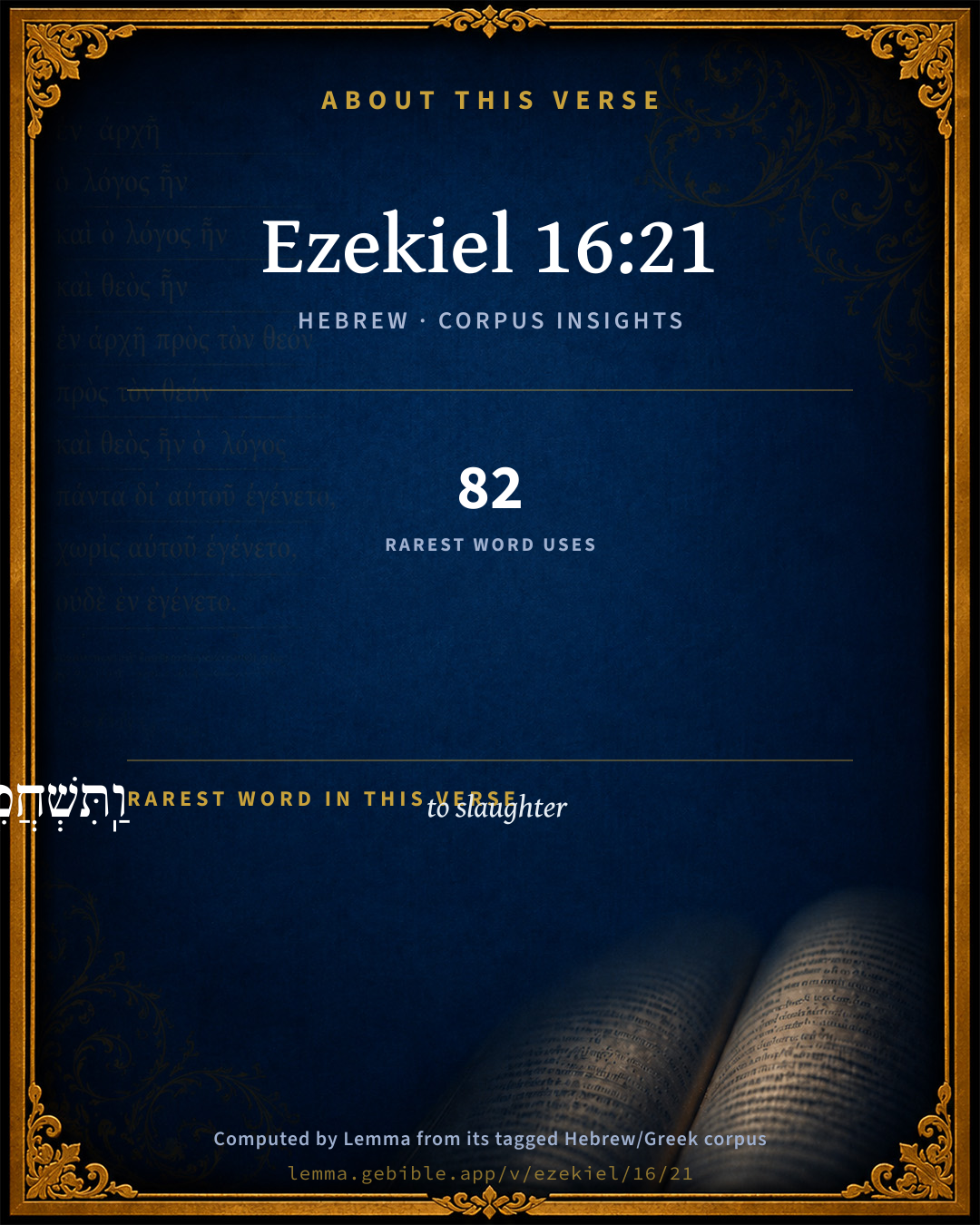
Ezekiel, in the Prophets, opens this verse with 7 words (5 distinct Hebrew lemmas). Its most distinctive word is shâchaṭ (“to slaughter”). A historical commentator’s framing appears above. Read the whole chapter for the surrounding context.

Discussion questions

  1. The word shâchaṭ carries the sense “to slaughter.” How does it shape the verse?
  2. How does 2 Kings 17:17, which shares this passage’s theme, read alongside this verse?
  3. These translations render this verse differently. What is at stake in choosing one wording over another?
  4. «וַֽתִּשְׁחֲטִ֖י» is a Qal Sequential Imperfect verb. How does that grammatical form shape the action described?
  5. Compare how Trapp's Complete Commentary and Adam Clarke's Commentary read this verse. Where do they agree or differ?

Things to notice

Reading settings

Reading text

Shown beneath each verse's original-language words.

Old Testament
Old Testament edition

Read the OT as the Masoretic Hebrew (MT) or the Greek Septuagint (LXX).

English shown for the Greek Septuagint (in the Hebrew ↔ Greek comparison).

Comparing translations? Open the Compare panel on any verse page to stack up to four side by side.