
Ezekiel 23:39

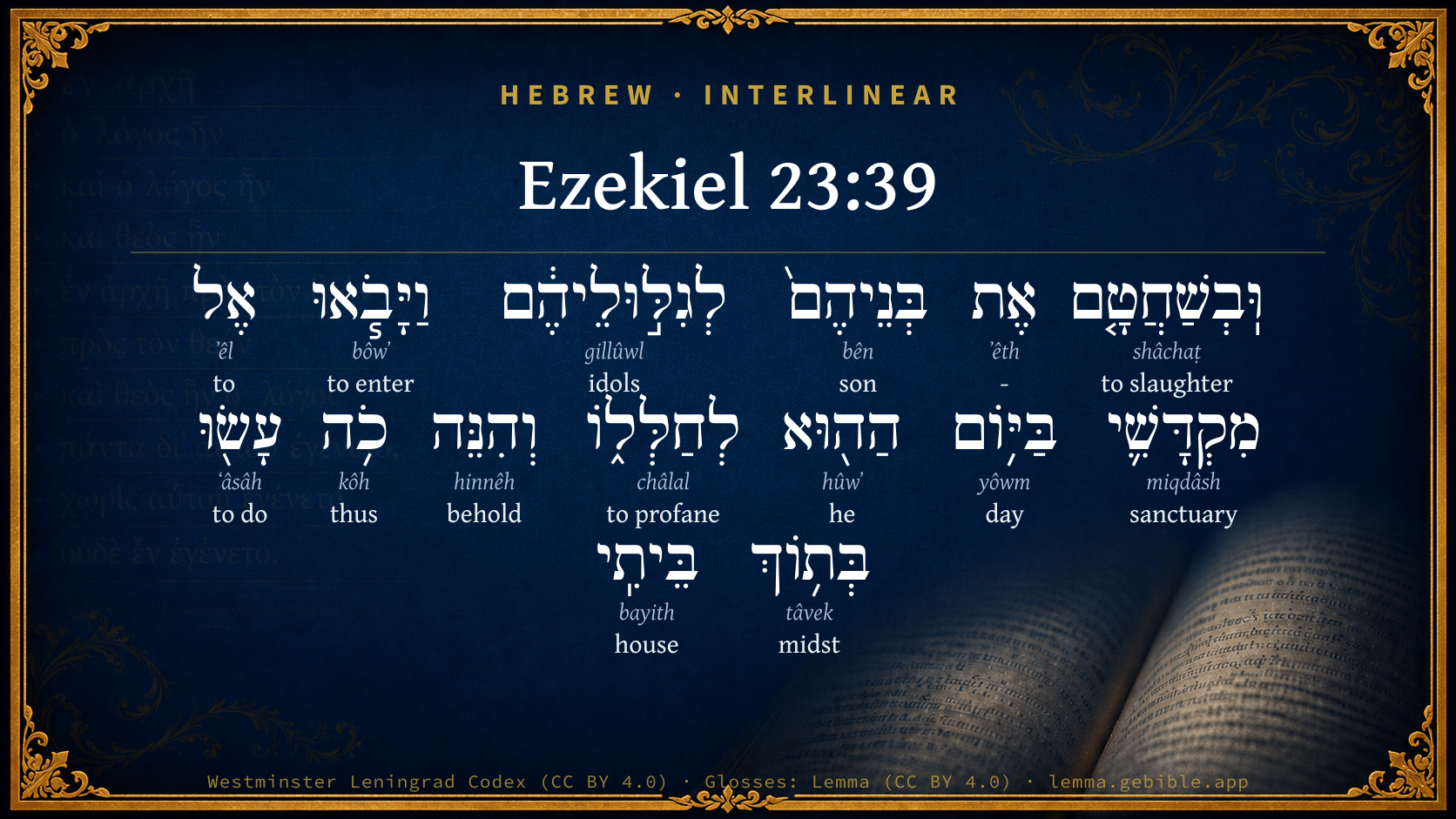
Hebrew (Westminster Leningrad Codex) Ezekiel 23:39 appears in the Hebrew Old Testament. The text above is from the Westminster Leningrad Codex. Each word links to its Strong’s number, a concise gloss, and parsing drawn from the Open Scriptures Hebrew Bible morphology. Click any word for its full Brown-Driver-Briggs (BDB) entry.
Download image
Cite this verse

Ezekiel 23:39 (World English Bible). Public Domain. Lemma interlinear Bible study tool, https://lemma.gebible.app/v/ezekiel/23/39.

Show BibTeX & RIS
BibTeX
RIS
English Translation
For when they had slain their children to their idols, then they came the same day into my sanctuary to profane it; and, behold, thus have they done in the midst of my house.
World English Bible · Public Domain
Download a study sheet

One document with this verse’s original text, its word-by-word gloss line, the meaning frame, cross-references with their text, attributed commentary, and full source and license credits — printable, and it pastes into notes with its structure intact.

This verse Autodidact and up

Study sheet (.html) Plain text (.txt)

A passage Seminary Student

Up to 50 verses in one chapter. A passage sheet keeps up to 6 commentary sources and 12 cross-references per verse, in the order this page ranks them, and says so on the sheet whenever that leaves anything out. Ask for a single verse and you get the Autodidact verse sheet above.

Everything on this page stays free to read, with no account — the sheet is a download of what is already on screen, not access to it.

Want to remove ads? Support Godless Engineer
Compare translations 3

The same verse in 3 English versions, stacked beneath the original-language interlinear above. Click any original word for its lexicon entry.

Each is an independent rendering of the whole verse — the interlinear is not word-aligned to these translations.

Highlighted words mark where these versions differ — a whole-verse word diff, not a word-by-word alignment.

  • World English Bible Public Domain
    For when they had slain their children to their idols, then they came the same day into my sanctuary to profane it; and, behold, thus have they done in the midst of my house.
  • King James Version Public Domain
    For when they had slain their children to their idols, then they came the same day into my sanctuary to profane it; and, lo, thus have they done in the midst of mine house.
  • unfoldingWord Literal Text CC BY-SA 4.0
    For when they had slaughtered their children for their idols, then they came to my sanctuary on the same day to defile it! So behold! This is what they have done in the middle of my house.

unfoldingWord Literal Text — © unfoldingWord, licensed CC BY-SA 4.0. Word-aligned USFM3 via Door43 (git.door43.org/unfoldingWord/en_ult).

Versions to compare (up to 4)

3 of 4 selected

Show all 18 translations

Every available English version of this verse, each an independent rendering of the whole verse.

  • World English Bible Public Domain
    For when they had slain their children to their idols, then they came the same day into my sanctuary to profane it; and, behold, thus have they done in the midst of my house.
  • Berean Standard Bible Public Domain
    On the very day they slaughtered their children for their idols, they entered My sanctuary to profane it. Yes, they did this inside My house.
  • Majority Standard Bible Public Domain
    On the very day they slaughtered their children for their idols, they entered My sanctuary to profane it. Yes, they did this inside My house.
  • King James Version Public Domain
    For when they had slain their children to their idols, then they came the same day into my sanctuary to profane it; and, lo, thus have they done in the midst of mine house.
  • American Standard Version (1901) Public Domain
    For when they had slain their children to their idols, then they came the same day into my sanctuary to profane it; and, lo, thus have they done in the midst of my house.
  • Revised Version (1885) Public Domain
    For when they had slain their children to their idols, then they came the same day into my sanctuary to profane it; and, lo, thus have they done in the midst of mine house.
  • Geneva Bible (1599) Public Domain
    For when they had slaine their children to their idoles, they came the same day into my Sanctuarie to defile it: and loe, thus haue they done in the middes of mine house.
  • Douay-Rheims (1899) Public Domain
    And when they sacrificed their children to their idols, and went into my sanctuary the same day to profane it: they did these things even in the midst of my house.
  • Young's Literal Translation Public Domain
    And in their slaughtering their sons to their idols They also come in unto My sanctuary in that day to pollute it, And lo, thus they have done in the midst of My house,
  • Literal Standard Version CC BY-SA 4.0
    And in their slaughtering their sons to their idols || They also come into My sanctuary in that day to defile it, || And behold, thus they have done in the midst of My house,
  • Unlocked Literal Bible CC BY-SA 4.0
    For when they had slaughtered their children for their idols, then they came to my sanctuary on the same day to defile it! So behold! This is what they have done in the middle of my house.
  • unfoldingWord Literal Text CC BY-SA 4.0
    For when they had slaughtered their children for their idols, then they came to my sanctuary on the same day to defile it! So behold! This is what they have done in the middle of my house.
  • Darby Bible Public Domain
    For when they had slaughtered their children unto their idols, they came the same day into my sanctuary to profane it; and behold, thus have they done in the midst of my house.
  • World Messianic Bible Public Domain
    For when they had slain their children to their idols, then they came the same day into my sanctuary to profane it; and behold, they have done this in the middle of my house.
  • Webster's Bible Public Domain
    For when they had slain their children to their idols, then they came the same day into my sanctuary to profane it; and lo, thus have they done in the midst of my house.
  • Free Bible Version CC BY-SA 4.0
    On the very day that they killed their children for their idols, they went into my sanctuary and made it unclean. Look at what they did right inside my Temple!
  • Bible in Basic English Public Domain
    For when she had made an offering of her children to her images, she came into my holy place to make it unclean; see, this is what she has done inside my house.
  • JPS Tanakh (1917) Public Domain
    For when they had slain their children to their idols, then they came the same day into My sanctuary to profane it; and, lo, thus have they done in the midst of My house.

Literal Standard Version (2020), Covenant Press — licensed CC BY-SA 4.0. Text via the HelloAO Bible API (eBible.org). Unlocked Literal Bible (unfoldingWord) — licensed CC BY-SA 4.0. Text via the HelloAO Bible API (eBible.org). unfoldingWord Literal Text — © unfoldingWord, licensed CC BY-SA 4.0. Word-aligned USFM3 via Door43 (git.door43.org/unfoldingWord/en_ult). Free Bible Version, Dr. Jonathan Gallagher — licensed CC BY-SA 4.0. Text via the HelloAO Bible API (eBible.org).

Word by word

More ways to search: Search by grammar → Find every occurrence → Compare this word →

Practice this passage: Drill this verse → Learn its vocabulary →

לְגִלּ֣וּלֵיהֶ֔ם
gillûwl
H1544
“to/for · idols · their”
Preposition + Noun, Common, Masculine, Plural, Construct + Suffix, Personal, 3rd Person, Masculine, Plural
Part of Speech
Preposition + Noun
Type
Common
Gender
Masculine
Number
Plural
State
Construct
Full BDB Definition

Origin: from H1556

TWOT: 353h

idols
  1. וּֽבְשַׁחֲטָ֤ם shâchaṭ H7819 “and · in/at · to slaughter · them” Conjunction + Preposition + Verb, Qal, Infinitive Construct + Suffix, Personal, 3rd Person, Masculine, Plural
  2. אֶת ʼêth H853 “-” Particle, Direct Object
  3. בְּנֵיהֶם֙ bên H1121 “sons · their” Noun, Common, Masculine, Plural, Construct + Suffix, Personal, 3rd Person, Masculine, Plural
  4. וַיָּבֹ֧אוּ bôwʼ H935 “and · to enter” Conjunction + Verb, Qal, Sequential Imperfect, 3rd Person, Masculine, Plural
  5. אֶל ʼêl H413 “to” Preposition
  6. מִקְדָּשִׁ֛י miqdâsh H4720 “sanctuary · my” Noun, Common, Masculine, Singular, Construct + Suffix, Personal, 1st Person, Common, Singular
  7. בַּיּ֥וֹם yôwm H3117 “in/at the · day” Preposition, Determined + Noun, Common, Masculine, Singular, Absolute
  8. הַה֖וּא hûwʼ H1931 “the · he” Particle, Definite Article + Pronoun, Personal, 3rd Person, Masculine, Singular
  9. לְחַלְּל֑וֹ châlal H2490 “to profane · him” Preposition + Verb, Piel, Infinitive Construct + Suffix, Personal, 3rd Person, Masculine, Singular
  10. וְהִנֵּה hinnêh H2009 “and · behold” Conjunction + Particle, Demonstrative
  11. כֹ֥ה kôh H3541 “thus” Adverb
  12. עָשׂ֖וּ ʻâsâh H6213 “to do” Verb, Qal, Perfect, 3rd Person, Common, Plural
  13. בְּת֥וֹךְ tâvek H8432 “in/at · midst of” Preposition + Noun, Common, Masculine, Singular, Construct
  14. בֵּיתִֽי bayith H1004 “house · my” Noun, Common, Masculine, Singular, Construct + Suffix, Personal, 1st Person, Common, Singular

About this verse

These counts appear in no published source. They are computed here, from the morphology-tagged text and Lemma’s own curated glosses. What Lemma adds →

15
words
15
distinct lemmas
Prophets
section

Shared distinctive vocabulary

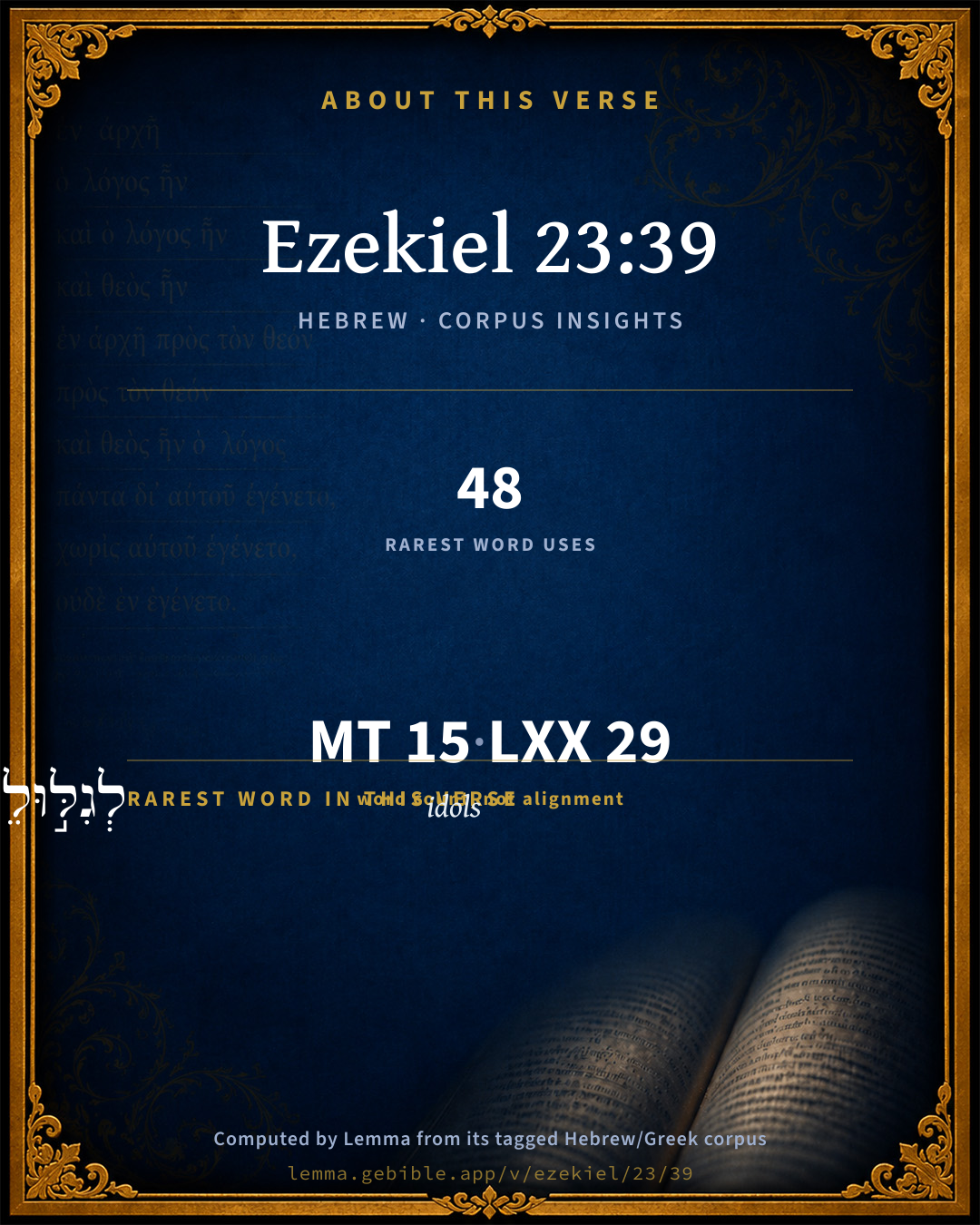
לְגִלּ֣וּלֵיהֶ֔ם idols H1544 occurs in 45 verses of the Hebrew Bible. Also found in:

Grammatical profile

  • 4 verbs
  • 6 nouns
  • 1 pronoun
  • 1 preposition
  • 1 adverb
  • 2 particles

Verb forms

  • וּֽבְשַׁחֲטָ֤ם Qal · Infinitive Construct
  • וַיָּבֹ֧אוּ Qal · Sequential Imperfect
  • לְחַלְּל֑וֹ Piel · Infinitive Construct
  • עָשׂ֖וּ Qal · Perfect

Hebrew & Septuagint length

In English translation the verse runs 34 words from the Hebrew and 29 from the Septuagint (LXX English) — closely comparable.

A rough comparison of the two English renderings, which tokenize alike — not a word-level alignment.

Word counts can differ between the Hebrew and the Greek without any difference in meaning — e.g. the Hebrew direct-object marker אֵת has no separate Greek word, and Greek often adds the article ὁ.

In the original languages it is 15 Hebrew tokens and 29 Greek tokens — but the two are counted differently (Hebrew bundles its prefixes and suffixes into one token; the Greek is in lemma form), so that isn’t a like-for-like length.

Cross-references

10

Topical passages linked to Ezekiel 23:39 in the Treasury of Scripture Knowledge — connected by theme and wording, ordered by reader-vote popularity; previews shown in the World English Bible.

  • 2 Kings 21:4 He built altars in the house of Yahweh, of which Yahweh said, In Jerusalem will I put my name.
  • Jeremiah 23:11 for both prophet and priest are profane; yes, in my house have I found their wickedness, says Yahweh.
  • Ezekiel 44:7 in that you have brought in foreigners, uncircumcised in heart and uncircumcised in flesh, to be in my sanctuary, to profane it, even my house, when you offer my bread, the fat and the blood, and they have broken my covenant, [to add] to all your abominations.
  • 2 Chronicles 33:4–7 He built altars in the house of Yahweh, of which Yahweh said, In Jerusalem shall my name be forever.
  • Isaiah 3:9 The look of their faces testify against them. They parade their sin like Sodom. They don't hide it. Woe to their soul! For they have brought disaster upon themselves.
  • Jeremiah 7:8–11 Behold, you trust in lying words, that can't profit.
  • Jeremiah 11:15 What has my beloved to do in my house, seeing she has worked lewdness [with] many, and the holy flesh is passed from you? when you do evil, then you rejoice.
  • Ezekiel 23:38 Moreover this they have done to me: they have defiled my sanctuary in the same day, and have profaned my Sabbaths.
  • Micah 3:11 Her leaders judge for bribes, And her priests teach for a price, And her prophets of it tell forturnes for money: Yet they lean on Yahweh, and say, Isn't Yahweh in the midst of us? No disaster will come on us.
  • John 18:28 They led Jesus therefore from Caiaphas into the Praetorium. It was early, and they themselves didn't enter into the Praetorium, that they might not be defiled, but might eat the Passover.

Cross-references courtesy of OpenBible.info (CC BY 4.0).

Hebrew and Greek witnesses Masoretic Hebrew ↔ Greek Septuagint

The same verse in the two great witnesses to the Old Testament, shown verse-for-verse.

These are two independent witnesses, not word-aligned to each other, and the Septuagint is shown in lemma (dictionary) form.

Hebrew Ezekiel 23:39 Masoretic · Westminster Leningrad Codex

וּֽבְשַׁחֲטָ֤ם אֶת בְּנֵיהֶם֙ לְגִלּ֣וּלֵיהֶ֔ם וַיָּבֹ֧אוּ אֶל מִקְדָּשִׁ֛י בַּיּ֥וֹם הַה֖וּא לְחַלְּל֑וֹ וְהִנֵּה כֹ֥ה עָשׂ֖וּ בְּת֥וֹךְ בֵּיתִֽי

For when they had slain their children to their idols, then they came the same day into my sanctuary to profane it; and, behold, thus have they done in the midst of my house.

World English Bible · Public Domain

Greek LXX Ezekiel 23:39 Septuagint · lemma form

καί ἐν ὁ σφάζω αὐτός ὁ τέκνον αὐτός ὁ εἴδωλον αὐτός καί εἰςπορεύομαι εἰς ὁ ἅγιος ἐγώ ὁ βεβηλόω αὐτός καί ὅτι οὕτως ποιέω ἐν μέσος ὁ οἶκος ἐγώ

And when they sacrificed their children to their idols, they also went into my sanctuary to profane it: and whereas they did thus in the midst of my house;

LXX2012 (modern English Septuagint) · Public Domain

Hebrew: Westminster Leningrad Codex (CC BY 4.0). Greek: Septuagint (public domain); English from LXX2012 (modern English Septuagint) (Public Domain). How the Septuagint differs from the Hebrew →

Targum (Aramaic paraphrase)

1

The Targum is the ancient Jewish Aramaic paraphrase of the Hebrew Scriptures — an interpretive translation, not the Hebrew text itself. Onkelos (literal) and Pseudo-Jonathan (expansive) render the Torah, and Jonathan the Prophets. Coverage is partial: where no permissively-licensed English translation exists for a verse, only the Aramaic is shown. This is verse-level text, not a word-by-word alignment to the Hebrew.

  1. Targum Jonathan Prophets (Joshua–Malachi)
    וּבְמִכְסוּתְהֶן יַת בְּנֵיהוֹן לְפוּלְחַן טַעֲוַתְהוֹן וְעָלוּ לְבֵית מַקְדְשִׁי בְיוֹמָא הַהוּא לְאָחָלוּתֵיהּ וְהָא כְדֵין עֳבָדוּ בְּגוֹ בֵּית מַקְדְשֵׁי:

    (no public-domain English translation for this verse)

    Targum Jonathan — Aramaic: “Mikraot Gedolot” (public domain). English: “Sefaria Community Translation” (CC0 1.0 (public-domain dedication)); “London "Chaldee Paraphrase," 1871” (public domain). Text via Sefaria.

Commentary

Notes on Ezekiel 23:39 from classic Christian and Jewish commentators (each source and its license shown beneath its notes). The classic Christian expositions comment on the surrounding passage and are grouped to its opening verse, so a note may address several verses; the Jewish commentaries on the Tanakh (Rashi and others) are per-verse, so they appear only where the commentator wrote on this verse.

Lemma curates 59 commentaries, every one of them public domain or Creative Commons licensed, each selected and text-cleaned for this edition rather than reprinted as found. About our sources →

Trapp's Complete Commentary

John Trapp

Eze 23:39 For when they had slain their children to their idols, then they came the same day into my sanctuary to profane it; and, lo, thus have they done in the midst of mine house.

Ver. 39. For when they had slain.] When their hands were full of blood, and even reeking hot therewith. This was detestable impudence.

Then they came the same day into my sanctuary.] Citra conscientiam, as if they had done God good service. So Erasmus {a} telleth of a fierce friar, Augustine of Antwerp, who openly in the pulpit there preaching to the people, wished that Luther were present, that he might bite out his throat with his teeth; so doing he would nothing doubt to resort to the altar with the same bloody teeth, and receive the body of Christ. Fiducia in federibus.

{a} Eras. Ep., lib. xvi. ad obtrect.

John Trapp, A Commentary or Exposition upon All the Books of the Old and New Testament (1647–1656) — public domain. Text from a community e-Sword module.

The Cambridge Bible for Schools and Colleges

gen. ed. J. J. S. Perowne

39. The particular profanation of the Lord’s house lay in this that those who had sacrificed their children entered it. The children were no doubt offered to Jehovah, under whatever conception or name, and the worshippers felt no incongruity in entering his house. Jer_7:9 seq.

midst of mine house] It is not meant that children were sacrificed in the house; their sacrifice was combined with other service in the house.

The Cambridge Bible for Schools and Colleges (gen. ed. J. J. S. Perowne; Cambridge University Press, 1878–1918) — public domain. Text from a community e-Sword module.

John Gill's Exposition

For when they had slain their children to their idols,.... This explains more clearly what is before said, that by causing their children to pass through the fire was a slaying them; and that their passing through it "for them" was for their idols, and unto them; see Eze 23:37, and how when they had been guilty of such shocking wickedness,

then they came the same day into my sanctuary to profane it; not that they came into the temple on purpose to profane it; but coming into it, being themselves defiled with the murder of their infants, and offering sacrifices to idols, or performing a hypocritical service to the Lord, this was in the event a profanation of the sanctuary:

and, lo, thus they have done in the midst of mine house; set up idols there, and worshipped them; as they did in the temple itself, in the times of Ahaz and Manasseh; see Jer 7:30.

John Gill's Exposition of the Whole Bible (1746–1763) — public domain (CC PDM 1.0). Text via the HelloAO Bible API.

Albert Barnes' Notes on the Bible

Yahweh was placed as it were in the list of deities, not acknowledged as the One God. Idols and idol-temples were erected close to the House of God, and yet the temple-service went on Jer 32:34.

Albert Barnes' Notes on the Bible (1834–1885) — public domain. Text from a community e-Sword/MySword module.

Matthew Poole's English Annotations

Slain their children: see Eze 16:20.

To profane it; using my holy temple as if it were a common and unclean place.

Thus have they done in the midst of my house; nay, these things have been done in my house, they have offered to their idols in the house where my name alone should be called upon.

Matthew Poole's English Annotations on the Holy Bible (1683–1685) — public domain. Text from a community e-Sword/MySword module.

Whedon's Commentary on the Bible

Daniel D. Whedon

39. The same day — This was an especial insult to Jehovah. The sacrilegious irreverence of these pretended worshipers of Jehovah is seen in the fact that they do not even repent of such practices, but unblushingly enter the holy place. This proved that they neither obeyed nor feared the Lord of the house (Eze_8:17; 2Ki_21:4; Jer_32:34).

Jerusalem has become like the prostitutes of the heathen temple, who seek visitors from afar (see Eze_23:16); who bathe themselves, and paint their eyes with kohl to make them look large and bright, who bedeck themselves with jewels (Eze_23:40), and use the sacred incense and oil as attractions for their bed of lust (Eze_23:41). The revelations of Jerusalem life given elsewhere by Ezekiel and other prophets prove that this was not all metaphor, nor does it refer merely to political alliances. The prevalence of idolatry in Jerusalem, and even in the temple itself, proves the presence of these other shameless iniquities. No wonder the prophet calls the holy city a harlot, and speaks in words that cut to the quick against practices which strike at the roots of all social and family life (Eze_23:40-44).

Daniel D. Whedon (gen. ed.), Commentary on the Old and New Testaments (1874–1909) — public domain. Text from a community e-Sword module.

John Wesley's Explanatory Notes

My house - Nay, these things have been in my house.

John Wesley, Explanatory Notes Upon the Whole Bible (1754–1765) — public domain. Text via the GEBible commentary corpus.

Lesson kit

Teaching starters — assembled from the data on this page, not authored interpretation. Every prompt links to the verse data it draws on. Edit before teaching.

Ezekiel, in the Prophets, opens this verse with 15 words (15 distinct Hebrew lemmas). Its most distinctive word is gillûwl (“idols”). A historical commentator’s framing appears above. Read the whole chapter for the surrounding context.

Discussion questions

  1. The word gillûwl carries the sense “idols.” How does it shape the verse?
  2. Leviticus 26:30 shares the word «idols» with this verse. How do the two illuminate each other?
  3. These translations render this verse differently; the difference is in the English rendering, not the original. What questions does that raise?
  4. The verb «וּֽבְשַׁחֲטָ֤ם» is Qal Infinitive Construct. How does its form color the action?
  5. Reading how Trapp's Complete Commentary and The Cambridge Bible for Schools and Colleges read this verse, where do the two commentators agree and where do they part?

Things to notice

Reading settings

Reading text

Shown beneath each verse's original-language words.

Old Testament
Old Testament edition

Read the OT as the Masoretic Hebrew (MT) or the Greek Septuagint (LXX).

English shown for the Greek Septuagint (in the Hebrew ↔ Greek comparison).

Comparing translations? Open the Compare panel on any verse page to stack up to four side by side.