
Jeremiah 41:7

Hebrew (Westminster Leningrad Codex) Jeremiah 41:7 appears in the Hebrew Old Testament. The text above is from the Westminster Leningrad Codex. Each word links to its Strong’s number, a concise gloss, and parsing drawn from the Open Scriptures Hebrew Bible morphology. Click any word for its full Brown-Driver-Briggs (BDB) entry.
Download image
Cite this verse

Jeremiah 41:7 (World English Bible). Public Domain. Lemma interlinear Bible study tool, https://lemma.gebible.app/v/jeremiah/41/7.

Show BibTeX & RIS
BibTeX
RIS
English Translation
It was so, when they came into the midst of the city, that Ishmael the son of Nethaniah killed them, [and cast them] into the midst of the pit, he, and the men who were with him.
World English Bible · Public Domain
Download a study sheet

One document with this verse’s original text, its word-by-word gloss line, the meaning frame, cross-references with their text, attributed commentary, and full source and license credits — printable, and it pastes into notes with its structure intact.

This verse Autodidact and up

Study sheet (.html) Plain text (.txt)

A passage Seminary Student

Up to 50 verses in one chapter. A passage sheet keeps up to 6 commentary sources and 12 cross-references per verse, in the order this page ranks them, and says so on the sheet whenever that leaves anything out. Ask for a single verse and you get the Autodidact verse sheet above.

Everything on this page stays free to read, with no account — the sheet is a download of what is already on screen, not access to it.

Want to remove ads? Support Godless Engineer
Compare translations 3

The same verse in 3 English versions, stacked beneath the original-language interlinear above. Click any original word for its lexicon entry.

Each is an independent rendering of the whole verse — the interlinear is not word-aligned to these translations.

Highlighted words mark where these versions differ — a whole-verse word diff, not a word-by-word alignment.

  • World English Bible Public Domain
    It was so, when they came into the midst of the city, that Ishmael the son of Nethaniah killed them, [and cast them] into the midst of the pit, he, and the men who were with him.
  • King James Version Public Domain
    And it was so, when they came into the midst of the city, that Ishmael the son of Nethaniah slew them, and cast them into the midst of the pit, he, and the men that were with him.
  • unfoldingWord Literal Text CC BY-SA 4.0
    It came about that when they came into the city, Ishmael son of Nethaniah slaughtered them and threw them into a pit, he and the men who were with him.

unfoldingWord Literal Text — © unfoldingWord, licensed CC BY-SA 4.0. Word-aligned USFM3 via Door43 (git.door43.org/unfoldingWord/en_ult).

Versions to compare (up to 4)

3 of 4 selected

Show all 18 translations

Every available English version of this verse, each an independent rendering of the whole verse.

  • World English Bible Public Domain
    It was so, when they came into the midst of the city, that Ishmael the son of Nethaniah killed them, [and cast them] into the midst of the pit, he, and the men who were with him.
  • Berean Standard Bible Public Domain
    And when they came into the city, Ishmael son of Nethaniah and the men with him slaughtered them and threw them into a cistern.
  • Majority Standard Bible Public Domain
    And when they came into the city, Ishmael son of Nethaniah and the men with him slaughtered them and threw them into a cistern.
  • King James Version Public Domain
    And it was so, when they came into the midst of the city, that Ishmael the son of Nethaniah slew them, and cast them into the midst of the pit, he, and the men that were with him.
  • American Standard Version (1901) Public Domain
    And it was so, when they came into the midst of the city, that Ishmael the son of Nethaniah slew them, `and cast them' into the midst of the pit, he, and the men that were with him.
  • Revised Version (1885) Public Domain
    And it was so, when they came into the midst of the city, that Ishmael the son of Nethaniah slew them, and cast them into the midst of the pit, he, and the men that were with him.
  • Geneva Bible (1599) Public Domain
    And when they came into the middes of the citie, Ishmael the sonne of Nethaniah slewe them, and cast them into the middes of the pit, he and the men that were with him.
  • Douay-Rheims (1899) Public Domain
    And when they were come to the midst of the city, Ismahel the son of Nathanias, slew them, and cast them into the midst of the pit, he and the men that were with him.
  • Young's Literal Translation Public Domain
    And it cometh to pass, at their coming in unto the midst of the city, that Ishmael son of Nethaniah doth slaughter them, at the midst of the pit, he and the men who `are' with him.
  • Literal Standard Version CC BY-SA 4.0
    And it comes to pass, at their coming into the midst of the city, that Ishmael son of Nethaniah slaughters them, at the midst of the pit, he and the men who [are] with him.
  • Unlocked Literal Bible CC BY-SA 4.0
    It came about that when they came into the city, Ishmael son of Nethaniah slaughtered them and threw them into a pit, he and the men who were with him.
  • unfoldingWord Literal Text CC BY-SA 4.0
    It came about that when they came into the city, Ishmael son of Nethaniah slaughtered them and threw them into a pit, he and the men who were with him.
  • Darby Bible Public Domain
    And it was so, when they came into the midst of the city, that Ishmael the son of Nethaniah, he and the men that were with him, slew them, [and cast them] into the midst of the pit.
  • World Messianic Bible Public Domain
    It was so, when they came into the middle of the city, that Ishmael the son of Nethaniah killed them, and cast them into the middle of the pit, he, and the men who were with him.
  • Webster's Bible Public Domain
    And it was so, when they came into the midst of the city, that Ishmael the son of Nethaniah slew them, and cast them into the midst of the pit, he, and the men that were with him.
  • Free Bible Version CC BY-SA 4.0
    But when they arrived in town, Ishmael and his men killed most of them and threw their bodies into a cistern.
  • Bible in Basic English Public Domain
    And when they came inside the town, Ishmael, the son of Nethaniah, and the men who were with him, put them to death and put their bodies into a deep hole.
  • JPS Tanakh (1917) Public Domain
    And it was so, when they came into the midst of the city, that Ishmael the son of Nethaniah slew them, and cast them into the midst of the pit, he, and the men that were with him.

Literal Standard Version (2020), Covenant Press — licensed CC BY-SA 4.0. Text via the HelloAO Bible API (eBible.org). Unlocked Literal Bible (unfoldingWord) — licensed CC BY-SA 4.0. Text via the HelloAO Bible API (eBible.org). unfoldingWord Literal Text — © unfoldingWord, licensed CC BY-SA 4.0. Word-aligned USFM3 via Door43 (git.door43.org/unfoldingWord/en_ult). Free Bible Version, Dr. Jonathan Gallagher — licensed CC BY-SA 4.0. Text via the HelloAO Bible API (eBible.org).

Word by word

More ways to search: Search by grammar → Find every occurrence → Compare this word →

Practice this passage: Drill this verse → Learn its vocabulary →

נְתַנְיָה֙
Nᵉthanyâh
H5418
“Nethaniah”
Noun, Proper
Part of Speech
Noun
Type
Proper
Full BDB Definition

Origin: from H5414 and H3050

TWOT: None

Nethaniah = "given of Jehovah" - son of Elishama of the royal family of Judah and father of Ishmael who murdered Gedaliah - father of Jehudi - a Levite, one of the 4 sons of Asaph the minstrel - a Levite in the reign of king Jehoshaphat of Judah
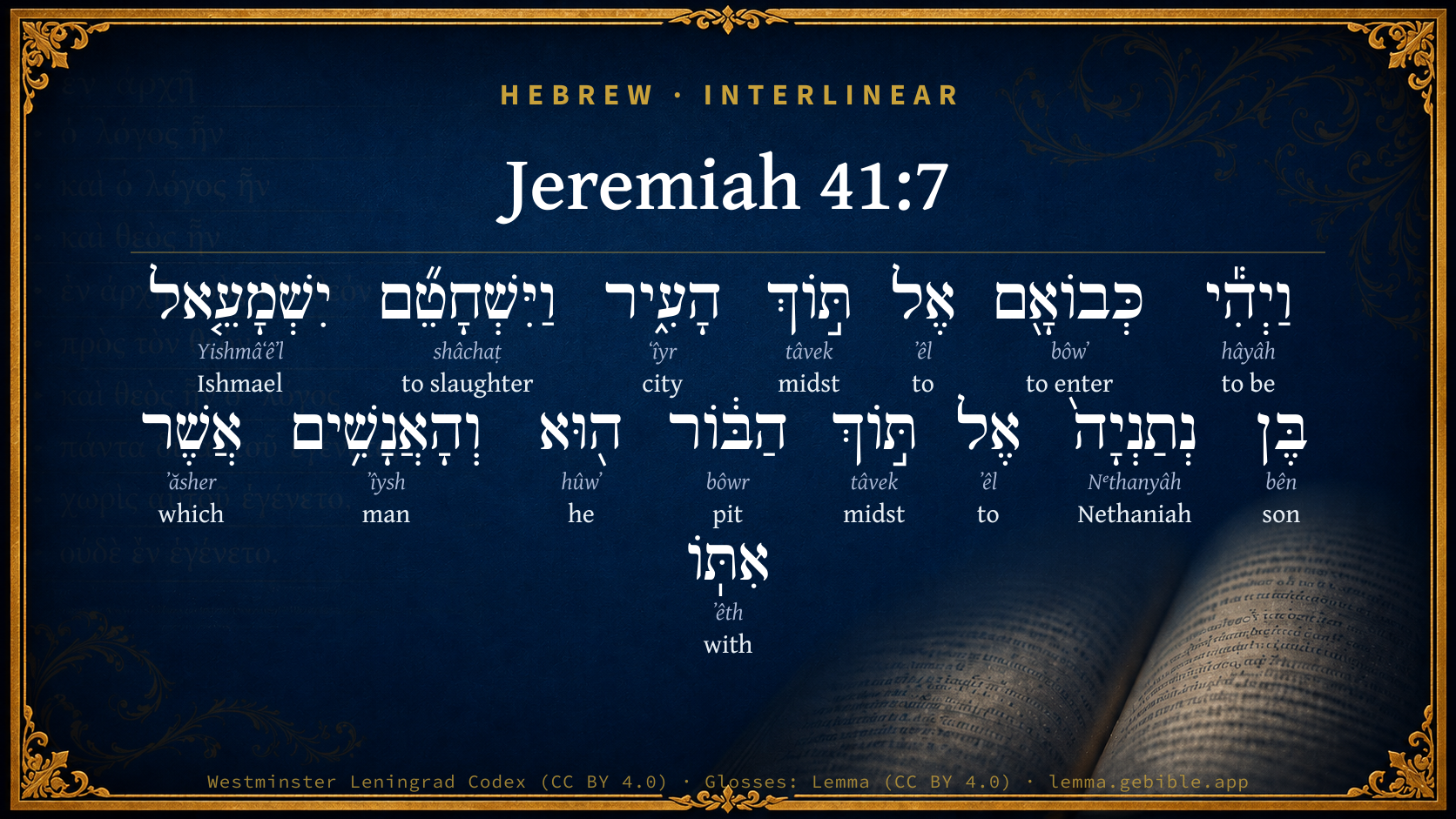
  1. וַיְהִ֕י hâyâh H1961 “and · to be” Conjunction + Verb, Qal, Sequential Imperfect, 3rd Person, Masculine, Singular
  2. כְּבוֹאָ֖ם bôwʼ H935 “like/as · to enter · them” Preposition + Verb, Qal, Infinitive Construct + Suffix, Personal, 3rd Person, Masculine, Plural
  3. אֶל ʼêl H413 “to” Preposition
  4. תּ֣וֹךְ tâvek H8432 “midst of” Noun, Common, Masculine, Singular, Construct
  5. הָעִ֑יר ʻîyr H5892 “the · city” Particle, Definite Article + Noun, Common, Feminine, Singular, Absolute
  6. וַיִּשְׁחָטֵ֞ם shâchaṭ H7819 “and · to slaughter · them” Conjunction + Verb, Qal, Sequential Imperfect, 3rd Person, Masculine, Singular + Suffix, Personal, 3rd Person, Masculine, Plural
  7. יִשְׁמָעֵ֤אל Yishmâʻêʼl H3458 “Ishmael” Noun, Proper
  8. בֶּן bên H1121 “son of” Noun, Common, Masculine, Singular, Construct
  9. אֶל ʼêl H413 “to” Preposition
  10. תּ֣וֹךְ tâvek H8432 “midst of” Noun, Common, Masculine, Singular, Construct
  11. הַבּ֔וֹר bôwr H953 “the · pit” Particle, Definite Article + Noun, Common, Masculine, Singular, Absolute
  12. ה֖וּא hûwʼ H1931 “he” Pronoun, Personal, 3rd Person, Masculine, Singular
  13. וְהָאֲנָשִׁ֥ים ʼîysh H376 “and · the · men” Conjunction + Particle, Definite Article + Noun, Common, Masculine, Plural, Absolute
  14. אֲשֶׁר ʼăsher H834 “which” Particle, Relative
  15. אִתּֽוֹ ʼêth H854 “with · him” Preposition + Suffix, Personal, 3rd Person, Masculine, Singular

About this verse

These counts appear in no published source. They are computed here, from the morphology-tagged text and Lemma’s own curated glosses. What Lemma adds →

16
words
14
distinct lemmas
Prophets
section

Notable vocabulary

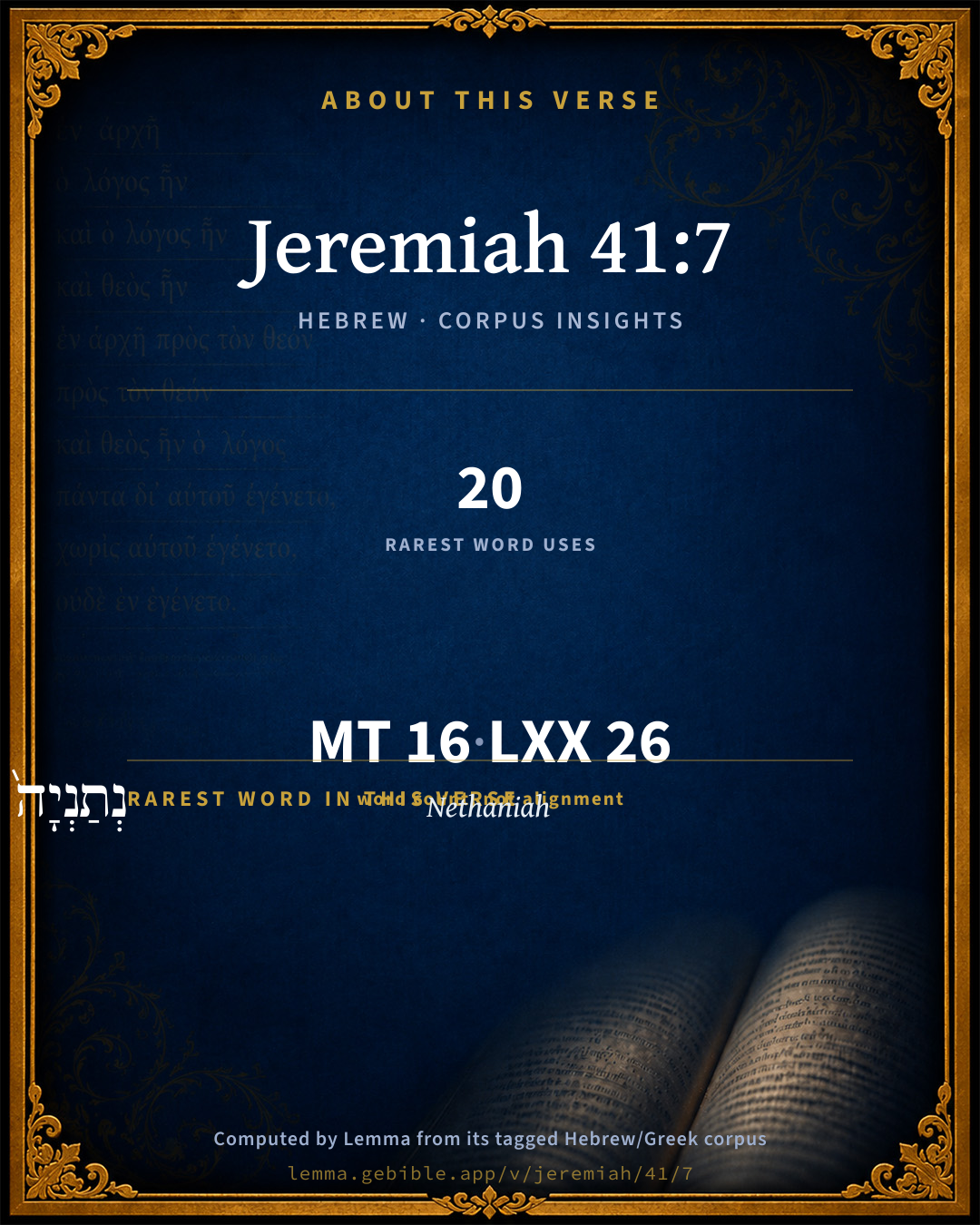
The rarest word here is נְתַנְיָה֙ Nethaniah H5418 — appearing just 20 times in the whole Hebrew Bible.

Shared distinctive vocabulary

נְתַנְיָה֙ Nethaniah H5418 occurs in 20 verses of the Hebrew Bible. Also found in:

Grammatical profile

  • 3 verbs
  • 8 nouns
  • 1 pronoun
  • 3 prepositions
  • 1 particle

Verb forms

  • וַיְהִ֕י Qal · Sequential Imperfect
  • כְּבוֹאָ֖ם Qal · Infinitive Construct
  • וַיִּשְׁחָטֵ֞ם Qal · Sequential Imperfect

Repetition

Words recur within this verse — often emphatic in Hebrew:

  • תּ֣וֹךְ midst H8432 ×2
  • אֶל to H413 ×2

Hebrew & Septuagint length

In the original languages it is 16 Hebrew tokens and 26 Greek tokens — but the two are counted differently (Hebrew bundles its prefixes and suffixes into one token; the Greek is in lemma form), so that isn’t a like-for-like length.

Cross-references

10

Topical passages linked to Jeremiah 41:7 in the Treasury of Scripture Knowledge — connected by theme and wording, ordered by reader-vote popularity; previews shown in the World English Bible.

  • Psalms 55:23 But you, God, will bring them down into the pit of destruction. Bloodthirsty and deceitful men shall not live out half their days, But I will trust in you.
  • Isaiah 59:7 Their feet run to evil, and they make haste to shed innocent blood: their thoughts are thoughts of iniquity; desolation and destruction are in their paths.
  • Ezekiel 22:27 Her princes in the midst of it are like wolves ravening the prey, to shed blood, [and] to destroy souls, that they may get dishonest gain.
  • 1 Kings 15:28–29 Even in the third year of Asa king of Judah did Baasha kill him, and reigned in his place.
  • 1 Kings 16:10–12 and Zimri went in and struck him, and killed him, in the twenty-seventh year of Asa king of Judah, and reigned in his place.
  • 2 Kings 11:1–2 Now when Athaliah the mother of Ahaziah saw that her son was dead, she arose and destroyed all the seed royal.
  • 2 Kings 15:25 Pekah the son of Remaliah, his captain, conspired against him, and struck him in Samaria, in the castle of the king's house, with Argob and Arieh; and with him were fifty men of the Gileadites: and he killed him, and reigned in his place.
  • Proverbs 1:16 For their feet run to evil. They hurry to shed blood.
  • Ezekiel 33:24–26 Son of man, they who inhabit those waste places in the land of Israel speak, saying, Abraham was one, and he inherited the land: but we are many; the land is given us for inheritance.
  • Romans 3:15 "Their feet are swift to shed blood.

Cross-references courtesy of OpenBible.info (CC BY 4.0).

Hebrew and Greek witnesses Masoretic Hebrew ↔ Greek Septuagint

The same verse in the two great witnesses to the Old Testament, shown verse-for-verse.

These are two independent witnesses, not word-aligned to each other, and the Septuagint is shown in lemma (dictionary) form.

Hebrew Jeremiah 41:7 Masoretic · Westminster Leningrad Codex

וַיְהִ֕י כְּבוֹאָ֖ם אֶל תּ֣וֹךְ הָעִ֑יר וַיִּשְׁחָטֵ֞ם יִשְׁמָעֵ֤אל בֶּן נְתַנְיָה֙ אֶל תּ֣וֹךְ הַבּ֔וֹר ה֖וּא וְהָאֲנָשִׁ֥ים אֲשֶׁר אִתּֽוֹ

It was so, when they came into the midst of the city, that Ishmael the son of Nethaniah killed them, [and cast them] into the midst of the pit, he, and the men who were with him.

World English Bible · Public Domain

Greek LXX Structure differs

In the Septuagint, Jeremiah is about an eighth shorter than the Hebrew and arranges its material differently — the Oracles Against the Nations (Hebrew chapters 46–51) appear in the middle of the Greek book, after 25:13. Because the chapter and verse boundaries do not line up, a verse-for-verse comparison with the Hebrew is not shown.

A verse-for-verse comparison isn’t shown here because the chapters and verses don’t line up. Switch to the LXX edition with the MT / LXX toggle above to read the Greek directly.

Hebrew: Westminster Leningrad Codex (CC BY 4.0). Greek: Septuagint (public domain); English from a public-domain English Septuagint. How the Septuagint differs from the Hebrew →

Targum (Aramaic paraphrase)

1

The Targum is the ancient Jewish Aramaic paraphrase of the Hebrew Scriptures — an interpretive translation, not the Hebrew text itself. Onkelos (literal) and Pseudo-Jonathan (expansive) render the Torah, and Jonathan the Prophets. Coverage is partial: where no permissively-licensed English translation exists for a verse, only the Aramaic is shown. This is verse-level text, not a word-by-word alignment to the Hebrew.

  1. Targum Jonathan Prophets (Joshua–Malachi)
    וַהֲוָה כְּמֵיעַלְהוֹן לְגוֹ קַרְתָּא וּנְכֵיסִינוּן יִשְׁמָעֵאל בַּר נְתַנְיָה לְגוֹ גוּבָא הוּא וְגַבְרַיָא דִי עִמֵיהּ:

    (no public-domain English translation for this verse)

    Targum Jonathan — Aramaic: “Mikraot Gedolot” (public domain). English: “Sefaria Community Translation” (CC0 1.0 (public-domain dedication)); “London "Chaldee Paraphrase," 1871” (public domain). Text via Sefaria.

Commentary

Notes on Jeremiah 41:7 from classic Christian and Jewish commentators (each source and its license shown beneath its notes). The classic Christian expositions comment on the surrounding passage and are grouped to its opening verse, so a note may address several verses; the Jewish commentaries on the Tanakh (Rashi and others) are per-verse, so they appear only where the commentator wrote on this verse.

Lemma curates 59 commentaries, every one of them public domain or Creative Commons licensed, each selected and text-cleaned for this edition rather than reprinted as found. About our sources →

Trapp's Complete Commentary

John Trapp

Jer 41:7 And it was [so], when they came into the midst of the city, that Ishmael the son of Nethaniah slew them, [and cast them] into the midst of the pit, he, and the men that [were] with him.

Ver. 7. Ishmael the son of Nethaniah slew them.] This hell hound having once, as other hounds, dipped his tongue in blood, can put no period to his unparalleled cruelty.

He, and the men that were with him.] His slaughter slaves, his assassins to help him; for he alone could not have done this bloody execution, unless he had taken as much time thereunto as that Popish villain did in doing to death those poor Protestants of Calabria, A.D. 1550. For as Ishmael here brought these eighty innocent men into the midst of the city as into a pound, and there slew them, so eighty-eight poor professors of the truth according to godliness, being all thrust up in one house together, as sheep in a fold, the executioner comes in, saith Mr Foxe, and among them takes one and blindfolds him with a muffler about his eyes, and so leads him forth to a larger place, where he commandeth him to kneel down, which being done, he cutteth his throat, and so leaving him half dead, and taking his butcher’s knife and muffler all of gore blood, cometh again to the rest, and so leadeth them one after another till he had despatched them all. {a}

{a} Acts and Mon., 859.

John Trapp, A Commentary or Exposition upon All the Books of the Old and New Testament (1647–1656) — public domain. Text from a community e-Sword module.

Jamieson, Fausset & Brown

Robert Jamieson, A. R. Fausset & David Brown

and cast them into . . . pit--He had not killed them in the pit (compare Jer 41:9); these words are therefore rightly supplied in English Version. "The pit" or cistern made by Asa to guard against a want of water when Baasha was about to besiege the city (Kg1 15:22). The trench or fosse round the city [GROTIUS]. Ishmael's motive for the murder seems to have been a suspicion that they were coming to live under Gedaliah.

Jamieson, Fausset & Brown — Commentary Critical and Explanatory on the Whole Bible (1871) — public domain (CC PDM 1.0). Text via the HelloAO Bible API.

Adam Clarke's Commentary

Verse 7. Slew them] He kept the murder of Gedaliah secret, and no doubt had a band of his assassins lodged in Mizpah; and he decoyed these fourscore men thither that he might have strength to slay them. He kept ten alive because they told him they had treasures hidden in a field, which they would show him. Whether he kept his word with them is not recorded. He could do nothing good or great; and it is likely that, when he had possessed himself of those treasures, he served them as he had served their companions. Grain is preserved to the present day in subterranean pits, called mattamores, in different parts of the east.

Adam Clarke's Commentary on the Bible (1810–1826) — public domain. Text from a community e-Sword/MySword module.

John Calvin's Commentaries

Here Jeremiah relates another circumstance in the nefarious conduct of Ishmael, that by flatteries he enticed simple men, who feared no evil, and while pretending kindness, slew them. The slaughter was in itself very detestable, but added to it was the most abominable deceit, for he pretended to weep with them, and offered an act of kindness, to bring them to Gedaliah, and then he traitorously killed them! We hence see that it was an act of extreme wickedness. In saying that he wept, it was no doubt a sign of feigned piety, He saw these good men in torn garments and in tears on account of the Temple being destroyed, he therefore pretended that he had the same feeling. This was falsely to pretend a regard for God, and his tears were those of the crocodile; for he shed tears as though he lamented the ruin of the Temple and of the city. He thus gained the confidence of the unwary men, and then after having led them into the middle of the city, he slew them. The place also is mentioned, nigh to the middle of the pit, for so I render it, rather than in the middle, for it is not credible that he killed them in the pit itself; but when led to the pit they were killed and were cast into it, as we shall see. He then slew them at the outside of the pit, and immediately cast them in.

It may, however be asked, Whether he could with so few attack with success so many men? for it seems strange, that as they were eighty men they did not resist; they might at least have frightened their enemies. But we must, in the first place, recollect that they were, as we have seen, unarmed; for they had brought only a sacred offering with incense; but the others were armed and well trained for war; they had also been reduced to a state of hopeless despair, so that they had doubtless contracted great ferocity, as those who are continually in danger accustom themselves to acts of cruelty. Ishmael, then, and his companions were armed, but the others were without any arms, and were also simple men and in no degree accustomed to war. Hence it was that they were killed like sheep, while Ishmael and his associates were like wolves, altogether ferocious. It now follows, —

John Calvin's Commentaries (1540-1563) — public domain. Text from the Calvin Translation Society English edition (1840s-50s) via the Christian Classics Ethereal Library (ccel.org). Calvin's coverage is partial (roughly two-thirds of the Bible); uncommented books and verses are honest gaps, never fabricated. The 19th-century editor's footnotes and remarks are omitted so the notes are faithfully Calvin's own voice.

Ellicott's Commentary for English Readers

(7) Ishmael the son of Nethaniah slew them.—The purpose of the new murder does not appear at first sight. The very presence of the devout mourners may have roused him to bitterness. Their recognition of Gedaliah may have seemed the act of traitors to their country. Possibly also the act may have been one of vindictive retaliation for the murder of his kinsmen (Jer_52:10), or have been perpetrated for the sake of plunder.

A Bible Commentary for English Readers, edited by Charles John Ellicott (1878–1897) — public domain. Text from a community e-Sword module.

The Cambridge Bible for Schools and Colleges

gen. ed. J. J. S. Perowne

7. Ishmael the son of Nethaniah slew them] See on Jer_41:2.

The Cambridge Bible for Schools and Colleges (gen. ed. J. J. S. Perowne; Cambridge University Press, 1878–1918) — public domain. Text from a community e-Sword module.

John Gill's Exposition

And it was so, when they came into the midst of the city,.... Where Gedaliah's house was, to which he invited them; and as they went in, he shut up the court, as Josephus (h) says, and slew them, as it here follows:

that Ishmael the son of Nethaniah slew them, and cast them into the midst of the pit; when he had slain them, the fourscore men he had enticed into the city, except ten of them, he cast their dead bodies into a pit near at hand:

he, and the men that were with him; Ishmael and the ten princes, with what servants they brought with them; these were all concerned in the death of these men.

(h) Antiqu. l. 10. c. 9. sect. 4.

John Gill's Exposition of the Whole Bible (1746–1763) — public domain (CC PDM 1.0). Text via the HelloAO Bible API.

Albert Barnes' Notes on the Bible

The pit - the cistern, and in Jer 41:9.

Albert Barnes' Notes on the Bible (1834–1885) — public domain. Text from a community e-Sword/MySword module.

Haydock's Catholic Bible Commentary

Into. Literally, "slew them about the," &c. (Haydock) --- The pit was not full of water, but had been intended by Asa for a reservoir, (ver. 9., and 3 Kings xv. 20.; Calmet) when he built Maspha. (Worthington)

George Leo Haydock (1774–1849), Haydock's Catholic Family Bible and Commentary, 1859 edition — public domain. Excludes Psalms (Douay-Rheims chapter numbering differs from Protestant) and Deuterocanonical books (Catholic canon only).

Matthew Poole's English Annotations

When he had thus enticed them into Mizpah, he and his followers slay them, and throw their dead bodies into a pit, with the assistance of those bloody men that were with him.

Matthew Poole's English Annotations on the Holy Bible (1683–1685) — public domain. Text from a community e-Sword/MySword module.

Whedon's Commentary on the Bible

Daniel D. Whedon

7. Slew them… into the midst of the pit — This is a pregnant construction, quite characteristic of the Hebrew. The words inserted by the translators are fully justified, and indeed necessary for the English reader.

Daniel D. Whedon (gen. ed.), Commentary on the Old and New Testaments (1874–1909) — public domain. Text from a community e-Sword module.

The Pulpit Commentary

The pit (see on ver. 9).

The Pulpit Commentary (1880–1919), ed. H.D.M. Spence-Jones & Joseph S. Exell — public domain. Text from a community e-Sword module.

Lesson kit

Teaching starters — assembled from the data on this page, not authored interpretation. Every prompt links to the verse data it draws on. Edit before teaching.

Jeremiah, in the Prophets, opens this verse with 16 words (14 distinct Hebrew lemmas). Its most distinctive word is Nᵉthanyâh (“Nethaniah”). A historical commentator’s framing appears above. Read the whole chapter for the surrounding context.

Discussion questions

  1. How does “Nethaniah” (Nᵉthanyâh) shape what this verse is saying?
  2. How does 2 Kings 25:23, which shares the word «Nethaniah», read alongside this verse?
  3. What does the repetition of “midst” (2× in this one verse) do in this verse?
  4. The translations on this page render this verse differently — a whole-verse word diff, not a word-by-word alignment. What might account for the different wordings?
  5. «וַיְהִ֕י» is a Qal Sequential Imperfect verb. How does that grammatical form shape the action described?
  6. Compare how Trapp's Complete Commentary and Jamieson, Fausset & Brown read this verse. Where do they agree or differ?

Things to notice

Reading settings

Reading text

Shown beneath each verse's original-language words.

Old Testament
Old Testament edition

Read the OT as the Masoretic Hebrew (MT) or the Greek Septuagint (LXX).

English shown for the Greek Septuagint (in the Hebrew ↔ Greek comparison).

Comparing translations? Open the Compare panel on any verse page to stack up to four side by side.