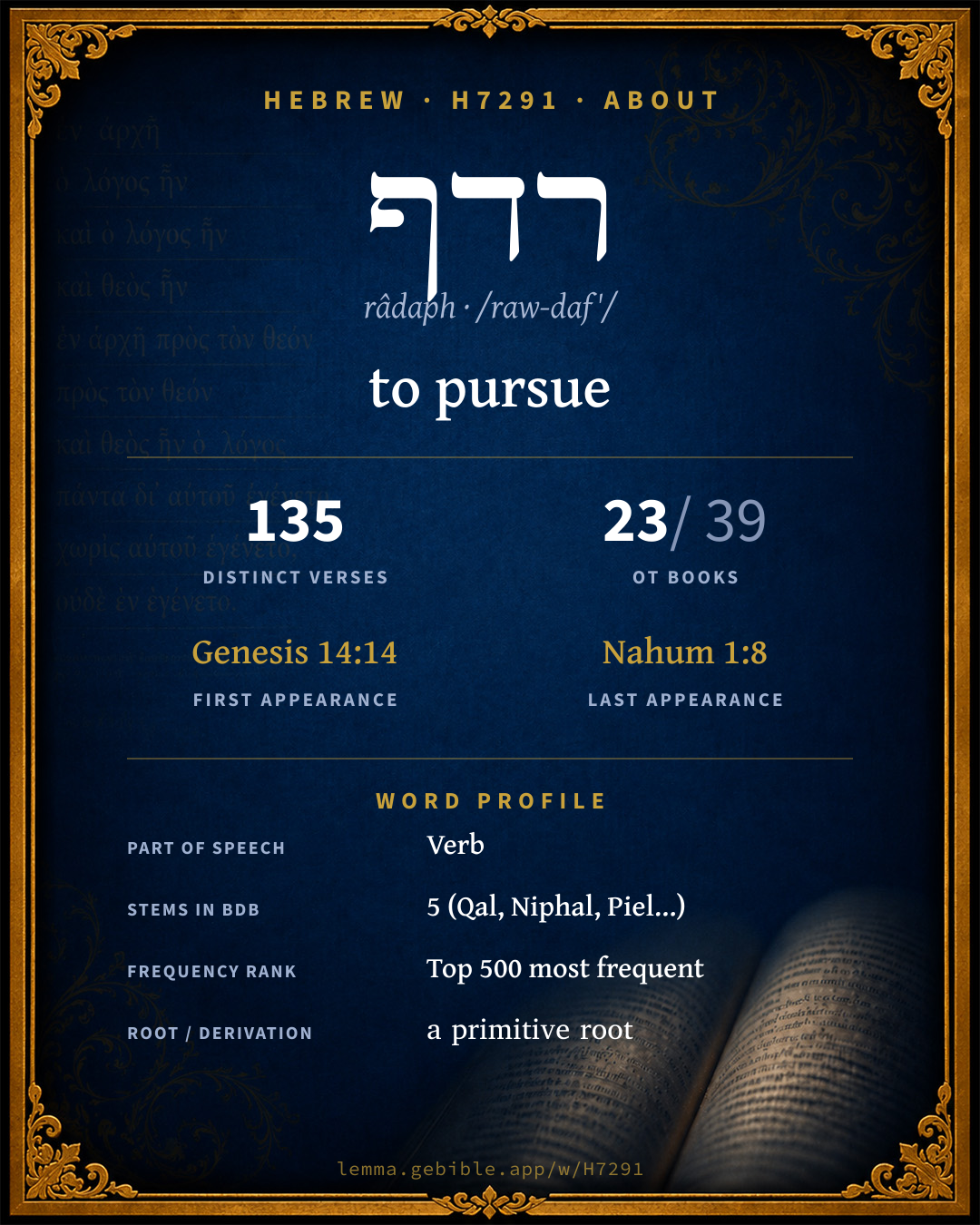
רָדַף
to pursue
‘to pursue’ is one of 4 main senses fuller range ↓
Full lexicon entry — Brown-Driver-Briggs (BDB)
From Brown-Driver-Briggs (BDB)
Where this word appears
See every Qal verb in the Hebrew Bible →
Grammar key — what these labels mean
Part of speech
- Verb
- An action or state-of-being word.
Stem
- Qal
- The basic, simple active stem — the plain form of the verb (“he wrote”). Here: ‘pursue’
- Piel
- An intensive or resultative active stem.
- Pual
- The passive counterpart of the Piel.
- Niphal
- Usually the simple passive or reflexive of the Qal (“he was written”). Here: ‘pass.’
- Hiphil
- The causative active stem (“he caused / brought about”).
Form
- Sequential Imperfect
- An imperfect with prefixed waw — the standard past-narrative form (waw-consecutive imperfect).
- Participle Active
- A verbal adjective expressing ongoing or characteristic action (“writing / one who writes”).
- Imperfect
- An incomplete, ongoing, or future action (“he will / would write”).
- Infinitive Construct
- A bound verbal noun, frequently with prepositions (“to write / in writing”).
- Imperative
- A direct command (“write!”).
- Perfect
- A completed action or state — Hebrew marks aspect (completeness) more than strict tense (“he wrote”).
- Sequential Perfect
- A perfect with prefixed waw continuing a preceding imperfect or command (waw-consecutive perfect).
- Cohortative
- A first-person volitional form expressing wish or resolve (“let me / let us write”).
- Participle Passive
- A verbal adjective expressing action received (“written”).
State
- Absolute
- The independent form of a noun, not bound to a following word.
- Construct
- A noun bound to a following noun in a possessive / “of” relationship (the construct chain).
Person
- 3rd Person
- The one spoken about (“he / she / it / they”).
- 2nd Person
- The one addressed (“you”).
- 1st Person
- The speaker (“I / we”).
Gender
- Masculine
- Grammatically masculine.
- Common
- Either gender — not distinguished for this form.
- Feminine
- Grammatically feminine.
Number
- Plural
- More than one (in Hebrew, generally three or more).
- Singular
- One.
1 verse where H7291 appears in the Hiphil stem in the Book of Judges. Filtered view — show all forms. Click any verse to open its interlinear word-by-word view. Verse text shown in the World English Bible for context — . Each verse’s Hebrew form is shown with its reference; the English is not keyword-highlighted, since the data carries no word-level English alignment. Use “Compare translations” on any verse to read it across multiple English versions. This concordance covers the Hebrew Bible; Septuagint (Greek Old Testament) occurrences are not indexed here.
Judges
About this entry
At a glance — auto-summarized from this page’s data, not written by a person. Every figure links to its source below. This summary describes the numbers; it doesn’t interpret them.
At its core, רדף (râdaph) means “to pursue.” Across 5 stems, its meaning turns on the binyan (Qal, Niphal). It appears 135 verses across 23 books of the Hebrew Bible, among its common vocabulary. First canonically at Genesis 14:14, it enters the text early. It shares a root with מרדף. Each statement above links to its evidence; the full detail follows below.
Gloss history
Strong's 1890 vs modern scholarship
About this word
Strong's H7291 catalogs a Hebrew word from the Hebrew Old Testament.
These counts are not copied from any lexicon or concordance. They are computed here, from the morphology-tagged Hebrew Old Testament. What Lemma adds →
- 135
- distinct verses
- The word appears in 135 distinct verses.
- 23 / 39
- OT books
- The word appears in 23 of 39 Old Testament books.
- #312
- by frequency
- Top 500 most frequent Hebrew words (rank 312 of 8,640 Hebrew words by occurrence).
View all 135 occurrences in the concordance →
By section of the Old Testament
By traditional corpus
Conventional, traditional groupings — biblical authorship is debated, so this is a traditional corpus grouping, not an authorship claim. Each share is this word’s portion of its verses in that division of the Hebrew canon. Each figure is a share of the word’s 135 distinct verses.
- Prophets (Nevi'im) 70 verses · 52%
- Writings (Ketuvim) 42 verses · 31%
- Torah (Pentateuch) 23 verses · 17%
How translations render this word
Counts come from each version’s own published word-to-Strong’s tagging or interlinear alignment — an approximate guide to how each version renders this word, not a word-level alignment the data otherwise carries. Because each total is that version’s own tagged count, the per-version totals vary from one another and need not match the appearance or distinct-verse counts above. These counts may also differ from a printed concordance because Lemma counts each distinctly tagged rendering and does not collapse phrase taggings into a single head-word total. This is a fixed set of word-tagged versions (KJV, ASV, BSB, ULT) and does not change with the reading translation you choose elsewhere. Each version’s license is shown beside its name below (and on Sources).
- King James Version: Pursued 24×, Pursue 11×, Persecute 9×
- American Standard Version: Pursued 22×, Pursue 10×, Pursuers 5×
- Berean Standard Bible: Pursued 17×, Pursue 9×, Pursuers 9×
- unfoldingWord Literal Text: Pursued 15×, Pursuers 14×, Pursue 13×
King James Version Public Domain
Renders H7291 across 143 tagged occurrences — most commonly:
Plus other, less common renderings. Plus 49 renderings that appear only once — usually multi-word phrases or single function words the recovered tagging swept in, not distinct renderings.
American Standard Version Public Domain
Renders H7291 across 143 tagged occurrences — most commonly:
Plus other, less common renderings. Plus 60 renderings that appear only once — usually multi-word phrases or single function words the recovered tagging swept in, not distinct renderings.
Berean Standard Bible Public Domain
Renders H7291 across 142 tagged occurrences — most commonly:
Plus other, less common renderings. Plus 53 renderings that appear only once — usually multi-word phrases or single function words the recovered tagging swept in, not distinct renderings. Not rendered by a distinct English word in 1 further occurrence.
unfoldingWord Literal Text CC BY-SA 4.0
Renders H7291 across 162 tagged occurrences — most commonly:
Plus other, less common renderings. Plus 44 renderings that appear only once — usually multi-word phrases or single function words the recovered tagging swept in, not distinct renderings.
13 senses and sub-senses in the full BDB
Hebrew verbs can shift meaning by stem (binyan): Qal is the basic action, Niphal is often passive or reflexive, Piel often intensifies or makes it factitive, and Hiphil is typically causative. The senses below are grouped under the stem BDB assigns to each. This entry also uses Pual (the passive of Piel).
What do BDB’s symbols mean?
BDB uses these scholarly abbreviations:
| Symbol | Meaning |
|---|---|
| 𝔊 | the Septuagint (the ancient Greek translation, LXX) |
| 𝔙 | the Vulgate (the Latin translation) |
| 𝔖 | the Syriac version (the Peshitta) |
| 𝔗 | the Targum (the Aramaic translation) |
| ψ | the Psalms |
| √ | root (the underlying root or stem) |
| ‖ | parallel passage (a synonymous or contrasted parallel) |
| † | the dagger: every passage where the word occurs is cited |
The 13 senses and sub-senses the full Brown-Driver-Briggs lexicon distinguishes for this word, in lexicon order (not ranked by frequency), with BDB’s own verbatim wording and sub-sense lettering. Shown in Hebrew script with BDB’s own scholarly abbreviations. The condensed entry is in the Lexicon Entry tab. See also the Forms in the corpus table below.
Qal
- Pf. 3 ms. ר׳ Ju 4:16 +; 1 s. וְרָדַפְתִּ֫י Je 29:18, etc.; Impf. יִרְדֹּף Dt 19:6 +, יִֽרַדֹּף ψ 7:6 (appar. to give choice of Qal or Pi, Ki JHMich Bae al.; Ges§ 63 n expl. as developed from יִרֲדֹף, cf. Ol § 236 e, and, further, Köi. 160), sf. יִרְדָּפֶ֑ךָ Ez 35:6(×2), etc.; Imv. ms. רְדֹף Gn 44:4 +, sf. רָדְפֵהוּ ψ 34:15; mpl. רִדְפוּ Ju 3:28 +;, Inf. cstr. לִרְדֹּף Jos 8:16 +, מִרְדֹף 1 S 23:28; 2 S 18:16, sf. רָדְפִי ψ 38:21 Qr, רדופי Kt, etc.; Pt. רֹדֵף Ju 4:22 +, pl. רֹדְפִים 8:4 +;— e.g. Judges 4:16
- 1.
- a. pursue (sometimes + הִשִּׂיג): lit. c. אַהֲרֵי pers., in order to overtake Gn 44:4 (J), 2 K 5:21; especially with hostile purpose Gn 31:23 (+ הִדְבִּיק), 35:5; Jos 24:6 (all E), 2:5, 7(×2); 8:16(×2), 17; 10:19 (JE), Dt 11:4; 19:6; Jos 20:5 (all D), Ex 14:4, 8, 9 (P), Ju 1:6; 2 S 20:6, 7, 10, 13; 2 K 9:27 + 17 times, + 2 K 25:5 (אַהַר), + Ju 4:16 (אַהֲרֵי הָרֶכֶב); + רִדְפוּ אַהֲרַי Ju 3:28 = follow me (as leader; but this meaning not elsewhere; read רְדוּ 𝔊 Kit GFM). e.g. Genesis 44:4
- b. lit., c. acc. pers., put to flight, chase (defeated foe; sometimes c. הִשִּׂיג): Am 1:11; Ho 8:3; Dt 32:30 (poem; ‖ הֵנִיס), 28:22, 45; Jos 23:10 (D), Lv 26:8(×2) (H); וְרָדַף אֹתָם קוֹל עָלֶה נִדָּף v 36a (H); Jos 7:5; 8:24; 10:10; 11:8 (all JE), Gn 14:15; Dt 1:44; Ju 4:22; Is 41:3 + 13 times + Ju 7:25 (read אֶת־ for אֶל־, 𝔊 𝔙 𝔗 GFM Bu Now). e.g. Amos 1:11
- c. lit., acc. om. Ju 8:4; 1 S 30:8 (+ הִשִּׂיג), v 10; Gn 14:14; Ex 14:23 (P), 15:9 (poem; + הִשִּׂיג), Lv 26:36b, 37 (H), Pr 28:1; especially pt. pl. הָר׳ the pursuers Jos 2:16(×2), 22(×2;) Ne 9:11; Is 30:16, so הָרֹדֵף Jos 8:20; La 1:6. e.g. Judges 8:4
- d. chase, hunt, partridge (קֹרֵא) 1 S 26:20 (in sim.; ‖ בִּקֵּשׁ). e.g. 1 Samuel 26:20
- e. pursue, in fig., Je 20:11; La 4:19, רִדְפוּ וְתִפְשׂוּהוּ ψ 71:11, cf. La 1:3; ψ 7:6 (+ הִשִּׂיג; v. supr.); especially subj. י׳, pursue (fig. of punishment, judgment), c. אחרי Je 29:18 (בַּהֶרֶב), acc. pers. La 3:43 (om. v 66), ψ 83:16 (בְּסַעֲרֶ֑ךָ); אֶת־קַשׁ יָבֵשׁ תִּרְדֹּף Jb 13:25 (‖ תַּעֲרוֹץ); רֹדְכָּם, of מַלְאַךְ י׳, ψ 35:6. e.g. Jeremiah 20:11
- f. fig. persecute, harass, c. acc. pers. Dt 30:7; Jb 19:22 (כְּמוֹ־אֵל), ψ 69:27; 109:16; 119:86, 161; c. acc. נַפְשִׁי 143:3, c. acc. נְדִבָתִי Jb 30:15 (but subj. obscure; read perhaps תֵּרָדֵף Bu; Du תִּנָּדֵף); c. ל pers. Jb 19:28; pt. as subst. Je 15:15; 17:18 ψ 7:2; 31:16 (‖ אוֹיְבַי; We מְרַדְּפָ֑י for מֵרֹדְפָ֑י), 35:3; 119:84, 157 (+ צָרַי), 142:7. e.g. Deuteronomy 30:7
- g. pursue, dog, subj. דָּם, c. acc. pers. Ez 35:6(×2) (del v a 𝔊 Co Toy Krae); in good sense, attend closely upon, טוֹב וָחֶסֶד יִרְדְּפוּנִי ψ 23:6. e.g. Ezekiel 35:6
- 2. fig. follow after, aim to secure: in bad sense, c. acc. שַׁלְמֹנִים Is 1:23, שֵׁכָר 5:11, ר׳ קָדִים Ho 12:2, רֹדְפֵי זִמָּה ψ 119:150; good sense, c. inf. לְדַעַת אֶת־י׳ Ho 6:3, c. acc. צֶדֶק Dt 16:20 Is 51:1 (‖ מְבַקְשֵׁי י׳), צְדָקָה וָהָ֑סֶד Pr 21:21, שָׁלוֹם ψ 34:15 (‖ בַּקֵּשׁ), טוֹב 38:21. e.g. Isaiah 1:23
Niphal
- pass.: Pf. 1 pl. עַל־צַוָּארֵנוּ נִרְדָּ֑פְנוּ La 5:5 upon our neck (i.e. closely) we are pursued (improb., cf. Bu); perhaps Impf. 3 fs. תֵּרָדֵף Jb 30:15 Bu (for תִּרְדֹּף); Pt. א׳ יְבַקֵּשׁ אֶת־נִרְדָּ֑ף Ec 3:15 God seeketh the pursued, (i.e. what has disappeared, is past, but dub.). e.g. Lamentations 5:5
Piel
- Pf. 3 fs. consec. וְּרִדְּפָה Ho 2:9; Impf. 3 ms. יְרַדֶּף־ Na 1:8 (ψ 7:6 v. Qal); 3 fs. תְּדַדֵּף Pr 13:21; Pt. מְרַדֵּף 11:19 +;—pursue ardently, c. acc. pers. Ho 2:9 (in fig.); fig. also וְאֹיְבָיו יְר׳ הֹשֶׁךְ Na 1:8 (GunkZAW xiii (1893), 230, plausibly, רֶהְדֹּף), cf. Pr 13:21; elsewhere pt., in Pr: aim (eagerly) to secure, c. acc. רָעָה 11:19, רֵיקִים 12:11; 28:19, אֲמָרִים 19:7 (meaning dub., v. Toy); in good sense, צְדָקָה 15:9. e.g. Hosea 2:9
Pual
- Pf. 3 ms. consec. וְרֻדַּף כְמֹץ הָרִים Is 17:13 it shall be chased away like chaff of the mountains (‖ וְנָס). e.g. Isaiah 17:13
Hiphil
- Pf. 3 ms. sf. הִרְּדִיפֻהוּ Ju 20:43 usually they chased him (Benj., coll.), but strange after כִּתְּרוּ surrounded (still stranger after כתתו or כרתו 𝔊), and why Hiph.? GFM conj. dittogr. of הִדְרִיכֻהוּ foll.; the reverse conjectured by Bu Now. e.g. Judges 20:43
Senses from the full Brown-Driver-Briggs lexicon (Brown, Driver, Briggs; Oxford 1906 — public domain), digitized via Sefaria, supplemented by the OpenScriptures HebrewLexicon (CC BY 4.0). Full attribution on Sources.
Word origin
vb. pursue, chase, persecute (NH id., Aramaic רְדַף, ܪܕܰܦ; Arabic رَدَفَ; Sab. רדף id., SabDenkm No. 7, 1, 2);—
— Brown-Driver-Briggs (Oxford 1906, public domain), digitized via Sefaria, supplemented by the OpenScriptures HebrewLexicon (CC BY 4.0). See Sources.
Origin: a primitive root
Jastrow Dictionary
A second Hebrew/Aramaic lexicon for comparison, covering Aramaic and post-biblical (Talmudic, Targumic, Midrashic) usage that the biblical-Hebrew BDB does not. Matched by lemma rather than by Strong’s number, so a lemma may carry more than one Jastrow headword (shown separately below), and the entries cover usage well beyond the Bible.
רָדַף
- (b. h.) to run: to pursue. Gen. R. s. 44 רָדַפְתִּי מלכים וכ׳ I pursued the kings to Damascus. Ab. Zar. 75ᵃ שמימיו רוֹדְפִין (Ms. M. רדופין), v. infra. Snh. VIII, 7 הרוֹדֵף אחר חבירו וכ׳ he that runs after his fellowman with murderous intention. Ib. 74ᵃ רודף שהיה רודף אחר רודף וכ׳ a pursuer who runs after a pursuer in order to save him (prevent him from murder); a. fr.—Pes. 114ᵃ אכול בצל … ולבך רודף עליך Ms. M. 1 (ed. ויהא לבך וכ׳, Ms. M. 2 רדוף) eat onion and sit in the shade (v. צֵל), rather than eat goose and chicken with thy heart within thee running (being restless and greedy).—Part. pass. רָדוּף; f. רְדוּפָה &c. a) quick, rapid. Ab. Zar. 75ᵃ מעיין שמימיו רְדוּפִין Ms. M. (ed. רודפין) a spring whose waters run rapidly; (Y. ib. V, end, 45ᵇ נהר שמימיו מהלכין).—b) anxious, longing. Tosef. Yeb. VI, 6 הרי שהיתה ר׳ לילך וכ׳ if the wife (at the time of her husband’s death) has been following her desire to go on a visit to her parental home; Yeb. 42ᵇ. Keth. 71ᵇ כאן בר׳ וכ׳ in the one case it means when she is anxious to go home (during her first year of married life) &c. Ib. ככלה … ור׳ לילך וכ׳ like a bride that has been found perfect in her husband’s paternal home, and is anxious to go home and tell &c.; Pes. 87ᵃ.—רגל (ה)רְדוּפִין the first festival after marriage. Y. ib. VIII, 35ᵈ top איזהו רגל הר׳ … שאביה רוֹדְפָהּ וכ׳ which festival is ‘the festival of the anxious’?… The first festival after marriage, when her father urges her to go back to her husband’s house. Ib. לא הלכה … רגל ר׳ if she did not go home for the first festival, may the second festival be considered ‘the festival of the anxious’ (with regard to her partaking of the father’s Passover meal)? Cant. R. to VIII, 9 בת מלכים … ר׳ ר׳ a princess that went to observe the first festival at her father’s house; a. e.
- to be pursued, chased, persecuted. Snh. l. c. בין של רודף בין של נִרְדָּף וכ׳ whether he broke the vessels of the pursuer (in his attempt to prevent him from murder) or those of the pursued. Lev. R. s. 27 (ref. to Koh. III, 15) לעולם … הנִרְדָּפִין מן הרודפין at all times the Lord requires the blood of the pursued at the hands of the pursuers; הבל נ׳ מפני קין וכ׳ Abel was pursued by Cain, and the Lord chose Abel &c.; ib. לא תקריבו … אלא מן הנרדפין bring me no offerings from among the pursuers (beasts of prey), but from among the pursued; Pesik. Shor, p. 76ᵃ, sq.; a. fr. e.g. Ecclesiastes 3:15
- to pursue, strive after. Y. Snh. III, beg. 21ᵃ מתוך שביררו מְרַדֵּף זכותו because he has chosen him as arbiter, he will advocate his (client’s) claim.
רְדַף
- Targ. I Sam. XXIII, 28. Targ. Prov. XIII, 21 (ed. Wil. Pa.); a. fr.—Part. רָדִיף. Targ. Deut. XVI, 20 (O. ed. Berl. תרדוף). Targ. Koh. III, 15; a. e.—Part. pass. רְדִיף quick, rapid. Yoma 77ᵇ שאני נחל דרְדִיפֵי מיא it is different with a brook, because its waters are rapid. B. Bath. 73ᵇ לאו משום … דרדיפי מיא (not דרדפי) not because the water is very deep, but because it is so rapid; a. e.
- same. Targ. Prov. l. c., v. supra.
A Dictionary of the Targumim, the Talmud Babli and Yerushalmi, and the Midrashic Literature (Marcus Jastrow; London, Luzac, 1903) — Public Domain. Digitized via Sefaria. Digitized via Sefaria. Full attribution on Sources.
Forms in the corpus
The 120 distinct written forms H7291 takes in the Hebrew Bible, most frequent first — each parse links to that stem’s occurrences in the concordance. Hebrew forms include their vowel points and cantillation, so a single lemma takes many written forms.
The 60 most common forms are shown; 60 rarer forms follow in the full concordance.
Same root — word family
Other BDB entries built from the same root as H7291, grouped by Strong’s listed origin. These share a root / origin per the lexicon — not necessarily a shared meaning. Each links to that word’s own entry.
Derived from this word
Compare all same-root words → They share a root, not necessarily a meaning.
Septuagint verse parallels
This word appears in 121 verses that also exist in the Greek Old Testament (Septuagint), out of the 135 Hebrew verses it occurs in. You can read those verses in Greek by switching the Old Testament edition to the Septuagint.
Read these verses in the Septuagint
- Genesis 14:14
- Exodus 14:4
- Leviticus 26:7
- Deuteronomy 1:44
- Joshua 2:5
- Judges 1:6
- 1 Samuel 7:11
- 2 Samuel 2:19
- 1 Kings 20:20
- 2 Kings 5:21
- 2 Chronicles 13:19
- Job 13:25
This is a verse-level parallel only — the same verses exist in both the Hebrew and Greek Old Testaments. No word-level Hebrew↔Greek correspondence is claimed: the data carries no such alignment, so no Greek word is shown as this Hebrew word’s translation. Coverage is not total — the Septuagint omits the deuterocanon and renumbers the Psalms, so some Hebrew verses have no direct Greek parallel.