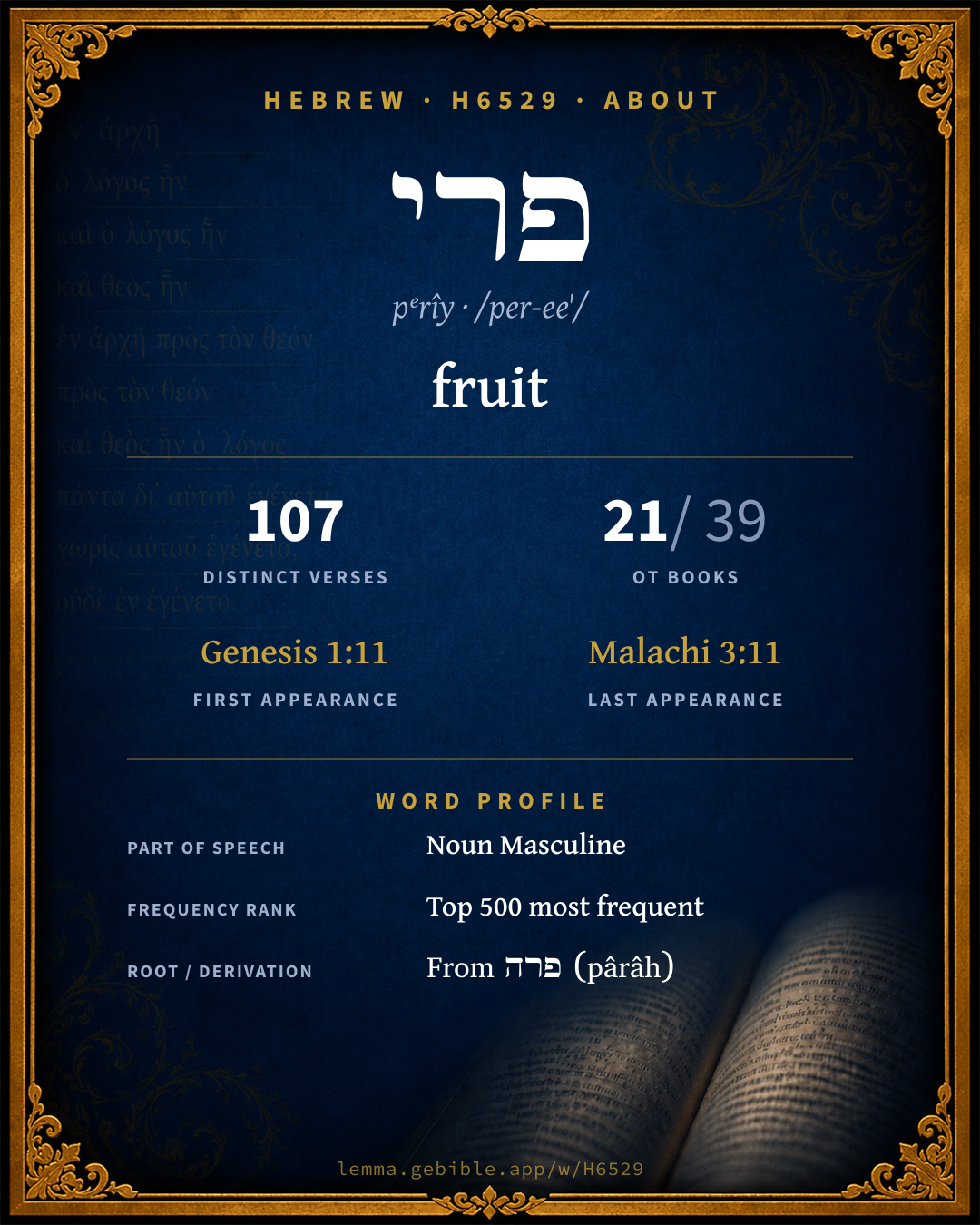
פְּרִי
fruit
‘fruit’ is one of 4 main senses fuller range ↓
Full lexicon entry — Brown-Driver-Briggs (BDB)
From Brown-Driver-Briggs (BDB)
Where this word appears
See every Absolute-state word in the Hebrew Bible →
Grammar key — what these labels mean
Part of speech
- Noun
- A naming word — a person, place, thing, or idea.
Noun type
- Common
- A common noun — a general class of person, place, or thing (“king,” “city,” “water”), not a specific name.
State
- Construct
- A noun bound to a following noun in a possessive / “of” relationship (the construct chain).
- Absolute
- The independent form of a noun, not bound to a following word.
Gender
- Masculine
- Grammatically masculine.
Number
- Singular
- One.
1 verse where H6529 appears in the Construct state in the Book of 2 Kings. Filtered view — show all forms. Click any verse to open its interlinear word-by-word view. Verse text shown in the World English Bible for context — . Each verse’s Hebrew form is shown with its reference; the English is not keyword-highlighted, since the data carries no word-level English alignment. Use “Compare translations” on any verse to read it across multiple English versions. This concordance covers the Hebrew Bible; Septuagint (Greek Old Testament) occurrences are not indexed here.
2 Kings
About this entry
At a glance — auto-summarized from this page’s data, not written by a person. Every figure links to its source below. This summary describes the numbers; it doesn’t interpret them.
At its core, פרי (pᵉrîy) means “fruit.” Carrying more than one sense, it rewards its full sense range. It turns up in 107 verses across 21 books, a common footprint. Scripture first uses it in Genesis 1:11. It shares a root with פרה and אפרת. Dig into 107-verse concordance and the renderings breakdown below.
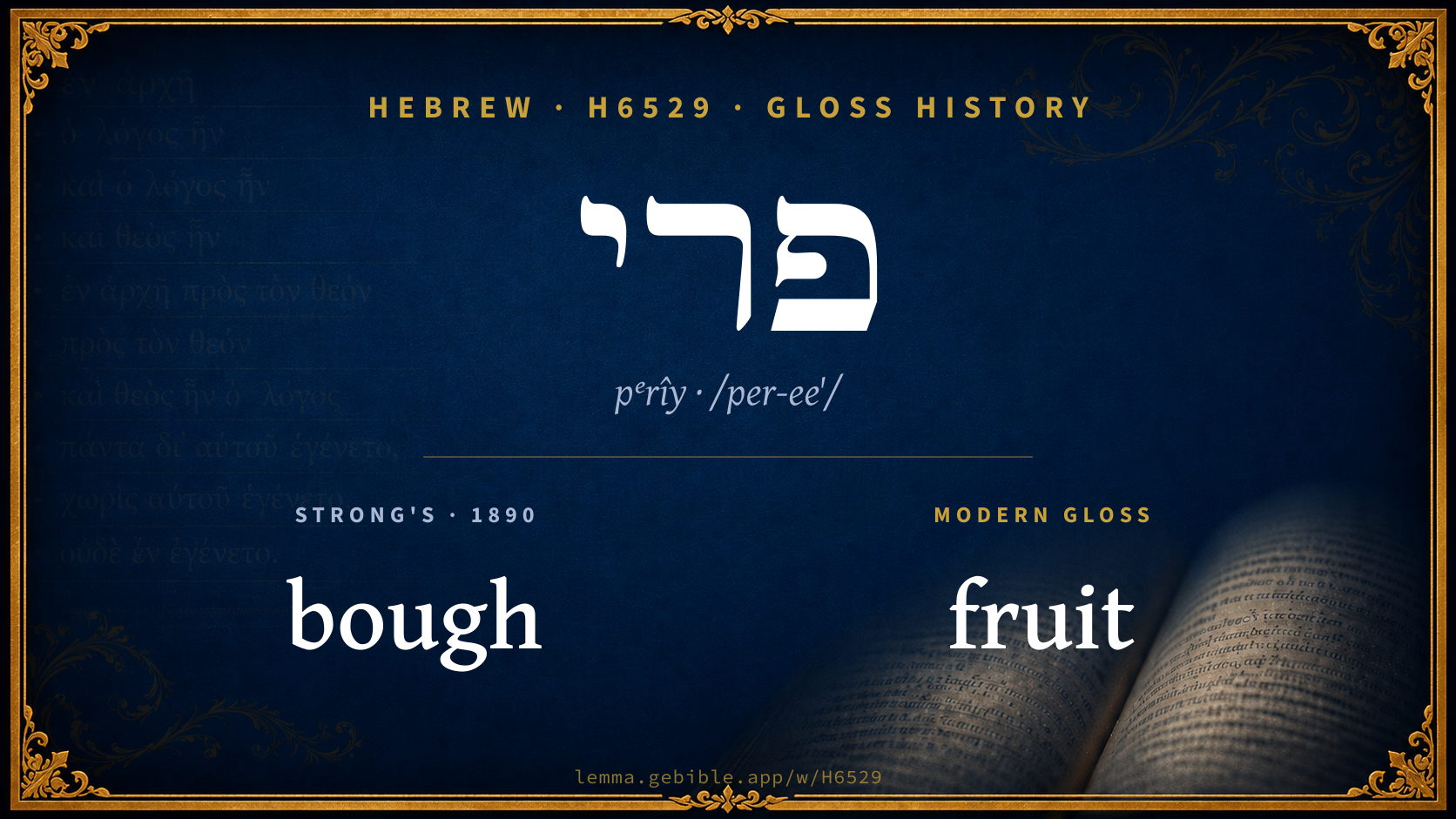
Gloss history
Strong's 1890 vs modern scholarship
About this word
Strong's H6529 catalogs a Hebrew word from the Hebrew Old Testament.
These counts are not copied from any lexicon or concordance. They are computed here, from the morphology-tagged Hebrew Old Testament. What Lemma adds →
- 107
- distinct verses
- The word appears in 107 distinct verses.
- 21 / 39
- OT books
- The word appears in 21 of 39 Old Testament books.
- #363
- by frequency
- Top 500 most frequent Hebrew words (rank 363 of 8,640 Hebrew words by occurrence).
View all 107 occurrences in the concordance →
Most concentrated in
- Deuteronomy 12 verses 11%
- Psalms 11 verses 10%
- Jeremiah 11 verses 10%
By section of the Old Testament
By traditional corpus
Conventional, traditional groupings — biblical authorship is debated, so this is a traditional corpus grouping, not an authorship claim. Each share is this word’s portion of its verses in that division of the Hebrew canon. Each figure is a share of the word’s 107 distinct verses.
- Prophets (Nevi'im) 44 verses · 41%
- Torah (Pentateuch) 32 verses · 30%
- Writings (Ketuvim) 31 verses · 29%
How translations render this word
Counts come from each version’s own published word-to-Strong’s tagging or interlinear alignment — an approximate guide to how each version renders this word, not a word-level alignment the data otherwise carries. Because each total is that version’s own tagged count, the per-version totals vary from one another and need not match the appearance or distinct-verse counts above. These counts may also differ from a printed concordance because Lemma counts each distinctly tagged rendering and does not collapse phrase taggings into a single head-word total. This is a fixed set of word-tagged versions (KJV, ASV, BSB, ULT) and does not change with the reading translation you choose elsewhere. Each version’s license is shown beside its name below (and on Sources).
- King James Version: Fruit 89×, Fruits 6×, All the fruit 3×
- American Standard Version: Fruit 76×, Fruit of them 4×, Fruit thereof 4×
- Berean Standard Bible: Fruit 74×, Produce 11×, Offspring 5×
- unfoldingWord Literal Text: Fruit 53×, Fruit of 48×, According to the fruit of 2×
King James Version Public Domain
Renders H6529 across 119 tagged occurrences — most commonly:
Plus 13 renderings that appear only once — usually multi-word phrases or single function words the recovered tagging swept in, not distinct renderings.
American Standard Version Public Domain
Renders H6529 across 118 tagged occurrences — most commonly:
Plus 20 renderings that appear only once — usually multi-word phrases or single function words the recovered tagging swept in, not distinct renderings.
Berean Standard Bible Public Domain
Renders H6529 across 119 tagged occurrences — most commonly:
Plus 16 renderings that appear only once — usually multi-word phrases or single function words the recovered tagging swept in, not distinct renderings.
unfoldingWord Literal Text CC BY-SA 4.0
Renders H6529 across 121 tagged occurrences — most commonly:
Plus 14 renderings that appear only once — usually multi-word phrases or single function words the recovered tagging swept in, not distinct renderings.
Senses in the full BDB
What do BDB’s symbols mean?
BDB uses these scholarly abbreviations:
| Symbol | Meaning |
|---|---|
| 𝔊 | the Septuagint (the ancient Greek translation, LXX) |
| 𝔙 | the Vulgate (the Latin translation) |
| 𝔖 | the Syriac version (the Peshitta) |
| 𝔗 | the Targum (the Aramaic translation) |
| ψ | the Psalms |
| √ | root (the underlying root or stem) |
| ‖ | parallel passage (a synonymous or contrasted parallel) |
| † | the dagger: every passage where the word occurs is cited |
The 3 senses and sub-senses the full Brown-Driver-Briggs lexicon distinguishes for this word, in lexicon order (not ranked by frequency), with BDB’s own verbatim wording and sub-sense lettering. Shown in Hebrew script with BDB’s own scholarly abbreviations. The condensed entry is in the Lexicon Entry tab. See also the Forms in the corpus table below.
- 1. פְּרִי הָאֲדָמָה Gn 4:3 (J), fruit of the ground, of produce in gen., so Dt 7:13 + 9 times Dt + 3 times; פ׳ הָאֶרֶץ Nu 13:20, 26, 27 (JE) + 5 times, cf. Ez 25:4; fruit of vineyard 2 K 19:29 = Is 37:30, Zc 8:12 Is 65:21 Ct 8:11, 12, in fig. Ho 10:1(×2) + 5 times +Ez 17:14 (but del. 𝔊 Co al.); especially פ׳ הָעֵץ Gn 3:2, 3, 6 Ex 10:15 (all J) + 21 times, also, in fig., Am 2:9 Ho 9:16 + 4 times + Ez 17:23 (read פֹּארָה branches Co al.); of gardens Am 9:14; Je 29:5, 28, fig. Ct 4:12, 16; עֵץ פְּרִי is fruit-tree Gn 1:11 ψ 148:9, cf. Ec 2:5; אֶרֶץ פְּרִי ψ 107:34; פְּרִי תְּבוּאָה v 37 fruit of (consisting in) a crop; ψ 72:16 is dub.; Che Du interpr. as 2; Bae proposes יִפְרוּ. e.g. Genesis 4:3
- 2. = off-spring: fruit of womb (בֶּטֶן) Gn 30:2; Dt 7:13 + 9 times, cf. La 2:20 ψ 21:11; of cattle (בְּהֵמָה) Dt 28:4, 11, 51; 30:9; of serpent, fig. of power conquering Philistia Is 14:29. e.g. Genesis 30:2
- 3. fig. of fruit of actions, i.e. their consequences: good Is 3:10 ψ 58:12; bad Ho 10:13 Pr 1:31 Mi 7:13, of thoughts Je 6:19; of result of removing sin Is 27:9; result of labour (fruit of hands) Pr 31:16, 31; product of works of י׳ ψ 104:13, of wisdom Pr 8:19; פ׳ צְדָקָה Am 6:12, cf. פ׳ צְדִּיק Pr 11:30 (read צֶדֶק 𝔊 Hi Toy); of doings (i.e. course of life, or character) Je 17:10; 21:14; 32:19; פ׳ פִי־אִישׁ i.e. speech Pr 12:14; 13:2; 18:20; fruit of arrogance Is 10:12 is arrogant speech; fruit of tongue Pr 18:21 = consequences of speech. e.g. Isaiah 3:10
Senses from the full Brown-Driver-Briggs lexicon (Brown, Driver, Briggs; Oxford 1906 — public domain), digitized via Sefaria, supplemented by the OpenScriptures HebrewLexicon (CC BY 4.0). Full attribution on Sources.
Word origin
n.m. Ho 14:9 fruit;—abs. פ׳ Ho 9:16 +, פֶּ֑רִי Je 12:12 +; especially cstr. פְּרִי Gn 4:3 +; sf. פִּרְיִי Pr. 8:19, פֶּרְיְךָ Ho 14:9, פִּרְיוֹ Gn 3:6 +, וּפֶרְיְכֶם Ez 36:8, פְּרִיהֶם Am 9:14, פִּרְיָם La 2:20 +, פִּרְיָמוֹ ψ 21:11, פְּרִיהֶן Je 29:28, פִּרְיָן v 5, etc.;—
— Brown-Driver-Briggs (Oxford 1906, public domain), digitized via Sefaria, supplemented by the OpenScriptures HebrewLexicon (CC BY 4.0). See Sources.
Derived from פרה (pârâh) (H6509) — to bear fruit.
Jastrow Dictionary
A second Hebrew/Aramaic lexicon for comparison, covering Aramaic and post-biblical (Talmudic, Targumic, Midrashic) usage that the biblical-Hebrew BDB does not. Matched by lemma rather than by Strong’s number, so a lemma may carry more than one Jastrow headword (shown separately below), and the entries cover usage well beyond the Bible.
פרי
- [to break through,] to grow, increase, be fruitful. Gitt. 57ᵃ כלומר פְּרוּ ורבו וכ׳ intimating, ‘multiply and increase like chickens’. Num. R. s. 11 את פְּרֵה ורבה לגוי גדול be thou fruitful and grow to be a great nation. Ib. כל מה … היה פָּרֶה ורבה whatever existed in the Temple grew and increased (v. פַּרְוַיִם). Ḥag. 16ᵃ פָּרִין ורבין כבני אדם they increase by propagation like human beings. Ḥull. 92ᵃ (ref. to כפרחת, Gen. XL, 10) הגיע לִפְרוֹת ולרבות … the time has come for Israel to grow and increase (as a nation); a. fr. e.g. Genesis 40:10
- 1. to cause to grow, make fruitful. Ber. 40ᵃ דגים קטנים מַפְרִין ומרבין ומברין כל גופו וכ׳ (Ms. M. מפרין ומרבין גופו וכ׳) small fish make fruitful (increase the sexual vigor) and strengthen the whole body of man; ib. 57ᵇ מפרין ומברין (Ms. M. מפרין ומרבין); Ab. Zar. 29ᵃ מפרין ומרבין (read: ומַבְרִין); a. e.—[
- 2. to increase the rent above the original stipulation in consideration of a loan, v. פָּרַז. B. Mets. V, 5 (69ᵇ) מפרין על שדהו ואין חוששין וכ׳ Ar. (Y. ed. ואין חושש—which indicates that מפרין is singular, fr. פָּרַן q. v.).]
פְּרֵי
- 1. to increase, grow. B. Bath. 18ᵇ הדר פָּארֵי it will grow again; ib. 19ᵃ top.
- 2. (cmp. פרח) to run. Lam. R. to III, 7 ערקת תורתיה ופרא בתרה Ar. (ed. נפק) his cow ran off, and he ran after her. Y. Sabb. VI, 8ᶜ bot. חויא פָרֵי בתרך a serpent is running after thee. Y. Maas. Sh. V, 56ᵃ top הוות פַּרְיָא והוה פרי וכ׳ she (the cow) ran, and he ran after her &c.; a. fr.
פְּרִי
- preced. wds.) fruit, produce; fruition, usufruct; profit, interest. Ber. VI, 1 (35ᵃ) על פירות … בורא פְּ׳ העץ over fruits of trees you must say, (blessed be thou &c.) who hast created the fruit of the tree; על פירות הארץ … בורא פ׳ האדמה over growths from the ground you must say; … who hast created the products of the soil. Y. Sabb. VII, 10ᵃ הפירי, v. בָּחַל II. Ḥull. 79ᵃ פ׳ עם האם the copulation of a hybrid issue with its mother; a. v. fr.—Pl. פִּרוֹת, פֵּי׳. Ber. l. c., v. supra. Gitt. 47ᵇ, a. e. המוכר שדהו לפ׳ if a man sells his field for the usufruct (for a number of years). Ib. קנין פ׳ כקנין הגיף דמי possession of the usufruct is like ownership of a field (for the time being). Keth. IX, 1 הרי זה אוכל פ׳ בחייה he has the usufruct (of her property) during her lifetime. Ib. פֵּירֵי פ׳ (פֵּרֵי) the usufruct of the produce of the produce, i.e. of the income invested. Peah I, 1 אלו דברים שאדם אוכל פּירוֹתֵיהֶן וכ׳ these are the things of which a man enjoys the interest (for which man is rewarded) in this world, whereas the principal remains for the hereafter. Tosef. ib. I, 2 זכות יש לה קרן ויש לה פ׳ a good deed yields a principal (for the hereafter), and bears interest (in this world); ib. 3 עבירה יש לה קרן ואין לה פ׳ sin creates a capital, but bears no interest; עבירה שעושה פ׳ יש לה פ׳ a sin which bears fruit (influences other people for bad) bears fruit (is punished in this world); Kidd. 40ᵃ; a. v. fr.—Midr. Sam. ch. IV פְּרָיִין שלו its fruits.
A Dictionary of the Targumim, the Talmud Babli and Yerushalmi, and the Midrashic Literature (Marcus Jastrow; London, Luzac, 1903) — Public Domain. Digitized via Sefaria. Digitized via Sefaria. Full attribution on Sources.
Forms in the corpus
The 69 distinct written forms H6529 takes in the Hebrew Bible, most frequent first — each parse links to that state’s occurrences in the concordance. Hebrew forms include their vowel points and cantillation, so a single lemma takes many written forms.
The 60 most common forms are shown; 9 rarer forms follow in the full concordance.
Same root — word family
Other BDB entries built from the same root as H6529, grouped by Strong’s listed origin. These share a root / origin per the lexicon — not necessarily a shared meaning. Each links to that word’s own entry.
Derives from
Proper names from this root
People and places named from this root — a name, not an additional meaning of the word.
Compare all same-root words → 1 of the same-root words is a proper name (a person or place). They share a root, not necessarily a meaning.
Septuagint verse parallels
This word appears in 100 verses that also exist in the Greek Old Testament (Septuagint), out of the 107 Hebrew verses it occurs in. You can read those verses in Greek by switching the Old Testament edition to the Septuagint.
Read these verses in the Septuagint
- Genesis 1:11
- Exodus 10:15
- Leviticus 19:23
- Numbers 13:20
- Deuteronomy 1:25
- 2 Kings 19:29
- Psalms 1:3
- Proverbs 1:31
- Ecclesiastes 2:5
- Song of Solomon 2:3
- Isaiah 3:10
- Jeremiah 2:7
This is a verse-level parallel only — the same verses exist in both the Hebrew and Greek Old Testaments. No word-level Hebrew↔Greek correspondence is claimed: the data carries no such alignment, so no Greek word is shown as this Hebrew word’s translation. Coverage is not total — the Septuagint omits the deuterocanon and renumbers the Psalms, so some Hebrew verses have no direct Greek parallel.