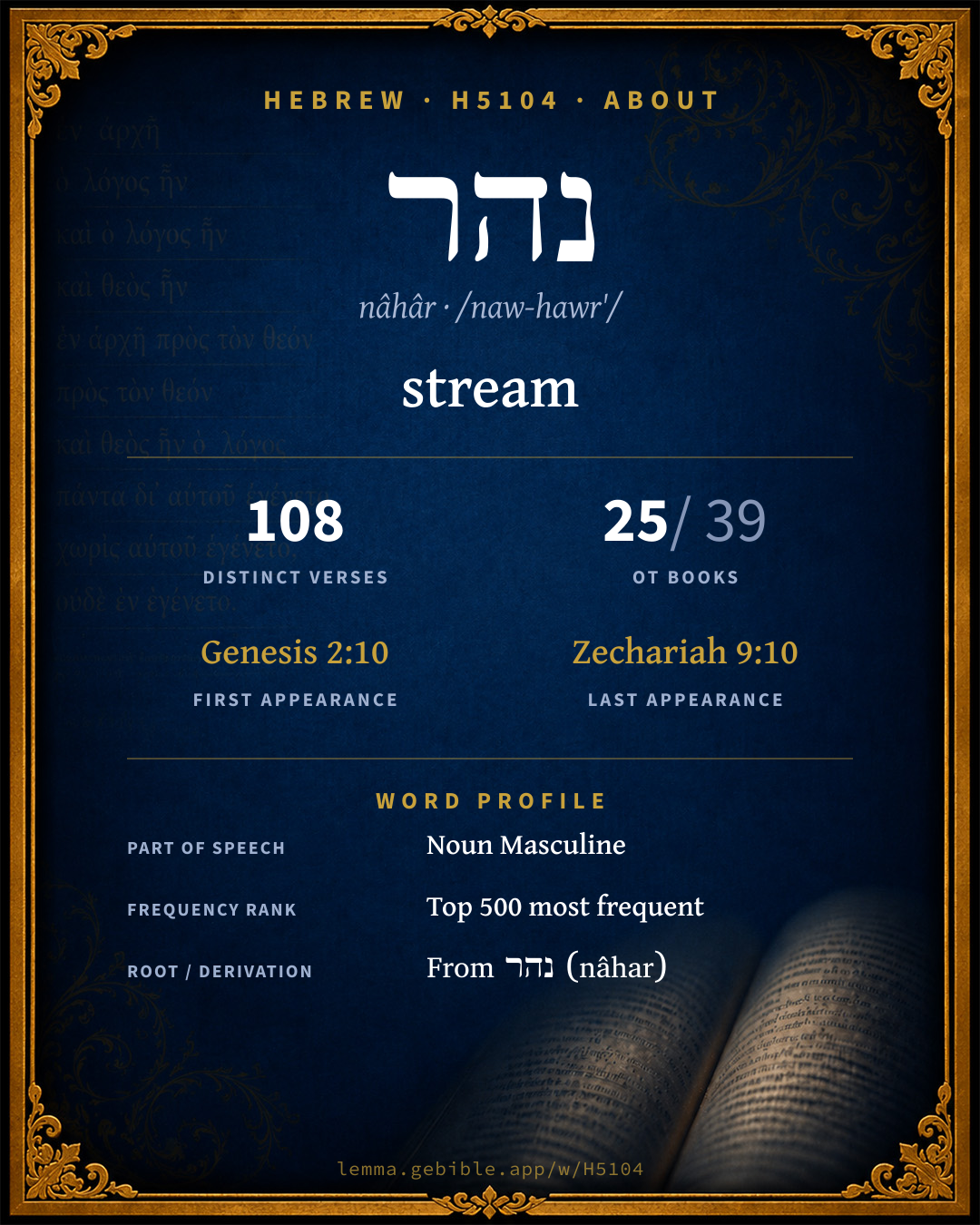
נָהָר
stream
‘stream’ is one of 2 main senses fuller range ↓
Full lexicon entry — Brown-Driver-Briggs (BDB)
From Brown-Driver-Briggs (BDB)
Where this word appears
Grammar key — what these labels mean
Part of speech
- Noun
- A naming word — a person, place, thing, or idea.
Noun type
- Common
- A common noun — a general class of person, place, or thing (“king,” “city,” “water”), not a specific name.
State
- Absolute
- The independent form of a noun, not bound to a following word.
- Construct
- A noun bound to a following noun in a possessive / “of” relationship (the construct chain).
Gender
- Masculine
- Grammatically masculine.
Number
- Singular
- One.
- Plural
- More than one (in Hebrew, generally three or more).
Every verse where H5104 appears in the Book of 2 Chronicles — 1 distinct verse. Click any verse to open its interlinear word-by-word view. Verse text shown in the World English Bible for context — . Each verse’s Hebrew form is shown with its reference; the English is not keyword-highlighted, since the data carries no word-level English alignment. Use “Compare translations” on any verse to read it across multiple English versions. This concordance covers the Hebrew Bible; Septuagint (Greek Old Testament) occurrences are not indexed here.
2 Chronicles
About this entry
At a glance — auto-summarized from this page’s data, not written by a person. Every figure links to its source below. This summary describes the numbers; it doesn’t interpret them.
The Hebrew noun נהר centers on the idea of “stream.” Its earliest occurrence is Genesis 2:10. It turns up in 108 verses across 25 books, a common footprint. The lexicon spreads it across several senses; see its full sense range. It shares a root with נהר, מנהרה and נהר. For the data behind this summary, explore the sense tree and the renderings breakdown below.
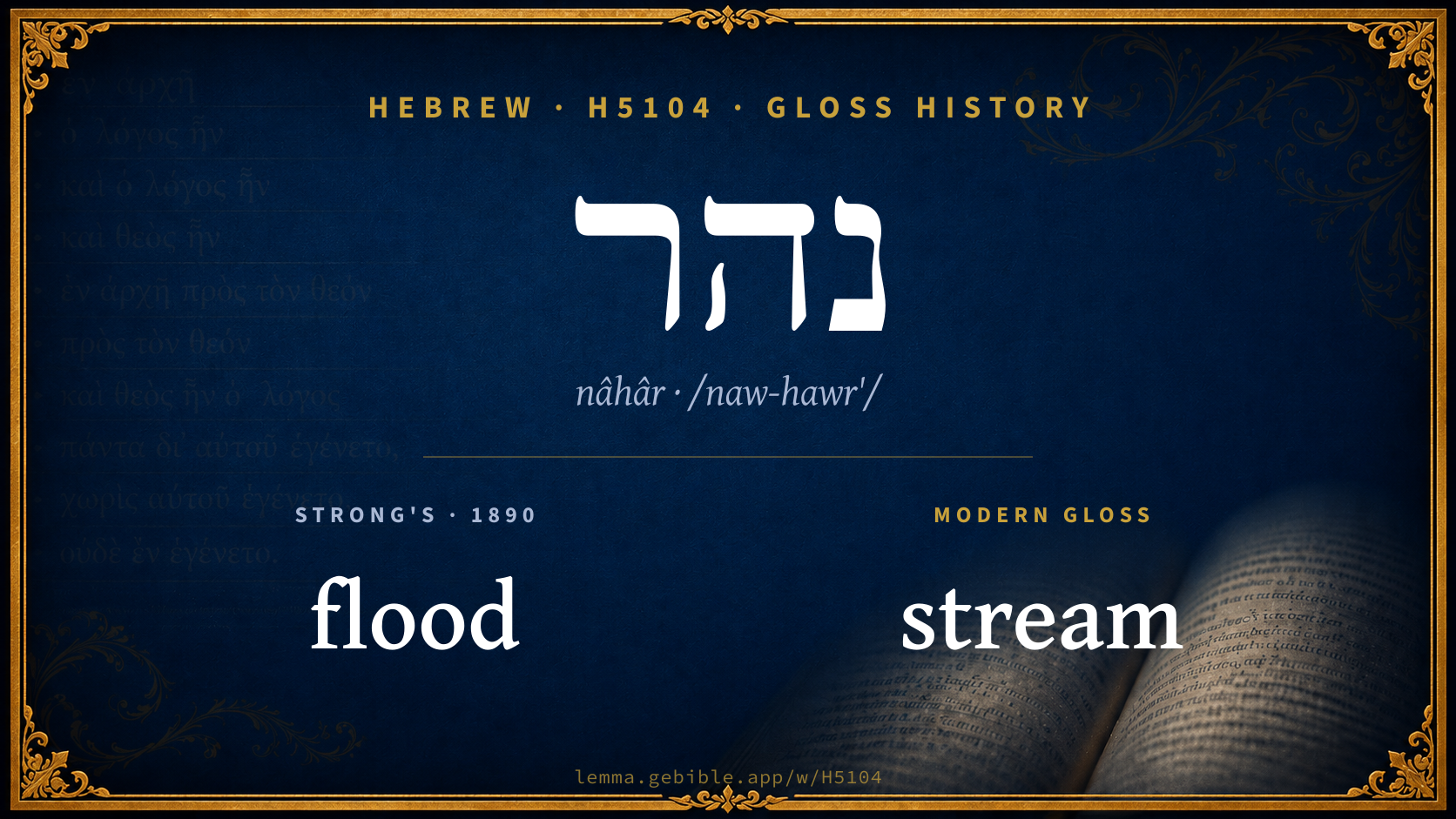
Gloss history
Strong's 1890 vs modern scholarship
About this word
Strong's H5104 catalogs a Hebrew word from the Hebrew Old Testament.
These counts are not copied from any lexicon or concordance. They are computed here, from the morphology-tagged Hebrew Old Testament. What Lemma adds →
- 108
- distinct verses
- The word appears in 108 distinct verses.
- 25 / 39
- OT books
- The word appears in 25 of 39 Old Testament books.
- #363
- by frequency
- Top 500 most frequent Hebrew words (rank 363 of 8,640 Hebrew words by occurrence).
View all 108 occurrences in the concordance →
By section of the Old Testament
By traditional corpus
Conventional, traditional groupings — biblical authorship is debated, so this is a traditional corpus grouping, not an authorship claim. Each share is this word’s portion of its verses in that division of the Hebrew canon. Each figure is a share of the word’s 108 distinct verses.
- Prophets (Nevi'im) 62 verses · 57%
- Writings (Ketuvim) 33 verses · 31%
- Torah (Pentateuch) 13 verses · 12%
How translations render this word
Counts come from each version’s own published word-to-Strong’s tagging or interlinear alignment — an approximate guide to how each version renders this word, not a word-level alignment the data otherwise carries. Because each total is that version’s own tagged count, the per-version totals vary from one another and need not match the appearance or distinct-verse counts above. These counts may also differ from a printed concordance because Lemma counts each distinctly tagged rendering and does not collapse phrase taggings into a single head-word total. This is a fixed set of word-tagged versions (KJV, ASV, BSB, ULT) and does not change with the reading translation you choose elsewhere. Each version’s license is shown beside its name below (and on Sources).
- King James Version: River 60×, Rivers 24×, Floods 8×
- American Standard Version: River 63×, Rivers 24×, Floods 4×
- Berean Standard Bible: River 32×, Euphrates 24×, Rivers 24×
- unfoldingWord Literal Text: River 53×, Rivers 19×, The 15×
King James Version Public Domain
Renders H5104 across 119 tagged occurrences — most commonly:
Plus 17 renderings that appear only once — usually multi-word phrases or single function words the recovered tagging swept in, not distinct renderings. Not rendered by a distinct English word in 1 further occurrence.
American Standard Version Public Domain
Renders H5104 across 118 tagged occurrences — most commonly:
Plus 23 renderings that appear only once — usually multi-word phrases or single function words the recovered tagging swept in, not distinct renderings.
Berean Standard Bible Public Domain
Renders H5104 across 114 tagged occurrences — most commonly:
Plus 14 renderings that appear only once — usually multi-word phrases or single function words the recovered tagging swept in, not distinct renderings. Not rendered by a distinct English word in 5 further occurrences.
unfoldingWord Literal Text CC BY-SA 4.0
Renders H5104 across 132 tagged occurrences — most commonly:
Plus 16 renderings that appear only once — usually multi-word phrases or single function words the recovered tagging swept in, not distinct renderings.
Senses in the full BDB
What do BDB’s symbols mean?
BDB uses these scholarly abbreviations:
| Symbol | Meaning |
|---|---|
| 𝔊 | the Septuagint (the ancient Greek translation, LXX) |
| 𝔙 | the Vulgate (the Latin translation) |
| 𝔖 | the Syriac version (the Peshitta) |
| 𝔗 | the Targum (the Aramaic translation) |
| ψ | the Psalms |
| √ | root (the underlying root or stem) |
| ‖ | parallel passage (a synonymous or contrasted parallel) |
| † | the dagger: every passage where the word occurs is cited |
The 3 senses and sub-senses the full Brown-Driver-Briggs lexicon distinguishes for this word, in lexicon order (not ranked by frequency), with BDB’s own verbatim wording and sub-sense lettering. Shown in Hebrew script with BDB’s own scholarly abbreviations. The condensed entry is in the Lexicon Entry tab. See also the Forms in the corpus table below.
- 1. stream, river, Nu 24:6 (JE), Jb 14:11; 40:23 ψ 105:41 (in sim.), Is 48:18 (id.), 59:19 (id.) + often; freq. of partic. rivers; r. of Eden Gn 2:10 and its branches v 13, 14 (all J); נְהַר מִצְרַיִם 15:18 (J; i.e., si vera l., the Nile) but read prob. נַחַל מ׳, whence נהר through infl. of foll. נהר—cf. 2 K 24:7—NöZMG xl. 1886, 699 (alternat.), LagBN 140 BallHpt; נָהָר of Nile Is 19:5; especially of Euphrates נְהַר פְּרָת Gn 15:18; Dt 1:7 (both + הַנּ׳ הַגָּדוֹל) Jos 1:4 + 8 times + 2 S 8:3 (Qr 𝔊 and ‖ 1 Ch 18:3; Kt om. פְּרָת;—cf. also Gn 2:14b supr.); oftener (of Euphr.) without פ׳: הַנָּהָר κατʼ ἐξοχήν, Gn 31:21 Ex 23:31 Nu 22:5; Jos 24:2, 3, 14, 15 (all E), poss. also Gn 36:37 (P; cf. Di) = 1 Ch 1:48, + 13 times + 2 S 8:3 Kt (v. supr.); and even without art. (poet.) † Is 7:20; Je 2:18 Mi 7:12; Zc 9:10; ψ 72:8; הַנּ׳ הַגּ׳ once of Tigris †Dn 10:4; †נְהַר גוֹזָן (חבור) 2 K 17:6; 18:11 cf. 1 Ch 5:26; pl. נַהֲרֵי כוּשׁ Zp 3:10; perhaps of a canal: נְהַר־כְּבָר Ez 1:1, 3 + 6 times Ez; הַנָּהָר אַהֲוָא Ezr 8:21, נְהַר א׳ v 31; cf. נַהֲרוֹת בָּבֶל ψ 137:1; canals poss. also in שַׁעֲרֵי הַנּ׳ Na 2:7 (of Nineveh); of canals of Egypt Ex 7:19 (‖ יְאֹרִים etc.), 8:1 (‖ id.). e.g. Numbers 24:6
- 2. נְהָרוֹת (מִבְּכִי) Jb 28:11 usually understood of (underground) streams; SzoldComm. Jb GrMonatsschr. 1887, 410 and PerlesAnalekten. 69 proposes נִבְכֵי נ׳ sources of rivers (cf. 36:16); Wetzst Hoffm Bu מַבְּכֵי נ׳ (not elsewhere) with similar meaning. e.g. Job 28:11
- 3. fig. of י׳s favour ψ 46:5.—On נַהֲרַיִם ending appar. du., v. אֲרַם; Tel Am. Na-ri-ma, Naḫrima (WklTelAm.40), and Egyptian Nhrina (WMMAs. u. Eur. 249 ff.) point however to orig. ending ִים; this inconsistent with view of EMeyGesch. § 180 that ַיִם here a locative ending (cf. Ba§ c. Anm. 1 BuhlGes 12), v. also Di Gn 24:10. e.g. Psalms 46:5
Senses from the full Brown-Driver-Briggs lexicon (Brown, Driver, Briggs; Oxford 1906 — public domain), digitized via Sefaria, supplemented by the OpenScriptures HebrewLexicon (CC BY 4.0). Full attribution on Sources.
Word origin
n.m. Gn 2:10 stream, river;—abs. נ׳ Gn 2:10 +; cstr. נְהַר Dt 1:7 +; pl. נְהָרִים Is 18:7 + 4 times, cstr. נַהֲרֵי Is 18:1 + 2 times; but oftener נְהָר(וֹ)ת Is 19:6 + 23 times; cstr. נַהֲרוֹת 2 K 5:12 + 2 times; sf. נַהֲרוֹתֶיךָ Ez 32:2, נַהֲרֹתַיִךְ Is 44:27, נַהֲרֹתֶיהָ Ez 31:4, 15, נַהֲרֹתָם Ex 7:19, נַהֲרוֹתָם Ez 32:2, 14; appar. du. נַהֲרַיִם Gn 24:10 + 2 times, נַהֲרָ֑יִם Ju 3:8 (v. infr.) (all in אֲרַם נ׳);—
— Brown-Driver-Briggs (Oxford 1906, public domain), digitized via Sefaria, supplemented by the OpenScriptures HebrewLexicon (CC BY 4.0). See Sources.
Derived from נהר (nâhar) (H5102) — to shine.
Jastrow Dictionary
A second Hebrew/Aramaic lexicon for comparison, covering Aramaic and post-biblical (Talmudic, Targumic, Midrashic) usage that the biblical-Hebrew BDB does not. Matched by lemma rather than by Strong’s number, so a lemma may carry more than one Jastrow headword (shown separately below), and the entries cover usage well beyond the Bible.
נָהַר
- v. נוּר) to break forth, shine (v. אוֹר I).
- to enlighten. Erub. 13ᵇ; Sabb. 147ᵇ שמַנְהִיר וכ׳, he enlightened the eyes &c., v. נְהוֹרַאי.
נְהַר I
- , to shine. Targ. O. Gen. XLIV, 3 (Y. נְהִיר). Targ. Job XVIII, 5; a. fr.—Taan. 10ᵃ נְהוּר ענני וכ׳ when the clouds are bright, their waters are little. Pesik. Ekha, p. 123ᵃ יִנְהוֹר דינא וכ׳ let justice shine before thee like this lamp; Yalk. Is. 258 יִנְהַר דיני וכ׳ let my case shine &c.; Sabb. 116ᵇ נְהוֹר נהורך וכ׳ let thy light (wisdom) shine (prob. to be read: ינהור); a. fr.—Part. pass. נְהִיר; f. נְהִירָא; pl. נְהִירִין; נְהִירָן a) bright, clear. Lev. R. s. 19 אולפני מה נ׳ באפי how my learning shines on my face (makes me look well); Yalk. Prov. 964 נרי באפוי (corr. acc.). Y. Sabb. VIII, beg. 11ᵃ (נהירן) אפוי נהירין his looks were bright.—Ber. 58ᵇ נ׳ לי שבילי וכ׳ the paths of the heavens (the courses of the heavenly bodies) are as clear (well-known) to me as the streets &c.; a. fr.—b) knowing clearly, remembering. Y. Taan. I, 64ᵃ bot. נ׳ את כד הוינן וכ׳ dost thou remember when we were standing &c.?; Y. Meg. III, 74ᵇ bot. Y. Keth. V, 30ᵃ top נ׳ דהויתון וכ׳ (insert את) dost thou remember that thou &c.? Y. Orl. II, 62ᶜ top [read:] נ׳ את דאמריתון את וכ׳ dost thou remember that you, thyself and R. J., said &c. Y. Naz. V, end, 54ᵇ נ׳ הוינין וכ׳ we remember that an old man was here &c.; Y. Ber. VIII, 11ᵇ bot. נ׳ אנן; Gen. R. s. 91 נהרין אנן (corr. acc.); Koh. R. to VII, 11. Ḥull. 54ᵃ ולא נְהִירַת ליה וכ׳ dost thou not remember (recognize) that student &c.? Ib. 93ᵃ נְהִירְנָא I remember. B. Bath. 91ᵇ; a. fr.—[R. Hash. 34ᵇ כי נהירנא לך, v. נְחַר].
- , Pa. נַהֵר
- 1. to give light, shine; to illumine, brighten, make shine. Targ. O. Gen. I, 15 (Y. למְנַהֲרָא). Targ. Num. VI, 25; a. fr.—Y. Yoma III, beg. 40ᵇ א׳ מְנַהֲרָא, v. בְּרַק I; Y. R. Hash. II, beg. 57ᵈ. Y. Taan. III, 66ᵈ bot. שמענן … והיא מְנַהֲרָה we hear that when he entered the Temple court, it used to shine; עאל ואַנְהָרַת he entered, and it shone. Cant. R. to V, 11 הוה מנהרא לי וכ׳ it (the Law) brightened my countenance by night. Sot. 6ᵃ וא׳ לן עיינין וכ׳ and he enlightened our eyes (by evidence) from our Mishnah; a. fr.
- 2. to recall to memory, remember. Y. Peah III, 17ᵈ bot. וא׳ ר׳ אימי וכ׳ whereupon R. I. recalled (that he had heard the same tradition), and rescinded his decision. Y. Kidd. I, 61ᵃ bot. א׳ ונפיק וכ׳ it struck him (that he had forgotten to hear his grandson’s lesson), and he left the bath house &c.; a. e.—Part. pass. מְנַהַר; pl. מְנַהֲרִין. Gen. R. s. 33 אתון … מְנַהֲרִין אנא מְנַהַר ליה you do not remember that poor man, I will remember him.
- 1. to be brightened, enlightened. Targ. Y. Gen. III, 7. Targ. Ps. XXXIV, 6.
- 2. to come forth. Cant. R. to IV, 1 טורא דאִתְנַהַרְתּוּן וכ׳, v. גָּלַשׁ.
נָהָר
- v. נָהַר) river, stream, canal. Ex. R. s. 15 נְהַר אש, נ׳ של אש a river of fire (v. דִּינוּר). Gen. R. s. 16 עד מקום שהנ׳ מהלך וכ׳ as far as the river (Euphrates) goes, goes the border of the land of Israel. Shebi. VI, 1 מכזיב ועד הנ׳ from Kezib to the river (N’har Mitsrayim); a. fr.—Pl. נְהָרִים, נְהָרוֹת. Gen. R. l. c. (ref. to Gen. II, 10) והיה לארבעה נ׳ אין וכ׳ it does not say, ‘and it divided into four rivers’ but ‘into four heads’. Ib. אוותנטין של נ׳, v. אֶוְותַּנְטִי. Bekh. 55ᵃ כל הנ׳ למטה וכ׳ all other rivers are lower than the three (mentioned Gen. II, 11, sq.), and these three are lower than the Euphrates; a. fr.—נְהַר in pr. n. of rivers, e. g. נ׳ פקוד, v. respective determinants. e.g. Genesis 2:10
נְהַר II
- Targ. Jon. II, 4. Targ. Gen. II, 10; a. fr.—Gen. R. s. 16 אעברת נ׳ בְּנֵה build (me a house) on the (western) banks of the river. Gitt. 60ᵇ קא מתקיל לנַהֲרִין he spoils our portion of the canal. Ib. נ׳ כפשטיה ליזיל let the canal run its natural course (and those above have no right to dam it before those below have used it for irrigation). Ḥull. 18ᵇ (prov.) נ׳ נ׳ ופשטיה every river has its own course, i.e. each place has its own usages; ib. 57ᵃ; a. fr.—Pl. נַהֲרִין, נַהֲרַיָּא. Targ. Gen. l. c. Targ. Ex. VIII, 1.—Y. Sabb. VII, 9ᵃ top, a. e., v. בְּדִי I; a. fr.—Fem. forms: נַהַרְוָן, נַהַרְוָתָא, נַהַרְוָו׳. Targ. Is. XLIII, 19. Targ. Ps. XXIV, 2; a. e.—Taan. 25ᵃ תליסרי נ׳ וכ׳ thirteen rivers of balsam oil; a. e.—נְהַר in pr. n. of canals or places, e. g. נ׳ אבא N’har Abba, Sabb. 140ᵇ; v. respective determinants (v. Berl. Beitr. Geogr. p. 47).
פַּפָּא II
- N’har Pappa, name of a canal and of a place in Babylonia. B. Mets. 86ᵃ Yoma 77ᵇ (Ms. O. פקוד; Ar. a. Ms. Alf. פרת, v. Rabb. D. S. a. l. note 8).—Denom. f. pl. (נְהַר) פַּפְיָתָא belonging to N. P. Erub. 82ᵇ תרתי ריפתא נ׳ פ׳ (Ms. M. פַּפְיָאתָא; ed. Sonc. ריפתאה פפיתאה, v. Rabb. D. S. a. l. note) two loaves of the size baked in N. P.
A Dictionary of the Targumim, the Talmud Babli and Yerushalmi, and the Midrashic Literature (Marcus Jastrow; London, Luzac, 1903) — Public Domain. Digitized via Sefaria. Digitized via Sefaria. Full attribution on Sources.
Forms in the corpus
The 66 distinct written forms H5104 takes in the Hebrew Bible, most frequent first — each parse links to that state’s occurrences in the concordance. Hebrew forms include their vowel points and cantillation, so a single lemma takes many written forms.
The 60 most common forms are shown; 6 rarer forms follow in the full concordance.
Same root — word family
Other BDB entries built from the same root as H5104, grouped by Strong’s listed origin. These share a root / origin per the lexicon — not necessarily a shared meaning. Each links to that word’s own entry.
Derives from
Shares the same root
Compare all same-root words → Showing 4 of 5 — not the complete family. They share a root, not necessarily a meaning.
Septuagint verse parallels
This word appears in 96 verses that also exist in the Greek Old Testament (Septuagint), out of the 108 Hebrew verses it occurs in. You can read those verses in Greek by switching the Old Testament edition to the Septuagint.
Read these verses in the Septuagint
- Genesis 2:10
- Exodus 7:19
- Numbers 22:5
- Deuteronomy 1:7
- Joshua 1:4
- 2 Samuel 8:3
- 2 Kings 5:12
- 1 Chronicles 5:9
- 2 Chronicles 9:26
- Ezra 8:15
- Job 14:11
- Psalms 24:2
This is a verse-level parallel only — the same verses exist in both the Hebrew and Greek Old Testaments. No word-level Hebrew↔Greek correspondence is claimed: the data carries no such alignment, so no Greek word is shown as this Hebrew word’s translation. Coverage is not total — the Septuagint omits the deuterocanon and renumbers the Psalms, so some Hebrew verses have no direct Greek parallel.