
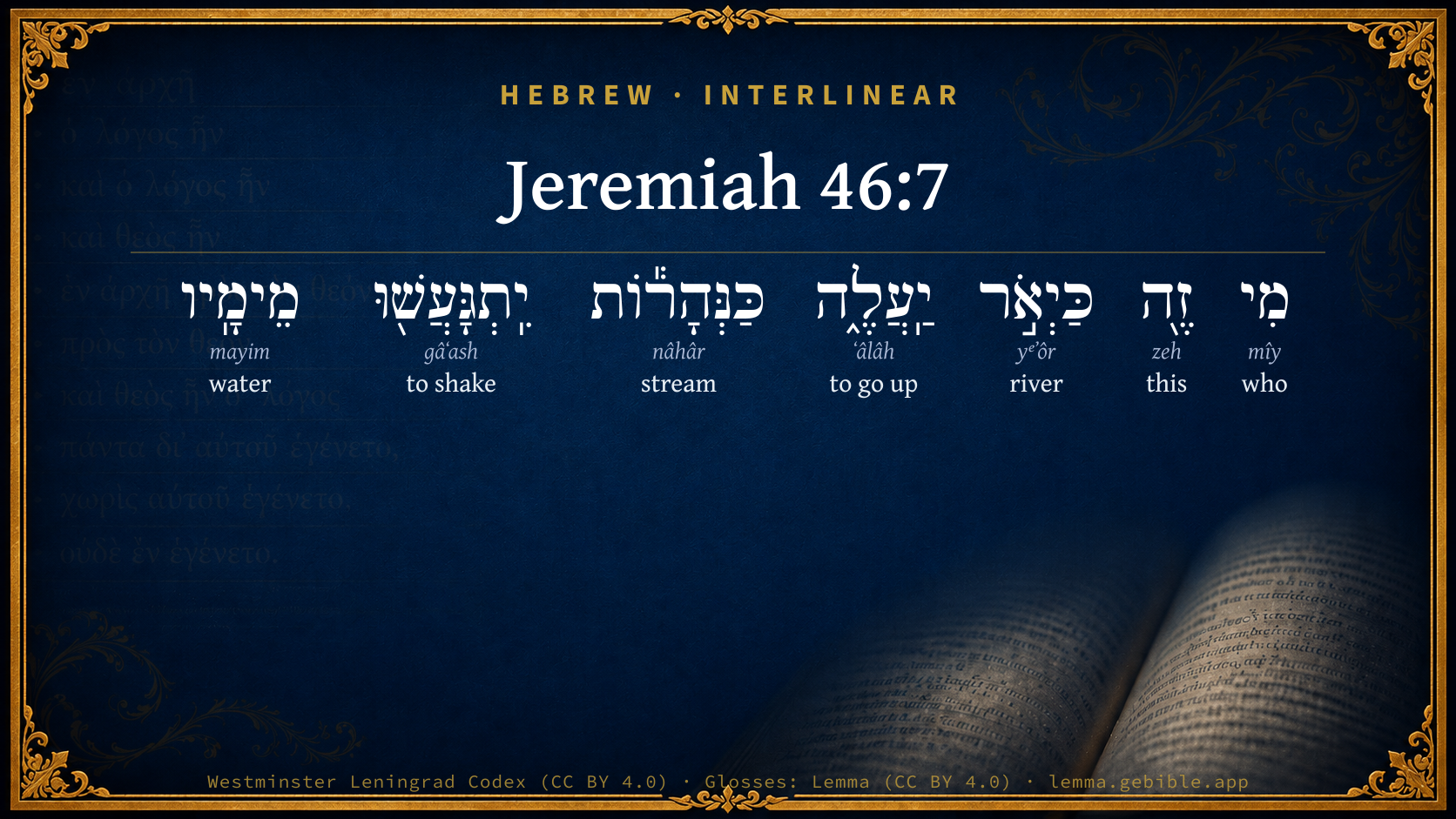
Jeremiah 46:7

Hebrew (Westminster Leningrad Codex) Jeremiah 46:7 appears in the Hebrew Old Testament. The text above is from the Westminster Leningrad Codex. Each word links to its Strong’s number, a concise gloss, and parsing drawn from the Open Scriptures Hebrew Bible morphology. Click any word for its full Brown-Driver-Briggs (BDB) entry.
Download image
Cite this verse

Jeremiah 46:7 (World English Bible). Public Domain. Lemma interlinear Bible study tool, https://lemma.gebible.app/v/jeremiah/46/7.

Show BibTeX & RIS
BibTeX
RIS
English Translation
Who is this who rises up like the Nile, whose waters toss themselves like the rivers?
World English Bible · Public Domain
Download a study sheet

One document with this verse’s original text, its word-by-word gloss line, the meaning frame, cross-references with their text, attributed commentary, and full source and license credits — printable, and it pastes into notes with its structure intact.

This verse Autodidact and up

Study sheet (.html) Plain text (.txt)

A passage Seminary Student

Up to 50 verses in one chapter. A passage sheet keeps up to 6 commentary sources and 12 cross-references per verse, in the order this page ranks them, and says so on the sheet whenever that leaves anything out. Ask for a single verse and you get the Autodidact verse sheet above.

Everything on this page stays free to read, with no account — the sheet is a download of what is already on screen, not access to it.

Want to remove ads? Support Godless Engineer
Compare translations 3

The same verse in 3 English versions, stacked beneath the original-language interlinear above. Click any original word for its lexicon entry.

Each is an independent rendering of the whole verse — the interlinear is not word-aligned to these translations.

Highlighted words mark where these versions differ — a whole-verse word diff, not a word-by-word alignment.

  • World English Bible Public Domain
    Who is this who rises up like the Nile, whose waters toss themselves like the rivers?
  • King James Version Public Domain
    Who is this that cometh up as a flood, whose waters are moved as the rivers?
  • unfoldingWord Literal Text CC BY-SA 4.0
    Who is this who rises like the Nile, whose waters toss up and down like the rivers?

unfoldingWord Literal Text — © unfoldingWord, licensed CC BY-SA 4.0. Word-aligned USFM3 via Door43 (git.door43.org/unfoldingWord/en_ult).

Versions to compare (up to 4)

3 of 4 selected

Show all 18 translations

Every available English version of this verse, each an independent rendering of the whole verse.

  • World English Bible Public Domain
    Who is this who rises up like the Nile, whose waters toss themselves like the rivers?
  • Berean Standard Bible Public Domain
    Who is this, rising like the Nile, like rivers whose waters churn?
  • Majority Standard Bible Public Domain
    Who is this, rising like the Nile, like rivers whose waters churn?
  • King James Version Public Domain
    Who is this that cometh up as a flood, whose waters are moved as the rivers?
  • American Standard Version (1901) Public Domain
    Who is this that riseth up like the Nile, whose waters toss themselves like the rivers?
  • Revised Version (1885) Public Domain
    Who is this that riseth up like the Nile, whose waters toss themselves like the rivers?
  • Geneva Bible (1599) Public Domain
    Who is this, that commeth vp, as a flood, whose waters are mooued like the riuers?
  • Douay-Rheims (1899) Public Domain
    Who is this that cometh up as a flood: and his streams swell like those of rivers?
  • Young's Literal Translation Public Domain
    Who is this? as a flood he cometh up, As rivers do his waters shake themselves!
  • Literal Standard Version CC BY-SA 4.0
    Who is this? He comes up as a flood, || His waters shake themselves as rivers!
  • Unlocked Literal Bible CC BY-SA 4.0
    Who is this who rises like the Nile, whose waters toss up and down like the rivers?
  • unfoldingWord Literal Text CC BY-SA 4.0
    Who is this who rises like the Nile, whose waters toss up and down like the rivers?
  • Darby Bible Public Domain
    Who is this [that] riseth up as the Nile, whose waters toss themselves like the rivers?
  • World Messianic Bible Public Domain
    “Who is this who rises up like the Nile, like rivers whose waters surge?
  • Webster's Bible Public Domain
    Who is this that cometh up as a flood, whose waters are moved as the rivers?
  • Free Bible Version CC BY-SA 4.0
    Who is this that's coming, rising like the Nile, like swirling rivers whose waters flood?
  • Bible in Basic English Public Domain
    Who is this coming up like the Nile, whose waters are lifting their heads like the rivers?
  • JPS Tanakh (1917) Public Domain
    Who is this like the Nile that riseth up, like the rivers whose waters toss themselves?

Literal Standard Version (2020), Covenant Press — licensed CC BY-SA 4.0. Text via the HelloAO Bible API (eBible.org). Unlocked Literal Bible (unfoldingWord) — licensed CC BY-SA 4.0. Text via the HelloAO Bible API (eBible.org). unfoldingWord Literal Text — © unfoldingWord, licensed CC BY-SA 4.0. Word-aligned USFM3 via Door43 (git.door43.org/unfoldingWord/en_ult). Free Bible Version, Dr. Jonathan Gallagher — licensed CC BY-SA 4.0. Text via the HelloAO Bible API (eBible.org).

Word by word

More ways to search: Search by grammar → Find every occurrence → Compare this word →

Practice this passage: Drill this verse → Learn its vocabulary →

About this verse

These counts appear in no published source. They are computed here, from the morphology-tagged text and Lemma’s own curated glosses. What Lemma adds →

7
words
7
distinct lemmas
Prophets
section

Notable vocabulary

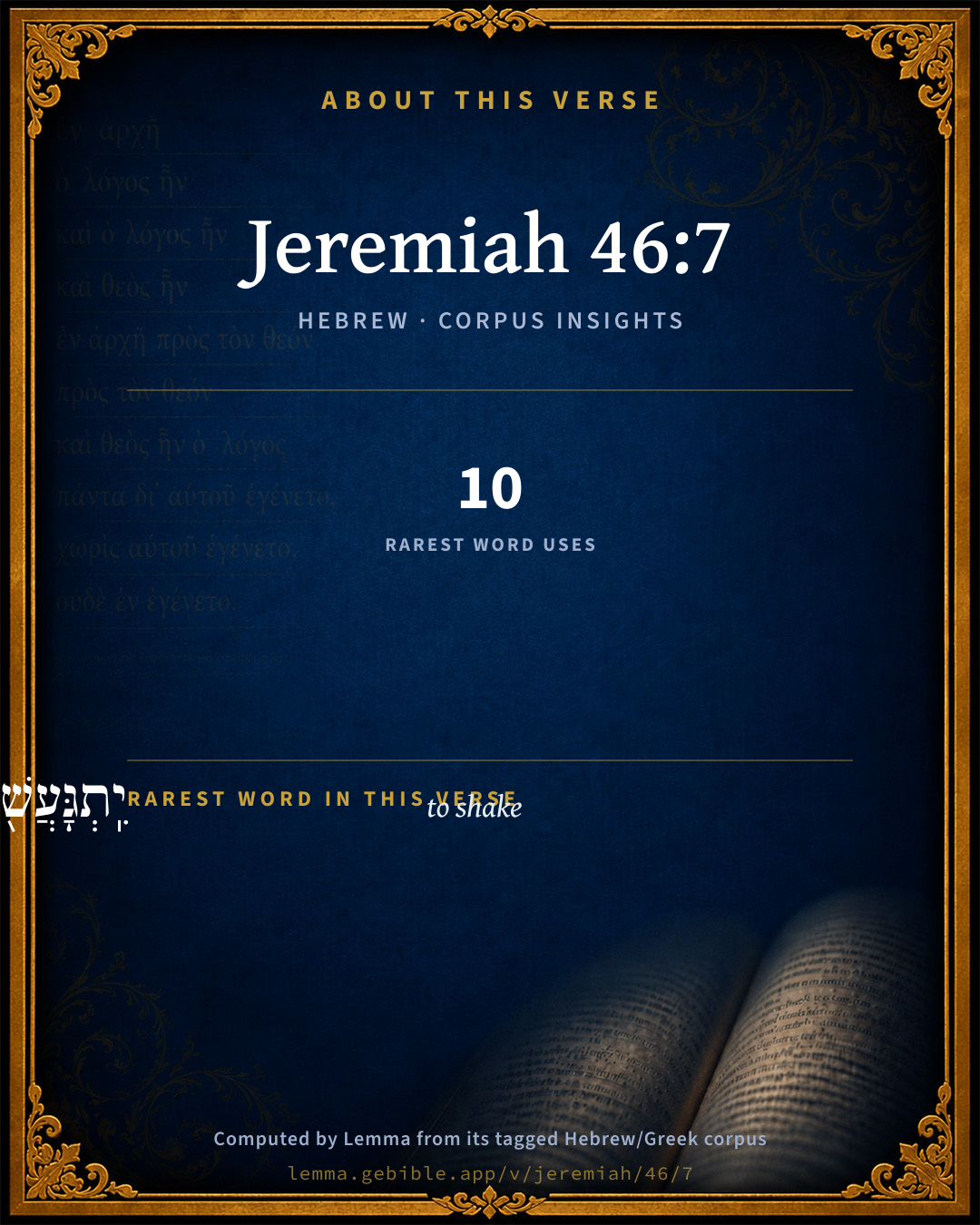
The rarest word here is יִֽתְגָּעֲשׁ֖וּ to shake H1607 — appearing just 10 times in the whole Hebrew Bible.

Shared distinctive vocabulary

יִֽתְגָּעֲשׁ֖וּ to shake H1607 occurs in 7 verses of the Hebrew Bible. Also found in:

Grammatical profile

  • 2 verbs
  • 3 nouns
  • 1 pronoun
  • 1 particle

Verb forms

  • יַֽעֲלֶ֑ה Qal · Imperfect
  • יִֽתְגָּעֲשׁ֖וּ Hithpael · Imperfect

Cross-references

9

Topical passages linked to Jeremiah 46:7 in the Treasury of Scripture Knowledge — connected by theme and wording, ordered by reader-vote popularity; previews shown in the World English Bible.

  • Jeremiah 47:2 Thus says Yahweh: Behold, waters rise up out of the north, and shall become an overflowing stream, and shall overflow the land and all that is therein, the city and those who dwell therein; and the men shall cry, and all the inhabitants of the land shall wail.
  • Isaiah 8:7–8 now therefore, behold, the Lord brings up on them the waters of the River, strong and many, [even] the king of Assyria and all his glory: and it shall come up over all its channels, and go over all its banks;
  • Daniel 11:22 The overwhelming forces shall be overwhelmed from before him, and shall be broken; yes, also the prince of the covenant.
  • Song of Solomon 3:6 Who is this who comes up from the wilderness like pillars of smoke, Perfumed with myrrh and frankincense, With all spices of the merchant?
  • Song of Solomon 8:5 Who is this who comes up from the wilderness, Leaning on her beloved? Under the apple tree I aroused you. There your mother conceived you. There she was in labor and bore you.
  • Isaiah 63:1 Who is this who comes from Edom, with dyed garments from Bozrah? this who is glorious in his clothing, marching in the greatness of his strength? I who speak in righteousness, mighty to save.
  • Daniel 9:26 After the sixty-two weeks the Anointed One shall be cut off, and shall have nothing: and the people of the prince who shall come shall destroy the city and the sanctuary; and the end of it shall be with a flood, and even to the end shall be war; desolations are determined.
  • Amos 8:8 Won't the land tremble for this, And everyone mourn who dwells in it? Yes, it will rise up wholly like the River; And it will be stirred up and sink again, like the River of Egypt.
  • Revelation 12:15 The serpent spewed water out of his mouth after the woman like a river, that he might cause her to be carried away by the stream.

Cross-references courtesy of OpenBible.info (CC BY 4.0).

Hebrew and Greek witnesses Masoretic Hebrew ↔ Greek Septuagint

The same verse in the two great witnesses to the Old Testament, shown verse-for-verse.

These are two independent witnesses, not word-aligned to each other, and the Septuagint is shown in lemma (dictionary) form.

Hebrew Jeremiah 46:7 Masoretic · Westminster Leningrad Codex

מִי זֶ֖ה כַּיְאֹ֣ר יַֽעֲלֶ֑ה כַּנְּהָר֕וֹת יִֽתְגָּעֲשׁ֖וּ מֵימָֽיו

Who is this who rises up like the Nile, whose waters toss themselves like the rivers?

World English Bible · Public Domain

Greek LXX Structure differs

In the Septuagint, Jeremiah is about an eighth shorter than the Hebrew and arranges its material differently — the Oracles Against the Nations (Hebrew chapters 46–51) appear in the middle of the Greek book, after 25:13. Because the chapter and verse boundaries do not line up, a verse-for-verse comparison with the Hebrew is not shown.

A verse-for-verse comparison isn’t shown here because the chapters and verses don’t line up. Switch to the LXX edition with the MT / LXX toggle above to read the Greek directly.

Hebrew: Westminster Leningrad Codex (CC BY 4.0). Greek: Septuagint (public domain); English from a public-domain English Septuagint. How the Septuagint differs from the Hebrew →

Targum (Aramaic paraphrase)

1

The Targum is the ancient Jewish Aramaic paraphrase of the Hebrew Scriptures — an interpretive translation, not the Hebrew text itself. Onkelos (literal) and Pseudo-Jonathan (expansive) render the Torah, and Jonathan the Prophets. Coverage is partial: where no permissively-licensed English translation exists for a verse, only the Aramaic is shown. This is verse-level text, not a word-by-word alignment to the Hebrew.

  1. Targum Jonathan Prophets (Joshua–Malachi)
    מַן דֵין דְסָלֵיק בְּמַשִׁרְיָתֵיהּ כַּעֲנָנָא דְסַלֵיק וְחָפֵי יַת אַרְעָא כְּמַבּוּעַ דְמַיִין דִמְטַרְפִין מוֹהִי:

    (no public-domain English translation for this verse)

    Targum Jonathan — Aramaic: “Mikraot Gedolot” (public domain). English: “Sefaria Community Translation” (CC0 1.0 (public-domain dedication)); “London "Chaldee Paraphrase," 1871” (public domain). Text via Sefaria.

Commentary

Notes on Jeremiah 46:7 from classic Christian and Jewish commentators (each source and its license shown beneath its notes). The classic Christian expositions comment on the surrounding passage and are grouped to its opening verse, so a note may address several verses; the Jewish commentaries on the Tanakh (Rashi and others) are per-verse, so they appear only where the commentator wrote on this verse.

Lemma curates 59 commentaries, every one of them public domain or Creative Commons licensed, each selected and text-cleaned for this edition rather than reprinted as found. About our sources →

Trapp's Complete Commentary

John Trapp

Jer 46:7 Who [is] this [that] cometh up as a flood, whose waters are moved as the rivers?

Ver. 7. Who is this that cometh up like a flood?] Pharaoh with his forces is here notably described, vivo sermonum colore, and compared to an impetuous river, that threateneth to overflow and swallow up all. See Isa 8:7.

John Trapp, A Commentary or Exposition upon All the Books of the Old and New Testament (1647–1656) — public domain. Text from a community e-Sword module.

Albert Barnes' Notes on the Bible

In Jer 46:3-6 we saw only a mighty army marshalling for battle, and its hasty flight. In Jer 46:7-12 the prophet tells us at whose defeat we have been present.

A flood - the Nile. The metaphor describing the advance of the Egyptian army is naturally drawn from the annual overflow of their own sacred stream.

Whose waters are moved ... - literally, his waters toss to and fro as the rivers, the natural branches of the Nile in Lower Egypt.

Albert Barnes' Notes on the Bible (1834–1885) — public domain. Text from a community e-Sword/MySword module.

Joseph Benson's Commentary

Jer 46:7-10. Who is this that cometh up as a flood — Here the king of Egypt is compared to a mighty river, the Nile, or the Euphrates, when it swells above its banks, and threatens to overwhelm the country with ruin and desolation. And he saith I will go up, and will cover the earth — With my numerous armies; I will destroy the city — Carchemish or Babylon; and the inhabitants thereof — Who shall not be able to withstand the powerful force I bring against them. Thus the prophet represents him as beginning his march with all the ostentation and insolence of presumed success. Come up, ye horses; and rage, ye chariots, &c. — Here he is exhibited calling aloud to the nations of which his army is composed, giving them the signal for action, and rousing them to deeds of desperate valour; but all in vain: for the time is come for God to avenge himself of his ancient foes: they are doomed to slaughter, to fall a bloody sacrifice on the plains of the north. For, adds the prophet, Jer 46:10, this is the day of the Lord God of hosts — That is, as it follows, the day of his vengeance. Hence, the day of the Lord is used in the New Testament to signify the day of judgment, of which all other days of vengeance are the earnests and forerunners. That he may avenge himself of his adversaries — Of the idols of Egypt and their worshippers: the Egyptians were some of the first idolaters, and carried idolatry to its greatest height. And the sword shall devour, it shall be satiate, &c. — These metaphorical expressions signify the very great slaughter which would be made at that time in the Egyptian army. For the Lord God hath a sacrifice, &c. — The slaughter of men in battle, which is by way of punishment for their sins, is called a sacrifice to God, because it makes some kind of satisfaction and atonement to the divine justice. See the margin.

Joseph Benson's Commentary on the Old and New Testaments (1811–1818) — public domain. Text from a community e-Sword module.

Tyndale Open Study Notes

Tyndale Open Resources

46:7-8 In spite of Pharaoh Neco’s boasting and the imposing presence of his soldiers, his tactics did not confuse the enemy or win the battle (cp. 1 Kgs 20:11).

Tyndale Open Study Notes — © Tyndale Open Resources, licensed CC BY-SA 4.0. Text via the HelloAO Bible API.

Geneva Bible (1599)

Geneva Bible translators

He derideth the boastings of the Egyptians, who thought by their riches and power to have overcome all the world, alluding to the river Nilus, which at certain times overfloweth the country of Egypt.

Geneva Bible (1599) marginal notes — public domain. Text via Bolls.life.

Jamieson, Fausset & Brown

Robert Jamieson, A. R. Fausset & David Brown

as a flood-- (Jer 47:2; Isa 8:7-8; Dan 11:22). The figure is appropriate in addressing Egyptians, as the Nile, their great river, yearly overspreads their lands with a turbid, muddy flood. So their army, swelling with arrogance, shall overspread the region south of Euphrates; but it, like the Nile, shall retreat as fast as it advanced.

Jamieson, Fausset & Brown — Commentary Critical and Explanatory on the Whole Bible (1871) — public domain (CC PDM 1.0). Text via the HelloAO Bible API.

Adam Clarke's Commentary

Verse 7. Who is this that cometh up as a flood] The vast concourse of people is here represented as a river: for instance, the Jordan, suddenly swollen with the rains in harvest, rolling its waters along, and overflowing the whole country. A fine image to represent the incursions of vast armies carrying all before them. Such was the army of Pharaoh-necho in its march to Carchemish.

Adam Clarke's Commentary on the Bible (1810–1826) — public domain. Text from a community e-Sword/MySword module.

John Calvin's Commentaries

The Prophet again meets those doubts which might have possessed the minds of the godly, so as to prevent them to receive this prophecy in faith and with due reverence: for we have said, that when our thoughts are occupied with external things, the power of God is disregarded. When, therefore, we speak of some impregnable kingdom, it does not come into our minds, that all strongholds are of no account with God. It was therefore necessary highly to extol the power of God, when the Prophets spoke of his judgments: otherwise the flesh, as we have stated, would have said, “They who are well fortified must be free from evils, and as it were beyond the reach of weapons, and hence there is nothing for them to fear.” And it is with this false imagination that the proud deceive themselves, for they set up their forces, their auxiliaries, and all the things which they deem, according to the judgment of the flesh, as sufficient to protect their safety. Titus it happens, that they heedlessly disregard all threatenings, even because they think that the subsidies which they have are so many fortresses against all attacks.

It is for this purpose that the Prophet now says, Who is this that as a lake rises, or swells, as rivers are moved, or, whose waters are agitated? But he speaks according to the common judgment of men, for the very sight could not but fill men with fear; and so the Jews could never have thought that possible which the Prophet here asserts. He then, as it were, introduces them all as anxiously inquiring according to their own judgment, Who is this? as though Pharaoh was not a mortal, but something above human. For the drift of the question is this, that Pharaoh was as it were exempted from the common condition of men, because his power increased like a river rising or swelling; and its waters, he says, make a noise

John Calvin's Commentaries (1540-1563) — public domain. Text from the Calvin Translation Society English edition (1840s-50s) via the Christian Classics Ethereal Library (ccel.org). Calvin's coverage is partial (roughly two-thirds of the Bible); uncommented books and verses are honest gaps, never fabricated. The 19th-century editor's footnotes and remarks are omitted so the notes are faithfully Calvin's own voice.

Ellicott's Commentary for English Readers

(7, 8) Who is this that cometh up as a flood? . . .—The Hebrew word for “flood” is used as a proper name almost exclusively (Dan_12:5-6 being the only exception) for the Nile (e.g., Gen_41:1-3; Exo_2:3; Exo_4:9; Amo_8:8; Amo_9:5), and thus the very form of the question points to the answer that follows. The prophet goes back, as an English poet might have done after the destruction of the Spanish Armada, to the time when all the strength of Egypt had been poured forth in the exultation of anticipated victory, as the great river of Egypt poured its waters. The word for “rivers,” though more general, has a like allusive reference, being used in Exo_7:19; Exo_8:5 and Eze_32:2; Eze_32:14 for the arms or canals of the Nile.

A Bible Commentary for English Readers, edited by Charles John Ellicott (1878–1897) — public domain. Text from a community e-Sword module.

The Cambridge Bible for Schools and Colleges

gen. ed. J. J. S. Perowne

7, 8. Who is this … Egypt riseth up like the Nile] The mg. is to be preferred. Egypt’s boast that she will spread herself in conquest over the earth is illustrated by the annual rise of the Nile, flooding the adjacent country. Cp. in Isa_8:7 f. the illustration of Assyrian conquest of Judaea taken from the swelling waters of the Euphrates.

The Cambridge Bible for Schools and Colleges (gen. ed. J. J. S. Perowne; Cambridge University Press, 1878–1918) — public domain. Text from a community e-Sword module.

John Gill's Exposition

Who is this that cometh up as a flood,.... These are either the words of the prophet, who having a vision in prophecy of the march of the Egyptian army from the south to the north, which he compares to a flood; in allusion to the river Nile, which used to overflow its banks, and spread itself over the land; because of the vast numbers of which it consisted; because of the noise it made, and, because of its rapidity and force, threatening to bear all down before it; as wondering, asks, who it was, whose army it was, and to whom it belonged? or they are the words of God, who puts this question, in order to, give an answer to it, and thereby upbraid the Egyptians with their arrogance, pride, and vanity; which would all come to nothing:

whose waters are moved as the rivers? whose numerous armies came with a great noise and force, like the openings of the Nile, the seven gates of it; which were very boisterous, especially in hard gales of wind: it is no unusual thing for large armies to be compared to floods and rivers, which move forcibly and swiftly, and make a large spread; see Isa 8:7. The Targum is,

"who is this that comes up with his army as a cloud, and covers the earth, and as a fountain of water, whose waters are moved?''

John Gill's Exposition of the Whole Bible (1746–1763) — public domain (CC PDM 1.0). Text via the HelloAO Bible API.

Haydock's Catholic Bible Commentary

Rivers. He alludes to the Nile. The king of Egypt had a numerous army.

George Leo Haydock (1774–1849), Haydock's Catholic Family Bible and Commentary, 1859 edition — public domain. Excludes Psalms (Douay-Rheims chapter numbering differs from Protestant) and Deuterocanonical books (Catholic canon only).

Matthew Poole's English Annotations

The next verse expoundeth this.

Matthew Poole's English Annotations on the Holy Bible (1683–1685) — public domain. Text from a community e-Sword/MySword module.

Whedon's Commentary on the Bible

Daniel D. Whedon

7, 8. In the preceding verses we have a picture of the army and its defeat, in those which follow the same story is told, but with grander imagery — a mighty rising of the whole land of Egypt, even as the floods of their own Nile overspread the land, and then God visits upon that people his overwhelming judgments.

Egypt riseth up like a flood — The word for “flood,” here and in the preceding verse, is יאר, (yeor,) and is thought by some — Keil, for instance — to be the name of the Nile River taken from the Egyptian into the Hebrew. On the contrary, Furst maintains the Shemitic origin not only of this, but all the other names of the Nile in the Old Testament. Certain it is, that this name is prevailingly applied to the Nile, as in Genesis 41, etc.; Exo_1:22, etc., etc., and just as little doubt is there that the metaphor of this passage comes from the Nile overflow.

Daniel D. Whedon (gen. ed.), Commentary on the Old and New Testaments (1874–1909) — public domain. Text from a community e-Sword module.

The Pulpit Commentary

Who is this, etc.? "Once more surprise at the same phenomenon recurs, and in a stronger form; a monstrous, devastating river appears to roll itself wildly along, overwhelming all countries: who is it? It is Egypt, which is now threatening to overrun the earth and to lay everything waste, whose various nationalities are advancing fully equipped" (Ewald). As a flood; rather, as the Nile (y"or, a word of Egyptian affinities, and only once used of another river than the Nile, Dan_12:5, Dan_12:6, Dan_12:7). The naturalness of the figure in this context needs no exhibiting. It reminds us of Isa_8:7, Isa_8:8, where the Assyrian army is compared to the Euphrates. Are moved as the rivers; rather, toss themselves as the rivers. By the "rivers" the prophet means the branches of the Nile, which are described by the same word in Isa_19:8 Exo_7:19.

The Pulpit Commentary (1880–1919), ed. H.D.M. Spence-Jones & Joseph S. Exell — public domain. Text from a community e-Sword module.

unfoldingWord translationNotes

Door43 World Missions Community

General Information:

Jeremiah continues quoting Yahweh's declaration to the nation of Egypt.

Who is this who rises like the Nile ... the rivers?

Yahweh uses a question to draw attention to what he is about to say concerning Egypt. This can be translated as a statement. AT: "Look at who rises like the Nile ... the rivers." (See: Rhetorical Question)

Egypt rises like the Nile

The Nile river floods its banks once a year, covering the surrounding area with water. Yahweh compares the kingdom of Egypt to the Nile because the Egyptian people think they are mighty enough to destroy cities in all the lands. (See: Simile)

Egypt rises ... Egypt says ... I will

Here "Egypt" represents all the people of Egypt. AT: "The Egyptians rise ... The Egyptians say ... We will" (See: Metonymy)

Go up, horses. Be angry, you chariots

Here "horses" and "chariots" represent the soldiers who use horses and chariots in battle. The leaders of Egypt are ordering their soldiers to start the battle. AT: "Go up to battle, you soldiers on horses. Fight furiously, you soldiers in chariots" (See: Metonymy)

Let the soldiers go out, Cush and Put, men skillful with a shield

This command can be addressed directly to the soldiers. What they were to go out for can be stated clearly. AT: "You soldiers from Cush and Put, who are skillful with your shields, go out to battle" (See: Assumed Knowledge and Implicit Information)

Cush ... Put

These are biblical names for the countries of Ethiopia and Libya. (See: How to Translate Names)

Ludim, men skillful at bending their bows

The ideas of soldiers and going out to battle are understood from earlier in the sentence. They can be repeated. This command can also be addressed directly to the soldiers. AT: "you soldiers from Lud, who are skillful at bending your bows, go out to battle" (See: Ellipsis)

Ludim

This is the name of the people group from the nation of Lud. Lud is the biblical name for Lydia. (See: How to Translate Names)

skillful at bending their bows

The phrase "bend the bow" means to pull the string of the bow back with an arrow in order to shoot the arrow. AT: "skillful at shooting arrows from their bows" or "skillful with the bow and arrow" (See: Idiom)

translationWords

raise

like

Nile River

water

Egypt

earth

horse

anger

chariot

Cush

shield

bow and arrow

unfoldingWord translationNotes — © Distant Shores Media and the Door43 World Missions Community, licensed CC BY-SA 4.0. Source: git.door43.org/Door43/en_tn.

Rashi

Rabbi Shlomo Yitzchaki (Rashi)

Who...would come up like the Nile Who was wont to bring up troops around him like the waters of a river, to flood its environs.

Rashi on the Tanakh — English translations: “The Judaica Press complete Tanach with Rashi, translated by A. J. Rosenberg” (CC BY 4.0); “Pentateuch with Rashi's commentary by M. Rosenbaum and A.M. Silbermann, 1929-1934” (public domain); “The Metsudah Tanach series, Lakewood, N.J” (CC BY 4.0); and “The Book of Joshua, Metsudah Publications, 1997” (CC BY 4.0). Text via Sefaria.

Lesson kit

Teaching starters — assembled from the data on this page, not authored interpretation. Every prompt links to the verse data it draws on. Edit before teaching.

Jeremiah, in the Prophets, opens this verse with 7 words (7 distinct Hebrew lemmas). Its most distinctive word is gâʻash (“to shake”). A historical commentator’s framing appears above. Read the whole chapter for the surrounding context.

Discussion questions

  1. What does “to shake” (gâʻash) contribute to the verse as a whole?
  2. 2 Samuel 22:8 shares the word «to shake» with this verse. How do the two illuminate each other?
  3. The translations on this page render this verse differently — a whole-verse word diff, not a word-by-word alignment. What might account for the different wordings?
  4. The verb «יַֽעֲלֶ֑ה» is Qal Imperfect. How does its form color the action?
  5. Reading how Trapp's Complete Commentary and Albert Barnes' Notes on the Bible read this verse, where do the two commentators agree and where do they part?

Things to notice

Reading settings

Reading text

Shown beneath each verse's original-language words.

Old Testament
Old Testament edition

Read the OT as the Masoretic Hebrew (MT) or the Greek Septuagint (LXX).

English shown for the Greek Septuagint (in the Hebrew ↔ Greek comparison).

Comparing translations? Open the Compare panel on any verse page to stack up to four side by side.