
Ezekiel 31:15

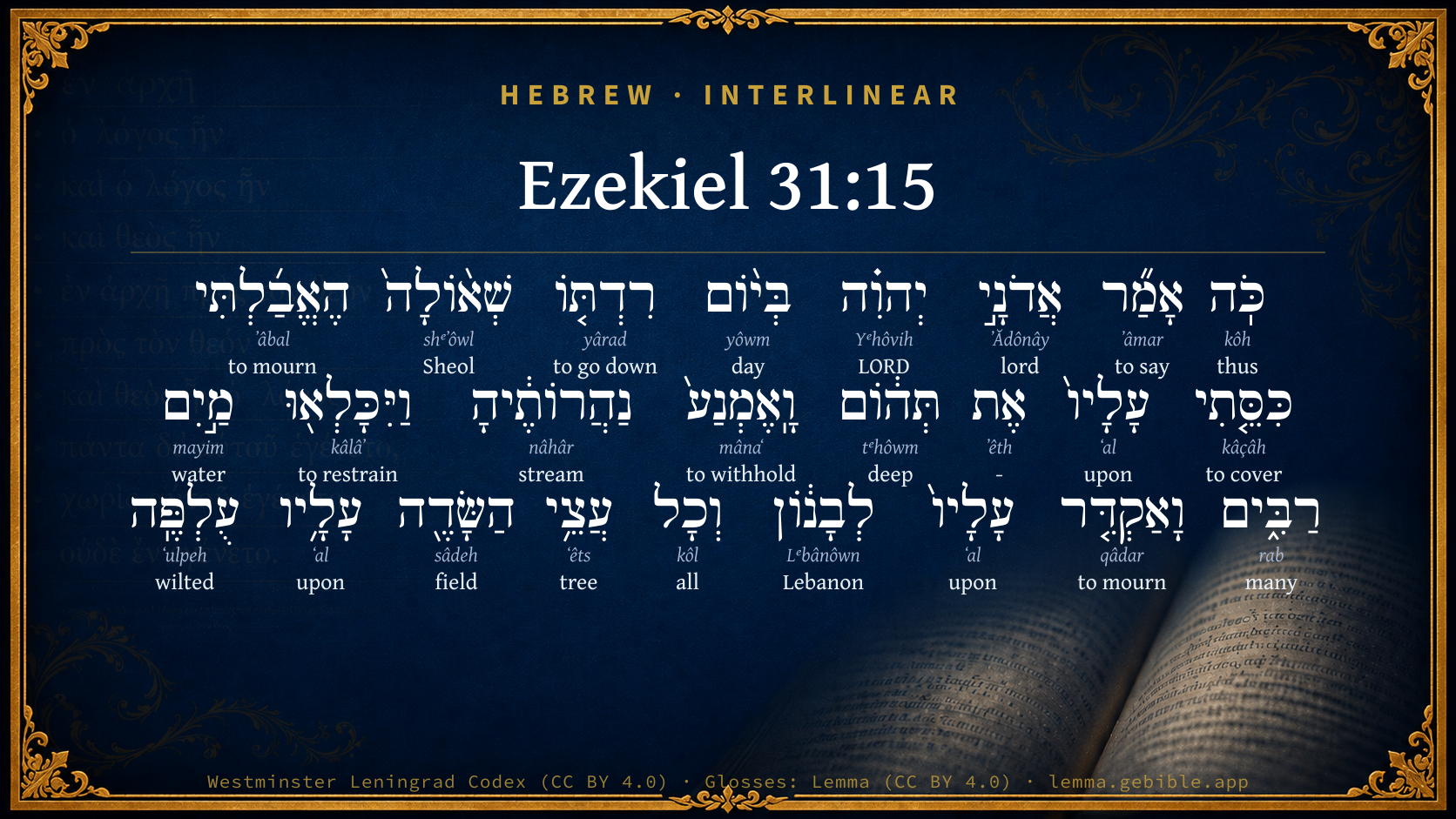
Hebrew (Westminster Leningrad Codex) Ezekiel 31:15 appears in the Hebrew Old Testament. The text above is from the Westminster Leningrad Codex. Each word links to its Strong’s number, a concise gloss, and parsing drawn from the Open Scriptures Hebrew Bible morphology. Click any word for its full Brown-Driver-Briggs (BDB) entry.
Download image
Cite this verse

Ezekiel 31:15 (World English Bible). Public Domain. Lemma interlinear Bible study tool, https://lemma.gebible.app/v/ezekiel/31/15.

Show BibTeX & RIS
BibTeX
RIS
English Translation
Thus says the Lord Yahweh: In the day when he went down to Sheol I caused a mourning: I covered the deep for him, and I restrained the rivers of it; and the great waters were stayed; and I caused Lebanon to mourn for him, and all the trees of the field fainted for him.
World English Bible · Public Domain
Highlights
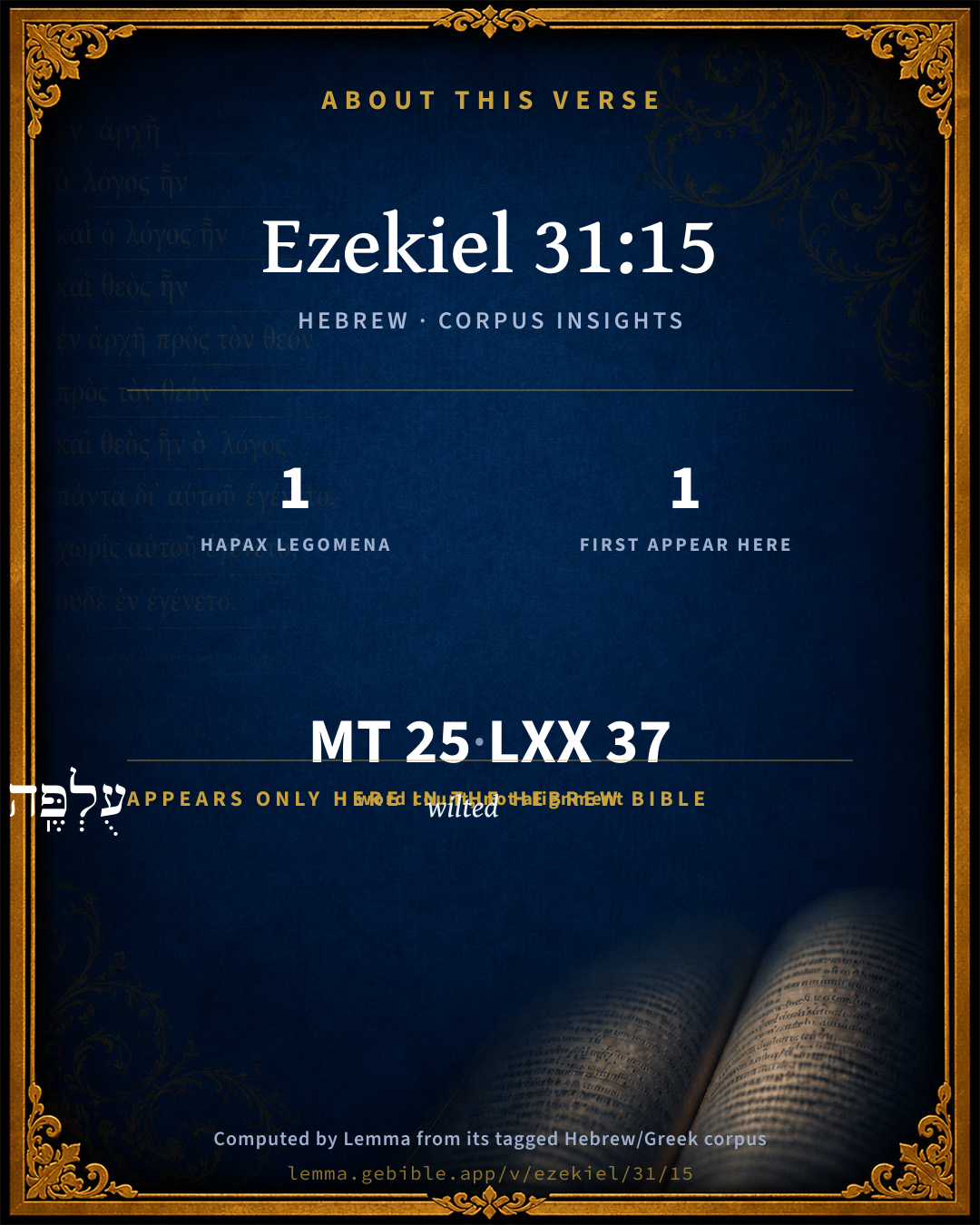
  • 1 hapax legomenon — only here in the Hebrew Bible
  • 1 first appearance in the Hebrew Bible
Full analysis ↓
Download a study sheet

One document with this verse’s original text, its word-by-word gloss line, the meaning frame, cross-references with their text, attributed commentary, and full source and license credits — printable, and it pastes into notes with its structure intact.

This verse Autodidact and up

Study sheet (.html) Plain text (.txt)

A passage Seminary Student

Up to 50 verses in one chapter. A passage sheet keeps up to 6 commentary sources and 12 cross-references per verse, in the order this page ranks them, and says so on the sheet whenever that leaves anything out. Ask for a single verse and you get the Autodidact verse sheet above.

Everything on this page stays free to read, with no account — the sheet is a download of what is already on screen, not access to it.

Want to remove ads? Support Godless Engineer
Compare translations 3

The same verse in 3 English versions, stacked beneath the original-language interlinear above. Click any original word for its lexicon entry.

Each is an independent rendering of the whole verse — the interlinear is not word-aligned to these translations.

Highlighted words mark where these versions differ — a whole-verse word diff, not a word-by-word alignment.

  • World English Bible Public Domain
    Thus says the Lord Yahweh: In the day when he went down to Sheol I caused a mourning: I covered the deep for him, and I restrained the rivers of it; and the great waters were stayed; and I caused Lebanon to mourn for him, and all the trees of the field fainted for him.
  • King James Version Public Domain
    Thus saith the Lord GOD; In the day when he went down to the grave I caused a mourning: I covered the deep for him, and I restrained the floods thereof, and the great waters were stayed: and I caused Lebanon to mourn for him, and all the trees of the field fainted for him.
  • unfoldingWord Literal Text CC BY-SA 4.0
    The Lord Yahweh says this: On the day when the cedar went down to Sheol I brought mourning to the earth. I covered the deep waters over it, and I held back the ocean waters. I kept back the great waters, and I brought mourning to Lebanon for him. So all the trees of the field mourned because of it.

unfoldingWord Literal Text — © unfoldingWord, licensed CC BY-SA 4.0. Word-aligned USFM3 via Door43 (git.door43.org/unfoldingWord/en_ult).

Versions to compare (up to 4)

3 of 4 selected

Show all 18 translations

Every available English version of this verse, each an independent rendering of the whole verse.

  • World English Bible Public Domain
    Thus says the Lord Yahweh: In the day when he went down to Sheol I caused a mourning: I covered the deep for him, and I restrained the rivers of it; and the great waters were stayed; and I caused Lebanon to mourn for him, and all the trees of the field fainted for him.
  • Berean Standard Bible Public Domain
    This is what the Lord GOD says: ‘On the day it was brought down to Sheol, I caused mourning. I covered the deep because of it; I held back its rivers; its abundant waters were restrained. I made Lebanon mourn for it, and all the trees of the field fainted because of it.
  • Majority Standard Bible Public Domain
    This is what the Lord GOD says: ‘On the day it was brought down to Sheol, I caused mourning. I covered the deep because of it; I held back its rivers; its abundant waters were restrained. I made Lebanon mourn for it, and all the trees of the field fainted because of it.
  • King James Version Public Domain
    Thus saith the Lord GOD; In the day when he went down to the grave I caused a mourning: I covered the deep for him, and I restrained the floods thereof, and the great waters were stayed: and I caused Lebanon to mourn for him, and all the trees of the field fainted for him.
  • American Standard Version (1901) Public Domain
    Thus saith the Lord Jehovah: In the day when he went down to Sheol I caused a mourning: I covered the deep for him, and I restrained the rivers thereof; and the great waters were stayed; and I caused Lebanon to mourn for him, and all the trees of the field fainted for him.
  • Revised Version (1885) Public Domain
    Thus saith the Lord GOD: In the day when he went down to hell I caused a mourning: I covered the deep for him, and I restrained the rivers thereof, and the great waters were stayed: and I caused Lebanon to mourn for him, and all the trees of the field fainted for him.
  • Geneva Bible (1599) Public Domain
    Thus saith the Lord God, In the day when he went downe to hell, I caused them to mourne, and I couered the deepe for him, and I did restreine the floods thereof, and the great waters were stayed: I caused Lebanon to mourne for him, and all the trees of the fielde fainted.
  • Douay-Rheims (1899) Public Domain
    Thus saith the Lord God: In the day when he went down to hell, I brought in mourning, I covered him with the deep: and I withheld its rivers, and restrained the many waters: Libanus grieved for him, and all the trees of the field trembled.
  • Young's Literal Translation Public Domain
    Thus said the Lord Jehovah: In the day of his going down to sheol I have caused mourning, I have covered for him the deep, and diminish its flowings, And restrained are many waters, And I make Lebanon black for him, And all trees of the field have been covered for him.
  • Literal Standard Version CC BY-SA 4.0
    Thus said Lord YHWH: I have caused mourning in the day of his going down to Sheol, || I have covered the deep over him, and diminish its flowings, || And many waters are restrained, || And I make Lebanon black for him, || And all trees of the field [have been] a covering for him.
  • Unlocked Literal Bible CC BY-SA 4.0
    The Lord Yahweh says this: On the day when the cedar went down to Sheol I brought mourning to the earth. I covered the deep waters over it, and I held back the ocean waters. I kept back the great waters, and I brought mourning to Lebanon for him. So all the trees of the field mourned because of it.
  • unfoldingWord Literal Text CC BY-SA 4.0
    The Lord Yahweh says this: On the day when the cedar went down to Sheol I brought mourning to the earth. I covered the deep waters over it, and I held back the ocean waters. I kept back the great waters, and I brought mourning to Lebanon for him. So all the trees of the field mourned because of it.
  • Darby Bible Public Domain
    Thus saith the Lord Jehovah: In the day when he went down to Sheol, I caused a mourning: I covered the deep for him, and I restrained the floods thereof, and the great waters were stayed; and I made Lebanon black for him, and all the trees of the field fainted for him.
  • World Messianic Bible Public Domain
    “The Lord GOD says: ‘In the day when he went down to Sheol, I caused a mourning. I covered the deep for him, and I restrained its rivers. The great waters were stopped. I caused Lebanon to mourn for him, and all the trees of the field fainted for him.
  • Webster's Bible Public Domain
    Thus saith the Lord GOD; In the day when he went down to the grave I caused a mourning: I covered the deep for him, and I restrained its floods, and the great waters were stayed: and I caused Lebanon to mourn for him, and all the trees of the field fainted for him.
  • Free Bible Version CC BY-SA 4.0
    This is what the Lord God says: On the day it was brought down to Sheol, I had the deep waters mourn for it; I stopped its rivers flowing; I held back all its waters. I covered Lebanon in darkness, and all the trees in the forest withered.
  • Bible in Basic English Public Domain
    This is what the Lord has said: The day when he goes down to the underworld, I will make the deep full of grief for him; I will keep back her streams and the great waters will be stopped: I will make Lebanon dark for him, and all the trees of the field will be feeble because of him.
  • JPS Tanakh (1917) Public Domain
    Thus saith the Lord GOD: In the day when he went down to the nether-world I caused the deep to mourn and cover itself for him, and I restrained the rivers thereof, and the great waters were stayed; and I caused Lebanon to mourn for him, and all the trees of the field fainted for him.

Literal Standard Version (2020), Covenant Press — licensed CC BY-SA 4.0. Text via the HelloAO Bible API (eBible.org). Unlocked Literal Bible (unfoldingWord) — licensed CC BY-SA 4.0. Text via the HelloAO Bible API (eBible.org). unfoldingWord Literal Text — © unfoldingWord, licensed CC BY-SA 4.0. Word-aligned USFM3 via Door43 (git.door43.org/unfoldingWord/en_ult). Free Bible Version, Dr. Jonathan Gallagher — licensed CC BY-SA 4.0. Text via the HelloAO Bible API (eBible.org).

Word by word

More ways to search: Search by grammar → Find every occurrence → Compare this word →

Practice this passage: Drill this verse → Learn its vocabulary →

עֻלְפֶּֽה
ʻulpeh
H5969
“wilted”
Noun, Common, Masculine, Singular, Absolute
Part of Speech
Noun
Type
Common
Gender
Masculine
Number
Singular
State
Absolute
Full BDB Definition

Origin: from H5968

TWOT: 1634

wilted, fainted
  1. כֹּֽה kôh H3541 “thus” Adverb
  2. אָמַ֞ר ʼâmar H559 “to say” Verb, Qal, Perfect, 3rd Person, Masculine, Singular
  3. אֲדֹנָ֣י ʼĂdônây H136 “Lord · my” Noun, Common, Masculine, Plural, Construct + Suffix, Personal, 1st Person, Common, Singular
  4. יְהוִ֗ה Yᵉhôvih H3069 “LORD” Noun, Proper
  5. בְּי֨וֹם yôwm H3117 “in/at · day of” Preposition + Noun, Common, Masculine, Singular, Construct
  6. רִדְתּ֤וֹ yârad H3381 “to go down · him” Verb, Qal, Infinitive Construct + Suffix, Personal, 3rd Person, Masculine, Singular
  7. שְׁא֨וֹלָה֙ shᵉʼôwl H7585 “Sheol · toward” Noun, Proper + Suffix, Demonstrative
  8. הֶאֱבַ֜לְתִּי ʼâbal H56 “to mourn” Verb, Hiphil, Perfect, 1st Person, Common, Singular
  9. כִּסֵּ֤תִי kâçâh H3680 “to cover” Verb, Piel, Perfect, 1st Person, Common, Singular
  10. עָלָיו֙ ʻal H5921 “upon · him” Preposition + Suffix, Personal, 3rd Person, Masculine, Singular
  11. אֶת ʼêth H853 “-” Particle, Direct Object
  12. תְּה֔וֹם tᵉhôwm H8415 “deep” Noun, Common, Both, Singular, Absolute
  13. וָֽאֶמְנַע֙ mânaʻ H4513 “and · to withhold” Conjunction + Verb, Qal, Sequential Imperfect, 1st Person, Common, Singular
  14. נַהֲרוֹתֶ֔יהָ nâhâr H5104 “streams · her” Noun, Common, Masculine, Plural, Construct + Suffix, Personal, 3rd Person, Feminine, Singular
  15. וַיִּכָּלְא֖וּ kâlâʼ H3607 “and · to restrain” Conjunction + Verb, Niphal, Sequential Imperfect, 3rd Person, Masculine, Plural
  16. מַ֣יִם mayim H4325 “water(s)” Noun, Common, Masculine, Plural, Absolute
  17. רַבִּ֑ים rab H7227 “many” Adjective, Adjective, Masculine, Plural, Absolute
  18. וָאַקְדִּ֤ר qâdar H6937 “and · to mourn” Conjunction + Verb, Hiphil, Sequential Imperfect, 1st Person, Common, Singular
  19. עָלָיו֙ ʻal H5921 “upon · him” Preposition + Suffix, Personal, 3rd Person, Masculine, Singular
  20. לְבָנ֔וֹן Lᵉbânôwn H3844 “Lebanon” Noun, Proper
  21. וְכָל kôl H3605 “and · all of” Conjunction + Noun, Common, Masculine, Singular, Construct
  22. עֲצֵ֥י ʻêts H6086 “trees of” Noun, Common, Masculine, Plural, Construct
  23. הַשָּׂדֶ֖ה sâdeh H7704 “the · field” Particle, Definite Article + Noun, Common, Masculine, Singular, Absolute
  24. עָלָ֥יו ʻal H5921 “upon · him” Preposition + Suffix, Personal, 3rd Person, Masculine, Singular

About this verse

These counts appear in no published source. They are computed here, from the morphology-tagged text and Lemma’s own curated glosses. What Lemma adds →

25
words
23
distinct lemmas
Prophets
section

Notable vocabulary

1 hapax legomenon — a word that appears only here in the entire Hebrew Bible:

  • עֻלְפֶּֽה wilted H5969

First appearance in Scripture

This word makes its first canonical appearance in the Hebrew Bible here:

  • עֻלְפֶּֽה wilted H5969

Shared distinctive vocabulary

וָאַקְדִּ֤ר to mourn H6937 occurs in 17 verses of the Hebrew Bible. Also found in:

Grammatical profile

  • 7 verbs
  • 12 nouns
  • 1 adjective
  • 3 prepositions
  • 1 adverb
  • 1 particle

Verb forms

  • אָמַ֞ר Qal · Perfect
  • רִדְתּ֤וֹ Qal · Infinitive Construct
  • הֶאֱבַ֜לְתִּי Hiphil · Perfect
  • כִּסֵּ֤תִי Piel · Perfect
  • וָֽאֶמְנַע֙ Qal · Sequential Imperfect
  • וַיִּכָּלְא֖וּ Niphal · Sequential Imperfect
  • וָאַקְדִּ֤ר Hiphil · Sequential Imperfect

Repetition

A word recurs within this verse — often emphatic in Hebrew:

  • עָלָיו֙ upon H5921 ×3

Hebrew & Septuagint length

In English translation the verse runs 55 words from the Hebrew and 44 from the Septuagint (LXX English) — closely comparable.

A rough comparison of the two English renderings, which tokenize alike — not a word-level alignment.

Word counts can differ between the Hebrew and the Greek without any difference in meaning — e.g. the Hebrew direct-object marker אֵת has no separate Greek word, and Greek often adds the article ὁ.

In the original languages it is 25 Hebrew tokens and 37 Greek tokens — but the two are counted differently (Hebrew bundles its prefixes and suffixes into one token; the Greek is in lemma form), so that isn’t a like-for-like length.

Cross-references

4

Topical passages linked to Ezekiel 31:15 in the Treasury of Scripture Knowledge — connected by theme and wording, ordered by reader-vote popularity; previews shown in the World English Bible.

  • Nahum 2:8–10 But Nineveh has been from of old like a pool of water, yet they flee away. "Stop! Stop!" they cry, but no one looks back.
  • Malachi 3:4 Then the offering of Judah and Jerusalem will be pleasant to Yahweh, as in the days of old, and as in ancient years.
  • Revelation 18:9–11 The kings of the earth, who committed sexual immorality and lived wantonly with her, will weep and wail over her, when they look at the smoke of her burning,
  • Revelation 18:18–19 and cried out as they looked at the smoke of her burning, saying, 'What is like the great city?'

Cross-references courtesy of OpenBible.info (CC BY 4.0).

Hebrew and Greek witnesses Masoretic Hebrew ↔ Greek Septuagint

The same verse in the two great witnesses to the Old Testament, shown verse-for-verse.

These are two independent witnesses, not word-aligned to each other, and the Septuagint is shown in lemma (dictionary) form.

Hebrew Ezekiel 31:15 Masoretic · Westminster Leningrad Codex

כֹּֽה אָמַ֞ר אֲדֹנָ֣י יְהוִ֗ה בְּי֨וֹם רִדְתּ֤וֹ שְׁא֨וֹלָה֙ הֶאֱבַ֜לְתִּי כִּסֵּ֤תִי עָלָיו֙ אֶת תְּה֔וֹם וָֽאֶמְנַע֙ נַהֲרוֹתֶ֔יהָ וַיִּכָּלְא֖וּ מַ֣יִם רַבִּ֑ים וָאַקְדִּ֤ר עָלָיו֙ לְבָנ֔וֹן וְכָל עֲצֵ֥י הַשָּׂדֶ֖ה עָלָ֥יו עֻלְפֶּֽה

Thus says the Lord Yahweh: In the day when he went down to Sheol I caused a mourning: I covered the deep for him, and I restrained the rivers of it; and the great waters were stayed; and I caused Lebanon to mourn for him, and all the trees of the field fainted for him.

World English Bible · Public Domain

Greek LXX Ezekiel 31:15 Septuagint · lemma form

ὅδε λέγω κύριος κύριος ἐν ὅς ἡμέρα καταβαίνω εἰς ᾅδης πενθέω αὐτός ὁ ἄβυσσος καί ἐπιἵστημι ὁ ποταμός αὐτός καί κωλύω πλῆθος ὕδωρ καί σκοτάζω ἐπί αὐτός ὁ λίβανος πᾶς ὁ ξύλον ὁ πεδίον ἐπί αὐτός ἐκλύω

Thus says the Lord God; In the day wherein he went down to Hades, the deep mourned for him: and I stayed her floods, and restrained her abundance of water: and Libanus saddened for him, all the trees of the field fainted for him.

LXX2012 (modern English Septuagint) · Public Domain

On this verse, Keil & Delitzsch discusses the Septuagint’s reading. Read the note in Commentary ↓

Hebrew: Westminster Leningrad Codex (CC BY 4.0). Greek: Septuagint (public domain); English from LXX2012 (modern English Septuagint) (Public Domain). How the Septuagint differs from the Hebrew →

Targum (Aramaic paraphrase)

1

The Targum is the ancient Jewish Aramaic paraphrase of the Hebrew Scriptures — an interpretive translation, not the Hebrew text itself. Onkelos (literal) and Pseudo-Jonathan (expansive) render the Torah, and Jonathan the Prophets. Coverage is partial: where no permissively-licensed English translation exists for a verse, only the Aramaic is shown. This is verse-level text, not a word-by-word alignment to the Hebrew.

  1. Targum Jonathan Prophets (Joshua–Malachi)
    כִּדְנַן אֲמַר יְיָ אֱלֹהִים בְּיוֹם אַחְתוֹתִי יָתֵיהּ לִשְׁאוֹל אִתְאַבָּלוּ עֲלוֹהִי חֲפַת עָקָא יַת עַלְמָא וְחָרוֹבָא מְדִינָתָא וְזָעוּ עַמְמִין סַגִיאִין וַחֲשׁוֹכוּ עֲלוֹהִי אַפֵּי מַלְכַיָא וְכָל מַלְכֵי עַמְמַיָא עֲלוֹהִי טְפָחוּ כַתְפָא:

    (no public-domain English translation for this verse)

    Targum Jonathan — Aramaic: “Mikraot Gedolot” (public domain). English: “Sefaria Community Translation” (CC0 1.0 (public-domain dedication)); “London "Chaldee Paraphrase," 1871” (public domain). Text via Sefaria.

Commentary

Notes on Ezekiel 31:15 from classic Christian and Jewish commentators (each source and its license shown beneath its notes). The classic Christian expositions comment on the surrounding passage and are grouped to its opening verse, so a note may address several verses; the Jewish commentaries on the Tanakh (Rashi and others) are per-verse, so they appear only where the commentator wrote on this verse.

Lemma curates 59 commentaries, every one of them public domain or Creative Commons licensed, each selected and text-cleaned for this edition rather than reprinted as found. About our sources →

Ellicott's Commentary for English Readers

(15) I covered the deep for him.—Eze_31:15-17 describe the effect of Assyria’s fall. Eze_31:15 speaks of the mourning of the nations and of the drying up of the streams, or sources of Assyria’s prosperity. “The deep” is the same as in Eze_31:4, the flood of waters which fertilised the great cedar; this is covered, as in mourning. “Floods” is the same word as “rivers” in Eze_31:4, and “great waters” as “multitude of waters” in Eze_31:5. “To mourn” is, literally, to be black, and the sense is well given in our version, although the original is more appropriate to the figure of Lebanon with its cedars. “The trees of the field” are, of course, the subordinate potentates, who are dismayed, “faint,” at Assyria’s fall. (Comp. Eze_26:15-18.)

A Bible Commentary for English Readers, edited by Charles John Ellicott (1878–1897) — public domain. Text from a community e-Sword module.

Trapp's Complete Commentary

John Trapp

Eze 31:15 Thus saith the Lord GOD; In the day when he went down to the grave I caused a mourning: I covered the deep for him, and I restrained the floods thereof, and the great waters were stayed: and I caused Lebanon to mourn for him, and all the trees of the field fainted for him.

Ver. 15. I restrained the floods thereof.] I made them keep home, as mourners use to do.

And I caused Lebanon to mourn for him.] Heb., To be black; i.e., in mourning habit. Athenienses non nisi atrati sapiunt, said one.

John Trapp, A Commentary or Exposition upon All the Books of the Old and New Testament (1647–1656) — public domain. Text from a community e-Sword module.

Albert Barnes' Notes on the Bible

Effect of Assyria’s fall.

Eze 31:15

I covered the deep - To cover with sack-cloth was an expression of mourning Eze 27:31. The deep, the source of Assyria’s prosperity Eze 31:4, was made to mourn, being dried up instead of giving forth its waters, its glad abundance.

For him - Upon his account.

Floods ... great waters - Or, rivers ... the multitude of waters (as in Eze 31:4-5).

Lebanon represents the country which Assyria governed; “the trees,” the tributary princes.

Eze 31:16

See the marginal references.

Eze 31:17

His arm ... - The subject princes who were his strength and support in war.

Albert Barnes' Notes on the Bible (1834–1885) — public domain. Text from a community e-Sword/MySword module.

Joseph Benson's Commentary

Eze 31:15. In the day when he went down to the grave — This, and the following verses, are an elegant description of that consternation that seized the king of Assyria’s allies, at the suddenness of his downfall; the same metaphor being still pursued. I caused a mourning: I covered the deep for him — The deep, that is said to have raised up this fair tree, Eze 31:4, is now described as mourning at his downfall. I restrained the floods, and the great waters were stayed — As if the streams had stopped their usual course on purpose to lament his fate. The meaning seems to be, that the great nations and numerous people under his dominions, or his confederates and allies, were all struck with astonishment at his fall. I caused Lebanon to mourn for him — By Lebanon is probably signified Syria, which was in alliance with the king of Assyria. All the trees of the field fainted for him — All the neighbouring princes lamented his ruin, and were disheartened at having lost their protector.

Joseph Benson's Commentary on the Old and New Testaments (1811–1818) — public domain. Text from a community e-Sword module.

Keil & Delitzsch

C. F. Keil & F. Delitzsch

Impression Made upon the Nations by the Fall of Asshur; and Its Application to Pharaoh

Eze 31:15. Thus saith the Lord Jehovah, In the day that he went down to hell I caused a mourning: covered the flood for his sake, and stopped its streams, and the great waters were held back: I caused Lebanon to blacken itself for him, and all the trees of the field pined for him. Eze 31:16. I made the nations tremble at the noise of his fall, when I cast him down to hell to those who go into the grave: and they comforted themselves in the nether world, even all the trees of Eden, the choice and most beautiful of Lebanon, all the water-drinkers. Eze 31:17. They also went with him into hell, to those pierced with the sword, who sat as his helpers in his shade among the nations. Eze 31:18. Whom dost thou thus resemble in glory and greatness among the trees of Eden? So shalt thou be thrust down to the trees of Eden into the nether world, and lie among uncircumcised ones with those pierced with the sword. This is Pharaoh and all his tumult, is the saying of the Lord Jehovah. - In order that the overthrow of the Assyrian, i.e., the destruction of the Assyrian empire, may be placed in the clearest light, a picture is drawn of the impression which it made upon the whole creation. There is no necessity to understand כּה אמר in a past sense, as in Eze 31:10. What God did on the overthrow of Asshur He may even now, for the first time, make known through the prophet, for a warning to Pharaoh and the people of Israel. That this is the way in which the words are to be interpreted, is evident from the use of the perfect האבלתּי, followed by the historical imperfects, which cannot be taken in a prophetical sense, as Kliefoth supposes, or turned into futures. It is contrary to Hebrew usage to connect האבלתּי and כּסּתי together as asyndeton, so as to form one idea, viz., "to veil in mourning" as Ewald and Hvernick propose. The circumstances under which two verbs are joined together to form one idea are of a totally different kind. In this instance האבלתּי is placed first as an absolute; and in the sentences which follow, it is more specifically defined by a detail of the objects which were turned into mourning. כּסּה עליו את־תּהום cannot mean her, "to cover the flood upon (over) him" (after Eze 24:7 and Eze 26:19); for this is altogether unsuitable to either the more remote or the more immediate context. The tree Asshur was not destroyed by a flood, but cut down by strangers. The following clauses, "I stopped its streams," etc., show very plainly that the connection between the flood (תּהום) and the tree which had been felled is to be understood in accordance with Eze 31:4. A flood, which poured its נהרות round about its plantation, made the cedar-tree great; and now that the tree has been felled, God covers the flood on its account. כּסּה is to be explained from כּסּה שׂק, to veil or wrap in mourning, as Raschi, Kimchi, Vatablus, and many others have shown. The word שׂק is omitted, because it appeared inappropriate to תּהום. The mourning of the flood is to be taken as equivalent to drying up, so that the streams which issued from it were deprived of their water. Lebanon, i.e., the cedar-forest (Isa 10:34), and all the other trees, mourned over the fall of the cedar Asshur. הקדּיר, to clothe in black, i.e., to turn into mourning. עלפּה is regarded by Ewald as a Pual formed after the Aramean mode, that is to say, by attaching the syllable ae instead of doubling the middle radical; whilst Hitzig proposes to change the form into עלּפּה. In any case the word must be a perfect Pual, as a nomen verbale appears unsuitable; and it must also be a third person feminine, the termination ־ה being softened into ־ה, as in זוּרה (Isa 59:5), and the doubling of the ל being dropped on account of the Sheva; so that the plural is construed with the singular feminine (Ewald, 317a). עלּף, to faint with grief (cf. Isa 51:20). The thought is the following: all nature was so painfully affected by the fall of Asshur, that the whole of the resources from which its prosperity and might had been derived were dried up. To interpret the different figures as specially relating to princes and nations appears a doubtful procedure, for the simple reason that in Eze 31:16 the trembling of the nations is expressly named.

Whilst all the nations on the surface of the earth tremble at the fall of Assyria, because they are thereby warned of the perishable nature of all earthly greatness and of their own destruction, the inhabitants of the nether world console themselves with the thought that the Assyrian is now sharing their fate (for this thought, compare Eze 32:31 and Isa 14:9-10). "All the trees of Eden" are all the powerful and noble princes. The idea itself, "trees of Eden," is explained by the apposition, "the choice and beautiful ones of Lebanon," i.e., the picked and finest cedars, and still further strengthened by the expression כּל־שׁתי (cf. Eze 31:14). מבחר are connected, as in Sa1 9:2; and both words are placed side by side in the construct state, as in Dan 1:4 (cf. Ewald, 339b). They comfort themselves because they have gone down with him into Sheol, so that he has no advantage over them. They come thither to those pierced with the sword, i.e., to the princes and peoples whom Asshur slew in wars to establish his imperial power. וּזרעו might also belong to ירדוּ as a second subject. In that case ישׁבוּ בצלּו should be taken in a relative sense: "and his arm," i.e., his resources, "which sat in his shadow among the nations." With this explanation זרעו would be different from הם, and could only denote the army of the Assyrian. But this does not harmonize with the sitting in his shadow among the nations, for these words obviously point back to Eze 31:6; so that זרעו is evidently meant to correspond to כּּל־גוים רבּים (Eze 31:6), and is actually identical with הם, i.e., with all the trees of Eden. We therefore agree with Osiander, Grotius, and others, in regarding the whole of the second hemistich as more precisely determining the subject, - in other words, as a declaration of the reason for their descending into hell along with the Assyrians, - and render the passage thus: "for as his arm (as his might) they sat in his shadow among the nations;" so that the cop. w is used in place of a causal particle. In any case, the conjecture which Ewald has adopted from the lxx and the Syriac, viz., וזרעו, and his seed, in support of which appeal might be made to Isa 14:21, is unsuitable, for the simple reason that the statement, that it sat in his shadow among the nations, does not apply. - After this description of the greatness and the destruction of the imperial power of Assyria, Ezekiel repeats in Eze 31:18 the question already asked in Eze 31:3 : to whom is Pharaoh like? כּכה, so, i.e., under such circumstances, when the glorious cedar Asshur has been smitten by such a fate (Hitzig). The reply to this question is really contained in the description given already; so that it is immediately followed by the announcement, "and thou wilt be thrust down," etc. ערלים, uncircumcised, equivalent to ungodly heathen 'הוּא פ, not "he is," as that would require פּרעה הוּא; but הוּא is the predicate: this is (i.e., so does it happen to) Pharaoh. המונו, as in Eze 31:2.

Keil & Delitzsch — Biblical Commentary on the Old Testament (1861–1891) — public domain (CC PDM 1.0). Text via the HelloAO Bible API. (Old Testament only.)

Tyndale Open Study Notes

Tyndale Open Resources

31:15 The mourning over the great tree, Assyria, matched its great size. • The tallest cedar trees of the ancient world were found in Lebanon. • To be clothed . . . in black meant wearing garments of mourning.

Tyndale Open Study Notes — © Tyndale Open Resources, licensed CC BY-SA 4.0. Text via the HelloAO Bible API.

Geneva Bible (1599)

Geneva Bible translators

The deep waters that caused him to mount so high (meaning his great abundance and pomp) shall now lament as though they were covered with sackcloth.

Geneva Bible (1599) marginal notes — public domain. Text via Bolls.life.

Jamieson, Fausset & Brown

Robert Jamieson, A. R. Fausset & David Brown

covered the deep--as mourners cover their heads in token of mourning, "I made the deep that watered the cedar" to wrap itself in mourning for him. The waters of the deep are the tributary peoples of Assyria (Rev 17:15).

fainted--literally, were "faintness" (itself); more forcible than the verb.

Jamieson, Fausset & Brown — Commentary Critical and Explanatory on the Whole Bible (1871) — public domain (CC PDM 1.0). Text via the HelloAO Bible API.

Adam Clarke's Commentary

Verse 15. I caused Lebanon to mourn for him] All the confederates of Pharaoh are represented as deploring his fall, Eze 31:16-17.

Adam Clarke's Commentary on the Bible (1810–1826) — public domain. Text from a community e-Sword/MySword module.

The Cambridge Bible for Schools and Colleges

gen. ed. J. J. S. Perowne

15. Creation puts on mourning and is paralysed at Pharaoh’s fall. Lebanon is covered with blackness, and all the trees faint.

down to the grave] to Sheòl, the place of the dead.

caused a mourning] Rather: I caused to mourn, I covered the deep for him. The term “covered” (wanting in LXX.) is used as in Eze_32:7, “cover the heaven, and make the stars thereof black,” having the same meaning as “caused to mourn.” The “deep” and the “floods” (rivers in Eze_31:4) are those mentioned in Eze_31:4, but though the ref. is to the Nile and the waters of Egypt, a universal magnitude is given to these, they are the “deep” absolutely. This deep which had nourished the great cedar is covered with mourning and paralysed by his fall, she is motionless, her waters congeal.

caused Lebanon to mourn] Lit. made Lebanon black, in mourning. The prophet’s representation naturally is not quite consistent. The home of Pharaoh, as a cedar, is Lebanon, but it is the waters of Egypt, magnified here into the “deep” absolutely, that nourish him. Hence both the deep and Lebanon, with all the trees thereon, mourn and faint (Isa_51:20) over his fall. What the language primarily expresses is the idea of the world-wide importance of the Egyptian power, so that, as the greatest forces of nature minister to its growth, all creation is affected by its fall. Cf. Eze_32:9-10.

The Cambridge Bible for Schools and Colleges (gen. ed. J. J. S. Perowne; Cambridge University Press, 1878–1918) — public domain. Text from a community e-Sword module.

John Gill's Exposition

Thus saith the Lord God, in the day when he went down to the grave,.... The Assyrian monarch; when his monarchy was destroyed, and he ceased to be king, and was stripped of all his majesty, power, and authority, and was as one dead, and laid in the grave, and buried:

I caused a mourning: that is, for him, in the waters, and among the trees, among the people and the kings of the earth, as follows:

I covered the deep for him; with mourning, with thick darkness, which set him up on high Eze 31:4,

and I restrained the floods thereof, and the great waters were stayed; which made him great, Eze 31:4, signifying by all this that the kingdoms of the world, comparable to the sea, of which his monarchy consisted, and all the inhabitants and people of them, comparable to floods and great waters, were affected with the fall of this great monarch, and thrown into consternation by it; not knowing what the event of things would be, stood still, and knew not what course to take; all business was stopped, especially all traffic by sea, and all trade and commerce every where; a stagnation of everything for a while:

and I caused Lebanon to mourn for him; where he was a cedar, Eze 31:3, this may respect the whole empire he was head of, particularly the kingdom of Syria, on the borders of which Lebanon was; and was a part of the Assyrian empire, which must mourn and be concerned at the fall of it:

and all the trees of the field fainted for him: all the kings of the earth that were in alliance with him, or subject to him, trembled for fear that their destruction would be next; or as doubtful and concerned what would be their condition, under the yoke of another. The Targum is,

"tribulation covered the world, and the provinces were forsaken, and many people trembled, and all the kings of the people smote the shoulder because of him.''

John Gill's Exposition of the Whole Bible (1746–1763) — public domain (CC PDM 1.0). Text via the HelloAO Bible API.

Haydock's Catholic Bible Commentary

Waters, as if they bewailed his fate. (Calmet) --- Those whom the king of Ninive had exalted, and the people, who wished not to submit to a foreigner, would no doubt lament the slaughtered monarch, new silent (Haydock) in the grave. (Theodoret)

George Leo Haydock (1774–1849), Haydock's Catholic Family Bible and Commentary, 1859 edition — public domain. Excludes Psalms (Douay-Rheims chapter numbering differs from Protestant) and Deuterocanonical books (Catholic canon only).

Matthew Poole's English Annotations

When he, the king of Assyria, the tall cedar, or the kingdom of Assyria, went down to the grave; was a man in grave; buried in its own ruins.

I caused a mourning there was much lamentation.

I covered the deep; I put the sea, i.e. either neighbouring states, or the body of is people, or the trading part of the world, into mourning for him.

The floods thereof; all public affairs; commerce and friendly intelligences were at a great stand.

The great waters were stayed; the great traffic and wealth by it, which did flow as great waters, were stayed, and living rivers were as void of motion as the Dead Sea, all was out of course. Lebanon; the field in which this cedar grew, i.e. the whole kingdom of Assyria.

All the trees of the field; all the lesser kings and princes about him.

Fainted; fell into a swoon at the news of this great and unparalleled downfall of this mighty king and kingdom, which hath been here in sacred hyperbole set forth to warn Egypt, and convince it; none can stand whom God will east down. Whether there were any portentous signs in the sea and great waters, and the rivers, and among the trees, presages of this fall, and pointed at here, I inquire not.

Matthew Poole's English Annotations on the Holy Bible (1683–1685) — public domain. Text from a community e-Sword/MySword module.

Whedon's Commentary on the Bible

Daniel D. Whedon

15. The grave — The proper word (as also for “hell” in Eze_31:16-17) is Sheol, the place of the dead. (See note Eze_32:18.) A pall of darkness is spread over the canals, the river, and the sea. All nature, that had rejoiced at its birth and coronation (Eze_31:4), takes part in the funeral of this dead kingdom. (Compare Eze_32:10.)

Daniel D. Whedon (gen. ed.), Commentary on the Old and New Testaments (1874–1909) — public domain. Text from a community e-Sword module.

The Pulpit Commentary

I covered the deep for him. The face of the whole world of nature is painted by the prophet as sharing in the awe and terror of that tremendous fail Lebanon was made to mourn (literally, to be black), the waters failed in their channels, the trees (all that drink water) shuddered. They formed part, as it were, of the pageantry of woe at the funeral of the fallen kingdom. It is as if the prophet felt, in all its intensity, what we have learnt to call the sympathy of nature with the sorrows of humanity. It would, perhaps, be over-literal to press details; but the picture, in one of its features at least, suggests a failure of the inundation of the Nile, like that indicated in Eze_30:12.

Vers. 15-17. Mourning and lamentation.

The description here given of the distress and mourning which took place upon the occasion of the downfall of Assyria is very poetical, and might appear exaggerated were we not able, by the aid of imagination, to place ourselves in the position of an observer at that critical epoch in the history of the world. It was necessary that Pharaoh and his people should be enabled to enter into the fate of Assyria in order that they might learn the warning intended to be conveyed by that awful event. It was the aim of Ezekiel to portray Assyria in all her glory and in all her desolation, in order to impress upon the Egyptians the lesson which at that conjuncture it was so important, for them to lay to heart. The mourning raised over the one kingdom might speedily be required by the condition of the other.

I THE CAUSE OF MOURNING. The immediate cause was the disaster which befell Assyria and the allied and dependent nations. But to those who looked beneath the surface there was a deep-seated cause in the sin by which the mighty kingdom and its rulers brought upon themselves a fate so calamitous and irreversible. Wherever there is lamentation it may be suspected that the ultimate explanation of it is sin.

II THE MOURNERS. The prophet speaks of the mighty rivers and the terrible ocean, of the majestic trees of the forest, as taking part in this lamentation. The nations shook at the Sound of Assyria"s fall, when it went down to Hades. The literal fact is this that all spectators with intelligence to understand what had occurred, and with a nature susceptible of feeling, viewed the calamity with appreciative pity. It was a catastrophe never to be forgotten, and the compassion of those who witnessed it rose to sublimity.

III THE EXTENT AND VASTNESS OF THE MOURNING. This is evident from the fact of the Divine intervention. "Thus saith the Lord God, I caused a mourning." There could then be nothing petty or trivial in it. Originating in the counsels of the Eternal, and diffused throughout the earth, and reaching to the gates of Hades, this lamentation was worthy of the event. And it certainly justifies us in making our own the sorrows, not of individuals alone, but of nations and of mankind. It is a Divine exercise so to sympathize. "In all their afflictions he is afflicted.

IV THE PROFIT OF MOURNING. We are assured upon high authority that "it is better to go to the house of mourning than to the house of feasting." It is a whole some and chastening discipline of the Soul. To mourn for our own faults is morally necessary. "They that lack time to mourn lack time to mend." But the case before the reader of this passage is that of mourning for the sins and the chastisement of humanity generally, and especially of the nations with whose experience we are personally conversant. A common sorrow binds hearts together, and enables men to realize their community. Grief over sin and its consequences is no inconsiderable protection against participation in the evil lamented. T.

The Pulpit Commentary (1880–1919), ed. H.D.M. Spence-Jones & Joseph S. Exell — public domain. Text from a community e-Sword module.

John Wesley's Explanatory Notes

He - The king of Assyria. A mourning - There was much lamentation. Fainted - Probably there were portentous signs in the sea, and great waters, and the rivers, and among the trees.

John Wesley, Explanatory Notes Upon the Whole Bible (1754–1765) — public domain. Text via the GEBible commentary corpus.

unfoldingWord translationNotes

Door43 World Missions Community

General Information:

Yahweh's parable about the cedar continues. Here, Yahweh speaks about the great sadness caused by the tree being cut down as if even the waters, Lebanon, and the wild trees all mourned for the cedar.

On the day when the cedar went down to Sheol

The phrase "went down to Sheol" means "died." AT: "On the day that the cedar died" or "On the day that the cedar was chopped down" (See: Idiom)

I brought mourning to the earth

The abstract noun "mourning" can be stated as a verb. AT: "I caused the earth to mourn" (See: Abstract Nouns)

I covered the deep waters over it

The word "covered" possibly refers to putting on clothes for mourning. AT: "I made the water from the springs mourn for the cedar" or "it was as though the springs that watered it mourned for it" (See: Metaphor)

I held back the ocean waters

"I kept the water in the ocean from watering the earth"

I kept back the great waters

"I made it so that there would not be a lot of water anymore"

I brought mourning to Lebanon for him

The abstract noun "mourning" can be stated as a verb. AT: "I made Lebanon mourn for the cedar" (See: Abstract Nouns)

translationWords

Lord Yahweh

Hades

mourn

earth

Lebanon

unfoldingWord translationNotes — © Distant Shores Media and the Door43 World Missions Community, licensed CC BY-SA 4.0. Source: git.door43.org/Door43/en_tn.

Rashi

Rabbi Shlomo Yitzchaki (Rashi)

On the day he descended into the Grave When I humbled the king of Assyria into the hands of his enemy.

I caused mourning [I caused] many mourners who relied on him [to mourn] over him.

I covered the deep on his account I covered the deep because of him, for it was accustomed to water him and cause his growth, as Scripture stated above (verse 4): “the deep made it grow tall.” That day, I covered it so that it should not ascend and extinguish his fire. i.e., I weakened his aids.

I withdrew its rivers which were flowing around its planting.

abundant waters stopped [The waters] that used to make its branches grow long, as he said above (verse 5): “and its branches grew long because of abundant waters.”

and I darkened the Lebanon because of him.

[Heb. וָאַקְדִיר,] from an expression for blackness.

and all the trees of the field to which his channels were sent, as stated above.

swooned over him Because of him, their moisture ceased, as a person who swoons and whose spirit flies away [i.e., he loses consciousness]; pasmer in Old French, to faint, to swoon. [pamer in Modern French.]

Rashi on the Tanakh — English translations: “The Judaica Press complete Tanach with Rashi, translated by A. J. Rosenberg” (CC BY 4.0); “Pentateuch with Rashi's commentary by M. Rosenbaum and A.M. Silbermann, 1929-1934” (public domain); “The Metsudah Tanach series, Lakewood, N.J” (CC BY 4.0); and “The Book of Joshua, Metsudah Publications, 1997” (CC BY 4.0). Text via Sefaria.

Lesson kit

Teaching starters — assembled from the data on this page, not authored interpretation. Every prompt links to the verse data it draws on. Edit before teaching.

Ezekiel, in the Prophets, opens this verse with 25 words (23 distinct Hebrew lemmas). Its most distinctive word is ʻulpeh (“wilted”). A historical commentator’s framing appears above. Read the whole chapter for the surrounding context.

Discussion questions

  1. How does “wilted” (ʻulpeh) shape what this verse is saying?
  2. 1 word here appears nowhere else in the Hebrew Bible. Why might the author reach for such rare wording?
  3. This is the first place “wilted” appears in Scripture (first appears here). What does its debut here establish?
  4. How does 1 Kings 18:45, which shares the word «to mourn», read alongside this verse?
  5. What does the repetition of “upon” (3× in this one verse) do in this verse?
  6. The translations on this page render this verse differently — a whole-verse word diff, not a word-by-word alignment. What might account for the different wordings?
  7. «אָמַ֞ר» is a Qal Perfect verb. How does that grammatical form shape the action described?
  8. Compare how Ellicott's Commentary for English Readers and Trapp's Complete Commentary read this verse. Where do they agree or differ?

Things to notice

  • 1 word in this verse appears nowhere else in the Hebrew Bible.
  • 1 word makes its first canonical appearance in Scripture here.
  • This verse counts 25 Hebrew ↔ 37 Greek words.
  • These translations choose different wording for 24 words in this verse.
  • “upon” occurs 3× in this single verse.

Reading settings

Reading text

Shown beneath each verse's original-language words.

Old Testament
Old Testament edition

Read the OT as the Masoretic Hebrew (MT) or the Greek Septuagint (LXX).

English shown for the Greek Septuagint (in the Hebrew ↔ Greek comparison).

Comparing translations? Open the Compare panel on any verse page to stack up to four side by side.