Isaiah 19:6

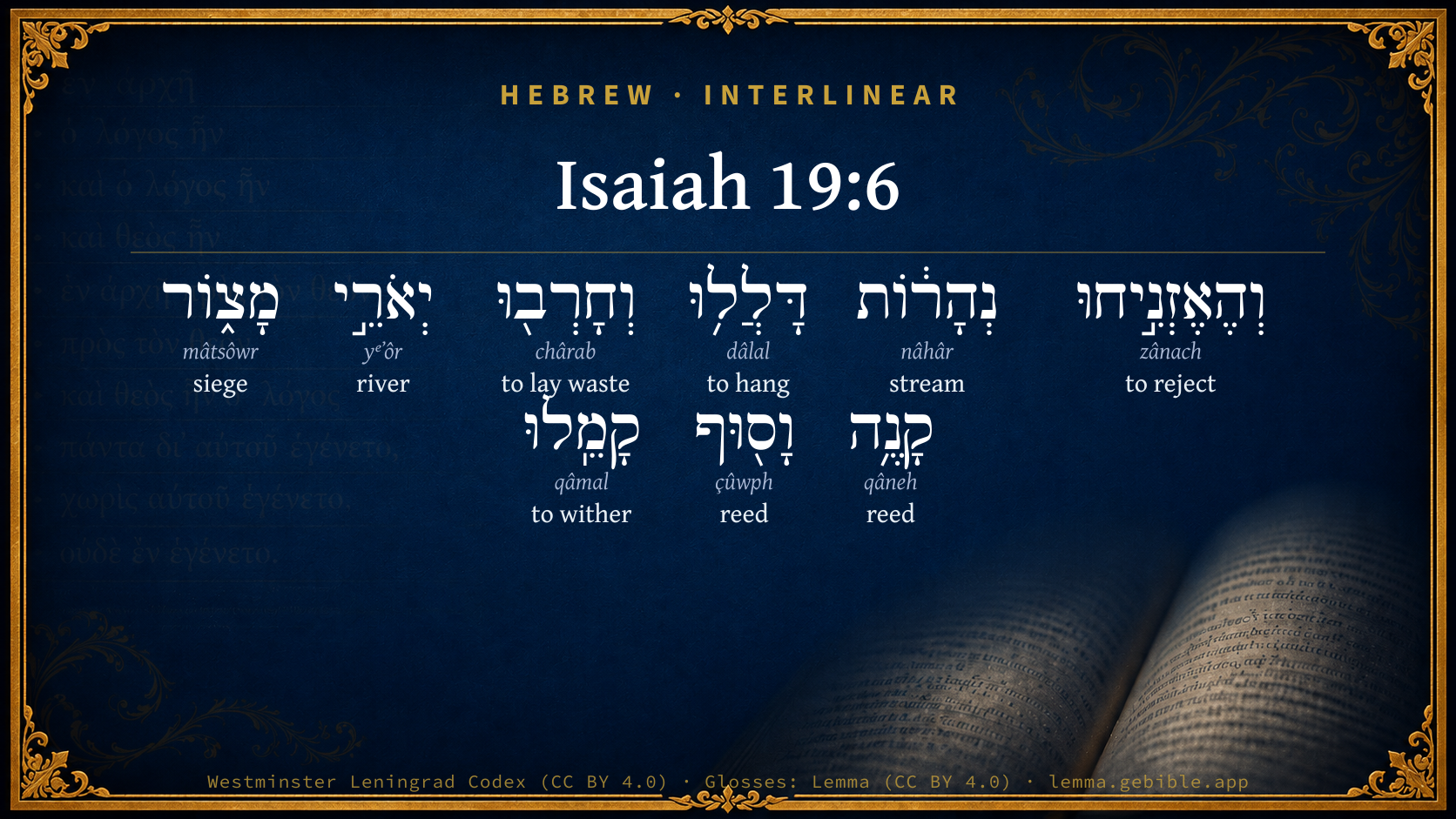
Hebrew (Westminster Leningrad Codex) Isaiah 19:6 appears in the Hebrew Old Testament. The text above is from the Westminster Leningrad Codex. Each word links to its Strong’s number, a concise gloss, and parsing drawn from the Open Scriptures Hebrew Bible morphology. Click any word for its full Brown-Driver-Briggs (BDB) entry.
Download image
Cite this verse

Isaiah 19:6 (World English Bible). Public Domain. Lemma interlinear Bible study tool, https://lemma.gebible.app/v/isaiah/19/6.

Show BibTeX & RIS
BibTeX
RIS
English Translation
The rivers shall become foul; the streams of Egypt shall be diminished and dried up; the reeds and flags shall wither away.
World English Bible · Public Domain
Highlights
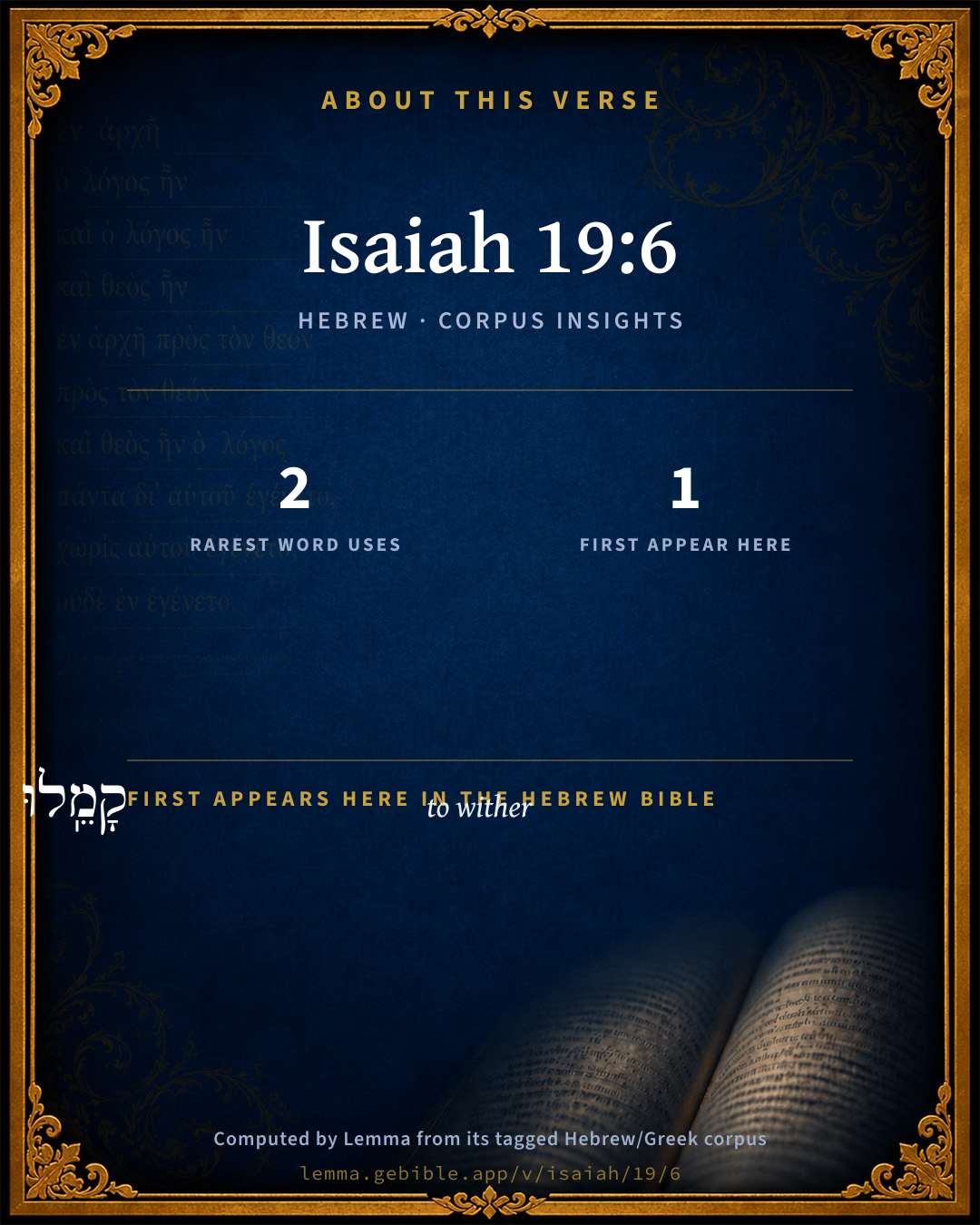
  • 1 first appearance in the Hebrew Bible
Full analysis ↓
Download a study sheet

One document with this verse’s original text, its word-by-word gloss line, the meaning frame, cross-references with their text, attributed commentary, and full source and license credits — printable, and it pastes into notes with its structure intact.

This verse Autodidact and up

Study sheet (.html) Plain text (.txt)

A passage Seminary Student

Up to 50 verses in one chapter. A passage sheet keeps up to 6 commentary sources and 12 cross-references per verse, in the order this page ranks them, and says so on the sheet whenever that leaves anything out. Ask for a single verse and you get the Autodidact verse sheet above.

Everything on this page stays free to read, with no account — the sheet is a download of what is already on screen, not access to it.

Want to remove ads? Support Godless Engineer
Compare translations 3

The same verse in 3 English versions, stacked beneath the original-language interlinear above. Click any original word for its lexicon entry.

Each is an independent rendering of the whole verse — the interlinear is not word-aligned to these translations.

Highlighted words mark where these versions differ — a whole-verse word diff, not a word-by-word alignment.

  • World English Bible Public Domain
    The rivers shall become foul; the streams of Egypt shall be diminished and dried up; the reeds and flags shall wither away.
  • King James Version Public Domain
    And they shall turn the rivers far away; and the brooks of defence shall be emptied and dried up: the reeds and flags shall wither.
  • unfoldingWord Literal Text CC BY-SA 4.0
    And the rivers will become foul; the streams of Matsor will dwindle and become dry. The reed and the rush will wither.

unfoldingWord Literal Text — © unfoldingWord, licensed CC BY-SA 4.0. Word-aligned USFM3 via Door43 (git.door43.org/unfoldingWord/en_ult).

Versions to compare (up to 4)

3 of 4 selected

Show all 18 translations

Every available English version of this verse, each an independent rendering of the whole verse.

  • World English Bible Public Domain
    The rivers shall become foul; the streams of Egypt shall be diminished and dried up; the reeds and flags shall wither away.
  • Berean Standard Bible Public Domain
    The canals will stink; the streams of Egypt will trickle and dry up; the reeds and rushes will wither.
  • Majority Standard Bible Public Domain
    The canals will stink; the streams of Egypt will trickle and dry up; the reeds and rushes will wither.
  • King James Version Public Domain
    And they shall turn the rivers far away; and the brooks of defence shall be emptied and dried up: the reeds and flags shall wither.
  • American Standard Version (1901) Public Domain
    And the rivers shall become foul; the streams of Egypt shall be diminished and dried up; the reeds and flags shall wither away.
  • Revised Version (1885) Public Domain
    And the rivers shall stink; the streams of Egypt shall be minished and dried up: the reeds and flags shall wither away.
  • Geneva Bible (1599) Public Domain
    And the riuers shall goe farre away: the riuers of defence shalbe emptied and dryed vp: the reedes and flagges shall be cut downe.
  • Douay-Rheims (1899) Public Domain
    And the rivers shall fail: the streams of the banks shall be diminished, and be dried up. The reed and the bulrush shall wither away.
  • Young's Literal Translation Public Domain
    And they have turned away the flowings, Weak and dried up have been brooks of the bulwark, Reed and flag have withered.
  • Literal Standard Version CC BY-SA 4.0
    And they have turned away the flowings, || Brooks of the bulwark have been weak and dried up, || Reed and flag have withered.
  • Unlocked Literal Bible CC BY-SA 4.0
    The rivers will become foul; the streams of Egypt will dwindle and dry up; the reeds and flags will wither away.
  • unfoldingWord Literal Text CC BY-SA 4.0
    And the rivers will become foul; the streams of Matsor will dwindle and become dry. The reed and the rush will wither.
  • Darby Bible Public Domain
    and the rivers shall stink, and the streams of Egypt shall be diminished and drain away: the reeds and sedges shall wither.
  • World Messianic Bible Public Domain
    The rivers will become foul. The streams of Egypt will be diminished and dried up. The reeds and flags will wither away.
  • Webster's Bible Public Domain
    And they shall turn the rivers far away; and the brooks of defense shall be emptied and dried up: the reeds and flags shall wither.
  • Free Bible Version CC BY-SA 4.0
    The channels will start to stink; the branches of the Nile in Egypt will dry to a trickle and dry up; the reeds and rushes will wither away.
  • Bible in Basic English Public Domain
    And the rivers will have an evil smell; the stream of Egypt will become small and dry: all the water-plants will come to nothing.
  • JPS Tanakh (1917) Public Domain
    And the rivers shall become foul; the streams of Egypt shall be minished and dried up; the reeds and flags shall wither.

Literal Standard Version (2020), Covenant Press — licensed CC BY-SA 4.0. Text via the HelloAO Bible API (eBible.org). Unlocked Literal Bible (unfoldingWord) — licensed CC BY-SA 4.0. Text via the HelloAO Bible API (eBible.org). unfoldingWord Literal Text — © unfoldingWord, licensed CC BY-SA 4.0. Word-aligned USFM3 via Door43 (git.door43.org/unfoldingWord/en_ult). Free Bible Version, Dr. Jonathan Gallagher — licensed CC BY-SA 4.0. Text via the HelloAO Bible API (eBible.org).

Word by word

More ways to search: Search by grammar → Find every occurrence → Compare this word →

Practice this passage: Drill this verse → Learn its vocabulary →

About this verse

These counts appear in no published source. They are computed here, from the morphology-tagged text and Lemma’s own curated glosses. What Lemma adds →

9
words
9
distinct lemmas
Prophets
section

Notable vocabulary

The rarest word here is קָמֵֽלוּ to wither H7060 — appearing just 2 times in the whole Hebrew Bible.

First appearance in Scripture

This word makes its first canonical appearance in the Hebrew Bible here:

  • קָמֵֽלוּ to wither H7060

Shared distinctive vocabulary

קָמֵֽלוּ to wither H7060 occurs in 2 verses of the Hebrew Bible. Also found in:

Grammatical profile

  • 4 verbs
  • 5 nouns

Verb forms

  • וְהֶאֶזְנִ֣יחוּ Hiphil · Sequential Perfect
  • דָּלֲל֥וּ Qal · Perfect
  • וְחָרְב֖וּ Qal · Sequential Perfect
  • קָמֵֽלוּ Qal · Perfect

Hebrew & Septuagint length

In English translation the verse runs 22 words from the Hebrew and 28 from the Septuagint (LXX English) — closely comparable.

A rough comparison of the two English renderings, which tokenize alike — not a word-level alignment.

Word counts can differ between the Hebrew and the Greek without any difference in meaning — e.g. the Hebrew direct-object marker אֵת has no separate Greek word, and Greek often adds the article ὁ.

Cross-references

7

Topical passages linked to Isaiah 19:6 in the Treasury of Scripture Knowledge — connected by theme and wording, ordered by reader-vote popularity; previews shown in the World English Bible.

  • Isaiah 37:25 I have dug and drunk water, and with the sole of my feet will I dry up all the rivers of Egypt.
  • Exodus 2:3 When she could no longer hide him, she took a papyrus basket for him, and coated it with tar and with pitch. She put the child in it, and laid it in the reeds by the river's bank.
  • Exodus 7:18 The fish that are in the river shall die, and the river shall become foul; and the Egyptians shall loathe to drink water from the river."'"
  • 2 Kings 19:24 I have dug and drunk strange waters, and with the sole of my feet will I dry up all the rivers of Egypt.
  • Job 8:11 "Can the papyrus grow up without mire? Can the rushes grow without water?
  • Isaiah 15:6 For the waters of Nimrim shall be desolate; for the grass is withered away, the tender grass fails, there is no green thing.
  • Isaiah 18:2 that sends ambassadors by the sea, even in vessels of papyrus on the waters, [saying], Go, you swift messengers, to a nation tall and smooth, to a people awesome from their beginning onward, a nation that measures out and treads down, whose land the rivers divide!

Cross-references courtesy of OpenBible.info (CC BY 4.0).

Hebrew and Greek witnesses Masoretic Hebrew ↔ Greek Septuagint

The same verse in the two great witnesses to the Old Testament, shown verse-for-verse.

These are two independent witnesses, not word-aligned to each other, and the Septuagint is shown in lemma (dictionary) form.

Hebrew Isaiah 19:6 Masoretic · Westminster Leningrad Codex

וְהֶאֶזְנִ֣יחוּ נְהָר֔וֹת דָּלֲל֥וּ וְחָרְב֖וּ יְאֹרֵ֣י מָצ֑וֹר קָנֶ֥ה וָס֖וּף קָמֵֽלוּ

The rivers shall become foul; the streams of Egypt shall be diminished and dried up; the reeds and flags shall wither away.

World English Bible · Public Domain

Greek LXX Isaiah 19:6 Septuagint · lemma form

καί ἐκλείπω ὁ ποταμός καί ὁ διῶρυξ ὁ ποταμός καί ξηραίνω πᾶς συναγωγή ὕδωρ καί ἐν πᾶς ἕλος κάλαμος καί πάπυρος

And the streams shall fail, and the canals of the river; and every reservoir of water shall be dried up, in every marsh also of reed and papyrus.

LXX2012 (modern English Septuagint) · Public Domain

On this verse, Jamieson, Fausset & Brown discusses the Septuagint’s reading. Read the note in Commentary ↓

Hebrew: Westminster Leningrad Codex (CC BY 4.0). Greek: Septuagint (public domain); English from LXX2012 (modern English Septuagint) (Public Domain). How the Septuagint differs from the Hebrew →

Targum (Aramaic paraphrase)

1

The Targum is the ancient Jewish Aramaic paraphrase of the Hebrew Scriptures — an interpretive translation, not the Hebrew text itself. Onkelos (literal) and Pseudo-Jonathan (expansive) render the Torah, and Jonathan the Prophets. Coverage is partial: where no permissively-licensed English translation exists for a verse, only the Aramaic is shown. This is verse-level text, not a word-by-word alignment to the Hebrew.

  1. Targum Jonathan Prophets (Joshua–Malachi)
    וְיִצְדוּן נַהַרְוָתְהוֹן וְיִבְשׁוּן וְיֶחְרְבוּן נַהֲרֵיהוֹן עַמִיקַיָא קָנֵי וְגוֹמָא לָא יִסְקוּן:

    And their rivers shall be laid waste, and their deep streams shall be dried up and wasted: the reeds and flags shall not grow.

    Targum Jonathan — Aramaic: “Mikraot Gedolot” (public domain). English: “Sefaria Community Translation” (CC0 1.0 (public-domain dedication)); “London "Chaldee Paraphrase," 1871” (public domain). Text via Sefaria.

Commentary

Notes on Isaiah 19:6 from classic Christian and Jewish commentators (each source and its license shown beneath its notes). The classic Christian expositions comment on the surrounding passage and are grouped to its opening verse, so a note may address several verses; the Jewish commentaries on the Tanakh (Rashi and others) are per-verse, so they appear only where the commentator wrote on this verse.

Lemma curates 59 commentaries, every one of them public domain or Creative Commons licensed, each selected and text-cleaned for this edition rather than reprinted as found. About our sources →

Trapp's Complete Commentary

John Trapp

Isa 19:6 And they shall turn the rivers far away; [and] the brooks of defence shall be emptied and dried up: the reeds and flags shall wither.

Ver. 6. And they shall turn the rivers far away.] The Assyrians shall, or some of their own fond and vainglorious princes shall drain the river Nile at several passages and in several places, to the impairing of the river and the impeaching of the state. {a}

The reeds and flags shall wither.] These were of great use there; for of flags they made their barks and boats, mats also, wheels, baskets, &c.; of reeds they made their sails, ropes, paper, and a kind of juice serving them for food, {b} &c. As therefore the palm tree is to the Indians a cornucopia, yielding many commodities, so are reeds and flags to the Egyptians.

{a} Herodot., lib. ii.

{b} Plin., lib. xiii. cap. 11.

John Trapp, A Commentary or Exposition upon All the Books of the Old and New Testament (1647–1656) — public domain. Text from a community e-Sword module.

Geneva Bible (1599)

Geneva Bible translators

For the Nile ran into the sea by seven streams, as though they were so many rivers.

Geneva Bible (1599) marginal notes — public domain. Text via Bolls.life.

Jamieson, Fausset & Brown

Robert Jamieson, A. R. Fausset & David Brown

they shall turn the rivers--rather, "the streams shall become putrid"; that is, the artificial streams made for irrigation shall become stagnant and offensive when the waters fail [MAURER]. HORSLEY, with the Septuagint, translates, "And waters from the sea shall be drunk"; by the failure of the river water they shall be reduced to sea water.

brooks of defence--rather, "canals of Egypt"; "canals," literally, "Niles," Nile canals, the plural of the Egyptian term for the great river. The same Hebrew word, Matzor, whence comes Mitzraim, expresses Egypt, and a place of "defense." HORSLEY, as English Version translates it, "embanked canals,"

reeds . . . flags--the papyrus. "Reed and rush"; utter withering.

Jamieson, Fausset & Brown — Commentary Critical and Explanatory on the Whole Bible (1871) — public domain (CC PDM 1.0). Text via the HelloAO Bible API.

Adam Clarke's Commentary

Verse 6. Shall turn the rivers far away - "Shall become putrid"] האזניחו heeznichu. This sense of the word, which Simonis gives in his Lexicon, from the meaning of it in Arabic, suits the place much better than any other interpretation hitherto given; and that the word in Hebrew had some such signification, is probable from 2Ch 29:19, where the Vulgate renders it by polluit, polluted, and the Targum, by profaned, and made abominable, which the context in that place seems plainly to require. The form of the verb here is very irregular; and the rabbins and grammarians seem to give no probable account of it.

Adam Clarke's Commentary on the Bible (1810–1826) — public domain. Text from a community e-Sword/MySword module.

Ellicott's Commentary for English Readers

(6) And they shall turn the rivers far away.—Better, the river shall stagnate; i.e., in consequence of the Nile’s inundation failing.

The brooks of defence.—The latter noun (Heb., matzor) is better treated as a proper name, the singular of the dual form Mitsraim, commonly used for Egypt. Here it would seem to be used for Lower Egypt, the region of Zoan and Memphis, as distinct from Upper Egypt or the Thebaid. The same form occurs in Isa_37:25; 2Ki_19:24; Mic_7:12. Its primary meaning is that of a fortified land. The “flags” are strictly the papyrus of the Nile; the “brooks” are the canals or Nile-branches of the Delta.

A Bible Commentary for English Readers, edited by Charles John Ellicott (1878–1897) — public domain. Text from a community e-Sword module.

The Cambridge Bible for Schools and Colleges

gen. ed. J. J. S. Perowne

6. The verse reads: And the streams shall stink, the canals of Egypt shall become feeble and dry up, &c. The word for “stink” is an anomalous form in Hebr. That rendered in A.V. “defence” is a rare name for Egypt (Maçôr, cf. Assyr. Muṣur, Arab. Miṣr), found also in ch. Isa_37:25; 2Ki_19:24; Mic_7:12. “Canals” (A.V. “brooks”) is literally “Niles” (cf. Isa_7:18).

The Cambridge Bible for Schools and Colleges (gen. ed. J. J. S. Perowne; Cambridge University Press, 1878–1918) — public domain. Text from a community e-Sword module.

John Gill's Exposition

And they shall turn the rivers far away,.... The river Nile, called "rivers", the plural for the singular, because of the abundance of water in it; or its seven streams, with other rivulets, derived from it. Some make the "they" here to refer to the kings of Egypt, and interpret the words of some projects of theirs, by which the course of the river was turned to great disadvantage; particularly they understand it of the twelve tyrants that reigned after Sethon, to whom they ascribe the digging of the vast lake of Moeris, the two pyramids built in the midst of it, and a labyrinth near it, though only the labyrinth was made by them (b); and as for the lake, it was made by Moeris, a king of Egypt, from whom it had its name, some hundred years before; and, besides, was of service, and not disservice, to the Nile; for it received its waters when it overflowed too much, and it furnished it with water by an outlet when it failed: rather therefore this passage may be illustrated by the attempt which Necus, the son of Psammiticus, whom the Scripture calls Pharaohnecho, made, to join the Nile and the Red Sea together, by making a canal from the one to the other; in which work he lost a hundred and twenty thousand men, and desisted from it without finishing it (c); but it is thought hereby the river was greatly weakened:

and the brooks of defence shall be emptied and dried up; as the river of Nile and its streams were the defence of the land of Egypt, as well as made for the fruitfulness of it, for these must make it less accessible to a foreign enemy; and besides, here lay their shipping, which were their protection; and moreover, from hence brooks and courses of water might be derived and carried about their fortified cities, which added to the strength of them. The Targum renders it deep brooks or rivers; and Kimchi interprets it the brooks of Egypt, taking Matzor to signify Egypt, a word in sound near to Mitzraim, the common word used for Egypt. It looks, by this and other expressions in the context, as if more were designed than the above instance or instances will account for:

the reeds and flags shall wither; which grew in the brooks, and near them; and therefore much more the grass and corn, and other trees, which were at a distance; besides, these are mentioned, bemuse of the great usefulness they were of; for of these they made ships, barks, and boats, and mats for bedding, and nets fishing; as also paper to write on, as follows, and which was a staple commodity with them; See Gill on Isa 18:2.

(b) Herodot. l. 2. c. 148, 149. (c) Ib. c. 158.

John Gill's Exposition of the Whole Bible (1746–1763) — public domain (CC PDM 1.0). Text via the HelloAO Bible API.

Albert Barnes' Notes on the Bible

And they shall turn the rivers far away - (האזיּחוּ he'ezenı̂ychû), probably from זנח zânach, “to have an offensive smell; to be rancid, or putrid.” The word in this form occurs nowhere else. It is in the Hiphil conjugation, and is probably a form made from a mixture with the Chaldee. The sense is not doubtful. It means ‘the rivers shall become putrid - or have an offensive smell;’ that is, shall become stagnant, and send forth unwholesome “miasmata” producing sickness, as stagnant waters often do. The Vulgate renders it, ‘And the rivers shall fail.’ The Septuagint, ‘And the Egyptians shall drink the waters from the sea, but the river shall fail, and be dried up, and the rivers shall fail, and the streams (διὼρυχες diōruches) of the river, and all the assembling (συναγωγή sunagōgē) waters shall be dried up.’

And the brooks of defense - Hebrew, ‘The rivers of מצור mâtsôr. The word מצור mâtsôr often means “straitness, affliction;” then a siege, a wall, a bulwark, a fortification. But, probably, it here means “Egypt,” or the same as מצרים mı̂tserayı̂m (compare Isa 37:25; 2Ki 18:24; Mar 7:12). Perhaps the Hebrews may have thought of Egypt as a strongly fortified place, and thus have given the name to it; or possibly this may have been a modification of the name “Mitsraim.”

The reeds and flags - Which grew on the banks of the Nile - the papyrus, etc. (see the note at Isa 18:2)

Albert Barnes' Notes on the Bible (1834–1885) — public domain. Text from a community e-Sword/MySword module.

Matthew Poole's English Annotations

They shall turn the rivers far away; which is to be taken impersonally, as such expressions are very frequently, for, the rivers (those small rivulets by which the waters of Nilus were conveyed and distributed into several parts of the land)

shall be turned far away, as they must needs be, when the greater river Nilus, which fed them, was dried up.

The brooks of defence; the several branches of the river Nilus, which were a great defence to Egypt, as is well known.

The reeds and flags; which were very useful to them for making their boats, which were absolutely necessary in that country, and divers other things.

Shall wither; as they commonly do for want of water.

Matthew Poole's English Annotations on the Holy Bible (1683–1685) — public domain. Text from a community e-Sword/MySword module.

Whedon's Commentary on the Bible

Daniel D. Whedon

6, 7. Shall turn the rivers — Many famines have occurred in Egypt owing to failure of the rains in the south. The river becomes low and stagnant and putrid. Instead of “they shall turn the rivers,” the Speaker’s Commentary renders, “The rivers shall become loathsome;” and Lange, “shall become a stench.”

Brooks of defence — The Nile canals were a “defence” in two ways: the first, in giving fertility and defending from starvation; the second in being unbridged moats against invading hordes; but being dried up, they would allow a foe to approach the walls of the city. Reeds… flags…

paper reeds — The first two of these mean the papyrus, doubtless; (see chap. Isa_18:2;) “paper reeds” is from a different word in Hebrew. Gesenius supposes, from its root, that bare places along the banks covered with grass are intended. The meaning is, the Nile is unavailing to the people. It brings no food by its fertility. It brings no commerce, on account of the half-anarchical condition of the country; but it does bring stench, disease, and death by its stagnancy.

Daniel D. Whedon (gen. ed.), Commentary on the Old and New Testaments (1874–1909) — public domain. Text from a community e-Sword module.

The Pulpit Commentary

And they shall turn the rivers far away; rather, and the rivers shall stagnate (Cheyne). Probably the canals are intended, as in Exo_7:19 (see "Pulpit Commentary," ad loc.). The brooks of defense shall be emptied. Some render this "brooks of Egypt," regarding matsor as here used for "Mitsraim;" but our translation is more forcible, and may well stand. The "brooks of defense" are those which had hitherto formed the moats round walled cities. (comp. Isa_37:25 Nah_3:8) The reeds and flags shall wither. Reeds, flags, rushes, and water-plants of all kinds abound in the backwaters of the Nile, and the numerous ponds and marshes connected with its overflow (see the "Pulpit Commentary" on Exo_2:3, p. 24). These forms of vegetation would be the first to wither on the occurrence of a deficient inundation.

The Pulpit Commentary (1880–1919), ed. H.D.M. Spence-Jones & Joseph S. Exell — public domain. Text from a community e-Sword module.

John Wesley's Explanatory Notes

Rivers - The rivers (those rivulets by which the waters of Nile were distributed into several parts of the land) shall be turned far away, as they must needs be, when the river which fed them was dried up. Brooks - The several branches of the river Nile, which were a great defense to Egypt. Reeds - Which were useful to them for making their boats. Whither - As they commonly do for want of water.

John Wesley, Explanatory Notes Upon the Whole Bible (1754–1765) — public domain. Text via the GEBible commentary corpus.

J. A. Alexander on Isaiah

Joseph Addison Alexander

“And the rivers shall stink (or become putrid), the streams of Egypt are emptied and dried up, reed and rush sicken (pine or wither).” The streams meant are the natural and artificial branches of the Nile. The reed and rush are mentioned as a common growth in marshy situations.

Joseph Addison Alexander, The Prophecies of Isaiah (1846–1847; New York: Scribner, 1870–1878) — public domain. Text from a community e-Sword module.

Rashi

Rabbi Shlomo Yitzchaki (Rashi)

And they shall abandon When the water decreases, the mud is noticeable in it, and it becomes a mire and is abandoned.

the deep canals Heb. יְאֹרֵי מָצוֹר. The deep canals, like the ditches of the sieges of cities. [Rashi according to Parshandatha. Printed editions read:] In the ditches of the sieges of cities.

reeds and rushes that grew there because of their abundant water.

shall be cut off When the canals dry up, the reeds stop growing, and they dry up and fall. Jonathan renders: Shall not come up. Elsewhere (infra 33:9), he renders: “The Lebanon was dried up, cut off (קָמַל),” as ‘fell.’ I say, however, that it is an expression of cutting off, that they are cut off by themselves because of their dryness, and they fall.

Rashi on the Tanakh — English translations: “The Judaica Press complete Tanach with Rashi, translated by A. J. Rosenberg” (CC BY 4.0); “Pentateuch with Rashi's commentary by M. Rosenbaum and A.M. Silbermann, 1929-1934” (public domain); “The Metsudah Tanach series, Lakewood, N.J” (CC BY 4.0); and “The Book of Joshua, Metsudah Publications, 1997” (CC BY 4.0). Text via Sefaria.

Ibn Ezra

Rabbi Abraham ibn Ezra

והאזניחו And shall leave.. א is epenthetic. והאזניחו נהרות And the people will leave the rivers.

דללו They shall be poor. Comp. דל poor (Lev. 14:21).

יאורי מצור The ponds of siege. The ponds which are prepared in order that the enemy should not be able to destroy the inhabitants through want of water, when he besieges the town.

קנה וסוף The reeds and flags. The plants on the banks of the river.

קמלו Shall be cut off. Another instance of the same root occurs in this book (33:9)

Ibn Ezra on the Tanakh — English translations: “Sefaria Community Translation” (CC0 1.0 (public-domain dedication)); “Yalkut, Sifsei Chachomim Chumash, Metsudah Publications, 2009” (CC BY 4.0); and “Commentary of Ibn Ezra on Isaiah - trans. by M. Friedlander, 1873” (public domain). Text via Sefaria.

Lesson kit

Teaching starters — assembled from the data on this page, not authored interpretation. Every prompt links to the verse data it draws on. Edit before teaching.

Isaiah, in the Prophets, opens this verse with 9 words (9 distinct Hebrew lemmas). Its most distinctive word is qâmal (“to wither”). A historical commentator’s framing appears above. Read the whole chapter for the surrounding context.

Discussion questions

  1. The word qâmal carries the sense “to wither.” How does it shape the verse?
  2. This is the first place “to wither” appears in Scripture (first appears here). What does its debut here establish?
  3. How does Isaiah 33:9, which shares the word «to wither», read alongside this verse?
  4. The translations on this page render this verse differently — a whole-verse word diff, not a word-by-word alignment. What might account for the different wordings?
  5. «וְהֶאֶזְנִ֣יחוּ» is a Hiphil Sequential Perfect verb. How does that grammatical form shape the action described?
  6. Compare how Trapp's Complete Commentary and Geneva Bible (1599) read this verse. Where do they agree or differ?

Things to notice

Reading settings

Reading text

Shown beneath each verse's original-language words.

Old Testament
Old Testament edition

Read the OT as the Masoretic Hebrew (MT) or the Greek Septuagint (LXX).

English shown for the Greek Septuagint (in the Hebrew ↔ Greek comparison).

Comparing translations? Open the Compare panel on any verse page to stack up to four side by side.