
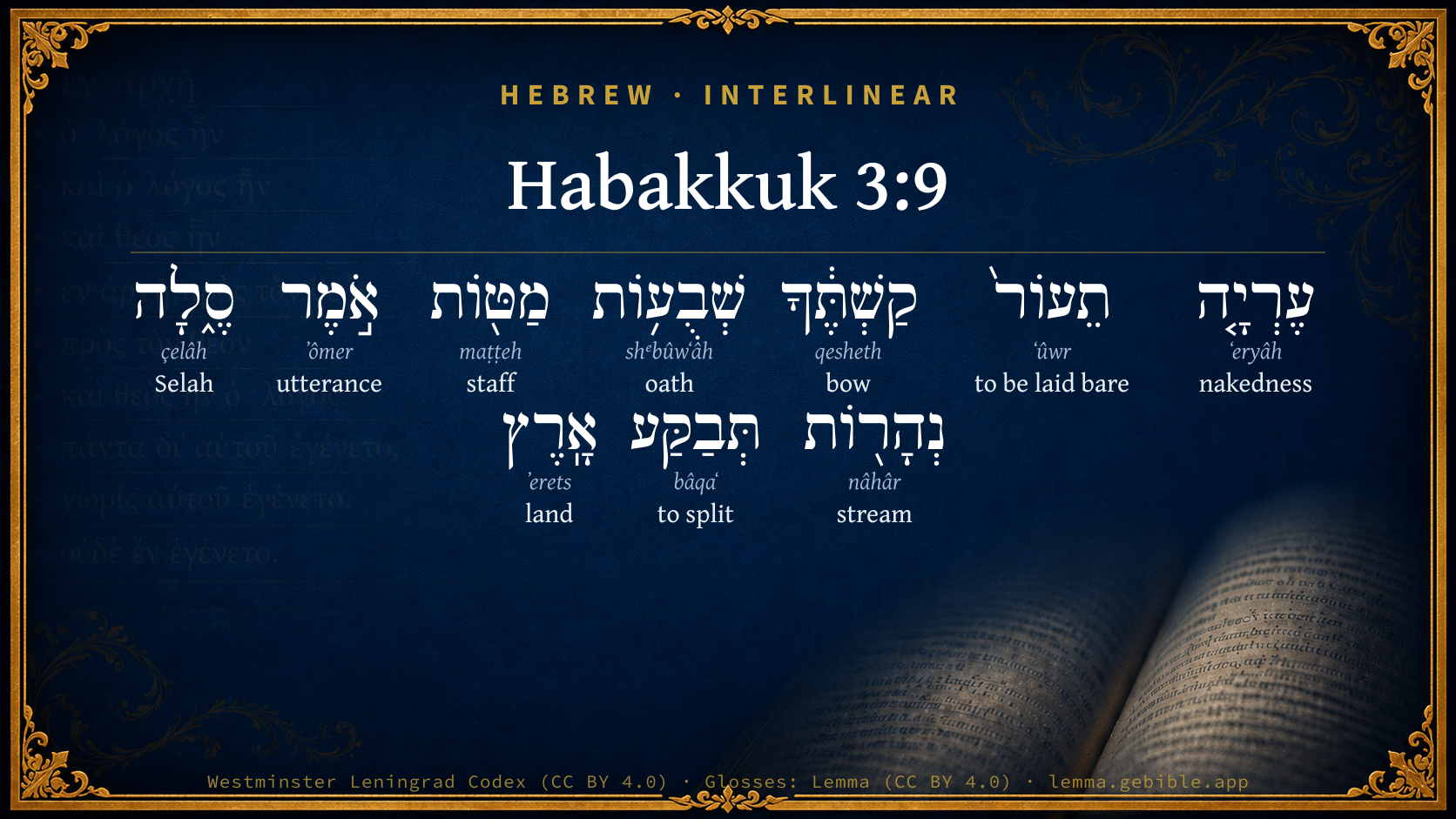
Habakkuk 3:9

Hebrew (Westminster Leningrad Codex) Habakkuk 3:9 appears in the Hebrew Old Testament. The text above is from the Westminster Leningrad Codex. Each word links to its Strong’s number, a concise gloss, and parsing drawn from the Open Scriptures Hebrew Bible morphology. Click any word for its full Brown-Driver-Briggs (BDB) entry.
Download image
Cite this verse

Habakkuk 3:9 (World English Bible). Public Domain. Lemma interlinear Bible study tool, https://lemma.gebible.app/v/habakkuk/3/9.

Show BibTeX & RIS
BibTeX
RIS
English Translation
You uncovered your bow. You called for your sworn arrows. Selah. You split the earth with rivers.
World English Bible · Public Domain
Highlights
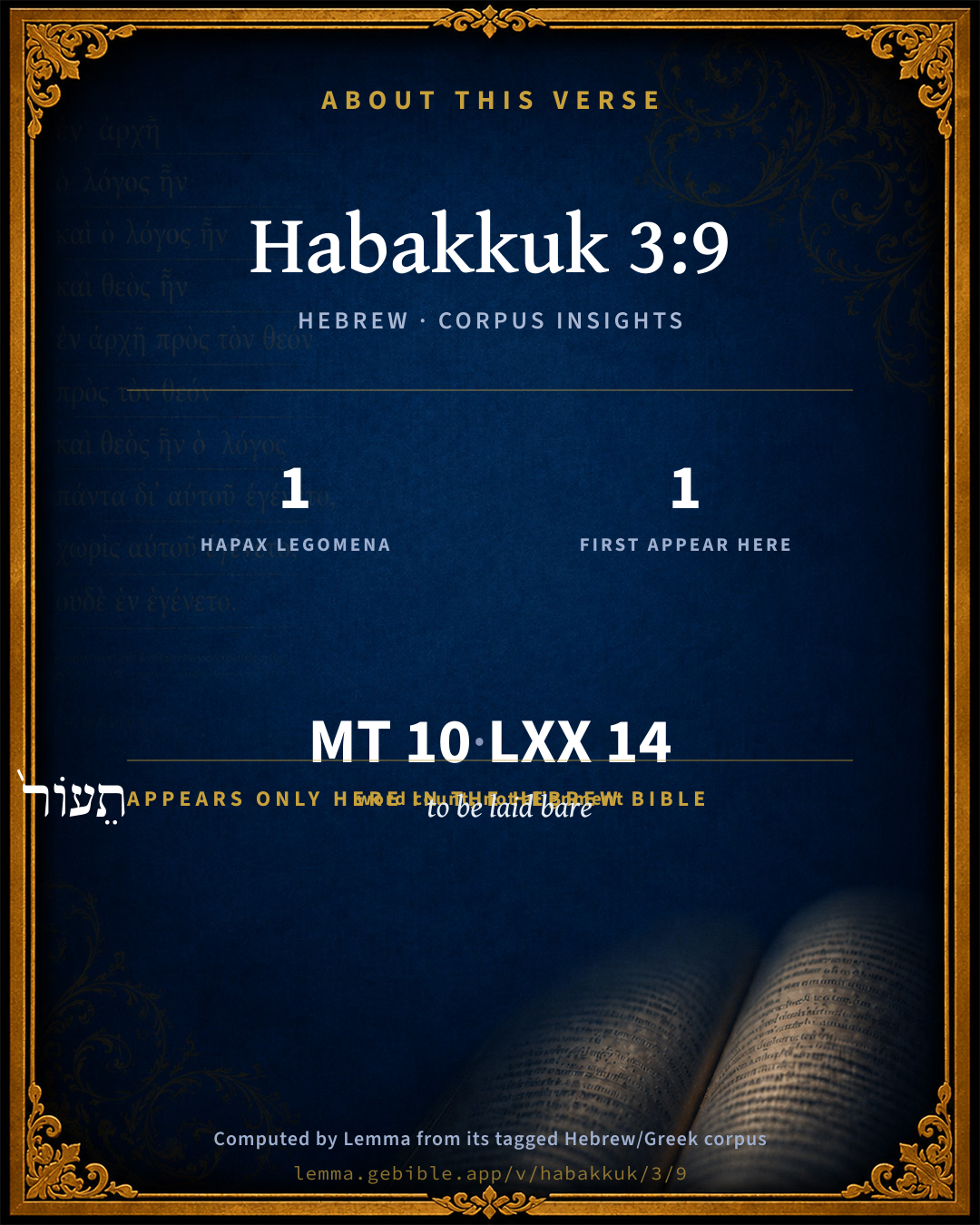
  • 1 hapax legomenon — only here in the Hebrew Bible
  • 1 first appearance in the Hebrew Bible
Full analysis ↓
Download a study sheet

One document with this verse’s original text, its word-by-word gloss line, the meaning frame, cross-references with their text, attributed commentary, and full source and license credits — printable, and it pastes into notes with its structure intact.

This verse Autodidact and up

Study sheet (.html) Plain text (.txt)

A passage Seminary Student

Up to 50 verses in one chapter. A passage sheet keeps up to 6 commentary sources and 12 cross-references per verse, in the order this page ranks them, and says so on the sheet whenever that leaves anything out. Ask for a single verse and you get the Autodidact verse sheet above.

Everything on this page stays free to read, with no account — the sheet is a download of what is already on screen, not access to it.

Want to remove ads? Support Godless Engineer
Compare translations 3

The same verse in 3 English versions, stacked beneath the original-language interlinear above. Click any original word for its lexicon entry.

Each is an independent rendering of the whole verse — the interlinear is not word-aligned to these translations.

Highlighted words mark where these versions differ — a whole-verse word diff, not a word-by-word alignment.

  • World English Bible Public Domain
    You uncovered your bow. You called for your sworn arrows. Selah. You split the earth with rivers.
  • King James Version Public Domain
    Thy bow was made quite naked, according to the oaths of the tribes, even thy word. Selah. Thou didst cleave the earth with rivers.
  • unfoldingWord Literal Text CC BY-SA 4.0
    Your bow was completely bared; the oaths to the staffs a word. Selah You split the earth with rivers.

unfoldingWord Literal Text — © unfoldingWord, licensed CC BY-SA 4.0. Word-aligned USFM3 via Door43 (git.door43.org/unfoldingWord/en_ult).

Versions to compare (up to 4)

3 of 4 selected

Show all 18 translations

Every available English version of this verse, each an independent rendering of the whole verse.

  • World English Bible Public Domain
    You uncovered your bow. You called for your sworn arrows. Selah. You split the earth with rivers.
  • Berean Standard Bible Public Domain
    You brandished Your bow; You called for many arrows. Selah You split the earth with rivers.
  • Majority Standard Bible Public Domain
    You brandished Your bow; You called for many arrows. Selah You split the earth with rivers.
  • King James Version Public Domain
    Thy bow was made quite naked, according to the oaths of the tribes, even thy word. Selah. Thou didst cleave the earth with rivers.
  • American Standard Version (1901) Public Domain
    Thy bow was made quite bare; The oaths to the tribes were a `sure' word. Selah. Thou didst cleave the earth with rivers.
  • Revised Version (1885) Public Domain
    Thy bow was made quite bare; the oaths to the tribes were a sure word. Selah Thou didst cleave the earth with rivers.
  • Geneva Bible (1599) Public Domain
    Thy bowe was manifestly reueiled, and the othes of the tribes were a sure worde, Selah. thou diddest cleaue the earth with riuers.
  • Douay-Rheims (1899) Public Domain
    Thou wilt surely take up thy bow: according to the oaths which thou hast spoken to the tribes. Thou wilt divide the rivers of the earth.
  • Young's Literal Translation Public Domain
    Utterly naked Thou dost make Thy bow, Sworn are the tribes -- saying, `Pause!' `With' rivers Thou dost cleave the earth.
  • Literal Standard Version CC BY-SA 4.0
    You make Your bow utterly naked, || The tribes have sworn, saying, “Pause!” You cleave the earth [with] rivers.
  • Unlocked Literal Bible CC BY-SA 4.0
    You have brought out your bow without a cover; you put arrows to your bow! Selah You divided the earth with rivers.
  • unfoldingWord Literal Text CC BY-SA 4.0
    Your bow was completely bared; the oaths to the staffs a word. Selah You split the earth with rivers.
  • Darby Bible Public Domain
    Thy bow was made naked, The rods [of discipline] sworn according to [thy] word. Selah. Thou didst cleave the earth with rivers.
  • World Messianic Bible Public Domain
    You uncovered your bow. You called for your sworn arrows. Selah. You split the earth with rivers.
  • Webster's Bible Public Domain
    Thy bow was made quite naked, according to the oaths of the tribes, even thy word. Selah. Thou didst cleave the earth with rivers.
  • Free Bible Version CC BY-SA 4.0
    You took out your bow; you filled your quiver with arrows. Selah. You split the earth open with rivers.
  • Bible in Basic English Public Domain
    Your bow was quite uncovered. Selah. By you the earth was cut through with rivers.
  • JPS Tanakh (1917) Public Domain
    Thy bow is made quite bare; sworn are the rods of the word. Selah. Thou dost cleave the earth with rivers.

Literal Standard Version (2020), Covenant Press — licensed CC BY-SA 4.0. Text via the HelloAO Bible API (eBible.org). Unlocked Literal Bible (unfoldingWord) — licensed CC BY-SA 4.0. Text via the HelloAO Bible API (eBible.org). unfoldingWord Literal Text — © unfoldingWord, licensed CC BY-SA 4.0. Word-aligned USFM3 via Door43 (git.door43.org/unfoldingWord/en_ult). Free Bible Version, Dr. Jonathan Gallagher — licensed CC BY-SA 4.0. Text via the HelloAO Bible API (eBible.org).

Word by word

More ways to search: Search by grammar → Find every occurrence → Compare this word →

Practice this passage: Drill this verse → Learn its vocabulary →

About this verse

These counts appear in no published source. They are computed here, from the morphology-tagged text and Lemma’s own curated glosses. What Lemma adds →

10
words
10
distinct lemmas
Prophets
section

Notable vocabulary

1 hapax legomenon — a word that appears only here in the entire Hebrew Bible:

  • תֵעוֹר֙ to be laid bare H5783

First appearance in Scripture

This word makes its first canonical appearance in the Hebrew Bible here:

  • תֵעוֹר֙ to be laid bare H5783

Shared distinctive vocabulary

עֶרְיָ֤ה nakedness H6181 occurs in 6 verses of the Hebrew Bible. Also found in:

Grammatical profile

  • 2 verbs
  • 7 nouns
  • 1 particle

Verb forms

  • תֵעוֹר֙ Niphal · Imperfect
  • תְּבַקַּע Piel · Imperfect

Hebrew & Septuagint length

In English translation the verse runs 17 words from the Hebrew and 20 from the Septuagint (LXX English) — closely comparable.

A rough comparison of the two English renderings, which tokenize alike — not a word-level alignment.

Word counts can differ between the Hebrew and the Greek without any difference in meaning — e.g. the Hebrew direct-object marker אֵת has no separate Greek word, and Greek often adds the article ὁ.

In the original languages it is 10 Hebrew tokens and 14 Greek tokens — but the two are counted differently (Hebrew bundles its prefixes and suffixes into one token; the Greek is in lemma form), so that isn’t a like-for-like length.

Cross-references

20

Topical passages linked to Habakkuk 3:9 in the Treasury of Scripture Knowledge — connected by theme and wording, ordered by reader-vote popularity; previews shown in the World English Bible.

  • Psalms 7:12–13 If a man doesn't relent, he will sharpen his sword; He has bent and strung his bow.
  • Psalms 78:15–16 He split rocks in the wilderness, And gave them drink abundantly as out of the depths.
  • Psalms 105:41 He opened the rock, and waters gushed out. They ran as a river in the dry places.
  • Luke 1:72–75 To show mercy towards our fathers, To remember his holy covenant,
  • Exodus 17:6 Behold, I will stand before you there on the rock in Horeb. You shall strike the rock, and water will come out of it, that the people may drink." Moses did so in the sight of the elders of Israel.
  • Numbers 20:11 Moses lifted up his hand, and struck the rock with his rod twice: and water came forth abundantly, and the congregation drank, and their cattle.
  • Deuteronomy 32:23 I will heap evils on them; I will spend my arrows on them:
  • Psalms 105:8–11 He has remembered his covenant forever, The word which he commanded to a thousand generations,
  • Psalms 143:6 I spread forth my hands to you. My soul thirsts for you, like a parched land. Selah.
  • Isaiah 51:9–10 Awake, awake, put on strength, arm of Yahweh; awake, as in the days of old, the generations of ancient times. Isn't it you who did cut Rahab in pieces, who pierced the monster?
  • Isaiah 52:10 Yahweh has made bare his holy arm in the eyes of all the nations; and all the ends of the earth have seen the salvation of our God.
  • Lamentations 2:4 He has bent his bow like an enemy, he has stood with his right hand as an adversary, Has killed all that were pleasant to the eye: In the tent of the daughter of Zion he has poured out his wrath like fire.
  • 1 Corinthians 10:4 and all drank the same spiritual drink. For they drank of a spiritual rock that followed them, and the rock was Christ.
  • Hebrews 6:13–18 For when God made a promise to Abraham, since he could swear by none greater, he swore by himself,
  • Genesis 15:18–21 In that day Yahweh made a covenant with Abram, saying, "To your seed have I given this land, from the river of Egypt to the great river, the river Euphrates:
  • Genesis 17:7–8 I will establish my covenant between me and you and your seed after you throughout their generations for an everlasting covenant, to be a God to you and to your seed after you.
  • Genesis 22:16–18 and said, "I have sworn by myself, says Yahweh, because you have done this thing, and have not withheld your son, your only son,
  • Genesis 26:3–4 Sojourn in this land, and I will be with you, and will bless you. For to you, and to your seed, I will give all these lands, and I will establish the oath which I swore to Abraham your father.
  • Genesis 28:13–14 Behold, Yahweh stood above it, and said, "I am Yahweh, the God of Abraham your father, and the God of Isaac. The land whereon you lie, to you will I give it, and to your seed.
  • Psalms 35:1–3 Contend, Yahweh, with those who contend with me. Fight against those who fight against me.

Cross-references courtesy of OpenBible.info (CC BY 4.0).

Hebrew and Greek witnesses Masoretic Hebrew ↔ Greek Septuagint

The same verse in the two great witnesses to the Old Testament, shown verse-for-verse.

These are two independent witnesses, not word-aligned to each other, and the Septuagint is shown in lemma (dictionary) form.

Hebrew Habakkuk 3:9 Masoretic · Westminster Leningrad Codex

עֶרְיָ֤ה תֵעוֹר֙ קַשְׁתֶּ֔ךָ שְׁבֻע֥וֹת מַטּ֖וֹת אֹ֣מֶר סֶ֑לָה נְהָר֖וֹת תְּבַקַּע אָֽרֶץ

You uncovered your bow. You called for your sworn arrows. Selah. You split the earth with rivers.

World English Bible · Public Domain

Greek LXX Habakkuk 3:9 Septuagint · lemma form

ἐντείνω ἐντείνω ὁ τόξον σύ ἐπί ὁ σκῆπτρον λέγω κύριος διάψαλμα ποταμός ῥήγνυμι γῆ

Surely you did bend they bow at scepters, says the Lord. Pause. The land of rivers shall be torn asunder.

LXX2012 (modern English Septuagint) · Public Domain

On this verse, Haydock's Catholic Bible Commentary discusses the Septuagint’s reading. Read the note in Commentary ↓

Hebrew: Westminster Leningrad Codex (CC BY 4.0). Greek: Septuagint (public domain); English from LXX2012 (modern English Septuagint) (Public Domain). How the Septuagint differs from the Hebrew →

Targum (Aramaic paraphrase)

1

The Targum is the ancient Jewish Aramaic paraphrase of the Hebrew Scriptures — an interpretive translation, not the Hebrew text itself. Onkelos (literal) and Pseudo-Jonathan (expansive) render the Torah, and Jonathan the Prophets. Coverage is partial: where no permissively-licensed English translation exists for a verse, only the Aramaic is shown. This is verse-level text, not a word-by-word alignment to the Hebrew.

  1. Targum Jonathan Prophets (Joshua–Malachi)
    אִתְגְלָאָה אִתְגְלֵיתָא בִּגְבוּרְתָּךְ בְּדִיל קְיָמָךְ דְעִם שִׁבְטַיָא מֵימְרָךְ קַיָם לְעַלְמִין לְהוֹן בְּזִיעֲתָא טִנָרִין תַּקִיפִין נְפָקוּ נַהֲרִין שָׁטְפִין אַרְעָא:

    (no public-domain English translation for this verse)

    Targum Jonathan — Aramaic: “Mikraot Gedolot” (public domain). English: “Sefaria Community Translation” (CC0 1.0 (public-domain dedication)); “London "Chaldee Paraphrase," 1871” (public domain). Text via Sefaria.

Commentary

Notes on Habakkuk 3:9 from classic Christian and Jewish commentators (each source and its license shown beneath its notes). The classic Christian expositions comment on the surrounding passage and are grouped to its opening verse, so a note may address several verses; the Jewish commentaries on the Tanakh (Rashi and others) are per-verse, so they appear only where the commentator wrote on this verse.

Lemma curates 59 commentaries, every one of them public domain or Creative Commons licensed, each selected and text-cleaned for this edition rather than reprinted as found. About our sources →

Trapp's Complete Commentary

John Trapp

Hab 3:9 Thy bow was made quite naked, [according] to the oaths of the tribes, [even thy] word. Selah. Thou didst cleave the earth with rivers.

Ver. 9. Thy bow was made quite naked] sc. Out of the case. He meaneth, thy power was clearly manifested and powerfully exerted against the nations above mentioned; so that all men might see plainly that thou wert that man of war, Exo 15:3, which shootest thine arrows at a certainty, and never missest thine enemies, thy buttmark, see Job 16:12.

According to the oaths of the tribes, even thy word] i.e. According to thy promises to thy people, confirmed with oaths, even those sure mercies of David, or assured to David. Some render it, according to the oaths, those props of thy word. His word is sure and sufficient of itself; but, for our better settlement, and as a prop to our faith, he hath bound it with oaths; "that by two immutable things, in which it was impossible for God to lie, we might have strong consolation," Heb 6:18. For now we may say with Solomon, "For thy word’s sake," nay, more, for thine oath’s sake, "and according to thine own heart, hast thou done all this," 2Sa 7:18; 2Sa 7:21. Thy love moved thee to make promise, yea, to give oath; and now thy truth bindeth thee to perform. All thy paths to thy people are mercy and truth, Psa 25:10; not mercy only, but mercy and truth; not by a providence only, but by virtue of a promise ratified with an oath: this is sweet indeed; this deserves a Selah to be set to it.

Thou didst cleave the earth with rivers] Exo 17:6 Psa 78:15-16 Deu 8:15 Neh 9:15. This cleaving the hard rock, and setting it abroach, this turning of the flint into a fountain, Psa 114:8, was a work of omnipotence, and is therefore so much celebrated. It maketh much to the miracle that the earth was cleft with rivers; this importeth both the plenty and the perennity thereof; for the rock, that is, the river out of the rock, followed them, 1Co 10:4, lest in that dry and barren wilderness they should perish for want of water. The same God also who had given his people petram aquatilem, gave them pluviam escatilem (as Tertullian phraseth it), manna from heaven, quails in great abundance, and never was prince better served in his greatest pomp. He also defended them from the fiery serpents, and delivered them from a thousand other deaths and dangers; all which mercies are here implied, though one only be instanced; and all to ascertain the saints how much God setteth by them, and what he will yet do for them, as occasion requireth. As he made the world at first, that he might communicate and impart himself to his elect; so for their sakes doth he still preserve and govern it, ordering the world’s disorders by an over ruling power, for his own glory and their eternal good.

John Trapp, A Commentary or Exposition upon All the Books of the Old and New Testament (1647–1656) — public domain. Text from a community e-Sword module.

The Biblical Illustrator

Joseph S. Exell

Hab_3:9

The bow was made quite naked, according to the oaths of the tribes, even Thy Word.

--The prophets closing prayer is that God would, in wrath, remember mercy. For this he is encouraged to hope by a remembrance of Gods past dealings with His people, which he reviews in a strain of sublime eloquence, lifting up his heart to God with devout acknowledgment of past help, he exclaims, Thy bow was made quite naked, etc. Apply

I. To the defence of Gods people against their enemies. There is allusion to the Eastern mode of warfare. The bow was taken out of its case, and placed upon the string ready to go forth on its errand of destruction against those who assailed the servants of God.

1. The opposition of the ungodly. There has always been a wide distinction between those who serve God, and those who serve Him not. The latter have always set themselves in fierce antagonism against the former. But Gods people have never wanted an avenger in God.

2. The designs of evil spirits. We have enemies in the invisible world. One arrow from the bow of the Almighty will put to flight the hosts of Satan.

3. The plague of our own hearts. We often carry our most dangerous enemies within us. If we allow sin to dwell unmolested within us, we carry about with us a combustible material. Until you get rid of these, you can have no abiding peace. The blood of Christ can wash them all away, the fire of the Holy Spirit can consume them all.

II. The triumph of Gods truth over every form of error.

1. The abominations of idolatry.

2. The delusions of superstition.

3. The fallacies of human reasoning.

Intellect alone is insufficient to guide us in our search after truth without some directing power from heaven. But the issue of conflict with all error is certain. These things will surely be accomplished according to the oaths of the tribes, that is, the covenant of God with His people, according to His infallible Word. (W. J. Brock, B. A,)

The Biblical Illustrator, edited by Joseph S. Exell (c. 1880s–1900s) — public domain. Text from a community e-Sword module.

Tyndale Open Study Notes

Tyndale Open Resources

3:9-11 Only God controls the forces of the natural world.

Tyndale Open Study Notes — © Tyndale Open Resources, licensed CC BY-SA 4.0. Text via the HelloAO Bible API.

Geneva Bible (1599)

Geneva Bible translators

That is, thy power.

Read Num. 20:11.

For he had not only made a covenant with Abraham, but renewed it with his posterity.

Geneva Bible (1599) marginal notes — public domain. Text via Bolls.life.

Jamieson, Fausset & Brown

Robert Jamieson, A. R. Fausset & David Brown

bow . . . made . . . naked--that is, was drawn forth from its cover, in which bows usually were cased when not in use. Compare Isa 22:6, "Kir uncovered the shield."

according to the oaths of the tribes even thy word--that is, Thy oaths of promise to the tribes of Israel (Psa 77:8; Luk 1:73-74). Habakkuk shows that God's miraculous interpositions for His people were not limited to one time, but that God's oaths to His people are sure ground for their always expecting them. The mention of the tribes, rather than Abraham or Moses, is in order that they may not doubt that to them belongs this grace of which Abraham was the depository [CALVIN and JEROME]. MAURER translates, "The spears were glutted with blood, the triumphal song!" that is, no sooner did Jehovah begin the battle by baring His bow, than the spears were glutted with blood and the triumphal song sung.

Thou didst cleave the earth with rivers--the result of the earthquake caused by God's approach [MAURER]. GROTIUS refers it to the bringing forth water from the rock (Exo 17:6; Num 20:10-11; Psa 78:15-16; Psa 105:4). But the context implies not the giving of water to His people to drink, but the fearful physical phenomena attending Jehovah's attack on Israel's foes.

Jamieson, Fausset & Brown — Commentary Critical and Explanatory on the Whole Bible (1871) — public domain (CC PDM 1.0). Text via the HelloAO Bible API.

Adam Clarke's Commentary

Verse 9. Thy bow was made quite naked] That is, it was drawn out of its case; as the arrows had their quiver, so the bows had their cases. A fine oriental bow and bow-case, with quiver and arrows, are now before me; they show with what propriety Jehovah is represented as taking his bow out of its case, in order to set his arrow upon the cord, to shoot at his enemies. It is not the drawing out, or making bare the arrow, that is mentioned here; but the taking the bow out of its case to prepare to shoot.

This verse appears to be an answer to the questions in the preceding: "Was the Lord displeased," c. The answer is, All this was done "according to the oaths of the tribes" the covenant of God, frequently repeated and renewed, which he made with the tribes, to give them the land of the Canaanites for their inheritance.

Thou didst cleave the earth with rivers.] Or, "Thou didst cleave the streams of the land." Or, "Thou cleavedst the dry land into rivers." This may be a reference to the passage of Jordan, and transactions at Arnon and the brook Jabbok. See Nu 21:13-15.

In this verse we have Selah again, which, as before, may signify a pause, or some alteration in the music.

Adam Clarke's Commentary on the Bible (1810–1826) — public domain. Text from a community e-Sword/MySword module.

John Calvin's Commentaries

The Prophet explains the same thing more clearly in this verse—that the power of God was formerly manifested for no other reason but that the children of Abraham might be taught to expect from him a continued deliverance: for he says that the bow of God was made bare. By the bow, he means also the sword and other weapons; as though he had said, that God was then armed, as we have found declared before. God therefore was then furnished with weapons, and marched to the battle, having undertaken the cause of his chosen people, that he might defend them against the wicked. Since it was so, we hence see that these miracles were not to avail only for one period, but were intended perpetually to encourage the faithful to look ever for the aid of God, even in the midst of death; for he can find escapes, though they may not appear to us.

We now see the import of the text; but he emphatically adds, The oaths of the tribes; for hereby he more fully confirms that God had not then assisted the children of Abraham, so as to discard them afterwards; but that he had really proved how true he was in his promises; for by the oaths of (or to) the tribes he means the covenant that God had made not only with Abraham, but also with his posterity for ever. He puts oaths in the plural number, because God had not only once promised to be a God to Abraham and to his seed, but had often repeated the same promise, in order that faith might be rendered more certain, inasmuch as we have need of more than one thing to confirm us. For we see how our infirmity always vacillates, unless God supplies us with many props. As, then, God had often confirmed his servant Abraham, the Prophet speaks here of his oaths: but then as to the substance, the oath of God is the same; which was, that he had taken the race of Abraham under his protection, and promised that they should be to him a peculiar people, and, especially, that he had united the people under one head; for except Christ had been introduced, that covenant of God would not have been ratified nor valid. As, then, God had once included every thing when he said to Abraham, “I am God Almighty, and I shall be a God to you and to your children;” it is certain that nothing was added when God afterwards confirmed the faith of Abraham: but yet the Prophet does not without reason use the plural number; it was done, that the faithful might recomb with less fear on God’s promise, seeing, that it had been so often and by so many words confirmed.

He calls them too the oaths to the tribes: for though God had spoken to Abraham and afterwards to Moses, yet the promise was deposited in the hands of Abraham, and of the patriarchs, and afterwards in those of Moses, that the people might understand that it belonged equally to them; for it would have been no great matter to promise what we read of to a few men only. But Abraham was as it were the depository; and it was a certain solemn stipulation made with his whole race. We hence see why the Prophet here mentions the tribes rather than Abraham, or the patriarchs or Moses. He had indeed a special regard to those of his own time, in order to confirm them, that they might not doubt but that God would extend to them also the same power. How so? Because God had formerly wrought in a wonderful manner for the deliverance of his people. Why? That he might prove himself to be true and faithful. In what respect? Because he had said, that he would be the protector of his people; and he did not adopt a few men only, but the whole race of Abraham. Since it was so, why should not his posterity hope for that which they knew was promised to their fathers? for the truth of God can never fail. Though many ages had passed away, the faith of his people ought to have remained certain, for God intended to show himself to be the same as he had been formerly known by their fathers.

He afterwards adds אמר, amer, which means a word or speech; but it is to be taken here for a fixed and an irrevocable word. The word, אמר, amer, he says; that is, as they say, the word and the deed: for when we say, that words are given, we often understand that those who liberally promise are false men, and that we are only trifled with and disappointed when we place confidence in them. But the term, word, is sometimes taken in a good sense. “This is the word,” we often say, when we intend to remove every doubt. We now then perceive what the Prophet meant by adding אמר, amer, the word. “O Lord, thou hast not given mere words to a people; but what has proceeded from thy mouth has been found to be true and valid. Such, therefore, is and faithfulness in thy promises, that we ought not to entertain the least doubt as to the event. As soon as thou givest to us any hope, we ought to feel assured of its accomplishment, as though it were not a word but the exhibition of the thing itself.” In short, by this term the Prophet commends the faithfulness of God, lest we should harbour doubts as to his promises.

He then says, that by rivers had been cleft the earth. He refers, I doubt not, to the history we read in Numbers 14; for the Lord, when the people were nearly dead through thirst, drew forth water from the rock, and caused a river to flow wherever the people journeyed. As then he had cleft the earth to make a perpetual course for the stream, and thus supplied the people in dry places with abundance of water, the Prophet says here, that the earth had been cleft by rivers or streams. It was indeed but one river; but he amplifies, and justly so, that remarkable work of God. He afterwards adds—

John Calvin's Commentaries (1540-1563) — public domain. Text from the Calvin Translation Society English edition (1840s-50s) via the Christian Classics Ethereal Library (ccel.org). Calvin's coverage is partial (roughly two-thirds of the Bible); uncommented books and verses are honest gaps, never fabricated. The 19th-century editor's footnotes and remarks are omitted so the notes are faithfully Calvin's own voice.

Ellicott's Commentary for English Readers

(9) Thy bow was made quite naked.—Better, Thy bow shall be bared, even the chastisements sworn by Thy word. Selah. With rivers shalt thou cleave the earth. God’s chastisements, which are compared in Psa_21:12 to arrows fitted to the string, are here represented as a bow taken out of the case, and so “made naked,” or “bared.” The word matteh, “rod,” “stem” (hence, also, “tribe”), used to denote an instrument of chastisement in Mic_6:9, Isa_30:32, here apparently means the punishment, or chastisement, of heathen iniquities, which God has sworn (see Deu_32:40-41) to execute. On the term Selah see Psa_3:4 note. With rivers shalt thou cleave the earth, i.e., the rocks shall send forth new watercourses at Jehovah’s bidding, so that “rivers run in the dry places.” (See Exo_17:6; Num_20:11.)

A Bible Commentary for English Readers, edited by Charles John Ellicott (1878–1897) — public domain. Text from a community e-Sword module.

The Cambridge Bible for Schools and Colleges

gen. ed. J. J. S. Perowne

9. Thy bow was made quite naked] is made bare. The “bow” is the battle-bow. It is bared of its covering in order to be freely used and to discharge its arrows—a figure for the flashing thunderbolts, or for the missiles with which Jehovah smites the rivers and the sea.

According to the oaths of the tribes] The words down to Selah form a riddle which all the ingenuity of scholars has not been able to solve. Delitzsch calculates that a hundred translations of them have been offered. The clause no doubt carries on the previous one, “thy bow is made bare,” just as it is taken up by the following one, “thou cleavest the rivers (or, currents) into dryland.” What must be described therefore is the discharge from the naked bow of the shafts which smote the rivers. The word rendered “tribes” (which have nothing to do here) may mean staves (Hab_3:14), i.e. spears or shafts. The term “oaths” might more naturally be some derivative of the word seven and mean sevens, heptads (so Ewald), sevens of spears, with the meaning that Jehovah’s shafts were discharged not singly but in sevens. There still remains the expression word (A. V. even thy word), which is difficult to connect with the preceding. The idea that Jehovah’s arrows are really His “word,” whereby He rebukes and cleaves the sea, is not very natural. The multiplication of conjectures would serve no purpose.

Thou didst cleave the earth with rivers] The language certainly admits of this sense, but the connexion seems rather to require: thou dost cleave the rivers (or, water-currents) into dryland. Both the words “rivers” and “earth” are in the accus.; and only the connexion can shew which is the direct object and which the more remote (acc. of result).

The Cambridge Bible for Schools and Colleges (gen. ed. J. J. S. Perowne; Cambridge University Press, 1878–1918) — public domain. Text from a community e-Sword module.

John Gill's Exposition

Thy bow was made quite naked,.... It was took out of its case, and arrows out of their quiver, and these made use of against the enemies of his people: this is put for all weapons of war; the sword was unsheathed, and all military weapons employed, and the power of the Lord was exerted; or, as the Targum,

"the Lord was revealed in his power;''

fighting the battles of his people, as in the times of Joshua:

according to the oaths of the tribes, even thy word. Selah. That is, to fulfil his word of promise, to which he had annexed his oaths, he at several times swore to Abraham, Isaac, and Jacob, and to the fathers of the Israelites, that he would put them in possession of the land of Canaan; and which being worthy of notice, and to be remarked, the word "Selah" is added. So the Targum,

"in revealing thou art revealed in thy power, because of thy covenant which thy word made with the tribes for ever.''

The "bow" here is an emblem of the Gospel, with which Christ the Captain of our salvation, the antitype of Joshua, went forth, more especially in the first ages of Christianity, conquering and to conquer, Rev 6:2. The arrows of this bow are the doctrines of the Gospel, which are sharp in the heart of Christ's enemies, his elect; who are so in a state of nature, whereby they are brought into subjection to him, Psa 45:5 and hereby the promises of God confirmed by his oaths are accomplished, that the spiritual seed of Christ shall endure for ever; or he shall never want a seed to serve him, Psa 89:35,

Thou didst cleave the earth with rivers; which is generally supposed to allude to the smiting of the rock, from whence waters gushed out, and ran in dry places like a river; for which channels or canals were made in the earth, in which they flowed and followed the Israelites wherever they went, and supplied man and beast with water. So the Targum,

"for thou didst break strong rocks, rivers came forth overflowing the earth;''

see Psa 105:41 but this seems to be going back in the history; rather therefore this refers to the rivers formed in the land of Canaan, whereby it became fertile; hence it is called a land of brooks of water, of fountains and depths, that spring out of valleys and hills, Deu 8:7. This may respect, in futurity, either the provisions of grace, and the large abundance of the blessings of it, made for the supply and satisfaction of the children of God in times of distress and difficulty, Isa 41:17 or that help and assistance against, protection and deliverance from, the flood of persecution, cast out after the church by Satan, in order to overwhelm her, by the earth opening its mouth, and swallowing up the flood, Rev 12:15.

John Gill's Exposition of the Whole Bible (1746–1763) — public domain (CC PDM 1.0). Text via the HelloAO Bible API.

Albert Barnes' Notes on the Bible

Thy bow was made quite naked - The word is repeated for emphasis. Literally, (In) “nakedness, it was laid naked;” the sheath being laid aside and cast away, as Isaiah says, Isa 22:6. “Kir laid bare the shield.” Gregory, Mor. xix. 9. n. 54, Compare Augustine in Ps. 59, n. 6.: The bow represents the threat of the vengeance of Almighty God, from which it is at length discharged, if not turned aside; the longer the string is drawn, the sharper issueth the arrow. So then the more the coming of the day of judgment is delayed, the stricter is the severity of the judgment then issuing. So long as judgment is delayed, the bow seems laid up in its sheath. God’s judgments mostly strike suddenly. Psa 64:7, “as with a swift arrow,” because men regard them not, coming from a bow at a distance which they see not. His more signal judgments He makes bare in sight of all.

According to the oath of (to) the tribes - “the oath which He swore unto our father Abraham,” which oath He often renewed to Abraham, Isaac and Jacob, and again to David This oath, the word and promise of God, was the pledge of the deliverance of His people, that they “should be saved from their enemies, and from the hand of all that hate them.” It lay, as it were, covered and hid, so long as God completed it not. Selah. A pause followeth, wherein to meditate on all which is contained in the word or promise of God, which is all time and eternity.

Thou didst cleave the earth with (into) rivers - Sea and river had become dry land for the passing through of God’s people; again, the rock, struck by Moses’ rod, was split, so that “rivers ran in the dry places.” Until that Rock, which was Christ, was stricken, and “out of His side came blood and water” Joh 19:24, the whole world was desert and barren; then it was turned into streams of water, and “now not four but twelve streams went forth from the Paradise of Scriptures” (Jerome) For from the One Fountain which is Christ, there issue many streams, even as many as convey the waters of His teaching, to water the earth.

Albert Barnes' Notes on the Bible (1834–1885) — public domain. Text from a community e-Sword/MySword module.

Haydock's Catholic Bible Commentary

Take. Septuagint bend thy bow over the sceptres, says the Lord, Dinpsalma." Sela is neglected by the Vulgate or (Haydock) by S. Jerome, as having no meaning. (Calmet) --- Yet we find in the edition of his works he renders it, for ever; and here observes, that the Lord "always dwells with his saints," and attacks vices by their mouths. --- Rivers. Septuagint, "the earth shall be cut by rivers." (Haydock) --- Greek historians mention several rivers which have appeared or ceased to flow in consequence of earthquakes. The apostles, moved by Christ, water the world and form the Church. (St. Jerome)

George Leo Haydock (1774–1849), Haydock's Catholic Family Bible and Commentary, 1859 edition — public domain. Excludes Psalms (Douay-Rheims chapter numbering differs from Protestant) and Deuterocanonical books (Catholic canon only).

Matthew Poole's English Annotations

Thy bow; one part of armour put for the whole; or else the Lord here is represented as armed, in readiness to smite through all enemies, having his bow in his hand.

Was made quite naked; the case taken off, that when it was to be used there might be no delay.

According to the oaths of the tribes; in pursuance of his oath made to our fathers: he promised, and confirmed the promise by oath, that he would drive out the Canaanites, and this oath is here called

oaths, because repeated and renewed at several times; and it is oaths of, i.e. to, the tribes, to raise their hope in their present low condition not Abraham here mentioned, lest they should be upbraided with degenerating and losing the right to the promises; but it is

tribes, the right is in them.

Even thy word of promise.

Selah; note it well.

Thou didst cleave the earth with rivers: when they were to march through a dry and thirsty land where no water was, how should they subsist? What good to be defended from perishing by the sword of an enemy, and be left to perish for want of refreshing waters? This then is added to complete the mercy; our God made rivers in the desert for them, and satisfied them with streams out of the flinty rock.

Matthew Poole's English Annotations on the Holy Bible (1683–1685) — public domain. Text from a community e-Sword/MySword module.

The Pulpit Commentary

The prophet continues his description of the Lord as "a man of. (Exo_15:3) Thy bow was made quite naked. The sheath of the bow was laid aside to make it ready for use. In the Assyrian monuments the bow case forms part of the quiver, and holds only the lower half of the bow (Rawlinson, "Anc. Mon.," 2:55, edit. 1864). It was fastened to the side of the chariot or carried at the back of the archer. (For the general sense, comp. (Deu_32:40, etc.; Psa_45:5) In the Revelation (Rev_6:2) he that sits on the white horse has a bow. According to the oaths of the tribes, even thy word; i.e. thou doest all this to confirm the promises of deliverance and salvation made to the tribes of Israel This sense is satisfactory; but the Hebrew text is corrupt, and cannot be explained with any certainty. The Revised Version gives," The oaths to the tribes were a sure word;" in the margin, "Sworn were the chastisements (Hebrew, "rods") of thy word." Thus Dr. Briggs: "Sworn are the rods of thy word." Orelli translates," Oaths, rods of the word," and explains the clause to mean that the Lord comes to execute the denounced punishment, which proceeds from his mouth like chastising rods. The word mattoth is translated "tribes" (as in 2Ch_5:2) or "rods." Keil contends for the latter, as instruments of chastisement, rendering," Rods are sworn by word" Henderson, taking the words as a military signal, curiously translates, of spears" was the word." Pusey supports the Authorized Version, which, indeed. gives a good sense, and is probably correct It is virtually supported by Jerome, who has, "Suscitans suscitabis arcum tuum, juramenta tribubus quae locutus es," "Thou wilt awaken the oaths," which, so long as the evil prospered, seemed to be forgotten and sleeping. The LXX emits the word rendered "oaths," and translates mattoth, skhptra, thus: jEnteinwn ejneteinav toxon sou ejpigei Kuriov, "Thou didst surely bend thy bow against sceptres." Selah. A pause ensues before the introduction of a new series of natural phenomena, accompanying the Lord"s epiphany (see on ver. 3). The next clause would be more fitly joined with ver. 10. Thou didst cleave the earth with (or, into) rivers. This refers to some catastrophe like that which happened at the Flood, when "the fountains of the great deep were broken up" (Gen_7:11; comp. Psa_77:16) Others think that the allusion is to the miracles at the Red Sea, or Sinai, or Rephidim in the wilderness, as in Ps 74 Ps 78 Ps 105. But though the prophet glances at such particular circumstances, his scope is more general.

Vers. 9-16An ideal theophany: 4. The glorious interposition of the Deity.

I NATURE"S HOMAGE TO THE JUDGE. (Vers. 10, 11.) Jehovah"s presence on that great and terrible day will be attested by a succession of marvels.

1. Wonders in the earth.

(1) The cleaving of the earth with rivers (ver. 9) may point to the bursting forth of waters from the deep places of the earth, which are again opened as at the Flood (Gen_7:11) through violent convulsions, or to the overflowing of the land by the agitated and swollen waters, as also happened on the occasion of that appalling catastrophe. (Gen_7:11, Gen_7:17, Gen_7:19)

(2) The trembling of the mountains, which writhe as if in pain, may contain an allusion to earthquakes and similar cataclysms.

1. Wonders in the sea. The tempest of waters passed by, the deep uttered his voice, and lifted up his hands on high" (ver. 10). These words possibly allude to what occurred both in the Flood and in the dividing of the Red Sea and the Jordan.

2. Wonders in the sky. "The sun and moon stood still in their habitation: at the light of thine arrows they went, at the shining of thy glittering spear" (ver. 11), as they did in the time of Joshua, when Jehovah fought for Israel against Gibson. (Jos_10:13) Compare the description in theApocalypse of the great day of the wrath of the Lamb. (Rev_6:12-16)

II THE WRATHFUL PROCEDURE OF THE JUDGE.

1. Marching through the land in indignation. The land referred to is in the foreground Chaldea, and in the background the whole earth, which, no less than Babylon, will have become an object of Divine displeasure.

2. Threshing the nations in anger. Not the Chaldean people only, but all the peoples who, like them, shall have become the oppressors of God"s heritage, all the nations that have not known or served God, will experience the strokes of his anger.

3. Wounding the head of the house of the wicked, laying bare the foundation even to the neck. The wicked one is first the Chaldean king, the head of the Chaldean power, and lastly that wicked one whom Christ will destroy with the brightness of his coming. (1Th_4:8) The image is that of complete destruction (see Exposition).

4. Piercing with his own staves the head of his warriors or hordes. These were the Chaldean troops, whom the prophet saw coming up against himself and Israel as a whirlwind to scatter them, as highway murderers lying in wait to devour the poor secretly, but whom he also beheld falling upon and destroying one another, wounding themselves with their own swords. (cf. 1Sa_14:20; 2Ch_20:23, 2Ch_20:24) So will God"s enemies in the end consume and devour one another.

5. Overcoming every obstacle that might be supposed to hinder his purpose, viz. the execution of wrath upon his foes, or the deliverance of his people.

III THE MERCIFUL PURPOSE OF THE JUDGE. This was (and always will be) the salvation of his people and of his anointed, i.e. of his people Israel and Judah with their Davidic king, then of his believing Church with its anointed Head. If God executes judgment upon the ungodly, it is because otherwise the salvation of the godly cannot be secured.

LESSONS.

1. The certainty of a day of judgment.

2. The terrifying aspect to the wicked of the glory of God.

3. The infinite fierceness of the wrath of the Almighty.

4. The ability of God to execute his purposes both of judgment andsalvation.

5. The graciousness towards believers of all God"s interpositions.

The Pulpit Commentary (1880–1919), ed. H.D.M. Spence-Jones & Joseph S. Exell — public domain. Text from a community e-Sword module.

John Wesley's Explanatory Notes

Thy bow - One part of armour is put for the whole. The Lord is represented as armed, in readiness to smite through all his enemies. According to the oaths - In pursuance of his oath made to our fathers, and their posterity. Cleave the earth - When they were to march through a dry and thirsty land.

John Wesley, Explanatory Notes Upon the Whole Bible (1754–1765) — public domain. Text via the GEBible commentary corpus.

Keil & Delitzsch

C. F. Keil & F. Delitzsch

God has already made bare the bow, to shoot His arrows at the foe. תּעור, third pers. imperf. niph. of עוּר, equivalent to ערר (Isa 32:11), and the more usual ערה, to be naked. To strengthen the thought, the noun עריה is written before the verb instead of the inf. abs. (cf. Mic 1:11). The bow is made bare, not by the shooting of the arrows, but by its covering (γωρυτός, corytus) being removed, in order to use it as a weapon. The reference is to the bow used in war, which God carries as a warrior; so that we are not to think of the rainbow, even if the chariots might be understood as signifying the clouds, as in Isa 19:1 and Psa 104:3, since the rainbow is a sign of peace and of the covenant, whereas God is represented as attacking His enemies. The next clause, שׁבעות מטּות אמר, is very obscure, and has not yet been satisfactorily explained. Of the two meanings which may be given to mattōth, viz., branches, rods, or staffs, and tribes of the people of Israel, the latter can hardly be thought of here, since mattōth would certainly have been defined by either a suffix or some determining clause, if the tribes of Israel were intended. On the other hand, the meaning staffs or sticks is very naturally suggested both by the context - viz. the allusion to the war-bow - and also by Hab 3:14, where mattı̄m unquestionably signifies staves or lances. At the same time, the meaning spears or darts cannot be deduced from either Hab 3:14 or Sa2 18:14. In both passages the meaning staves, used as lances or weapons, is quite sufficient. Matteh, a stick or staff with which blows were struck, might stand, as an instrument of chastisement, for the punishment or chastisement itself (cf. Isa 9:3; Isa 10:5), and in Mic 6:9 it denotes the rod. שׁבעות may be either the plural construct of שׁבוּע, the seventh, the heptad, or the plural of שׁבוּעה, an oath, or the passive participle of שׁבע, to be sworn, like שׁבעי שׁבעות in Eze 21:23. There is no material difference in the meaning obtained from the last two; and the view we take of the word אמר must decide between them and the first explanation. This word, which is peculiar to poetry, denotes a discourse or a word, and in Job 22:28 the affair, or the occasion, like דּבר. Here, at any rate, it signifies the address or word of God, as in Psa 68:12; Psa 77:9, and is either a genitive dependent upon mattōth or an adverbial accusative. The Masoretic pointing, according to which mattōth is separated from 'ōmer by tiphchah, and the latter joined to selâh by munach, is connected with the evidently false rabbinical rendering of selah as eternity (in sempiternum), and being decidedly erroneous, cannot be taken into consideration at all. But the interpretation of שׁבעות as the seventh, does not suit either of these two possible views of 'ōmer. We therefore prefer the second meaning, chastising rods or chastisements. אמר, however, cannot be a genitive dependent upon mattōth; since chastisements of speech would hardly stand for chastisements which God had spoken, but, according to the analogy of שׁבט פּיו in Isa 11:4, would point to chastisements consisting in words, and this does not agree with the present train of thought. 'Omer is rather an adverbial accusative, and belongs to שׁבעות, indicating the instrument or media employed in the swearing: sworn with the word or through the word, like חרבּך in Psa 17:13 (for the use of the accusative to describe the substance or the instrumental medium of an action, see Ewald, 282, c).

Hence שׁבעות cannot be a noun, but must be a passive participle, sworn. The expression, "chastising rods (chastisements) are sworn through the word," points to the solemn oath with which God promised in Deu 32:40-42 to take vengeance upon His enemies, and avenge the blood of His servants: "For I lift up my hand to heaven, and say, As I live for ever, when I have sharpened my glittering sword, and my hand grasps for judgment, I will render vengeance to mine adversaries, and repay them that hate me. I will make mine arrows drunk with blood, and my sword will eat flesh; from the blood of the slain and the captives, from the hairy head of the enemy." That Habakkuk had in his mind this promise of the vengeance of God upon His enemies, which is strengthened by a solemn oath, is unmistakeably evident, if we compare בּרק חניתך in Hab 3:11 with בּרק חרבּי in Deu 32:41, and observe the allusion in ראשׁ מבּית רשׁע and ראשׁ פּרזו in Hab 3:13 and Hab 3:14 to ראשׁ פּרעות אויב in Deu 32:42. From this promise the words of the prophet, which are so enigmatical in themselves, obtain the requisite light to render them intelligible. Gesenius (Thes. p. 877) has explained the prophet's words in a similar manner, jurejurando firmatae sunt castigationes promissae (the threatened rods, i.e., chastisements, are sworn), even without noticing the allusion to Deu 32:40. upon which these words are founded. Delitzsch was the first to call attention to the allusion to Deu 32:40.; but in his explanation, "the darts are sworn through his word of power (jurejurando adstricta sunt tela verbo tuo)," the swearing is taken in a sense which is foreign to Deuteronomy, and therefore conceals the connection with the original passage. Of the other explanations not one can be vindicated. The rabbinical view which we find in the Vulgate, juramenta tribubus quae locutus es, is overthrown by the fact that שׁבעות without a preposition cannot mean per, or ob, or juxta juramenta, as we should have to render it, and as Luther actually has rendered it in his version ("as Thou hadst sworn to the tribes"). Ewald's rendering, "sevenfold darts of the word," is precluded by the combination of ideas, "darts of the word," which is quite foreign to the context. According to our explanation, the passage does indeed form simply a parenthesis in the description of the judicial interposition of God, but it contains a very fitting thought, through which the description gains in emphasis. In the last clause of the verse the description is continued in the manner already begun, and the effect indicated, which is produced upon the world of nature by the judicial interposition of God: "Thou splittest the earth into rivers." בּקּע is construed with a double accusative, as in Zac 14:4. This may be understood either as signifying that the earth trembles at the wrath of the Judge, and rents arise in consequence, through which rivers of water burst forth from the deep, or so that at the quaking of the earth the sea pours its waves over the land and splits it into rivers. The following verses point to an earthquake through which the form of the earth's surface is changed.

Keil & Delitzsch — Biblical Commentary on the Old Testament (1861–1891) — public domain (CC PDM 1.0). Text via the HelloAO Bible API. (Old Testament only.)

unfoldingWord translationNotes

Door43 World Missions Community

General Information:

Habakkuk continues to describe his vision of Yahweh.

You have brought out your bow without a cover

This means that Yahweh has removed his bow from its protective case and is prepared to shoot. AT: "You have prepared to shoot your bow" (See: Assumed Knowledge and Implicit Information)

You divided the earth with rivers

Possible meanings are 1) "You created rivers that divide the lands through which they run" or 2) "You split open the earth and rivers flowed forth."

The mountains saw you and twisted in pain

The effects that Yahweh's presence has on the mountains is spoken of as if the mountains were people who writhe in pain. This may refer either to the mountains shaking from an earthquake or to the water from the storm eroding the sides of the mountains as the streams flow down. (See: Personification)

Downpours of water passed over them

Possible meanings are 1) torrential rains fell on the mountains or 2) the rain caused raging streams to flow down the mountains.

the deep sea raised a shout

The loud noises that the sea makes as the wind and storm pass over it are spoken of as if the sea were a person who begins to shout loudly. AT: "the deep sea became loud" (See: Metaphor and Personification)

It lifted up its waves

The level of the water in the sea rising and the storm winds causing waves in the sea is spoken of as if the sea were a person who lifts its waves. AT: "Waves began to form in the sea" (See: Metaphor and Personification)

translationWords

bow and arrow

unfoldingWord translationNotes — © Distant Shores Media and the Door43 World Missions Community, licensed CC BY-SA 4.0. Source: git.door43.org/Door43/en_tn.

Rashi

Rabbi Shlomo Yitzchaki (Rashi)

Your bow revealed itself Your might was revealed.

the oaths to the tribes The oaths that You swore to the tribes.

perpetual statement A statement that is to last forever. אֹמֶר is vowelized with a “pattah,” [meaning a “seggol”] and the accent is on the first syllable, making it a noun.

You split the earth into rivers According to the Targum.

Rashi on the Tanakh — English translations: “The Judaica Press complete Tanach with Rashi, translated by A. J. Rosenberg” (CC BY 4.0); “Pentateuch with Rashi's commentary by M. Rosenbaum and A.M. Silbermann, 1929-1934” (public domain); “The Metsudah Tanach series, Lakewood, N.J” (CC BY 4.0); and “The Book of Joshua, Metsudah Publications, 1997” (CC BY 4.0). Text via Sefaria.

Lesson kit

Teaching starters — assembled from the data on this page, not authored interpretation. Every prompt links to the verse data it draws on. Edit before teaching.

Habakkuk, in the Prophets, opens this verse with 10 words (10 distinct Hebrew lemmas). Its most distinctive word is ʻûwr (“to be laid bare”). A historical commentator’s framing appears above. Read the whole chapter for the surrounding context.

Discussion questions

  1. What does “to be laid bare” (ʻûwr) contribute to the verse as a whole?
  2. This verse holds 1 word here found nowhere else in the Hebrew Bible. What might the rare word draw attention to?
  3. The word “to be laid bare” first appears here in Scripture. What is being introduced at this debut?
  4. Ezekiel 16:7 shares the word «nakedness» with this verse. How do the two illuminate each other?
  5. These translations render this verse differently. What is at stake in choosing one wording over another?
  6. The verb «תֵעוֹר֙» is Niphal Imperfect. How does its form color the action?
  7. Reading how Trapp's Complete Commentary and The Biblical Illustrator read this verse, where do the two commentators agree and where do they part?

Things to notice

Reading settings

Reading text

Shown beneath each verse's original-language words.

Old Testament
Old Testament edition

Read the OT as the Masoretic Hebrew (MT) or the Greek Septuagint (LXX).

English shown for the Greek Septuagint (in the Hebrew ↔ Greek comparison).

Comparing translations? Open the Compare panel on any verse page to stack up to four side by side.