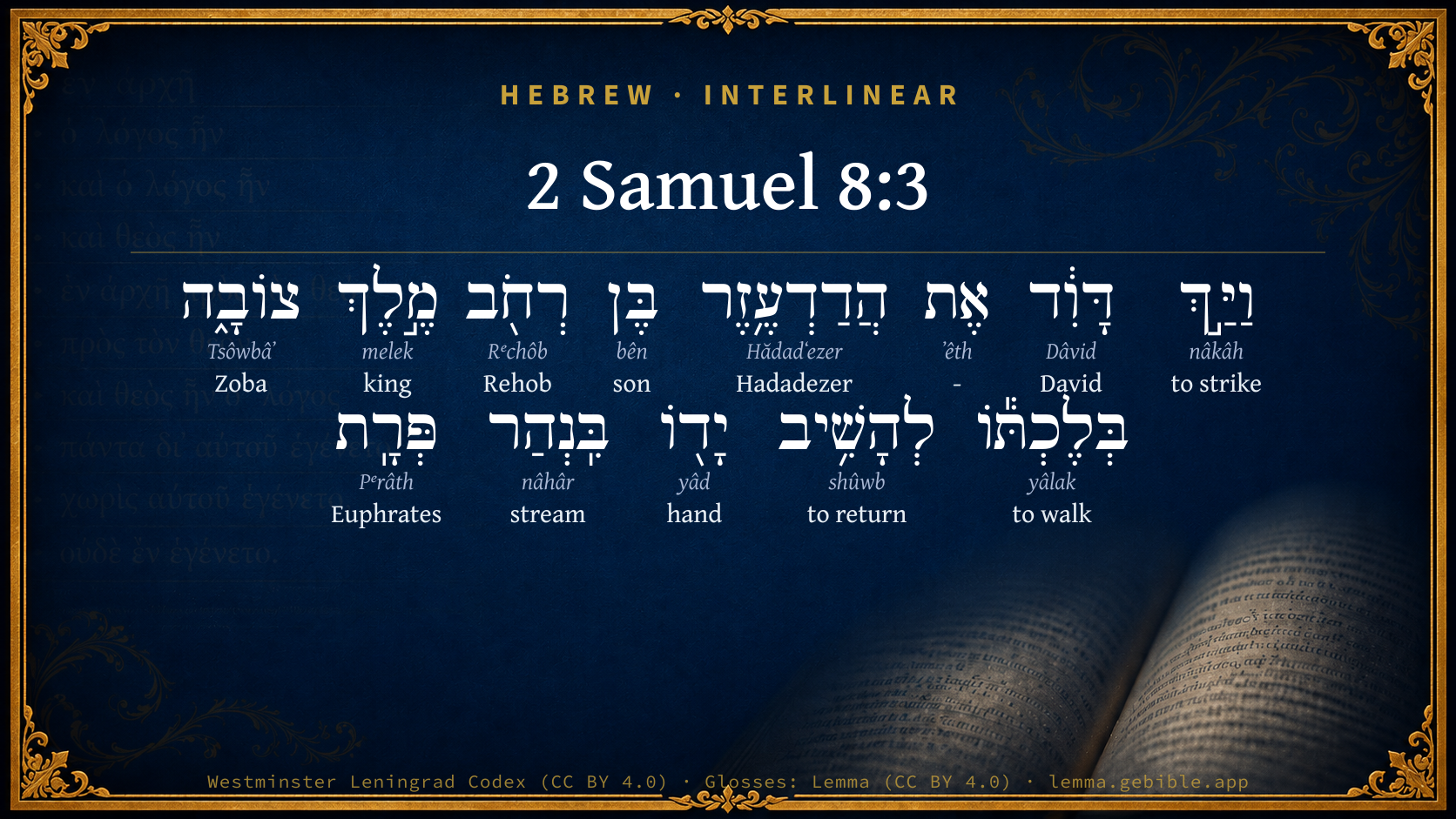
2 Samuel 8:3

Hebrew (Westminster Leningrad Codex) 2 Samuel 8:3 appears in the Hebrew Old Testament. The text above is from the Westminster Leningrad Codex. Each word links to its Strong’s number, a concise gloss, and parsing drawn from the Open Scriptures Hebrew Bible morphology. Click any word for its full Brown-Driver-Briggs (BDB) entry.
Download image
Cite this verse

2 Samuel 8:3 (World English Bible). Public Domain. Lemma interlinear Bible study tool, https://lemma.gebible.app/v/2-samuel/8/3.

Show BibTeX & RIS
BibTeX
RIS
English Translation
David struck also Hadadezer the son of Rehob, king of Zobah, as he went to recover his dominion at the River.
World English Bible · Public Domain
Highlights
  • 1 first appearance in the Hebrew Bible
Full analysis ↓
Download a study sheet

One document with this verse’s original text, its word-by-word gloss line, the meaning frame, cross-references with their text, attributed commentary, and full source and license credits — printable, and it pastes into notes with its structure intact.

This verse Autodidact and up

Study sheet (.html) Plain text (.txt)

A passage Seminary Student

Up to 50 verses in one chapter. A passage sheet keeps up to 6 commentary sources and 12 cross-references per verse, in the order this page ranks them, and says so on the sheet whenever that leaves anything out. Ask for a single verse and you get the Autodidact verse sheet above.

Everything on this page stays free to read, with no account — the sheet is a download of what is already on screen, not access to it.

Want to remove ads? Support Godless Engineer
Compare translations 3

The same verse in 3 English versions, stacked beneath the original-language interlinear above. Click any original word for its lexicon entry.

Each is an independent rendering of the whole verse — the interlinear is not word-aligned to these translations.

Highlighted words mark where these versions differ — a whole-verse word diff, not a word-by-word alignment.

  • World English Bible Public Domain
    David struck also Hadadezer the son of Rehob, king of Zobah, as he went to recover his dominion at the River.
  • King James Version Public Domain
    David smote also Hadadezer, the son of Rehob, king of Zobah, as he went to recover his border at the river Euphrates.
  • unfoldingWord Literal Text CC BY-SA 4.0
    And David struck Hadadezer, the son of Rehob, the king of Zobah, when he went to establish his hand at the River.

unfoldingWord Literal Text — © unfoldingWord, licensed CC BY-SA 4.0. Word-aligned USFM3 via Door43 (git.door43.org/unfoldingWord/en_ult).

Versions to compare (up to 4)

3 of 4 selected

Show all 18 translations

Every available English version of this verse, each an independent rendering of the whole verse.

  • World English Bible Public Domain
    David struck also Hadadezer the son of Rehob, king of Zobah, as he went to recover his dominion at the River.
  • Berean Standard Bible Public Domain
    David also defeated Hadadezer son of Rehob, king of Zobah, who had marched out to restore his dominion along the Euphrates River.
  • Majority Standard Bible Public Domain
    David also defeated Hadadezer son of Rehob, king of Zobah, who had marched out to restore his dominion along the Euphrates River.
  • King James Version Public Domain
    David smote also Hadadezer, the son of Rehob, king of Zobah, as he went to recover his border at the river Euphrates.
  • American Standard Version (1901) Public Domain
    David smote also Hadadezer the son of Rehob, king of Zobah, as he went to recover his dominion at the River.
  • Revised Version (1885) Public Domain
    David smote also Hadadezer the son of Rehob, king of Zobah, as he went to recover his dominion at the River.
  • Geneva Bible (1599) Public Domain
    Dauid smote also Hadadezer the sonne of Rehob King of Zobah, as he went to recouer his border at the riuer Euphrates.
  • Douay-Rheims (1899) Public Domain
    David defeated also Adarezer the son of Rohob king of Soba, when he went to extend his dominion over the river Euphrates.
  • Young's Literal Translation Public Domain
    And David smiteth Hadadezer son of Rehob, king of Zobah, in his going to bring back his power by the River `Euphrates;'
  • Literal Standard Version CC BY-SA 4.0
    And David strikes Hadadezer son of Rehob, king of Zobah, in his going to bring back his power by the River [Euphrates];
  • Unlocked Literal Bible CC BY-SA 4.0
    David then defeated Hadadezer son of Rehob, the king of Zobah, as Hadadezer was traveling to recover his rule by the Euphrates River.
  • unfoldingWord Literal Text CC BY-SA 4.0
    And David struck Hadadezer, the son of Rehob, the king of Zobah, when he went to establish his hand at the River.
  • Darby Bible Public Domain
    And David smote Hadadezer, the son of Rehob, king of Zobah, as he went to recover his dominion by the river Euphrates.
  • World Messianic Bible Public Domain
    David also struck Hadadezer the son of Rehob, king of Zobah, as he went to recover his dominion at the River.
  • Webster's Bible Public Domain
    David smote also Hadadezer, the son of Rehob, king of Zobah, as he went to recover his border at the river Euphrates.
  • Free Bible Version CC BY-SA 4.0
    David also defeated Hadadezer, son of Rehob, king of Zobah, as he tried to enforce his control along the Euphrates River.
  • Bible in Basic English Public Domain
    And David overcame Hadadezer, the son of Rehob, king of Zobah, when he went to make his power seen by the River.
  • JPS Tanakh (1917) Public Domain
    David smote also Hadadezer the son of Rehob, king of Zobah, as he went to establish his dominion at the river Euphrates.

Literal Standard Version (2020), Covenant Press — licensed CC BY-SA 4.0. Text via the HelloAO Bible API (eBible.org). Unlocked Literal Bible (unfoldingWord) — licensed CC BY-SA 4.0. Text via the HelloAO Bible API (eBible.org). unfoldingWord Literal Text — © unfoldingWord, licensed CC BY-SA 4.0. Word-aligned USFM3 via Door43 (git.door43.org/unfoldingWord/en_ult). Free Bible Version, Dr. Jonathan Gallagher — licensed CC BY-SA 4.0. Text via the HelloAO Bible API (eBible.org).

Word by word

More ways to search: Search by grammar → Find every occurrence → Compare this word →

Practice this passage: Drill this verse → Learn its vocabulary →

רְחֹ֖ב
Rᵉchôb
H7340
“Rehob”
Noun, Proper
Part of Speech
Noun
Type
Proper
Full BDB Definition

Origin: the same as H7339

TWOT: None

Rehob = "broad place" - father of Hadadezer the king of Zobah who was killed by David (noun proper masculine) - a Levite who sealed the covenant with Nehemiah (noun proper masculine) - the northern limit of the exploration of the spies in Canaan; on the road to Hamath (noun proper locative) - a town in Asher (noun proper locative) - a second town by the same name also in Asher (noun proper locative)
  1. וַיַּ֣ךְ nâkâh H5221 “and · to strike” Conjunction + Verb, Hiphil, Sequential Imperfect, 3rd Person, Masculine, Singular
  2. דָּוִ֔ד Dâvid H1732 “David” Noun, Proper
  3. אֶת ʼêth H853 “-” Particle, Direct Object
  4. הֲדַדְעֶ֥זֶר Hădadʻezer H1909 “Hadadezer” Noun, Proper
  5. בֶּן bên H1121 “son of” Noun, Common, Masculine, Singular, Construct
  6. מֶ֣לֶךְ melek H4428 “king of” Noun, Common, Masculine, Singular, Construct
  7. צוֹבָ֑ה Tsôwbâʼ H6678 “Zoba” Noun, Proper
  8. בְּלֶכְתּ֕וֹ yâlak H3212 “in/at · to walk · him” Preposition + Verb, Qal, Infinitive Construct + Suffix, Personal, 3rd Person, Masculine, Singular
  9. לְהָשִׁ֥יב shûwb H7725 “to return” Preposition + Verb, Hiphil, Infinitive Construct
  10. יָד֖וֹ yâd H3027 “hand · his” Noun, Common, Both, Singular, Construct + Suffix, Personal, 3rd Person, Masculine, Singular
  11. בִּֽנְהַר nâhâr H5104 “in/at · stream of” Preposition + Noun, Common, Masculine, Singular, Construct
  12. פְּרָֽת Pᵉrâth H6578 “Euphrates” Noun, Proper

About this verse

These counts appear in no published source. They are computed here, from the morphology-tagged text and Lemma’s own curated glosses. What Lemma adds →

13
words
13
distinct lemmas
Historical
section

Notable vocabulary

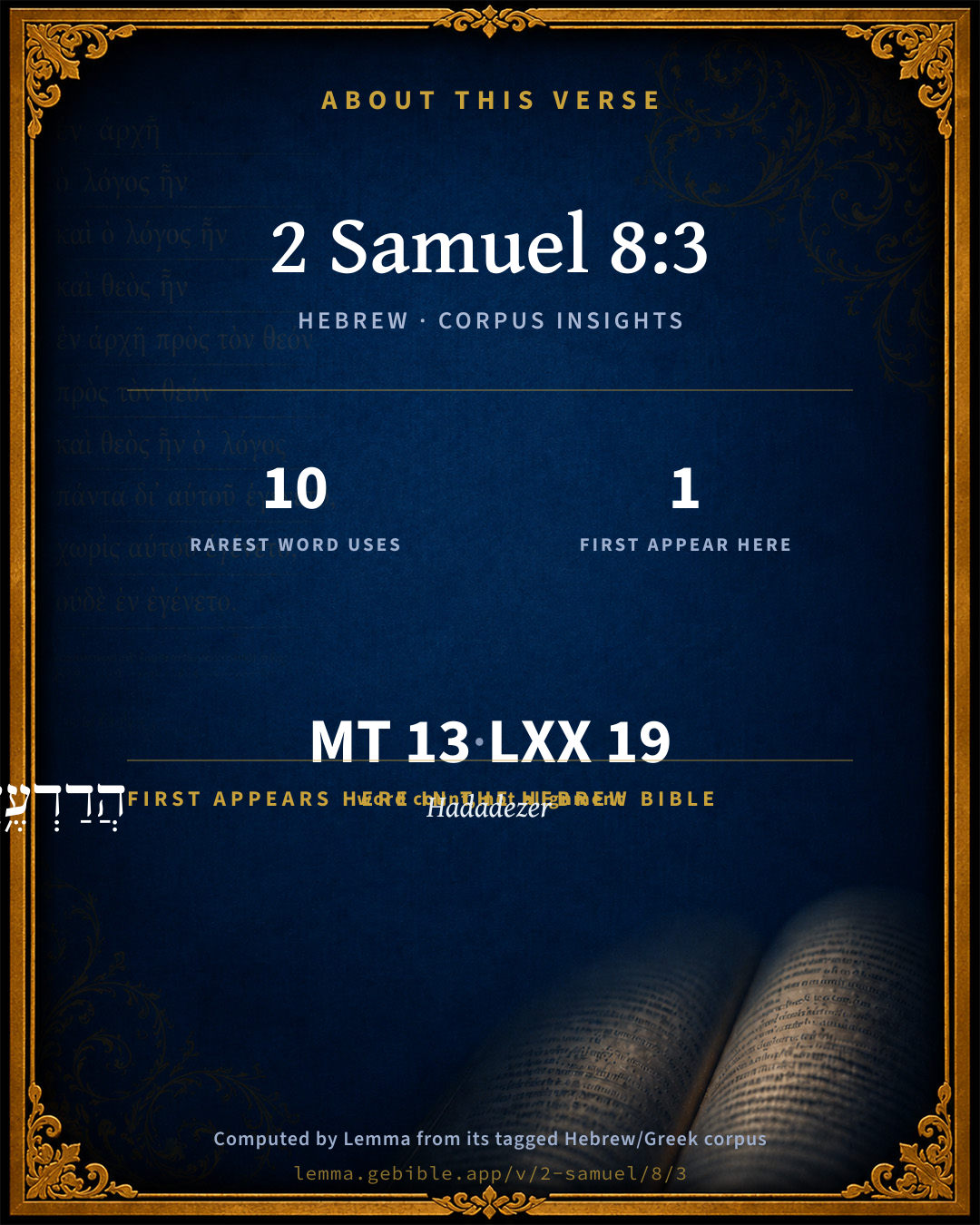
The rarest word here is רְחֹ֖ב Rehob H7340 — appearing just 10 times in the whole Hebrew Bible.

First appearance in Scripture

This word makes its first canonical appearance in the Hebrew Bible here:

  • הֲדַדְעֶ֥זֶר Hadadezer H1909

Shared distinctive vocabulary

רְחֹ֖ב Rehob H7340 occurs in 10 verses of the Hebrew Bible. Also found in:

Grammatical profile

  • 3 verbs
  • 9 nouns
  • 1 particle

Verb forms

  • וַיַּ֣ךְ Hiphil · Sequential Imperfect
  • בְּלֶכְתּ֕וֹ Qal · Infinitive Construct
  • לְהָשִׁ֥יב Hiphil · Infinitive Construct

Hebrew & Septuagint length

In English translation the verse runs 21 words from the Hebrew and 22 from the Septuagint (LXX English) — closely comparable.

A rough comparison of the two English renderings, which tokenize alike — not a word-level alignment.

Word counts can differ between the Hebrew and the Greek without any difference in meaning — e.g. the Hebrew direct-object marker אֵת has no separate Greek word, and Greek often adds the article ὁ.

In the original languages it is 13 Hebrew tokens and 19 Greek tokens — but the two are counted differently (Hebrew bundles its prefixes and suffixes into one token; the Greek is in lemma form), so that isn’t a like-for-like length.

Cross-references

12

Topical passages linked to 2 Samuel 8:3 in the Treasury of Scripture Knowledge — connected by theme and wording, ordered by reader-vote popularity; previews shown in the World English Bible.

  • 1 Samuel 14:47 Now when Saul had taken the kingdom over Israel, he fought against all his enemies on every side, against Moab, and against the children of Ammon, and against Edom, and against the kings of Zobah, and against the Philistines: and wherever he turned himself, he put [them] to the worse.
  • 2 Samuel 10:16 Hadarezer sent, and brought out the Syrians who were beyond the River: and they came to Helam, with Shobach the captain of the host of Hadarezer at their head.
  • 2 Samuel 10:19 When all the kings who were servants to Hadarezer saw that they were put to the worse before Israel, they made peace with Israel, and served them. So the Syrians feared to help the children of Ammon any more.
  • 2 Samuel 10:6 When the children of Ammon saw that they were become odious to David, the children of Ammon sent and hired the Syrians of Beth Rehob, and the Syrians of Zobah, twenty thousand footmen, and the king of Maacah with one thousand men, and the men of Tob twelve thousand men.
  • 1 Chronicles 18:3 David struck Hadarezer king of Zobah to Hamath, as he went to establish his dominion by the river Euphrates.
  • Genesis 15:18 In that day Yahweh made a covenant with Abram, saying, "To your seed have I given this land, from the river of Egypt to the great river, the river Euphrates:
  • Exodus 23:31 I will set your border from the Red Sea even to the sea of the Philistines, and from the wilderness to the River; for I will deliver the inhabitants of the land into your hand, and you shall drive them out before you.
  • Deuteronomy 11:24 Every place whereon the sole of your foot shall tread shall be yours: from the wilderness, and Lebanon, from the river, the river Euphrates, even to the hinder sea shall be your border.
  • 1 Kings 4:21 Solomon ruled over all the kingdoms from the River to the land of the Philistines, and to the border of Egypt: they brought tribute, and served Solomon all the days of his life.
  • 1 Kings 11:23–24 God raised up [another] adversary to him, Rezon the son of Eliada, who had fled from his lord Hadadezer king of Zobah.
  • Psalms 60:1 God, you have rejected us. You have broken us down. You have been angry. Restore us, again.
  • Psalms 72:8 He shall have dominion also from sea to sea, From the River to the ends of the earth.

Cross-references courtesy of OpenBible.info (CC BY 4.0).

Hebrew and Greek witnesses Masoretic Hebrew ↔ Greek Septuagint

The same verse in the two great witnesses to the Old Testament, shown verse-for-verse.

These are two independent witnesses, not word-aligned to each other, and the Septuagint is shown in lemma (dictionary) form.

Hebrew 2 Samuel 8:3 Masoretic · Westminster Leningrad Codex

וַיַּ֣ךְ דָּוִ֔ד אֶת הֲדַדְעֶ֥זֶר בֶּן רְחֹ֖ב מֶ֣לֶךְ צוֹבָ֑ה בְּלֶכְתּ֕וֹ לְהָשִׁ֥יב יָד֖וֹ בִּֽנְהַר פְּרָֽת

David struck also Hadadezer the son of Rehob, king of Zobah, as he went to recover his dominion at the River.

World English Bible · Public Domain

Greek LXX 2 Samuel 8:3 Septuagint · lemma form

καί πατάσσω δαυίδ ὁ αδρααζαρ υἱός ρααβ βασιλεύς σουβα πορεύομαι αὐτός ἐπιἵστημι ὁ χείρ αὐτός ἐπί ὁ ποταμός εὐφράτης

And David struck Adraazar the son of Raab king of Suba, as he went to extend his power to the river Euphrates.

LXX2012 (modern English Septuagint) · Public Domain

On this verse, Ellicott's Commentary for English Readers discusses the Septuagint’s reading. Read the note in Commentary ↓

Hebrew: Westminster Leningrad Codex (CC BY 4.0). Greek: Septuagint (public domain); English from LXX2012 (modern English Septuagint) (Public Domain). How the Septuagint differs from the Hebrew →

Targum (Aramaic paraphrase)

1

The Targum is the ancient Jewish Aramaic paraphrase of the Hebrew Scriptures — an interpretive translation, not the Hebrew text itself. Onkelos (literal) and Pseudo-Jonathan (expansive) render the Torah, and Jonathan the Prophets. Coverage is partial: where no permissively-licensed English translation exists for a verse, only the Aramaic is shown. This is verse-level text, not a word-by-word alignment to the Hebrew.

  1. Targum Jonathan Prophets (Joshua–Malachi)
    וּמְחָא דָוִד יַת הַדַדְעֶזֶר בַּר רְחוֹב מַלְכָּא דְצוֹבָא כַּד אֲזַל לְאַשְׁנָאָה תְּחוּמֵיהּ בִּנְהַר פְּרָת:

    (no public-domain English translation for this verse)

    Targum Jonathan — Aramaic: “Mikraot Gedolot” (public domain). English: “Sefaria Community Translation” (CC0 1.0 (public-domain dedication)); “London "Chaldee Paraphrase," 1871” (public domain). Text via Sefaria.

Commentary

Notes on 2 Samuel 8:3 from classic Christian and Jewish commentators (each source and its license shown beneath its notes). The classic Christian expositions comment on the surrounding passage and are grouped to its opening verse, so a note may address several verses; the Jewish commentaries on the Tanakh (Rashi and others) are per-verse, so they appear only where the commentator wrote on this verse.

Lemma curates 59 commentaries, every one of them public domain or Creative Commons licensed, each selected and text-cleaned for this edition rather than reprinted as found. About our sources →

Jamieson, Fausset & Brown

Robert Jamieson, A. R. Fausset & David Brown

HE SMITES HADADEZER AND THE SYRIANS. (Sa2 8:3-14)

Zobah-- (Ch1 18:3). This kingdom was bounded on the east by the Euphrates, and it extended westward from that river, perhaps as far north as Aleppo. It was long the chief among the petty kingdoms of Syria, and its king bore the hereditary title of "Hadadezer" or "Hadarezer" ("Hadad," that is, "helped").

as he went to recover his border at the river Euphrates--in accordance with the promises God made to Israel that He would give them all the country as far as the Euphrates (Gen 15:18; Num 24:17). In the first campaign David signally defeated Hadadezer. Besides a great number of foot prisoners, he took from him an immense amount of booty in chariots and horses. Reserving only a small number of the latter, he hamstrung the rest. The horses were thus mutilated because they were forbidden to the Hebrews, both in war and agriculture. So it was of no use to keep them. Besides, their neighbors placed much dependence on cavalry, but having, for want of a native breed, to procure them by purchase, the greatest damage that could be done to such enemies was to render their horses unserviceable in war. (See also Gen 46:6; Jos 11:6, Jos 11:9). A king of Damascene-Syria came to Hadadezer's succor; but David routed those auxiliary forces also, took possession of their country, put garrisons into their fortified towns, and made them tributary.

Jamieson, Fausset & Brown — Commentary Critical and Explanatory on the Whole Bible (1871) — public domain (CC PDM 1.0). Text via the HelloAO Bible API.

Trapp's Complete Commentary

John Trapp

2Sa 8:3 David smote also Hadadezer, the son of Rehob, king of Zobah, as he went to recover his border at the river Euphrates.

Ver. 3. David smote also Hadadezer.] An ambitious and turbulent prince, who began to grow exceeding potent; and had already, as it may seem, subdued Damascus, and was now formidable to the Israelites. Saul had had wars with his father Zobah, {1Sa 14:47} and haply he might pretend that old quarrel, or the conquest of Canaan by his predecessor Cushanrishathaim.

As he went to recover.] And so must needs pass through part of Judea on the other side Jordan, or not far from it. And so if he had returned a conqueror, was like enough to invade it; for ambition is restless, and never saith, It is enough.

John Trapp, A Commentary or Exposition upon All the Books of the Old and New Testament (1647–1656) — public domain. Text from a community e-Sword module.

Joseph Benson's Commentary

2Sa 8:3. King of Zobah — Zobah was a part of Syria, whose eastern border was Euphrates, as the western was the land of Canaan, and the kingdom of Damascus. As he went to recover his border — That is, as David went to extend the limits of his kingdom toward the river Euphrates, he smote this king, who probably came out to oppose him. David remembered the grant which God had made to his people of all the land, as far as that river; and, having subdued his neighbouring enemies, went to recover his rights, according to the divine promise and gift.

Joseph Benson's Commentary on the Old and New Testaments (1811–1818) — public domain. Text from a community e-Sword module.

Keil & Delitzsch

C. F. Keil & F. Delitzsch

Conquest and Subjugation of the King of Zobah, and of the Damascene Syrians. - Sa2 8:3. The situation of Zobah cannot be determined. The view held by the Syrian church historians, and defended by Michaelis, viz., that Zobah was the ancient Nisibis in northern Mesopotamia, has no more foundation to rest upon than that of certain Jewish writers who suppose it to have been Aleppo, the present Haleb. Aleppo is too far north for Zobah, and Nisibis is quite out of the range of the towns and tribes in connection with which the name of Zobah occurs. In Sa1 14:47, compared with Sa2 8:12 of this chapter, Zobah, or Aram Zobah as it is called in Sa2 10:6 and Psa 60:2, is mentioned along with Ammon, Moab, and Edom, as a neighbouring tribe and kingdom to the Israelites; and, according to Sa2 8:3, Sa2 8:5, and Sa2 8:9 of the present chapter, it is to be sought for in the vicinity of Damascus and Hamath towards the Euphrates. These data point to a situation to the north-east of Damascus and south of Hamath, between the Orontes and Euphrates, and in fact extending as far as the latter according to Sa2 8:3, whilst, according to Sa2 10:16, it even reached beyond it with its vassal-chiefs into Mesopotamia itself. Ewald (Gesch. iii. p. 195) has therefore combined Zobah, which was no doubt the capital, and gave its name to the kingdom, with the Sabe mentioned in Ptol. v. 19, - a town in the same latitude as Damascus, and farther east towards the Euphrates. The king of Zobah at the time referred to is called Hadadezer in the text (i.e., whose help is Hadad); but in Sa2 10:16-19 and throughout the Chronicles he is called Hadarezer. The first is the original form; for Hadad, the name of the sun-god of the Syrians, is met with in several other instances in Syrian names (vid., Movers, Phnizier). David smote this king "as he was going to restore his strength at the river (Euphrates)." ידו השׁיב does not mean to turn his hand, but signifies to return his hand, to stretch it out again over or against any one, in all the passage in which the expression occurs. It is therefore to be taken in a derivative sense in the passage before us, and signifying to restore or re-establish his sway. The expression used in the Chronicles (Sa2 8:3), ידו הצּיב, has just the same meaning, since establishing or making fast presupposes a previous weakening or dissolution. Hence the subject of the sentence "as he went," etc., must be Hadadezer and not David; for David could not have extended his power to the Euphrates before the defeat of Hadadezer. The Masoretes have interpolated P'rath (Euphrates) after "the river," as in the text of the Chronicles. This is correct enough so far as the sense is concerned, but it is by no means necessary, as the nahar (the river κ. ἐξ.) is quite sufficient of itself to indicate the Euphrates.

There is also a war between David and Hadadezer and other kings of Syria mentioned in 2 Samuel 10; and the commentators all admit that that war, in which David defeated these kings when they came to the help of the Ammonites, is connected with the war mentioned in the present chapter. But the connection is generally supposed to be this, that the first of David's Aramaean wars is given in 2 Samuel 8, the second in 2 Samuel 10; for no other reason, however, than because 2 Samuel 10 stands after 2 Samuel 8. This view is decidedly an erroneous one. According to the chapter before us, the war mentioned there terminated in the complete subjugation of the Aramaean kings and kingdoms. Aram became subject to David, paying tribute (Sa2 8:6). Now, though the revolt of subjugated nations from their conquerors is by no means a rare thing in history, and therefore it is perfectly conceivable in itself that the Aramaeans should have fallen away from David when he was involved in the war with the Ammonites, and should have gone to the help of the Ammonites, such an assumption is precluded by the fact that there is nothing in 2 Samuel 10 about any falling away or revolt of the Aramaeans from David; but, on the contrary, these tribes appear to be still entirely independent of David, and to be hired by the Ammonites to fight against him. But what is absolutely decisive against this assumption, is the fact that the number of Aramaeans killed in the two wars is precisely the same (compare Sa2 8:4 with Sa2 10:18): so that it may safely be inferred, not only that the war mentioned in 2 Samuel 10, in which the Aramaeans who had come to the help of the Ammonites were smitten by David, was the very same as the Aramaean war mentioned in 2 Samuel 8, but of which the result only is given; but also that all the wars which David waged with the Aramaeans, like his war with Edom (Sa2 8:13.), arose out of the Ammonitish war (2 Samuel 10), and the fact that the Ammonites enlisted the help of the kings of Aram against David (Sa2 10:6). We also obtain from 2 Samuel 10 an explanation of the expression "as he went to restore his power (Eng. Ver. 'recover his border') at the river," since it is stated there that Hadadezer was defeated by Joab the first time, and that, after sustaining this defeat, he called the Aramaeans on the other side of the Euphrates to his assistance, that he might continue the war against Israel with renewed vigour (Sa2 10:13, Sa2 10:15.). The power of Hadadezer had no doubt been crippled by his first defeat; and in order to restore it, he procured auxiliary troops from Mesopotamia with which to attack David, but he was defeated a second time, and obliged to submit to him (Sa2 10:17-18). In this second engagement "David took from him (i.e., captured) seventeen hundred horse-soldiers and twenty thousand foot" (Sa2 8:4, compare Sa2 10:18). This decisive battle took place, according to Ch1 18:3, in the neighbourhood of Hamath, i.e., Epiphania on the Orontes (see at Num 13:21, and Gen 10:18), or, according to Sa2 10:18 of this book, at Helam, - a difference which may easily be reconciled by the simple assumption that the unknown Helam was somewhere near to Hamath. Instead of 1700 horse-soldiers, we find in the Chronicles (Ch1 18:4) 1000 chariots and 7000 horsemen. Consequently the word receb has no doubt dropped out after אלף in the text before us, and the numeral denoting a thousand has been confounded with the one used to denote a hundred; for in the plains of Syria seven thousand horsemen would be a much juster proportion to twenty thousand foot than seventeen hundred. (For further remarks, see at Sa2 10:18.) "And David lamed all the cavalry," i.e., he made the war-chariots and cavalry perfectly useless by laming the horses (see at Jos 11:6, Jos 11:9), - "and only left a hundred horses." The word receb in these clauses signifies the war-horses generally, - not merely the carriage-horses, but the riding-horses as well, - as the meaning cavalry is placed beyond all doubt by Isa 21:7, and it can hardly be imagined that David would have spared the riding-horses.

Keil & Delitzsch — Biblical Commentary on the Old Testament (1861–1891) — public domain (CC PDM 1.0). Text via the HelloAO Bible API. (Old Testament only.)

Tyndale Open Study Notes

Tyndale Open Resources

8:3 Hadadezer reappears in 10:16 as David’s foe. He was either the direct son of Rehob and his successor or the reigning king of a dynasty established by a king named Rehob, whose kingdom was near the northern city of Dan (see Judg 18:28; cp. Num 13:21). • Zobah was north and east of David’s kingdom. • It is possible that David, not Hadadezer (literally he), marched out to strengthen his control. • the Euphrates River: Literally the river; 1 Chr 18:3 specifically identifies the Euphrates. Cp. 2 Sam 10:16.

Tyndale Open Study Notes — © Tyndale Open Resources, licensed CC BY-SA 4.0. Text via the HelloAO Bible API.

Geneva Bible (1599)

Geneva Bible translators

Hebrew, Perath.

Or, enlarge.

Geneva Bible (1599) marginal notes — public domain. Text via Bolls.life.

Adam Clarke's Commentary

Verse 3. David smote - Hadadezer] He is supposed to have been king of all Syria, except Phoenicia; and, wishing to extend his dominions to the Euphrates, invaded a part of David's dominions which lay contiguous to it; but being attacked by David, he was totally routed.

Adam Clarke's Commentary on the Bible (1810–1826) — public domain. Text from a community e-Sword/MySword module.

Ellicott's Commentary for English Readers

(3) Hadadezer . . . king of Zobah.—This name is sometimes (1Ch_18:3; 1Ch_18:5; 1Ch_18:7, &c.) spelt “Hadarezer,” the letters d and r being much alike in Hebrew and easily confused; but the form given here is right, Hadad being the chief idol of the Syrians. Zobah (called in the title of Psalms 60 Aram-Zobah) was a kingdom, the position of which cannot be exactly determined, but lying north-east of Israel, and formerly governed by petty kings with whom Saul had wars (1Sa_14:47). When or by what means it had become united under a single sovereign is unknown, but from 2Sa_8:4 with 2Sa_10:6; 2Sa_10:16, it is plain that he was a monarch of considerable power, and controlled tribes beyond the Euphrates.

To recover his border.—Literally, to cause his hand to return, a phrase which in itself might mean either to renew his attack, or to re-establish his power. The latter is shown to be the sense here by the expression in 1Ch_18:3, “to establish his dominion,” and is so translated in the LXX. What happened is more fully explained in 2Sa_10:13-19 : the Ammonites had obtained the help of the Syrians when their combined armies were defeated by David; Hadadezer then attempted to summon to his aid the tribes “beyond the river” (i.e., the Euphrates), but David cut short his plans by another crushing defeat, which reduced them all to subjection. Our Version inserts the word Euphrates on the authority of the margin of the Hebrew, several MSS., and all the ancient versions. The river, however, would in any case mean the Euphrates.

A Bible Commentary for English Readers, edited by Charles John Ellicott (1878–1897) — public domain. Text from a community e-Sword module.

The Cambridge Bible for Schools and Colleges

gen. ed. J. J. S. Perowne

3–8. Conquest of Zobah and Damascus

3. Hadadezer] This name is written Hadarezer in ch. 2Sa_10:16-19, and in Chronicles, the letters d (ד) and r (ר) being easily confused in Hebrew. Hadad was the name of the Syrian sun-god, and Hadadezer appears to be the true form, meaning “whose help is Hadad.”

Zobah] The exact position and limits of this kingdom are undetermined. It seems to have been north-east of Damascus and south of Hamath, between the Orontes and Euphrates. Saul waged wars with its “kings,” who were probably independent chieftains (1Sa_14:47), but now it was consolidated under one ruler, and was a country of considerable wealth and power.

to recover his border] The phrase cannot be thus rendered, but means probably either to renew his attack or to re-establish his power. The parallel passage in 1Ch_18:3 has a different verb, meaning to set up his power. The subject of the sentence is Hadadezer, and the occasion referred to is probably that which is described more fully in ch. 2Sa_10:15-19. The Ammonites had hired the Syrians to help them against David, who defeated their combined forces. Hadadezer thereupon summoned the Syrians from beyond the Euphrates to his assistance, but was totally defeated.

at the river Euphrates] Euphrates is not in the written text, but according to the Jewish tradition is to be read (see Introd. p. 15). But the addition is unnecessary. “The River” by itself was understood to mean the Euphrates. Cp. ch. 2Sa_10:16; Psa_72:8.

The Cambridge Bible for Schools and Colleges (gen. ed. J. J. S. Perowne; Cambridge University Press, 1878–1918) — public domain. Text from a community e-Sword module.

John Gill's Exposition

And David also smote Hadadezer the son of Rehob, king of Zobah,.... Called sometimes Aramzobah, and was a part of Syria, as its name shows. Benjamin, of Tudela (h) takes it to be the same with Haleb or Aleppo; Josephus (i) calls it Sophene; but that is placed by Ptolemy (k) beyond the Euphrates; whereas this country must be between that river and the land of Israel, and was contiguous to it, and near Damascus; and it was so near the land of Israel, and being conquered by David, that it became a controversy with the Jews, whether it was not to be reckoned part of it, and in several things they allow it to be equal to it (l). Rehob was the first king of this part of Syria, and then his son the second and last; he is called Hadarezer in Ch1 18:3; the letters "D" and "R", being frequently changed in the Hebrew tongue: him David fought with, and overcame:

as he went to recover his border at the river Euphrates; which some understand of Hadadezer, so Jarchi and Kimchi, who attempted to recover part of his dominions that had been taken by some one or another from him, which lay upon the river Euphrates; or he endeavoured to enlarge his dominions, and carry them as far as the river, and establish the borders of them; and while he was doing this, or attempting it, David fell upon him, and routed him; or rather this refers to David, who considering that the ancient border of the land of Israel, as given to Abraham, reached to the river Euphrates, Gen 15:18; he set out on an expedition to recover this border, and whereas the country of this king lay in his way, he invaded that; upon which Hadadezer rose up against him, and was conquered by him, and by this means the border was recovered to the kingdom of Israel, and reached so far, as is plain it did in Solomon's time, Kg1 4:21.

(h) Itinerar. p. 59. (i) Ut supra. (Antiqu. l. 7. c. 5. sect. 1.) (k) Geograph. l. 5. c. 13. (l) T. Bab. Gittin, fol. 8. 1. 2. Misn. Demai, c. 6. sect. 11. & Maimon. & Bartenora in ib.

John Gill's Exposition of the Whole Bible (1746–1763) — public domain (CC PDM 1.0). Text via the HelloAO Bible API.

Albert Barnes' Notes on the Bible

Hadadezer - Not (see the margin) Hadarezer. Hadadezer, is the true form, as seen in the names Benhadad, Hadad (1Ki 15:18, etc.; 1Ki 11:14, etc.). Hadad was the chief idol, or sun-god, of the Syrians.

To recover his border - literally, to cause his hand to return. The phrase is used sometimes literally, as e. g. Exo 4:7; 1Ki 13:4; Pro 19:24; and sometimes figuratively, as Isa 1:25; Isa 14:27; Amo 1:8; Psa 74:11. The exact force of the metaphor must in each case be decided by the context. If, as is most probable, this verse relates to the circumstances more fully detailed in 2Sa 10:15-19, the meaning of the phrase here will be when he (Hadadezer) went to renew his attack (upon Israel), or to recruit his strength against Israel, at the river Euphrates.

Albert Barnes' Notes on the Bible (1834–1885) — public domain. Text from a community e-Sword/MySword module.

Haydock's Catholic Bible Commentary

Adarezer. He is styled Adadezer in Hebrew and this seems to have been his true name, though it is written Adarezer in Paralipomenon. Adad, or "the sun," was the chief idol of Syria, and the kings inserted the name with their own; as Benadad did. Josephus produces a fragment from Nicholaus of Damascus, in which he says that "Adad was king of Damascus, and of all Syria, except Phœnicia, and was defeated by David....His successors took his name, as the kings of Egypt did that of Ptolemy; and that the third in descent from this king, made an attack upon Samaria," and upon Achab. (Antiquities vii. 6.) --- Euphrates, which had been promised by God, Genesis xv. 18., and Numbers xxiv. 17. (Calmet) --- Adadezer was probably the aggressor. (Salien) (Menochius)

George Leo Haydock (1774–1849), Haydock's Catholic Family Bible and Commentary, 1859 edition — public domain. Excludes Psalms (Douay-Rheims chapter numbering differs from Protestant) and Deuterocanonical books (Catholic canon only).

Matthew Poole's English Annotations

Hadadezer, called Hadarezer, 1Ch 18:3, the Hebrew letters daleth and reseh being alike, and so oft interchanged.

Zobah; a part of Syria, lying north-east from Canaan, towards Hamath, 1Ch 18:3. See 1Sa 14:47.

As he went.

Quest. Who?

Answ. Either, first, Hadarezer; who, being already very potent, and going to enlarge his dominion further, David thought fit to oppose him. Or, secondly, David, who remembering the grant which God had made to his people of all the land as far as Euphrates, and having subdued his neighbouring enemies, went to recover his rights, and stablish his dominion as far as Euphrates.

Matthew Poole's English Annotations on the Holy Bible (1683–1685) — public domain. Text from a community e-Sword/MySword module.

Whedon's Commentary on the Bible

Daniel D. Whedon

3. Smote also Hadadezer — In 2Sa_10:16; 2Sa_10:19 and 1Ch_18:3 called Hadarezer. Owing to the fragmentary character of the accounts, and it being no design, of the writer in either place to give all the details of these Aramean wars, the relation of this defeat of Hadadezer to that recorded in chap. x cannot be positively decided. The mere fact that the account of chap. x stands after this decides nothing in the case. Probably the Syrians’ interference in the Ammonitish war, as recorded in chap. x, was the occasion of David’s first battle with them, and the account of this chapter is a condensed statement of the results of that same war. By calling out his forces from beyond the Euphrates, (2Sa_10:16,) Hadadezer seems to have lost his dominion in that quarter. But after his defeat by the Israelites, as soon as he could gather up his scattered army he went to recover that border, (ידו of this verse,) and then David straightway pursued and gained the victories here recorded. So the order of these Syrian wars we take to be the following. The Syrians, hired by Hanun, come and fight with Joab before Medeba. 2Sa_10:8, see note. Being defeated they gather up again, and, being reinforced by fresh troops from beyond the Euphrates, they suffer a second defeat at Helam. 2Sa_10:15-19. The officers of the army, including several petty kings of Syria, make peace with David, but as soon as Hadarezer can recruit a new army he goes to recover his border beyond the river, when David pursues and defeats him a third time, and also the Syrians of Damascus, who interfere to help the king of Zobah. On Zobah see note on 1Sa_14:47. It was a great and powerful province of ancient Syria, and its kings were bitter foes of the Israelitish monarchy. It was rich in brass and gold, and seems to have extended over the vast plains that stretch off northeast of Damascus towards the Euphrates.

His border — Hadadezer’s border — the outskirts of his kingdom on the east. This he seems to have lost by going to assist the Ammonites. 2Sa_10:16.

Daniel D. Whedon (gen. ed.), Commentary on the Old and New Testaments (1874–1909) — public domain. Text from a community e-Sword module.

The Pulpit Commentary

Hadadezer. The name is spelt Hadarezer in 2Sa_10:16 1Ch_18:3, and such is the reading of the versions here and of many Hebrew manuscripts. The other reading has been defended on the ground that Hadad is the name of the Syrian sun-god, but the cuneiform inscriptions show that his real name was Hadar. The King of Syria, mentioned in 1Ki_20:1, is called in Assyrian Ben-Hidri. Zobah. Ewald identifies Zobah with the "Sabo" mentioned by Ptolemy. This is uncertain, but evidently Zobah lay northeast of Damascus and south of Hamath, in the region between the rivers Orontes and Euphrates. In 1Sa_14:47 it appears as a powerless country governed by a multitude of petty kings; but evidently now Hadarezer had made himself supreme, and become a powerful monarch whose authority extended even across the river into Mesopotamia. (2Sa_10:16) Having crushed his rivals at home, he had next endeavoured to extend his dominion abroad. As he went to recover his border at the river Euphrates. The word "Euphrates" is inserted in the Authorized Version, because the margin says, "Euphrates read but not written." In the Revised Version it is omitted, because the unauthoritative nature of these directions to read something not in the text has been demonstrated. Technically these readings are called K"ri, and the written text K"tib. In 1Ch_18:3 the reading is, "as he went to stablish his dominion by the river a change which involves the alteration of only one letter, as the word rendered here "his border," and in 1Ch_18:3 "his dominion," is the same, signifying literally, "his hand." For this reason the Revised Version renders it correctly in both places "his dominion." Now, David never had possessed up to this time any dominion upon the Euphrates, but in the fuller narrative in ch. 10. we learn that these Syrians of Zobah had sent powerful reinforcements to the Ammonites in their war with David; and he might reasonably, therefore, determine to follow up his victory over. them by extending his power up to the river, so as to guard the fords, and prevent all future invasions. And this Hadarezer would resent. As an able and enterprising man, he had succeeded in making Zobah a powerful realm, and was not likely to submit to having a bridle put upon his adventurous spirit by the posting of an Israelitish garrison on the borders. We learn from 2Sa_10:19 that David"s object was to prevent aid coming to Ammon from Zobah, and that he succeeded in putting a barrier in Hadarezer"s way. We can scarcely doubt, therefore, that the reading in the Chronicles is to be preferred. In 1Sa_14:47 we read that Saul had waged war with Zobah, and as David had probably served in it, he would have thereby acquired both a knowledge of the country, very useful in this present more serious expedition, and also have learned the necessity of guarding his dominions against perpetual invasions from that quarter.

The Pulpit Commentary (1880–1919), ed. H.D.M. Spence-Jones & Joseph S. Exell — public domain. Text from a community e-Sword module.

John Wesley's Explanatory Notes

As he went - David, remembering the grant which God had made to his people of all the land as far as Euphrates, and having subdued his neighbouring enemies, went to recover his rights, and stablish his dominion as far as Euphrates.

John Wesley, Explanatory Notes Upon the Whole Bible (1754–1765) — public domain. Text via the GEBible commentary corpus.

unfoldingWord translationNotes

Door43 World Missions Community

David then defeated Hadadezer

Here both "David" and "Hadadezer" represent their armies. AT: "David and his army then defeated the army of Hadadezer" (See: Synecdoche)

Hadadezer ... Rehob

These are the names of men. (See: How to Translate Names)

Zobah

This is the name of a region in Aram. (See: How to Translate Names)

to recover his rule

"to regain control over a region" or "to recapture a region"

1,700 chariots

"one thousand seven hundred chariots" (See: Numbers)

twenty thousand footmen

"20,000 footmen" (See: Numbers)

David hamstrung

This is a practice where the tendons in the backs of the legs are cut so that the horses cannot run.

reserved enough

"set aside enough" or "saved enough"

a hundred chariots

"100 chariots" (See: Numbers)

translationWords

king

Euphrates River

chariot

horse

unfoldingWord translationNotes — © Distant Shores Media and the Door43 World Missions Community, licensed CC BY-SA 4.0. Source: git.door43.org/Door43/en_tn.

Rashi

Rabbi Shlomo Yitzchaki (Rashi)

As he went. When Haddadezer was going

To enlarge his border. As [Yonasan] translates, "To widen his border," [Haddadezer] conquored land outside his countries border and widened his border.

Rashi on the Tanakh — English translations: “The Judaica Press complete Tanach with Rashi, translated by A. J. Rosenberg” (CC BY 4.0); “Pentateuch with Rashi's commentary by M. Rosenbaum and A.M. Silbermann, 1929-1934” (public domain); “The Metsudah Tanach series, Lakewood, N.J” (CC BY 4.0); and “The Book of Joshua, Metsudah Publications, 1997” (CC BY 4.0). Text via Sefaria.

Lesson kit

Teaching starters — assembled from the data on this page, not authored interpretation. Every prompt links to the verse data it draws on. Edit before teaching.

2 Samuel, in the Historical, opens this verse with 13 words (13 distinct Hebrew lemmas). Its most distinctive word is Rᵉchôb (“Rehob”). A historical commentator’s framing appears above. Read the whole chapter for the surrounding context.

Discussion questions

  1. What does “Rehob” (Rᵉchôb) contribute to the verse as a whole?
  2. The word “Hadadezer” first appears here in Scripture. What is being introduced at this debut?
  3. Numbers 13:21 shares the word «Rehob» with this verse. How do the two illuminate each other?
  4. The translations on this page render this verse differently — a whole-verse word diff, not a word-by-word alignment. What might account for the different wordings?
  5. The verb «וַיַּ֣ךְ» is Hiphil Sequential Imperfect. How does its form color the action?
  6. Reading how Jamieson, Fausset & Brown and Trapp's Complete Commentary read this verse, where do the two commentators agree and where do they part?

Things to notice

Reading settings

Reading text

Shown beneath each verse's original-language words.

Old Testament
Old Testament edition

Read the OT as the Masoretic Hebrew (MT) or the Greek Septuagint (LXX).

English shown for the Greek Septuagint (in the Hebrew ↔ Greek comparison).

Comparing translations? Open the Compare panel on any verse page to stack up to four side by side.