
Isaiah 44:27

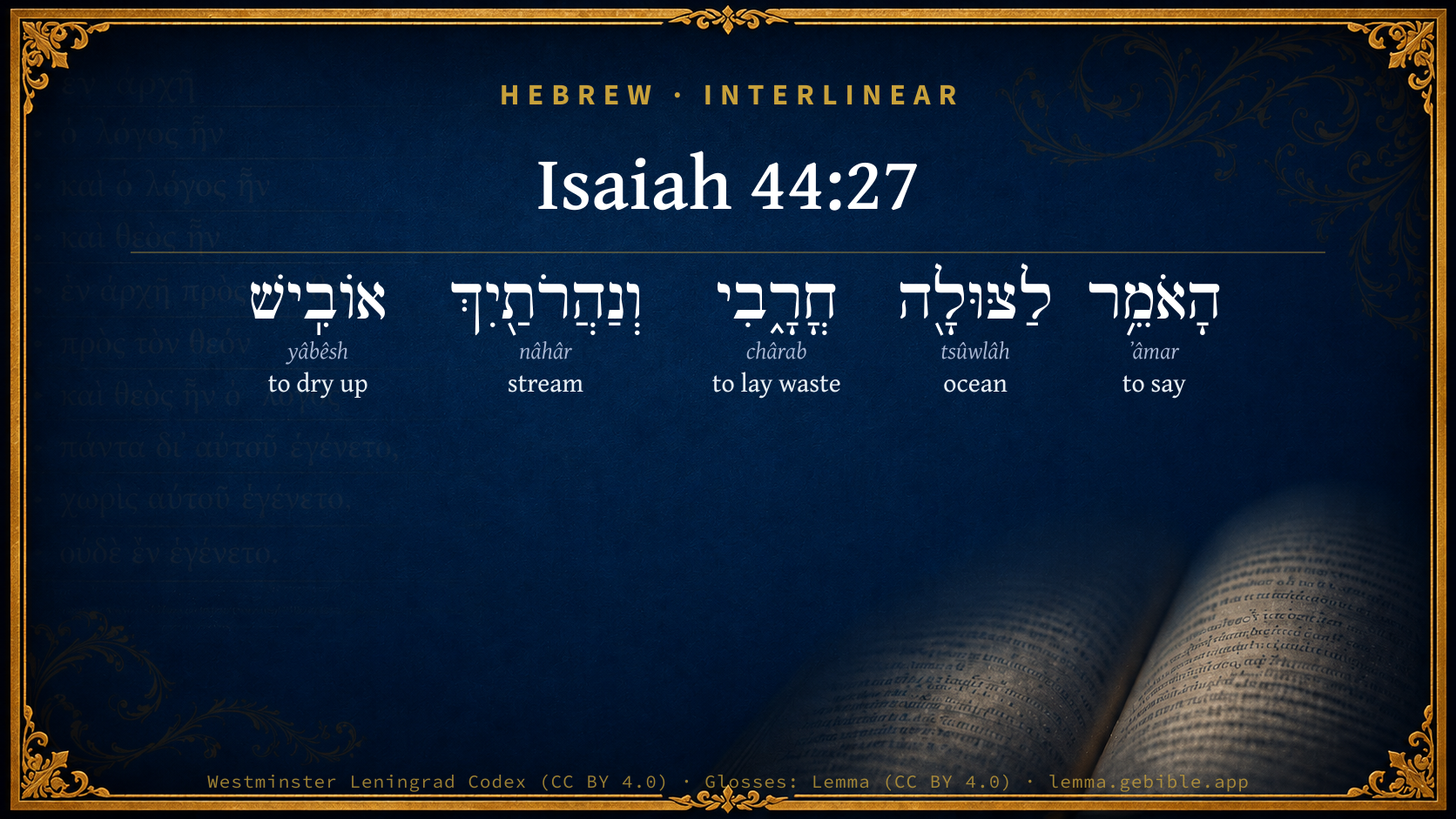
Hebrew (Westminster Leningrad Codex) Isaiah 44:27 appears in the Hebrew Old Testament. The text above is from the Westminster Leningrad Codex. Each word links to its Strong’s number, a concise gloss, and parsing drawn from the Open Scriptures Hebrew Bible morphology. Click any word for its full Brown-Driver-Briggs (BDB) entry.
Download image
Cite this verse

Isaiah 44:27 (World English Bible). Public Domain. Lemma interlinear Bible study tool, https://lemma.gebible.app/v/isaiah/44/27.

Show BibTeX & RIS
BibTeX
RIS
English Translation
who says to the deep, Be dry, and I will dry up your rivers;
World English Bible · Public Domain
Highlights
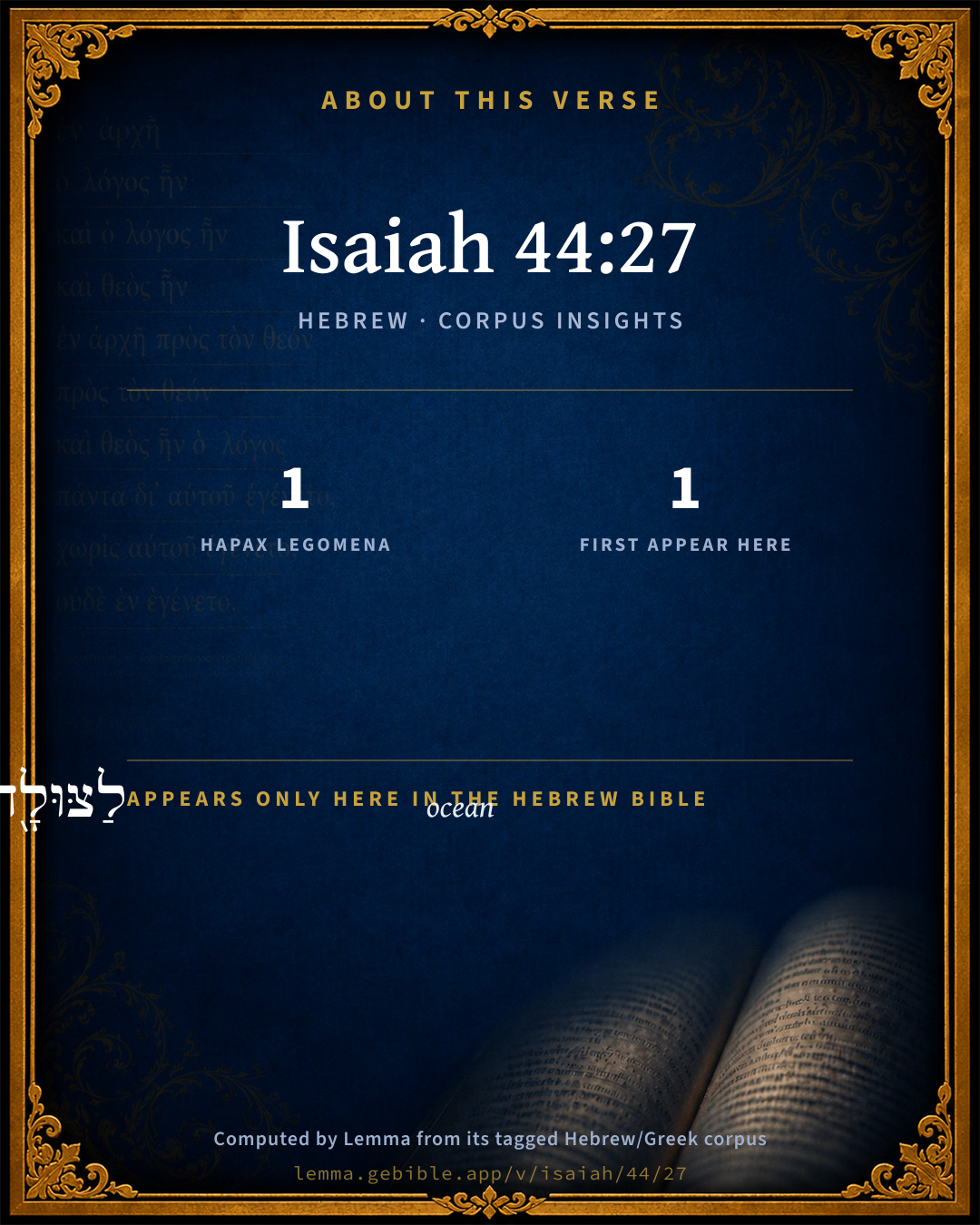
  • 1 hapax legomenon — only here in the Hebrew Bible
  • 1 first appearance in the Hebrew Bible
Full analysis ↓
Download a study sheet

One document with this verse’s original text, its word-by-word gloss line, the meaning frame, cross-references with their text, attributed commentary, and full source and license credits — printable, and it pastes into notes with its structure intact.

This verse Autodidact and up

Study sheet (.html) Plain text (.txt)

A passage Seminary Student

Up to 50 verses in one chapter. A passage sheet keeps up to 6 commentary sources and 12 cross-references per verse, in the order this page ranks them, and says so on the sheet whenever that leaves anything out. Ask for a single verse and you get the Autodidact verse sheet above.

Everything on this page stays free to read, with no account — the sheet is a download of what is already on screen, not access to it.

Want to remove ads? Support Godless Engineer
Compare translations 3

The same verse in 3 English versions, stacked beneath the original-language interlinear above. Click any original word for its lexicon entry.

Each is an independent rendering of the whole verse — the interlinear is not word-aligned to these translations.

Highlighted words mark where these versions differ — a whole-verse word diff, not a word-by-word alignment.

  • World English Bible Public Domain
    who says to the deep, Be dry, and I will dry up your rivers;
  • King James Version Public Domain
    That saith to the deep, Be dry, and I will dry up thy rivers:
  • unfoldingWord Literal Text CC BY-SA 4.0
    the one saying to the deep, ‘Be dry, and your currents, I will dry up,’

unfoldingWord Literal Text — © unfoldingWord, licensed CC BY-SA 4.0. Word-aligned USFM3 via Door43 (git.door43.org/unfoldingWord/en_ult).

Versions to compare (up to 4)

3 of 4 selected

Show all 18 translations

Every available English version of this verse, each an independent rendering of the whole verse.

  • World English Bible Public Domain
    who says to the deep, Be dry, and I will dry up your rivers;
  • Berean Standard Bible Public Domain
    who says to the depths of the sea, ‘Be dry, and I will dry up your currents,’
  • Majority Standard Bible Public Domain
    who says to the depths of the sea, ‘Be dry, and I will dry up your currents,’
  • King James Version Public Domain
    That saith to the deep, Be dry, and I will dry up thy rivers:
  • American Standard Version (1901) Public Domain
    that saith to the deep, Be dry, and I will dry up thy rivers;
  • Revised Version (1885) Public Domain
    that saith to the deep, Be dry, and I will dry up thy rivers:
  • Geneva Bible (1599) Public Domain
    He saith to the deepe, Be drye and I will drye vp thy floods.
  • Douay-Rheims (1899) Public Domain
    Who say to the deep: Be thou desolate, and I will dry up thy rivers.
  • Young's Literal Translation Public Domain
    Who is saying to the deep, Be dry, and thy rivers I cause to dry up,
  • Literal Standard Version CC BY-SA 4.0
    Who is saying to the deep, || Be dry, and your rivers I cause to dry up,
  • Unlocked Literal Bible CC BY-SA 4.0
    who says to the deep sea, 'Be dry, and I will dry up your currents.'
  • unfoldingWord Literal Text CC BY-SA 4.0
    the one saying to the deep, ‘Be dry, and your currents, I will dry up,’
  • Darby Bible Public Domain
    that saith to the deep, Be dry, and I will dry up thy rivers;
  • World Messianic Bible Public Domain
    who says to the deep, ‘Be dry,’ and ‘I will dry up your rivers,’
  • Webster's Bible Public Domain
    That saith to the deep, Be dry, and I will dry up thy rivers:
  • Free Bible Version CC BY-SA 4.0
    When I order deep waters, ‘Dry up!’ I will make sure the rivers dry up!
  • Bible in Basic English Public Domain
    Who says to the deep, Be dry, and I will make your rivers dry:
  • JPS Tanakh (1917) Public Domain
    That saith to the deep: 'Be dry, and I will dry up thy rivers';

Literal Standard Version (2020), Covenant Press — licensed CC BY-SA 4.0. Text via the HelloAO Bible API (eBible.org). Unlocked Literal Bible (unfoldingWord) — licensed CC BY-SA 4.0. Text via the HelloAO Bible API (eBible.org). unfoldingWord Literal Text — © unfoldingWord, licensed CC BY-SA 4.0. Word-aligned USFM3 via Door43 (git.door43.org/unfoldingWord/en_ult). Free Bible Version, Dr. Jonathan Gallagher — licensed CC BY-SA 4.0. Text via the HelloAO Bible API (eBible.org).

Word by word

More ways to search: Search by grammar → Find every occurrence → Compare this word →

Practice this passage: Drill this verse → Learn its vocabulary →

About this verse

These counts appear in no published source. They are computed here, from the morphology-tagged text and Lemma’s own curated glosses. What Lemma adds →

5
words
5
distinct lemmas
Prophets
section

Notable vocabulary

1 hapax legomenon — a word that appears only here in the entire Hebrew Bible:

  • לַצּוּלָ֖ה ocean H6683

First appearance in Scripture

This word makes its first canonical appearance in the Hebrew Bible here:

  • לַצּוּלָ֖ה ocean H6683

Shared distinctive vocabulary

חֳרָ֑בִי to lay waste H2717 occurs in 38 verses of the Hebrew Bible. Also found in:

Grammatical profile

  • 3 verbs
  • 2 nouns

Verb forms

  • הָאֹמֵ֥ר Qal · Participle Active
  • חֳרָ֑בִי Qal · Imperative
  • אוֹבִֽישׁ Hiphil · Imperfect

Hebrew & Septuagint length

In English translation the verse runs 14 words from the Hebrew and 17 from the Septuagint (LXX English) — closely comparable.

A rough comparison of the two English renderings, which tokenize alike — not a word-level alignment.

Word counts can differ between the Hebrew and the Greek without any difference in meaning — e.g. the Hebrew direct-object marker אֵת has no separate Greek word, and Greek often adds the article ὁ.

Cross-references

9

Topical passages linked to Isaiah 44:27 in the Treasury of Scripture Knowledge — connected by theme and wording, ordered by reader-vote popularity; previews shown in the World English Bible.

  • Isaiah 42:15 I will lay waste mountains and hills, and dry up all their herbs; and I will make the rivers islands, and will dry up the pools.
  • Jeremiah 50:38 A drought is on her waters, and they shall be dried up; for it is a land of engraved images, and they are mad over idols.
  • Jeremiah 51:36 Therefore thus says Yahweh: Behold, I will plead your cause, and take vengeance for you; and I will dry up her sea, and make her fountain dry.
  • Psalms 74:15 You opened up spring and stream. You dried up mighty rivers.
  • Isaiah 11:15–16 Yahweh will utterly destroy the tongue of the Egyptian sea; and with his scorching wind will he wave his hand over the River, and will strike it into seven streams, and cause men to march over in sandals.
  • Isaiah 43:16 Thus says Yahweh, who makes a way in the sea, and a path in the mighty waters;
  • Isaiah 51:15 For I am Yahweh your God, who stirs up the sea, so that the waves of it roar: Yahweh of Hosts is his name.
  • Jeremiah 51:32 and the passages are seized, and the reeds they have burned with fire, and the men of war are frightened.
  • Revelation 16:12 The sixth poured out his bowl on the great river, the Euphrates. Its water was dried up, that the way might be made ready for the kings that come from the sunrise.

Cross-references courtesy of OpenBible.info (CC BY 4.0).

Hebrew and Greek witnesses Masoretic Hebrew ↔ Greek Septuagint

The same verse in the two great witnesses to the Old Testament, shown verse-for-verse.

These are two independent witnesses, not word-aligned to each other, and the Septuagint is shown in lemma (dictionary) form.

Hebrew Isaiah 44:27 Masoretic · Westminster Leningrad Codex

הָאֹמֵ֥ר לַצּוּלָ֖ה חֳרָ֑בִי וְנַהֲרֹתַ֖יִךְ אוֹבִֽישׁ

who says to the deep, Be dry, and I will dry up your rivers;

World English Bible · Public Domain

Greek LXX Isaiah 44:27 Septuagint · lemma form

ὁ λέγω ὁ ἄβυσσος ἐρημόω καί ὁ ποταμός σύ ξηραίνω

Who says to the deep, You shall be dried up, and I will dry up the rivers.

LXX2012 (modern English Septuagint) · Public Domain

On this verse, Albert Barnes' Notes on the Bible discusses the Septuagint’s reading. Read the note in Commentary ↓

Hebrew: Westminster Leningrad Codex (CC BY 4.0). Greek: Septuagint (public domain); English from LXX2012 (modern English Septuagint) (Public Domain). How the Septuagint differs from the Hebrew →

Targum (Aramaic paraphrase)

1

The Targum is the ancient Jewish Aramaic paraphrase of the Hebrew Scriptures — an interpretive translation, not the Hebrew text itself. Onkelos (literal) and Pseudo-Jonathan (expansive) render the Torah, and Jonathan the Prophets. Coverage is partial: where no permissively-licensed English translation exists for a verse, only the Aramaic is shown. This is verse-level text, not a word-by-word alignment to the Hebrew.

  1. Targum Jonathan Prophets (Joshua–Malachi)
    דַּאֲמַר עַל בָּבֶל תֶּחְרוֹב וְנַהֲרָתָא אֲיַבֵּשׁ:

    That saith to Babylon, Be desolate, and I will dry up thy rivers.

    Targum Jonathan — Aramaic: “Mikraot Gedolot” (public domain). English: “Sefaria Community Translation” (CC0 1.0 (public-domain dedication)); “London "Chaldee Paraphrase," 1871” (public domain). Text via Sefaria.

Commentary

Notes on Isaiah 44:27 from classic Christian and Jewish commentators (each source and its license shown beneath its notes). The classic Christian expositions comment on the surrounding passage and are grouped to its opening verse, so a note may address several verses; the Jewish commentaries on the Tanakh (Rashi and others) are per-verse, so they appear only where the commentator wrote on this verse.

Lemma curates 59 commentaries, every one of them public domain or Creative Commons licensed, each selected and text-cleaned for this edition rather than reprinted as found. About our sources →

Trapp's Complete Commentary

John Trapp

Isa 44:27 That saith to the deep, Be dry, and I will dry up thy rivers:

Ver. 27. That saith to the deep, Be dry,] i.e., That will put it into the heart of Cyrus to dry up Euphrates, and so to take Babylon; which, according to some, is here called the deep or abyss, because situated in a plain well watered with various rivers, had wealth at will, and many princes who ran into her, as rivers do into the sea.

And I will dry up thy rivers.] This Basil {a} expounds of the end of the world.

{a} Hex., lib. ii.

John Trapp, A Commentary or Exposition upon All the Books of the Old and New Testament (1647–1656) — public domain. Text from a community e-Sword module.

Tyndale Open Study Notes

Tyndale Open Resources

44:27 The sudden depletion of natural resources at times indicates a divine judgment (see 42:15; cp. 43:20). Here, however, God’s ability to dry up streams with just a word illustrates his power to do what he said he would do through Cyrus of Persia.

Tyndale Open Study Notes — © Tyndale Open Resources, licensed CC BY-SA 4.0. Text via the HelloAO Bible API.

Geneva Bible (1599)

Geneva Bible translators

He showeth that God’s work should be no less notable in this their deliverance, than when he brought them out of Egypt, through the sea.

Geneva Bible (1599) marginal notes — public domain. Text via Bolls.life.

Jamieson, Fausset & Brown

Robert Jamieson, A. R. Fausset & David Brown

Referring to the Euphrates, which was turned into a different channel, close to Babylon, by Cyrus, who thereby took the city. "The deep" is applied to Euphrates as "sea" (Jer 51:32, Jer 51:36). "Rivers" refers to the artificial canals from the Euphrates made to irrigate the country; when it was turned off into a different bed (namely, a lake, forty miles square, which was originally formed to receive the superfluous water in an inundation), the canals became dry.

Jamieson, Fausset & Brown — Commentary Critical and Explanatory on the Whole Bible (1871) — public domain (CC PDM 1.0). Text via the HelloAO Bible API.

Adam Clarke's Commentary

Verse 27. That saith to the deep, Be dry - "Who saith to the deep, Be thou wasted"] Cyrus took Babylon by laying the bed of the Euphrates dry, and leading his army into the city by night through the empty channel of the river. This remarkable circumstance, in which the event so exactly corresponded with the prophecy, was also noted by Jeremiah, Jer 50:38; Jer 51:36.

"A drought shall be upon her waters, and they shall

be dried up: -

I will lay her sea dry

And I will scorch up her springs."

It is proper here to give some account of the means and method lay which the stratagem of Cyrus was effected.

The Euphrates in the middle of the summer, from the melting of the snows on the mountains of Armenia, like the Nile, overflows the country. In order to diminish the inundation, and to carry off the waters, two canals were made by Nebuchadnezzar a hundred miles above the city; the first on the eastern side called Naharmalca, or the Royal River, by which the Euphrates was let into the Tigris; the other on the western side, called Pallacopas, or Naharaga, (נהר אגם nahar agam, The river of the pool,) by which the redundant waters were carried into a vast lake, forty miles square, contrived, not only to lessen the inundation, but for a reservoir, with sluices, to water the barren country on the Arabian side. Cyrus, by turning the whole river into the lake by the Pallacopas, laid the channel, where it ran through the city, almost dry; so that his army entered it, both above and below, by the bed of the river, the water not reaching above the middle of the thigh. By the great quantity - of water let into the lake, the sluices and dams were destroyed; and being never repaired afterwards, the waters spread over the whole country below, and reduced it to a morass, in which the river is lost. Ingens modo et navigabilis, inde tenuis rivus, despectus emoritur; et nusquam manifesto exitit effluit, ut alii omnes, sed deficit. "And thus a navigable river has been totally lost, it having no exit from this morass. No wonder then that the geographical face of this country is completely changed;" MELA iii. 8; HEROD. i. 186, 190; XENOPHON, Cyrop. vii.; ARRIAN vii.

Adam Clarke's Commentary on the Bible (1810–1826) — public domain. Text from a community e-Sword/MySword module.

Ellicott's Commentary for English Readers

(27) That saith to the deep—i.e., to the Euphrates. The words find a literal fulfilment in the strategical operation by which Cyrus turned the river from its usual bed into the Sepharvaim channel, and thus enabled his soldiers to cross on foot (Herod. i. 191). Symbolically the words may mean simply the destruction of the power of Babylon, of which its river was the emblem. (Comp. Rev_16:12.)

A Bible Commentary for English Readers, edited by Charles John Ellicott (1878–1897) — public domain. Text from a community e-Sword module.

The Cambridge Bible for Schools and Colleges

gen. ed. J. J. S. Perowne

27. the deep] is a figure for the obstacles to the deliverance of Israel. It has been thought by some commentators (including Vitringa and Lowth) that the verse contains an allusion to the well-known stratagem by which Cyrus is said to have got possession of Babylon (Herodotus 1. 185–191). The Hebrew word for “deep” might no doubt be applied to a river, as a cognate word is in Zec_10:11. But the recently discovered Cyrus-inscriptions seem to shew that the narrative of Herodotus is legendary. See Introd. p. xviii.

The Cambridge Bible for Schools and Colleges (gen. ed. J. J. S. Perowne; Cambridge University Press, 1878–1918) — public domain. Text from a community e-Sword module.

John Gill's Exposition

That saith to the deep, be dry,.... The Targum is,

"that saith to Babylon, be desolate;''

and most interpreters, Jewish and Christian, understand it of Babylon, which was situated in a watery place, by rivers of water, particularly the river Euphrates, and in a low valley:

and I will dry up thy rivers; some think the allusion is to the stratagem of Cyrus, made use of, under a divine direction, to drain the river Euphrates, and make it passable for his army; by which means he surprised the city of Babylon, and took it: though others think it refers to the drying up of the Red sea and the river Jordan, which are proofs of what God can do, and a periphrasis of his power.

John Gill's Exposition of the Whole Bible (1746–1763) — public domain (CC PDM 1.0). Text via the HelloAO Bible API.

Albert Barnes' Notes on the Bible

That saith to the deep, Be dry - Lowth supposes, that this refers to the fact that Cyrus took Babylon by diverting from their course the waters of the river Euphrates, and thus leaving the bed of the river dry, so that he could march his army under the walls of the city (see the notes at Isa. 13; 14) With this interpretation, also, Vitringa, John II Michaelis, Grotius, Rosenmuller, and some others, accord. Gesenius supposes that it is a description of the power of God in general; and some others have referred it to the dividing of the waters of the Red Sea when the Hebrews came out of Egypt, as in Isa 43:16-17. The most obvious interpretation is that of Lowth, Vitringa, etc., by which it is supposed that it refers to the drying up of the Euphrates and the streams about Babylon, when Cyrus took the city. The principal reasons for this interpretation are, first, that the entire statement in these verses has reference to the events connected with the taking of Babylon; secondly, that it is strikingly descriptive of the manner in which the city was taken by Cyrus; and thirdly, that Cyrus is expressly mentioned Isa 44:28, as being concerned in the transaction here referred to. The word rendered ‘deep’ (צוּלה tsûlâh) denotes properly anything sunk; the depth of the sea; an abyss. ‘But it may be applied to a deep river, and especially to the Euphrates, as a deep and mighty stream. In Jer 51:36, the word ‘sea’ is applied to the Euphrates:

‘I will dry up her sea,

And make her springs dry.’

Cyrus took the city of Babylon, after having besieged it a long time in vain, by turning the waters of the river into a vast lake, forty miles square, which had been constructed in order to carry off the superfluous waters in a time of inundation. By doing this, he laid the channel of the river almost dry, and was thus enabled to enter the city above and below, under the walls, and to take it by surprise. The Septuagint renders the word ‘deep’ here by Ἀβύσσῳ Abussō - ‘Abyss.’ The Chaldee, ‘Who says to Babylon, Be desolate, and I will dry up your streams.’

I will dry up thy rivers - Referring doubtless to the numerous canals or artificial streams by which Babylon and the adjacent country were watered. These were supplied from the Euphrates, and when that was diverted from its usual bed, of course they became dry.

Albert Barnes' Notes on the Bible (1834–1885) — public domain. Text from a community e-Sword/MySword module.

Haydock's Catholic Bible Commentary

Deep. Babylon, situated amid waters, chap. xxi. 1. (Calmet) --- Rivers, as Cyrus did. (Herodotus i. 191.)

George Leo Haydock (1774–1849), Haydock's Catholic Family Bible and Commentary, 1859 edition — public domain. Excludes Psalms (Douay-Rheims chapter numbering differs from Protestant) and Deuterocanonical books (Catholic canon only).

Matthew Poole's English Annotations

That with a word can and will dry up the sea (which in Scripture is very frequently called

the deep, as Psa 107:24; Isa 63:13; Jon 2:3, &c.) and rivers, and remove all impediments, and make the way plain, that my people may return. Some think these words relate to that stratagem of Cyrus, whereby he diverted, and in a great measure dried up, the river Euphrates, and made it passable for his army. But he seems rather to allude to that great action of God’s drying up the Red Sea and Jordan, to give passage to the Israelites.

Matthew Poole's English Annotations on the Holy Bible (1683–1685) — public domain. Text from a community e-Sword/MySword module.

The Pulpit Commentary

That saith to the deep, Be Dry."the (comp. Isa_42:15) flood" here is probably the main stream of the Euphrates, while "the rivers" are the various side streams which branched off from it and again united themselves with it. Some commentators regard the drying of Euphrates as a mere metaphor for the exhaustion and ruin of Babylon (Kay); but (with Delitzsch) I should be inclined to understand a reference to the action of Cyrus in drawing off the water of the river. (see the comment on Isa_42:15)

The Pulpit Commentary (1880–1919), ed. H.D.M. Spence-Jones & Joseph S. Exell — public domain. Text from a community e-Sword module.

John Wesley's Explanatory Notes

That saith - That with a word can dry up the sea and rivers, and remove all impediments.

John Wesley, Explanatory Notes Upon the Whole Bible (1754–1765) — public domain. Text via the GEBible commentary corpus.

J. A. Alexander on Isaiah

Joseph Addison Alexander

“The (One) saying to the deep, ‘Be dry, and I will dry up thy floods’ (or streams).” This may be understood as a description of God’s power over nature and the elements, with or without an allusion to the passage of the Red Sea at the Exodus. This exposition is strongly recommended by the analogy of Isa 42:15; Isa 43:16; Isa 50:2; Isa 51:10. That of Jer 50:38; Jer 51:36 does not prove that Isaiah’s description was designed to have exclusive reference to the conquest of Babylon by Cyrus, but only that this was included in it as a signal instance of God’s power to overcome all obstacles, and that the later prophet made a specific application of the words accordingly.

Joseph Addison Alexander, The Prophecies of Isaiah (1846–1847; New York: Scribner, 1870–1878) — public domain. Text from a community e-Sword module.

Rashi

Rabbi Shlomo Yitzchaki (Rashi)

Who says to the deep, “Be dry” Who says to Babylon, “Be dry.”

and I will dry up your rivers Since it is situated on rivers, he compares the slaying of its population to the drying up of rivers.

Rashi on the Tanakh — English translations: “The Judaica Press complete Tanach with Rashi, translated by A. J. Rosenberg” (CC BY 4.0); “Pentateuch with Rashi's commentary by M. Rosenbaum and A.M. Silbermann, 1929-1934” (public domain); “The Metsudah Tanach series, Lakewood, N.J” (CC BY 4.0); and “The Book of Joshua, Metsudah Publications, 1997” (CC BY 4.0). Text via Sefaria.

Ibn Ezra

Rabbi Abraham ibn Ezra

מצולה═צולה (Jon. 2:4) The deep. A figurative expression, signifying Babylon, that was full of men and wealth like the deep of the sea.

Ibn Ezra on the Tanakh — English translations: “Sefaria Community Translation” (CC0 1.0 (public-domain dedication)); “Yalkut, Sifsei Chachomim Chumash, Metsudah Publications, 2009” (CC BY 4.0); and “Commentary of Ibn Ezra on Isaiah - trans. by M. Friedlander, 1873” (public domain). Text via Sefaria.

Lesson kit

Teaching starters — assembled from the data on this page, not authored interpretation. Every prompt links to the verse data it draws on. Edit before teaching.

Isaiah, in the Prophets, opens this verse with 5 words (5 distinct Hebrew lemmas). Its most distinctive word is tsûwlâh (“ocean”). A historical commentator’s framing appears above. Read the whole chapter for the surrounding context.

Discussion questions

  1. The word tsûwlâh carries the sense “ocean.” How does it shape the verse?
  2. This verse holds 1 word here found nowhere else in the Hebrew Bible. What might the rare word draw attention to?
  3. The word “ocean” first appears here in Scripture. What is being introduced at this debut?
  4. Genesis 8:13 shares the word «to lay waste» with this verse. How do the two illuminate each other?
  5. These translations render this verse differently; the difference is in the English rendering, not the original. What questions does that raise?
  6. The verb «הָאֹמֵ֥ר» is Qal Participle Active. How does its form color the action?
  7. Reading how Trapp's Complete Commentary and Tyndale Open Study Notes read this verse, where do the two commentators agree and where do they part?

Things to notice

  • 1 word in this verse appears nowhere else in the Hebrew Bible.
  • 1 word makes its first canonical appearance in Scripture here.
  • These translations choose different wording for 6 words in this verse.
  • 5 distinct Hebrew lemmas span 5 words in this verse.

Reading settings

Reading text

Shown beneath each verse's original-language words.

Old Testament
Old Testament edition

Read the OT as the Masoretic Hebrew (MT) or the Greek Septuagint (LXX).

English shown for the Greek Septuagint (in the Hebrew ↔ Greek comparison).

Comparing translations? Open the Compare panel on any verse page to stack up to four side by side.