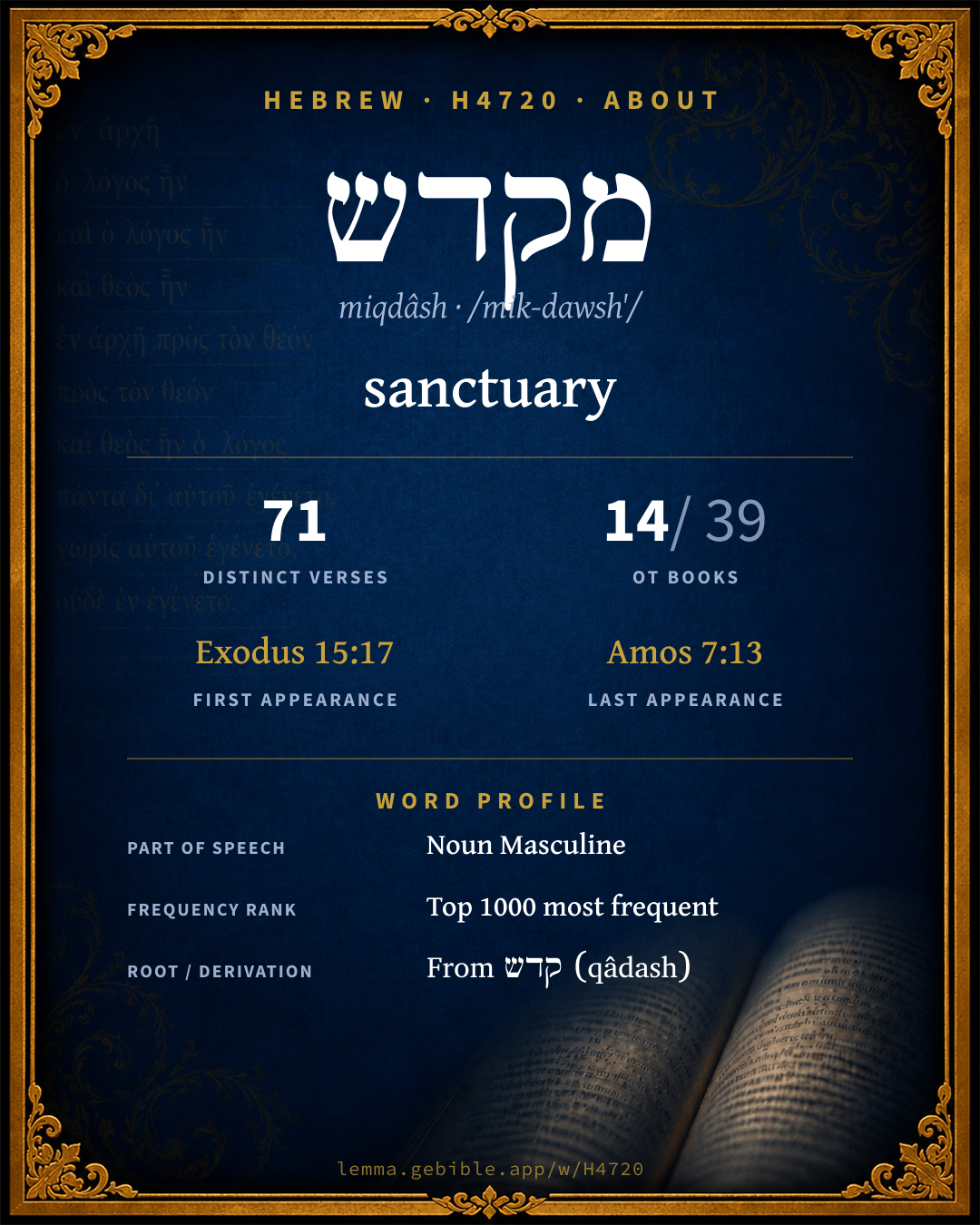
מִקְדָּשׁ
sanctuary
also: sacred place, holy place fuller range ↓
Full lexicon entry — Brown-Driver-Briggs (BDB)
From Brown-Driver-Briggs (BDB)
Where this word appears
See every Construct-state word in the Hebrew Bible →
Grammar key — what these labels mean
Part of speech
- Noun
- A naming word — a person, place, thing, or idea.
Noun type
- Common
- A common noun — a general class of person, place, or thing (“king,” “city,” “water”), not a specific name.
State
- Absolute
- The independent form of a noun, not bound to a following word.
- Construct
- A noun bound to a following noun in a possessive / “of” relationship (the construct chain).
Gender
- Masculine
- Grammatically masculine.
Number
- Singular
- One.
- Plural
- More than one (in Hebrew, generally three or more).
18 verses where H4720 appears in the Construct state in the Book of Ezekiel. Filtered view — show all forms. Click any verse to open its interlinear word-by-word view. Verse text shown in the World English Bible for context — . Each verse’s Hebrew form is shown with its reference; the English is not keyword-highlighted, since the data carries no word-level English alignment. Use “Compare translations” on any verse to read it across multiple English versions. This concordance covers the Hebrew Bible; Septuagint (Greek Old Testament) occurrences are not indexed here.
Ezekiel
- Ezekiel 5:11 מִקְדָּשִׁ֣/י n c ms cs + sfx pers 1cs Therefore, as I live, says the Lord Yahweh, surely, because you have defiled my sanctuary with all your detestable things, and with all your abominations, therefore will I also diminish [you]; neither shall my eye spare, and I also will have no pity.
- Ezekiel 8:6 מִקְדָּשִׁ֔/י n c ms cs + sfx pers 1cs He said to me, Son of man, see you what they do? even the great abominations that the house of Israel do commit here, that I should go far off from my sanctuary? but you shall again see yet other great abominations.
- Ezekiel 9:6 וּ/מִ/מִּקְדָּשִׁ֖/י conj + prep + n c ms cs + sfx pers 1cs kill utterly the old man, the young man and the virgin, and little children and women; but don't come near any man on whom is the mark: and begin at my sanctuary. Then they began at the old men that were before the house.
- Ezekiel 23:38 מִקְדָּשִׁ/י֙ n c ms cs + sfx pers 1cs Moreover this they have done to me: they have defiled my sanctuary in the same day, and have profaned my Sabbaths.
- Ezekiel 23:39 מִקְדָּשִׁ֛/י n c ms cs + sfx pers 1cs For when they had slain their children to their idols, then they came the same day into my sanctuary to profane it; and, behold, thus have they done in the midst of my house.
- Ezekiel 24:21 מִקְדָּשִׁ/י֙ n c ms cs + sfx pers 1cs Speak to the house of Israel, Thus says the Lord Yahweh: Behold, I will profane my sanctuary, the pride of your power, the desire of your eyes, and that which your soul pities; and your sons and your daughters whom you have left behind shall fall by the sword.
- Ezekiel 25:3 מִקְדָּשִׁ֣/י n c ms cs + sfx pers 1cs and tell the children of Ammon, Hear the word of the Lord Yahweh: Thus says the Lord Yahweh, Because you said, Aha, against my sanctuary, when it was profaned; and against the land of Israel, when it was made desolate; and against the house of Judah, when they went into captivity:
- Ezekiel 28:18 מִקְדָּשֶׁ֑י/ךָ n c mp cs + sfx pers 2ms By the multitude of your iniquities, in the unrighteousness of your traffic, you have profaned your sanctuaries; therefore have I brought forth a fire from the midst of you; it has devoured you, and I have turned you to ashes on the earth in the sight of all those who see you.
- Ezekiel 37:26 מִקְדָּשִׁ֛/י n c ms cs + sfx pers 1cs Moreover I will make a covenant of peace with them; it shall be an everlasting covenant with them; and I will place them, and multiply them, and will set my sanctuary in the midst of them forevermore.
- Ezekiel 37:28 מִקְדָּשִׁ֛/י n c ms cs + sfx pers 1cs The nations shall know that I am Yahweh who sanctifies Israel, when my sanctuary shall be in the midst of them forevermore.
- Ezekiel 44:7 בְּ/מִקְדָּשִׁ֖/י prep + n c ms cs + sfx pers 1cs in that you have brought in foreigners, uncircumcised in heart and uncircumcised in flesh, to be in my sanctuary, to profane it, even my house, when you offer my bread, the fat and the blood, and they have broken my covenant, [to add] to all your abominations.
- Ezekiel 44:8 בְּ/מִקְדָּשִׁ֖/י prep + n c ms cs + sfx pers 1cs You have not kept the charge of my holy things; but you have set keepers of my charge in my sanctuary for yourselves.
- Ezekiel 44:9 מִקְדָּשִׁ֑/י n c ms cs + sfx pers 1cs Thus says the Lord Yahweh, No foreigner, uncircumcised in heart and uncircumcised in flesh, shall enter into my sanctuary, of any foreigners who are among the children of Israel.
- Ezekiel 44:11 בְ/מִקְדָּשִׁ/י֙ prep + n c ms cs + sfx pers 1cs Yet they shall be ministers in my sanctuary, having oversight at the gates of the house, and ministering in the house: they shall kill the burnt offering and the sacrifice for the people, and they shall stand before them to minister to them.
- Ezekiel 44:15 מִקְדָּשִׁ/י֙ n c ms cs + sfx pers 1cs But the priests the Levites, the sons of Zadok, who kept the charge of my sanctuary when the children of Israel went astray from me, they shall come near to me to minister to me; and they shall stand before me to offer to me the fat and the blood, says the Lord Yahweh:
- Ezekiel 44:16 מִקְדָּשִׁ֗/י n c ms cs + sfx pers 1cs they shall enter into my sanctuary, and they shall come near to my table, to minister to me, and they shall keep my charge.
- Ezekiel 48:10 מִקְדַּשׁ n c ms cs For these, even for the priests, shall be the holy offering: toward the north twenty-five thousand [in length], and toward the west ten thousand in breadth, and toward the east ten thousand in breadth, and toward the south twenty-five thousand in length: and the sanctuary of Yahweh shall be in the midst of it.
- Ezekiel 48:21 וּ/מִקְדַּ֥שׁ conj + n c ms cs The residue shall be for the prince, on the one side and on the other of the holy offering and of the possession of the city; in front of the twenty-five thousand of the offering toward the east border, and westward in front of the twenty-five thousand toward the west border, answerable to the portions, it shall be for the prince: and the holy offering and the sanctuary of the house shall be in the midst of it.
About this entry
At a glance — auto-summarized from this page’s data, not written by a person. Every figure links to its source below. This summary describes the numbers; it doesn’t interpret them.
מקדש (miqdâsh) is a Hebrew noun most often rendered “sanctuary.” It first appears in Exodus 15:17. It turns up in 71 verses across 14 books, a moderately common footprint. It concentrates in Ezekiel, which alone accounts for 39% of its uses. It also covers “sacred place” and “holy place”, alongside “sanctuary” — see its full sense range. The sections below give every sense, occurrence, and version rendering.
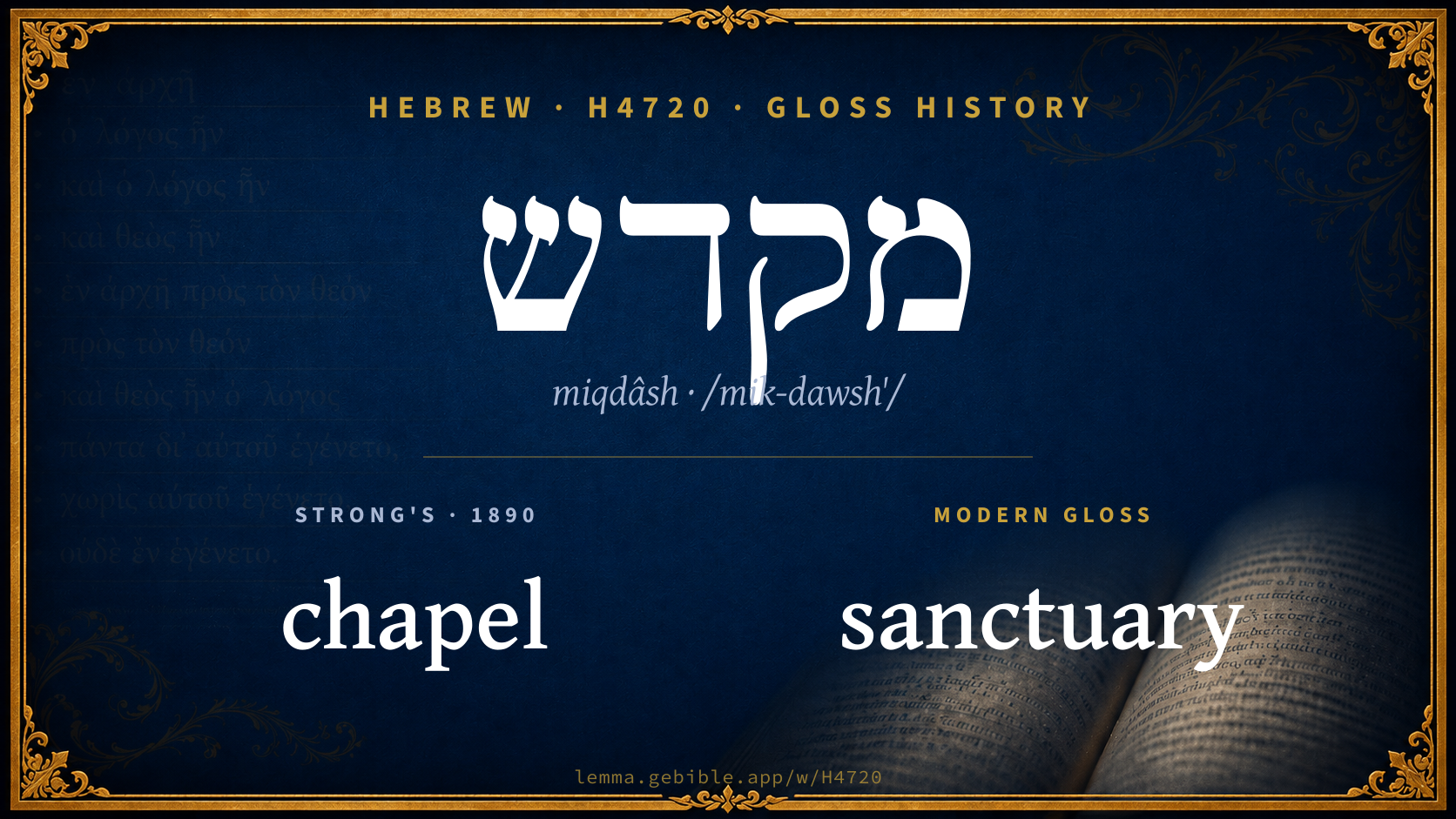
Gloss history
Strong's 1890 vs modern scholarship
About this word
Strong's H4720 catalogs a Hebrew word from the Hebrew Old Testament.
These counts are not copied from any lexicon or concordance. They are computed here, from the morphology-tagged Hebrew Old Testament. What Lemma adds →
- 71
- distinct verses
- The word appears in 71 distinct verses.
- 14 / 39
- OT books
- The word appears in 14 of 39 Old Testament books.
- #536
- by frequency
- Top 1000 most frequent Hebrew words (rank 536 of 8,640 Hebrew words by occurrence).
View all 71 occurrences in the concordance →
By section of the Old Testament
By traditional corpus
Conventional, traditional groupings — biblical authorship is debated, so this is a traditional corpus grouping, not an authorship claim. Each share is this word’s portion of its verses in that division of the Hebrew canon. Each figure is a share of the word’s 71 distinct verses.
- Prophets (Nevi'im) 37 verses · 52%
- Writings (Ketuvim) 19 verses · 27%
- Torah (Pentateuch) 15 verses · 21%
How translations render this word
Counts come from each version’s own published word-to-Strong’s tagging or interlinear alignment — an approximate guide to how each version renders this word, not a word-level alignment the data otherwise carries. Because each total is that version’s own tagged count, the per-version totals vary from one another and need not match the appearance or distinct-verse counts above. These counts may also differ from a printed concordance because Lemma counts each distinctly tagged rendering and does not collapse phrase taggings into a single head-word total. This is a fixed set of word-tagged versions (KJV, ASV, BSB, ULT) and does not change with the reading translation you choose elsewhere. Each version’s license is shown beside its name below (and on Sources).
- King James Version: Sanctuary 56×, Sanctuaries 5×
- American Standard Version: Sanctuary 46×, Sanctuaries 5×
- Berean Standard Bible: Sanctuary 60×, Sanctuaries 5×, Holy places 2×
- unfoldingWord Literal Text: Sanctuary 36×, Holy place 17×, The 3×
King James Version Public Domain
Renders H4720 across 74 tagged occurrences — most commonly:
Plus 13 renderings that appear only once — usually multi-word phrases or single function words the recovered tagging swept in, not distinct renderings.
American Standard Version Public Domain
Renders H4720 across 74 tagged occurrences — most commonly:
Plus 23 renderings that appear only once — usually multi-word phrases or single function words the recovered tagging swept in, not distinct renderings.
Berean Standard Bible Public Domain
Renders H4720 across 74 tagged occurrences — most commonly:
Plus 7 renderings that appear only once — usually multi-word phrases or single function words the recovered tagging swept in, not distinct renderings. Not rendered by a distinct English word in 1 further occurrence.
unfoldingWord Literal Text CC BY-SA 4.0
Renders H4720 across 76 tagged occurrences — most commonly:
Plus 12 renderings that appear only once — usually multi-word phrases or single function words the recovered tagging swept in, not distinct renderings.
Senses in the full BDB
What do BDB’s symbols mean?
BDB uses these scholarly abbreviations:
| Symbol | Meaning |
|---|---|
| 𝔊 | the Septuagint (the ancient Greek translation, LXX) |
| 𝔙 | the Vulgate (the Latin translation) |
| 𝔖 | the Syriac version (the Peshitta) |
| 𝔗 | the Targum (the Aramaic translation) |
| ψ | the Psalms |
| √ | root (the underlying root or stem) |
| ‖ | parallel passage (a synonymous or contrasted parallel) |
| † | the dagger: every passage where the word occurs is cited |
The 6 senses and sub-senses the full Brown-Driver-Briggs lexicon distinguishes for this word, in lexicon order (not ranked by frequency), with BDB’s own verbatim wording and sub-sense lettering. Shown in Hebrew script with BDB’s own scholarly abbreviations. The condensed entry is in the Lexicon Entry tab. See also the Forms in the corpus table below.
- 1. old Isr. sanctuaries: of י׳ at Schechem Jos 24:26 (E); prob. also Ex 15:17 (i.e. Shiloh); pl. of sanct. to be destroyed by י׳ Lv 26:31 (H); מִקְדְּשֵׁי יִשׂ׳ in N. Isr. Am 7:9; מִקְדַּשׁ־מֶלֶךְ v 13 (Bethel). e.g. Joshua 24:26
- 2. of the nations: Moab Is 16:12 pl. of Tyre Ez 28:18 (Co Toy [not Berthol Krae] read קָדְשְׁךָ thy sanctity). e.g. Isaiah 16:12
- 3. tabernacle and its precincts Ex 25:8 (P) +; מִקְדַּשׁ הַקֹּדֶשׁ Lv 16:33, pl. 21:23. e.g. Exodus 25:8
- 4. temple and precincts 1 Ch 22:19 Is 63:18 ψ 74:7 +; בֵּית מִקְדָּשָׁם 2 Ch 36:17, מקדשׁ הבית Ez 48:21, מְבוֹן מ׳ Dn 8:11; pl. of many sacred places in and about the temple, מִקְדְּשֵׁי בית י׳ Je 51:51; מִקְדְּשֵׁי אֵל ψ 73:17. Doubtful are: מִמִּקְדָּשֶׁיךָ ψ 68:36 (𝔊 ἐν τοῖς ὁσίοις αὐτοῦ; 𝔙 de sanctuario; SS מִקְדָּשֶׁ֑ךָ); מִקְדָּשִׁים Ez 21:7 (𝔊 Co Berthol Buhl מִקְדָּשָׁם; Toy Krae מִקְדָּשֶׁיהָ; ‖ יְרוּשָׁלַםִ); וּמִקְדָּשׁ לַמִּקְדָּשׁ Ez 45:4b (Co, after 𝔊, מִפְקָד לְקָדְשָׁם [לְבָֽתֵּי]; Toy וּלְמִגְרָשִׁים [לְבָֽתִּים], cf. Krae לְמִגְרָשׁ). e.g. 1 Chronicles 22:19
- 5. י׳ will become לְמ׳ for his people Ez 11:16 (BrMP 268), so appar. Is 8:14 (but gloss Du CheHpt Marti; Lag Sem. i. 16 מִקָּשׁ i. e. stumbling-block [he cp. Syriac ܢܩܰܫ strike]). e.g. Ezekiel 11:16
- 6. of י׳’s future sanct., מ׳ בתוכם לעולם Ez 37:26, 28.—(מִמֶּנּוּ) אֶת־מִקְדְּשׁוֹ (מִכָּל־חֶלְבּוֹ) Nu 18:29 even the hallowed part thereof AV RV, but this not the meaning of מ׳; Ew§ 255 c assumes מַקְדֵּשׁ* in this sense; קָדְשׁוֹ (v. קֹדֶשׁ 3 d), מִ being dittogr. e.g. Ezekiel 37:26
Senses from the full Brown-Driver-Briggs lexicon (Brown, Driver, Briggs; Oxford 1906 — public domain), digitized via Sefaria, supplemented by the OpenScriptures HebrewLexicon (CC BY 4.0). Full attribution on Sources.
Word origin
n.m. Am 7:9 sacred place, sanctuary;—מ׳ Ex 25:8 +; מִקְדָשׁ 15:17 (Ges§ 20 h Köii. 1, 471); cstr. מִקְּדַּשׁ Lv 16:23 +; sf. מִקְדָּשִׁי Lv 20:3 +, etc., מִקְדְּשׁוֹ Nu 18:29 (Köii 1, 97); pl. מִקְדָּשִׁים Ez 21:7, cstr. מִקְדְּשֵׁי Je 51:51 + 2 times; sf. מִקְדָּשַׁי Lv 21:23; מְקַדְשֵׁיהֶם Ez 7:24 (on anomalous pointing v. Ew§ 215 a Hi-Sm; but prob. Pi. Pt. was in mind, Ges§ 9300 Anm.; מִקְדְּשֵׁיהֶם); etc.;—
— Brown-Driver-Briggs (Oxford 1906, public domain), digitized via Sefaria, supplemented by the OpenScriptures HebrewLexicon (CC BY 4.0). See Sources.
Derived from קדש (qâdash) (H6942) — to consecrate.
Jastrow Dictionary
A second Hebrew/Aramaic lexicon for comparison, covering Aramaic and post-biblical (Talmudic, Targumic, Midrashic) usage that the biblical-Hebrew BDB does not. Matched by lemma rather than by Strong’s number, so a lemma may carry more than one Jastrow headword (shown separately below), and the entries cover usage well beyond the Bible.
מִקְדָּשׁ
- sanctuary, esp. מִ׳ or בֵּית הַמִּ׳ (abbr. בה"מ) the Jerusalem Temple, contrad. to משכן the Tabernacle. M. Kat. 9ᵃ. Erub. 2ᵃ אשכחן משכן דאיקרי מ׳ ומ׳ וכ׳ we find that the Tabernacle is sometimes called miḳdash, and the Temple mishkan.—מ׳ ראשון the first Temple (the Solomonic Temple); מ׳ שני the second (post-exilic) Temple. Yoma 21ᵇ; a. e.—Ib. בשעה … בה"מ when Solomon had built the Temple; a. fr.—Pl. מִקְדָּשִׁים. Meg. 16ᵇ שני מ׳ two sanctuaries (that of Shiloh and the Jerusalem Temple); Yalk. Gen. 152.
מַקְדַּשׁ
- Targ. Ex. XXV, 8; a. fr.—Y. Ber. II, 5ᵃ top בֵּי מוּקְ׳, בֵּית = h. בית המקדש, v. preced.; Lam. R. to I, 16 בית מַקְדָּשׁוֹן דיהודאי (not מקדשין) the Temple of the Jews.—Pl. מַקְדְּשִׁין. Targ. Ez. XXI, 7; a. e.
A Dictionary of the Targumim, the Talmud Babli and Yerushalmi, and the Midrashic Literature (Marcus Jastrow; London, Luzac, 1903) — Public Domain. Digitized via Sefaria. Digitized via Sefaria. Full attribution on Sources.
Forms in the corpus
The 51 distinct written forms H4720 takes in the Hebrew Bible, most frequent first — each parse links to that state’s occurrences in the concordance. Hebrew forms include their vowel points and cantillation, so a single lemma takes many written forms.
Same root — word family
Other BDB entries built from the same root as H4720, grouped by Strong’s listed origin. These share a root / origin per the lexicon — not necessarily a shared meaning. Each links to that word’s own entry.
Derives from
Shares the same root
Proper names from this root
People and places named from this root — a name, not an additional meaning of the word.
Compare all same-root words → Showing 4 of 6 — not the complete family. 1 of the same-root words is a proper name (a person or place). They share a root, not necessarily a meaning.
Septuagint verse parallels
This word appears in 68 verses that also exist in the Greek Old Testament (Septuagint), out of the 71 Hebrew verses it occurs in. You can read those verses in Greek by switching the Old Testament edition to the Septuagint.
Read these verses in the Septuagint
- Exodus 15:17
- Leviticus 12:4
- Numbers 3:38
- Joshua 24:26
- 1 Chronicles 22:19
- 2 Chronicles 20:8
- Psalms 68:35
- Isaiah 8:14
- Jeremiah 17:12
- Lamentations 1:10
- Ezekiel 5:11
- Daniel 8:11
This is a verse-level parallel only — the same verses exist in both the Hebrew and Greek Old Testaments. No word-level Hebrew↔Greek correspondence is claimed: the data carries no such alignment, so no Greek word is shown as this Hebrew word’s translation. Coverage is not total — the Septuagint omits the deuterocanon and renumbers the Psalms, so some Hebrew verses have no direct Greek parallel.