Ezekiel 44:8

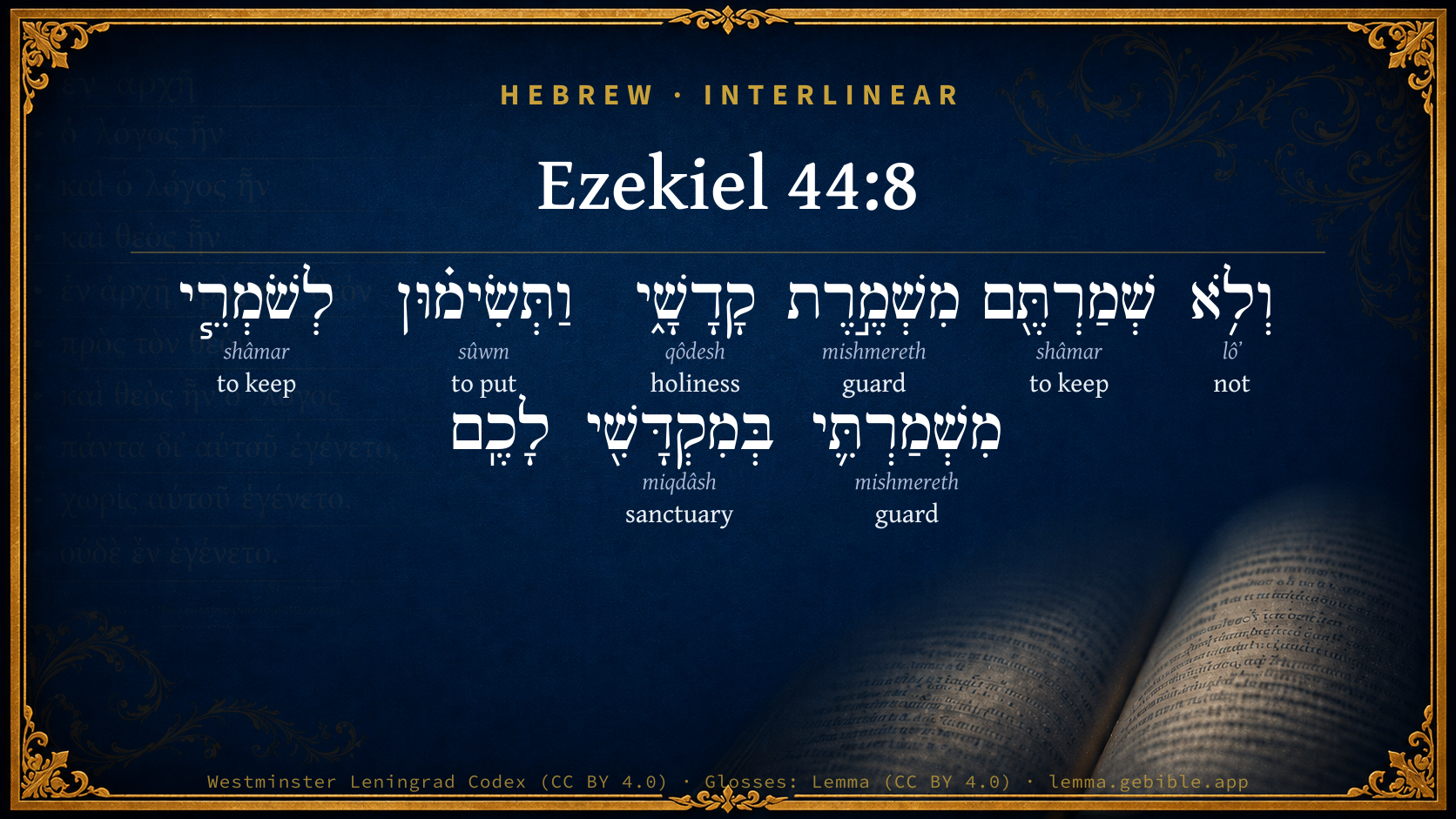
Hebrew (Westminster Leningrad Codex) Ezekiel 44:8 appears in the Hebrew Old Testament. The text above is from the Westminster Leningrad Codex. Each word links to its Strong’s number, a concise gloss, and parsing drawn from the Open Scriptures Hebrew Bible morphology. Click any word for its full Brown-Driver-Briggs (BDB) entry.
Download image
Cite this verse

Ezekiel 44:8 (World English Bible). Public Domain. Lemma interlinear Bible study tool, https://lemma.gebible.app/v/ezekiel/44/8.

Show BibTeX & RIS
BibTeX
RIS
English Translation
You have not kept the charge of my holy things; but you have set keepers of my charge in my sanctuary for yourselves.
World English Bible · Public Domain
Download a study sheet

One document with this verse’s original text, its word-by-word gloss line, the meaning frame, cross-references with their text, attributed commentary, and full source and license credits — printable, and it pastes into notes with its structure intact.

This verse Autodidact and up

Study sheet (.html) Plain text (.txt)

A passage Seminary Student

Up to 50 verses in one chapter. A passage sheet keeps up to 6 commentary sources and 12 cross-references per verse, in the order this page ranks them, and says so on the sheet whenever that leaves anything out. Ask for a single verse and you get the Autodidact verse sheet above.

Everything on this page stays free to read, with no account — the sheet is a download of what is already on screen, not access to it.

Want to remove ads? Support Godless Engineer
Compare translations 3

The same verse in 3 English versions, stacked beneath the original-language interlinear above. Click any original word for its lexicon entry.

Each is an independent rendering of the whole verse — the interlinear is not word-aligned to these translations.

Highlighted words mark where these versions differ — a whole-verse word diff, not a word-by-word alignment.

  • World English Bible Public Domain
    You have not kept the charge of my holy things; but you have set keepers of my charge in my sanctuary for yourselves.
  • King James Version Public Domain
    And ye have not kept the charge of mine holy things: but ye have set keepers of my charge in my sanctuary for yourselves.
  • unfoldingWord Literal Text CC BY-SA 4.0
    You have not carried out your duties regarding my holy things, but you appointed others to take up your duties, and you assigned them to care for my holy place.

unfoldingWord Literal Text — © unfoldingWord, licensed CC BY-SA 4.0. Word-aligned USFM3 via Door43 (git.door43.org/unfoldingWord/en_ult).

Versions to compare (up to 4)

3 of 4 selected

Show all 18 translations

Every available English version of this verse, each an independent rendering of the whole verse.

  • World English Bible Public Domain
    You have not kept the charge of my holy things; but you have set keepers of my charge in my sanctuary for yourselves.
  • Berean Standard Bible Public Domain
    And you have not kept charge of My holy things, but have appointed others to keep charge of My sanctuary for you.’
  • Majority Standard Bible Public Domain
    And you have not kept charge of My holy things, but have appointed others to keep charge of My sanctuary for you.’
  • King James Version Public Domain
    And ye have not kept the charge of mine holy things: but ye have set keepers of my charge in my sanctuary for yourselves.
  • American Standard Version (1901) Public Domain
    And ye have not kept the charge of my holy things; but ye have set keepers of my charge in my sanctuary for yourselves.
  • Revised Version (1885) Public Domain
    And ye have not kept the charge of mine holy things: but ye have set keepers of my charge in my sanctuary for yourselves.
  • Geneva Bible (1599) Public Domain
    For yee haue not kept the ordinances of mine holy things: but you your selues haue set other to take the charge of my Sanctuarie.
  • Douay-Rheims (1899) Public Domain
    And you have not kept the ordinances of my sanctuary: but you have set keepers of my charge in my sanctuary for yourselves.
  • Young's Literal Translation Public Domain
    and ye have not kept the charge of My holy things, and ye set `them' for keepers of My charge in My sanctuary for you.
  • Literal Standard Version CC BY-SA 4.0
    and you have not kept [the] charge of My holy things, and you set [others] for keeping My charge in My sanctuary for you.
  • Unlocked Literal Bible CC BY-SA 4.0
    You have not carried out your duties regarding my holy things, but you appointed others to take up your duties, and you assigned them to care for my holy place.
  • unfoldingWord Literal Text CC BY-SA 4.0
    You have not carried out your duties regarding my holy things, but you appointed others to take up your duties, and you assigned them to care for my holy place.
  • Darby Bible Public Domain
    And ye have not kept the charge of my holy things, but have set keepers of my charge in my sanctuary for yourselves.
  • World Messianic Bible Public Domain
    You have not performed the duty of my holy things; but you have set performers of my duty in my sanctuary for yourselves.”
  • Webster's Bible Public Domain
    And ye have not kept the charge of my holy things: but ye have set keepers of my charge in my sanctuary for yourselves.
  • Free Bible Version CC BY-SA 4.0
    In addition you have not taken care of my sanctuary as you were required to, but instead you employed others to look after my sanctuary for you.
  • Bible in Basic English Public Domain
    And you have not taken care of my holy things; but you have put them as keepers to take care of my work in my holy place.
  • JPS Tanakh (1917) Public Domain
    And ye have not kept the charge of My holy things; but ye have set keepers of My charge in My sanctuary to please yourselves.

Literal Standard Version (2020), Covenant Press — licensed CC BY-SA 4.0. Text via the HelloAO Bible API (eBible.org). Unlocked Literal Bible (unfoldingWord) — licensed CC BY-SA 4.0. Text via the HelloAO Bible API (eBible.org). unfoldingWord Literal Text — © unfoldingWord, licensed CC BY-SA 4.0. Word-aligned USFM3 via Door43 (git.door43.org/unfoldingWord/en_ult). Free Bible Version, Dr. Jonathan Gallagher — licensed CC BY-SA 4.0. Text via the HelloAO Bible API (eBible.org).

Word by word

More ways to search: Search by grammar → Find every occurrence → Compare this word →

Practice this passage: Drill this verse → Learn its vocabulary →

בְּמִקְדָּשִׁ֖י
miqdâsh
H4720
“in/at · sanctuary · my”
Preposition + Noun, Common, Masculine, Singular, Construct + Suffix, Personal, 1st Person, Common, Singular
Part of Speech
Preposition + Noun
Type
Common
Gender
Masculine
Number
Singular
State
Construct
Full BDB Definition

Origin: from H6942

TWOT: 1990f

sacred place, sanctuary, holy place - sanctuary - of the temple - of the tabernacle - of Ezekiel's temple - of Jehovah
  1. וְלֹ֥א lôʼ H3808 “and · not” Conjunction + Particle, Negative
  2. שְׁמַרְתֶּ֖ם shâmar H8104 “to keep” Verb, Qal, Perfect, 2nd Person, Masculine, Plural
  3. מִשְׁמֶ֣רֶת mishmereth H4931 “guard of” Noun, Common, Feminine, Singular, Construct
  4. קָדָשָׁ֑י qôdesh H6944 “holy things · my” Noun, Common, Masculine, Plural, Construct + Suffix, Personal, 1st Person, Common, Singular
  5. וַתְּשִׂימ֗וּן sûwm H7760 “and · to put” Conjunction + Verb, Qal, Sequential Imperfect, 2nd Person, Masculine, Plural + Suffix, n
  6. לְשֹׁמְרֵ֧י shâmar H8104 “to/for · keeping” Preposition + Verb, Qal, Participle Active, Masculine, Plural, Construct
  7. מִשְׁמַרְתִּ֛י mishmereth H4931 “guard · my” Noun, Common, Feminine, Singular, Construct + Suffix, Personal, 1st Person, Common, Singular

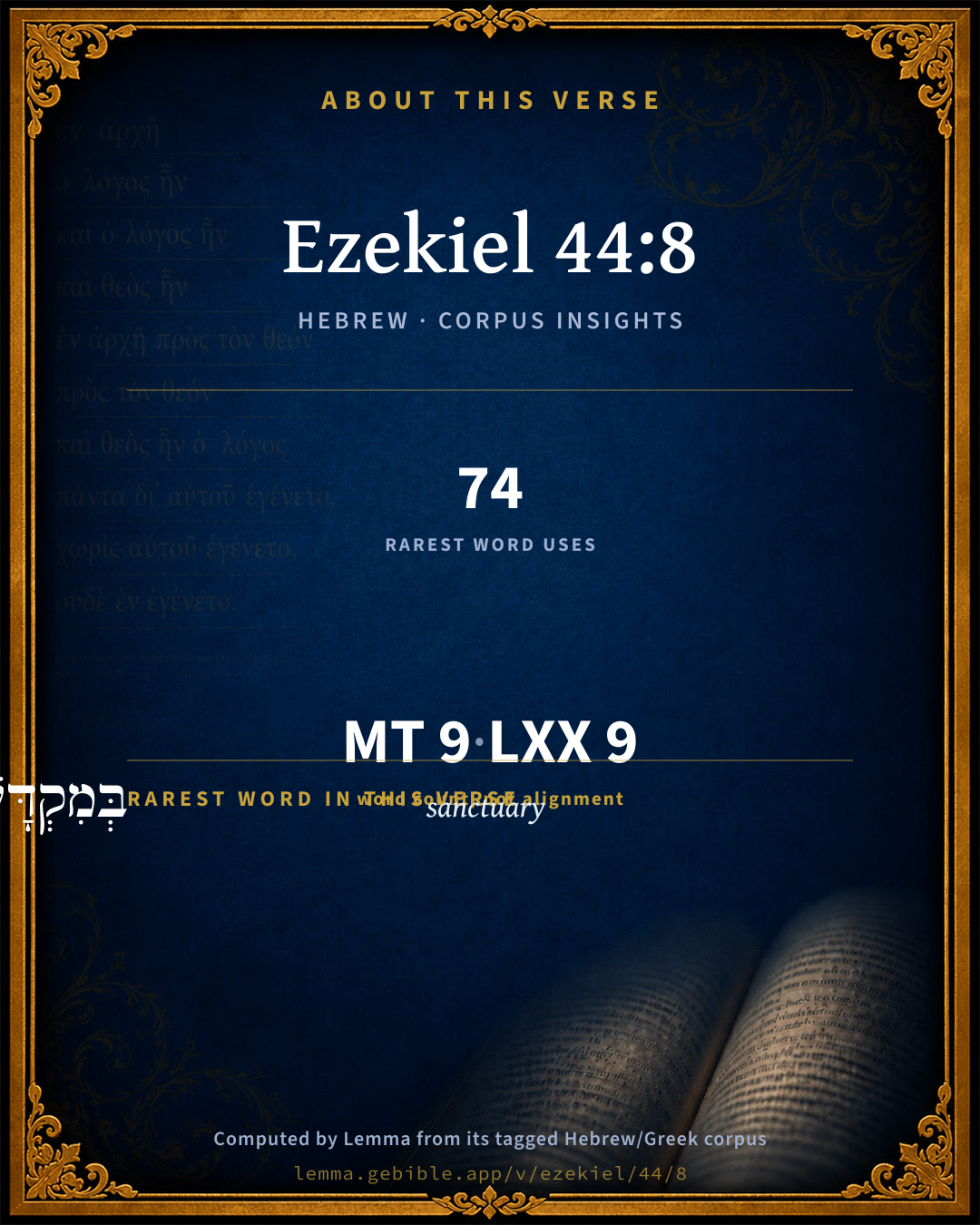
About this verse

These counts appear in no published source. They are computed here, from the morphology-tagged text and Lemma’s own curated glosses. What Lemma adds →

9
words
6
distinct lemmas
Prophets
section

Grammatical profile

  • 3 verbs
  • 4 nouns
  • 1 preposition
  • 1 particle

Verb forms

  • שְׁמַרְתֶּ֖ם Qal · Perfect
  • וַתְּשִׂימ֗וּן Qal · Sequential Imperfect
  • לְשֹׁמְרֵ֧י Qal · Participle Active

Repetition

Words recur within this verse — often emphatic in Hebrew:

  • שְׁמַרְתֶּ֖ם to keep H8104 ×2
  • מִשְׁמֶ֣רֶת guard H4931 ×2

Hebrew & Septuagint length

In English translation the verse runs 23 words from the Hebrew and 11 from the Septuagint (LXX English) — the Septuagint runs noticeably shorter here. See the side-by-side →

A rough comparison of the two English renderings, which tokenize alike — not a word-level alignment.

Word counts can differ between the Hebrew and the Greek without any difference in meaning — e.g. the Hebrew direct-object marker אֵת has no separate Greek word, and Greek often adds the article ὁ.

In the original languages it is 9 Hebrew tokens and 9 Greek tokens — but the two are counted differently (Hebrew bundles its prefixes and suffixes into one token; the Greek is in lemma form), so that isn’t a like-for-like length.

Cross-references

11

Topical passages linked to Ezekiel 44:8 in the Treasury of Scripture Knowledge — connected by theme and wording, ordered by reader-vote popularity; previews shown in the World English Bible.

  • Leviticus 22:2–33 "Tell Aaron and his sons to separate themselves from the holy things of the children of Israel, which they make holy to me, and that they not profane my holy name. I am Yahweh.
  • Numbers 18:3–5 They shall keep your charge, and the charge of all the Tent: only they shall not come near to the vessels of the sanctuary and to the altar, that they not die, neither they, nor you.
  • Numbers 18:7 You and your sons with you shall keep your priesthood for everything of the altar, and for that within the veil; and you shall serve: I give you the priesthood as a service of gift: and the stranger who comes near shall be put to death.
  • 1 Chronicles 23:32 and that they should keep the charge of the tent of meeting, and the charge of the holy place, and the charge of the sons of Aaron their brothers, for the service of the house of Yahweh.
  • Ezra 8:24–30 Then I set apart twelve of the chiefs of the priests, even Sherebiah, Hashabiah, and ten of their brothers with them,
  • Ezekiel 40:45–46 He said to me, This chamber, whose prospect is toward the south, is for the priests, the keepers of the charge of the house;
  • Ezekiel 44:14 Yet will I make them keepers of the charge of the house, for all the service of it, and for all that shall be done therein.
  • Ezekiel 44:16 they shall enter into my sanctuary, and they shall come near to my table, to minister to me, and they shall keep my charge.
  • Acts 7:53 You received the law as it was ordained by angels, and didn't keep it!"
  • 1 Timothy 6:13 I charge you before God, who gives life to all things, and before Christ Jesus, who before Pontius Pilate testified the good confession,
  • 2 Timothy 4:1 I charge you therefore before God and the Lord Jesus Christ, who will judge the living and the dead at his appearing and his Kingdom:

Cross-references courtesy of OpenBible.info (CC BY 4.0).

Hebrew and Greek witnesses Masoretic Hebrew ↔ Greek Septuagint

The same verse in the two great witnesses to the Old Testament, shown verse-for-verse.

Here the Septuagint runs noticeably shorter than the Hebrew — LXX2012 (modern English Septuagint) 11 words vs World English Bible 23. A rough length comparison of the two English translations, not a word-level alignment — read both below.

These are two independent witnesses, not word-aligned to each other, and the Septuagint is shown in lemma (dictionary) form.

Hebrew Ezekiel 44:8 Masoretic · Westminster Leningrad Codex

וְלֹ֥א שְׁמַרְתֶּ֖ם מִשְׁמֶ֣רֶת קָדָשָׁ֑י וַתְּשִׂימ֗וּן לְשֹׁמְרֵ֧י מִשְׁמַרְתִּ֛י בְּמִקְדָּשִׁ֖י לָכֶֽם

You have not kept the charge of my holy things; but you have set keepers of my charge in my sanctuary for yourselves.

World English Bible · Public Domain

Greek LXX Ezekiel 44:8 Septuagint · lemma form

καί διατάσσω ὁ φυλάσσω φυλακή ἐν ὁ ἅγιος ἐγώ

and you⌃ appointed others to keep the charges in my sanctuary.

LXX2012 (modern English Septuagint) · Public Domain

On this verse, The Cambridge Bible for Schools and Colleges discusses the Septuagint’s reading. Read the note in Commentary ↓

Hebrew: Westminster Leningrad Codex (CC BY 4.0). Greek: Septuagint (public domain); English from LXX2012 (modern English Septuagint) (Public Domain). How the Septuagint differs from the Hebrew →

Targum (Aramaic paraphrase)

1

The Targum is the ancient Jewish Aramaic paraphrase of the Hebrew Scriptures — an interpretive translation, not the Hebrew text itself. Onkelos (literal) and Pseudo-Jonathan (expansive) render the Torah, and Jonathan the Prophets. Coverage is partial: where no permissively-licensed English translation exists for a verse, only the Aramaic is shown. This is verse-level text, not a word-by-word alignment to the Hebrew.

  1. Targum Jonathan Prophets (Joshua–Malachi)
    וְלָא נְטַרְתּוּן מֵטְרַת קוּדְשִׁי וּמַנִיתוּן לְנַטְרֵי מַטְרַת מֵימְרִי בְמַקְדְשִׁי לְכוֹן:

    (no public-domain English translation for this verse)

    Targum Jonathan — Aramaic: “Mikraot Gedolot” (public domain). English: “Sefaria Community Translation” (CC0 1.0 (public-domain dedication)); “London "Chaldee Paraphrase," 1871” (public domain). Text via Sefaria.

Commentary

Notes on Ezekiel 44:8 from classic Christian and Jewish commentators (each source and its license shown beneath its notes). The classic Christian expositions comment on the surrounding passage and are grouped to its opening verse, so a note may address several verses; the Jewish commentaries on the Tanakh (Rashi and others) are per-verse, so they appear only where the commentator wrote on this verse.

Lemma curates 59 commentaries, every one of them public domain or Creative Commons licensed, each selected and text-cleaned for this edition rather than reprinted as found. About our sources →

Trapp's Complete Commentary

John Trapp

Eze 44:8 And ye have not kept the charge of mine holy things: but ye have set keepers of my charge in my sanctuary for yourselves.

Ver. 8. For yourselves.] Pro vestro arbitratu, non pro mea voluntate; as best suited with your own ends, and fitted to your own humours.

John Trapp, A Commentary or Exposition upon All the Books of the Old and New Testament (1647–1656) — public domain. Text from a community e-Sword module.

Geneva Bible (1599)

Geneva Bible translators

Ye have not offered unto me according to my Law.

Geneva Bible (1599) marginal notes — public domain. Text via Bolls.life.

Jamieson, Fausset & Brown

Robert Jamieson, A. R. Fausset & David Brown

keepers . . . for yourselves--such as you yourselves thought fit, not such as I approve of. Or else, "Ye have not yourselves kept the charge of My holy things, but have set others as keepers of My charge in My sanctuary for yourselves" [MAURER].

Jamieson, Fausset & Brown — Commentary Critical and Explanatory on the Whole Bible (1871) — public domain (CC PDM 1.0). Text via the HelloAO Bible API.

Ellicott's Commentary for English Readers

(8) For yourselves.—Comp. 1Ki_12:31.

A Bible Commentary for English Readers, edited by Charles John Ellicott (1878–1897) — public domain. Text from a community e-Sword module.

The Cambridge Bible for Schools and Colleges

gen. ed. J. J. S. Perowne

8. ye have set keepers] Some would read: ye have set them keepers. This of course is the meaning. The change is hardly supported by LXX (as Well. p. 122).

The Cambridge Bible for Schools and Colleges (gen. ed. J. J. S. Perowne; Cambridge University Press, 1878–1918) — public domain. Text from a community e-Sword module.

John Gill's Exposition

And ye have not kept the charge of mine holy things,.... That is, have not kept and retained the holy doctrines of the Gospel; nor observed the holy ordinances of it, as they were first delivered:

but ye have set keepers of my charge in my sanctuary for yourselves; meaning either, that such as were in public office did not attend to it; but were idol shepherds, and left the flock, their care and charge, to others, to surrogates and curates, to do their work for them; while they indulged themselves in sloth and idleness: or that the members and hearers set up preachers for themselves, according to their lusts, agreeable to their own carnal sentiments, without any regard to the will and glory of God.

John Gill's Exposition of the Whole Bible (1746–1763) — public domain (CC PDM 1.0). Text via the HelloAO Bible API.

Haydock's Catholic Bible Commentary

Yourselves, out of ambition, contrary to the regulations of David. (Calmet)

George Leo Haydock (1774–1849), Haydock's Catholic Family Bible and Commentary, 1859 edition — public domain. Excludes Psalms (Douay-Rheims chapter numbering differs from Protestant) and Deuterocanonical books (Catholic canon only).

Matthew Poole's English Annotations

You have not observed the laws I gave you for the careful and exact keeping of my holy things; house, sacrifices, and worship. You have substituted others in your rooms, made officials, and surrogates, and curates to look to the gates, and these have let in the profane and unclean; your pride, or covetousness, or laziness, hath taken you off from your duty and your charge; or you have, as you saw good, consecrated persons, whether fit or unfit, whether approved or not approved by me. So you have profaned my name, and violated my law, Num 18:4.

Matthew Poole's English Annotations on the Holy Bible (1683–1685) — public domain. Text from a community e-Sword/MySword module.

The Pulpit Commentary

Instead of having exercised a holy solicitude for the purity of the temple and the regularity of its rites, by keeping strict watch over the holy things of Jehovah, the house of Israel had set keepers; literally, had set them, i.e. the uncircumcised "strangers" above referred to, as keepers of Jehovah"s charge in his sanctuary for themselves, i.e. to please themselves, irrespective altogether of Jehovah"s enactments. From this it has been argued, by Wellhausen, Smend, Driver, and others, that the "strangers" above mentioned had been not only allowed access to the outer court as spectators or as worshippers while the priests were offering sacrifice, but admitted to the inner court as assistants to the priests in their altar duties, that this, the employment of these heathen hierodules, had been the special wickedness of which Israel had been guilty, and that henceforward these "foreign ministers" were to be thrust out from their offices, and their places supplied by the about-to-be-degraded Levites. It is, however, doubtful if the phrase, keepers of my charge in the sanctuary, can be made to signify more than has already been expressed by the clause, "to be in my sanctuary when ye offer my bread" (ver. 7), by which, as Kliefoth and Keil explain, Israel had practically made these strangers "keepers of Jehovah"s charge," i.e. observers of the rites of worship prescribed by him, though observers in their way, not in his; if more can be extracted from the words, then the most they can be legitimately made to affirm (as there is no mention of the inner court) is that these "strangers," in addition to obtaining access to the outer court to witness the sacrifices, or perhaps offer such for themselves, had been more or less frequently employed in performing subordinate offices towards the Levites, who were the proper priests" assistants, like the Gibeonites, whom Joshua (Jos_9:27) made "hewers of wood and drawers of water for the congregation and for the altar of the Lord unto this day," and like the Nethinim, whom, according to Ezra, (Ezr_8:20) David and the princes had given for the service of the Levites (see Delitzsch, Luthardt"s "Zeitschrift fur kirchliche Wissenschaft," 1880, p. 283). (On the phrase, "to keep the charge of Jehovah," as signifying to follow his directions or comply with his prescriptions, see Num_9:23) "In the sanctuary" explains that the prescriptions alluded to were those pertaining to the sanctuary or to the worship of Jehovah.

Religion by proxy.

The people had neglected their own duty in regard to the worship of God, and had appointed hirelings to discharge the sacred offices in their stead. This was a case of trying to practice religion by proxy. We often see the attempt made in various ways now, but it is doomed to failure.

I THE ATTEMPT TO SATISFY THE CLAIMS OF RELIGION BY PROXY. There are now many Jews in Jerusalem kept in idleness by their more wealthy brethren in Europe, who hope by this expedient to secure for themselves the merit of living and dying in the Holy City, without undergoing the irksome experience of actual residence. In Roman Catholic countries it is common to devote a sum of money to the payment of the priest who is to say so many Masses on behalf of a person. Among ourselves there is an unconfessed but common notion that the minister in some way performs the offices of religion on behalf of the people, who stand by as idle spectators, and yet enjoy the fruits of his vicarious service. The development of elaborate ritual and the cultivation of highly ornate choral services tend in this direction, by taking the acts of worship out of the grasp of the people, and consigning them to the clergy and choir.

Where this is not the ease, there is a common feeling that the mere attendance at church when a service is being conducted is of some religious efficacy, the officiating minister carrying on the real worship on behalf of the congregation, which may be listless and indifferent, so long as he discharges his duty faithfully. Or perhaps the religion by proxy is attempted in the way of money payments. The rich man who will make no moral sacrifice, and who is unwilling to worship God or serve him, subscribes to charities and Missionary Societies, and consoles himself by the thought that he is supporting religion and other good works. He is not a pillar of the church within the sacred building, but he is a sort of buttress outside it. By this indirect service of a money payment he thinks to compound for his irreligion. Lastly, living in a Christian land, belonging to a Christian home, and having Christian associates are regarded as matters of some religious value by people who possess no real religion of their own. Thus they too would be religious by proxy.

II THE UTTER FUTILITY OF THIS ATTEMPT. Every man must have his own personal dealings with God. There are such things as mediation, intercession, and vicarious sacrifices. The good mother is spiritually helpful to her children. Christ"s righteousness, his obedience, and his sacrifice are for the good of the world. But none of these things will compensate for irreligion in those who would avail themselves of their advantages. Moreover, God looks to the heart. Money gifts not offered by a grateful, devout heart, but only paid in fines to exonerate a man from the consequences of his misdeeds and negligences, are of no value whatever in the sight of God. There is no merit in helping the religion of other people if no right motive inspires the action. The very desire to be religious by proxy reveals a wrong state of the heart, for it shows that those people who experience it have no love for God and no real inclination for religion. The man whose heart is right with God will not wish to be religious by proxy. The son who has true affections will have no inclination to pay a substitute to take his place in the family circle. When his heart is renewed the Christian is most eager to be near to God, for then worship is glad and spontaneous.

The Pulpit Commentary (1880–1919), ed. H.D.M. Spence-Jones & Joseph S. Exell — public domain. Text from a community e-Sword module.

John Wesley's Explanatory Notes

Have not kept - You have not observed the laws I gave you for the keeping of my holy things, house, sacrifices, and worship. Have set - You have substituted others in your rooms.

John Wesley, Explanatory Notes Upon the Whole Bible (1754–1765) — public domain. Text via the GEBible commentary corpus.

unfoldingWord translationNotes

Door43 World Missions Community

General Information:

Yahweh continues giving Ezekiel his message to the house of Israel.

translationWords

holy place

alien

Israel

circumcise

heart

flesh

unfoldingWord translationNotes — © Distant Shores Media and the Door43 World Missions Community, licensed CC BY-SA 4.0. Source: git.door43.org/Door43/en_tn.

Rashi

Rabbi Shlomo Yitzchaki (Rashi)

And you appointed keepers of My watch in My Sanctuary You knowingly appointed in My Sanctuary, people who are not fit to be keepers of My watch.

Rashi on the Tanakh — English translations: “The Judaica Press complete Tanach with Rashi, translated by A. J. Rosenberg” (CC BY 4.0); “Pentateuch with Rashi's commentary by M. Rosenbaum and A.M. Silbermann, 1929-1934” (public domain); “The Metsudah Tanach series, Lakewood, N.J” (CC BY 4.0); and “The Book of Joshua, Metsudah Publications, 1997” (CC BY 4.0). Text via Sefaria.

Lesson kit

Teaching starters — assembled from the data on this page, not authored interpretation. Every prompt links to the verse data it draws on. Edit before teaching.

Ezekiel, in the Prophets, opens this verse with 9 words (6 distinct Hebrew lemmas). Its most distinctive word is miqdâsh (“sanctuary”). The Greek Septuagint runs shorter here. A historical commentator’s framing appears above. Read the whole chapter for the surrounding context.

Discussion questions

  1. What does “sanctuary” (miqdâsh) contribute to the verse as a whole?
  2. How does Leviticus 22:2–33, which shares this passage’s theme, read alongside this verse?
  3. What does the repetition of “to keep” (2× in this one verse) do in this verse?
  4. The Septuagint runs shorter here than the Hebrew. What might account for the difference?
  5. These translations render this verse differently; the difference is in the English rendering, not the original. What questions does that raise?
  6. «שְׁמַרְתֶּ֖ם» is a Qal Perfect verb. How does that grammatical form shape the action described?
  7. Compare how Trapp's Complete Commentary and Geneva Bible (1599) read this verse. Where do they agree or differ?

Things to notice

Reading settings

Reading text

Shown beneath each verse's original-language words.

Old Testament
Old Testament edition

Read the OT as the Masoretic Hebrew (MT) or the Greek Septuagint (LXX).

English shown for the Greek Septuagint (in the Hebrew ↔ Greek comparison).

Comparing translations? Open the Compare panel on any verse page to stack up to four side by side.