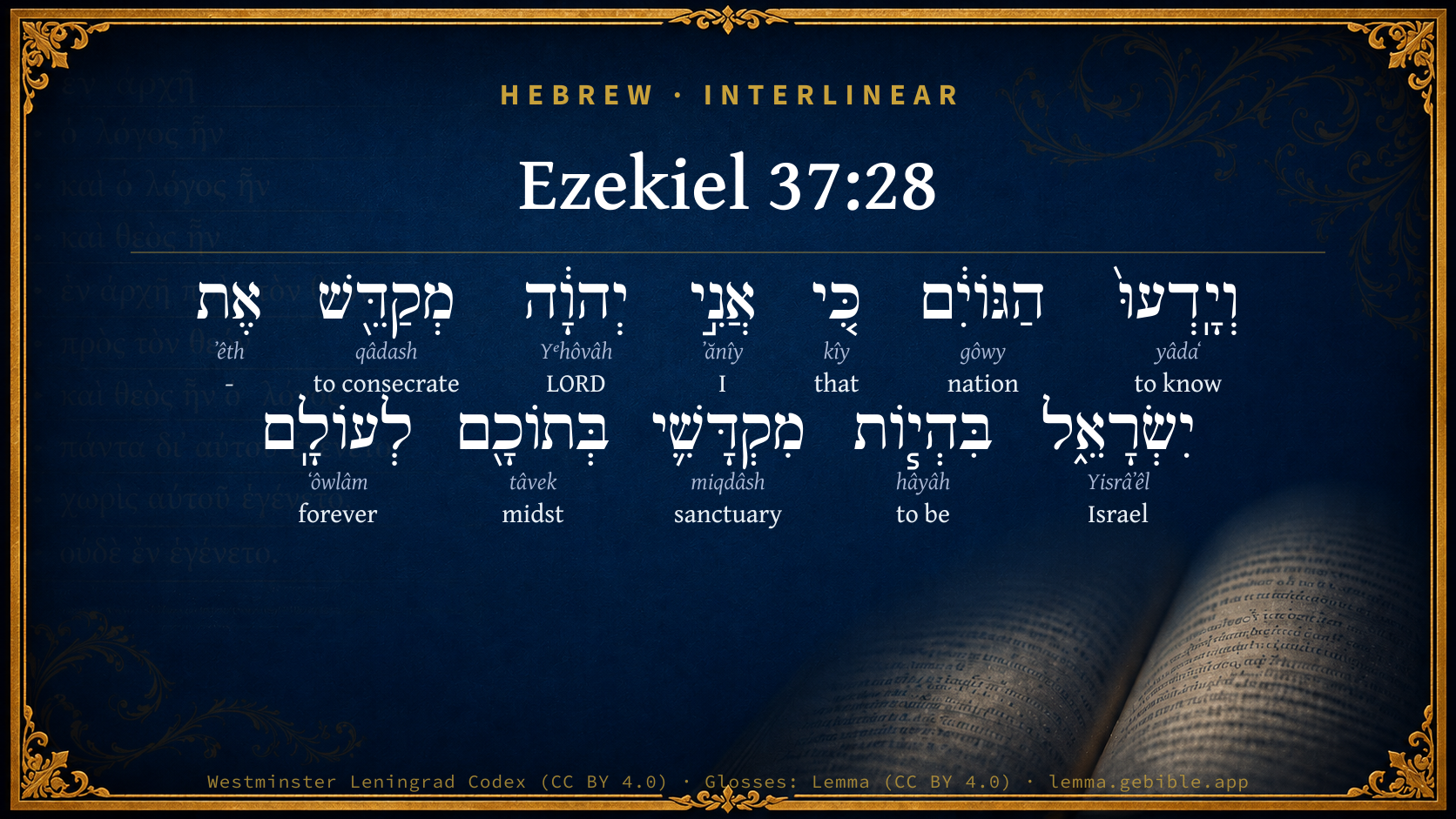
Ezekiel 37:28

Hebrew (Westminster Leningrad Codex) Ezekiel 37:28 appears in the Hebrew Old Testament. The text above is from the Westminster Leningrad Codex. Each word links to its Strong’s number, a concise gloss, and parsing drawn from the Open Scriptures Hebrew Bible morphology. Click any word for its full Brown-Driver-Briggs (BDB) entry.
Download image
Cite this verse

Ezekiel 37:28 (World English Bible). Public Domain. Lemma interlinear Bible study tool, https://lemma.gebible.app/v/ezekiel/37/28.

Show BibTeX & RIS
BibTeX
RIS
English Translation
The nations shall know that I am Yahweh who sanctifies Israel, when my sanctuary shall be in the midst of them forevermore.
World English Bible · Public Domain
Download a study sheet

One document with this verse’s original text, its word-by-word gloss line, the meaning frame, cross-references with their text, attributed commentary, and full source and license credits — printable, and it pastes into notes with its structure intact.

This verse Autodidact and up

Study sheet (.html) Plain text (.txt)

A passage Seminary Student

Up to 50 verses in one chapter. A passage sheet keeps up to 6 commentary sources and 12 cross-references per verse, in the order this page ranks them, and says so on the sheet whenever that leaves anything out. Ask for a single verse and you get the Autodidact verse sheet above.

Everything on this page stays free to read, with no account — the sheet is a download of what is already on screen, not access to it.

Want to remove ads? Support Godless Engineer
Compare translations 3

The same verse in 3 English versions, stacked beneath the original-language interlinear above. Click any original word for its lexicon entry.

Each is an independent rendering of the whole verse — the interlinear is not word-aligned to these translations.

Highlighted words mark where these versions differ — a whole-verse word diff, not a word-by-word alignment.

  • World English Bible Public Domain
    The nations shall know that I am Yahweh who sanctifies Israel, when my sanctuary shall be in the midst of them forevermore.
  • King James Version Public Domain
    And the heathen shall know that I the LORD do sanctify Israel, when my sanctuary shall be in the midst of them for evermore.
  • unfoldingWord Literal Text CC BY-SA 4.0
    Then the nations will know that I am Yahweh who sets Israel apart, when my holy place is among them forever.’”

unfoldingWord Literal Text — © unfoldingWord, licensed CC BY-SA 4.0. Word-aligned USFM3 via Door43 (git.door43.org/unfoldingWord/en_ult).

Versions to compare (up to 4)

3 of 4 selected

Show all 18 translations

Every available English version of this verse, each an independent rendering of the whole verse.

  • World English Bible Public Domain
    The nations shall know that I am Yahweh who sanctifies Israel, when my sanctuary shall be in the midst of them forevermore.
  • Berean Standard Bible Public Domain
    Then the nations will know that I the LORD sanctify Israel, when My sanctuary is among them forever.’”
  • Majority Standard Bible Public Domain
    Then the nations will know that I the LORD sanctify Israel, when My sanctuary is among them forever.’”
  • King James Version Public Domain
    And the heathen shall know that I the LORD do sanctify Israel, when my sanctuary shall be in the midst of them for evermore.
  • American Standard Version (1901) Public Domain
    And the nations shall know that I am Jehovah that sanctifieth Israel, when my sanctuary shall be in the midst of them for evermore.
  • Revised Version (1885) Public Domain
    And the nations shall know that I am the LORD that sanctify Israel, when my sanctuary shall be in the midst of them for evermore.
  • Geneva Bible (1599) Public Domain
    Thus the heathen shall knowe, that I the Lord do sanctifie Israel, when my Sanctuarie shall be among them for euermore.
  • Douay-Rheims (1899) Public Domain
    And the nations shall know that I am the Lord the sanctifier of Israel, when my sanctuary shall be in the midst of them for ever.
  • Young's Literal Translation Public Domain
    And known have the nations that I Jehovah am sanctifying Israel, In My sanctuary being in their midst -- to the age!'
  • Literal Standard Version CC BY-SA 4.0
    And the nations have known that I, YHWH, am sanctifying Israel, || In My sanctuary being in their midst for all time!”
  • Unlocked Literal Bible CC BY-SA 4.0
    Then the nations will know that I am Yahweh who sets Israel apart, when my holy place is among them forever.'”
  • unfoldingWord Literal Text CC BY-SA 4.0
    Then the nations will know that I am Yahweh who sets Israel apart, when my holy place is among them forever.’”
  • Darby Bible Public Domain
    And the nations shall know that I Jehovah do hallow Israel, when my sanctuary shall be in the midst of them for ever.
  • World Messianic Bible Public Domain
    The nations will know that I am the LORD who sanctifies Israel, when my sanctuary is among them forever more.”’”
  • Webster's Bible Public Domain
    And the heathen shall know that I the LORD do sanctify Israel, when my sanctuary shall be in the midst of them for ever.
  • Free Bible Version CC BY-SA 4.0
    The nations will acknowledge that I am the Lord who blesses Israel, when my sanctuary is with them forever.”
  • Bible in Basic English Public Domain
    And the nations will be certain that I who make Israel holy am the Lord, when my holy place is among them for ever.
  • JPS Tanakh (1917) Public Domain
    And the nations shall know that I am the LORD that sanctify Israel, when My sanctuary shall be in the midst of them for ever.'

Literal Standard Version (2020), Covenant Press — licensed CC BY-SA 4.0. Text via the HelloAO Bible API (eBible.org). Unlocked Literal Bible (unfoldingWord) — licensed CC BY-SA 4.0. Text via the HelloAO Bible API (eBible.org). unfoldingWord Literal Text — © unfoldingWord, licensed CC BY-SA 4.0. Word-aligned USFM3 via Door43 (git.door43.org/unfoldingWord/en_ult). Free Bible Version, Dr. Jonathan Gallagher — licensed CC BY-SA 4.0. Text via the HelloAO Bible API (eBible.org).

Word by word

More ways to search: Search by grammar → Find every occurrence → Compare this word →

Practice this passage: Drill this verse → Learn its vocabulary →

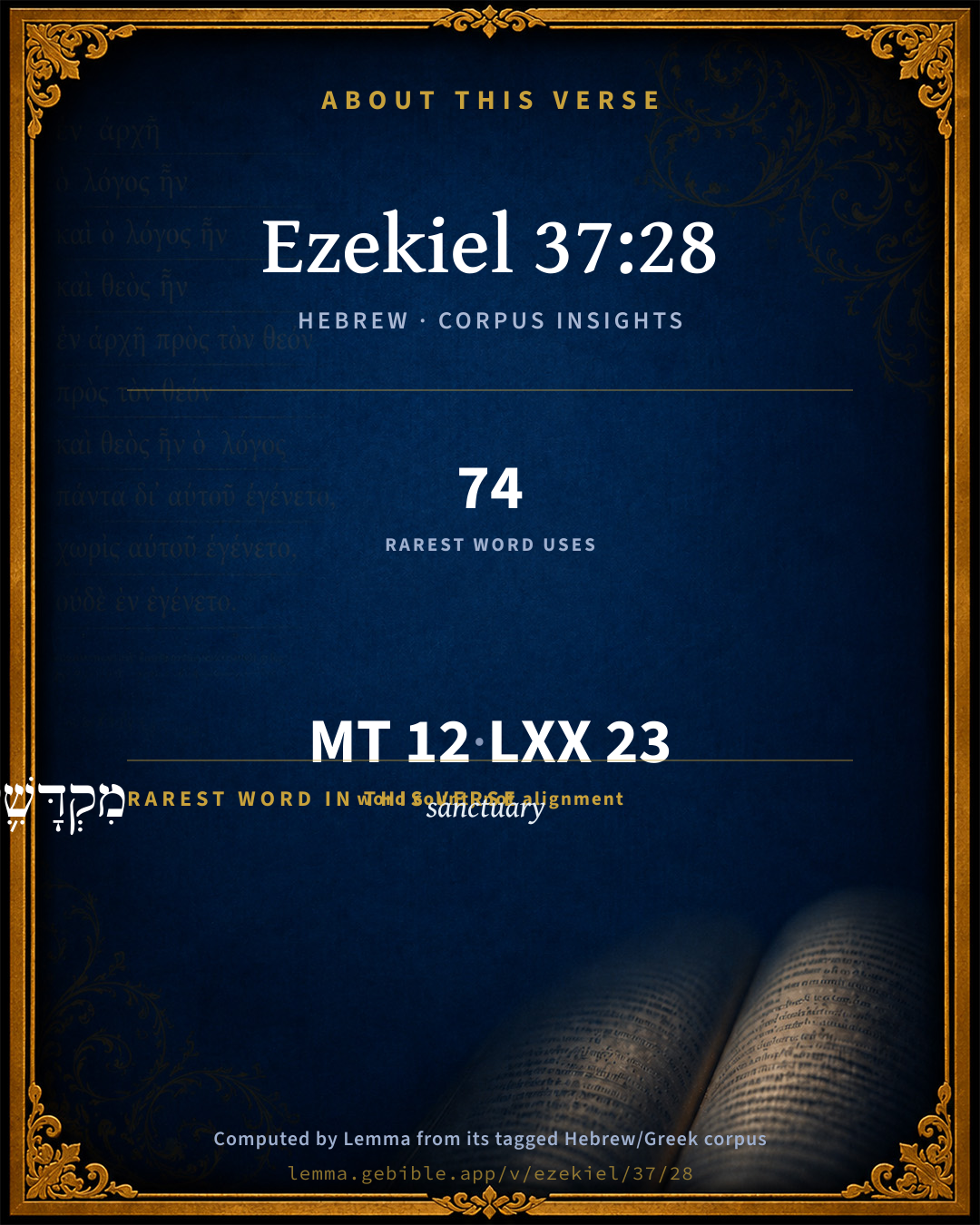
מִקְדָּשִׁ֛י
miqdâsh
H4720
“sanctuary · my”
Noun, Common, Masculine, Singular, Construct + Suffix, Personal, 1st Person, Common, Singular
Part of Speech
Noun
Type
Common
Gender
Masculine
Number
Singular
State
Construct
Full BDB Definition

Origin: from H6942

TWOT: 1990f

sacred place, sanctuary, holy place - sanctuary - of the temple - of the tabernacle - of Ezekiel's temple - of Jehovah
  1. וְיָֽדְעוּ֙ yâdaʻ H3045 “and · to know” Conjunction + Verb, Qal, Sequential Perfect, 3rd Person, Common, Plural
  2. הַגּוֹיִ֔ם gôwy H1471 “the · nations” Particle, Definite Article + Noun, Common, Masculine, Plural, Absolute
  3. כִּ֚י kîy H3588 “that” Conjunction
  4. אֲנִ֣י ʼănîy H589 “I” Pronoun, Personal, 1st Person, Common, Singular
  5. יְהוָ֔ה Yᵉhôvâh H3068 “LORD” Noun, Proper
  6. מְקַדֵּ֖שׁ qâdash H6942 “consecrating” Verb, Piel, Participle Active, Masculine, Singular, Absolute
  7. אֶת ʼêth H853 “-” Particle, Direct Object
  8. יִשְׂרָאֵ֑ל Yisrâʼêl H3478 “Israel” Noun, Proper
  9. בִּהְי֧וֹת hâyâh H1961 “in/at · to be” Preposition + Verb, Qal, Infinitive Construct
  10. בְּתוֹכָ֖ם tâvek H8432 “in/at · midst · their” Preposition + Noun, Common, Masculine, Singular, Construct + Suffix, Personal, 3rd Person, Masculine, Plural
  11. לְעוֹלָֽם ʻôwlâm H5769 “to/for · forever” Preposition + Noun, Common, Masculine, Singular, Absolute

About this verse

These counts appear in no published source. They are computed here, from the morphology-tagged text and Lemma’s own curated glosses. What Lemma adds →

12
words
12
distinct lemmas
Prophets
section

Grammatical profile

  • 3 verbs
  • 6 nouns
  • 1 pronoun
  • 1 conjunction
  • 1 particle

Verb forms

  • וְיָֽדְעוּ֙ Qal · Sequential Perfect
  • מְקַדֵּ֖שׁ Piel · Participle Active
  • בִּהְי֧וֹת Qal · Infinitive Construct

Hebrew & Septuagint length

In English translation the verse runs 22 words from the Hebrew and 24 from the Septuagint (LXX English) — closely comparable.

A rough comparison of the two English renderings, which tokenize alike — not a word-level alignment.

Word counts can differ between the Hebrew and the Greek without any difference in meaning — e.g. the Hebrew direct-object marker אֵת has no separate Greek word, and Greek often adds the article ὁ.

In the original languages it is 12 Hebrew tokens and 23 Greek tokens — but the two are counted differently (Hebrew bundles its prefixes and suffixes into one token; the Greek is in lemma form), so that isn’t a like-for-like length.

Cross-references

17

Topical passages linked to Ezekiel 37:28 in the Treasury of Scripture Knowledge — connected by theme and wording, ordered by reader-vote popularity; previews shown in the World English Bible.

  • John 17:17–19 Sanctify them in your truth. Your word is truth.
  • Ezekiel 20:12 Moreover also I gave them my Sabbaths, to be a sign between me and them, that they might know that I am Yahweh who sanctifies them.
  • Exodus 31:13 "Speak also to the children of Israel, saying, 'Most assuredly you shall keep my Sabbaths: for it is a sign between me and you throughout your generations; that you may know that I am Yahweh who sanctifies you.
  • 1 Corinthians 1:30 But of him, you are in Christ Jesus, who was made to us wisdom from God, and righteousness and sanctification, and redemption:
  • Leviticus 21:8 You shall sanctify him therefore; for he offers the bread of your God: he shall be holy to you: for I Yahweh, who sanctify you, am holy.
  • Ezekiel 36:23 I will sanctify my great name, which has been profaned among the nations, which you have profaned in the midst of them; and the nations shall know that I am Yahweh, says the Lord Yahweh, when I shall be sanctified in you before their eyes.
  • Ephesians 5:26 that he might sanctify it, having cleansed it by the washing of water with the word,
  • 1 Thessalonians 5:23 May the God of peace himself sanctify you completely. May your whole spirit, soul, and body be preserved blameless at the coming of our Lord Jesus Christ.
  • Leviticus 20:8 You shall keep my statutes, and do them. I am Yahweh who sanctifies you.
  • Psalms 79:10 Why should the nations say, "Where is their God?" Let it be known among the nations, before our eyes, That vengeance for your servants' blood is being poured out.
  • Psalms 102:15 So the nations will fear the name of Yahweh; All the kings of the earth your glory.
  • Psalms 126:2 Then our mouth was filled with laughter, And our tongue with singing. Then they said among the nations, "Yahweh has done great things for them."
  • Ezekiel 36:36 Then the nations that are left round about you shall know that I, Yahweh, have built the ruined places, and planted that which was desolate: I, Yahweh, have spoken it, and I will do it.
  • Ezekiel 38:23 I will magnify myself, and sanctify myself, and I will make myself known in the eyes of many nations; and they shall know that I am Yahweh.
  • Ezekiel 39:7 My holy name will I make known in the midst of my people Israel; neither will I allow my holy name to be profaned any more: and the nations shall know that I am Yahweh, the Holy One in Israel.
  • Romans 11:15 For if the rejection of them is the reconciling of the world, what would their acceptance be, but life from the dead?
  • Ezekiel 39:23 The nations shall know that the house of Israel went into captivity for their iniquity; because they trespassed against me, and I hid my face from them: so I gave them into the hand of their adversaries, and they fell all of them by the sword.

Cross-references courtesy of OpenBible.info (CC BY 4.0).

Hebrew and Greek witnesses Masoretic Hebrew ↔ Greek Septuagint

The same verse in the two great witnesses to the Old Testament, shown verse-for-verse.

These are two independent witnesses, not word-aligned to each other, and the Septuagint is shown in lemma (dictionary) form.

Hebrew Ezekiel 37:28 Masoretic · Westminster Leningrad Codex

וְיָֽדְעוּ֙ הַגּוֹיִ֔ם כִּ֚י אֲנִ֣י יְהוָ֔ה מְקַדֵּ֖שׁ אֶת יִשְׂרָאֵ֑ל בִּהְי֧וֹת מִקְדָּשִׁ֛י בְּתוֹכָ֖ם לְעוֹלָֽם

The nations shall know that I am Yahweh who sanctifies Israel, when my sanctuary shall be in the midst of them forevermore.

World English Bible · Public Domain

Greek LXX Ezekiel 37:28 Septuagint · lemma form

καί γιγνώσκω ὁ ἔθνος ὅτι ἐγώ εἰμί κύριος ὁ ἁγιάζω αὐτός ἐν ὁ εἰμί ὁ ἅγιος ἐγώ ἐν μέσος αὐτός εἰς ὁ αἰών

And the nations shall know that I am the Lord that sanctifies them, when my sanctuary is in the midst of them for ever.

LXX2012 (modern English Septuagint) · Public Domain

Hebrew: Westminster Leningrad Codex (CC BY 4.0). Greek: Septuagint (public domain); English from LXX2012 (modern English Septuagint) (Public Domain). How the Septuagint differs from the Hebrew →

Targum (Aramaic paraphrase)

1

The Targum is the ancient Jewish Aramaic paraphrase of the Hebrew Scriptures — an interpretive translation, not the Hebrew text itself. Onkelos (literal) and Pseudo-Jonathan (expansive) render the Torah, and Jonathan the Prophets. Coverage is partial: where no permissively-licensed English translation exists for a verse, only the Aramaic is shown. This is verse-level text, not a word-by-word alignment to the Hebrew.

  1. Targum Jonathan Prophets (Joshua–Malachi)
    וְיֵדְעוּן עַמְמַיָא אֲרֵי אֲנָא יְיָ מְקַדֵשׁ יַת יִשְׂרָאֵל בְּמֶהֱוֵי מַקְדְשִׁי בֵּינֵיהוֹן לְעַלָם:

    (no public-domain English translation for this verse)

    Targum Jonathan — Aramaic: “Mikraot Gedolot” (public domain). English: “Sefaria Community Translation” (CC0 1.0 (public-domain dedication)); “London "Chaldee Paraphrase," 1871” (public domain). Text via Sefaria.

Commentary

Notes on Ezekiel 37:28 from classic Christian and Jewish commentators (each source and its license shown beneath its notes). The classic Christian expositions comment on the surrounding passage and are grouped to its opening verse, so a note may address several verses; the Jewish commentaries on the Tanakh (Rashi and others) are per-verse, so they appear only where the commentator wrote on this verse.

Lemma curates 59 commentaries, every one of them public domain or Creative Commons licensed, each selected and text-cleaned for this edition rather than reprinted as found. About our sources →

The Cambridge Bible for Schools and Colleges

gen. ed. J. J. S. Perowne

28. The presence of Jehovah makes the house wherein he dwells a sanctuary (holy place), and the presence of his sanctuary (he being there, Eze_48:35) among the people sanctifies them or makes them “holy”—a term which expresses two things: being the possession of Jehovah, and being in disposition and life all that the people of Jehovah must be. The idea that Jehovah’s presence “sanctifies” the people is common. Jehovah’s dwelling-place being among the people for ever the nations shall know that he “sanctifies” them. To sanctify is not to protect, it is to make the people his own and worthy of him, but this implies protection. Jer_2:3, “Israel was a holy thing to the Lord, the first fruit of his increase, all that ate him up incurred guilt.” The ideas in this verse lead naturally over to the episode of Gog’s invasion, the issues of which so remarkably illustrate them.

The restoration of Israel includes the tribes of the north as well as Judah. All the prophets of this age regard the northern exiles as still existing, cf. Jer_3:12-15 : Isa_49:5-6, and the strong passage Isa_43:5-7 “every one called by my name,” i.e. every member of the people of the Lord. Cf. the present prophet’s disposition of all the tribes in the holy land, ch. 48.

Ch. 38, 39 Invasion of the Restored Israel in the latter days by Gog and all the nations lying in the outskirts of the world, and Israel’s protection by Jehovah

These two chapters are closely connected with ch. Eze_37:28, “the nations shall know that I Jehovah do sanctify” Israel. This recalls to the prophet’s mind the invasion of Gog, a great and final attack on Israel by the nations, and he introduces the description of it here, as it illustrates so conspicuously what is said in Eze_37:21-28. For the invasion of Gog is an episode out of connexion with the restoration of the people, which has formed the theme of the preceding chapters (33–37). It lies far in the future (Eze_37:8; Eze_37:16), long after Israel has been restored, and when it has dwelt long in peace in its own land (Eze_37:8; Eze_37:11). The sedulous care with which the land is purified from the carcases of Gog’s host, every bone being carefully collected and the whole buried beyond the Jordan, is sufficient evidence of the holiness of Israel and the land at the time of Gog’s attack (Eze_39:11-16).

The prophet is not the author of the idea of this invasion. It has been predicted of old by the prophets of Israel, prophesying over long periods (Eze_38:17, Eze_39:8). Neither is it probable that the idea was one read out of certain prophecies merely by Ezekiel. More likely it was an idea widely entertained. The former prophecies on which the belief was founded are not to be supposed to have contained the name of Gog, any more than the prophecies applied by the author of Isaiah 40 seq. to the career of Cyrus need have referred to him by name.

The conception is rather shadowy and vague. The time is indefinite, it is far into the years to come; the nations who cluster around the standard of Gog, himself a somewhat nebulous personage, are those lying in the uttermost regions of the world, which, had been heard of but never seen. The most distant north and the most distant south send their contingents to swell the innumerable host, and the far-off commercial peoples Sheba and Dedan and Tarshish follow his camp (Eze_37:3; Eze_37:5-6; Eze_37:13). The description seems almost a creation, the embodiment of an idea—the idea of the irreconcilable hostility of the nations of the world to the religion of Jehovah, and the presentiment that this must yet be manifested on a grander scale than has ever yet been. Hence the supernatural magnitude of the outlines of the picture (Eze_37:9; Eze_37:16; Eze_37:20). The main idea of the prophet, however, is quite perspicuous. With the exception of Ethiopia, a somewhat general name for the most distant south, none of the historical nations appear under Gog’s banner. These nations that came into connexion with Israel during her history have already learned to know Jehovah (ch. 25–32). They have not been exterminated, but his glory has been revealed to them and they no more trouble the peace of the restored Israel (Eze_36:36). But the nations lying in the outskirts of the earth, as another prophet expresses it, “have not heard Jehovah’s fame neither have seen his glory” (Isa_66:19), and he who is God alone must reveal himself to all flesh, for he has sworn by himself that to him every knee shall bow (Isa_45:23). Such is the meaning of this last act in the drama of the world’s history. As it is Jehovah’s final revelation of himself to all the nations of the earth, it is accompanied by all those terrors and convulsions in nature which in earlier prophets usually signalize the day of the Lord (Eze_38:19-23). This indeed is peculiar in Ezek. that he places Jehovah’s great and last revelation of himself after the restoration of his people to peace and felicity, while in the earlier prophets it precedes or accompanies their restoration; as it does even in prophets after him (Isa_40:5; Psa_102:16). In this order he is followed by the Apocalypse (Rev_19:11; Rev_20:7). Besides the display of Jehovah’s might in the overthrow of Gog and in the terrible convulsions of nature, his moral being and rule is also revealed through his people, for his protection of them now that they are holy and true casts light to the nations on his former dispersion of them (Eze_39:23).

Gog is styled prince of Rosh, Meshech and Tubal, nations lying in the extremities of the north (Eze_37:15). Other nations are joined to these, lying in the furthest south (Eze_37:5). And in the train of these warriors come the hosts of far-off commercial peoples, camp followers intent on gain (Eze_37:13). It is, therefore, self-evident that the Chaldeans are not represented under the name of Gog. The Chaldeans are Jehovah’s mandatories, commissioned to chastise his people, and humble the ungodly pride of such nations as Egypt and Phenicia, and Ezekiel’s prophecies contain no threats against Babylon. He intimates indeed that the supremacy of that power is but temporary, naming 40 years as the term when a new condition of the world will arise, which presupposes her decline and fall. But the invasion of Gog appears to him to be far away in the indefinite future, long after the promises of the Lord to his people have been fulfilled, and this fulfilment must be preceded by the overthrow of the Chaldean power.

The passage extends to ch. Eze_39:24, where the prophet resumes the point of view occupied in ch. 33–7 prior to the Restoration of Israel.

The Cambridge Bible for Schools and Colleges (gen. ed. J. J. S. Perowne; Cambridge University Press, 1878–1918) — public domain. Text from a community e-Sword module.

Trapp's Complete Commentary

John Trapp

Eze 37:28 And the heathen shall know that I the LORD do sanctify Israel, when my sanctuary shall be in the midst of them for evermore.

Ver. 28. Do sanctify Israel,] i.e., Do set them apart for mine use, and will see to their safety.

When my sanctuary.] Wherehence they shall have continual both direction and protection.

John Trapp, A Commentary or Exposition upon All the Books of the Old and New Testament (1647–1656) — public domain. Text from a community e-Sword module.

The Biblical Illustrator

Joseph S. Exell

Eze_37:28

I the Lord do sanctify Israel.

Sanctification

I. We shall view it as the Holy Spirits work to sanctify Israel. He gives a new, another, a spiritual life, yea, His own life, to sinners who were dead in trespasses and in sins. That is the religion of the Bible. That sanctification which becomes conspicuous and visible is the giving of life Divine, life spiritual, and into the soul of a sinner dead in trespasses and in sins. You hath He quickened, who were dead in trespasses and sins. The Apostle John puts it in another form, and says to his brethren who were regenerated by the power of the Holy Ghost, We are of God--that is, we have a life obtained from God--we know that we are of God, and the whole world lieth in wickedness. The Son of God Himself speaks of it in the third chapter of the Gospel of St. John as a new birth; and what is that but participation in a new, another nature? I, Jehovah, do sanctify Israel. Let me here glance at the identity of the covenant seed in this grand operation of grace. Wherever the Holy Ghost implants spiritual life, that soul is identified, at once, as an Israelite. The heathen shall know that I, the Lord, do sanctify Israel. And who are Israel? The seed of a covenant Head; a ransomed people; an emancipated people; a peculiar people. Oh! the vast importance of this distinction. I would to God that it were kept up and maintained among the followers of the Lamb. What is the first feature of their peculiarity? They are circumcised in heart, and love God, and are distinguished from the Egyptians. Light is in their dwellings, when all else is dark and dead. Look well to this point. Am I really sanctified by the Holy Ghost, set apart from the world, and made partaker of the Divine nature? Then am I Christs offspring. Then am I separated from the world for Him; redeemed by His precious blood; brought out of Egyptian bondage, and cannot live under the taskmasters and under the yoke any longer. Then am I made to serve Jehovah, and worship Him in spirit and in truth. Think of our daily and hourly dependence. Think of the matter of fact, that we cannot advance a step in the Divine life, that we cannot claim a promise even, or enjoy it, that we cannot surmount a difficulty, that we cannot meet an enemy, that we cannot sustain a trial, without communications of grace from on high. And therefore, says the apostle, when referring to Him in whom all is treasured up, Of His fulness have all we received, and grace for grace. Do not attempt to satisfy me, do not attempt to satisfy yourselves with a lazy religion. All Gods sanctified ones are employed; for He says to every one of them, Son, go work in My vineyard today. Dont stop till tomorrow. Go every day. The believing family of God are called upon to glorify Him with their bodies and spirits, because their bodies and spirits are the Lords. O God! employ Thy sanctified ones, and let every child of Thine be active and vigilant in extending the triumphs of the Cross! Do not tell me that you are incapable of doing anything. That is one of Satans falsehoods and artifices to allure you to indulge in laziness. Do not tell me that you have no talent. I can receive none of these excuses. All Gods sanctified ones have at least something to do in His vineyard for the glorifying of His name. And I would have them take a lesson from one of our old martyrs, picked up from the lowest walk of life, illiterate, and without a penny which he could call his own; and who when brought before a Roman pro-consul and sneeringly asked, What can you do for your Christ? replied, I cannot preach Him: I have no talent. I cannot support His cause; I have no money: but there are two things which I can do for Him; I can live for Him, and I can die for Him.

II. The heathen shall know that I, Jehovah, do sanctify Israel. The heathen shall know! What, do you mean to send all out as missionaries to foreign lands and barbarous tribes, to make known what God has done for our souls? I do not think, at any rate at present, that all should be employed thus, for you need not go out of England, or out of London, to find vast numbers of heathens. Now we would here come again to the subject of decision. Say, how is it with you? With a life so superior, with a dignity so supernatural, with prospects so bright, at an expense so vast as the atoning blood of Christ--will you degrade yourselves--will you suffer the heathen to triumph over you? Oh, to be able daily and hourly to put on the Lord Jesus Christ, that His likeness, His image, His mind, His Spirit may be exhibited by us, whilst we seek no provision for the flesh, to fulfil the lusts thereof. This is the way to make it known, that the heathen shall know and see the contrast. Not a few worldlings, whom I have thus set down as heathens, have been brought to acknowledge that there is something very singular, something very strange, something very mysterious, which they cannot fathom, in the Christianity which we possess. They cannot discover what that something is; and they never will until God gives it to them; it is His to bestow. And this brings me to dwell for a moment on the absolute sovereignty of the grace which imparts it. I, Jehovah, do it. Oh, how I wish that I could be more familiar with His doings, and jealous about my own I Oh, how I wish that every spiritual act that a believer is able to perform, might be instantly traced, as the apostle did his, to the hand of God! Oh, the blessedness of subscribing to that article of the apostles creed, Every good gift and every perfect gift is from above, etc. Then, having laid the foundation in absolute sovereignty, see how he goes on in the next verse to describe its operations:--Of His own will begat He us--not mans proud free-will--of His own will begat He us, by the word of truth, that we should be a kind of first-fruits of His creatures. Oh, the vast importance of having this distinction between us and the heathens, and the preservation of that distinction as the work of God--an act of the operation of His absolute power! I, the Lord, will do it, and the heathen shall know it. Now here is a glorious distinction--that the heathen shall know it. They must not only acknowledge that what is done is a good thing, but that it is supernatural and beyond the creatures power; and admit, as the heathen monarch of old did, in the case of the deliverance of Shadrach, Meshech, and Abednego, that it is the work of Him whose dwelling is not upon this earth--that it is a supernatural, Divine work. Another point which will be conspicuous to the heathen is, your circumspection; for, when God sanctifies, He makes the recipient of His sanctifying grace very circumspect. The heathen will not see the secret intercourse that is going on in your heart with God. They cannot see the hidden springs of life. They cannot see the secret purpose of predestinating love, from whence all proceeds; but they can see your circumspection. They can see how you walk; they can see what spirit, and mind, and temper you exhibit. They can see whether there is anything about you--in your whole conduct and deportment--which gives the lie to your profession; and they will not be backward in talking about it. They discover it in a moment. Oh, how important, therefore, is that solemn advice of the apostle!--Be ye therefore holy, even as he who hath called you is holy. One point more: it relates to the experimental enjoyment--which sanctifying grace imparts when we stand before the heathen as a distinguished people, and the heathen shall know it. (J. Irons.)

.

The Biblical Illustrator, edited by Joseph S. Exell (c. 1880s–1900s) — public domain. Text from a community e-Sword module.

Jamieson, Fausset & Brown

Robert Jamieson, A. R. Fausset & David Brown

(Eze 36:23).

sanctify Israel--set it apart as holy unto Myself and inviolable (Exo 19:5-6).

The objections to a literal interpretation of the prophecy are--(1) The ideal nature of the name Gog, which is the root of Magog, the only kindred name found in Scripture or history. (2) The nations congregated are selected from places most distant from Israel, and from one another, and therefore most unlikely to act in concert (Persians and Libyans, &c.). (3) The whole spoil of Israel could not have given a handful to a tithe of their number, or maintained the myriads of invaders a single day (Eze 38:12-13). (4) The wood of their invaders' weapons was to serve for fuel to Israel for seven years! And all Israel were to take seven months in burying the dead! Supposing a million of Israelites to bury each two corpses a day, the aggregate buried in the hundred eighty working days of the seven months would be three hundred sixty millions of corpses! Then the pestilential vapors from such masses of victims before they were all buried! What Israelite could live in such an atmosphere? (5) The scene of the Lord's controversy here is different from that in Isa 34:6, Edom, which creates a discrepancy. (But probably a different judgment is alluded to). (6) The gross carnality of the representation of God's dealings with His adversaries is inconsistent with Messianic times. It therefore requires a non-literal interpretation. The prophetical delineations of the divine principles of government are thrown into the familiar forms of Old Testament relations. The final triumph of Messiah's truth over the most distant and barbarous nations is represented as a literal conflict on a gigantic scale, Israel being the battlefield, ending in the complete triumph of Israel's anointed King, the Saviour of the world. It is a prophetical parable [FAIRBAIRN]. However, though the details are not literal, the distinctiveness in this picture, characterizing also parallel descriptions in writers less ideally picturesque than Ezekiel, gives probability to a more definite and generally literal interpretation. The awful desolations caused in Judea by Antiochus Epiphanes, of Syria (1 Maccabees; and PORPHYRY, quoted by JEROME on Ezekiel), his defilement of Jehovah's temple by sacrificing swine and sprinkling the altar with the broth, and setting up the altar of Jupiter Olympius, seem to be an earnest of the final desolations to be caused by Antichrist in Israel, previous to His overthrow by the Lord Himself, coming to reign (compare Dan. 8:10-26; Dan 11:21-45; Dan 12:1; Zac 13:9; Zac 14:2-3). GROTIUS explains Gog as a name taken from Gyges, king of Lydia; and Magog as Syria, in which was a city called Magag [PLINY, 5.28]. What Ezekiel stated more generally, Rev 20:7-9 states more definitely as to the anti-Christian confederacy which is to assail the beloved city.

Next: Ezekiel Chapter 38

Jamieson, Fausset & Brown — Commentary Critical and Explanatory on the Whole Bible (1871) — public domain (CC PDM 1.0). Text via the HelloAO Bible API.

John Gill's Exposition

And the Heathen shall know that I the Lord do sanctify Israel,.... Or the Gentiles, the converted Gentiles, shall observe and take notice of the gracious dealings of God with his people the Jews; that he calls them with an holy calling; implants principles of grace and holiness in them; separates and consecrates them for his service, and enables them to walk holily, soberly, and righteously:

when my sanctuary shall be in the midst of them for evermore; when his worship shall be set up among them; his Gospel shall be preached unto them, and received by them; and his ordinances administered unto them; and which shall continue till the second coming of Christ.

Next: Ezekiel Chapter 38

John Gill's Exposition of the Whole Bible (1746–1763) — public domain (CC PDM 1.0). Text via the HelloAO Bible API.

Matthew Poole's English Annotations

When Christ by his Spirit in gospel ordinances is among them, it shall appear they are a consecrated and a sanctified people.

Matthew Poole's English Annotations on the Holy Bible (1683–1685) — public domain. Text from a community e-Sword/MySword module.

The Pulpit Commentary

Verse 28 describes the effect which such a glorious transformation of Israel"s character and condition, should produce upon the heathen world. They should recognize from his presence amongst his people, symbolized by the establishment in their midst of his sanctuary, that he had both the power and the will to sanctify them, by making them inwardly as well as outwardly holy; and, recognizing this, they would seek admittance to the congregation and fellowship of God"s spiritual Israel.

The sanctification of the Church a gospel for the world.

I THE SANCTIFICATION OF THE CHURCH.

1. Its form. Sanctification is essentially a being set apart for God. This involves two ideas.

(1) Separation. The Jews were separated from the heathen. Christians are called out from the world. Christ founded the Church partly in order that Christians might realize the brotherhood of a family within its borders, and partly that they might be divided from the heathenish world. The superficial Christianizing of the world, and the more than superficial worldliness of the Church, have combined to obscure the old lines of demarcation. But we cannot afford to neglect them.

(2) Dedication. The separated people are set apart for God, as young Samuel was separated from his house and given to the Lord. This is the explanation of the separation; here we see its purpose. The separation does not take place for the sake of making a difference, but in order that the people of God may wholly give themselves to his service.

2. Its character. Though the pure idea of sanctification is formal rather than moral, and means essentially a setting apart for God, it is only realized in the experience of personal holiness.

(1) We can only be separated from the world by giving up the sin of the world. The mark of separation is purity of character.

(2) We can only be devoted to God by purity of heart. Only thus can we see God. (Mat_5:8) Only thus can our service be acceptable in his sight. Thus sanctification comes to be equivalent to making pure and holy.

3. Its cause. God sanctifies his people. They must desire and seek the sanctification, but they cannot create it. Men may separate themselves from the world in external profession and habit, living as hermits in the wilderness, immuring themselves in cloistered monasteries, repudiating conventional manners with Puritan precision; and all the while they may remain worldly at heart. They may offer themselves formally for the service of God, and take office in the Church, and yet be only self-seekers and servants of sin. As purification is essential to sanctification, sanctification must be a Divine act. This is the great work of the Holy Spirit. God separates, consecrates, and purifies his people through the action of his Spirit in them.

II THE INFLUENCE OF THE SANCTIFICATION OF THE CHURCH ON THE WORLD. The heathen shall know that God sanctifies Israel. This fact will be a witness to the pagan world of the power and character of God. It will be a great sermon in history, a preaching in events. No preaching can be more powerful. The greatest hindrance to missionary work consists in the wicked conduct of persons from Christian lands who visit heathen countries. The example of the Christian life is its best help. Christ preached by his life more than by his words. His cross on Calvary is more eloquent than his Sermon on the Mount. If we desire to give a new impulse to missionary enterprises we must begin at home. We must first of all consecrate our own hearts and lives afresh to our Master; we must seek a new baptism of the Holy Ghost for the sanctification of the Church. The Pentecost that brought a spiritual blessing to the little company in the upper room at Jerusalem started the great evangelistic triumphs of the apostolic age. While it may be well to discuss missionary methods, we much more need to seek a spiritual revival of the home Churches, that a new impulse may be given to the most fruitful form of missionizing the living influence of a consecrated people.

The Pulpit Commentary (1880–1919), ed. H.D.M. Spence-Jones & Joseph S. Exell — public domain. Text from a community e-Sword module.

Lesson kit

Teaching starters — assembled from the data on this page, not authored interpretation. Every prompt links to the verse data it draws on. Edit before teaching.

Ezekiel, in the Prophets, opens this verse with 12 words (12 distinct Hebrew lemmas). Its most distinctive word is miqdâsh (“sanctuary”). A historical commentator’s framing appears above. Read the whole chapter for the surrounding context.

Discussion questions

  1. What does “sanctuary” (miqdâsh) contribute to the verse as a whole?
  2. How does John 17:17–19, which shares this passage’s theme, read alongside this verse?
  3. These translations render this verse differently; the difference is in the English rendering, not the original. What questions does that raise?
  4. «וְיָֽדְעוּ֙» is a Qal Sequential Perfect verb. How does that grammatical form shape the action described?
  5. Compare how The Cambridge Bible for Schools and Colleges and Trapp's Complete Commentary read this verse. Where do they agree or differ?

Things to notice

Reading settings

Reading text

Shown beneath each verse's original-language words.

Old Testament
Old Testament edition

Read the OT as the Masoretic Hebrew (MT) or the Greek Septuagint (LXX).

English shown for the Greek Septuagint (in the Hebrew ↔ Greek comparison).

Comparing translations? Open the Compare panel on any verse page to stack up to four side by side.