Ezekiel 23:38

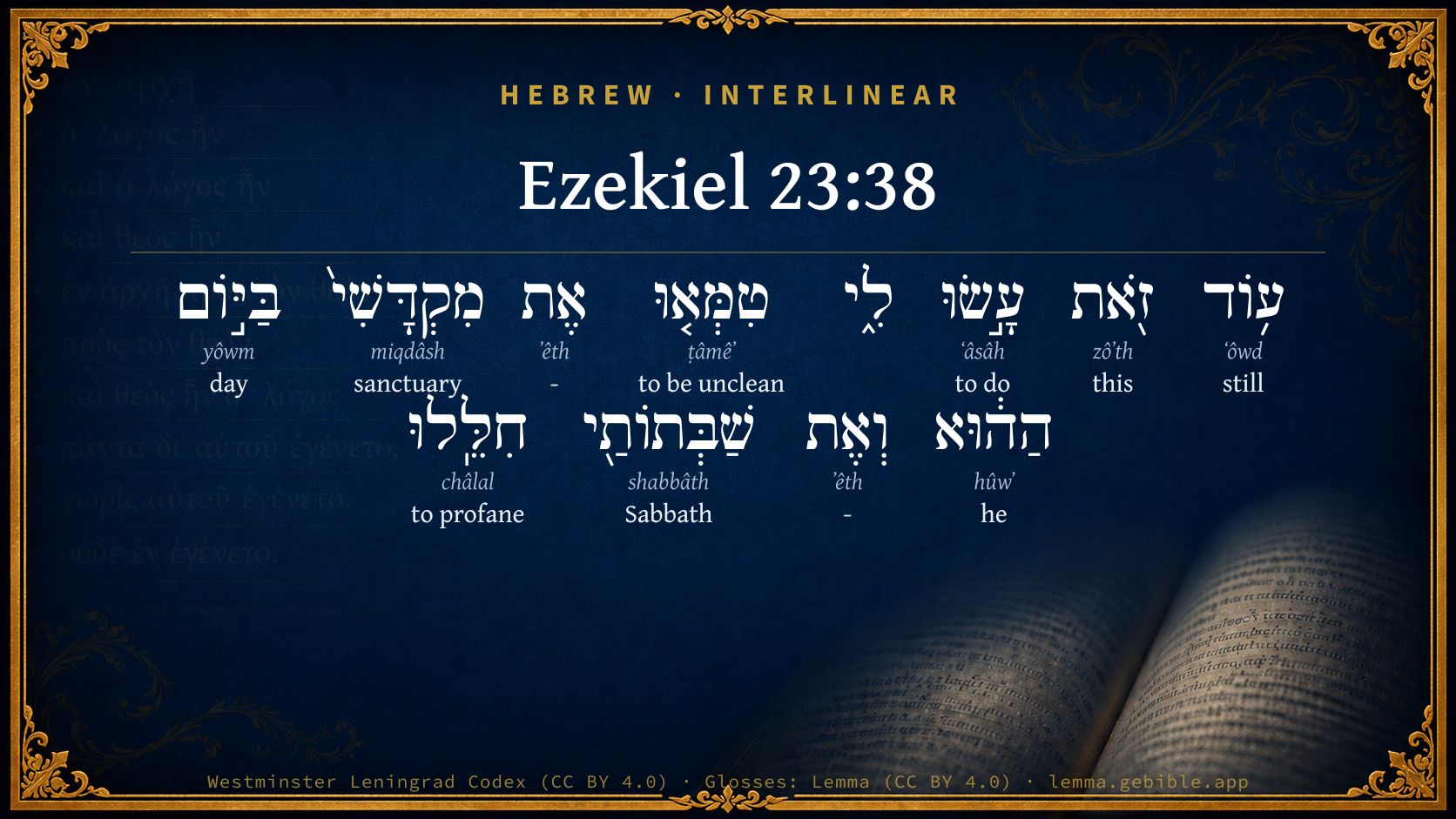
Hebrew (Westminster Leningrad Codex) Ezekiel 23:38 appears in the Hebrew Old Testament. The text above is from the Westminster Leningrad Codex. Each word links to its Strong’s number, a concise gloss, and parsing drawn from the Open Scriptures Hebrew Bible morphology. Click any word for its full Brown-Driver-Briggs (BDB) entry.
Download image
Cite this verse

Ezekiel 23:38 (World English Bible). Public Domain. Lemma interlinear Bible study tool, https://lemma.gebible.app/v/ezekiel/23/38.

Show BibTeX & RIS
BibTeX
RIS
English Translation
Moreover this they have done to me: they have defiled my sanctuary in the same day, and have profaned my Sabbaths.
World English Bible · Public Domain
Download a study sheet

One document with this verse’s original text, its word-by-word gloss line, the meaning frame, cross-references with their text, attributed commentary, and full source and license credits — printable, and it pastes into notes with its structure intact.

This verse Autodidact and up

Study sheet (.html) Plain text (.txt)

A passage Seminary Student

Up to 50 verses in one chapter. A passage sheet keeps up to 6 commentary sources and 12 cross-references per verse, in the order this page ranks them, and says so on the sheet whenever that leaves anything out. Ask for a single verse and you get the Autodidact verse sheet above.

Everything on this page stays free to read, with no account — the sheet is a download of what is already on screen, not access to it.

Want to remove ads? Support Godless Engineer
Compare translations 3

The same verse in 3 English versions, stacked beneath the original-language interlinear above. Click any original word for its lexicon entry.

Each is an independent rendering of the whole verse — the interlinear is not word-aligned to these translations.

Highlighted words mark where these versions differ — a whole-verse word diff, not a word-by-word alignment.

  • World English Bible Public Domain
    Moreover this they have done to me: they have defiled my sanctuary in the same day, and have profaned my Sabbaths.
  • King James Version Public Domain
    Moreover this they have done unto me: they have defiled my sanctuary in the same day, and have profaned my sabbaths.
  • unfoldingWord Literal Text CC BY-SA 4.0
    Then they continue to do this to me: They make my sanctuary unclean, and on the same day they defile my Sabbaths.

unfoldingWord Literal Text — © unfoldingWord, licensed CC BY-SA 4.0. Word-aligned USFM3 via Door43 (git.door43.org/unfoldingWord/en_ult).

Versions to compare (up to 4)

3 of 4 selected

Show all 18 translations

Every available English version of this verse, each an independent rendering of the whole verse.

  • World English Bible Public Domain
    Moreover this they have done to me: they have defiled my sanctuary in the same day, and have profaned my Sabbaths.
  • Berean Standard Bible Public Domain
    They have also done this to Me: On that very same day, they defiled My sanctuary and profaned My Sabbaths.
  • Majority Standard Bible Public Domain
    They have also done this to Me: On that very same day, they defiled My sanctuary and profaned My Sabbaths.
  • King James Version Public Domain
    Moreover this they have done unto me: they have defiled my sanctuary in the same day, and have profaned my sabbaths.
  • American Standard Version (1901) Public Domain
    Moreover this they have done unto me: they have defiled my sanctuary in the same day, and have profaned my sabbaths.
  • Revised Version (1885) Public Domain
    Moreover this they have done unto me: they have defiled my sanctuary in the same day, and have profaned my sabbaths.
  • Geneva Bible (1599) Public Domain
    Moreouer, thus haue they done vnto me: they haue defiled my Sanctuarie in the same day, and haue prophaned my Sabbaths.
  • Douay-Rheims (1899) Public Domain
    Yea, and they have done this to me. They polluted my sanctuary on the same day, and profaned my sabbaths.
  • Young's Literal Translation Public Domain
    Again, this they have done to Me, They defiled My sanctuary in that day, And My sabbaths they have polluted.
  • Literal Standard Version CC BY-SA 4.0
    Again, they have done this to Me, || They defiled My sanctuary in that day, || And they have defiled My Sabbaths.
  • Unlocked Literal Bible CC BY-SA 4.0
    Then they continue to do this to me: They make my sanctuary unclean, and on the same day they defile my Sabbaths.
  • unfoldingWord Literal Text CC BY-SA 4.0
    Then they continue to do this to me: They make my sanctuary unclean, and on the same day they defile my Sabbaths.
  • Darby Bible Public Domain
    Moreover this have they done unto me: in the same day have they defiled my sanctuary and profaned my sabbaths.
  • World Messianic Bible Public Domain
    Moreover this they have done to me: they have defiled my sanctuary in the same day, and have profaned my Sabbaths.
  • Webster's Bible Public Domain
    Moreover this they have done to me: they have defiled my sanctuary in the same day, and have profaned my sabbaths.
  • Free Bible Version CC BY-SA 4.0
    They also did this to me: On the very same day they both made my sanctuary unclean and violated my Sabbaths.
  • Bible in Basic English Public Domain
    Further, this is what she has done to me: she has made my holy place unclean and has made my Sabbaths unclean.
  • JPS Tanakh (1917) Public Domain
    Moreover this they have done unto Me: they have defiled My sanctuary in the same day, and have profaned My sabbaths.

Literal Standard Version (2020), Covenant Press — licensed CC BY-SA 4.0. Text via the HelloAO Bible API (eBible.org). Unlocked Literal Bible (unfoldingWord) — licensed CC BY-SA 4.0. Text via the HelloAO Bible API (eBible.org). unfoldingWord Literal Text — © unfoldingWord, licensed CC BY-SA 4.0. Word-aligned USFM3 via Door43 (git.door43.org/unfoldingWord/en_ult). Free Bible Version, Dr. Jonathan Gallagher — licensed CC BY-SA 4.0. Text via the HelloAO Bible API (eBible.org).

Word by word

More ways to search: Search by grammar → Find every occurrence → Compare this word →

Practice this passage: Drill this verse → Learn its vocabulary →

מִקְדָּשִׁי֙
miqdâsh
H4720
“sanctuary · my”
Noun, Common, Masculine, Singular, Construct + Suffix, Personal, 1st Person, Common, Singular
Part of Speech
Noun
Type
Common
Gender
Masculine
Number
Singular
State
Construct
Full BDB Definition

Origin: from H6942

TWOT: 1990f

sacred place, sanctuary, holy place - sanctuary - of the temple - of the tabernacle - of Ezekiel's temple - of Jehovah
  1. ע֥וֹד ʻôwd H5750 “still” Adverb
  2. זֹ֖את zôʼth H2063 “this” Pronoun, Demonstrative, Feminine, Singular
  3. עָ֣שׂוּ ʻâsâh H6213 “to do” Verb, Qal, Perfect, 3rd Person, Common, Plural
  4. טִמְּא֤וּ ṭâmêʼ H2930 “to be unclean” Verb, Piel, Perfect, 3rd Person, Common, Plural
  5. אֶת ʼêth H853 “-” Particle, Direct Object
  6. בַּיּ֣וֹם yôwm H3117 “in/at the · day” Preposition, Determined + Noun, Common, Masculine, Singular, Absolute
  7. הַה֔וּא hûwʼ H1931 “the · he” Particle, Definite Article + Pronoun, Personal, 3rd Person, Masculine, Singular
  8. וְאֶת ʼêth H853 “and · -” Conjunction + Particle, Direct Object
  9. שַׁבְּתוֹתַ֖י shabbâth H7676 “Sabbaths · my” Noun, Common, Both, Plural, Construct + Suffix, Personal, 1st Person, Common, Singular
  10. חִלֵּֽלוּ châlal H2490 “to profane” Verb, Piel, Perfect, 3rd Person, Common, Plural

About this verse

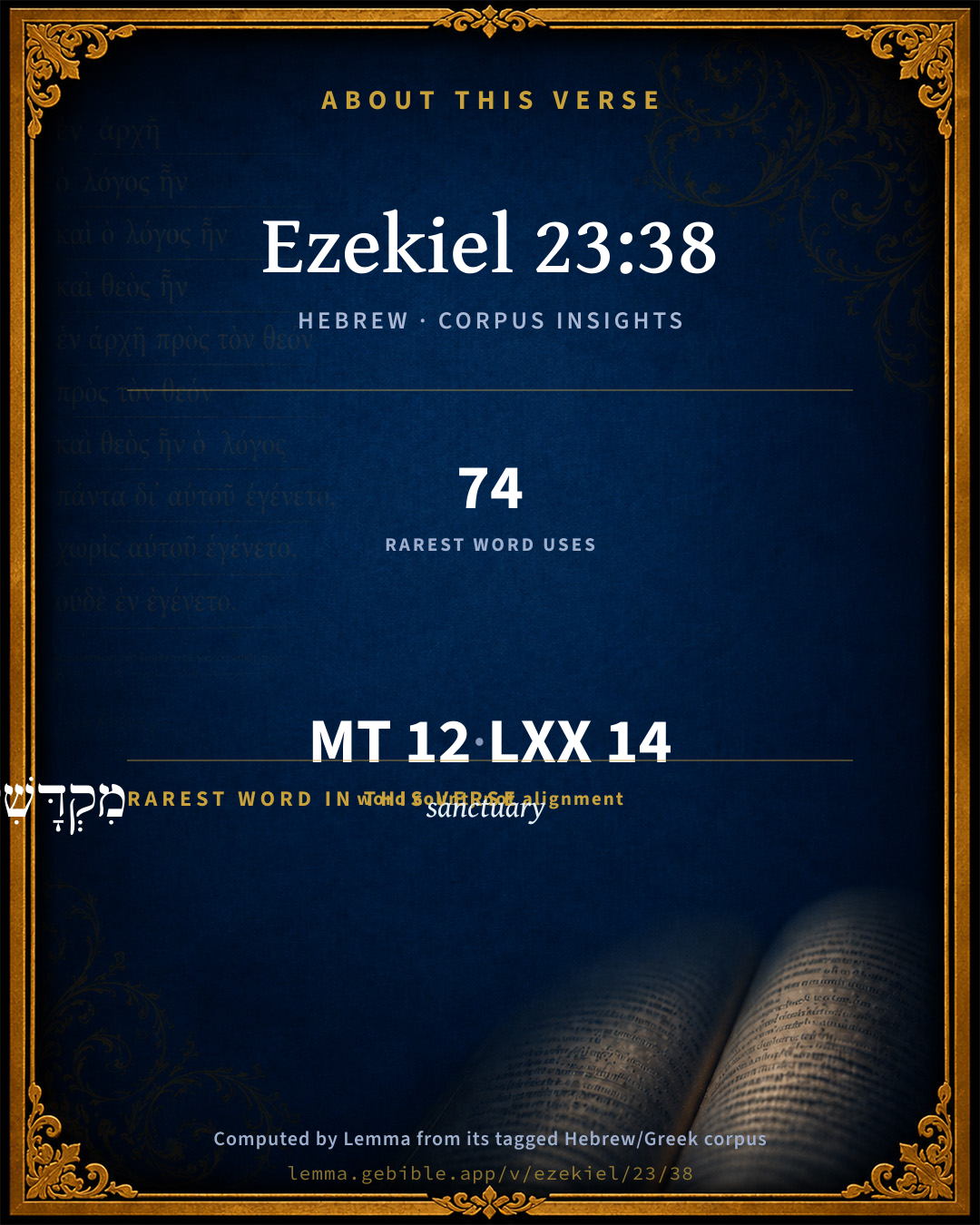
These counts appear in no published source. They are computed here, from the morphology-tagged text and Lemma’s own curated glosses. What Lemma adds →

12
words
10
distinct lemmas
Prophets
section

Grammatical profile

  • 3 verbs
  • 3 nouns
  • 2 pronouns
  • 1 preposition
  • 1 adverb
  • 2 particles

Verb forms

  • עָ֣שׂוּ Qal · Perfect
  • טִמְּא֤וּ Piel · Perfect
  • חִלֵּֽלוּ Piel · Perfect

Hebrew & Septuagint length

In English translation the verse runs 21 words from the Hebrew and 18 from the Septuagint (LXX English) — closely comparable.

A rough comparison of the two English renderings, which tokenize alike — not a word-level alignment.

Word counts can differ between the Hebrew and the Greek without any difference in meaning — e.g. the Hebrew direct-object marker אֵת has no separate Greek word, and Greek often adds the article ὁ.

In the original languages it is 12 Hebrew tokens and 14 Greek tokens — but the two are counted differently (Hebrew bundles its prefixes and suffixes into one token; the Greek is in lemma form), so that isn’t a like-for-like length.

Cross-references

11

Topical passages linked to Ezekiel 23:38 in the Treasury of Scripture Knowledge — connected by theme and wording, ordered by reader-vote popularity; previews shown in the World English Bible.

  • Ezekiel 20:13 But the house of Israel rebelled against me in the wilderness: they didn't walk in my statutes, and they rejected my ordinances, which if a man keep, he shall live in them; and my Sabbaths they greatly profaned. Then I said I would pour out my wrath on them in the wilderness, to consume them.
  • 2 Kings 21:7 He set the engraved image of Asherah, that he had made, in the house of which Yahweh said to David and to Solomon his son, In this house, and in Jerusalem, which I have chosen out of all the tribes of Israel, will I put my name forever;
  • Ezekiel 7:20 As for the beauty of his ornament, he set it in majesty; but they made the images of their abominations [and] their detestable things therein: therefore have I made it to them as an unclean thing.
  • Ezekiel 20:24 because they had not executed my ordinances, but had rejected my statutes, and had profaned my Sabbaths, and their eyes were after their fathers' idols.
  • 2 Kings 21:4 He built altars in the house of Yahweh, of which Yahweh said, In Jerusalem will I put my name.
  • 2 Kings 23:11–12 He took away the horses that the kings of Judah had given to the sun, at the entrance of the house of Yahweh, by the chamber of Nathan-melech the chamberlain, which was in the precincts; and he burned the chariots of the sun with fire.
  • Nehemiah 13:17–18 Then I contended with the nobles of Judah, and said to them, What evil thing is this that you do, and profane the Sabbath day?
  • Jeremiah 17:27 But if you will not listen to me to make the Sabbath day holy, and not to bear a burden and enter in at the gates of Jerusalem on the Sabbath day; then will I kindle a fire in the gates of it, and it shall devour the palaces of Jerusalem, and it shall not be quenched.
  • Ezekiel 8:5–16 Then said he to me, Son of man, lift up your eyes now the way toward the north. So I lifted up my eyes the way toward the north, and see, northward of the gate of the altar this image of jealousy in the entry.
  • Ezekiel 22:8 You have despised my holy things, and have profaned my Sabbaths.
  • Ezekiel 5:11 Therefore, as I live, says the Lord Yahweh, surely, because you have defiled my sanctuary with all your detestable things, and with all your abominations, therefore will I also diminish [you]; neither shall my eye spare, and I also will have no pity.

Cross-references courtesy of OpenBible.info (CC BY 4.0).

Hebrew and Greek witnesses Masoretic Hebrew ↔ Greek Septuagint

The same verse in the two great witnesses to the Old Testament, shown verse-for-verse.

These are two independent witnesses, not word-aligned to each other, and the Septuagint is shown in lemma (dictionary) form.

Hebrew Ezekiel 23:38 Masoretic · Westminster Leningrad Codex

ע֥וֹד זֹ֖את עָ֣שׂוּ לִ֑י טִמְּא֤וּ אֶת מִקְדָּשִׁי֙ בַּיּ֣וֹם הַה֔וּא וְאֶת שַׁבְּתוֹתַ֖י חִלֵּֽלוּ

Moreover this they have done to me: they have defiled my sanctuary in the same day, and have profaned my Sabbaths.

World English Bible · Public Domain

Greek LXX Ezekiel 23:38 Septuagint · lemma form

ἕως καί οὗτος ποιέω ἐγώ ὁ ἅγιος ἐγώ μιαίνω καί ὁ σάββατον ἐγώ βεβηλόω

So long too as they did these things to me, they defiled my sanctuary, and profaned my sabbaths.

LXX2012 (modern English Septuagint) · Public Domain

On this verse, The Cambridge Bible for Schools and Colleges discusses the Septuagint’s reading. Read the note in Commentary ↓

Hebrew: Westminster Leningrad Codex (CC BY 4.0). Greek: Septuagint (public domain); English from LXX2012 (modern English Septuagint) (Public Domain). How the Septuagint differs from the Hebrew →

Targum (Aramaic paraphrase)

1

The Targum is the ancient Jewish Aramaic paraphrase of the Hebrew Scriptures — an interpretive translation, not the Hebrew text itself. Onkelos (literal) and Pseudo-Jonathan (expansive) render the Torah, and Jonathan the Prophets. Coverage is partial: where no permissively-licensed English translation exists for a verse, only the Aramaic is shown. This is verse-level text, not a word-by-word alignment to the Hebrew.

  1. Targum Jonathan Prophets (Joshua–Malachi)
    עוֹד אַרְגִיזוּ קֳדָמַי סָאִיבוּ יַת בֵּית מַקְדְשִׁי בְּיוֹמָא הַהוּא וְיַת יוֹמֵי שַׁבַּיָא דִילִי אָחִילוּ:

    (no public-domain English translation for this verse)

    Targum Jonathan — Aramaic: “Mikraot Gedolot” (public domain). English: “Sefaria Community Translation” (CC0 1.0 (public-domain dedication)); “London "Chaldee Paraphrase," 1871” (public domain). Text via Sefaria.

Commentary

Notes on Ezekiel 23:38 from classic Christian and Jewish commentators (each source and its license shown beneath its notes). The classic Christian expositions comment on the surrounding passage and are grouped to its opening verse, so a note may address several verses; the Jewish commentaries on the Tanakh (Rashi and others) are per-verse, so they appear only where the commentator wrote on this verse.

Lemma curates 59 commentaries, every one of them public domain or Creative Commons licensed, each selected and text-cleaned for this edition rather than reprinted as found. About our sources →

Trapp's Complete Commentary

John Trapp

Eze 23:38 Moreover this they have done unto me: they have defiled my sanctuary in the same day, and have profaned my sabbaths.

Ver. 38. They have defiled my sanctuary in the same day.] When they had done evil as they could, they exercised mine external worship that they might seem religious. So Isa 66:3.

John Trapp, A Commentary or Exposition upon All the Books of the Old and New Testament (1647–1656) — public domain. Text from a community e-Sword module.

Jamieson, Fausset & Brown

Robert Jamieson, A. R. Fausset & David Brown

the same day--On the very day that they had burned their children to Molech in the valley of Gehenna, they shamelessly and hypocritically presented themselves as worshippers in Jehovah's temple (Jer 7:9-10).

Jamieson, Fausset & Brown — Commentary Critical and Explanatory on the Whole Bible (1871) — public domain (CC PDM 1.0). Text via the HelloAO Bible API.

Adam Clarke's Commentary

Verse 38. They have defiled my sanctuary] By placing idols there.

Adam Clarke's Commentary on the Bible (1810–1826) — public domain. Text from a community e-Sword/MySword module.

Ellicott's Commentary for English Readers

(38) In the same day.—This is explained more fully in Eze_23:39. Emphasis is laid upon the fact that they worshipped in the sanctuary of Jehovah in the same day that they offered their children to their idols, because the passing directly from the one to the other showed an utter disregard of the commands of the Lord, and an entire want of appreciation of His character and holiness. The figure in this and the following verses is partly dropped to bring out better the reality.

A Bible Commentary for English Readers, edited by Charles John Ellicott (1878–1897) — public domain. Text from a community e-Sword module.

The Cambridge Bible for Schools and Colleges

gen. ed. J. J. S. Perowne

38. the same day] The phrase is more fully explained in Eze_23:39. LXX. omits in both places.

The Cambridge Bible for Schools and Colleges (gen. ed. J. J. S. Perowne; Cambridge University Press, 1878–1918) — public domain. Text from a community e-Sword module.

John Gill's Exposition

Moreover this they have done unto me,..... The following piece of wickedness, which was very provoking to the Lord:

they have defiled my sanctuary in the same day; as they caused their children to pass through the tire to their idols, by entering into the sanctuary when they had so done, and were thus defiled, and by offering sacrifices to their idols in it; or under pretence of serving the Lord, when they had just been guilty of murder and idolatry:

and have profaned my sabbaths; not only by doing their own worldly and civil business, but by slaying their infants on those days, and sacrificing them to idols.

John Gill's Exposition of the Whole Bible (1746–1763) — public domain (CC PDM 1.0). Text via the HelloAO Bible API.

Albert Barnes' Notes on the Bible

The same day - The day when they made their offerings. See Eze 23:39.

Albert Barnes' Notes on the Bible (1834–1885) — public domain. Text from a community e-Sword/MySword module.

Matthew Poole's English Annotations

This; which is declared in the following words, it was some great injury or affront done to God.

Defiled my sanctuary; my holy things, house, altar, sacrifices, and oblations; one part of the temple put for all parts of the holy things of God.

In the same day; when they had newly polluted themselves with most horrid crimes, idolatry and murder, they thrust into the temple; whereas by the law, if they had been but unclean by touch of a dead body, they must have been cleansed by sacrifices before they ought to come into company with the Jews.

Profaned my sabbaths, by offering sacrifices to idols, and doing that on those days which God, nature, and all civil nations abhor, only the devil is pleased with, who is a murderer from the beginning, and promotes such bloody cruelties.

Matthew Poole's English Annotations on the Holy Bible (1683–1685) — public domain. Text from a community e-Sword/MySword module.

The Pulpit Commentary

Vers. 38, 39. The exclusiveness of the worship of the Lord God.

this they have done unto me: they have defiled my sanctuary in the same day," etc. The chief practical suggestions of our text may be arranged under three heads.

I MEN INSTRUCTED IN THE TRUE RELIGION PRACTISING THE GREATEST ABOMINATIONS OF HEATHENISM. "They had slain their children to their idols" (Ver. 39). "They have caused their sons, whom they bare unto me, to pass through the fire unto them to be devoured" (Ver. 37). We have already noticed the offering of children to Moloch. (on Eze_16:20, Eze_16:21) And in this age and in this professedly Christian land people make sacrifices which bear some resemblance to these in spirit. How many respectable and avowedly Christian parents sacrifice their daughters in marriage to mammon l The man may be unsuitable in age, uncongenial in temper, immoral in character and conduct; but, if he be rich, he is welcomed as a suitor. How frequently, too, are the best and the abiding interests of children their intellectual, spiritual, and eternal interests risked, or even sacrificed, by their parents, in order that they may attain unto higher social status or gain worldly honors and distinctions! And in other ways practices which are worthy only of heathen intelligence and morality are at work amongst us.

II MEN PASSING AT ONCE FROM THE PRACTICE OF THE ABOMINATIONS OF HEATHENISM INTO THE SANCTUARY AND SERVICE OF THE LIVING GOD. "When they had slain their children to their idols, then they came the same day into my sanctuary to profane it; and, lo, thus have they done in the midst of mine house." The Prophet Jeremiah complains of a similar sin: "Will ye steal, murder, and commit adultery, and swear falsely, and burn incense unto Baal, and walk after other gods whom ye have not known; and come and stand before me in this house, which is called by my Name, and say, We are delivered; that ye may do all these abominations?". (Jer_7:9, Jer_7:10) The sin is not unknown amongst us in these days. Men are on the racecourse, with its cruelty, profanity, and gambling, on the weekday, and on Sunday they enter the sanctuary of God, and take part in its services. There are those who, during the week, visit scenes of drunkenness and profligacy, and on the Lord"s day they go to church and unite in the forms of worship. It is an ill preparation for the sacred engagements of the house of God to spend the Saturday evening in the public house, worshipping Bacchus. Nor is the character of the case much altered when persons attend church on Sunday morning, and spend the remainder of the day in social festivity and dissipation.

III THAT SUCH CONDUCT IS A PROFANATION BOTH OF THE SABBATH AND THE SANCTUARY OF GOD. "Moreover this they have done unto me: they have defiled my sanctuary in the same day, and have profaned my sabbaths. For when they had slain their children to their idols," etc. We may show this by noticing:

1. That these things should be held in reverence.

(1) Because they were instituted by God. He ordained the sabbath and the sanctuary. They rest upon the basis of Divine authority.

(2) Because they were instituted for his glory. Both the sabbath and. the sanctuary are for the worship of the Most High. Both are intended to promote the best interests of man, to elevate him as a spiritual and immortal being, and thus to enable him more fully to glorify God. As man grows in spiritual purity and power, in righteousness and kindness towards men, and in reverence and devotion towards God, his life contributes to the honor of God. The sabbath and the sanctuary, when properly used, further these ends.

2. The conduct exhibited and condemned in the text is most irreverent in relation to these things.

(1) Because it puts the sanctuary and. the sabbath on the low level of heathen institutions and customs. So did the people of Israel and of Judah. How many today attend religious services for no higher reason than this, that it is socially respectable to do so.

(2) Because it disparages them in the eyes of observers. If men form their opinion of religious services and ordinances from such persons as take part in them on Sunday, and during the rest of the week lead lives of a character which is in utter opposition to them, they must conclude that they are shams and unworthy of the regard of true men.

(3) Because it is insulting to God. Such conduct implies that our outward and empty forms and ceremonies can please him, or that he will accept our attendance upon his worship as a compensation for our disregard of his will when we are absent from his house. But the Lord looketh on the heart," He rejects the worship which is offered to him by such persons as hypocritical service and offensive to him. (cf. Ps 1; Isa_1:11-15)

CONCLUSION. The worship of God is exclusive. "Thou shalt have none other gods before me;" "Thou shalt worship the Lord thy God, and him only shalt thou serve;" "Ye cannot serve God and mammon." Let us cultivate decision and thoroughness in his service. How different from the conduct condemned in the text was that of Cyprian! On his way to martyrdom he was told by the emperor that he would give him time to consider if he had not better cast a grain of incense into the fire in honor of the idol-gods than die so ignominiously. Cyprian replied, "There needs no deliberation in the case." John Huss, at the stake, was offered a pardon if he would recant. His reply was, "I am here, ready to suffer death." Thomas Hawkes, in like circumstances, said, "If I had a hundred bodies, I would suffer them all to be torn in pieces, rather than recant." Let us seek to be alike true, whole-hearted, and firm in our allegiance to our Lord. W.J.

The Pulpit Commentary (1880–1919), ed. H.D.M. Spence-Jones & Joseph S. Exell — public domain. Text from a community e-Sword module.

John Wesley's Explanatory Notes

In the same day - When they had newly polluted themselves with idolatry and murder, they thrust into the temple.

John Wesley, Explanatory Notes Upon the Whole Bible (1754–1765) — public domain. Text via the GEBible commentary corpus.

unfoldingWord translationNotes

Door43 World Missions Community

General Information:

Yahweh speaks about how the people of Jerusalem and Samaria have been unfaithful to him.

unclean

A person or thing God considers spiritually unacceptable or defiled is spoken of as if it were physically unclean. See how you translated this in Ezekiel 23:7. (See: Metaphor)

on the same day they defile my Sabbaths

The phrase "same day" refers to the previous phrase "make my sanctuary unclean." AT: "on the same day on which they make my sanctuary unclean, they defile my Sabbaths" (See: Ellipsis)

behold!

"pay attention, because what I am about to say is both true and important"

in the middle of my house

This refers to the house in general. The reference to the "middle" emphasizes that what was done happened openly in the temple and defiled the whole place. AT: "in my own house" (See: Synecdoche)

translationWords

sanctuary

defile

slaughter

house

unfoldingWord translationNotes — © Distant Shores Media and the Door43 World Missions Community, licensed CC BY-SA 4.0. Source: git.door43.org/Door43/en_tn.

Rashi

Rabbi Shlomo Yitzchaki (Rashi)

they defiled My sanctuary on that day On the day they slaughter their children for idolatry, they come before Me in My sanctuary to commit abominations therein, to provoke Me.

and they profaned My Sabbaths For they would slaughter their children on the Sabbath.

Rashi on the Tanakh — English translations: “The Judaica Press complete Tanach with Rashi, translated by A. J. Rosenberg” (CC BY 4.0); “Pentateuch with Rashi's commentary by M. Rosenbaum and A.M. Silbermann, 1929-1934” (public domain); “The Metsudah Tanach series, Lakewood, N.J” (CC BY 4.0); and “The Book of Joshua, Metsudah Publications, 1997” (CC BY 4.0). Text via Sefaria.

Lesson kit

Teaching starters — assembled from the data on this page, not authored interpretation. Every prompt links to the verse data it draws on. Edit before teaching.

Ezekiel, in the Prophets, opens this verse with 12 words (10 distinct Hebrew lemmas). Its most distinctive word is miqdâsh (“sanctuary”). A historical commentator’s framing appears above. Read the whole chapter for the surrounding context.

Discussion questions

  1. The word miqdâsh carries the sense “sanctuary.” How does it shape the verse?
  2. How does Ezekiel 20:13, which shares this passage’s theme, read alongside this verse?
  3. These translations render this verse differently; the difference is in the English rendering, not the original. What questions does that raise?
  4. «עָ֣שׂוּ» is a Qal Perfect verb. How does that grammatical form shape the action described?
  5. Compare how Trapp's Complete Commentary and Jamieson, Fausset & Brown read this verse. Where do they agree or differ?

Things to notice

Reading settings

Reading text

Shown beneath each verse's original-language words.

Old Testament
Old Testament edition

Read the OT as the Masoretic Hebrew (MT) or the Greek Septuagint (LXX).

English shown for the Greek Septuagint (in the Hebrew ↔ Greek comparison).

Comparing translations? Open the Compare panel on any verse page to stack up to four side by side.