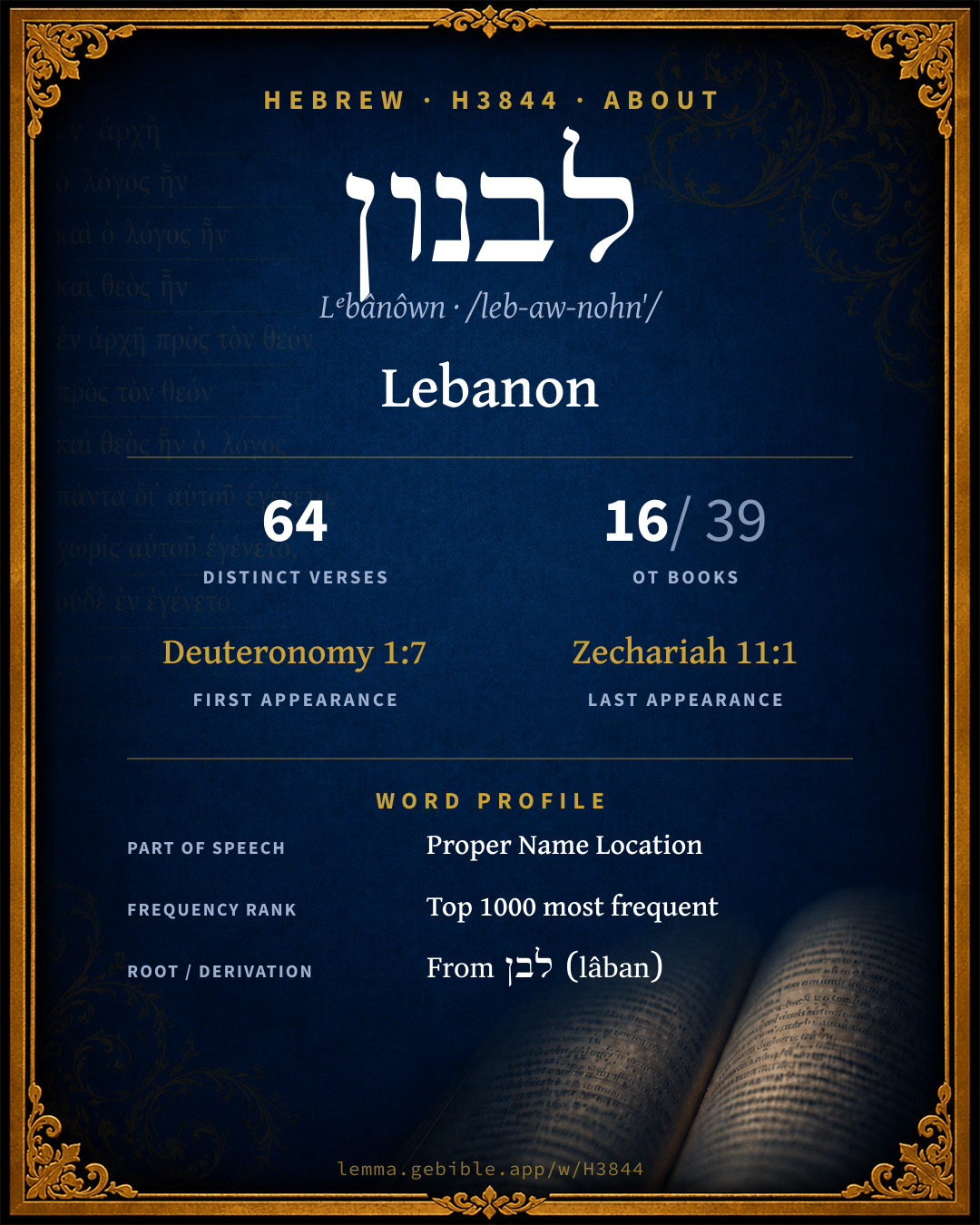
לְבָנוֹן
Lebanon
BDB lists 2 entries for ‘Lebanon’ fuller range ↓
Full lexicon entry — Brown-Driver-Briggs (BDB)
From Brown-Driver-Briggs (BDB)
Where this word appears
Grammar key — what these labels mean
Part of speech
- Noun
- A naming word — a person, place, thing, or idea.
Noun type
- Proper
- A name of a specific person, place, or people (e.g. Abraham, Zion, Israel).
Every verse where H3844 appears — 64 distinct verses across 16 books. Click any verse to open its interlinear word-by-word view. Verse text shown in the World English Bible for context — . Each verse’s Hebrew form is shown with its reference; the English is not keyword-highlighted, since the data carries no word-level English alignment. Use “Compare translations” on any verse to read it across multiple English versions. This concordance covers the Hebrew Bible; Septuagint (Greek Old Testament) occurrences are not indexed here.
Deuteronomy 3 verses
- Deuteronomy 1:7 וְ/הַ/לְּבָנ֔וֹן conj + ptcl def.art + n Proper turn you, and take your journey, and go to the hill-country of the Amorites, and to all [the places] near thereunto, in the Arabah, in the hill-country, and in the lowland, and in the South, and by the sea-shore, the land of the Canaanites, and Lebanon, as far as the great river, the river Euphrates.
- Deuteronomy 3:25 וְ/הַ/לְּבָנֽוֹן conj + ptcl def.art + n Proper Please let me go over and see the good land that is beyond the Jordan, that goodly mountain, and Lebanon.
- Deuteronomy 11:24 וְ/הַ/לְּבָנ֜וֹן conj + ptcl def.art + n Proper Every place whereon the sole of your foot shall tread shall be yours: from the wilderness, and Lebanon, from the river, the river Euphrates, even to the hinder sea shall be your border.
Joshua 6 verses
- Joshua 1:4 וְ/הַ/לְּבָנ֨וֹן conj + ptcl def.art + n Proper From the wilderness, and this Lebanon, even to the great river, the river Euphrates, all the land of the Hittites, and to the great sea toward the going down of the sun, shall be your border.
- Joshua 9:1 הַ/לְּבָנ֑וֹן ptcl def.art + n Proper It happened, when all the kings who were beyond the Jordan, in the hill-country, and in the lowland, and on all the shore of the great sea in front of Lebanon, the Hittite, and the Amorite, the Canaanite, the Perizzite, the Hivite, and the Jebusite, heard of it;
- Joshua 11:17 הַ/לְּבָנ֔וֹן ptcl def.art + n Proper from Mount Halak, that goes up to Seir, even to Baal Gad in the valley of Lebanon under Mount Hermon: and all their kings he took, and struck them, and put them to death.
- Joshua 12:7 הַ/לְּבָנ֔וֹן ptcl def.art + n Proper These are the kings of the land whom Joshua and the children of Israel struck beyond the Jordan westward, from Baal Gad in the valley of Lebanon even to Mount Halak, that goes up to Seir; and Joshua gave it to the tribes of Israel for a possession according to their divisions;
- Joshua 13:5 הַ/לְּבָנוֹן֙ ptcl def.art + n Proper and the land of the Gebalites, and all Lebanon, toward the sunrise, from Baal Gad under Mount Hermon to the entrance of Hamath;
- Joshua 13:6 הַ/לְּבָנ֞וֹן ptcl def.art + n Proper all the inhabitants of the hill-country from Lebanon to Misrephoth Maim, even all the Sidonians; them will I drive out from before the children of Israel: only allot you it to Israel for an inheritance, as I have commanded you.
Judges 2 verses
- Judges 3:3 הַ/לְּבָנ֑וֹן ptcl def.art + n Proper [namely], the five lords of the Philistines, and all the Canaanites, and the Sidonians, and the Hivites who lived on Mount Lebanon, from Mount Baal Hermon to the entrance of Hamath.
- Judges 9:15 הַ/לְּבָנֽוֹן ptcl def.art + n Proper The bramble said to the trees, If in truth you anoint me king over you, then come and take refuge in my shade; and if not, let fire come out of the bramble, and devour the cedars of Lebanon.
1 Kings 8 verses
- 1 Kings 4:33 בַּ/לְּבָנ֔וֹן prep det + n Proper He spoke of trees, from the cedar that is in Lebanon even to the hyssop that springs out of the wall; he spoke also of animals, and of birds, and of creeping things, and of fish.
- 1 Kings 5:6 הַ/לְּבָנ֗וֹן ptcl def.art + n Proper Now therefore command you that they cut me cedar trees out of Lebanon; and my servants shall be with your servants; and I will give you hire for your servants according to all that you shall say: for you know that there is not among us any who knows how to cut timber like the Sidonians.
- 1 Kings 5:9 הַ/לְּבָנ֜וֹן ptcl def.art + n Proper My servants shall bring them down from Lebanon to the sea; and I will make them into rafts to go by sea to the place that you shall appoint me, and will cause them to be broken up there, and you shall receive them; and you shall accomplish my desire, in giving food for my household.
- 1 Kings 5:14 לְבָנ֗וֹנָ/ה בַ/לְּבָנ֔וֹן n Proper + sfx dem prep det + n Proper He sent them to Lebanon, ten thousand a month by courses; a month they were in Lebanon, and two months at home; and Adoniram was over the men subject to forced labor.
- 1 Kings 7:2 הַ/לְּבָנ֗וֹן ptcl def.art + n Proper For he built the house of the forest of Lebanon; the length of it was one hundred cubits, and the breadth of it fifty cubits, and the height of it thirty cubits, on four rows of cedar pillars, with cedar beams on the pillars.
- 1 Kings 9:19 וּ/בַ/לְּבָנ֔וֹן conj + prep det + n Proper and all the store-cities that Solomon had, and the cities for his chariots, and the cities for his horsemen, and that which Solomon desired to build for his pleasure in Jerusalem, and in Lebanon, and in all the land of his dominion.
- 1 Kings 10:17 הַ/לְּבָנֽוֹן ptcl def.art + n Proper [he made] three hundred shields of beaten gold; three minas of gold went to one shield: and the king put them in the house of the forest of Lebanon.
- 1 Kings 10:21 הַ/לְּבָנ֖וֹן ptcl def.art + n Proper All king Solomon's drinking vessels were of gold, and all the vessels of the house of the forest of Lebanon were of pure gold: none were of silver; it was nothing accounted of in the days of Solomon.
2 Kings 2 verses
- 2 Kings 14:9 בַּ/לְּבָנ֗וֹן בַּ/לְּבָנוֹן֙ בַּ/לְּבָנ֔וֹן prep det + n Proper prep det + n Proper prep det + n Proper Jehoash the king of Israel sent to Amaziah king of Judah, saying, The thistle that was in Lebanon sent to the cedar that was in Lebanon, saying, Give your daughter to my son as wife: and there passed by a wild animal that was in Lebanon, and trod down the thistle.
- 2 Kings 19:23 לְבָנ֑וֹן n Proper By your messengers you have defied the Lord, and have said, With the multitude of my chariots am I come up to the height of the mountains, to the innermost parts of Lebanon; and I will cut down the tall cedars of it, and the choice fir trees of it; and I will enter into his farthest lodging-place, the forest of his fruitful field.
2 Chronicles 6 verses
- 2 Chronicles 2:8 מֵֽ/הַ/לְּבָנוֹן֒ לְבָנ֑וֹן prep + ptcl def.art + n Proper n Proper Send me also cedar trees, fir trees, and algum trees, out of Lebanon; for I know that your servants know how to cut timber in Lebanon: and, behold, my servants shall be with your servants,
- 2 Chronicles 2:16 הַ/לְּבָנוֹן֙ ptcl def.art + n Proper and we will cut wood out of Lebanon, as much as you shall need; and we will bring it to you in floats by sea to Joppa; and you shall carry it up to Jerusalem.
- 2 Chronicles 8:6 וּ/בַ/לְּבָנ֔וֹן conj + prep det + n Proper and Baalath, and all the store-cities that Solomon had, and all the cities for his chariots, and the cities for his horsemen, and all that Solomon desired to build for his pleasure in Jerusalem, and in Lebanon, and in all the land of his dominion.
- 2 Chronicles 9:16 הַ/לְּבָנֽוֹן ptcl def.art + n Proper [he made] three hundred shields of beaten gold; three hundred [shekels] of gold went to one shield: and the king put them in the house of the forest of Lebanon.
- 2 Chronicles 9:20 הַ/לְּבָנ֖וֹן ptcl def.art + n Proper All king Solomon's drinking vessels were of gold, and all the vessels of the house of the forest of Lebanon were of pure gold: silver was nothing accounted of in the days of Solomon.
- 2 Chronicles 25:18 בַּ/לְּבָנ֗וֹן בַּ/לְּבָנוֹן֙ בַּ/לְּבָנ֔וֹן prep det + n Proper prep det + n Proper prep det + n Proper Joash king of Israel sent to Amaziah king of Judah, saying, The thistle that was in Lebanon sent to the cedar that was in Lebanon, saying, Give your daughter to my son as wife: and there passed by a wild animal that was in Lebanon, and trod down the thistle.
Ezra 1 verse
Psalms 5 verses
- Psalms 29:5 הַ/לְּבָנֽוֹן ptcl def.art + n Proper The voice of Yahweh breaks the cedars. Yes, Yahweh breaks in pieces the cedars of Lebanon.
- Psalms 29:6 לְבָנ֥וֹן n Proper He makes them also to skip like a calf; Lebanon and Sirion like a young, wild ox.
- Psalms 72:16 כַּ/לְּבָנ֣וֹן prep det + n Proper There shall be abundance of grain throughout the land. Its fruit sways like Lebanon. Let it flourish, thriving like the grass of the field.
- Psalms 92:12 בַּ/לְּבָנ֣וֹן prep det + n Proper The righteous shall flourish like the palm tree. He will grow like a cedar in Lebanon.
- Psalms 104:16 לְ֝בָנ֗וֹן n Proper Yahweh's trees are well watered, The cedars of Lebanon, which he has planted;
Song of Solomon 6 verses
- Song of Solomon 3:9 הַ/לְּבָנֽוֹן ptcl def.art + n Proper King Solomon made himself a carriage Of the wood of Lebanon.
- Song of Solomon 4:8 מִ/לְּבָנוֹן֙ מִ/לְּבָנ֣וֹן prep + n Proper prep + n Proper Come with me from Lebanon, my bride, With me from Lebanon. Look from the top of Amana, From the top of Senir and Hermon, From the lions' dens, From the mountains of the leopards.
- Song of Solomon 4:11 לְבָנֽוֹן n Proper Your lips, my bride, drip like the honeycomb. Honey and milk are under your tongue. The smell of your garments is like the smell of Lebanon.
- Song of Solomon 4:15 לְבָנֽוֹן n Proper A fountain of gardens, A well of living waters, Flowing streams from Lebanon. Beloved
- Song of Solomon 5:15 כַּ/לְּבָנ֔וֹן prep det + n Proper His legs are like pillars of marble set on sockets of fine gold. His appearance is like Lebanon, excellent as the cedars.
- Song of Solomon 7:4 הַ/לְּבָנ֔וֹן ptcl def.art + n Proper Your neck is like an ivory tower. Your eyes are like the pools in Heshbon by the gate of Bath-rabbim; Your nose is like the tower of Lebanon which looks toward Damascus.
Isaiah 9 verses
- Isaiah 2:13 הַ/לְּבָנ֔וֹן ptcl def.art + n Proper For all the cedars of Lebanon, that are high and lifted up, For all the oaks of Bashan,
- Isaiah 10:34 וְ/הַ/לְּבָנ֖וֹן conj + ptcl def.art + n Proper He will cut down the thickets of the forest with iron, and Lebanon shall fall by a mighty one.
- Isaiah 14:8 לְבָנ֑וֹן n Proper Yes, the fir trees rejoice at you, [and] the cedars of Lebanon, [saying], Since you are laid low, no lumberjack is come up against us.
- Isaiah 29:17 לְבָנ֖וֹן n Proper Is it not yet a very little while, and Lebanon shall be turned into a fruitful field, and the fruitful field shall be esteemed as a forest?
- Isaiah 33:9 לְבָנ֖וֹן n Proper The land mourns and languishes; Lebanon is confounded and withers away; Sharon is like a desert; and Bashan and Carmel shake off [their leaves].
- Isaiah 35:2 הַ/לְּבָנוֹן֙ ptcl def.art + n Proper It shall blossom abundantly, and rejoice even with joy and singing; the glory of Lebanon shall be given to it, the excellency of Carmel and Sharon: they shall see the glory of Yahweh, the excellency of our God.
- Isaiah 37:24 לְבָנ֑וֹן n Proper By your servants have you defied the Lord, and have said, With the multitude of my chariots am I come up to the height of the mountains, to the innermost parts of Lebanon; and I will cut down the tall cedars of it, and the choice fir trees of it; and I will enter into its farthest height, the forest of its fruitful field;
- Isaiah 40:16 וּ/לְבָנ֕וֹן conj + n Proper Lebanon is not sufficient to burn, nor the animals of it sufficient for a burnt offering.
- Isaiah 60:13 הַ/לְּבָנוֹן֙ ptcl def.art + n Proper The glory of Lebanon shall come to you, the fir tree, the pine, and the box tree together, to beautify the place of my sanctuary; and I will make the place of my feet glorious.
Jeremiah 4 verses
- Jeremiah 18:14 לְבָנ֑וֹן n Proper Shall the snow of Lebanon fail from the rock of the field? [or] shall the cold waters that flow down from afar be dried up?
- Jeremiah 22:6 הַ/לְּבָנ֑וֹן ptcl def.art + n Proper For thus says Yahweh concerning the house of the king of Judah: You are Gilead to me, [and] the head of Lebanon; [yet] surely I will make you a wilderness, [and] cities which are not inhabited.
- Jeremiah 22:20 הַ/לְּבָנוֹן֙ ptcl def.art + n Proper Go up to Lebanon, and cry; and lift up your voice in Bashan, and cry from Abarim; for all your lovers are destroyed.
- Jeremiah 22:23 בַּ/לְּבָנ֔וֹן prep det + n Proper Inhabitant of Lebanon, who makes your nest in the cedars, how greatly to be pitied shall you be when pangs come on you, the pain as of a woman in travail!
Ezekiel 5 verses
- Ezekiel 17:3 הַ/לְּבָנ֔וֹן ptcl def.art + n Proper and say, Thus says the Lord Yahweh: A great eagle with great wings and long feathers, full of feathers, which had various colors, came to Lebanon, and took the top of the cedar:
- Ezekiel 27:5 מִ/לְּבָנוֹן֙ prep + n Proper They have made all your planks of fir trees from Senir; they have taken a cedar from Lebanon to make a mast for you.
- Ezekiel 31:3 בַּ/לְּבָנ֗וֹן prep det + n Proper Behold, the Assyrian was a cedar in Lebanon with beautiful branches, and with a forest-like shade, and of high stature; and its top was among the thick boughs.
- Ezekiel 31:15 לְבָנ֔וֹן n Proper Thus says the Lord Yahweh: In the day when he went down to Sheol I caused a mourning: I covered the deep for him, and I restrained the rivers of it; and the great waters were stayed; and I caused Lebanon to mourn for him, and all the trees of the field fainted for him.
- Ezekiel 31:16 לְבָנ֖וֹן n Proper I made the nations to shake at the sound of his fall, when I cast him down to Sheol with those who descend into the pit; and all the trees of Eden, the choice and best of Lebanon, all that drink water, were comforted in the lower parts of the earth.
Hosea 3 verses
- Hosea 14:5 כַּ/לְּבָנֽוֹן prep det + n Proper I will be like the dew to Israel. He will blossom like the lily, And send down his roots like Lebanon.
- Hosea 14:6 כַּ/לְּבָנֽוֹן prep det + n Proper His branches will spread, And his beauty will be like the olive tree, And his fragrance like Lebanon.
- Hosea 14:7 לְבָנֽוֹן n Proper Men will dwell in his shade. They will revive like the grain, And blossom like the vine. Their fragrance will be like the wine of Lebanon.
Nahum 1 verse
Habakkuk 1 verse
Zechariah 2 verses
- Zechariah 10:10 וּ/לְבָנוֹן֙ conj + n Proper I will bring them again also out of the land of Egypt, And gather them out of Assyria; And I will bring them into the land of Gilead and Lebanon; And there won't be room enough for them.
- Zechariah 11:1 לְבָנ֖וֹן n Proper Open your doors, Lebanon, That the fire may devour your cedars.
About this entry
At a glance — auto-summarized from this page’s data, not written by a person. Every figure links to its source below. This summary describes the numbers; it doesn’t interpret them.
The Hebrew name לבנון centers on the idea of “Lebanon.” Debuting at Deuteronomy 1:7, it then recurs through the corpus. Spanning 64 verses in 16 books, it ranks among the moderately common words of the Hebrew Bible. Dig into 64-verse concordance and the renderings breakdown below.
Gloss history
Strong's 1890 vs modern scholarship
About this word
Strong's H3844 catalogs a Hebrew word from the Hebrew Old Testament.
These counts are not copied from any lexicon or concordance. They are computed here, from the morphology-tagged Hebrew Old Testament. What Lemma adds →
- 64
- distinct verses
- The word appears in 64 distinct verses.
- 16 / 39
- OT books
- The word appears in 16 of 39 Old Testament books.
- #558
- by frequency
- Top 1000 most frequent Hebrew words (rank 558 of 8,640 Hebrew words by occurrence).
View all 64 occurrences in the concordance →
By section of the Old Testament
By traditional corpus
Conventional, traditional groupings — biblical authorship is debated, so this is a traditional corpus grouping, not an authorship claim. Each share is this word’s portion of its verses in that division of the Hebrew canon. Each figure is a share of the word’s 64 distinct verses.
- Prophets (Nevi'im) 43 verses · 67%
- Writings (Ketuvim) 18 verses · 28%
- Torah (Pentateuch) 3 verses · 5%
How translations render this word
Counts come from each version’s own published word-to-Strong’s tagging or interlinear alignment — an approximate guide to how each version renders this word, not a word-level alignment the data otherwise carries. Because each total is that version’s own tagged count, the per-version totals vary from one another and need not match the appearance or distinct-verse counts above. These counts may also differ from a printed concordance because Lemma counts each distinctly tagged rendering and does not collapse phrase taggings into a single head-word total. This is a fixed set of word-tagged versions (KJV, ASV, BSB, ULT) and does not change with the reading translation you choose elsewhere. Each version’s license is shown beside its name below (and on Sources).
- King James Version: Lebanon 59×, Was in lebanon 6×
- American Standard Version: Lebanon 54×, Was in lebanon 6×, Cedars of lebanon 2×
- Berean Standard Bible: Lebanon 62×, Like lebanon 2×
- unfoldingWord Literal Text: Lebanon 63×, Like lebanon 4×, Was in lebanon 3×
King James Version Public Domain
Renders H3844 across 71 tagged occurrences — most commonly:
Plus 6 renderings that appear only once — usually multi-word phrases or single function words the recovered tagging swept in, not distinct renderings.
American Standard Version Public Domain
Renders H3844 across 71 tagged occurrences — most commonly:
Plus 9 renderings that appear only once — usually multi-word phrases or single function words the recovered tagging swept in, not distinct renderings.
Berean Standard Bible Public Domain
Renders H3844 across 70 tagged occurrences — most commonly:
Plus 6 renderings that appear only once — usually multi-word phrases or single function words the recovered tagging swept in, not distinct renderings. Not rendered by a distinct English word in 1 further occurrence.
unfoldingWord Literal Text CC BY-SA 4.0
Renders H3844 across 74 tagged occurrences — most commonly:
Plus 2 renderings that appear only once — usually multi-word phrases or single function words the recovered tagging swept in, not distinct renderings.
Senses in BDB
The 2 senses BDB distinguishes for this word, in lexicon order (not ranked by frequency or importance). The full entry — with sub-senses — is in the Lexicon Entry tab.
- Lebanon = "whiteness"
- a wooded mountain range on the northern border of Israel
Word origin
(Dt 3:25 הַלְּבָנֹן Van d. H.)71 n.pr.mont. Lebanon (Ph. לבנן; Assyrian Labnanu, etc., SchrCOT on 1 K 5:13, DlPar. 103 ff.; Egyptian Ra-ma n-n WMMAsien u. Europa, 197 ff.; Arabic لُبْنَانٌ; cf. further RobBR ii, 435 ff. 493 GASmGeogr. 45 ff. BuhlGeogr. 110 and reff.; name prob. from whiteness of its cliffs RobBR ii, 493)—wooded mountain-range on northern border of Isr. [usually c. art. הַלּ׳ (51 times); without art. לְבָנוֹן, poet. and late Ho 14:8; Na 1:4; 2 K 19:23 = Is 37:24, Ez 31:15, 16; Is 14:8; 29:17; 33:9; 40:16; Je 18:14; Hb 2:17; Zc 10:10; 11:1; ψ 29:6 Ct 4:8(×2), 11, 15; c. ה loc. לְבָב֫וֹנָה 1 K 5:28a]; perhaps first mentioned in defining a locality, as הַר הַלְּבָנוֹן, Ju 3:3 (E according to GFM; this combination only here), but also in early proph., then in D, and later;—in defining a locality Jos 9:1; בִּקְעַת הַלּ׳ Jos 11:17; 12:7 (side of Baal Gad); as a marked feature, in describing extent of land Dt 1:7; 3:25; 11:24; Jos 1:4; 13:5 (בָּל־הַלּ׳) v 6 (all D), 1 K 9:19 = 2 Ch 8:6, Je 22:20; Zc 10:10; רֹאשׁ הַלּ׳ Je 22:6 (fig. of royal house of Judah), as a height Ct 4:8(×2); מִגְדַּל הַלּ׳ Ct 7:5 i.e. a tower built on Lebanon; שֶׁלֶגּ ל׳ Je 18:14 snow of L.; L. as source of streams Ct 4:15; יֵין ל׳ Ho 14:8; most often, however, as bearing forests, especially of cedars, אַרְזֵי הַלּ׳ Ju 9:15 (in allegory; perhaps J, according to GFM), Is 2:13; 14:8; ψ 29:5; 104:16, cf. 1 K 5:13, 20, 23, 28(×2) 2 Ch 2:7(×2), 15, 2 K 14:9(×2) = 2 Ch 25:18(×2) (in allegory), Je 22:23; Ez 17:3; 27:5; 31:3, 15, 16; Zc 11:1; Ezr 3:7; ψ 92:13 Ct 3:9; 5:15 (sim. of majestic figure); פֶּרַח ל׳ Na 1:4; כְּבוֹד הַלּ׳ Is 35:2; 60:13; וְשָׁב ל׳ לְכַרְמֶל 29:17 (‖ יַעַר); יַרְכְּתֵי ל׳ with the same ref. Is 37:24 = 2 K 19:23; הַלּ׳ = trees of Lebanon Ho 14:6; Is 10:34; 40:16; ψ 29:6; 72:16; ל׳ Is 33:9 fig., as mourning; חֲמַס ל׳ Hb 2:17 i.e. violence done to Lebanon, prob. by cutting down its trees; בֵּית יַעַר הַלּ׳ a royal mansion of Sol., 1 K 7:2; and 10:17, 21 = 2 Ch 9:16, 20; ל׳ as home of wild beast 2 K 14:9 = 2 Ch 25:18 (in allegory); רֵיחַ לְבָנוֹן, of the odour of cedar forests Ct 4:11, cf. Ho 14:7 (in sim.; We thinks ל׳ here to be a specific plant).
— Brown-Driver-Briggs (Oxford 1906, public domain), digitized via Sefaria, supplemented by the OpenScriptures HebrewLexicon (CC BY 4.0). See Sources.
Derived from לבן (lâban) (H3835) — to be white.
Jastrow Dictionary
A second Hebrew/Aramaic lexicon for comparison, covering Aramaic and post-biblical (Talmudic, Targumic, Midrashic) usage that the biblical-Hebrew BDB does not. Matched by lemma rather than by Strong’s number, so a lemma may carry more than one Jastrow headword (shown separately below), and the entries cover usage well beyond the Bible.
לְבָנוֹן
- (b. h.) pr. n. Lebanon, the mountain range in the north of Palestine. Cant. R. to IV, 15 עד שתהא … כמין ל׳ until the decision (Halachah) sprouts forth (bright) like a kind of Lebanon; ib. V, 12 (cmp. לִבְלֵב); a. fr.—Metaph. King; Temple. Sifré Deut. 6; Gitt. 56ᵇ; Yoma 39ᵇ, v. לָבַן.—[Y. Kil. I, 27ᵃ bot., כירכי ל׳, v. כְּרִיסוֹלָכַנוֹן.
A Dictionary of the Targumim, the Talmud Babli and Yerushalmi, and the Midrashic Literature (Marcus Jastrow; London, Luzac, 1903) — Public Domain. Digitized via Sefaria. Digitized via Sefaria. Full attribution on Sources.
Forms in the corpus
The 35 distinct written forms H3844 takes in the Hebrew Bible, most frequent first — each parse links to that state’s occurrences in the concordance. Hebrew forms include their vowel points and cantillation, so a single lemma takes many written forms.
| Form | Parsing | Example | Uses |
|---|---|---|---|
| הַ/לְּבָנוֹן֙ | Noun, Proper | Ezra 3:7 | 6 |
| הַ/לְּבָנ֔וֹן | Noun, Proper | Ezekiel 17:3 | 5 |
| הַ/לְּבָנֽוֹן | Noun, Proper | 1 Kings 10:17 | 5 |
| לְבָנ֑וֹן | Noun, Proper | 2 Chronicles 2:8 | 5 |
| לְבָנ֖וֹן | Noun, Proper | Ezekiel 31:16 | 5 |
| בַּ/לְּבָנ֔וֹן | Noun, Proper | 1 Kings 4:33 | 4 |
| בַּ/לְּבָנ֗וֹן | Noun, Proper | Ezekiel 31:3 | 3 |
| הַ/לְּבָנ֑וֹן | Noun, Proper | Jeremiah 22:6 | 3 |
| לְבָנֽוֹן | Noun, Proper | Hosea 14:7 | 3 |
| בַּ/לְּבָנוֹן֙ | Noun, Proper | 2 Chronicles 25:18 | 2 |
| הַ/לְּבָנ֖וֹן | Noun, Proper | 1 Kings 10:21 | 2 |
| הַ/לְּבָנ֗וֹן | Noun, Proper | 1 Kings 5:6 | 2 |
| וּ/בַ/לְּבָנ֔וֹן | Noun, Proper | 1 Kings 9:19 | 2 |
| כַּ/לְּבָנֽוֹן | Noun, Proper | Hosea 14:5 | 2 |
| מִ/לְּבָנוֹן֙ | Noun, Proper | Ezekiel 27:5 | 2 |
| בַ/לְּבָנ֔וֹן | Noun, Proper | 1 Kings 5:14 | 1 |
| בַּ/לְּבָנ֣וֹן | Noun, Proper | Psalms 92:12 | 1 |
| הַ/לְּבָנ֜וֹן | Noun, Proper | 1 Kings 5:9 | 1 |
| הַ/לְּבָנ֞וֹן | Noun, Proper | Joshua 13:6 | 1 |
| וְ/הַ/לְּבָנ֔וֹן | Noun, Proper | Deuteronomy 1:7 | 1 |
| וְ/הַ/לְּבָנ֖וֹן | Noun, Proper | Isaiah 10:34 | 1 |
| וְ/הַ/לְּבָנ֜וֹן | Noun, Proper | Deuteronomy 11:24 | 1 |
| וְ/הַ/לְּבָנ֨וֹן | Noun, Proper | Joshua 1:4 | 1 |
| וְ/הַ/לְּבָנֽוֹן | Noun, Proper | Deuteronomy 3:25 | 1 |
| וּ/לְבָנ֕וֹן | Noun, Proper | Isaiah 40:16 | 1 |
| וּ/לְבָנוֹן֙ | Noun, Proper | Zechariah 10:10 | 1 |
| כַּ/לְּבָנ֔וֹן | Noun, Proper | Song of Solomon 5:15 | 1 |
| כַּ/לְּבָנ֣וֹן | Noun, Proper | Psalms 72:16 | 1 |
| לְ֝בָנ֗וֹן | Noun, Proper | Psalms 104:16 | 1 |
| לְבָנ֔וֹן | Noun, Proper | Ezekiel 31:15 | 1 |
| לְבָנ֗וֹנָ/ה | Noun, Proper | 1 Kings 5:14 | 1 |
| לְבָנ֥וֹן | Noun, Proper | Psalms 29:6 | 1 |
| לְבָנוֹן֙ | Noun, Proper | Habakkuk 2:17 | 1 |
| מִ/לְּבָנ֣וֹן | Noun, Proper | Song of Solomon 4:8 | 1 |
| מֵֽ/הַ/לְּבָנוֹן֒ | Noun, Proper | 2 Chronicles 2:8 | 1 |
Same root — word family
Other BDB entries built from the same root as H3844, grouped by Strong’s listed origin. These share a root / origin per the lexicon — not necessarily a shared meaning. Each links to that word’s own entry.
Derives from
Shares the same root
- לבן lâbân H3836 white
- לבנה libneh H3839 poplar
- לבנה libnâh H3840 tile
- לבנה lᵉbânâh H3842 moon
- לבנה lᵉbênâh H3843 brick
- מלבן malbên H4404 brick mold
Proper names from this root
People and places named from this root — a name, not an additional meaning of the word.
Compare all same-root words → Showing 4 of 9 — not the complete family. 1 of the same-root words is a proper name (a person or place). They share a root, not necessarily a meaning.
Bible dictionary
Public-domain dictionary articles matched to this entry by name (Lebanon). A biblical name can be shared by more than one person or place, so an article may treat several.
Easton's Bible Dictionary · M. G. Easton, 1897
White, "the white mountain of Syria," is the loftiest and most celebrated mountain range in Syria. It is a branch running southward from the Caucasus, and at its lower end forking into two parallel ranges, the eastern or Anti-Lebanon, and the western or Lebanon proper. They enclose a long valley (Josh. 11:17) of from 5 to 8 miles in width, called by Roman writers Coele-Syria, now called el-Buka'a, "the valley," a prolongation of the valley of the Jordan.
Lebanon proper, Jebel es-Sharki, commences at its southern extremity in the gorge of the Leontes, the ancient Litany, and extends north-east, parallel to the Mediterranean coast, as far as the river Eleutherus, at the plain of Emesa, "the entering of Hamath" (Num. 34:8; 1 Kings 8:65), in all about 90 geographical miles in extent. The average height of this range is from 6,000 to 8,000 feet; the peak of Jebel Mukhmel is about 10,200 feet, and the Sannin about 9,000. The highest peaks are covered with perpetual snow and ice. In the recesses of the range wild beasts as of old still abound (2 Kings 14:9; Cant. 4:8). The scenes of the Lebanon are remarkable for their grandeur and beauty, and supplied the sacred writers with many expressive similes (Ps. 29:5, 6; 72:16; 104:16-18; Cant. 4:15; Isa. 2:13; 35:2; 60:13; Hos. 14:5). It is famous for its cedars (Cant. 5:15), its wines (Hos. 14:7), and its cool waters (Jer. 18:14). The ancient inhabitants were Giblites and Hivites (Josh. 13:5; Judg. 3:3). It was part of the Phoenician kingdom (1 Kings 5:2-6).
The eastern range, or Anti-Lebanon, or "Lebanon towards the sunrising," runs nearly parallel with the western from the plain of Emesa till it connects with the hills of Galilee in the south. The height of this range is about 5,000 feet. Its highest peak is Hermon (q.v.), from which a number of lesser ranges radiate.
Lebanon is first mentioned in the description of the boundary of Palestine (Deut. 1:7; 11:24). It was assigned to Israel, but was never conquered (Josh. 13:2-6; Judg. 3:1-3).
The Lebanon range is now inhabited by a population of about 300,000 Christians, Maronites, and Druses, and is ruled by a Christian governor. The Anti-Lebanon is inhabited by Mohammedans, and is under a Turkish ruler.
Smith's Bible Dictionary · William Smith, 1863
a mountain range in the north of Palestine. The name Lebanon signifies white, and was applied either on account of snow which, during a great part of the year, cover its whole summit, or on account of the white color of its limestone cliffs and peaks. It is the "white mountain"--the Mont Blane of Palestine. Lebanon is represented in Scripture as lying upon the northern border of the land of Israel. (1:7; 11:24; Joshua 1:4) Two distinct ranges bear this name. They run in parallel lines from southwest to northeast for about 90 geographical miles, enclosing between them a long, fertile valley from five to eight miles wide, anciently called Coele-Syria . The western range is the "Libanus" of the old geographers and the Lebanon of Scripture. The eastern range was called "Anti-Libanus" by geographers, and "Lebanon toward the sunrising" by the sacred writers. (Joshua 13:5)
+ Lebanon--the western range-- commences on the south of the deep ravine of the Litany, the ancient river Leontes, which drains the valley of Cole-Syria, and falls into the Mediterranean five miles north of Tyre. It runs northeast in a straight line parallel to the coast, to the opening from the Mediterranean into the plain of Emesa, called in Scripture the "entrance of Hamath." (Numbers 34:8) Here Nehr el-Kebir--the ancient river Eleutherus-- sweeps round its northern end, as the Leontes does round its southern. The average elevation of the range is from 6000 to 8000 feet; but two peaks rise considerably higher. On the summits of both these peaks the snow remains in patches during the whole summer. The line of cultivation runs along at the height of about 6000 feet; and below this the features of the western slopes are entirely different. The rugged limestone banks are scantily clothed with the evergreen oak, and the sandstone with pines; while every available spot is carefully cultivated. The cultivation is wonderful, and shows what all Syria might be if under a good government. Fig trees cling to the naked rock; vines are trained along narrow ledges; long ranges of mulberries, on terraces like steps of stairs, cover the more gentle declivities; and dense groves of olives fill up the bottoms of the glens. Hundreds of villages are seen-- here built among labyrinths of rocks, there clinging like among labyrinths of rocks, there clinging like swallows' nests to the sides of cliffs; while convents, no less numerous, are perched on the top of every peak. The vine is still largely cultivated in every part of the mountain. Lebanon also abounds in olives, figs and mulberries; while some remnants exist of the forests of pine, oak and cedar which formerly covered it. (1 Kings 5:6; Ezra 3:7; Psalms 29:5; Isaiah 14:8) Considerable numbers of wild beasts still inhabit its retired glens and higher peaks; the writer has seen jackals, hyaenas, wolves, bears and panthers. (2 Kings 14:9; Song of Solomon 4:8); Habb 2:17 Along the base of Lebanon runs the irregular plain of Phoenicia--nowhere more than two miles wide, and often interrupted by bold rocky spurs that dip into the sea. The main ridge of Lebanon is composed of Jura limestone, and abounds in fossils. Long belts of more recent sandstone run along the western slopes, which are in places largely impregnated with iron. Lebanon was originally inhabited by the Hivites and Giblites. (Joshua 13:5,6; Judges 3:3) The whole mountain range was assigned to the Israelites, but was never conquered by them. (Joshua 13:2-6; Judges 3:1-3) During the Jewish monarchy it appears to have been subject of the Phoenicians. (1 Kings 5:2-6; Ezra 3:7) From the Greek conquest until modern times Lebanon had no separate history. + Anti-Libanus.--The main chain of Anti-Libanus commences in the plateau of Bashan, near the parallel of Caesarea Philippi, runs north to Hermon, and then northeast in a straight line till it stinks down into the great plain of Emesa, not far from the site of Riblah. Hermon is the loftiest peak; the next highest is a few miles north of the site of Abila, beside the village of Bludan, and has an elevation of about 7000 feet. The rest of the ridge averages about 5000 feet; it is in general bleak and barren, with shelving gray declivities, gray cliffs and gray rounded summits. Here and there we meet with thin forests of dwarf oak and juniper. The western slopes descend abruptly into the Buka'a ; but the features of the eastern are entirely different. Three side ridges here radiate from Hermon, like the ribs of an open fan, and form the supporting walls of three great terraces. Anti-Libanus is only once distinctly mentioned in Scripture, where it is accurately described as "Lebanon toward the sunrising." (Joshua 13:5)
Hitchcock's Bible Names Dictionary · Roswell D. Hitchcock, 1869
white, incense
Classic public-domain reference works; full attribution on Sources.
Septuagint verse parallels
This word appears in 60 verses that also exist in the Greek Old Testament (Septuagint), out of the 64 Hebrew verses it occurs in. You can read those verses in Greek by switching the Old Testament edition to the Septuagint.
Read these verses in the Septuagint
- Deuteronomy 1:7
- Joshua 1:4
- Judges 3:3
- 1 Kings 5:9
- 2 Kings 14:9
- 2 Chronicles 2:8
- Ezra 3:7
- Psalms 29:5
- Song of Solomon 3:9
- Isaiah 2:13
- Jeremiah 18:14
- Ezekiel 17:3
This is a verse-level parallel only — the same verses exist in both the Hebrew and Greek Old Testaments. No word-level Hebrew↔Greek correspondence is claimed: the data carries no such alignment, so no Greek word is shown as this Hebrew word’s translation. Coverage is not total — the Septuagint omits the deuterocanon and renumbers the Psalms, so some Hebrew verses have no direct Greek parallel.