Joshua 13:5

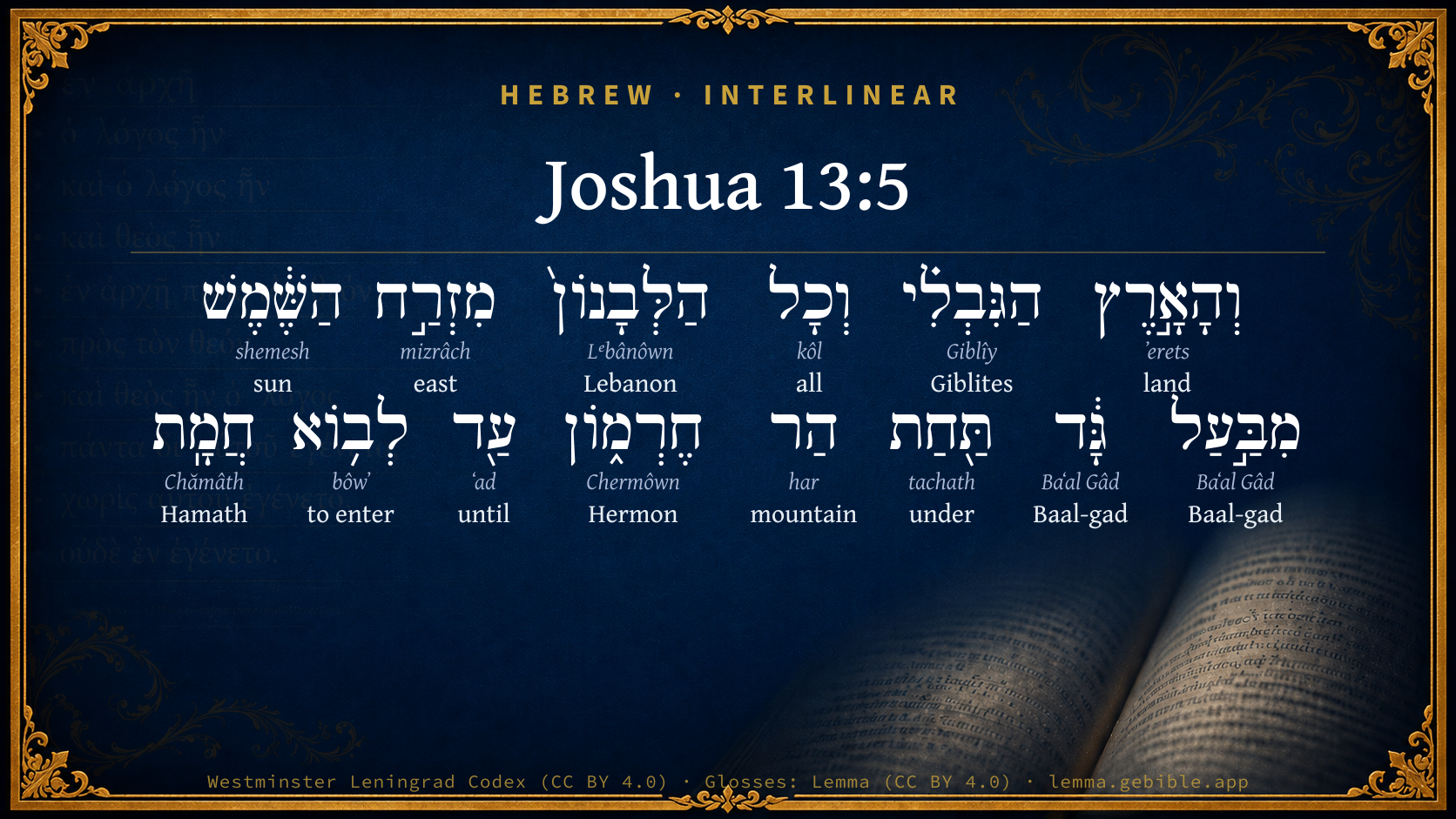
Hebrew (Westminster Leningrad Codex) Joshua 13:5 appears in the Hebrew Old Testament. The text above is from the Westminster Leningrad Codex. Each word links to its Strong’s number, a concise gloss, and parsing drawn from the Open Scriptures Hebrew Bible morphology. Click any word for its full Brown-Driver-Briggs (BDB) entry.
Download image
Cite this verse

Joshua 13:5 (World English Bible). Public Domain. Lemma interlinear Bible study tool, https://lemma.gebible.app/v/joshua/13/5.

Show BibTeX & RIS
BibTeX
RIS
English Translation
and the land of the Gebalites, and all Lebanon, toward the sunrise, from Baal Gad under Mount Hermon to the entrance of Hamath;
World English Bible · Public Domain
Highlights
  • 1 first appearance in the Hebrew Bible
Full analysis ↓
Download a study sheet

One document with this verse’s original text, its word-by-word gloss line, the meaning frame, cross-references with their text, attributed commentary, and full source and license credits — printable, and it pastes into notes with its structure intact.

This verse Autodidact and up

Study sheet (.html) Plain text (.txt)

A passage Seminary Student

Up to 50 verses in one chapter. A passage sheet keeps up to 6 commentary sources and 12 cross-references per verse, in the order this page ranks them, and says so on the sheet whenever that leaves anything out. Ask for a single verse and you get the Autodidact verse sheet above.

Everything on this page stays free to read, with no account — the sheet is a download of what is already on screen, not access to it.

Want to remove ads? Support Godless Engineer
Compare translations 3

The same verse in 3 English versions, stacked beneath the original-language interlinear above. Click any original word for its lexicon entry.

Each is an independent rendering of the whole verse — the interlinear is not word-aligned to these translations.

Highlighted words mark where these versions differ — a whole-verse word diff, not a word-by-word alignment.

  • World English Bible Public Domain
    and the land of the Gebalites, and all Lebanon, toward the sunrise, from Baal Gad under Mount Hermon to the entrance of Hamath;
  • King James Version Public Domain
    And the land of the Giblites, and all Lebanon, toward the sunrising, from Baalgad under mount Hermon unto the entering into Hamath.
  • unfoldingWord Literal Text CC BY-SA 4.0
    and the land of the Gebalite; and all of Lebanon from the rising of the sun, from Baal Gad below Mount Hermon unto Lebo Hamath.

unfoldingWord Literal Text — © unfoldingWord, licensed CC BY-SA 4.0. Word-aligned USFM3 via Door43 (git.door43.org/unfoldingWord/en_ult).

Versions to compare (up to 4)

3 of 4 selected

Show all 18 translations

Every available English version of this verse, each an independent rendering of the whole verse.

  • World English Bible Public Domain
    and the land of the Gebalites, and all Lebanon, toward the sunrise, from Baal Gad under Mount Hermon to the entrance of Hamath;
  • Berean Standard Bible Public Domain
    the land of the Gebalites; and all Lebanon to the east, from Baal-gad below Mount Hermon to Lebo-hamath.
  • Majority Standard Bible Public Domain
    the land of the Gebalites; and all Lebanon to the east, from Baal-gad below Mount Hermon to Lebo-hamath.
  • King James Version Public Domain
    And the land of the Giblites, and all Lebanon, toward the sunrising, from Baalgad under mount Hermon unto the entering into Hamath.
  • American Standard Version (1901) Public Domain
    and the land of the Gebalites, and all Lebanon, toward the sunrising, from Baal-gad under mount Hermon unto the entrance of Hamath;
  • Revised Version (1885) Public Domain
    and the land of the Gebalites, and all Lebanon, toward the sunrising, from Baal-gad under mount Hermon unto the entering in of Hamath:
  • Geneva Bible (1599) Public Domain
    And the land of the Giblites, and all Lebanon, toward the sunne rising from Bahal-gad vnder mount Hermon, vntil one come to Hamath.
  • Douay-Rheims (1899) Public Domain
    And his confines. The country also of Libanus towards the east from Baalgad under mount Hermon to the entering into Emath.
  • Young's Literal Translation Public Domain
    and the land of the Giblite, and all Lebanon, at the sun-rising, from Baal-Gad under mount Hermon, unto the going in to Hamath:
  • Literal Standard Version CC BY-SA 4.0
    and the land of the Giblite, and all Lebanon, at the sun-rising, from Ba‘al-Gad under Mount Hermon, to the going in to Hamath:
  • Unlocked Literal Bible CC BY-SA 4.0
    the land of the Gebalites, all of Lebanon toward the east, from Baal Gad below Mount Hermon to Lebo Hamath.
  • unfoldingWord Literal Text CC BY-SA 4.0
    and the land of the Gebalite; and all of Lebanon from the rising of the sun, from Baal Gad below Mount Hermon unto Lebo Hamath.
  • Darby Bible Public Domain
    and the land of the Giblites, and all Lebanon, toward the sun-rising, from Baal-Gad at the foot of mount Hermon to the entrance into Hamath;
  • World Messianic Bible Public Domain
    and the land of the Gebalites, and all Lebanon, toward the sunrise, from Baal Gad under Mount Hermon to the entrance of Hamath;
  • Webster's Bible Public Domain
    And the land of the Giblites, and all Lebanon towards the sun-rising, from Baal-gad under mount Hermon to the entering into Hamath.
  • Free Bible Version CC BY-SA 4.0
    as well as the land of the Gebalites and the Lebanon area from the town of Baalgad to the slopes of Mount Hermon to Lebo-hamath,
  • Bible in Basic English Public Domain
    And the land of the Gebalites, and all Lebanon, looking east, from Baal-gad under Mount Hermon as far as Hamath:
  • JPS Tanakh (1917) Public Domain
    and the land of the Gebalites, and all Lebanon, toward the sunrising, from Baal-gad under mount Hermon unto the entrance of Hamath;

Literal Standard Version (2020), Covenant Press — licensed CC BY-SA 4.0. Text via the HelloAO Bible API (eBible.org). Unlocked Literal Bible (unfoldingWord) — licensed CC BY-SA 4.0. Text via the HelloAO Bible API (eBible.org). unfoldingWord Literal Text — © unfoldingWord, licensed CC BY-SA 4.0. Word-aligned USFM3 via Door43 (git.door43.org/unfoldingWord/en_ult). Free Bible Version, Dr. Jonathan Gallagher — licensed CC BY-SA 4.0. Text via the HelloAO Bible API (eBible.org).

Word by word

More ways to search: Search by grammar → Find every occurrence → Compare this word →

Practice this passage: Drill this verse → Learn its vocabulary →

הַגִּבְלִ֗י
Giblîy
H1382
“the · Giblites”
Particle, Definite Article + Noun, Gentilic, Masculine, Singular, Absolute
Part of Speech
Particle + Noun
Type
Gentilic
Gender
Masculine
Number
Singular
State
Absolute
Full BDB Definition

Origin: patrial from H1380

TWOT: None

Giblites = "a boundary" - inhabitants of Gebal
  1. וְהָאָ֣רֶץ ʼerets H776 “and · the · land” Conjunction + Particle, Definite Article + Noun, Common, Both, Singular, Absolute
  2. וְכָל kôl H3605 “and · all of” Conjunction + Noun, Common, Masculine, Singular, Construct
  3. הַלְּבָנוֹן֙ Lᵉbânôwn H3844 “the · Lebanon” Particle, Definite Article + Noun, Proper
  4. מִזְרַ֣ח mizrâch H4217 “east of” Noun, Common, Masculine, Singular, Construct
  5. הַשֶּׁ֔מֶשׁ shemesh H8121 “the · sun” Particle, Definite Article + Noun, Common, Both, Singular, Absolute
  6. מִבַּ֣עַל Baʻal Gâd H1171 “from · Baal-gad” Preposition + Noun, Proper
  7. גָּ֔ד Baʻal Gâd H1171 “Baal-gad” Noun, Proper
  8. תַּ֖חַת tachath H8478 “under” Preposition
  9. הַר har H2022 “mountain of” Noun, Common, Masculine, Singular, Construct
  10. חֶרְמ֑וֹן Chermôwn H2768 “Hermon” Noun, Proper
  11. עַ֖ד ʻad H5704 “until” Preposition
  12. לְב֥וֹא bôwʼ H935 “entrance” Noun, Proper
  13. חֲמָֽת Chămâth H2574 “Hamath” Noun, Proper

About this verse

These counts appear in no published source. They are computed here, from the morphology-tagged text and Lemma’s own curated glosses. What Lemma adds →

14
words
13
distinct lemmas
Historical
section

Notable vocabulary

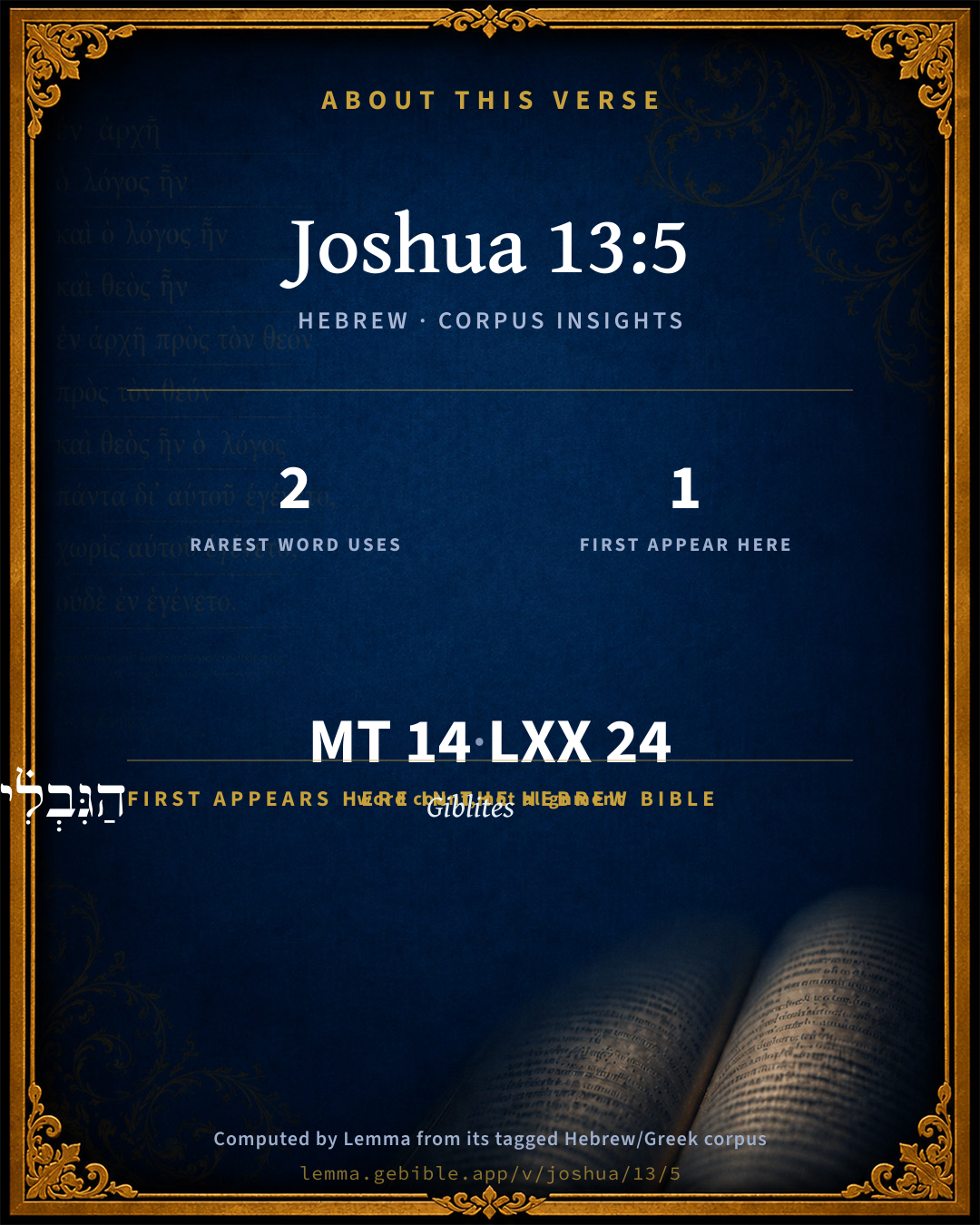
The rarest word here is הַגִּבְלִ֗י Giblites H1382 — appearing just 2 times in the whole Hebrew Bible.

First appearance in Scripture

This word makes its first canonical appearance in the Hebrew Bible here:

  • הַגִּבְלִ֗י Giblites H1382

Shared distinctive vocabulary

הַגִּבְלִ֗י Giblites H1382 occurs in 2 verses of the Hebrew Bible. Also found in:

Grammatical profile

  • 12 nouns
  • 2 prepositions

Repetition

A word recurs within this verse — often emphatic in Hebrew:

  • מִבַּ֣עַל Baal-gad H1171 ×2

Hebrew & Septuagint length

In English translation the verse runs 23 words from the Hebrew and 27 from the Septuagint (LXX English) — closely comparable.

A rough comparison of the two English renderings, which tokenize alike — not a word-level alignment.

Word counts can differ between the Hebrew and the Greek without any difference in meaning — e.g. the Hebrew direct-object marker אֵת has no separate Greek word, and Greek often adds the article ὁ.

In the original languages it is 14 Hebrew tokens and 24 Greek tokens — but the two are counted differently (Hebrew bundles its prefixes and suffixes into one token; the Greek is in lemma form), so that isn’t a like-for-like length.

Cross-references

10

Topical passages linked to Joshua 13:5 in the Treasury of Scripture Knowledge — connected by theme and wording, ordered by reader-vote popularity; previews shown in the World English Bible.

  • Joshua 12:7 These are the kings of the land whom Joshua and the children of Israel struck beyond the Jordan westward, from Baal Gad in the valley of Lebanon even to Mount Halak, that goes up to Seir; and Joshua gave it to the tribes of Israel for a possession according to their divisions;
  • 1 Kings 5:18 Solomon's builders and Hiram's builders and the Gebalites did fashion them, and prepared the timber and the stones to build the house.
  • Psalms 83:7 Gebal, Ammon, and Amalek; Philistia with the inhabitants of Tyre;
  • Ezekiel 27:9 The old men of Gebal and the wise men of it were in you your repairers of ship seams: all the ships of the sea with their mariners were in you to deal in your merchandise.
  • Numbers 34:8 from Mount Hor you shall mark out to the entrance of Hamath; and the goings out of the border shall be at Zedad;
  • Joshua 11:17 from Mount Halak, that goes up to Seir, even to Baal Gad in the valley of Lebanon under Mount Hermon: and all their kings he took, and struck them, and put them to death.
  • Deuteronomy 1:7 turn you, and take your journey, and go to the hill-country of the Amorites, and to all [the places] near thereunto, in the Arabah, in the hill-country, and in the lowland, and in the South, and by the sea-shore, the land of the Canaanites, and Lebanon, as far as the great river, the river Euphrates.
  • Deuteronomy 3:25 Please let me go over and see the good land that is beyond the Jordan, that goodly mountain, and Lebanon.
  • Isaiah 10:9 Isn't Calno as Carchemish? Isn't Hamath as Arpad? Isn't Samaria as Damascus?
  • Amos 6:2 Go to Calneh, and see; And from there go to Hamath the great; Then go down to Gath of the Philistines. Are they better than these kingdoms? Or is their border greater than your border?

Cross-references courtesy of OpenBible.info (CC BY 4.0).

Hebrew and Greek witnesses Masoretic Hebrew ↔ Greek Septuagint

The same verse in the two great witnesses to the Old Testament, shown verse-for-verse.

These are two independent witnesses, not word-aligned to each other, and the Septuagint is shown in lemma (dictionary) form.

Hebrew Joshua 13:5 Masoretic · Westminster Leningrad Codex

וְהָאָ֣רֶץ הַגִּבְלִ֗י וְכָל הַלְּבָנוֹן֙ מִזְרַ֣ח הַשֶּׁ֔מֶשׁ מִבַּ֣עַל גָּ֔ד תַּ֖חַת הַר חֶרְמ֑וֹן עַ֖ד לְב֥וֹא חֲמָֽת

and the land of the Gebalites, and all Lebanon, toward the sunrise, from Baal Gad under Mount Hermon to the entrance of Hamath;

World English Bible · Public Domain

Greek LXX Joshua 13:5 Septuagint · lemma form

καί πᾶς ὁ γῆ γαβλι φυλιστιιμ καί πᾶς ὁ λίβανος ἀπό ἀνατολή ἥλιος ἀπό γαλγαλ ὑπό ὁ ὄρος ὁ αερμων ἕως ὁ εἴσοδος εμαθ

And all the land of Galiath of the Phylistines, and all Libanus eastward from Galgal, under the mountain Aermon as far as the entering in of Emath;

LXX2012 (modern English Septuagint) · Public Domain

On this verse, The Cambridge Bible for Schools and Colleges discusses the Septuagint’s reading. Read the note in Commentary ↓

Hebrew: Westminster Leningrad Codex (CC BY 4.0). Greek: Septuagint (public domain); English from LXX2012 (modern English Septuagint) (Public Domain). How the Septuagint differs from the Hebrew →

Targum (Aramaic paraphrase)

1

The Targum is the ancient Jewish Aramaic paraphrase of the Hebrew Scriptures — an interpretive translation, not the Hebrew text itself. Onkelos (literal) and Pseudo-Jonathan (expansive) render the Torah, and Jonathan the Prophets. Coverage is partial: where no permissively-licensed English translation exists for a verse, only the Aramaic is shown. This is verse-level text, not a word-by-word alignment to the Hebrew.

  1. Targum Jonathan Prophets (Joshua–Malachi)
    וְאַרְעָא גִבְלִי וְכָל לִבְנָן מִדְנַח שִׁמְשָׁא מִמֵישַׁר גָד שִׁפּוּלֵי טוּרָא דְחֶרְמוֹן עַד מַעֲלָנָא דַחֲמָת:

    (no public-domain English translation for this verse)

    Targum Jonathan — Aramaic: “Mikraot Gedolot” (public domain). English: “Sefaria Community Translation” (CC0 1.0 (public-domain dedication)); “London "Chaldee Paraphrase," 1871” (public domain). Text via Sefaria.

Commentary

Notes on Joshua 13:5 from classic Christian and Jewish commentators (each source and its license shown beneath its notes). The classic Christian expositions comment on the surrounding passage and are grouped to its opening verse, so a note may address several verses; the Jewish commentaries on the Tanakh (Rashi and others) are per-verse, so they appear only where the commentator wrote on this verse.

Lemma curates 59 commentaries, every one of them public domain or Creative Commons licensed, each selected and text-cleaned for this edition rather than reprinted as found. About our sources →

The Cambridge Bible for Schools and Colleges

gen. ed. J. J. S. Perowne

5. the land of the Giblites] i.e. the land of the inhabitants of Gebal, a name which occurs in Psa_83:7,

“Gebal, and Ammon, and Amalek;

The Philistines with the inhabitants of Tyre;”

and Eze_27:8-9, “The inhabitants of Zidon and Arvad were thy mariners: thy wise men, O Tyrus, that were in thee, were thy pilots. The ancients of Gebal and the wise men thereof were in thee thy calkers.” It was a maritime town of Phœnicia. Its inhabitants are written “Giblians” in the Vulgate, and “Byblians” in the LXX. (while in 1Ki_5:18 the word is rendered “stone-squarers”), whence we may infer the identity of the city with the Byblus of classical literature. Byblus was a seat of the worship of Adonis or Syrian Tammuz. The modern name is Jebail, about 22 miles north of Beyrout. The coins of Byblus have frequently the type of Astarte, also of Isis, who came here in search of the body of Osiris. “At Jebail and in other ancient Phœnician cities there are traces of the same large bevelled stones clamped with iron, which appear in the foundations of Solomon’s temple. These are probably the work of the Giblites.” See Ritter’s Geog. Pal. II. 214, 215.

all Lebanon, toward the sunrising] i.e. Anti-Lebanon.

from Baal-gad] See above, note on Jos_11:17.

the entering into Hamath] The extreme northern boundary point of Palestine whither the spies originally penetrated (Num_13:21), and to which the kingdom of David and Solomon once actually extended (2Sa_8:3-12; 1Ch_13:5; 1Ch_18:3-11; 2Ch_8:3-4). In the time of the Crusades it was called Epiphaneia, a town situated on the western bank of the Orontes, lower down the stream than Emesa. It is called “Hamath the Great” (Amo_6:2), and commanded the whole of the Orontes valley, from the low screen of hills which forms the watershed between the Orontes and the Litâny—“the entrance of Hamath”—to the defile of Daphne below Antioch.

The Cambridge Bible for Schools and Colleges (gen. ed. J. J. S. Perowne; Cambridge University Press, 1878–1918) — public domain. Text from a community e-Sword module.

Trapp's Complete Commentary

John Trapp

Jos 13:5 And the land of the Giblites, and all Lebanon, toward the sunrising, from Baalgad under mount Hermon unto the entering into Hamath.

Ver. 5. And the land of the Giblites.] Called Gebal in Psa 83:7 Eze 27:9. Enemies to the Church.

John Trapp, A Commentary or Exposition upon All the Books of the Old and New Testament (1647–1656) — public domain. Text from a community e-Sword module.

Geneva Bible (1599)

Geneva Bible translators

Or, the plain of Gad.

Geneva Bible (1599) marginal notes — public domain. Text via Bolls.life.

Jamieson, Fausset & Brown

Robert Jamieson, A. R. Fausset & David Brown

all the land of the Giblites--Their capital was Gebal or Bylbos (Greek), on the Mediterranean, forty miles north of Sidon.

all Lebanon, toward the sunrising--that is, Anti-libanus; the eastern ridge, which has its proper termination in Hermon.

entering into Hamath--the valley of Baalbec.

Jamieson, Fausset & Brown — Commentary Critical and Explanatory on the Whole Bible (1871) — public domain (CC PDM 1.0). Text via the HelloAO Bible API.

Adam Clarke's Commentary

Verse 5. The land of the Giblites] This people dwelt beyond the precincts of the land of Canaan, on the east of Tyre and Sidon. See Eze 27:9; Ps 83:7; their capital was named Gebal. See Dodd.

All Lebanon] See Clarke on Jos 11:17.

Adam Clarke's Commentary on the Bible (1810–1826) — public domain. Text from a community e-Sword/MySword module.

John Gill's Exposition

And the land of the Giblites,.... This was another country that remained unconquered; the Greeks call it Byblus, and near to which Pliny (e) speaks of a place called Gabale, and is now called Gibyle; it is (f) said to be"pleasantly situated by the seaside, and at present it contains but a little extent of ground, but yet more than enough for the small number of its inhabitants:''it was in greater splendour, and its inhabitants of more fame, in the times of Ezekiel, Eze 27:9,

and all Lebanon toward the sunrising; or east of the land; all that inhabited that mountain remained unconquered, though the conquest was carried as far as the borders thereof:

from Baalgad, under Mount Hermon; of which see Jos 11:17;

unto the entering into Hamath: which was the north border of the land; see Num 34:8.

(e) Ut supra. (Nat. Hist. l. 5. c. 20.) (f) Maundrel's Journey from Aleppo, &c. p. 33.

John Gill's Exposition of the Whole Bible (1746–1763) — public domain (CC PDM 1.0). Text via the HelloAO Bible API.

Albert Barnes' Notes on the Bible

Giblites - The people of Gebal (“Jebail”, 22 miles north of Beyronut). They were “stone-squarers” 1Ki 5:18 and (ship) “caulkers” Eze 27:9.

Albert Barnes' Notes on the Bible (1834–1885) — public domain. Text from a community e-Sword/MySword module.

Matthew Poole's English Annotations

The Gibites; a people dwelling near Sidon in Gebal, of which see 1Ki 5:18; Eze 27:9.

Matthew Poole's English Annotations on the Holy Bible (1683–1685) — public domain. Text from a community e-Sword/MySword module.

Whedon's Commentary on the Bible

Daniel D. Whedon

[5. Giblites — Inhabitants of Gebal, the Gyblos of the Greeks, the modern Jebail, situated on the seacoast at the foot of the northern slopes of Lebanon, and about seventeen miles north of Beyroot. A multitude of gray granite columns are built into the modern walls and houses, choke up the harbour, and lie scattered over the surrounding fields, and they attest the antiquity of the town. The Giblites were employed in building Solomon’s temple, (1Ki_5:18, note,) and. according to Eze_27:9, were skilled in shipbuilding.

Baal-gad — See on Jos_11:17. Hamath was probably founded by the youngest son of Canaan, (Gen_10:18,) and so was one of the oldest cities in the world. In Amo_6:2, it is called “the great.” Its king Toi made peace with David, (2Sa_8:9,) but Solomon seems to have subjugated the kingdom and made it a part of his own empire. 2Ch_8:3. It early fall into the hands of the great Assyrian conquerors. 2Ki_18:34. It still exists, in the beautiful valley of the Orontes, about sixty miles southeast of Antioch, and has a population of 30,000. It lies on both sides of the river, and is noted for the immense wheels, eighty feet in diameter, which are turned by the rapid current and used for irrigation. The entering into Hamath is a geographical term used to designate the northern border of Israel. Num_34:8; 1Ki_8:65; 2Ki_14:25. It was evidently some great pass connected with the Lebanon mountains, but which one has been a matter of dispute. Robinson and Porter identify it with the depression between the northern end of Lebanon and the Nusairiyeh mountains, which opens westward, towards the coast of the Mediterranean. But as the Israelites never occupied territory so far north as that, most sacred geographers identify this entering with the southern opening into the great valley of Coele-Syria. This is by far the most notable entrance into the ancient kingdom and land of Hamath.]

Daniel D. Whedon (gen. ed.), Commentary on the Old and New Testaments (1874–1909) — public domain. Text from a community e-Sword module.

The Pulpit Commentary

The Giblites. The inhabitants of Gebal, called Jebail (i.e. , hill city, from Jebel) by the Arabs, and Byblus by the Greeks. This is Masius"s idea, and other commentators have accepted it. (see 1Ki 5:32 Psa_83:7; and Eze_27:9, where the LXX translates by Byblus) In the first named passage the word is translated "stone squarers," in our version (where it is the 18th and not the 32nd verse). All the other versions render "Giblites" as here, and no doubt the inhabitants of the Phoenician city of Jebail are meant, since in the ruins of Jebail the same kind of masonry is found as is seen in Solomon"s temple. Byblus (Kenriek, "Phoenicia," l.c. Movers, l.c. Lenormant, "Manual of the History of the East," if. 223) was the great seat of the worship of Tammuz, or Adonis. Here his father Cinyras was supposed to have been king, and the licentious worship, with its corrupting influences, was spread over the whole region of Lebanon and even Damascus. This territory was never actually occupied by the Israelites. (see for this passage also Jos_11:8, 17 12:7) Hamath. The spies penetrated nearly as far as this, (Num_22:21) and David reduced the land into subjection as far as the borders of this territory. But the Israelites never subdued it. Toi, king of Hamath, was an ally, not a tributary of David. (2Sa_8:9) The border of Israel is always described as extending "to the entering in of Hamath", (1Ki_8:65 2Ki_14:25) though Jeroboam II is said to have "recovered" (v. 28) Hamath itself. This "entering in of Hamath" commences at the end of the region called Coele Syria, according to Robinson, "Later Biblical Researches," see. 12, at the northeast end of the Lebanon range. So Vandevelde and Porter. Vandevelde remarks that the expression refers to an "entrance formed by Nature herself," namely, the termination of the Lebanon and Anti-Lebanon ranges. The city of Hamath, which gave its name to the territory, is situated on the Orontes, and was known later as Epiphaneia, no doubt after Antiochus Epiphanes, king of Syria.

The Pulpit Commentary (1880–1919), ed. H.D.M. Spence-Jones & Joseph S. Exell — public domain. Text from a community e-Sword module.

Rashi

Rabbi Shlomo Yitzchaki (Rashi)

The land of the Givlites and the entire Lebanon eastward foward the rising sun. And on the eastern border, the northern end remained unconquered, [including] the entire Lebanon, from Baal-gad, to the end of the border; and in the width from east to west to Levo-Chamos. This is the entire northern border, for Levo-Chamos is at the northwestern corner, as stated in Parshas “These are the journeys.”

Rashi on the Tanakh — English translations: “The Judaica Press complete Tanach with Rashi, translated by A. J. Rosenberg” (CC BY 4.0); “Pentateuch with Rashi's commentary by M. Rosenbaum and A.M. Silbermann, 1929-1934” (public domain); “The Metsudah Tanach series, Lakewood, N.J” (CC BY 4.0); and “The Book of Joshua, Metsudah Publications, 1997” (CC BY 4.0). Text via Sefaria.

Lesson kit

Teaching starters — assembled from the data on this page, not authored interpretation. Every prompt links to the verse data it draws on. Edit before teaching.

Joshua, in the Historical, opens this verse with 14 words (13 distinct Hebrew lemmas). Its most distinctive word is Giblîy (“Giblites”). A historical commentator’s framing appears above. Read the whole chapter for the surrounding context.

Discussion questions

  1. What does “Giblites” (Giblîy) contribute to the verse as a whole?
  2. This is the first place “Giblites” appears in Scripture (first appears here). What does its debut here establish?
  3. How does 1 Kings 5:18, which shares the word «Giblites», read alongside this verse?
  4. What does the repetition of “Baal-gad” (2× in this one verse) do in this verse?
  5. These translations render this verse differently. What is at stake in choosing one wording over another?
  6. Compare how The Cambridge Bible for Schools and Colleges and Trapp's Complete Commentary read this verse. Where do they agree or differ?

Things to notice

Reading settings

Reading text

Shown beneath each verse's original-language words.

Old Testament
Old Testament edition

Read the OT as the Masoretic Hebrew (MT) or the Greek Septuagint (LXX).

English shown for the Greek Septuagint (in the Hebrew ↔ Greek comparison).

Comparing translations? Open the Compare panel on any verse page to stack up to four side by side.