Isaiah 33:9

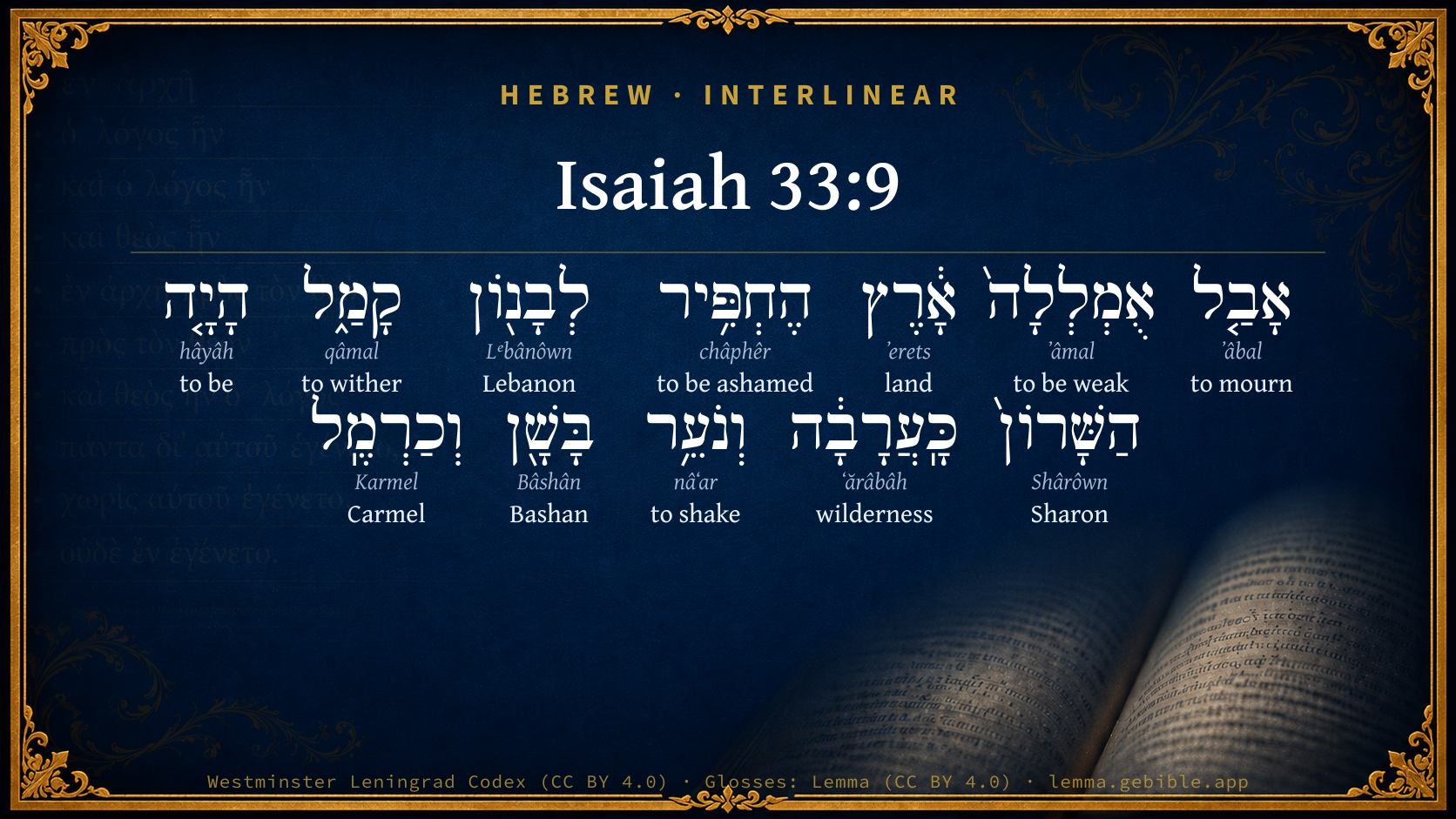
Hebrew (Westminster Leningrad Codex) Isaiah 33:9 appears in the Hebrew Old Testament. The text above is from the Westminster Leningrad Codex. Each word links to its Strong’s number, a concise gloss, and parsing drawn from the Open Scriptures Hebrew Bible morphology. Click any word for its full Brown-Driver-Briggs (BDB) entry.
Download image
Cite this verse

Isaiah 33:9 (World English Bible). Public Domain. Lemma interlinear Bible study tool, https://lemma.gebible.app/v/isaiah/33/9.

Show BibTeX & RIS
BibTeX
RIS
English Translation
The land mourns and languishes; Lebanon is confounded and withers away; Sharon is like a desert; and Bashan and Carmel shake off [their leaves].
World English Bible · Public Domain
Download a study sheet

One document with this verse’s original text, its word-by-word gloss line, the meaning frame, cross-references with their text, attributed commentary, and full source and license credits — printable, and it pastes into notes with its structure intact.

This verse Autodidact and up

Study sheet (.html) Plain text (.txt)

A passage Seminary Student

Up to 50 verses in one chapter. A passage sheet keeps up to 6 commentary sources and 12 cross-references per verse, in the order this page ranks them, and says so on the sheet whenever that leaves anything out. Ask for a single verse and you get the Autodidact verse sheet above.

Everything on this page stays free to read, with no account — the sheet is a download of what is already on screen, not access to it.

Want to remove ads? Support Godless Engineer
Compare translations 3

The same verse in 3 English versions, stacked beneath the original-language interlinear above. Click any original word for its lexicon entry.

Each is an independent rendering of the whole verse — the interlinear is not word-aligned to these translations.

Highlighted words mark where these versions differ — a whole-verse word diff, not a word-by-word alignment.

  • World English Bible Public Domain
    The land mourns and languishes; Lebanon is confounded and withers away; Sharon is like a desert; and Bashan and Carmel shake off [their leaves].
  • King James Version Public Domain
    The earth mourneth and languisheth: Lebanon is ashamed and hewn down: Sharon is like a wilderness; and Bashan and Carmel shake off their fruits.
  • unfoldingWord Literal Text CC BY-SA 4.0
    The land mourns, it is enfeebled; Lebanon displays disgrace, it withers; Sharon has become like the Arabah, and Bashan and Carmel are shaking off. q1

unfoldingWord Literal Text — © unfoldingWord, licensed CC BY-SA 4.0. Word-aligned USFM3 via Door43 (git.door43.org/unfoldingWord/en_ult).

Versions to compare (up to 4)

3 of 4 selected

Show all 18 translations

Every available English version of this verse, each an independent rendering of the whole verse.

  • World English Bible Public Domain
    The land mourns and languishes; Lebanon is confounded and withers away; Sharon is like a desert; and Bashan and Carmel shake off [their leaves].
  • Berean Standard Bible Public Domain
    The land mourns and languishes; Lebanon is ashamed and decayed. Sharon is like a desert; Bashan and Carmel shake off their leaves.
  • Majority Standard Bible Public Domain
    The land mourns and languishes; Lebanon is ashamed and decayed. Sharon is like a desert; Bashan and Carmel shake off their leaves.
  • King James Version Public Domain
    The earth mourneth and languisheth: Lebanon is ashamed and hewn down: Sharon is like a wilderness; and Bashan and Carmel shake off their fruits.
  • American Standard Version (1901) Public Domain
    The land mourneth and languisheth; Lebanon is confounded and withereth away; Sharon is like a desert; and Bashan and Carmel shake off `their leaves'.
  • Revised Version (1885) Public Domain
    The land mourneth and languisheth: Lebanon is ashamed and withereth away: Sharon is like a desert; and Bashan and Carmel shake off their leaves.
  • Geneva Bible (1599) Public Domain
    The earth mourneth and fainteth: Lebanon is ashamed, and hewen downe: Sharon is like a wildernes, and Bashan is shaken and Carmel.
  • Douay-Rheims (1899) Public Domain
    The land hath mourned, and languished: Libanus is confounded and become foul, and Saron is become as a desert: and Basan and Carmel are shaken.
  • Young's Literal Translation Public Domain
    Mourned, languished hath the land, Confounded hath been Lebanon, Withered hath been Sharon as a wilderness, And shaking are Bashan and Carmel.
  • Literal Standard Version CC BY-SA 4.0
    The land has mourned, languished, || Lebanon has been confounded, || Sharon has been withered as a wilderness, || And Bashan and Carmel are shaking.
  • Unlocked Literal Bible CC BY-SA 4.0
    The land mourns and withers away; Lebanon is ashamed and withers away; Sharon is like a desert plain; and Bashan and Carmel shake off their leaves.
  • unfoldingWord Literal Text CC BY-SA 4.0
    The land mourns, it is enfeebled; Lebanon displays disgrace, it withers; Sharon has become like the Arabah, and Bashan and Carmel are shaking off. q1
  • Darby Bible Public Domain
    The land mourneth, it languisheth; Lebanon is ashamed, is withered; the Sharon is become as a desert, and Bashan and Carmel are stripped.
  • World Messianic Bible Public Domain
    The land mourns and languishes. Lebanon is confounded and withers away. Sharon is like a desert, and Bashan and Carmel are stripped bare.
  • Webster's Bible Public Domain
    The earth mourneth and languisheth: Lebanon is ashamed and hewn down: Sharon is like a wilderness; and Bashan and Carmel shake off their fruits.
  • Free Bible Version CC BY-SA 4.0
    Israel is in mourning and fades away; Lebanon withers in shame; the fields of Sharon have become a desert; the forests of Bashan and Carmel have shed their leaves.
  • Bible in Basic English Public Domain
    The earth is sorrowing and wasting away; Lebanon is put to shame and has become waste; Sharon is like the Arabah; and in Bashan and Carmel the leaves are falling.
  • JPS Tanakh (1917) Public Domain
    The land mourneth and languisheth; Lebanon is ashamed, it withereth; Sharon is like a wilderness; and Bashan and Carmel are clean bare.

Literal Standard Version (2020), Covenant Press — licensed CC BY-SA 4.0. Text via the HelloAO Bible API (eBible.org). Unlocked Literal Bible (unfoldingWord) — licensed CC BY-SA 4.0. Text via the HelloAO Bible API (eBible.org). unfoldingWord Literal Text — © unfoldingWord, licensed CC BY-SA 4.0. Word-aligned USFM3 via Door43 (git.door43.org/unfoldingWord/en_ult). Free Bible Version, Dr. Jonathan Gallagher — licensed CC BY-SA 4.0. Text via the HelloAO Bible API (eBible.org).

Word by word

More ways to search: Search by grammar → Find every occurrence → Compare this word →

Practice this passage: Drill this verse → Learn its vocabulary →

קָמַ֑ל
qâmal
H7060
“to wither”
Verb, Qal, Perfect, 3rd Person, Masculine, Singular
Part of Speech
Verb
Stem
Qal
Form
Perfect
Person
3rd Person
Gender
Masculine
Number
Singular
Full BDB Definition

Origin: a primitive root

TWOT: 2035

to be decayed, be withered - (Qal) to moulder, be withered
  1. אָבַ֤ל ʼâbal H56 “to mourn” Verb, Qal, Perfect, 3rd Person, Masculine, Singular
  2. אֻמְלְלָה֙ ʼâmal H535 “to be weak” Verb, Pulal, Perfect, 3rd Person, Feminine, Singular
  3. אָ֔רֶץ ʼerets H776 “land” Noun, Common, Both, Singular, Absolute
  4. הֶחְפִּ֥יר châphêr H2659 “to be ashamed” Verb, Hiphil, Perfect, 3rd Person, Masculine, Singular
  5. לְבָנ֖וֹן Lᵉbânôwn H3844 “Lebanon” Noun, Proper
  6. הָיָ֤ה hâyâh H1961 “to be” Verb, Qal, Perfect, 3rd Person, Masculine, Singular
  7. הַשָּׁרוֹן֙ Shârôwn H8289 “the · Sharon” Particle, Definite Article + Noun, Proper
  8. כָּֽעֲרָבָ֔ה ʻărâbâh H6160 “like/as the · wilderness” Preposition, Determined + Noun, Common, Feminine, Singular, Absolute
  9. וְנֹעֵ֥ר nâʻar H5287 “and · shaking” Conjunction + Verb, Qal, Participle Active, Masculine, Singular, Absolute
  10. בָּשָׁ֖ן Bâshân H1316 “Bashan” Noun, Proper
  11. וְכַרְמֶֽל Karmel H3760 “and · Carmel” Conjunction + Noun, Proper

About this verse

These counts appear in no published source. They are computed here, from the morphology-tagged text and Lemma’s own curated glosses. What Lemma adds →

12
words
12
distinct lemmas
Prophets
section

Notable vocabulary

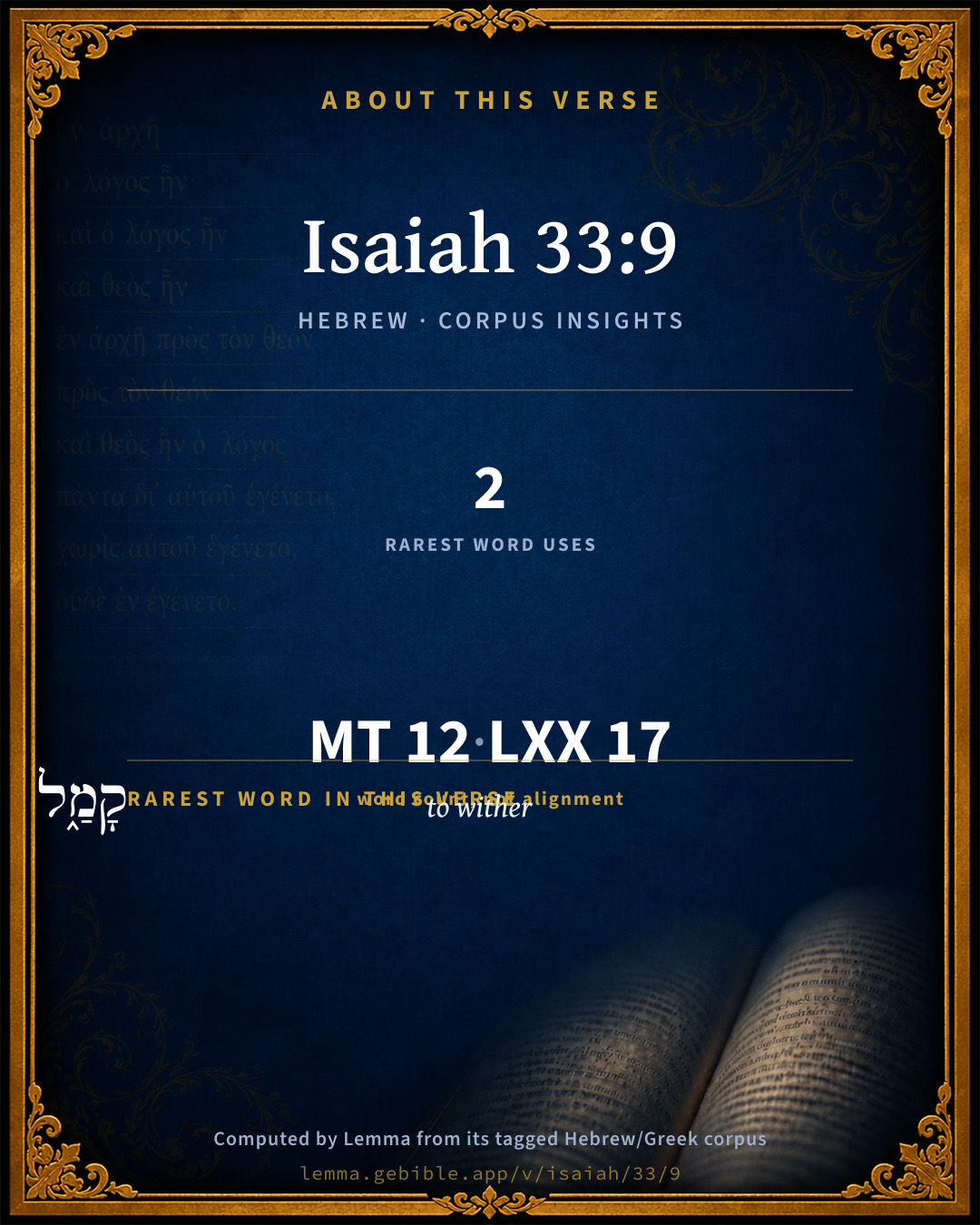
The rarest word here is קָמַ֑ל to wither H7060 — appearing just 2 times in the whole Hebrew Bible.

Shared distinctive vocabulary

קָמַ֑ל to wither H7060 occurs in 2 verses of the Hebrew Bible. Also found in:

Grammatical profile

  • 6 verbs
  • 6 nouns

Verb forms

  • אָבַ֤ל Qal · Perfect
  • אֻמְלְלָה֙ Pulal · Perfect
  • הֶחְפִּ֥יר Hiphil · Perfect
  • קָמַ֑ל Qal · Perfect
  • הָיָ֤ה Qal · Perfect
  • וְנֹעֵ֥ר Qal · Participle Active

Hebrew & Septuagint length

In English translation the verse runs 24 words from the Hebrew and 17 from the Septuagint (LXX English) — the Septuagint runs noticeably shorter here. See the side-by-side →

A rough comparison of the two English renderings, which tokenize alike — not a word-level alignment.

Word counts can differ between the Hebrew and the Greek without any difference in meaning — e.g. the Hebrew direct-object marker אֵת has no separate Greek word, and Greek often adds the article ὁ.

In the original languages it is 12 Hebrew tokens and 17 Greek tokens — but the two are counted differently (Hebrew bundles its prefixes and suffixes into one token; the Greek is in lemma form), so that isn’t a like-for-like length.

Cross-references

17

Topical passages linked to Isaiah 33:9 in the Treasury of Scripture Knowledge — connected by theme and wording, ordered by reader-vote popularity; previews shown in the World English Bible.

  • Isaiah 35:2 It shall blossom abundantly, and rejoice even with joy and singing; the glory of Lebanon shall be given to it, the excellency of Carmel and Sharon: they shall see the glory of Yahweh, the excellency of our God.
  • Isaiah 65:10 Sharon shall be a fold of flocks, and the valley of Achor a place for herds to lie down in, for my people who have sought me.
  • Nahum 1:4 He rebukes the sea, and makes it dry, and dries up all the rivers. Bashan languishes, and Carmel; and the flower of Lebanon languishes.
  • Deuteronomy 3:4 We took all his cities at that time; there was not a city which we didn't take from them; sixty cities, all the region of Argob, the kingdom of Og in Bashan.
  • Song of Solomon 2:1 I am a rose of Sharon, A lily of the valleys.
  • Isaiah 1:7–8 Your country is desolate. Your cities are burned with fire. Strangers devour your land in your presence, And it is desolate, As overthrown by strangers.
  • Isaiah 2:13 For all the cedars of Lebanon, that are high and lifted up, For all the oaks of Bashan,
  • Isaiah 3:26 Her gates shall lament and mourn; And she shall be desolate and sit on the ground.
  • Isaiah 14:8 Yes, the fir trees rejoice at you, [and] the cedars of Lebanon, [saying], Since you are laid low, no lumberjack is come up against us.
  • Isaiah 24:1 Behold, Yahweh makes the earth empty, and makes it waste, and turns it upside down, and scatters abroad the inhabitants of it.
  • Isaiah 24:4–6 The earth mourns and fades away, the world languishes and fades away, the lofty people of the earth do languish.
  • Isaiah 24:19–20 The earth is utterly broken, the earth is torn apart, the earth is shaken violently.
  • Isaiah 37:24 By your servants have you defied the Lord, and have said, With the multitude of my chariots am I come up to the height of the mountains, to the innermost parts of Lebanon; and I will cut down the tall cedars of it, and the choice fir trees of it; and I will enter into its farthest height, the forest of its fruitful field;
  • Jeremiah 4:20–26 Destruction on destruction is cried; for the whole land is laid waste: suddenly are my tents destroyed, [and] my curtains in a moment.
  • Jeremiah 50:19 I will bring Israel again to his pasture, and he shall feed on Carmel and Bashan, and his soul shall be satisfied on the hills of Ephraim and in Gilead.
  • Micah 7:14 Shepherd your people with your staff, The flock of your heritage, Who dwell by themselves in a forest, In the midst of fertile pasture land, let them feed; In Bashan and Gilead, as in the days of old.

Cross-references courtesy of OpenBible.info (CC BY 4.0).

Hebrew and Greek witnesses Masoretic Hebrew ↔ Greek Septuagint

The same verse in the two great witnesses to the Old Testament, shown verse-for-verse.

Here the Septuagint runs noticeably shorter than the Hebrew — LXX2012 (modern English Septuagint) 17 words vs World English Bible 24. A rough length comparison of the two English translations, not a word-level alignment — read both below.

These are two independent witnesses, not word-aligned to each other, and the Septuagint is shown in lemma (dictionary) form.

Hebrew Isaiah 33:9 Masoretic · Westminster Leningrad Codex

אָבַ֤ל אֻמְלְלָה֙ אָ֔רֶץ הֶחְפִּ֥יר לְבָנ֖וֹן קָמַ֑ל הָיָ֤ה הַשָּׁרוֹן֙ כָּֽעֲרָבָ֔ה וְנֹעֵ֥ר בָּשָׁ֖ן וְכַרְמֶֽל

The land mourns and languishes; Lebanon is confounded and withers away; Sharon is like a desert; and Bashan and Carmel shake off [their leaves].

World English Bible · Public Domain

Greek LXX Isaiah 33:9 Septuagint · lemma form

πενθέω ὁ γῆ αἰσχύνω ὁ λίβανος ἕλος γίγνομαι ὁ σαρων φανερός εἰμί ὁ γαλιλαία καί ὁ κάρμηλος

The land mourns; Libanus is ashamed: Saron is become marshes; Galilee shall be laid bare, and Chermel.

LXX2012 (modern English Septuagint) · Public Domain

On this verse, Albert Barnes' Notes on the Bible discusses the Septuagint’s reading. Read the note in Commentary ↓

Hebrew: Westminster Leningrad Codex (CC BY 4.0). Greek: Septuagint (public domain); English from LXX2012 (modern English Septuagint) (Public Domain). How the Septuagint differs from the Hebrew →

Targum (Aramaic paraphrase)

1

The Targum is the ancient Jewish Aramaic paraphrase of the Hebrew Scriptures — an interpretive translation, not the Hebrew text itself. Onkelos (literal) and Pseudo-Jonathan (expansive) render the Torah, and Jonathan the Prophets. Coverage is partial: where no permissively-licensed English translation exists for a verse, only the Aramaic is shown. This is verse-level text, not a word-by-word alignment to the Hebrew.

  1. Targum Jonathan Prophets (Joshua–Malachi)
    אִיתְאַבְּלַת חֲרוֹבַת אַרְעָא יָבֵישׁ לִבְנָן נְתַר הֲוָה שָׁרוֹנָא כְּמֵישְׁרָא צְדֵי מַתְנַן וְכַרְמְלָא:

    The land mourneth, it is laid desolate; Lebanon is withered, it shakes off its leaves: Sharon has become like a desert; Bashan is laid desolate, and Carmel.

    Targum Jonathan — Aramaic: “Mikraot Gedolot” (public domain). English: “Sefaria Community Translation” (CC0 1.0 (public-domain dedication)); “London "Chaldee Paraphrase," 1871” (public domain). Text via Sefaria.

Commentary

Notes on Isaiah 33:9 from classic Christian and Jewish commentators (each source and its license shown beneath its notes). The classic Christian expositions comment on the surrounding passage and are grouped to its opening verse, so a note may address several verses; the Jewish commentaries on the Tanakh (Rashi and others) are per-verse, so they appear only where the commentator wrote on this verse.

Lemma curates 59 commentaries, every one of them public domain or Creative Commons licensed, each selected and text-cleaned for this edition rather than reprinted as found. About our sources →

Trapp's Complete Commentary

John Trapp

Isa 33:9 The earth mourneth [and] languisheth: Lebanon is ashamed [and] hewn down: Sharon is like a wilderness; and Bashan and Carmel shake off [their fruits].

Ver. 9. The earth mourneth and languisheth.] {a} Or the land luget et languet. Thus they go on in their doleful relation: Miserrima sunt omnia, atque miseranda. What sad work hath Antichrist made of late years in the Christian world? what desolations in all parts?

Lebanon is ashamed and hewn down, Sharon is like a wilderness.] East, west, north, and south of the land are laid waste by the enemy and the avenger, that "boar out of the wood," that "bear out of the forest." {Psa 80:13}

{a} Metaphora Prosopopoetica.

John Trapp, A Commentary or Exposition upon All the Books of the Old and New Testament (1647–1656) — public domain. Text from a community e-Sword module.

Tyndale Open Study Notes

Tyndale Open Resources

33:9 Sharon, Bashan, and Carmel were all fertile areas. Their desolation represents the destruction Assyria had inflicted on Israel.

Tyndale Open Study Notes — © Tyndale Open Resources, licensed CC BY-SA 4.0. Text via the HelloAO Bible API.

Geneva Bible (1599)

Geneva Bible translators

Which was a plentiful country, meaning, that Sennacherib would destroy all.

Geneva Bible (1599) marginal notes — public domain. Text via Bolls.life.

Jamieson, Fausset & Brown

Robert Jamieson, A. R. Fausset & David Brown

(Isa 24:4).

Lebanon--personified; the allusion may be to the Assyrian cutting down its choice trees (Isa 14:8; Isa 37:24).

Sharon--south of Carmel, along the Mediterranean, proverbial for fertility (Isa 35:2).

Bashan--afterwards called Batanea (Isa 2:13).

fruits--rather, understand "leaves"; they lie as desolate as in winter.

Jamieson, Fausset & Brown — Commentary Critical and Explanatory on the Whole Bible (1871) — public domain (CC PDM 1.0). Text via the HelloAO Bible API.

Adam Clarke's Commentary

Verse 9. Bashan and Carmel shake off their fruits - "Bashan and Carmel are stripped of their beauty."] Φανερα εσται, made manifest. Sept. They read ונערה veneerah.

Adam Clarke's Commentary on the Bible (1810–1826) — public domain. Text from a community e-Sword/MySword module.

Ellicott's Commentary for English Readers

(9) The earth mourneth . . .—Lebanon, with its cedars, the Sharon (as we say, the Campagna), Bashan, with its oaks (Isa_2:13), Carmel, with its copse-wood, are the types of beauty and fertility, now languishing and decaying. Possibly the embassy referred to was sent in the autumn, so that the prophet saw in the natural features of that season the symbols of failure and decay.

A Bible Commentary for English Readers, edited by Charles John Ellicott (1878–1897) — public domain. Text from a community e-Sword module.

The Cambridge Bible for Schools and Colleges

gen. ed. J. J. S. Perowne

9. The earth mourneth and languisheth] (cf. ch. Isa_24:4; Isa_24:7) in sympathy with the distress of God’s people. It is the language of poetry. The “earth” is neither the whole world, nor merely the land of Palestine; its equivalent in modern parlance might be “Nature.” The spots mentioned are those famous for their luxuriant vegetation, and the standing types of natural beauty and perennial verdure (cf. ch. Isa_35:2; Zec_11:2; Son_7:4 f.). Instead of hewn down render with R.V. withereth away. The verb “shake off” requires an object to be supplied, but “their leaves” (as in R.V.) is decidedly better than “their fruits.”

The Cambridge Bible for Schools and Colleges (gen. ed. J. J. S. Perowne; Cambridge University Press, 1878–1918) — public domain. Text from a community e-Sword module.

John Gill's Exposition

The earth mourneth and languisheth,.... All Christendom, being now under the power, dominion, and tyranny of antichrist, and the church's faithful witnesses slain, and a stop put to all Gospel ministrations; and therefore the church must be in a very languishing condition, and great reason for mourning:

Lebanon is ashamed, and hewn down; being stripped of its stately cedars; as now the church of Christ, comparable to that goodly mountain Lebanon, will be deprived of its able ministers, which were like tall and spreading Cedars, for their gifts, grace, strength, and usefulness:

Sharon is like a wilderness; such parts, as Great Britain, which have been most fruitful (as Sharon was a very fruitful place) for the Gospel, and Gospel ordinances, in the purity of them, and for professors of religion, being fruitful in grace, and in good works, shall now be like a desert; there being no ministry, no ordinances, nor any, that dare to make an open profession of the true religion:

and Bashan and Carmel shake off their fruits; before they are ripe, or come to anything; places noted for being fruitful, and pastures for flocks; and denote, as before, such spots in Christendom where the Gospel has most flourished, but now should be like barren heaths, and desert places.

John Gill's Exposition of the Whole Bible (1746–1763) — public domain (CC PDM 1.0). Text via the HelloAO Bible API.

Albert Barnes' Notes on the Bible

The earth mourneth - The land through which he has passed. For the sense of this phrase, see the note at Isa 24:4.

Lebanon is ashamed and hewn down - For the situation of Lebanon, see the note at Isa 10:34. Lebanon was distinguished for its ornaments of beautiful cedars. Here iris represented as being stript of these ornaments, and as covered with shame on that account. There is not any direct historical evidence that Sennacherib had advanced to Lebanon, though there are some intimations that this had occurred (see the note at Isa 14:8), and it was certainly a part of his boast that he had done it (see Isa 37:24). There is no improbability in supposing that he had sent a part of his army to plunder the country in the vicinity of Lebanon (see Isa 20:1).

Sharon is like a wilderness - Sharon was the name of a district south of mount Carmel along the coast of the Mediterranean, extending to Cesarea and Joppa. The name was almost proverbial to express any place of extraordinary beauty and fertility (see 1Ch 5:16; 1Ch 27:29; Son 2:1; Isa 35:2; Isa 65:10). There was also another Sharon on the east side of the Jordan, and in the vicinity of Bashan, which was also a fertile region 1Ch 5:16. To this, it is more probable that the prophet here refers, though it is not certain. The object seems to be to mention the most fertile places in the land as being now desolate.

Bashan - For an account of the situation of Bashan, subsequently called Batanea, see the note at Isa 2:13.

And Carmel - (see the note at Isa 29:17).

Shake off their fruits - The words ‘their fruits,’ are not in the Hebrew. The Septuagint reads this: ‘Galilee and Carmel are made bare’ (φανερὰ ἔσται, κ.τ.λ. phanera estai, etc.) The Hebrew word נער no‛ēr probably means to shake; to shake out or off; and refers here to the fact probably that Bashan and Carmel are represented as having shaken off their leaves, and were now lying desolate as in winter.

Albert Barnes' Notes on the Bible (1834–1885) — public domain. Text from a community e-Sword/MySword module.

Haydock's Catholic Bible Commentary

Confounded. Its trees were cut down, chap. xxxvii. 24.

George Leo Haydock (1774–1849), Haydock's Catholic Family Bible and Commentary, 1859 edition — public domain. Excludes Psalms (Douay-Rheims chapter numbering differs from Protestant) and Deuterocanonical books (Catholic canon only).

Matthew Poole's English Annotations

The earth mourneth, being desolate and neglected.

Lebanon is ashamed and hewn down by the Assyrians. Or, as the word signifies, and is here rendered by others, withereth or languisheth, because its trees are not now used by the Jews for their buildings, as they have been; and because they are spoiled and destroyed by the Assyrians.

Sharon; a pleasant and fruitful place, as appears from 1Ch 27:29; Son 2:1; Isa 35:2.

Bashan and Carmel; two places eminent for fertility, and especially for good pastures, Deu 32:14; 1Sa 25:2, which are here synecdochically put for all such places.

Shake off their fruits; are spoiled of their fruits. Or, as it is rendered by some others, yell or roar, as this word is rendered Jer 51:38.

Matthew Poole's English Annotations on the Holy Bible (1683–1685) — public domain. Text from a community e-Sword/MySword module.

The Pulpit Commentary

The earth mourneth; rather, the land. Lebanon is... hewn down; rather, as in the margin, is withered away. (comp. Isa_19:6) Lebanon, Sharon, Carmel, and Bashan are the four most beautiful regions of the Holy Land, taking the word in its widest extent. Lebanon is the northern mountain-range, one hundred and twenty miles in length, clad with cedars and firs, and generally crowned with snow, whence the name (from laban , white). Sharon is "the broad rich tract of land" which stretches southwards from the foot of Carmel, and melts into the Shefelah, noted for its flowers (Son_2:1) and forests (Josephus, Ant. Jud:," 14:13, Carmel is the upland dividing Sharon from the Esdraelon plain, famous for its rocky dells" and "deep jungles of copse." Finally, Bashan is the trans-Jordanic upland, stretching from the flanks of Hermon to Gilead, celebrated for its "high downs" and "wide-sweeping plains," for its "forests of oak," and in ancient times for its herds of wild cattle. All are said to be "waste," "withered," and the like, partly on account of the Assyrian ravages, but perhaps still more as sympathizing with the Jewish nation in their distress for them, and clad in mourning on their account. Shake off their fruits; rather, perhaps, shake down their leaves. Mr. Cheyne conjectures that the prophecy was delivered in autumn.

The Pulpit Commentary (1880–1919), ed. H.D.M. Spence-Jones & Joseph S. Exell — public domain. Text from a community e-Sword module.

John Wesley's Explanatory Notes

Mourneth - Being desolate and neglected. Hewn - By the Assyrians. Bashan - Two places eminent for fertility, are spoiled of their fruits.

John Wesley, Explanatory Notes Upon the Whole Bible (1754–1765) — public domain. Text via the GEBible commentary corpus.

J. A. Alexander on Isaiah

Joseph Addison Alexander

“The land mourneth, languisheth; Lebanon is ashamed, it pines away; Sharon is like a wilderness, and Bashan and Carmel cast (their leaves).” The most fertile and flourishing parts of the country are described as desolate. That the language is figurative, may be inferred from the fact that none of the places mentioned were in Judah.

Joseph Addison Alexander, The Prophecies of Isaiah (1846–1847; New York: Scribner, 1870–1878) — public domain. Text from a community e-Sword module.

unfoldingWord translationNotes

Door43 World Missions Community

The land mourns and withers away

This speaks of the land becoming dry as if it were a person mourning. AT: "The land becomes dry and its plants wither away" (See: Personification)

Lebanon is ashamed and withers away

Here "Lebanon" represents Lebanon's trees. This speaks of the trees withering and decaying as if they were a person who is ashamed. AT: "Lebanon's trees wither and decay" (See: Metonymy and Personification)

Sharon ... Bashan ... Carmel

Many trees and flowers once grew in these places.

Sharon is like a desert plain

This compares how dry Sharon is to a desert plain. AT: "Sharon is as dry as a desert plain" (See: Simile)

Bashan and Carmel shake off their leaves

Here Bashan and Carmel are represented by their trees. AT: "there are no more leaves on the trees in Bashan and Carmel" (See: Synecdoche)

translationWords

mourn

Lebanon

Sharon

desert

Bashan

Carmel

unfoldingWord translationNotes — © Distant Shores Media and the Door43 World Missions Community, licensed CC BY-SA 4.0. Source: git.door43.org/Door43/en_tn.

Rashi

Rabbi Shlomo Yitzchaki (Rashi)

mourns (אָבֵל) an expression of mourning.

it was cut off Dried and cut off.

became (הָיָה, lit. was.) This is the past tense.

the Sharon The name of a region of pasture for animals, as we learned (Men. 87a): Rams from Moab, calves from Sharon.

like the plain a ruin.

have become emptied (וְנֹעֵר) An expression of shaking out. Comp. (Ex. 14:27): “And the Lord shook (וַיְנַעֵר).”

Rashi on the Tanakh — English translations: “The Judaica Press complete Tanach with Rashi, translated by A. J. Rosenberg” (CC BY 4.0); “Pentateuch with Rashi's commentary by M. Rosenbaum and A.M. Silbermann, 1929-1934” (public domain); “The Metsudah Tanach series, Lakewood, N.J” (CC BY 4.0); and “The Book of Joshua, Metsudah Publications, 1997” (CC BY 4.0). Text via Sefaria.

Ibn Ezra

Rabbi Abraham ibn Ezra

אבל אמללה ארץ The earth mourneth and languisheth. ארץ is sometimes used as a masculine noun; comp. 9:18. This phrase overthrows the rule laid down by R. Moses Hakkohen (Job 20:26), that words which can be used both as masculine and feminine nouns, cannot be joined with a feminine attribute, after having been joined with a masculine one in the same phrase.

החפיר לבנון He—the king of Assyria—put the Lebanon to shame. החפיר is transitive. קמל Till it was hewn down.

השרון Sharon. Comp. Song 2:1.

ונער בשן וכרמל And Bashan and Karmel shake off. Comp. נעור shaken (Neh. 5:13)

Ibn Ezra on the Tanakh — English translations: “Sefaria Community Translation” (CC0 1.0 (public-domain dedication)); “Yalkut, Sifsei Chachomim Chumash, Metsudah Publications, 2009” (CC BY 4.0); and “Commentary of Ibn Ezra on Isaiah - trans. by M. Friedlander, 1873” (public domain). Text via Sefaria.

Lesson kit

Teaching starters — assembled from the data on this page, not authored interpretation. Every prompt links to the verse data it draws on. Edit before teaching.

Isaiah, in the Prophets, opens this verse with 12 words (12 distinct Hebrew lemmas). Its most distinctive word is qâmal (“to wither”). The Greek Septuagint runs shorter here. A historical commentator’s framing appears above. Read the whole chapter for the surrounding context.

Discussion questions

  1. The word qâmal carries the sense “to wither.” How does it shape the verse?
  2. Isaiah 19:6 shares the word «to wither» with this verse. How do the two illuminate each other?
  3. Compared with the Hebrew, the Septuagint runs shorter here. What questions does that raise?
  4. These translations render this verse differently. What is at stake in choosing one wording over another?
  5. The verb «אָבַ֤ל» is Qal Perfect. How does its form color the action?
  6. Reading how Trapp's Complete Commentary and Tyndale Open Study Notes read this verse, where do the two commentators agree and where do they part?

Things to notice

Reading settings

Reading text

Shown beneath each verse's original-language words.

Old Testament
Old Testament edition

Read the OT as the Masoretic Hebrew (MT) or the Greek Septuagint (LXX).

English shown for the Greek Septuagint (in the Hebrew ↔ Greek comparison).

Comparing translations? Open the Compare panel on any verse page to stack up to four side by side.