
Song of Solomon 3:9

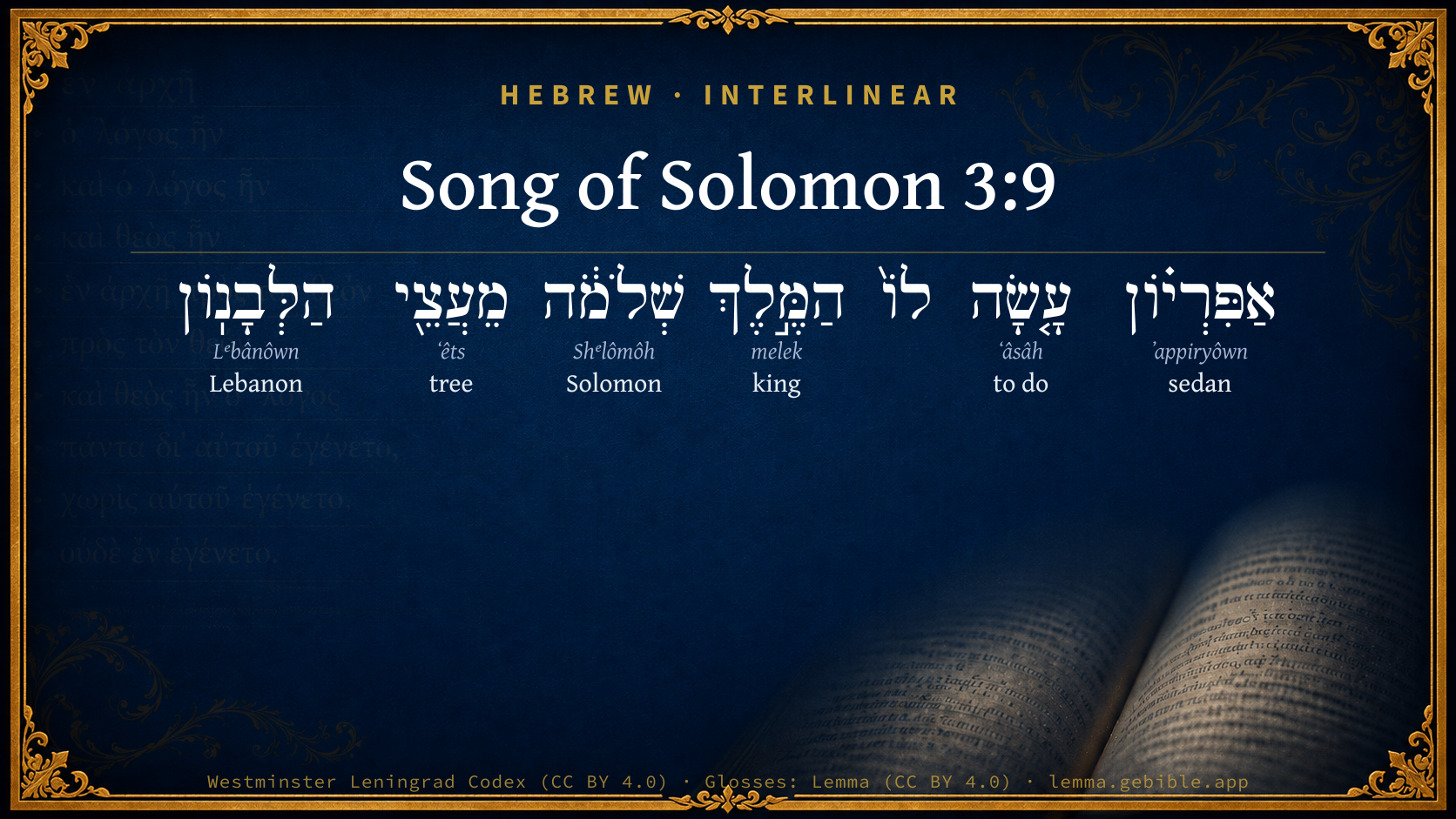
Hebrew (Westminster Leningrad Codex) Song of Solomon 3:9 appears in the Hebrew Old Testament. The text above is from the Westminster Leningrad Codex. Each word links to its Strong’s number, a concise gloss, and parsing drawn from the Open Scriptures Hebrew Bible morphology. Click any word for its full Brown-Driver-Briggs (BDB) entry.
Download image
Cite this verse

Song of Solomon 3:9 (World English Bible). Public Domain. Lemma interlinear Bible study tool, https://lemma.gebible.app/v/song-of-solomon/3/9.

Show BibTeX & RIS
BibTeX
RIS
English Translation
King Solomon made himself a carriage Of the wood of Lebanon.
World English Bible · Public Domain
Highlights
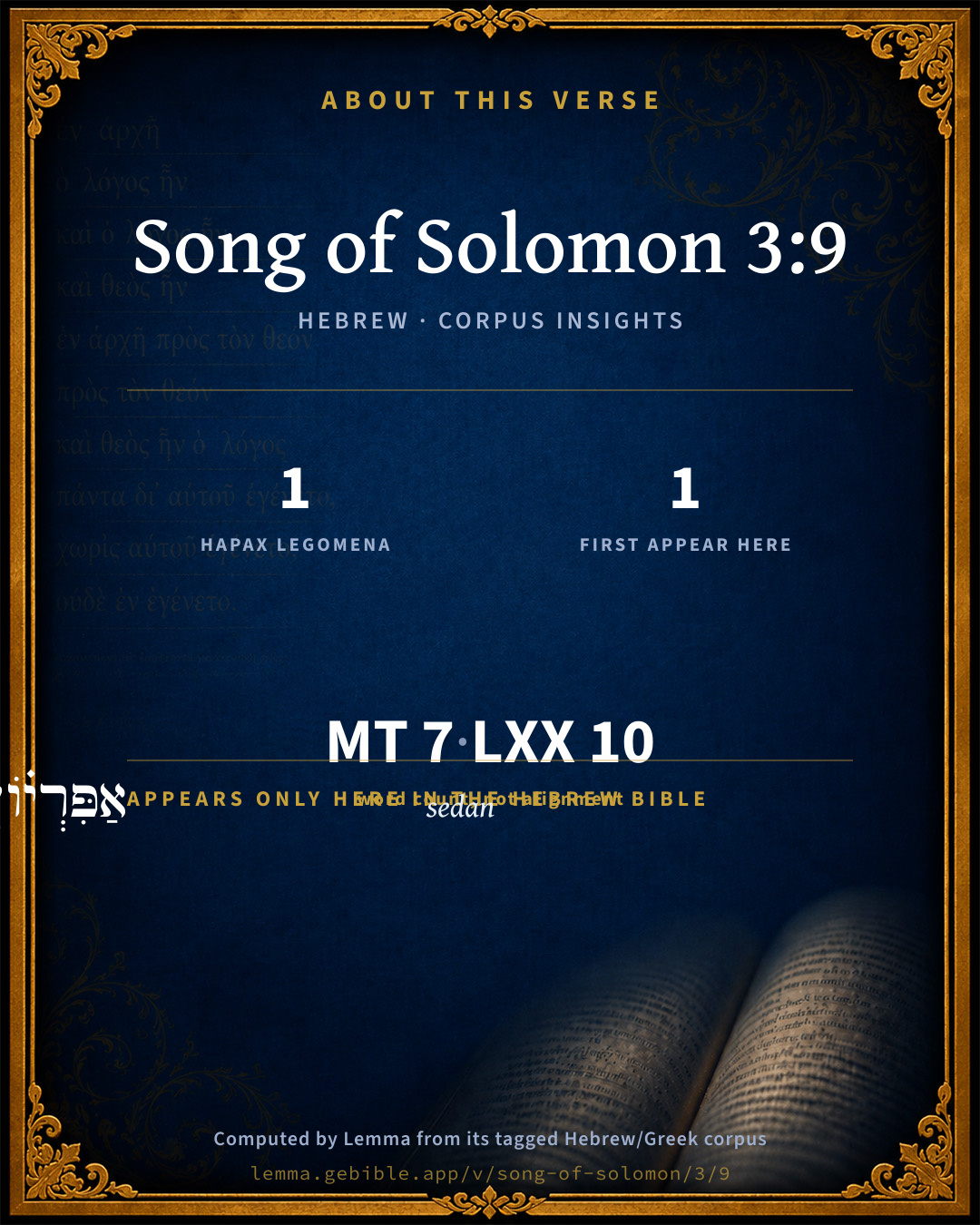
  • 1 hapax legomenon — only here in the Hebrew Bible
  • 1 first appearance in the Hebrew Bible
Full analysis ↓
Download a study sheet

One document with this verse’s original text, its word-by-word gloss line, the meaning frame, cross-references with their text, attributed commentary, and full source and license credits — printable, and it pastes into notes with its structure intact.

This verse Autodidact and up

Study sheet (.html) Plain text (.txt)

A passage Seminary Student

Up to 50 verses in one chapter. A passage sheet keeps up to 6 commentary sources and 12 cross-references per verse, in the order this page ranks them, and says so on the sheet whenever that leaves anything out. Ask for a single verse and you get the Autodidact verse sheet above.

Everything on this page stays free to read, with no account — the sheet is a download of what is already on screen, not access to it.

Want to remove ads? Support Godless Engineer
Compare translations 3

The same verse in 3 English versions, stacked beneath the original-language interlinear above. Click any original word for its lexicon entry.

Each is an independent rendering of the whole verse — the interlinear is not word-aligned to these translations.

Highlighted words mark where these versions differ — a whole-verse word diff, not a word-by-word alignment.

  • World English Bible Public Domain
    King Solomon made himself a carriage Of the wood of Lebanon.
  • King James Version Public Domain
    King Solomon made himself a chariot of the wood of Lebanon.
  • unfoldingWord Literal Text CC BY-SA 4.0
    He made for himself a palanquin, King Solomon, from the trees of Lebanon.

unfoldingWord Literal Text — © unfoldingWord, licensed CC BY-SA 4.0. Word-aligned USFM3 via Door43 (git.door43.org/unfoldingWord/en_ult).

Versions to compare (up to 4)

3 of 4 selected

Show all 18 translations

Every available English version of this verse, each an independent rendering of the whole verse.

  • World English Bible Public Domain
    King Solomon made himself a carriage Of the wood of Lebanon.
  • Berean Standard Bible Public Domain
    King Solomon has made his carriage out of the timber of Lebanon.
  • Majority Standard Bible Public Domain
    King Solomon has made his carriage out of the timber of Lebanon.
  • King James Version Public Domain
    King Solomon made himself a chariot of the wood of Lebanon.
  • American Standard Version (1901) Public Domain
    King Solomon made himself a palanquin Of the wood of Lebanon.
  • Revised Version (1885) Public Domain
    King Solomon made himself a palanquin of the wood of Lebanon.
  • Geneva Bible (1599) Public Domain
    King Salomon made himselfe a palace of the trees of Lebanon.
  • Douay-Rheims (1899) Public Domain
    King Solomon hath made him a litter of the wood of Libanus:
  • Young's Literal Translation Public Domain
    A palanquin king Solomon made for himself, Of the wood of Lebanon,
  • Literal Standard Version CC BY-SA 4.0
    A palanquin King Solomon made for himself, || Of the wood of Lebanon,
  • Unlocked Literal Bible CC BY-SA 4.0
    King Solomon made himself a sedan chair of the wood from Lebanon.
  • unfoldingWord Literal Text CC BY-SA 4.0
    He made for himself a palanquin, King Solomon, from the trees of Lebanon.
  • Darby Bible Public Domain
    King Solomon made himself a palanquin Of the wood of Lebanon.
  • World Messianic Bible Public Domain
    King Solomon made himself a carriage of the wood of Lebanon.
  • Webster's Bible Public Domain
    King Solomon made himself a chariot of the wood of Lebanon.
  • Free Bible Version CC BY-SA 4.0
    (Solomon's sedan chair was made for him with wood from Lebanon.
  • Bible in Basic English Public Domain
    King Solomon made himself a bed of the wood of Lebanon.
  • JPS Tanakh (1917) Public Domain
    King Solomon made himself a palanquin of the wood of Lebanon.

Literal Standard Version (2020), Covenant Press — licensed CC BY-SA 4.0. Text via the HelloAO Bible API (eBible.org). Unlocked Literal Bible (unfoldingWord) — licensed CC BY-SA 4.0. Text via the HelloAO Bible API (eBible.org). unfoldingWord Literal Text — © unfoldingWord, licensed CC BY-SA 4.0. Word-aligned USFM3 via Door43 (git.door43.org/unfoldingWord/en_ult). Free Bible Version, Dr. Jonathan Gallagher — licensed CC BY-SA 4.0. Text via the HelloAO Bible API (eBible.org).

Word by word

More ways to search: Search by grammar → Find every occurrence → Compare this word →

Practice this passage: Drill this verse → Learn its vocabulary →

About this verse

These counts appear in no published source. They are computed here, from the morphology-tagged text and Lemma’s own curated glosses. What Lemma adds →

7
words
6
distinct lemmas
Wisdom
section

Notable vocabulary

1 hapax legomenon — a word that appears only here in the entire Hebrew Bible:

  • אַפִּרְי֗וֹן sedan H668

First appearance in Scripture

This word makes its first canonical appearance in the Hebrew Bible here:

  • אַפִּרְי֗וֹן sedan H668

Grammatical profile

  • 1 verb
  • 5 nouns
  • 1 preposition

Verb forms

  • עָ֤שָׂה Qal · Perfect

Hebrew & Septuagint length

In English translation the verse runs 11 words from the Hebrew and 10 from the Septuagint (LXX English) — closely comparable.

A rough comparison of the two English renderings, which tokenize alike — not a word-level alignment.

Word counts can differ between the Hebrew and the Greek without any difference in meaning — e.g. the Hebrew direct-object marker אֵת has no separate Greek word, and Greek often adds the article ὁ.

In the original languages it is 7 Hebrew tokens and 10 Greek tokens — but the two are counted differently (Hebrew bundles its prefixes and suffixes into one token; the Greek is in lemma form), so that isn’t a like-for-like length.

Cross-references

3

Topical passages linked to Song of Solomon 3:9 in the Treasury of Scripture Knowledge — connected by theme and wording, ordered by reader-vote popularity; previews shown in the World English Bible.

  • Song of Solomon 3:7 Behold, it is Solomon's carriage! Sixty mighty men are around it, Of the mighty men of Israel.
  • 2 Samuel 23:5 Most assuredly my house is not so with God; Yet he has made with me an everlasting covenant, Ordered in all things, and sure: For it is all my salvation, and all [my] desire, Although he doesn't make it grow.
  • Revelation 14:6 I saw an angel flying in mid heaven, having an eternal Gospel to proclaim to those who dwell on the earth, and to every nation, tribe, language, and people.

Cross-references courtesy of OpenBible.info (CC BY 4.0).

Hebrew and Greek witnesses Masoretic Hebrew ↔ Greek Septuagint

The same verse in the two great witnesses to the Old Testament, shown verse-for-verse.

These are two independent witnesses, not word-aligned to each other, and the Septuagint is shown in lemma (dictionary) form.

Hebrew Song of Solomon 3:9 Masoretic · Westminster Leningrad Codex

אַפִּרְי֗וֹן עָ֤שָׂה לוֹ֙ הַמֶּ֣לֶךְ שְׁלֹמֹ֔ה מֵעֲצֵ֖י הַלְּבָנֽוֹן

King Solomon made himself a carriage Of the wood of Lebanon.

World English Bible · Public Domain

Greek LXX Song of Solomon 3:9 Septuagint · lemma form

φορεῖον ποιέω ἑαυτοῦ ὁ βασιλεύς σαλωμών ἀπό ξύλον ὁ λίβανος

King Solomon made himself a litter of woods of Lebanon.

LXX2012 (modern English Septuagint) · Public Domain

On this verse, Ellicott's Commentary for English Readers discusses the Septuagint’s reading. Read the note in Commentary ↓

Hebrew: Westminster Leningrad Codex (CC BY 4.0). Greek: Septuagint (public domain); English from LXX2012 (modern English Septuagint) (Public Domain). How the Septuagint differs from the Hebrew →

Commentary

Notes on Song of Solomon 3:9 from classic Christian and Jewish commentators (each source and its license shown beneath its notes). The classic Christian expositions comment on the surrounding passage and are grouped to its opening verse, so a note may address several verses; the Jewish commentaries on the Tanakh (Rashi and others) are per-verse, so they appear only where the commentator wrote on this verse.

Lemma curates 59 commentaries, every one of them public domain or Creative Commons licensed, each selected and text-cleaned for this edition rather than reprinted as found. About our sources →

Trapp's Complete Commentary

John Trapp

Son 3:9 King Solomon made himself a chariot of the wood of Lebanon.

Ver. 9. King Solomon made himself a chariot.] Hic locus lubricus est et difficilis. This is a hard text, saith one. It had been easier, perhaps, if commentators had not made it so hard. The word rendered chariot, is by others rendered a bridechamber, a bed, a throne, a palace. The Hebrew word is found in this place only; {a} it hath the name of fairness and fruitfulness. Rabbi Solomon saith it is thalamus honorificus, a bedchamber of honour, whereby we are to understand again the Church, as we did by "bed" in the former verse. She is oft compared to a house, here to a bridechamber, and Solomon’s bridechamber, which must needs be supposed very trim, and set forth to the best. It is further set forth here by the causes: efficient, Solomon himself; material, cedar, silver, gold, &c.; formal, paved with love; final, for himself first, and then for the daughters of Jerusalem. First, Solomon himself made it, though a king. Stupenda sane dignatio, a wonderful condescension. The Church is Christ’s own "workmanship," his "artificial facture," or creature (as the Greek word signifieth, Eph 2:10, ποιημα), that masterpiece of his architecture, wherein he hath showed singular skill, by erecting that glorious fabric of the new man, that "new heaven and new earth wherein dwelleth righteousness." {2Pe 3:13} For "he planteth the heavens and layeth the foundations of the earth, that he may say to Zion, Thou art my people," that he may "rejoice in the habitable part of God’s earth," {Pro 8:31} that he may say, "I will dwell in them, and walk in them, and I will be their God, and they shall be my people." {1Co 6:16} Christ wrought the centurion’s faith, as God; he wondered at it, as man. God wrought, and man marvelled; he did both to teach us where to bestow our wonder. Paul prays for his Ephesians, that their eyes might be enlightened to see the power that wrought in them. {Eph 1:18}

Of the wood of Lebanon.] {See Trapp on "Son 1:17"} The saints are the Church’s materials. {Rom 1:7 1Co 1:2} "The precious sons of Zion are comparable to fine gold." {Lam 4:2} "Her Nazarites are purer than snow, whiter than milk, more ruddy than rubies; their polishing is of sapphire." {Son 3:7} And yet Bellarmine is not ashamed to say, Nos etiamsi credimus in ecclesia inveniri omnes virtutes, &c. {b} Although we doubt not but that all virtues are found in the Church; yet that a man may be absolutely called a member of that true Church spoken of in Scripture, we hold not that any inward virtue is required, but only an external profession of the faith, and participation of the sacraments. Belle hoc convenit Ecclesiae Romanae, saith a learned man. {c} This description suits very well with the Church of Rome. For certainly if there be any virtuous persons in that Church, id eis convenit per accidens, it is by mere accident, and not as they are in that Church, but as they dissent from it; like as Cicero saith wittily of the Epicureans, that if any were good among them, it was merely from the goodness of their nature, for they taught and thought otherwise. And as Peter Moulin said of many of the priests of France, that they were for their loyalty not beholden to the maxims of Italy; and yet Bellarmine hath the face to say, Sunt quidem in Ecclesia Catholica plurimi mali, sed ex haeriticis nullus est bonus: {d} Among Papists there are many bad men, but among Protestants not one good man is to be found.

{a} Aπαξ λεγομ.

{b} Lib. iii. cap. 2, De Eccles. Militante.

{c} Cameron, De Eccles., p. 167.

{d} De Notis Eccles., lib. iv. cap. 13.

John Trapp, A Commentary or Exposition upon All the Books of the Old and New Testament (1647–1656) — public domain. Text from a community e-Sword module.

The Biblical Illustrator

Joseph S. Exell

Son_3:9-10

King Solomon made himself a chariot of the wood of Lebanon.

Solomons chariot

I. Solomon was a type of Jesus Christ.

1. In his offices he represented Jesus.

(1) He was, as you know full well, a king, and a very notable king, richer and wiser and more glorious than any of the kings of the earth. And what shall we say of Jesus, who, even when He was here in flesh and humiliation, was still a King? Now that He is exalted at the right hand of God, He seems to be yet more kingly; but He is destined to sit upon a still nobler throne, and to wield a still wider influence.

(2) But Solomon, in this passage, and, indeed, throughout this wonderful book, is seen as a bridegroom. Herein also he represents Jesus Christ. Christ, as the Head of the Church, calls us His precious and beloved bride. All He has we have. All that is Mine is thine, says Jesus, and the bonds that bind us to Him neither life, nor death, nor earth, nor hell, can ever break, or even stretch. Blessed be the name of Him who, while He is not ashamed to call us brethren, admits His people into still closer relationship, and calls them collectively, My sister, My spouse!

(3) Moreover, Solomon was distinguished as a great temple builder. Jesus Christ is the architect and builder of the Temple that shall never fade away. Solomons temple has long ago crumbled into dust, and its successors have passed away, but Jesus Christ has been engaged from all eternity erecting a Temple which abides, which will outlive the wreck of matter and the crash of worlds, which will shine in greater splendour as the everlasting ages come and go. He is at once the architect and the builder of it; He is also the foundation-stone, and the chief corner-stone of it.

2. But there are certain qualities that distinguished the king that shine resplendent in the King of kings.

(1) Solomon was the wisest of men; he was wise enough originally to ask for wisdom. Then God gave him not only wisdom, but riches and honour and power. But oh, how wise is Jesus! In Him are hid all the treasures of wisdom and of knowledge, and He is made unto us wisdom.

(2) If Solomon was wealthy, what shall we say of the Christ of God? The treasures of Solomons house, and the abundance of his table amazed all who visited his court, but think of the abundance of the wealth and fulness of Jesus Christ. He is the possessor of all things, He is Gods own Son and Heir.

(3) How glorious Solomon was, though indeed Christ said of the lilies that Solomon, in all his glory, was not arrayed like one of these. Yet it must be admitted that Solomons court was magnificent. Oriental splendour was at its grandest in his case, but oh, how Jesus outshines him, not with the same sort of glory, but with the glory that excelleth, the glory of His grace, the beauty of His holiness, the grandeur of His goodness! If the lilies outvied and excelled Solomon in all his glory, what shall be said of Jesus, who is at once the rose of Sharon and the lily of the valleys, the chiefest among ten thousand and the altogether lovely?

II. The kings chariot is a type of Christs covenant, and of the Gospel of the Grace of God. It was not a chariot really, but rather a travelling couch or palanquin, in which the king himself and his spouse were seated. It was the place of rest, in which these twain reclined at ease, while they came up from the wilderness towards the great and glorious city. Now such is the covenant to us.

1. Now notice concerning this so-called chariot that Solomon himself made it. King Solomon made himself a chariot. I do not mean that the royal hands were actually engaged in its construction--we can hardly suppose that--but he gave instructions for its construction, perhaps personally superintended the making of it I do say however, of the covenant of the Lord our God, that He Himself prepared it. As Noah built the ark, so God Himself has arranged the terms of the covenant. He Himself has signed it; Jesus Himself has sealed it with His own precious blood. Christ has built this chariot for Himself to ride in. You may be sure it is well and truly built, then; I have not the slightest fear in trusting myself on board that travelling couch, for I shall share it with Jesus.

2. Notice the materials of its construction. This royal litter is said to have been of cedar--the wood of Lebanon. That is the finest of all the woods, the most lasting and the most fragrant. It is as if to say that the covenant which God has made with Jesus Christ on behalf of all who love Him and trust Him, is a covenant that lasts, and which, while it lasts, is full of joy and fragrance. He made pillars thereof of silver. This represented Divine holiness and infinite purity. I notice that the floor or basis was of gold. It was constructed of this imperishable and unchangeable metal, because it was intended to set forth the immutable purpose and the unchanging decree of the infallible God. Over all was a purple canopy, with equally royal curtains hanging by the sides screening from the too-hot sun. Ah, here is sovereign grace, here is atoning blood: here is the doctrine of the substitution, for we can look through these purple curtains, even towards the sun of Gods holiness, and find the exceeding brightness bearable because Jesus Christ, the Days-Man, has come between us and Him. It was paved with love for the daughters of Jerusalem, or, as some think, the chariot was lined and upholstered with embroidered work, so that the daughters of Jerusalem should be glad at sight of it, and the bride herself be filled with joy.

3. What is the purpose of this covenant, and of this Gospel of His grace? A parallel purpose to that of Solomons chariot. Whereby believers are carried to heaven, says Cruden. The spouse shares the triumph to Zion as well as in it, while the daughters of Jerusalem go out to meet the cavalcade, and to share the joy. (T. Spurgeon.)

The saints palanquin

It seems no part of the mind of the Spirit that we should take this description to pieces, and try to allegorize the several parts. The intention is to represent to us the fact that the believer is carried onward to heaven in a conveyance as costly and glorious as that here described; that the materials are of the richest, choicest, most durable character; that the midst is paved or tessellated with love. The provision made, the means provided for bringing us to glory, are of a rare and splendid nature. After exhausting the things most valuable among men, making the pillars silver, the railing gold, the seat or couch purple, he adopts a feature in the description entirely new, and says the midst is curiously wrought with something more precious than silver or gold, even with love itself--showing that the saint, while thus passing through the wilderness between this world and heaven, between our state of guilt and our state of glory, is in a palanquin of the most costly make, borne up in the hands of angels, surrounded by an armed angelic guard, and reclining on a soft couch beautiful as purple, the most costly colour, with the midst of the litter formed of love--the many acts of Divine love from Father, Son and Holy Spirit, there combining underneath us like the different pieces in a beautiful mosaic, tessellated pavement. In the spirit of this passage, those who wait on the Lord are said to renew their strength; and He will give His angels charge concerning such, to bear them up in their hands, lest at any time they dash their foot against a stone (Isa_40:31; Psa_91:12). (G. Burrowes.)

The Biblical Illustrator, edited by Joseph S. Exell (c. 1880s–1900s) — public domain. Text from a community e-Sword module.

Joseph Benson's Commentary

Son 3:9-10. King Solomon made a chariot — In which the royal bridegroom and bride might ride together in state. By this chariot he seems to understand the word of Christ dispensed by his ministers, wherein Christ rides triumphantly in the world, conquering his enemies and subduing the world to the obedience of the gospel. Of the wood of Lebanon — Of cedars, which wood being incorruptible, doth fitly signify the word of the gospel, which endureth for ever, 1Pe 1:25. He made the pillars thereof — There is no necessity that either this or the following particulars should be distinctly applied to several things in the gospel; this in the general may suffice, that as all the particulars are added to show the perfection and beauty of the chariot, so they imply that Christ’s word is every way amiable and perfect. The bottom thereof of gold — The under and lower part. Whereby he may seem to intend the foundation of the word and promises, which is either God’s covenant, or Christ’s mediation, in whom all the promises are yea and amen. The covering of it — The uppermost part of it. The midst — The inward parts: being paved — Covered and adorned; with love — The love of Christ to the sons of men. For the daughters of Jerusalem — For their delight and comfort, who all bear a part in this marriage.

Joseph Benson's Commentary on the Old and New Testaments (1811–1818) — public domain. Text from a community e-Sword module.

Tyndale Open Study Notes

Tyndale Open Resources

3:9-10 The materials out of which King Solomon’s carriage was made befit his wealth and power, including the same expensive Lebanese wood that was used in building the Temple (1 Kgs 5:5-6). • decorated with love by the young women of Jerusalem: Beyond all his splendor, Solomon was admired and served with love, even by his servants.

Tyndale Open Study Notes — © Tyndale Open Resources, licensed CC BY-SA 4.0. Text via the HelloAO Bible API.

Geneva Bible (1599)

Geneva Bible translators

Or, chariot.

Geneva Bible (1599) marginal notes — public domain. Text via Bolls.life.

Adam Clarke's Commentary

Verse 9. Of the wood of Lebanon.] Of the cedar that grew on that mount. It is very likely that a nuptial bed, not a chariot, is intended by the original word אפיון appiryon. Montanus properly translates it sponsarum thalamum, a nuptial bed. It may, however, mean a palanquin.

Adam Clarke's Commentary on the Bible (1810–1826) — public domain. Text from a community e-Sword/MySword module.

Ellicott's Commentary for English Readers

(9) A chariot.—Marg., bed; Heb., appiryôn. A word of very doubtful etymology. Its derivation has been sought in Hebrew, Persian, Greek, and Sanskrit. The LXX. render φορεῖον; Vulg., ferculum; and it seems natural, with Gesenius, to trace the three words to the root common in parah, φέρω, fero, fahren, bear, and possibly the sign of such a common origin in the Sanskrit pargana = a saddle (Hitzig). At all events, appiryôn must be a palanquin, or litter, both from the context, which describes the approach of a royal cortége, and from the description given of it, where the word translated covering suggests the notion of a movable litter, rather than of a State bed.

A Bible Commentary for English Readers, edited by Charles John Ellicott (1878–1897) — public domain. Text from a community e-Sword module.

The Cambridge Bible for Schools and Colleges

gen. ed. J. J. S. Perowne

9. In this verse we have a continuation of the spectator’s or warder’s call to those who are looking out at the royal cavalcade from the house or palace where the Shulammite is. The speaker must be conceived as uttering an aside to those about him, giving a description of the miṭṭâh from his previous knowledge. Here he calls it an appiryôn, which the LXX translate by phǒreion, which means a litter in which one is borne. This is undoubtedly the correct meaning, but the derivation of the word is uncertain. It may be, as Cheyne says, Encycl. Bibl., art. ‘Canticles,’ a mere corruption.

the wood of Lebanon] Lit. the woods, i.e. the cedar and the cypress.

The Cambridge Bible for Schools and Colleges (gen. ed. J. J. S. Perowne; Cambridge University Press, 1878–1918) — public domain. Text from a community e-Sword module.

Haydock's Catholic Bible Commentary

Litter. Septuagint, to conduct his spouse with solemnity; or a throne; though it most probably denotes the bridal bed. (Calmet) --- Hebrew apiron. Greek phoreion.

George Leo Haydock (1774–1849), Haydock's Catholic Family Bible and Commentary, 1859 edition — public domain. Excludes Psalms (Douay-Rheims chapter numbering differs from Protestant) and Deuterocanonical books (Catholic canon only).

Matthew Poole's English Annotations

A chariot, in which the royal Bridegroom and bride might ride together in state, as the manner was in the nuptial solemnities of such persons. By this chariot he seems to understand the word of Christ dispensed by his ministers in the church, whereby both Christ is exalted and rides triumphantly in the world, conquering his enemies, and subduing the world to the obedience of the gospel, and all believers are carried with safety and comfort through this present evil world, into those blessed mansions of heavenly glory.

Of the wood of Lebanon, i.e. of cedars, for which Lebanon was famous; which wood, being incorruptible, doth fitly signify the word of the gospel, which endureth forever, 1Pe 1:25, and is called the everlasting gospel, Rev 14:6, in opposition to the legal institutions, which were to continue only until the time of reformation, as we read Heb 9:10.

Matthew Poole's English Annotations on the Holy Bible (1683–1685) — public domain. Text from a community e-Sword/MySword module.

Whedon's Commentary on the Bible

Daniel D. Whedon

9. Still another bystander calls attention to the great beauty and costliness of this palanquin.

Chariot — Its frame was of the choice cedar or cypress of Lebanon — strong, light, and admitting a polish. This framework usually includes a latticed door on each side.

Daniel D. Whedon (gen. ed.), Commentary on the Old and New Testaments (1874–1909) — public domain. Text from a community e-Sword module.

The Pulpit Commentary

Vers. 9, 10. King Solomon made himself a palanquin of the wood of Lebanon. He made the pillars thereof of silver, the bottom thereof of gold, the seats of it of purple, the midst thereof being paved with love, from the daughters of Jerusalem. The palanquin is described, that the attention may be kept fixed awhile on the bridal procession, which, of course, forms the kernel of the whole poem, as representing the perfect union of the bride and bridegroom. The Greek versions translate foreion : the Vulgate, ferculum. We read in Athenaeus (Son_5:13) that the philosopher and tyrant Athemon showed himself on "a silver-legged foreion with purple coverlet." There probably is some connection between the Hebrew appiryon and the Greek phoreion, but it is exceedingly doubtful if the Hebrew is merely a lengthened form of the Greek. Delitzsch derives the Hebrew from a root parah, "to cut or carve" anything of wood. The Greek would seem to be connected with the verb ferw , "to bear," "carry." The resemblance may be a mere coincidence. The rabbinical tradition is that the Hebrew word means "couch, or litter." Hitzig connects it with the Sanscrit paryana, meaning "saddle," "riding saddle," with which we may compare the Indian paryang. "bed." Others find a Chaldee root for the word, arp, "to run," as currus in Latin, or from a root raG, "to shine," i.e. " to be adorned." At all events, it would not be safe to argue the late date of the book from such a word as appiryon, on account of its resemblance to a Greek word. The "wood of Lebanon" is, of course, the cedar or cypress. (1Ki_5:10, etc.) There may be a covert allusion intended to the decoration of the temple as the place where the honour of the Lord dwelleth, and where he meets his people. The frame of the palanquin was of wood, the ornaments of silver. The references to the high value set upon silver, while gold is spoken of as though it was abundant, are indications of the age in which the poem was composed, which must have been nearly contemporaneous with the Homeric poems, in which gold is spoken of similarly. Recent discoveries of the tomb of Agamemnon, etc., confirm the literary argument. The palanquins of India are also highly decorated. The daughters of Jerusalem, i.e. the ladies of the court, in their affection for King Solomon, have procured a costly tapestry, or several such, which they have spread over the purple cushion. Thus it is paved, or covered over, with the tokens of love while all love is but a preparation for this supreme love. (For the purple coverings of the seat, see Jud_1:5:10 Amo_3:12 Pro_7:16) The preposition mi in the last clause is rendered differently by some, but there can be no doubt that the meaning is "on the part of," that is, coming from. The typical interpreter certainly finds a firm ground here. Whether we think of the individual believer or of the Church of God, the metaphor is very apt and beautiful we are borne along towards the perfection of our peace and blessedness in a chariot of love. All that surrounds us speaks to us of the Saviour"s love and of his royal magnificence, as he is adored by all the pure and lovely spirits in whose companionship he delights.

The Pulpit Commentary (1880–1919), ed. H.D.M. Spence-Jones & Joseph S. Exell — public domain. Text from a community e-Sword module.

John Wesley's Explanatory Notes

A chariot - In which the royal bridegroom and bride might ride together in state. By this chariot he seems to understand the word of Christ dispensed by his ministers, whereby Christ rides triumphantly in the world, and believers are carried into heavenly glory. Of Lebanon - Of cedars, which wood being incorruptible, doth fitly signify the word of the gospel, which endureth forever, 1 Pet. i, 25.

John Wesley, Explanatory Notes Upon the Whole Bible (1754–1765) — public domain. Text via the GEBible commentary corpus.

Rashi

Rabbi Shlomo Yitzchaki (Rashi)

King Solomon made himself a palanquin This refers to the Tent of Meeting, which was established in the Tabernacle at Shiloh. He made Himself a crowning canopy for glory.

Rashi on the Tanakh — English translations: “The Judaica Press complete Tanach with Rashi, translated by A. J. Rosenberg” (CC BY 4.0); “Pentateuch with Rashi's commentary by M. Rosenbaum and A.M. Silbermann, 1929-1934” (public domain); “The Metsudah Tanach series, Lakewood, N.J” (CC BY 4.0); and “The Book of Joshua, Metsudah Publications, 1997” (CC BY 4.0). Text via Sefaria.

Lesson kit

Teaching starters — assembled from the data on this page, not authored interpretation. Every prompt links to the verse data it draws on. Edit before teaching.

Song of Solomon, in the Wisdom, opens this verse with 7 words (6 distinct Hebrew lemmas). Its most distinctive word is ʼappiryôwn (“sedan”). A historical commentator’s framing appears above. Read the whole chapter for the surrounding context.

Discussion questions

  1. The word ʼappiryôwn carries the sense “sedan.” How does it shape the verse?
  2. 1 word here appears nowhere else in the Hebrew Bible. Why might the author reach for such rare wording?
  3. This is the first place “sedan” appears in Scripture (first appears here). What does its debut here establish?
  4. How does Song of Solomon 3:7, which shares this passage’s theme, read alongside this verse?
  5. These translations render this verse differently; the difference is in the English rendering, not the original. What questions does that raise?
  6. «עָ֤שָׂה» is a Qal Perfect verb. How does that grammatical form shape the action described?
  7. Compare how Trapp's Complete Commentary and The Biblical Illustrator read this verse. Where do they agree or differ?

Things to notice

Reading settings

Reading text

Shown beneath each verse's original-language words.

Old Testament
Old Testament edition

Read the OT as the Masoretic Hebrew (MT) or the Greek Septuagint (LXX).

English shown for the Greek Septuagint (in the Hebrew ↔ Greek comparison).

Comparing translations? Open the Compare panel on any verse page to stack up to four side by side.