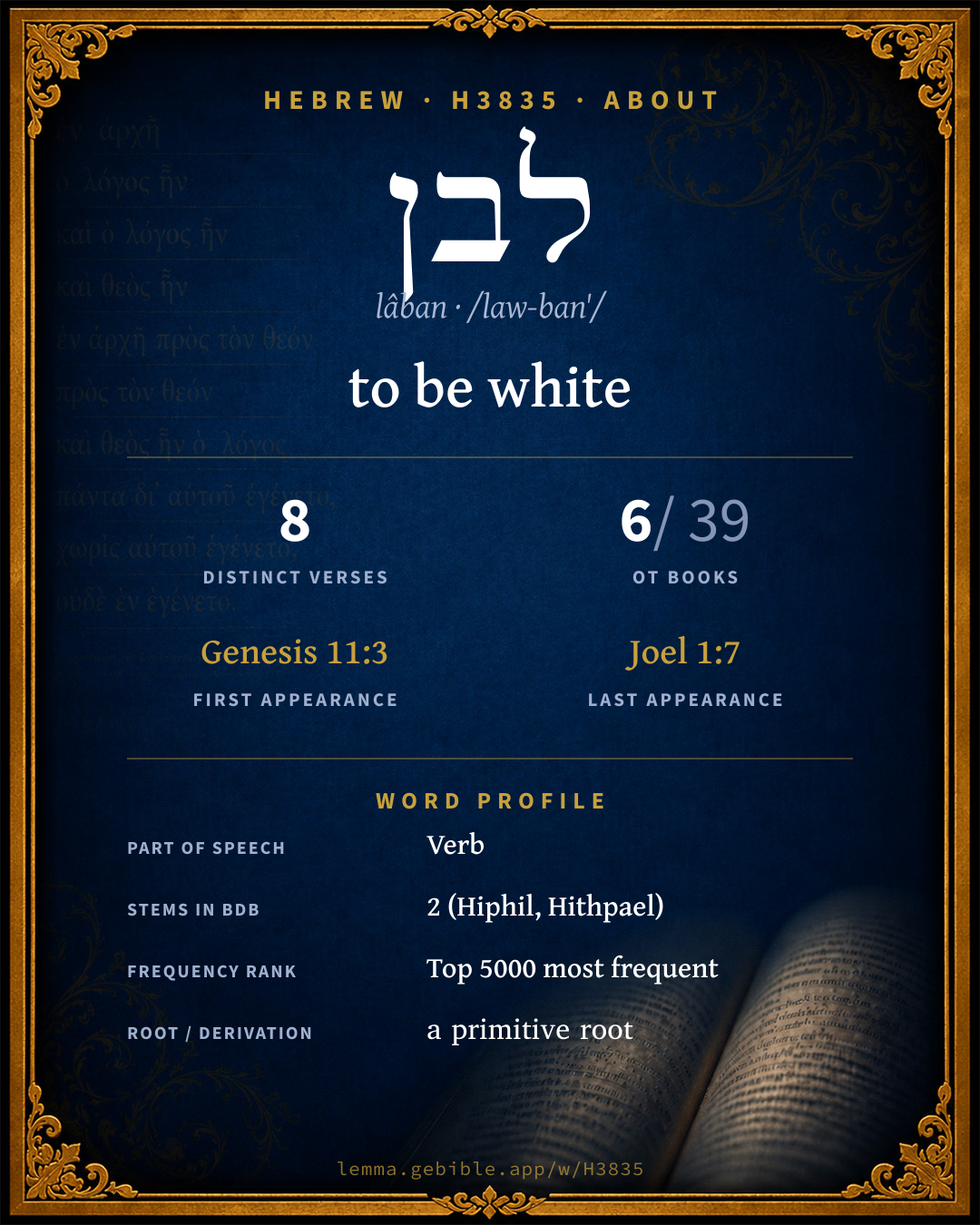
לבן
to be white
‘to be white’ is one of 2 main senses fuller range ↓
Full lexicon entry — Brown-Driver-Briggs (BDB)
From Brown-Driver-Briggs (BDB)
Where this word appears
See every Hiphil verb in the Hebrew Bible →
Grammar key — what these labels mean
Part of speech
- Verb
- An action or state-of-being word.
Stem
- Qal
- The basic, simple active stem — the plain form of the verb (“he wrote”).
- Hiphil
- The causative active stem (“he caused / brought about”). Here: ‘make white = purify’
- Hithpael
- The reflexive or reciprocal stem (the subject acts on itself).
Form
- Infinitive Construct
- A bound verbal noun, frequently with prepositions (“to write / in writing”).
- Imperfect
- An incomplete, ongoing, or future action (“he will / would write”).
- Perfect
- A completed action or state — Hebrew marks aspect (completeness) more than strict tense (“he wrote”).
- Cohortative
- A first-person volitional form expressing wish or resolve (“let me / let us write”).
Person
- 3rd Person
- The one spoken about (“he / she / it / they”).
- 1st Person
- The speaker (“I / we”).
Gender
- Masculine
- Grammatically masculine.
- Common
- Either gender — not distinguished for this form.
Number
- Plural
- More than one (in Hebrew, generally three or more).
- Singular
- One.
Grammatical forms
- Verb, Qal, Infinitive Construct 2 times (25%)
- Verb, Hiphil, Infinitive Construct 1 time (13%)
- Verb, Hithpael, Imperfect, 3rd Person, Masculine, Plural 1 time (13%)
- Verb, Hiphil, Imperfect, 1st Person, Common, Singular 1 time (13%)
- Verb, Hiphil, Imperfect, 3rd Person, Masculine, Plural 1 time (13%)
- Verb, Hiphil, Perfect, 3rd Person, Common, Plural 1 time (13%)
- Verb, Qal, Cohortative, 1st Person, Common, Plural 1 time (13%)
Parsed forms decoded from the imported morphology (morphhb / Westminster Leningrad Codex — WLC text public domain, morphhb tagging CC BY 4.0), counted across 8 parsed occurrences — not distinct verses.
Every verse where H3835 appears — 8 distinct verses across 6 books. Click any verse to open its interlinear word-by-word view. Verse text shown in the World English Bible for context — . Each verse’s Hebrew form is shown with its reference; the English is not keyword-highlighted, since the data carries no word-level English alignment. Use “Compare translations” on any verse to read it across multiple English versions. This concordance covers the Hebrew Bible; Septuagint (Greek Old Testament) occurrences are not indexed here.
Genesis 1 verse
Exodus 2 verses
- Exodus 5:7 לִ/לְבֹּ֥ן prep + Qal inf.cs "You shall no longer give the people straw to make brick, as before. Let them go and gather straw for themselves.
- Exodus 5:14 לִ/לְבֹּן֙ prep + Qal inf.cs The officers of the children of Israel, whom Pharaoh's taskmasters had set over them, were beaten, and demanded, "Why haven't you fulfilled your quota both yesterday and today, in making brick as before?"
Psalms 1 verse
Isaiah 1 verse
Daniel 2 verses
- Daniel 11:35 וְ/לַ/לְבֵּ֖ן conj + prep + Hiphil inf.cs Some of those who are wise shall fall, to refine them, and to purify, and to make them white, even to the time of the end; because it is yet for the time appointed.
- Daniel 12:10 וְ/יִֽתְלַבְּנ֤וּ conj + Hithpael impf 3mp Many shall purify themselves, and make themselves white, and be refined; but the wicked shall do wickedly; and none of the wicked shall understand; but those who are wise shall understand.
Joel 1 verse
About this entry
At a glance — auto-summarized from this page’s data, not written by a person. Every figure links to its source below. This summary describes the numbers; it doesn’t interpret them.
The Hebrew verb לבן centers on the idea of “to be white.” Its earliest occurrence is Genesis 11:3. Spanning 8 verses in 6 books, it ranks among the uncommon words of the Hebrew Bible. Exodus dominates its distribution — 2 of 8 verses. Different stems carry different senses — BDB groups them under 2 stems, among them Hiphil and Hithpael. For the data behind this summary, explore the sense tree and the renderings breakdown below.
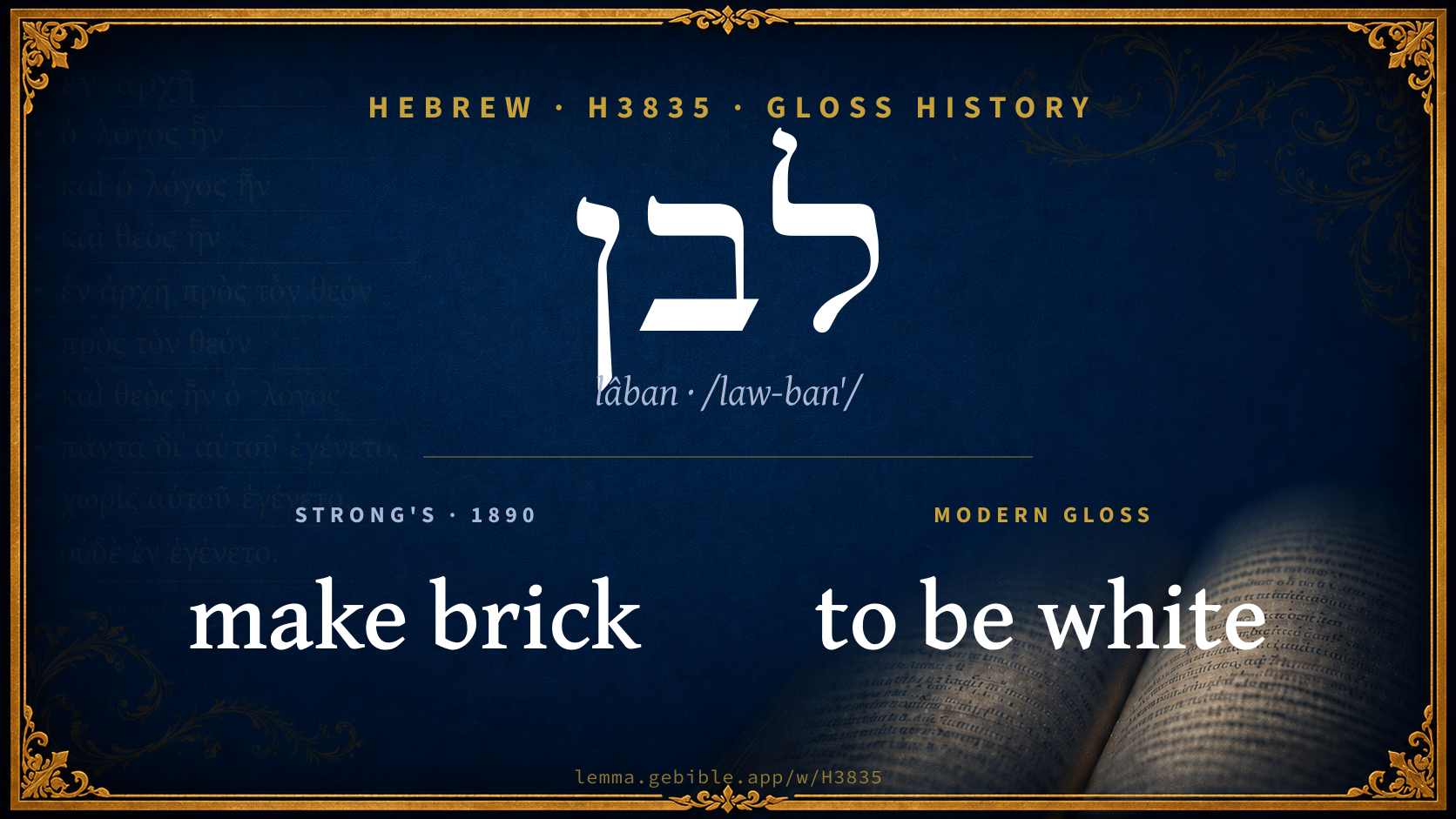
Gloss history
Strong's 1890 vs modern scholarship
About this word
Strong's H3835 catalogs a Hebrew word from the Hebrew Old Testament.
These counts are not copied from any lexicon or concordance. They are computed here, from the morphology-tagged Hebrew Old Testament. What Lemma adds →
- 8
- distinct verses
- The word appears in 8 distinct verses.
- 6 / 39
- OT books
- The word appears in 6 of 39 Old Testament books.
- #2,625
- by frequency
- Top 5000 most frequent Hebrew words (rank 2,625 of 8,640 Hebrew words by occurrence).
View all 8 occurrences in the concordance →
By section of the Old Testament
By traditional corpus
Conventional, traditional groupings — biblical authorship is debated, so this is a traditional corpus grouping, not an authorship claim. Each share is this word’s portion of its verses in that division of the Hebrew canon. Each figure is a share of the word’s 8 distinct verses.
- Torah (Pentateuch) 3 verses · 38%
- Writings (Ketuvim) 3 verses · 38%
- Prophets (Nevi'im) 2 verses · 25%
How translations render this word
Counts come from each version’s own published word-to-Strong’s tagging or interlinear alignment — an approximate guide to how each version renders this word, not a word-level alignment the data otherwise carries. Because each total is that version’s own tagged count, the per-version totals vary from one another and need not match the appearance or distinct-verse counts above. These counts may also differ from a printed concordance because Lemma counts each distinctly tagged rendering and does not collapse phrase taggings into a single head-word total. This is a fixed set of word-tagged versions (KJV, ASV, BSB, ULT) and does not change with the reading translation you choose elsewhere. Each version’s license is shown beside its name below (and on Sources).
BDB lists this Strong’s number as 2 distinct words (homographs). Each count above pools all of them and is not split by sense — see the Senses section below. A low-frequency rendering may belong to a different one of those words, not the primary meaning.
- King James Version†: I shall be whiter 1×, Let us make 1×, Made white 1×
- American Standard Version†: Let us make 1×, Make 1×, Making brick 1×
- Berean Standard Bible†: Made spotless 2×
- unfoldingWord Literal Text†: Brick making 1×, Cleanse 1×, Cleansed 1×
King James Version Public Domain
Renders H3835 across 8† tagged occurrences — most commonly:
American Standard Version Public Domain
Renders H3835 across 8† tagged occurrences — most commonly:
Berean Standard Bible Public Domain
Renders H3835 across 8† tagged occurrences — most commonly:
Plus 6 renderings that appear only once — usually multi-word phrases or single function words the recovered tagging swept in, not distinct renderings.
unfoldingWord Literal Text CC BY-SA 4.0
Renders H3835 across 8† tagged occurrences — most commonly:
Senses in the full BDB
Hebrew verbs can shift meaning by stem (binyan): Qal is the basic action, Niphal is often passive or reflexive, Piel often intensifies or makes it factitive, and Hiphil is typically causative. The senses below are grouped under the stem BDB assigns to each. This entry also uses Hithpael (reflexive or reciprocal).
What do BDB’s symbols mean?
BDB uses these scholarly abbreviations:
| Symbol | Meaning |
|---|---|
| 𝔊 | the Septuagint (the ancient Greek translation, LXX) |
| 𝔙 | the Vulgate (the Latin translation) |
| 𝔖 | the Syriac version (the Peshitta) |
| 𝔗 | the Targum (the Aramaic translation) |
| ψ | the Psalms |
| √ | root (the underlying root or stem) |
| ‖ | parallel passage (a synonymous or contrasted parallel) |
| † | the dagger: every passage where the word occurs is cited |
The 3 senses and sub-senses the full Brown-Driver-Briggs lexicon distinguishes for this word, in lexicon order (not ranked by frequency), with BDB’s own verbatim wording and sub-sense lettering. Shown in Hebrew script with BDB’s own scholarly abbreviations. The condensed entry is in the Lexicon Entry tab. See also the Forms in the corpus table below.
לבן I be white
Hiphil
- 1. make white = purify (ethical)
- 2. shew whiteness, grow white, of fig tree, stripped by locusts
Hithpael
- . be purified
לבן II make brick
Senses from the full Brown-Driver-Briggs lexicon (Brown, Driver, Briggs; Oxford 1906 — public domain), digitized via Sefaria, supplemented by the OpenScriptures HebrewLexicon (CC BY 4.0). Full attribution on Sources.
Word origin
[ לָבֵן ] vb. be white
[ לָבַן ] vb. denom. make brick
— Brown-Driver-Briggs (Oxford 1906, public domain), digitized via Sefaria, supplemented by the OpenScriptures HebrewLexicon (CC BY 4.0). See Sources.
Origin: a primitive root
Jastrow Dictionary
A second Hebrew/Aramaic lexicon for comparison, covering Aramaic and post-biblical (Talmudic, Targumic, Midrashic) usage that the biblical-Hebrew BDB does not. Matched by lemma rather than by Strong’s number, so a lemma may carry more than one Jastrow headword (shown separately below), and the entries cover usage well beyond the Bible.
בֵּן
- , constr. בֶּן (b. h.; בנה) offspring, son, child. שבוע הב׳ the male child’s week, a disguise for circumcision day, adopted during the Hadrianic persecutions. Snh. 32ᵇ; Y. Keth. I, 25ᶜ; a. e.—ישוע הב׳ a disguise for פִּדְיוֹן הבן. B. Kam. 80ᵃ.—… בְּנוֹ של the son of, v. שֶׁל. בְּנָן של קדושים descendant of holy men. Ab. Zar. 50ᵃ; a. e.—Pl. בָּנִים, constr. בְּנֵי. Ab. III, 14 ב׳ למקום chosen children of God. Gen. R. s. 82 בָּנֶיהָ של תורה children (followers) of the Law.—Trnsf. belonging to, fit for &c.; e.g. בני גולה those belonging to the colony of exiles, Babylonians &c.; בני גליל Galileans; בני אכילה things fit to be eaten &c. [For such compounds as are not self-evident, see the respective determinants.] [בני פיקרין, v. בְּנִיפיקָרִין.]
לָבַן I
- to make or pile bricks. B. Mets. X, 5 (118ᵇ) ואין לוֹבְנִין לבנים but you are not permitted to pile up bricks (on the public road). Ib. גובלין טיט … אבל לא לובנין Ms. M. (v. Rabb. D. S. a. l. note; ed. לבנים; Y. ed. ללבינים) you may knead clay on the public road (for immediate use), but you are not permitted to form bricks; (Y. ed.: but not for making bricks). Tosef. Kel. B. Kam. III, 7; ib. Ohol. XVII, 7.
לָבַן II
- (cmp. לָבָה) to glisten.
- 1. to polish, brighten; to finish. Sabb. VII, 2 הגוזז … והמְלַבְּנוֹ he who clips wool and he who cleanses it (by washing, removing clods &c.); Y. ib. 10ᶜ top המלבנו ההן דמגפר וכ׳ under m’labben of the Mishnah is implied (any preparation for improving raw material, e. g.) he who pitches wood &c., v. אֶלִּיקָה. Ib. המיינטון חייב משום מְלַבֵּן he who cleanses amiant (v. אַמְיַינְטוֹן) comes under the law forbidding polishing (on the Sabbath). Tosef. Ber. VII (VI), 2; Ber. 58ᵃ; Y. ib. IX, 13ᶜ top גזז ול׳ וכ׳ he (Adam) clipped (wool) and cleansed &c. Ab. Zar. V, 12 את שדרכו … לְלַבֵּן באור יְלַבֵּן וכ׳ such utensils as are ordinarily cleansed by being put in the fire (metal spits &c.) he must cleanse by fire.—Gen. R. s. 70 (play on לָבָן, Gen. XXIX, 5) do you know Him שהוא עתיד ללַבֵּן וכ׳ who will cleanse your sins to make them appear like snow (Is. I, 18)?; a. fr.—Part. pass. מְלוּבָּן finished, polished, refined. Nidd. 31ᵃ (of an embryo) מל׳ ומזורז well-formed and of strong vitality; Snh. 70ᵇ; Num. R. s. 10.—Ib. מל׳ ברשע finished (refined) in wickedness, v. אפדכסיס; Gen. R. s. 60; Ruth R. to II, 1; Yalk. Gen. 109.—Esp. a) to glaze tiles; to heat tiles. Bets. IV, 7 (33ᵃ) אין מְלַבְּנִין את וכ׳ you must not heat (new) tiles (on Holy Days) for roasting on them; Y. ib. IV, end, 62ᵈ מאן דאמר מלבנין בבדוקים he who says that you may heat tiles &c., refers to such as have been tested (to be sound under fire).—b) (of metal utensils, v. supra) to glow. Ḥull. 8ᵃ ל׳ סכין וכ׳ if one made a knife glowing hot and cut with it; a. fr.—Part. pass. מְלוּבָּן, f. מְלוּבֶּנֶת. Y. Yeb. XVI, 15ᶜ bot. e.g. Genesis 29:5
- 1. to grow white, glossy, be cleansed. Ex. R. s. 23 (play on שְׁלמ̇ה̇ a. שַׂלְמָה) מה השלמה הזאת מתלכלכת וחוזרת ומִתְלַבֶּנֶת as the garment gets soiled and is cleansed again &c.; (Yalk. Cant. 982 מתכבסת). Ib.; Cant. R. to I, 6 נ׳ גופו his tanned skin became white again, v. כִּרְכֵּם.
- 2. to be glowed, heated. Sabb. 27ᵇ והאונין … משיִתְלַבְּנוּ bundles of flax are considered finished after they are baked; Sifra Thazr., Neg., Par. 5, ch. XIII.
- 1. to grow white. Neg. I, 6 היו … והִלְבִּינוּ if the hair was black and turned white. Ib. IV, 4 עיקרן … וראשן מַלְבִּין if their roots are black and their tops white. Yoma VI, 8; a. fr.
- 2. to whiten, cleanse. Cant. R. to V, 11 להַלְבִּין כנף וכ׳ to make white one wing of a raven. Yoma. 39ᵇ the Temple is called Lebanon שמַלְבִּין וכ׳ because it cleanses the sins &c.—Keth. 59ᵇ הרוצה שיַלְבִּין את בתו he who desires to make his daughter white-complexioned (handsome); a. e.—Transf. (with פנים) to put to shame, expose. Ab. III, 11 המַלְבִּין פני וכ׳ he who exposes his fellowman to shame in public. B. Mets. 59ᵃ נוח לו לאדם שיפיל … ואל יַלְבִּין וכ׳ man should rather have himself thrown into a furnace than put his neighbor to shame. Yalk. Deut. 938 אני מלבין פניהם I should put them to shame; (Pirké d’R. El. ch. XLIV מגלה, v. גָּלָה). B. Mets. 58ᵇ כל המלבין … כאילו שופך דמים he who puts his neighbor to public shame is considered as if he shed blood; a. fr.—Y. Succ. V, 55ᶜ bot. (play on נ̇ב̇ל̇) שמל̇ב̇ין כמה מיני זמר it shames (excels) many a musical instrument.
לְבַן
- (denom. of לִבְנָא, cmp. אֲרִיחַ) to have a strong rest; to be well balanced. Sabb. 104ᵃ מ"ט שקר אחידא כרעיה ואמת מִלְבַּן לַבְנֵי Ms. M. why has the word שקר one single foot (in the letter ק), while the letters of אמת have a level foundation?; (ed. שיקרא אחדא כרעא קאי ואמת מְלַבַּן לִבּוּנֵיה falsehood (שקר) stands on one leg, while the foundation of truth (אמת) is level).
- to found, rest. Erub. 14ᵃ מְלַבֵּין ליה בטינא וכ׳ you may form a level rest for it by plastering, partly on this, partly on the other side, so that it will be firm.—Part. pass. מְלַבַּן, v. supra.
לָבָן I
- (b. h.) pr. n. m. Laban, son of Bethuel, freq. ל׳ הארמי L. the Aramaean. Snh. 105ᵃ. Ab. Zar. 3ᵃ יבוא ל׳ וכ׳ let L. come and give testimony for Jacob &c. Gen. R. s. 60, v. אפדכסיס. Koh. R. to II, 26; a. fr.
לָבָן II
- v. לָבַן) white; white color, white substance. Gen. R. s. 73 בן ל׳ a white child, opp. כּוּשִׁי. Men. IV, 1 התכלת … את הל׳ the absence of the blue fringe is no obstacle to using the white one &c. Bekh. 45ᵇ, v. בָּהַק. Lev. R. s. 31 אין אדם רואה מתוך הל׳ וכ׳ man does not see through the white (of the eye). Yoma 75ᵃ ל׳ כמרגלית, v. גַּד II. Ib. VII, 4, a. fr. בגדי ל׳ garments of white stuff. Ib. 1, v. אִסְטַלִּית; a. v. fr.—שְׂדֵה (ה)ל׳ a bright, shadeless field, vegetable or grain field, opp. שדה אילן orchard. Shebi. II, 1; M. Kat. I, 4ᶜ; a. fr.—Pl. לְבָנִים, לְבָנִין. Mikv. VIII, 2 (מים) ל׳ נמשכים white and cohesive matter (urin). Tosef. Sabb. I, 22 הל׳ white garments, opp. צבועין colored; a. fr.—Fem. לְבָנָה. Y. Shek. VI, 49ᵈ bot.; Cant. R. to V, 11 אש ל׳ white fire. Sifra Thazr., Neg., Par. 5, ch. XIII מה פשתים ל׳ אף צמר ל׳ as ‘linen’ means ‘of natural white color’, so does ‘wool’ &c. Gen. R. s. 73 שחורה או ל׳ is it the portrait of a black or of a white person?; a. fr.—Pl. לְבָנוֹת. Macc. 20ᵇ במלקט ל׳ וכ׳ when he plucks the gray hair from among the black. B. Kam. 60ᵇ; a. fr.
לָבָן
- 1. same. Targ. Y. Gen. XXX, 37, v. next w.—*2) = לִבְנָא, brick. Targ. Y. II, Ex. XXIV, 10 (Y. I, a. O. אבן; h. text לבנת).
לְבָן
- , white poplar. Targ. O. Gen. XXX, 37 (Y. דפרח לבן, v. פְּרַח). Targ. Hos. IV, 13.
לֹבֶן
- , v. לוֹבֶן
A Dictionary of the Targumim, the Talmud Babli and Yerushalmi, and the Midrashic Literature (Marcus Jastrow; London, Luzac, 1903) — Public Domain. Digitized via Sefaria. Digitized via Sefaria. Full attribution on Sources.
Forms in the corpus
The 8 distinct written forms H3835 takes in the Hebrew Bible, most frequent first — each parse links to that stem’s occurrences in the concordance. Hebrew forms include their vowel points and cantillation, so a single lemma takes many written forms.
| Form | Parsing | Example | Uses |
|---|---|---|---|
| אַלְבִּֽין | Verb, Hiphil, Imperfect, 1st Person, Common, Singular | Psalms 51:7 | 1 |
| הִלְבִּ֖ינוּ | Verb, Hiphil, Perfect, 3rd Person, Common, Plural | Joel 1:7 | 1 |
| וְ/יִֽתְלַבְּנ֤וּ | Verb, Hithpael, Imperfect, 3rd Person, Masculine, Plural | Daniel 12:10 | 1 |
| וְ/לַ/לְבֵּ֖ן | Verb, Hiphil, Infinitive Construct | Daniel 11:35 | 1 |
| יַלְבִּ֔ינוּ | Verb, Hiphil, Imperfect, 3rd Person, Masculine, Plural | Isaiah 1:18 | 1 |
| לִ/לְבֹּ֥ן | Verb, Qal, Infinitive Construct | Exodus 5:7 | 1 |
| לִ/לְבֹּן֙ | Verb, Qal, Infinitive Construct | Exodus 5:14 | 1 |
| נִלְבְּנָ֣ה | Verb, Qal, Cohortative, 1st Person, Common, Plural | Genesis 11:3 | 1 |
Same root — word family
Other BDB entries built from the same root as H3835, grouped by Strong’s listed origin. These share a root / origin per the lexicon — not necessarily a shared meaning. Each links to that word’s own entry.
Derived from this word
- לבן lâbân H3836 white
- לבנה libneh H3839 poplar
- לבנה libnâh H3840 tile
- לבנה lᵉbânâh H3842 moon
- לבנה lᵉbênâh H3843 brick
- מלבן malbên H4404 brick mold
Proper names from this root
People and places named from this root — a name, not an additional meaning of the word.
Compare all same-root words → Showing 4 of 9 — not the complete family. 2 of the same-root words are proper names (people or places). They share a root, not necessarily a meaning.
Septuagint verse parallels
This word appears in 8 verses that also exist in the Greek Old Testament (Septuagint), out of the 8 Hebrew verses it occurs in. You can read those verses in Greek by switching the Old Testament edition to the Septuagint.
Read these verses in the Septuagint
This is a verse-level parallel only — the same verses exist in both the Hebrew and Greek Old Testaments. No word-level Hebrew↔Greek correspondence is claimed: the data carries no such alignment, so no Greek word is shown as this Hebrew word’s translation. Coverage is not total — the Septuagint omits the deuterocanon and renumbers the Psalms, so some Hebrew verses have no direct Greek parallel.