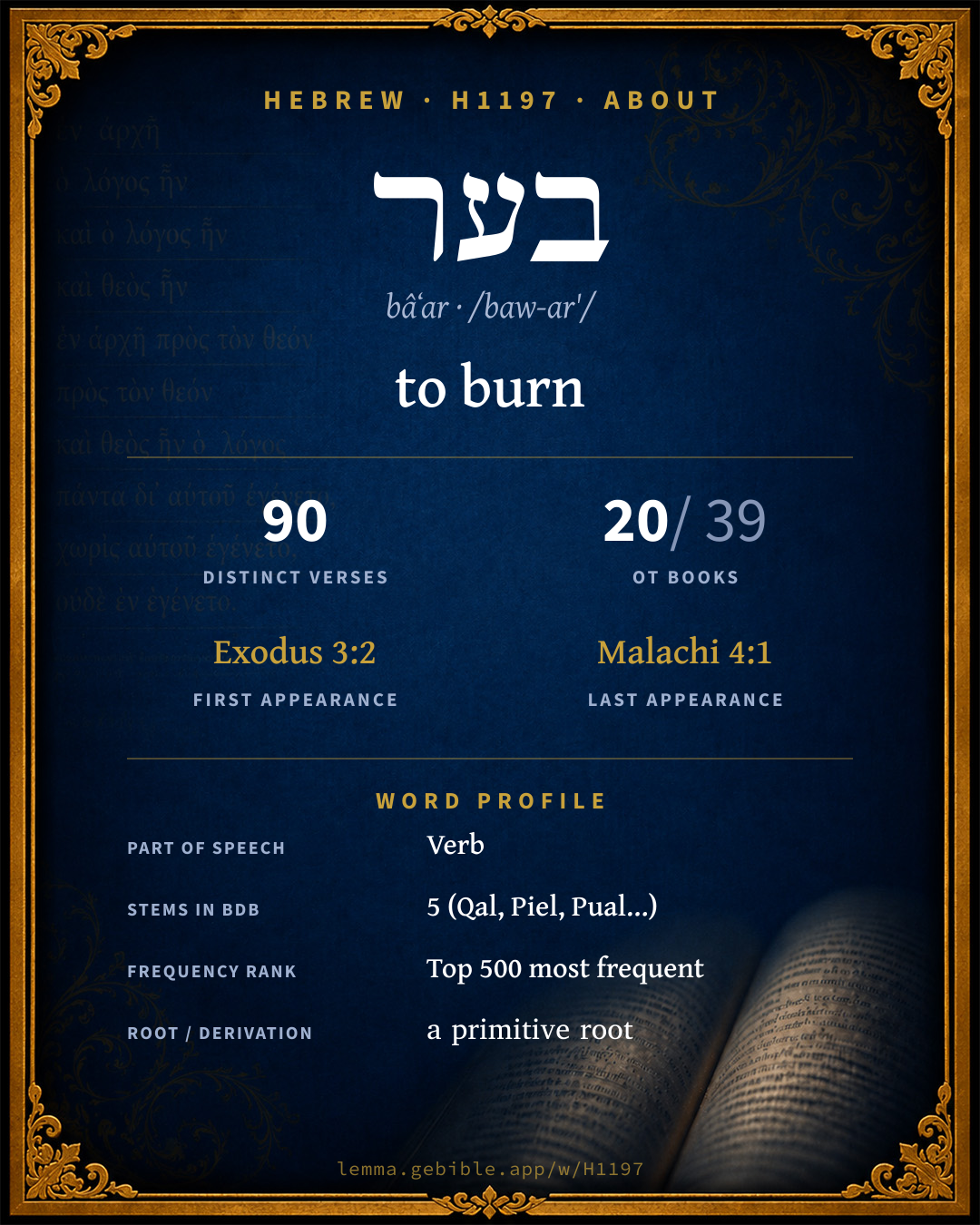
בָּעַר
to burn
also: consume, kindle, be kindled fuller range ↓
Full lexicon entry — Brown-Driver-Briggs (BDB)
From Brown-Driver-Briggs (BDB)
Where this word appears
See every Piel verb in the Hebrew Bible →
Grammar key — what these labels mean
Part of speech
- Verb
- An action or state-of-being word.
Stem
- Piel
- An intensive or resultative active stem. Here: ‘kindle’
- Qal
- The basic, simple active stem — the plain form of the verb (“he wrote”). Here: ‘be burning’
- Hiphil
- The causative active stem (“he caused / brought about”). Here: ‘kindle’
- Niphal
- Usually the simple passive or reflexive of the Qal (“he was written”).
- Pual
- The passive counterpart of the Piel.
Form
- Sequential Perfect
- A perfect with prefixed waw continuing a preceding imperfect or command (waw-consecutive perfect).
- Participle Active
- A verbal adjective expressing ongoing or characteristic action (“writing / one who writes”).
- Infinitive Construct
- A bound verbal noun, frequently with prepositions (“to write / in writing”).
- Sequential Imperfect
- An imperfect with prefixed waw — the standard past-narrative form (waw-consecutive imperfect).
- Imperfect
- An incomplete, ongoing, or future action (“he will / would write”).
- Perfect
- A completed action or state — Hebrew marks aspect (completeness) more than strict tense (“he wrote”).
- Cohortative
- A first-person volitional form expressing wish or resolve (“let me / let us write”).
- Participle Passive
- A verbal adjective expressing action received (“written”).
- Infinitive Absolute
- An unbound verbal noun, often intensifying or standing in for a finite verb.
State
- Absolute
- The independent form of a noun, not bound to a following word.
Person
- 2nd Person
- The one addressed (“you”).
- 3rd Person
- The one spoken about (“he / she / it / they”).
- 1st Person
- The speaker (“I / we”).
Gender
- Masculine
- Grammatically masculine.
- Feminine
- Grammatically feminine.
- Common
- Either gender — not distinguished for this form.
Number
- Singular
- One.
- Plural
- More than one (in Hebrew, generally three or more).
3 verses where H1197 appears in the Piel stem in the Book of 1 Kings. Filtered view — show all forms. Click any verse to open its interlinear word-by-word view. Verse text shown in the World English Bible for context — . Each verse’s Hebrew form is shown with its reference; the English is not keyword-highlighted, since the data carries no word-level English alignment. Use “Compare translations” on any verse to read it across multiple English versions. This concordance covers the Hebrew Bible; Septuagint (Greek Old Testament) occurrences are not indexed here.
1 Kings
- 1 Kings 14:10 וּ/בִֽעַרְתִּי֙ יְבַעֵ֥ר conj + Piel wpf 1cs Piel impf 3ms therefore, behold, I will bring evil on the house of Jeroboam, and will cut off from Jeroboam every man-child, him who is shut up and him who is left at large in Israel, and will utterly sweep away the house of Jeroboam, as a man sweeps away dung, until it be all gone.
- 1 Kings 21:21 וּ/בִעַרְתִּ֖י conj + Piel wpf 1cs Behold, I will bring evil on you, and will utterly sweep you away and will cut off from Ahab every man-child, and him who is shut up and him who is left at large in Israel:
- 1 Kings 22:46 בִּעֵ֖ר Piel pf 3ms The remnant of the sodomites, that remained in the days of his father Asa, he put away out of the land.
About this entry
At a glance — auto-summarized from this page’s data, not written by a person. Every figure links to its source below. This summary describes the numbers; it doesn’t interpret them.
בער (bâʻar) is a Hebrew verb most often rendered “to burn.” Where the King James Version says “burn,” newer translations reach for “you must purge” (Berean Standard Bible) and “burning” (unfoldingWord Literal Text); the renderings breakdown has the detail. The Hebrew Bible uses it across 90 verses — moderately common. Debuting at Exodus 3:2, it then recurs through the corpus. Across 5 stems, its meaning turns on the binyan (Qal, Piel). For the data behind this summary, explore the sense tree and the renderings breakdown below.
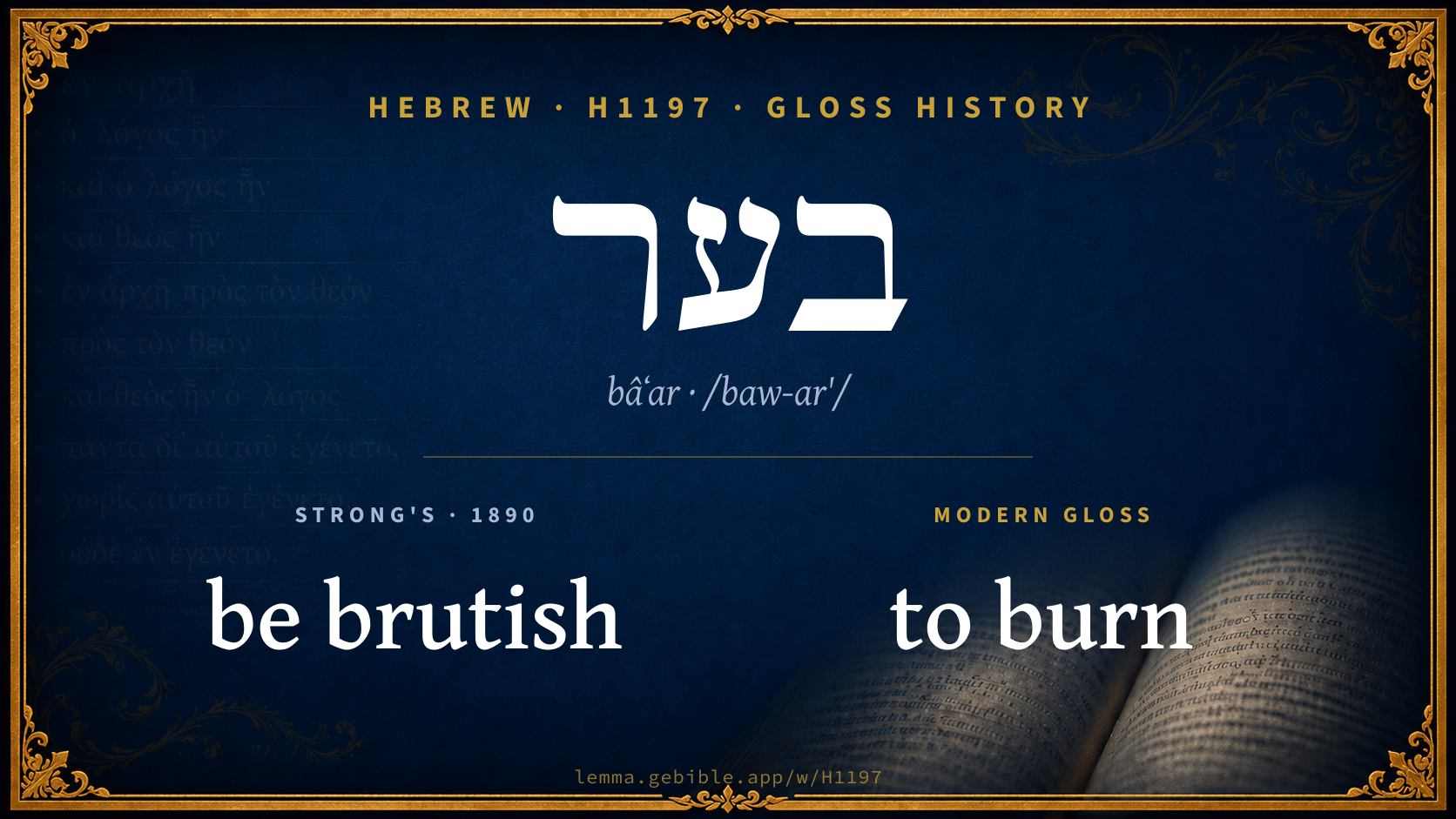
Gloss history
Strong's 1890 vs modern scholarship
About this word
Strong's H1197 catalogs a Hebrew word from the Hebrew Old Testament.
These counts are not copied from any lexicon or concordance. They are computed here, from the morphology-tagged Hebrew Old Testament. What Lemma adds →
- 90
- distinct verses
- The word appears in 90 distinct verses.
- 20 / 39
- OT books
- The word appears in 20 of 39 Old Testament books.
- #440
- by frequency
- Top 500 most frequent Hebrew words (rank 440 of 8,640 Hebrew words by occurrence).
View all 90 occurrences in the concordance →
Most concentrated in
- Isaiah 17 verses 19%
- Deuteronomy 16 verses 18%
- Jeremiah 11 verses 12%
By section of the Old Testament
By traditional corpus
Conventional, traditional groupings — biblical authorship is debated, so this is a traditional corpus grouping, not an authorship claim. Each share is this word’s portion of its verses in that division of the Hebrew canon. Each figure is a share of the word’s 90 distinct verses.
- Prophets (Nevi'im) 49 verses · 54%
- Torah (Pentateuch) 25 verses · 28%
- Writings (Ketuvim) 16 verses · 18%
How translations render this word
Counts come from each version’s own published word-to-Strong’s tagging or interlinear alignment — an approximate guide to how each version renders this word, not a word-level alignment the data otherwise carries. Because each total is that version’s own tagged count, the per-version totals vary from one another and need not match the appearance or distinct-verse counts above. These counts may also differ from a printed concordance because Lemma counts each distinctly tagged rendering and does not collapse phrase taggings into a single head-word total. This is a fixed set of word-tagged versions (KJV, ASV, BSB, ULT) and does not change with the reading translation you choose elsewhere. Each version’s license is shown beside its name below (and on Sources).
BDB lists this Strong’s number as 2 distinct words (homographs). Each count above pools all of them and is not split by sense — see the Senses section below. A low-frequency rendering may belong to a different one of those words, not the primary meaning.
- King James Version†: Burn 8×, Away 6×, Burned 6×
- American Standard Version†: Burn 9×, Away 6×, Burneth 5×
- Berean Standard Bible†: You must purge 9×, Burn 5×, Burned 5×
- unfoldingWord Literal Text†: Burning 11×, Burn 10×, You shall remove 10×
King James Version Public Domain
Renders H1197 across 100† tagged occurrences — most commonly:
Plus other, less common renderings. Plus 40 renderings that appear only once — usually multi-word phrases or single function words the recovered tagging swept in, not distinct renderings.
American Standard Version Public Domain
Renders H1197 across 100† tagged occurrences — most commonly:
Plus other, less common renderings. Plus 45 renderings that appear only once — usually multi-word phrases or single function words the recovered tagging swept in, not distinct renderings.
Berean Standard Bible Public Domain
Renders H1197 across 93† tagged occurrences — most commonly:
Plus other, less common renderings. Plus 45 renderings that appear only once — usually multi-word phrases or single function words the recovered tagging swept in, not distinct renderings.
unfoldingWord Literal Text CC BY-SA 4.0
Renders H1197 across 104† tagged occurrences — most commonly:
Plus other, less common renderings. Plus 36 renderings that appear only once — usually multi-word phrases or single function words the recovered tagging swept in, not distinct renderings.
18 senses and sub-senses in the full BDB
Hebrew verbs can shift meaning by stem (binyan): Qal is the basic action, Niphal is often passive or reflexive, Piel often intensifies or makes it factitive, and Hiphil is typically causative. The senses below are grouped under the stem BDB assigns to each. This entry also uses Pual (the passive of Piel).
What do BDB’s symbols mean?
BDB uses these scholarly abbreviations:
| Symbol | Meaning |
|---|---|
| 𝔊 | the Septuagint (the ancient Greek translation, LXX) |
| 𝔙 | the Vulgate (the Latin translation) |
| 𝔖 | the Syriac version (the Peshitta) |
| 𝔗 | the Targum (the Aramaic translation) |
| ψ | the Psalms |
| √ | root (the underlying root or stem) |
| ‖ | parallel passage (a synonymous or contrasted parallel) |
| † | the dagger: every passage where the word occurs is cited |
The 18 senses and sub-senses the full Brown-Driver-Briggs lexicon distinguishes for this word, in lexicon order (not ranked by frequency), with BDB’s own verbatim wording and sub-sense lettering. Shown in Hebrew script with BDB’s own scholarly abbreviations. The condensed entry is in the Lexicon Entry tab. See also the Forms in the corpus table below.
בער I burn, consume (𝔗 בְּעַר burn
Qal
- Pf. 3 fs. בָּֽעֲרָה Nu 11:3 + 2 times, וּבָֽעֲרָה consec. Is 10:17 + 3 times, בָּֽעֲרוּ Ju 15:14 + 2 times + 2 S 22:13 (but cf. De on ψ 18), וּבָֽעֲרוּ consec. Is 1:31; Impf. יִבְעַר Ex 3:3 ψ 2:12, etc.; Pt. בֹּעֵר Ex 3:2 + 6 times, בֹּעֵרָ֑ה Is 34:9, בּוֹעֵרָה Ho 7:4, בֹּעֲרָ֫ה Is 30:33, בֹּעֶ֫רֶת Je 20:9, בֹּעֲרוֹת Ez 1:13;—burn, e.g. Numbers 11:3
- 1. (intr.) specif. begin to burn, be kindled ψ 18:9 sq. מִן (subj. גֶּחָלִים) = 2 S 22:9 (in v 13 textual error cf. supr.), ψ 106:18 (subj. אֵשׁ); fig. ψ 2:12 (subj. אַפּוֹ); cf. Je 44:6 (subj. חֵמָה); Is 30:33 (c. בְּ, subj. נִשְׁמַת י׳), ψ 39:4 (subj. אֵשׁ fig. of grief, distress) cf. Je 20:9. e.g. Psalms 18:9
- 2. be burning, burn, Ju 15:14 (subj. פִּשְׁתִּים, c. בָּאֵשׁ), Ex 3:2 (הסנה, c. בָּאֵשׁ), v 3 (subj. id.); Dt 4:11; 5:25; 9:15 (all subj. הר, c. בָּאֵשׁ), cf. Is 34:9 (זֶפֶת בערה), fig. of destruction Is 1:31 (subj. חָסֹן & פֹּעֲלוֹ); of torch לַפִּיד Is 62:1; of oven תַּנּוּר Ho 7:4, 6 (i.e. heated by fire within it). e.g. Judges 15:14
- 3. trans. burn, consume (subj. אשׁ, להבה etc., sq. בְּ) Nu 11:1, 3 (אשׁ י׳). Jb 1:16 (אשׁ אלהים); in simile Ez 1:13 (גחלי אשׁ י׳), ψ 83:15 (only here trans. c.acc.; should תבער be pointed as Pi.?); fig. (subj. wrath of י׳) Is 42:25 cf. La 2:3 (subj. fire = fiery trial) Is 43:2. e.g. Numbers 11:1
- 4. act. but abs., fig. subj. wrath of י׳ Je 4:4; 7:20; 21:12 ψ 89:47 cf. Is 10:17 ψ 79:5 Is 30:27 (שֵׁם י׳ … בֹּעֵר אַפּוֹ) Mal 3:19 (היום בא); of human anger Est 1:12; subj. wickedness Is 9:17. e.g. Jeremiah 4:4
Piel
- Pf. בִּעֵר 1 K 22:47 2 K 23:24, וּבִעֵר consec. Lv 6:5, בִּעַ֫רְתָּ 2 Ch 19:3, וּבִעַרְתָּ֫ Dt 13:6 + 9 times in Dt; וּבִעֲרוּ cons. Ez 39:9(×2) (9a del. Co after Vrss), etc.; Impf. יְבַעֵר 1 K 14:10; 2 ms. תְּבַעֵר Dt 21:9, יְבַעֲרוּ Ez 39:10; 2 mpl. תְּבַעֲרוּ Ex 35:3, וּנְבַעֲרָה Ju 20:13 Inf. בָּעֵר Is 40:16; Pt. מְבַעֲרִים Je 7:18;— e.g. 1 Kings 22:47
- 1. kindle, lit. c. acc. אשׁ Ex 35:3 Je 7:18 cf. Ez 39:9 (v. supr.) v 10; fig. of י׳ sending destruction Ez 21:4 cf. of human schemes Is 50:11; light, obj. lamps in temple 2 Ch 4:20 cf. 13:11. e.g. Exodus 35:3
- 2. burn, lit. c. acc. עֵצִים Lv 6:5, גָּלָל dung 1 K 14:10; abs. Is 44:15 cf. 40:16 Ne 10:35. e.g. Leviticus 6:5
- 3. fig. consume, utterly remove, partic. of evil and guilt, c. acc., especially in Deuteronomic phrase (מישׂראל) ובערת הרע מקרבך Dt 13:6; 17:7, 12; 19:13, 19; 21:21 cf. v 9 22:21, 22, 24; 24:7, v. also Ju 20:13; further, 1 K 22:47 2 K 23:24 2 Ch 19:3; also of devoted (tabooed) things Dt 26:13, 14; of persons (exterminate) 2 S 4:11; sq. אחרי pregn. 1 K 14:10; 16:3; 21:21; = devour, devastate, greedily enjoy the fruits of, Is 3:14; abs. היה לְבָעֵר be for destruction, be destroyed Nu 24:22 Is 5:5; 6:13; cf. רוּחַ בָּעֵר Is 4:4. e.g. Deuteronomy 13:6
Pual
- Pt. מְבֹעָ֑רֶת Je 36:22;—burn (i.e. be supplied with fire), of fire-jar, הָאָח. e.g. Jeremiah 36:22
Hiphil
- Pf. וְהִבְעַרְתִּ֫י Na 2:14; Impf. וַיַּבְעֵר Ju 15:5 2 Ch 28:3, וַיַּבְעֶר־ Ju 15:5; תַּבְעִיר Ez 5:2; Pt. מַבְעִיר 1 K 16:3, מַבְעִר Ex 22:5;— e.g. Nahum 2:14
- 1. kindle (c. acc. cogn.) Ex 22:5, cf. Ju 15:5 ויב׳ אשׁ בלפידים caused fire to burn among the brands. e.g. Exodus 22:5
- 2. burn up, c. acc. Ju 15:5 2 Ch 28:3 (sacrifice of children) בָּאֵשׁ) Ez 5:2 (בָּאוּר but cf. Co) Na 2:14 (בעשׁן). e.g. Judges 15:5
- 3. consume = destroy (cf. Pi.) 1 K 16:3 (sq. אַחֲרֵי). e.g. 1 Kings 16:3
בער II denom. be brutish
Qal
- Impf. יִבְעֲרוּ Je 10:8 (‖ יכסלו) be stupid, dull-hearted, unreceptive; cf. Pt. pl. בֹּעֲרִים ψ 94:8 (‖ כסילים); of inhuman, cruel, barbarous men Ez 21:36. e.g. Jeremiah 10:8
Niphal
- Pf. נִבְעַר Je 10:14 = 51:17, נִבְעֲרוּ Je 10:21; Pt. נִבְעָרָ֑ה Is 19:11;—brutish, stupid Is 19:11 (עצה, ‖ אויל); dull-hearted, ignorant of God Je 10:14, 21; 51:17. Niph. Je 10:14 = 51:17 rather stupefied (by spectacle 10:13 = 51:16). e.g. Jeremiah 10:14
Piel
- Pf. וּבִעֵר consec. Ex 22:4 feed, graze (בשׂדה אחר). e.g. Exodus 22:4
Hiphil
- Impf. יַבְעֶר־ Ex 22:4 cause to be grazed over, sq. שׂדה. e.g. Exodus 22:4
Senses from the full Brown-Driver-Briggs lexicon (Brown, Driver, Briggs; Oxford 1906 — public domain), digitized via Sefaria, supplemented by the OpenScriptures HebrewLexicon (CC BY 4.0). Full attribution on Sources.
Word origin
I. vb. burn, consume (𝔗 בְּעַר burn; ܒܥܰܪ seek out, collect, glean; this apparently earlier meaning)—
II. vb.denom. be brutish—
— Brown-Driver-Briggs (Oxford 1906, public domain), digitized via Sefaria, supplemented by the OpenScriptures HebrewLexicon (CC BY 4.0). See Sources.
Origin: a primitive root
Jastrow Dictionary
A second Hebrew/Aramaic lexicon for comparison, covering Aramaic and post-biblical (Talmudic, Targumic, Midrashic) usage that the biblical-Hebrew BDB does not. Matched by lemma rather than by Strong’s number, so a lemma may carry more than one Jastrow headword (shown separately below), and the entries cover usage well beyond the Bible.
בָּעַר
- , v. בָּעָה; cmp. בָּאֵר) [to clear,]
- 1. to burn (act. a. neut.). Ex. R. s. 2 אש בּוֹעֶרֶת burning fire. Ib. כשם שהסנה בּוֹעֵר וכ׳ as the bush is burning &c. [Num. R. s. 9, end לבוערים בע"ז, read לבוסרים, v. בָּסַר I, Var. לכיפרים.]
- 2. to be empty. Denom. בַּעַר.
- 3. to eat up. Denom. בְּעִיר.
- 1. to clear, remove (out of existence or out of possession). Pes. 6ᵃ זקוק לבָעֵר is bound to remove (the leaven by burning or otherwise); a. fr.—Shebi. VII, 7 חייב לב׳ is bound to remove (dispose of the fruits of the Sabbath year in due time). [Num. R. s. 9 (p. 230ᵇ ed. Amst.) מבערים את העון, read with Yalk. Num. 708, Sifré Num. 11 מערערין; oth. vers. מבררין, v. בָּרַר.]
- 2. to clear, eat up. B. Kam. 2ᵇ וּבִעֵר זו השן ‘and it clears’ (Ex. XXII, 4) this refers to injury by the tooth (animal’s eating). [ e.g. Exodus 22:4
- 3. (b. h.) to start a fire, enkindle. V. בְּעֵרָה.]
- to start or entertain a fire, to clear a field. Sabb. 20ᵃ (ref. to לא תבערו וכ׳ Ex. XXXV, 3) בכל … אי אתה מַבְעִיר ‘in all your dwellings’ thou art not permitted to start a fire; v. הַבְעָרָה. B. Kam. 60ᵇ הַבְּעֵרָה שהִבְעַרְתִּי the fire which I set (to Zion). Ib. 55ᵇ (ref. to Ex. l. c. 5) עד דעביד כעין מבעיר only when he acts like the one setting fire (to clear the field, i.e. criminal negligence); a. e. e.g. Exodus 35:3
- to be rekindled, to burn again. Sabb. 37ᵃ; 37ᵇ
בְּעַר I
- 1. to burn. Targ. O. Ex. III, 2 בָּעַר ed. Berl. (oth. ed. בָּעֵר, Part). Targ. Is. LXII, 1. Targ. Ps. XVIII, 9; a. fr.
- 2. to remove; to dispose of. Pes. 5ᵇ בְּעִירוּ חמירא וכ׳ dispose ye of the leavened bread of the (gentile) soldiers (deposited with you).
- to enkindle, ignite. Targ. Ex. XXXV, 3. Targ. O. Lev. VI, 5 (Mss. a. some ed. יַבְעֵר Af.).
- same. Targ. O. Lev. VI, 5 (v. supra). *Targ. Y. I Gen. XV, 17 מַבְעִיר שביבין.
*בְּעַר II
- (cmp. בְּעֵי II) to open the mouth wide, to low (of oxen; cmp. פער). Targ. II Eth. I, 2 בוערין (some edit. געיין).
A Dictionary of the Targumim, the Talmud Babli and Yerushalmi, and the Midrashic Literature (Marcus Jastrow; London, Luzac, 1903) — Public Domain. Digitized via Sefaria. Digitized via Sefaria. Full attribution on Sources.
Forms in the corpus
The 75 distinct written forms H1197 takes in the Hebrew Bible, most frequent first — each parse links to that stem’s occurrences in the concordance. Hebrew forms include their vowel points and cantillation, so a single lemma takes many written forms.
The 60 most common forms are shown; 15 rarer forms follow in the full concordance.
Same root — word family
Other BDB entries built from the same root as H1197, grouped by Strong’s listed origin. These share a root / origin per the lexicon — not necessarily a shared meaning. Each links to that word’s own entry.
Derived from this word
Proper names from this root
People and places named from this root — a name, not an additional meaning of the word.
Compare all same-root words → Showing 4 of 6 — not the complete family. 2 of the same-root words are proper names (people or places). They share a root, not necessarily a meaning.
Septuagint verse parallels
This word appears in 84 verses that also exist in the Greek Old Testament (Septuagint), out of the 90 Hebrew verses it occurs in. You can read those verses in Greek by switching the Old Testament edition to the Septuagint.
Read these verses in the Septuagint
- Exodus 3:2
- Leviticus 6:12
- Numbers 11:1
- Deuteronomy 4:11
- Judges 15:5
- 2 Samuel 4:11
- 1 Kings 14:10
- 2 Kings 23:24
- 2 Chronicles 4:20
- Esther 1:12
- Job 1:16
- Psalms 2:12
This is a verse-level parallel only — the same verses exist in both the Hebrew and Greek Old Testaments. No word-level Hebrew↔Greek correspondence is claimed: the data carries no such alignment, so no Greek word is shown as this Hebrew word’s translation. Coverage is not total — the Septuagint omits the deuterocanon and renumbers the Psalms, so some Hebrew verses have no direct Greek parallel.