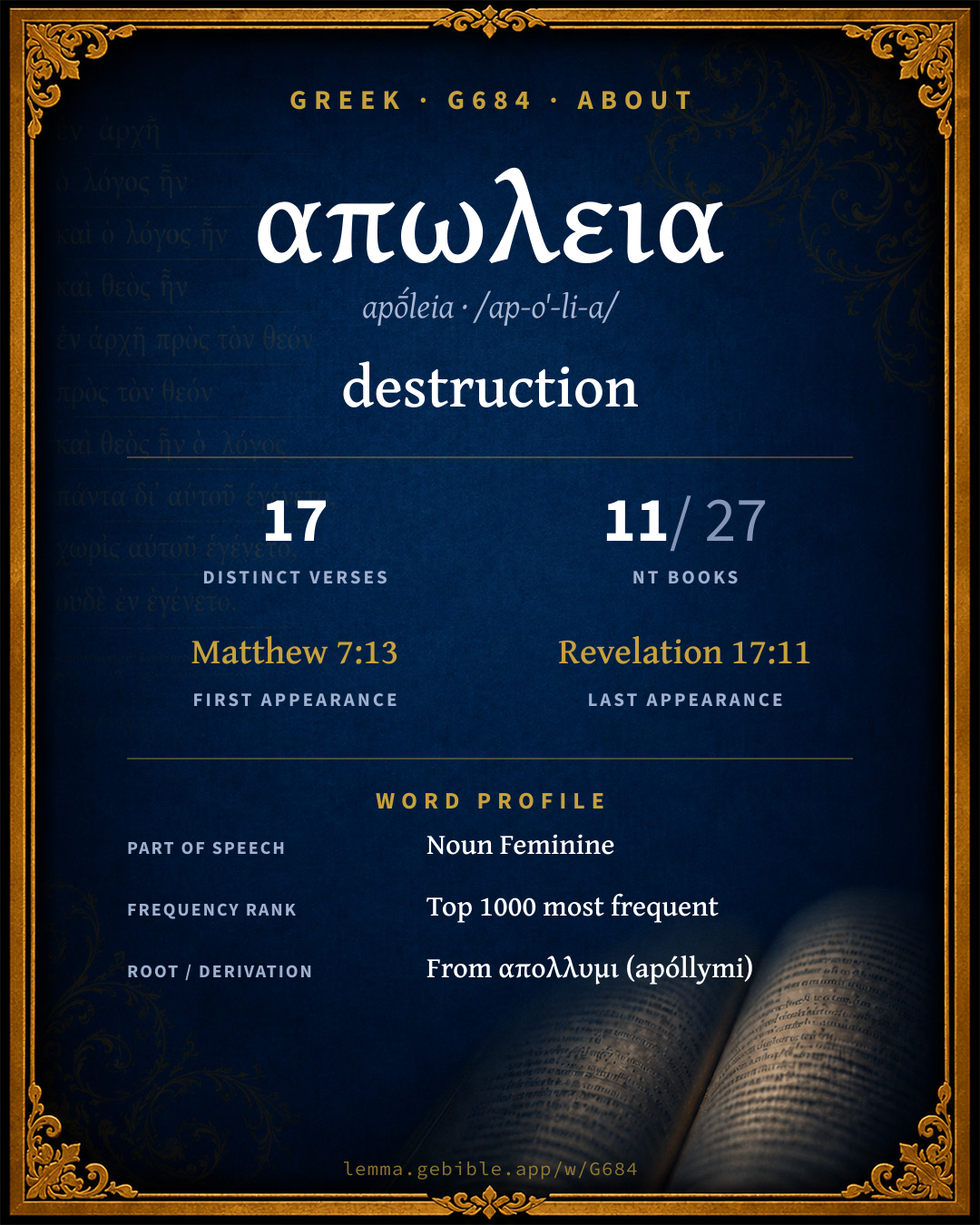
ἀπώλεια
destruction
‘destruction’ is one of 2 main senses fuller range ↓
Full lexicon entry — Thayer's Greek Lexicon
From Thayer's Greek Lexicon
Where this word appears
See every Accusative-case word in the Greek New Testament →
Grammar key — what these labels mean
Part of speech
- Noun
- A naming word — a person, place, thing, or idea.
Case
- Accusative
- The case of the direct object and of extent.
- Genitive
- The case of source, possession, or “of” — answers “whose / from what.”
- Nominative
- The case of the subject (and the predicate nominative).
Gender
- Feminine
- Grammatically feminine.
Number
- Singular
- One.
Grammatical forms
- Noun, Accusative, Singular, Feminine 9 times (50%)
- Noun, Genitive, Singular, Feminine 5 times (28%)
- Noun, Nominative, Singular, Feminine 4 times (22%)
Parsed forms decoded from the imported morphology (Robinson–Tischendorf, public domain), counted across 18 parsed occurrences — not distinct verses.
Every verse where G684 appears — 17 distinct verses across 11 books. Click any verse to open its interlinear word-by-word view. Verse text shown in the World English Bible for context — . Each verse’s Greek form is shown with its reference; the English is not keyword-highlighted, since the data carries no word-level English alignment. Use “Compare translations” on any verse to read it across multiple English versions. This concordance covers the Greek New Testament; Septuagint (Greek Old Testament) occurrences of this word are not indexed here.
Matthew 2 verses
Mark 1 verse
John 1 verse
Acts 1 verse
Romans 1 verse
Philippians 2 verses
- Philippians 1:28 ἀπωλείας n gen sg fem and in nothing frightened by the adversaries, which is for them a proof of destruction, but to you of salvation, and that from God.
- Philippians 3:19 ἀπώλεια n nom sg fem whose end is destruction, whose god is the belly, and whose glory is in their shame, who think about earthly things.
2 Thessalonians 1 verse
1 Timothy 1 verse
Hebrews 1 verse
2 Peter 4 verses
- 2 Peter 2:1 ἀπωλείας ἀπώλειαν n gen sg fem n acc sg fem But there also arose false prophets among the people, as among you also there will be false teachers, who will secretly bring in destructive heresies, denying even the Master who bought them, bringing on themselves swift destruction.
- 2 Peter 2:3 ἀπώλεια n nom sg fem In covetousness they will exploit you with deceptive words: whose sentence now from of old doesn't linger, and their destruction will not slumber.
- 2 Peter 3:7 ἀπωλείας n gen sg fem But the heavens that now are, and the earth, by the same word have been stored up for fire, being reserved against the day of judgment and destruction of ungodly men.
- 2 Peter 3:16 ἀπώλειαν n acc sg fem as also in all of his letters, speaking in them of these things. In those are some things hard to be understood, which the ignorant and unsettled twist, as they also do to the other Scriptures, to their own destruction.
Revelation 2 verses
- Revelation 17:8 ἀπώλειαν n acc sg fem The beast that you saw was, and is not; and is about to come up out of the abyss and to go into destruction. Those who dwell on the earth and whose names have not been written in the book of life from the foundation of the world will marvel when they see that the beast was, and is not, and shall be present.
- Revelation 17:11 ἀπώλειαν n acc sg fem The beast that was, and is not, is himself also an eighth, and is of the seven; and he goes to destruction.
About this entry
At a glance — auto-summarized from this page’s data, not written by a person. Every figure links to its source below. This summary describes the numbers; it doesn’t interpret them.
The Greek noun απωλεια centers on the idea of “destruction.” Debuting at Matthew 7:13, it then recurs through the corpus. Spanning 17 verses in 11 books, it ranks among the uncommon words of the Greek New Testament. Thayer's distinguishes 2 senses for it. Sharing its root, it stands alongside απολλυμι, Απολλυων and Απολλωνια. Dig into 17-verse concordance and the renderings breakdown below.
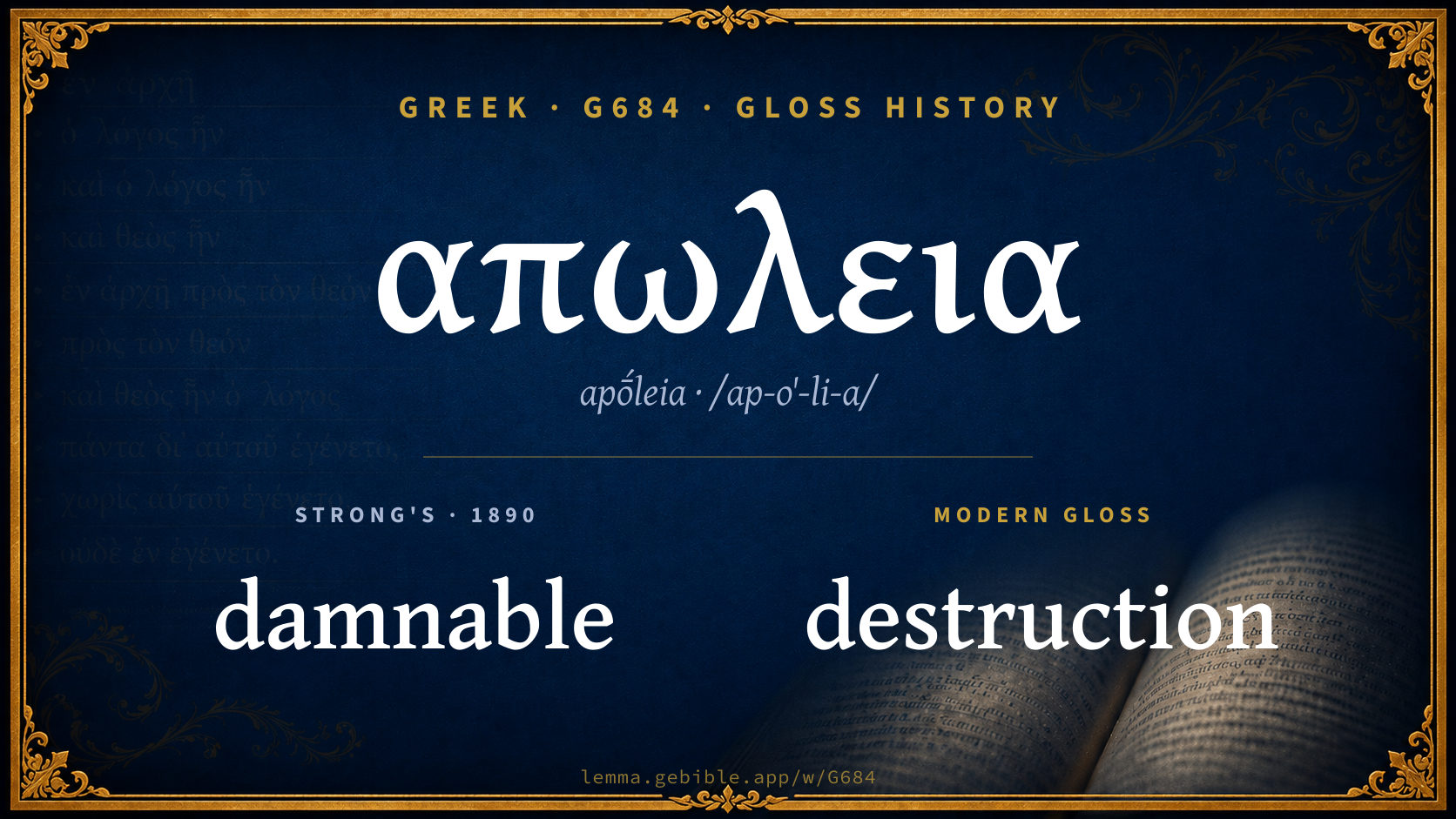
Gloss history
Strong's 1890 vs modern scholarship
About this word
Strong's G684 catalogs a Greek word from the Greek New Testament.
These counts are not copied from any lexicon or concordance. They are computed here, from the morphology-tagged Greek New Testament. What Lemma adds →
- 17
- distinct verses
- The word appears in 17 distinct verses.
- 11 / 27
- NT books
- The word appears in 11 of 27 New Testament books.
- #664
- by frequency
- Top 1000 most frequent Greek words (rank 664 of 5,347 Greek words by occurrence).
View all 17 occurrences in the concordance →
Most concentrated in
- 2 Peter 4 verses 24%
- Matthew 2 verses 12%
- Philippians 2 verses 12%
By section of the New Testament
By traditional corpus
Conventional, traditional groupings — biblical authorship is debated, so this is a traditional corpus grouping, not an authorship claim. Some books belong to more than one corpus (Luke is in both the Gospels and the Lukan corpus, and so on), so these shares overlap and need not total 100%. Each figure is a share of the word’s 17 distinct verses.
- Pauline corpus 5 verses · 29%
- Gospels 4 verses · 24%
- General (Catholic) Epistles 4 verses · 24%
- Johannine 3 verses · 18%
- Revelation 2 verses · 12%
- Lukan (Luke–Acts) 1 verse · 6%
- Hebrews 1 verse · 6%
How translations render this word
Counts come from each version’s own published word-to-Strong’s tagging or interlinear alignment — an approximate guide to how each version renders this word, not a word-level alignment the data otherwise carries. Because each total is that version’s own tagged count, the per-version totals vary from one another and need not match the appearance or distinct-verse counts above. These counts may also differ from a printed concordance because Lemma counts each distinctly tagged rendering and does not collapse phrase taggings into a single head-word total. This is a fixed set of word-tagged versions (KJV, ASV, BSB, ULT) and does not change with the reading translation you choose elsewhere. Each version’s license is shown beside its name below (and on Sources).
- King James Version: Perdition 8×, Destruction 4×, Waste 2×
- American Standard Version: Destruction 6×, Perdition 6×, Waste 2×
- Berean Standard Bible: Destruction 13×, Waste 2×
- unfoldingWord Literal Text: Destruction 15×, Waste 2×
King James Version Public Domain
Renders G684 across 19 tagged occurrences — most commonly:
Plus 5 renderings that appear only once — usually multi-word phrases or single function words the recovered tagging swept in, not distinct renderings. Not rendered by a distinct English word in 1 further occurrence.
American Standard Version Public Domain
Renders G684 across 18 tagged occurrences — most commonly:
Plus 4 renderings that appear only once — usually multi-word phrases or single function words the recovered tagging swept in, not distinct renderings.
Berean Standard Bible Public Domain
Renders G684 across 17 tagged occurrences — most commonly:
Plus 2 renderings that appear only once — usually multi-word phrases or single function words the recovered tagging swept in, not distinct renderings. Not rendered by a distinct English word in 1 further occurrence.
unfoldingWord Literal Text CC BY-SA 4.0
Renders G684 across 19 tagged occurrences — most commonly:
Plus 2 renderings that appear only once — usually multi-word phrases or single function words the recovered tagging swept in, not distinct renderings.
Senses in Thayer's
The 2 senses Thayer's distinguishes for this word, in lexicon order (not ranked by frequency or importance). The full entry — with sub-senses — is in the Lexicon Entry tab.
- destroying, utter destruction
- a perishing, ruin, destruction
Word origin
Derived from απολλυμι (apóllymi) (G622) — to destroy.
From a presumed derivative of G622 ; ruin or loss (physical spiritual or eternal): - damnable (-nation) destruction die perdition X perish pernicious ways waste.
— Strong’s Exhaustive Concordance (1890), public domain.
Forms in the corpus
The 3 distinct written forms G684 takes in the Greek New Testament, most frequent first — each parse links to that case’s occurrences in the concordance.
| Form | Parsing | Example | Uses |
|---|---|---|---|
| ἀπώλειαν apṓleian | Noun, Accusative, Singular, Feminine | Matthew 7:13 | 9 |
| ἀπωλείας apōleías | Noun, Genitive, Singular, Feminine | John 17:12 | 5 |
| ἀπώλεια apṓleia | Noun, Nominative, Singular, Feminine | Matthew 26:8 | 4 |
Same root — word family
Other Thayer's entries built from the same root as G684, grouped by Strong’s listed origin. These share a root / origin per the lexicon — not necessarily a shared meaning. Each links to that word’s own entry.
Derives from
Shares the same root
Proper names from this root
People and places named from this root — a name, not an additional meaning of the word.
Compare all same-root words → 1 of the same-root words is a proper name (a person or place). They share a root, not necessarily a meaning.
Septuagint usage
The same Greek word απωλεια appears 74 times in the Greek Old Testament (Septuagint), across 72 verses in 15 books.
- 74
- LXX occurrences
- Tagged occurrences of this Greek word in the Septuagint.
- 72
- verses
- Distinct Septuagint verses containing this word.
- 15 / 39
- OT books
- The word appears in 15 of the 39 Old Testament books.
Sample Septuagint occurrences
- Exodus 22:8 ἀπώλεια
- Leviticus 5:22 ἀπώλεια
- Numbers 20:3 ἀπώλεια
- Deuteronomy 4:26 ἀπώλεια
- 1 Chronicles 21:17 ἀπώλεια
- Esther 7:4 ἀπώλεια
- Job 11:20 ἀπώλεια
- Psalms 87:12 ἀπώλεια
- Proverbs 1:26 ἀπώλεια
- Isaiah 14:23 ἀπώλεια
- Jeremiah 12:11 ἀπώλεια
- Ezekiel 25:7 ἀπώλεια
Septuagint occurrences (same lexeme)
Every verse where the same Strong’s number (G684) appears in the Greek Septuagint — showing the first 50 of 72. Verse text shown in the World English Bible for context; the Greek form is the matched word — the English is not keyword-highlighted.
- Exodus 22:8 ἀπώλεια If the thief isn't found, then the master of the house shall come near to God, to find out if he hasn't put his hand to his neighbor's goods.
- Leviticus 5:22 ἀπώλεια
- Leviticus 5:23 ἀπώλεια
- Numbers 20:3 ἀπώλεια The people strove with Moses, and spoke, saying, Would that we had died when our brothers died before Yahweh!
- Deuteronomy 4:26 ἀπώλεια I call heaven and earth to witness against you this day, that you shall soon utterly perish from off the land whereunto you go over the Jordan to possess it; you shall not prolong your days on it, but shall utterly be destroyed.
- Deuteronomy 7:23 ἀπώλεια But Yahweh your God will deliver them up before you, and will confuse them with a great confusion, until they be destroyed.
- Deuteronomy 8:19 ἀπώλεια It shall be, if you shall forget Yahweh your God, and walk after other gods, and serve them, and worship them, I testify against you this day that you shall surely perish.
- Deuteronomy 12:2 ἀπώλεια You shall surely destroy all the places in which the nations that you shall dispossess served their gods, on the high mountains, and on the hills, and under every green tree:
- Deuteronomy 22:3 ἀπώλεια So shall you do with his donkey; and so shall you do with his garment; and so shall you do with every lost thing of your brother's, which he has lost, and you have found: you may not hide yourself.
- Deuteronomy 30:18 ἀπώλεια I denounce to you this day, that you shall surely perish; you shall not prolong your days in the land, where you pass over the Jordan to go in to possess it.
- Deuteronomy 32:35 ἀπώλεια Vengeance is mine, and recompense, At the time when their foot shall slide: For the day of their calamity is at hand, The things that are to come on them shall make haste.
- 1 Chronicles 21:17 ἀπώλεια David said to God, Isn't it I who commanded the people to be numbered? It is even I who have sinned and done very wickedly; but these sheep, what have they done? Please let your hand, O Yahweh my God, be against me, and against my father's house; but not against your people, that they should be plagued.
- Esther 7:4 ἀπώλεια for we are sold, I and my people, to be destroyed, to be slain, and to perish. But if we had been sold for bondservants and bondmaids, I had held my peace, although the adversary could not have compensated for the king's damage.
- Esther 8:6 ἀπώλεια for how can I endure to see the evil that shall come to my people? or how can I endure to see the destruction of my relatives?
- Job 11:20 ἀπώλεια But the eyes of the wicked shall fail, They shall have no way to flee; Their hope shall be the giving up of the spirit."
- Job 20:5 ἀπώλεια That the triumphing of the wicked is short, The joy of the godless but for a moment?
- Job 20:28 ἀπώλεια The increase of his house shall depart; They shall rush away in the day of his wrath.
- Job 21:30 ἀπώλεια That the evil man is reserved to the day of calamity? That they are led forth to the day of wrath?
- Job 26:6 ἀπώλεια Sheol is naked before God, And Abaddon has no covering.
- Job 27:7 ἀπώλεια "Let my enemy be as the wicked, Let him who rises up against me be as the unrighteous.
- Job 28:22 ἀπώλεια Destruction and Death say, 'We have heard a rumor of it with our ears.'
- Job 30:12 ἀπώλεια On my right hand rise the rabble. They thrust aside my feet, They cast up against me their ways of destruction.
- Job 31:3 ἀπώλεια Is it not calamity to the unrighteous, And disaster to the workers of iniquity?
- Job 41:14 ἀπώλεια Who can open the doors of his face? Around his teeth is terror.
- Psalms 87:12 ἀπώλεια
- Proverbs 1:26 ἀπώλεια I also will laugh at your disaster. I will mock when calamity overtakes you;
- Proverbs 6:15 ἀπώλεια Therefore his calamity will come suddenly. He will be broken suddenly, and that without remedy.
- Proverbs 6:32 ἀπώλεια He who commits adultery with a woman is void of understanding. He who does it destroys his own soul.
- Proverbs 10:11 ἀπώλεια The mouth of the righteous is a spring of life, But violence covers the mouth of the wicked.
- Proverbs 10:24 ἀπώλεια What the wicked fear, will overtake them, But the desire of the righteous will be granted.
- Proverbs 11:3 ἀπώλεια The integrity of the upright shall guide them, But the perverseness of the treacherous shall destroy them.
- Proverbs 11:6 ἀπώλεια The righteousness of the upright shall deliver them, But the unfaithful will be trapped by evil desires.
- Proverbs 13:1 ἀπώλεια A wise son listens to his father's instruction, But a scoffer doesn't listen to rebuke.
- Proverbs 13:15 ἀπώλεια Good understanding wins favor; But the way of the unfaithful is hard.
- Proverbs 15:11 ἀπώλεια Sheol and Abaddon are before Yahweh-- How much more then the hearts of the children of men!
- Proverbs 16:22 ἀπώλεια Understanding is a fountain of life to one who has it, But the punishment of fools is their folly.
- Proverbs 24:22 ἀπώλεια For their calamity will rise suddenly; The destruction from them both--who knows?
- Proverbs 27:20 ἀπώλεια Sheol and Abaddon are never satisfied; And a man's eyes are never satisfied.
- Proverbs 28:28 ἀπώλεια When the wicked rise, men hide themselves; But when they perish, the righteous thrive.
- Isaiah 14:23 ἀπώλεια I will also make it a possession for the porcupine, and pools of water: and I will sweep it with the broom of destruction, says Yahweh of Hosts.
- Isaiah 22:5 ἀπώλεια For it is a day of confusion, and of treading down, and of perplexity, from the Lord, Yahweh of Hosts, in the valley of vision; a breaking down of the walls, and a crying to the mountains.
- Isaiah 33:2 ἀπώλεια Yahweh, be gracious to us; we have waited for you: be our arm every morning, our salvation also in the time of trouble.
- Isaiah 34:5 ἀπώλεια For my sword has drunk its fill in the sky: behold, it shall come down on Edom, and on the people of my curse, to judgment.
- Isaiah 34:12 ἀπώλεια They shall call the nobles of it to the kingdom, but none shall be there; and all its princes shall be nothing.
- Isaiah 47:11 ἀπώλεια Therefore shall evil come on you; you shall not know the dawning of it: and mischief shall fall on you; you shall not be able to put it away: and desolation shall come on you suddenly, which you don't know.
- Isaiah 54:16 ἀπώλεια Behold, I have created the smith who blows the fire of coals, and brings forth a weapon for his work; and I have created the waster to destroy.
- Isaiah 57:4 ἀπώλεια Against whom do you sport yourselves? against whom make you a wide mouth, and put out the tongue? Aren't you children of disobedience, a seed of falsehood,
- Jeremiah 12:11 ἀπώλεια They have made it a desolation; it mourns to me, being desolate; the whole land is made desolate, because no man lays it to heart.
- Jeremiah 12:17 ἀπώλεια But if they will not hear, then will I pluck up that nation, plucking up and destroying it, says Yahweh.
- Jeremiah 18:17 ἀπώλεια I will scatter them as with an east wind before the enemy; I will show them the back, and not the face, in the day of their calamity.
These are occurrences of the same Greek lexeme (G684) in the Septuagint — not a translation of any one Hebrew word. The store carries no word-level Hebrew↔Greek alignment, so no Hebrew original is asserted here. Counts come from the recovered LXX Strong's tagging — high-frequency vocabulary is well covered, while rare or late forms may be untagged — so they reflect tagged occurrences and may slightly undercount.