
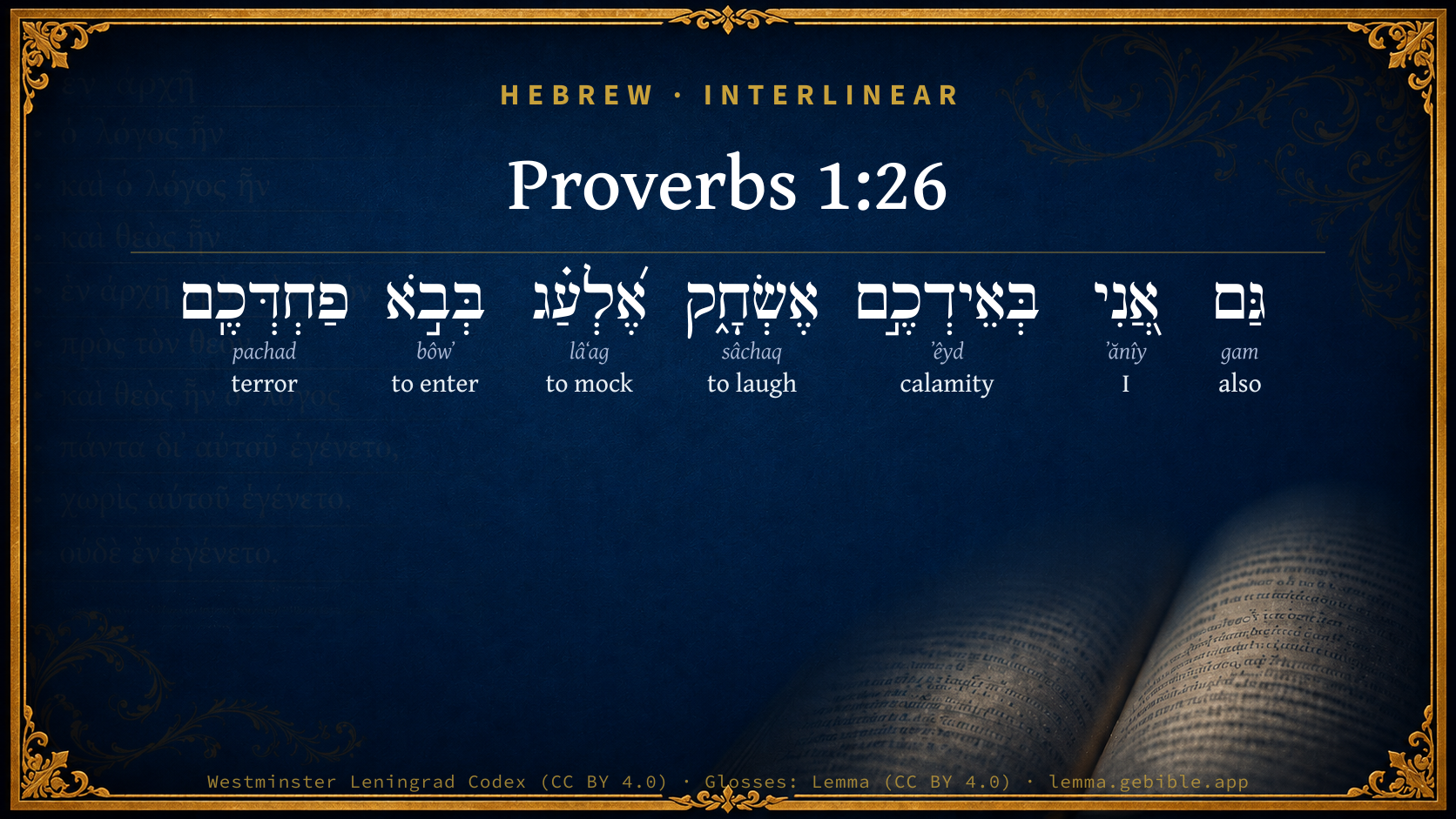
Proverbs 1:26

Hebrew (Westminster Leningrad Codex) Proverbs 1:26 appears in the Hebrew Old Testament. The text above is from the Westminster Leningrad Codex. Each word links to its Strong’s number, a concise gloss, and parsing drawn from the Open Scriptures Hebrew Bible morphology. Click any word for its full Brown-Driver-Briggs (BDB) entry.
Download image
Cite this verse

Proverbs 1:26 (World English Bible). Public Domain. Lemma interlinear Bible study tool, https://lemma.gebible.app/v/proverbs/1/26.

Show BibTeX & RIS
BibTeX
RIS
English Translation
I also will laugh at your disaster. I will mock when calamity overtakes you;
World English Bible · Public Domain
Download a study sheet

One document with this verse’s original text, its word-by-word gloss line, the meaning frame, cross-references with their text, attributed commentary, and full source and license credits — printable, and it pastes into notes with its structure intact.

This verse Autodidact and up

Study sheet (.html) Plain text (.txt)

A passage Seminary Student

Up to 50 verses in one chapter. A passage sheet keeps up to 6 commentary sources and 12 cross-references per verse, in the order this page ranks them, and says so on the sheet whenever that leaves anything out. Ask for a single verse and you get the Autodidact verse sheet above.

Everything on this page stays free to read, with no account — the sheet is a download of what is already on screen, not access to it.

Want to remove ads? Support Godless Engineer
Compare translations 3

The same verse in 3 English versions, stacked beneath the original-language interlinear above. Click any original word for its lexicon entry.

Each is an independent rendering of the whole verse — the interlinear is not word-aligned to these translations.

Highlighted words mark where these versions differ — a whole-verse word diff, not a word-by-word alignment.

  • World English Bible Public Domain
    I also will laugh at your disaster. I will mock when calamity overtakes you;
  • King James Version Public Domain
    I also will laugh at your calamity; I will mock when your fear cometh;
  • unfoldingWord Literal Text CC BY-SA 4.0
    I too shall laugh at your calamity, I shall mock when your dread comes,

unfoldingWord Literal Text — © unfoldingWord, licensed CC BY-SA 4.0. Word-aligned USFM3 via Door43 (git.door43.org/unfoldingWord/en_ult).

Versions to compare (up to 4)

3 of 4 selected

Show all 18 translations

Every available English version of this verse, each an independent rendering of the whole verse.

  • World English Bible Public Domain
    I also will laugh at your disaster. I will mock when calamity overtakes you;
  • Berean Standard Bible Public Domain
    in turn I will mock your calamity; I will sneer when terror strikes you,
  • Majority Standard Bible Public Domain
    in turn I will mock your calamity; I will sneer when terror strikes you,
  • King James Version Public Domain
    I also will laugh at your calamity; I will mock when your fear cometh;
  • American Standard Version (1901) Public Domain
    I also will laugh in `the day of' your calamity; I will mock when your fear cometh;
  • Revised Version (1885) Public Domain
    I also will laugh in the day of your calamity; I will mock when your fear cometh;
  • Geneva Bible (1599) Public Domain
    I will also laugh at your destruction, and mocke, when your feare commeth.
  • Douay-Rheims (1899) Public Domain
    I also will laugh in your destruction, and will mock when that shall come to you which you feared.
  • Young's Literal Translation Public Domain
    I also in your calamity do laugh, I deride when your fear cometh,
  • Literal Standard Version CC BY-SA 4.0
    I also laugh in your calamity, || I deride when your fear comes,
  • Unlocked Literal Bible CC BY-SA 4.0
    I will laugh at your calamity, I will mock you when the terror comes—
  • unfoldingWord Literal Text CC BY-SA 4.0
    I too shall laugh at your calamity, I shall mock when your dread comes,
  • Darby Bible Public Domain
    I also will laugh in your calamity, I will mock when your fear cometh;
  • World Messianic Bible Public Domain
    I also will laugh at your disaster. I will mock when calamity overtakes you,
  • Webster's Bible Public Domain
    I also will laugh at your calamity; I will mock when your fear cometh;
  • Free Bible Version CC BY-SA 4.0
    So I'll laugh at you when you're in trouble; I'll mock you when you're in a panic.
  • Bible in Basic English Public Domain
    So in the day of your trouble I will be laughing; I will make sport of your fear;
  • JPS Tanakh (1917) Public Domain
    I also, in your calamity, will laugh, I will mock when your dread cometh;

Literal Standard Version (2020), Covenant Press — licensed CC BY-SA 4.0. Text via the HelloAO Bible API (eBible.org). Unlocked Literal Bible (unfoldingWord) — licensed CC BY-SA 4.0. Text via the HelloAO Bible API (eBible.org). unfoldingWord Literal Text — © unfoldingWord, licensed CC BY-SA 4.0. Word-aligned USFM3 via Door43 (git.door43.org/unfoldingWord/en_ult). Free Bible Version, Dr. Jonathan Gallagher — licensed CC BY-SA 4.0. Text via the HelloAO Bible API (eBible.org).

Word by word

More ways to search: Search by grammar → Find every occurrence → Compare this word →

Practice this passage: Drill this verse → Learn its vocabulary →

About this verse

These counts appear in no published source. They are computed here, from the morphology-tagged text and Lemma’s own curated glosses. What Lemma adds →

7
words
7
distinct lemmas
Wisdom
section

Notable vocabulary

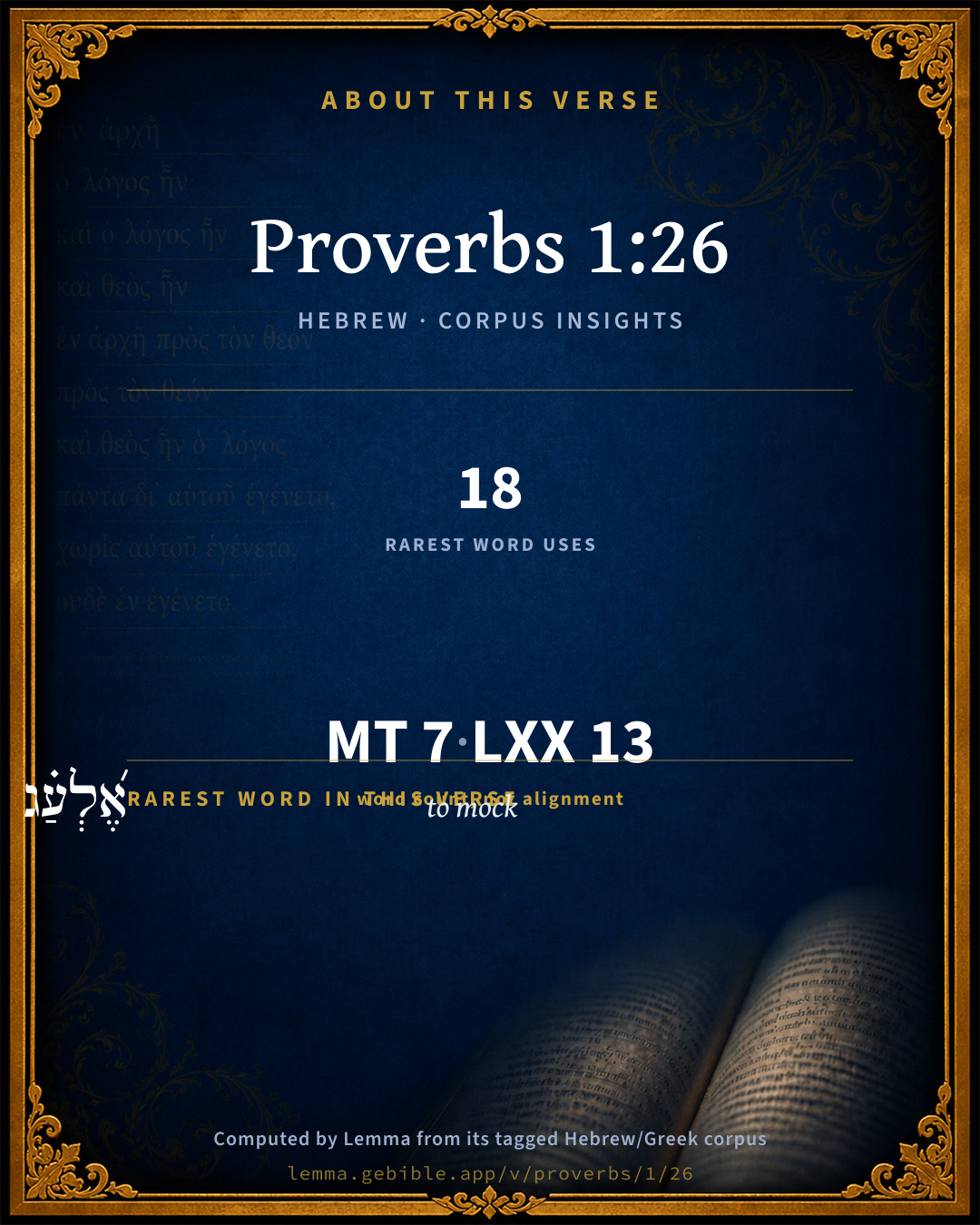
The rarest word here is אֶ֝לְעַ֗ג to mock H3932 — appearing just 18 times in the whole Hebrew Bible.

Shared distinctive vocabulary

אֶ֝לְעַ֗ג to mock H3932 occurs in 18 verses of the Hebrew Bible. Also found in:

Grammatical profile

  • 3 verbs
  • 2 nouns
  • 1 pronoun
  • 1 particle

Verb forms

  • אֶשְׂחָ֑ק Qal · Imperfect
  • אֶ֝לְעַ֗ג Qal · Imperfect
  • בְּבֹ֣א Qal · Infinitive Construct

Hebrew & Septuagint length

In English translation the verse runs 14 words from the Hebrew and 19 from the Septuagint (LXX English) — closely comparable.

A rough comparison of the two English renderings, which tokenize alike — not a word-level alignment.

Word counts can differ between the Hebrew and the Greek without any difference in meaning — e.g. the Hebrew direct-object marker אֵת has no separate Greek word, and Greek often adds the article ὁ.

In the original languages it is 7 Hebrew tokens and 13 Greek tokens — but the two are counted differently (Hebrew bundles its prefixes and suffixes into one token; the Greek is in lemma form), so that isn’t a like-for-like length.

Cross-references

6

Topical passages linked to Proverbs 1:26 in the Treasury of Scripture Knowledge — connected by theme and wording, ordered by reader-vote popularity; previews shown in the World English Bible.

  • Psalms 2:4 He who sits in the heavens will laugh. The Lord will have them in derision.
  • Psalms 37:13 The Lord will laugh at him, For he sees that his day is coming.
  • Proverbs 10:24 What the wicked fear, will overtake them, But the desire of the righteous will be granted.
  • Proverbs 6:15 Therefore his calamity will come suddenly. He will be broken suddenly, and that without remedy.
  • Luke 14:24 For I tell you that none of those men who were invited will taste of my supper.'"
  • Judges 10:14 Go and cry to the gods which you have chosen; let them save you in the time of your distress.

Cross-references courtesy of OpenBible.info (CC BY 4.0).

Hebrew and Greek witnesses Masoretic Hebrew ↔ Greek Septuagint

The same verse in the two great witnesses to the Old Testament, shown verse-for-verse.

These are two independent witnesses, not word-aligned to each other, and the Septuagint is shown in lemma (dictionary) form.

Hebrew Proverbs 1:26 Masoretic · Westminster Leningrad Codex

גַּם אֲ֭נִי בְּאֵידְכֶ֣ם אֶשְׂחָ֑ק אֶ֝לְעַ֗ג בְּבֹ֣א פַחְדְּכֶֽם

I also will laugh at your disaster. I will mock when calamity overtakes you;

World English Bible · Public Domain

Greek LXX Proverbs 1:26 Septuagint · lemma form

τοιγαροῦν καΐἐγώ ὁ ὑμέτερος ἀπώλεια ἐπιγελάω καταχαίρω δέ ἡνίκα ἄν ἔρχομαι σύ ὄλεθρος

therefore I also will laugh at your destruction; and I will rejoice against you when ruin comes upon you:

LXX2012 (modern English Septuagint) · Public Domain

On this verse, The Pulpit Commentary discusses the Septuagint’s reading. Read the note in Commentary ↓

Hebrew: Westminster Leningrad Codex (CC BY 4.0). Greek: Septuagint (public domain); English from LXX2012 (modern English Septuagint) (Public Domain). How the Septuagint differs from the Hebrew →

Commentary

Notes on Proverbs 1:26 from classic Christian and Jewish commentators (each source and its license shown beneath its notes). The classic Christian expositions comment on the surrounding passage and are grouped to its opening verse, so a note may address several verses; the Jewish commentaries on the Tanakh (Rashi and others) are per-verse, so they appear only where the commentator wrote on this verse.

Lemma curates 59 commentaries, every one of them public domain or Creative Commons licensed, each selected and text-cleaned for this edition rather than reprinted as found. About our sources →

Trapp's Complete Commentary

John Trapp

Pro 1:26 I also will laugh at your calamity; I will mock when your fear cometh;

Ver. 26. I also will laugh.] Quod Deus loquitur cum risu, tu legas cum fletu. {a} If God laugh, thou hast good cause to cry. Note here the venomous nature of sin, which is so offensive to God, that it makes him (against his ordinary wont) merry at his creatures’ misery, who otherwise delights in mercy. {Mic 7:18}

When your fear cometh.] That "terrible tempest." {Job 15:21-22 Psa 11:6} Tullus Hostilius (a profane prince) set up and worshipped at Rome two new gods, viz., Pavor and Pallor, as Lactantius {b} testifieth. Cataline was wont to be afraid at any sudden noise, as being haunted with the furies of his own evil conscience. {c} So was our Richard the Third after the murder of his two innocent nephews, {d} and Charles the Ninth of France after the Parisian massacre {e} These tyrants became more terrible to themselves than ever they had been to others.

{a} Augustine.

{b} Lactan. Instit.

{c} Salust.

{d} Daniel.

{e} Thuan.

John Trapp, A Commentary or Exposition upon All the Books of the Old and New Testament (1647–1656) — public domain. Text from a community e-Sword module.

Geneva Bible (1599)

Geneva Bible translators

This is spoken according to our capacity, signifying that the wicked, which mock and jest at God’s word, shall have the just reward of their mocking.

Geneva Bible (1599) marginal notes — public domain. Text via Bolls.life.

Jamieson, Fausset & Brown

Robert Jamieson, A. R. Fausset & David Brown

In their extreme distress He will not only refuse help, but aggravate it by derision.

Jamieson, Fausset & Brown — Commentary Critical and Explanatory on the Whole Bible (1871) — public domain (CC PDM 1.0). Text via the HelloAO Bible API.

Ellicott's Commentary for English Readers

(26) I also will laugh . . . I will mock.—For expressions like this, comp. Psa_2:4; Psa_37:13; Psa_59:8, where the same actions are attributed to God. They are not to be taken literally, of course, for the sight of human folly can give no pleasure to Him. They signify that He will act as if He mocked when He refuses to hear their cry. Similar expressions, imputing human actions to the Almighty, are Gen_11:5; Gen_11:7; 2Ch_16:9; Psa_18:9; human feelings, Gen_6:6.

A Bible Commentary for English Readers, edited by Charles John Ellicott (1878–1897) — public domain. Text from a community e-Sword module.

The Cambridge Bible for Schools and Colleges

gen. ed. J. J. S. Perowne

26. at] Rather, in, i.e. in the time of. Comp. on this verse Psa_2:4; Psa_37:13; Psa_59:8.

The Cambridge Bible for Schools and Colleges (gen. ed. J. J. S. Perowne; Cambridge University Press, 1878–1918) — public domain. Text from a community e-Sword module.

John Gill's Exposition

I also will laugh at your calamity,.... By way of retaliation, measuring measure for measure; even as they scorned him, and delighted in their scorning, now he in his turn will "laugh" at them and their distress; which act is ascribed to the Lord by an anthropopathy; see Psa 2:4; signifying that he should not at all pity them, show no compassion to them, and have no mercy upon them; but rather express a pleasure and delight in displaying the glory of his justice in their destruction: the plain sense is, that no favour would be shown them, Isa 27:11. The word translated "calamity" signifies a "vapour" (f), or cloud; denoting it would be a very dark dispensation with the Jews, as it was when "wrath came upon them to the uttermost", Th1 2:16; even on their nation, city, and temple; as in their last destruction by the Romans, which is here intended;

I will mock when your fear cometh; which is the same thing in different words; for by "fear" is meant the dreadful calamity on which brought dread, terror, and consternation with it, and of which they had fearful apprehensions beforehand: wherefore this is mentioned among the signs of Jerusalem's destruction, "men's hearts failing them for fear", Luk 21:26.

(f) "significat vaporem", Vatablus, Mercerus, Amama.

John Gill's Exposition of the Whole Bible (1746–1763) — public domain (CC PDM 1.0). Text via the HelloAO Bible API.

Albert Barnes' Notes on the Bible

Compare the marginal reference. The scorn and derision with which men look on pride and malice, baffled and put to shame, has something that answers to it in the Divine Judgment. It is, however, significant that in the fuller revelation of the mind and will of the Father in the person of the Son no such language meets us. Sadness, sternness, severity, there may be, but, from first to last, no word of mere derision.

Albert Barnes' Notes on the Bible (1834–1885) — public domain. Text from a community e-Sword/MySword module.

Haydock's Catholic Bible Commentary

Mock. God is too much above us to act thus; but he will treat us as an enraged enemy. (Calmet) --- In hell, the damned will cry in vain, ver. 28. They had sufficient graces offered while they were alive. (Worthington)

George Leo Haydock (1774–1849), Haydock's Catholic Family Bible and Commentary, 1859 edition — public domain. Excludes Psalms (Douay-Rheims chapter numbering differs from Protestant) and Deuterocanonical books (Catholic canon only).

Matthew Poole's English Annotations

As you have scoffed at me and my ways,

I also will laugh at your calamity, i.e. destroy you without pity, and take pleasure therein. Compare Rev 18:20.

Your fear; the misery which you do or should fear. The act for the object, as Isa 8:12, and elsewhere.

Matthew Poole's English Annotations on the Holy Bible (1683–1685) — public domain. Text from a community e-Sword/MySword module.

Whedon's Commentary on the Bible

Daniel D. Whedon

26. I…

laugh — Ye have laughed at my expostulations and mocked at my words; now, when your calamity comes, I also will laugh at you and deride your fears.

Daniel D. Whedon (gen. ed.), Commentary on the Old and New Testaments (1874–1909) — public domain. Text from a community e-Sword module.

The Pulpit Commentary

I also will laugh at your calamity; or, more accurately, in the time of your calamity; as in the Vulgate, in interitu vestro ridebo. The preposition prefixed to the substantive b"eyd"chem ( refers to the time, or state, or condition (Gesenius, "Gram.," 154, 3). In the time of their calamity wisdom will exult or rejoice. The LXX, Th umetera apleia epigelasomai , however, favours the rendering of the Authorized Version. Calamity (dyae, eyd) is heavy overwhelming misfortune, that which oppresses and crushes its victims. The terrific nature of the punishment of the wicked is marked by a succession of terms all of terrible import calamity, fear, desolation, destruction, distress, and anguish (vers. 26, 27). When these come upon them, then Wisdom will laugh and have them in derision. The verbs "laugh" (qjc, sakhak) and "mock" (gl laag) are the same as in Psa_2:4, where they are rendered "to mock" and "have in derision." When your fear cometh; i.e. has actually arrived. Fear (djp, pakhad); here used metonymically for that which causes the fear or terror (id, quod timebatis, Vulgate). There is a similar use of fobov in 1Pe_3:14.

The Pulpit Commentary (1880–1919), ed. H.D.M. Spence-Jones & Joseph S. Exell — public domain. Text from a community e-Sword module.

John Wesley's Explanatory Notes

Your fear - The misery you do or should fear.

John Wesley, Explanatory Notes Upon the Whole Bible (1754–1765) — public domain. Text via the GEBible commentary corpus.

unfoldingWord translationNotes

Door43 World Missions Community

General Information:

Wisdom continues to speak, describing what happens to those who ignore her.

I will laugh

This can be stated with the word "therefore" to show that the woman wisdom laughs at them because they ignored her. AT: "Therefore I will laugh" (See: Connecting Words)

at your calamity

"when bad things happen to you"

when the terror comes

The abstract noun "terror" can be stated as an adjective. AT: "when you are terrified" (See: Abstract Nouns)

when your fearful dread comes like a storm ... like a whirlwind ... come upon you

Terrible things happening to the people is compared to a storm hitting them and causing fear and suffering. (See: Simile)

whirlwind

a very strong wind storm that causes damage

translationWords

mock

terror

unfoldingWord translationNotes — © Distant Shores Media and the Door43 World Missions Community, licensed CC BY-SA 4.0. Source: git.door43.org/Door43/en_tn.

Lesson kit

Teaching starters — assembled from the data on this page, not authored interpretation. Every prompt links to the verse data it draws on. Edit before teaching.

Proverbs, in the Wisdom, opens this verse with 7 words (7 distinct Hebrew lemmas). Its most distinctive word is lâʻag (“to mock”). A historical commentator’s framing appears above. Read the whole chapter for the surrounding context.

Discussion questions

  1. How does “to mock” (lâʻag) shape what this verse is saying?
  2. 2 Kings 19:21 shares the word «to mock» with this verse. How do the two illuminate each other?
  3. These translations render this verse differently; the difference is in the English rendering, not the original. What questions does that raise?
  4. The verb «אֶשְׂחָ֑ק» is Qal Imperfect. How does its form color the action?
  5. Reading how Trapp's Complete Commentary and Geneva Bible (1599) read this verse, where do the two commentators agree and where do they part?

Things to notice

Reading settings

Reading text

Shown beneath each verse's original-language words.

Old Testament
Old Testament edition

Read the OT as the Masoretic Hebrew (MT) or the Greek Septuagint (LXX).

English shown for the Greek Septuagint (in the Hebrew ↔ Greek comparison).

Comparing translations? Open the Compare panel on any verse page to stack up to four side by side.