
2 Peter 2:3

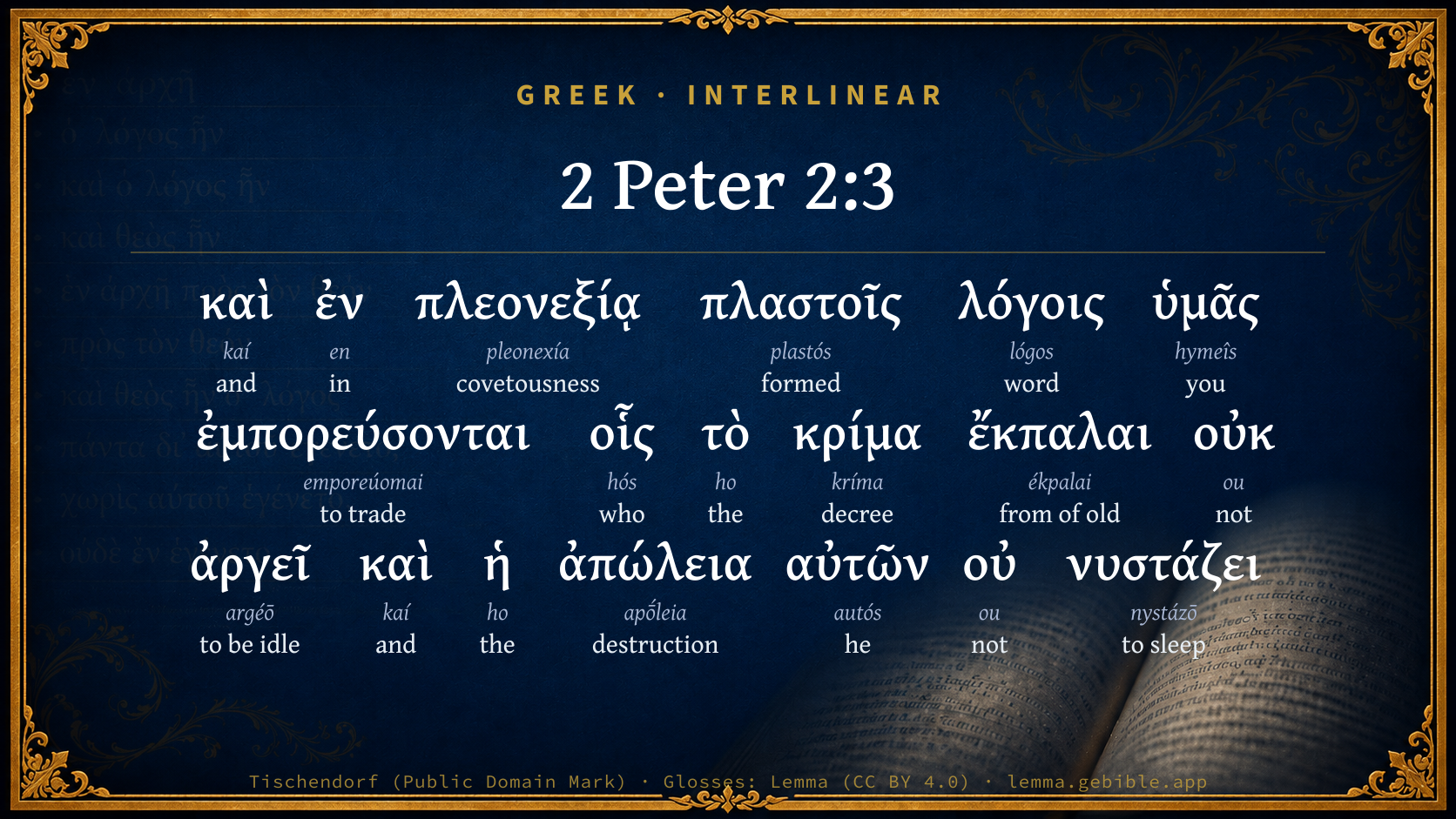
Greek (Tischendorf 8th ed.) 2 Peter 2:3 appears in the Greek New Testament. The text above is from the Tischendorf 8th edition. Each word links to its Strong’s number and a concise gloss. Click any word for its full Thayer’s Greek Lexicon entry.
Download image
Cite this verse

2 Peter 2:3 (World English Bible). Public Domain. Lemma interlinear Bible study tool, https://lemma.gebible.app/v/2-peter/2/3.

Show BibTeX & RIS
BibTeX
RIS
English Translation
In covetousness they will exploit you with deceptive words: whose sentence now from of old doesn't linger, and their destruction will not slumber.
World English Bible · Public Domain
Highlights
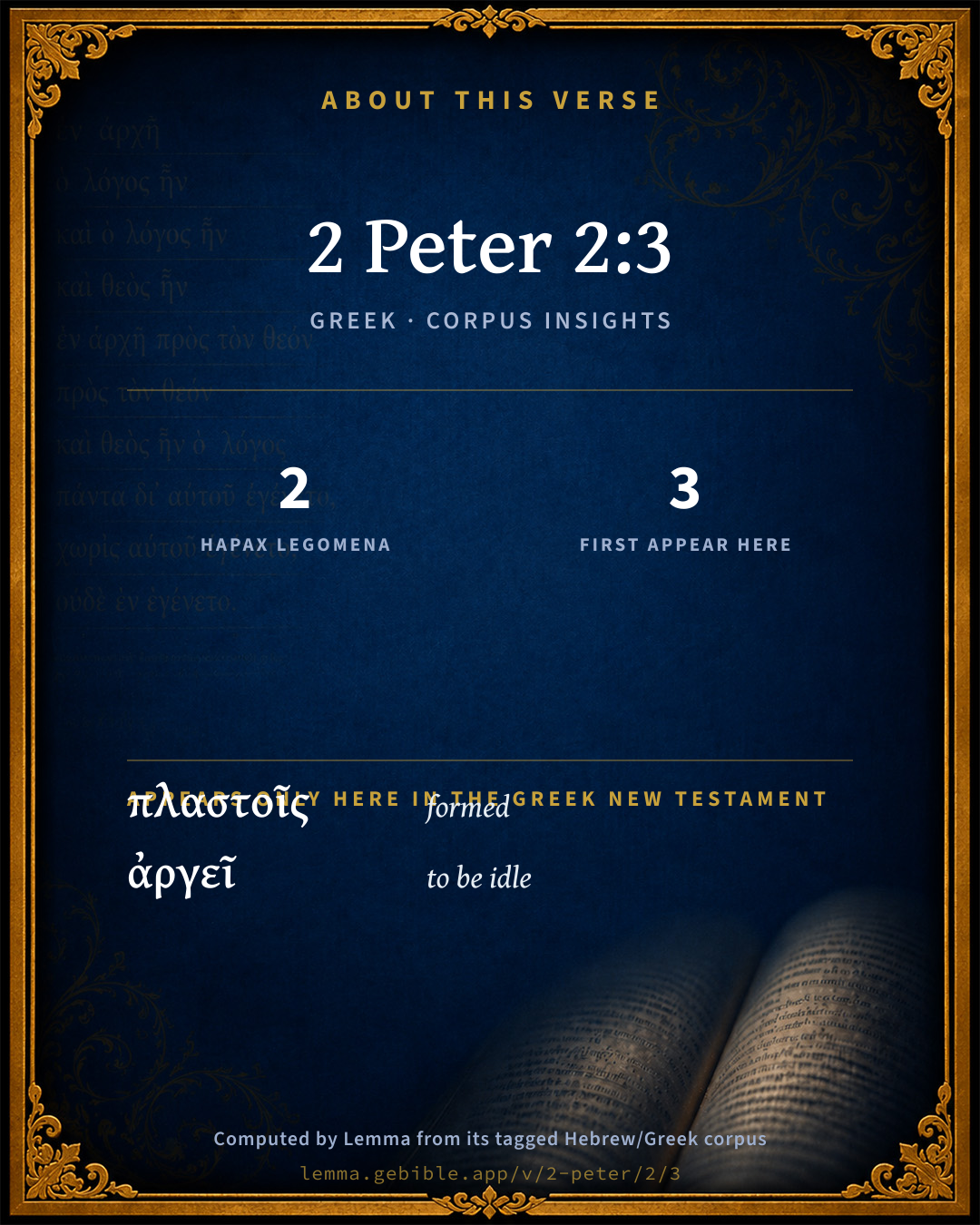
  • 2 hapax legomena — only here in the Greek New Testament
  • 3 first appearances in the Greek New Testament
Full analysis ↓
Download a study sheet

One document with this verse’s original text, its word-by-word gloss line, the meaning frame, cross-references with their text, attributed commentary, and full source and license credits — printable, and it pastes into notes with its structure intact.

This verse Autodidact and up

Study sheet (.html) Plain text (.txt)

A passage Seminary Student

Up to 50 verses in one chapter. A passage sheet keeps up to 6 commentary sources and 12 cross-references per verse, in the order this page ranks them, and says so on the sheet whenever that leaves anything out. Ask for a single verse and you get the Autodidact verse sheet above.

Everything on this page stays free to read, with no account — the sheet is a download of what is already on screen, not access to it.

Want to remove ads? Support Godless Engineer
Compare translations 3

The same verse in 3 English versions, stacked beneath the original-language interlinear above. Click any original word for its lexicon entry.

Each is an independent rendering of the whole verse — the interlinear is not word-aligned to these translations.

Highlighted words mark where these versions differ — a whole-verse word diff, not a word-by-word alignment.

  • World English Bible Public Domain
    In covetousness they will exploit you with deceptive words: whose sentence now from of old doesn't linger, and their destruction will not slumber.
  • King James Version Public Domain
    And through covetousness shall they with feigned words make merchandise of you: whose judgment now of a long time lingereth not, and their damnation slumbereth not.
  • unfoldingWord Literal Text CC BY-SA 4.0
    And in greed, they will exploit you with false words, for whom condemnation from long ago is not idle, and their destruction does not sleep.

unfoldingWord Literal Text — © unfoldingWord, licensed CC BY-SA 4.0. Word-aligned USFM3 via Door43 (git.door43.org/unfoldingWord/en_ult).

Versions to compare (up to 4)

3 of 4 selected

Show all 19 translations

Every available English version of this verse, each an independent rendering of the whole verse.

  • World English Bible Public Domain
    In covetousness they will exploit you with deceptive words: whose sentence now from of old doesn't linger, and their destruction will not slumber.
  • Berean Standard Bible Public Domain
    In their greed, these false teachers will exploit you with deceptive words. The longstanding verdict against them remains in force, and their destruction does not sleep.
  • Majority Standard Bible Public Domain
    In their greed, these false teachers will exploit you with deceptive words. The longstanding verdict against them remains in force, and their destruction will not sleep.
  • King James Version Public Domain
    And through covetousness shall they with feigned words make merchandise of you: whose judgment now of a long time lingereth not, and their damnation slumbereth not.
  • American Standard Version (1901) Public Domain
    And in covetousness shall they with feigned words make merchandise of you: whose sentence now from of old lingereth not, and their destruction slumbereth not.
  • Revised Version (1885) Public Domain
    And in covetousness shall they with feigned words make merchandise of you: whose sentence now from of old lingereth not, and their destruction slumbereth not.
  • Geneva Bible (1599) Public Domain
    And through couetousnes shall they with fained words make marchandise of you, whose condemnation long since resteth not, and their destruction slumbreth not.
  • Douay-Rheims (1899) Public Domain
    And through covetousness shall they with feigned words make merchandise of you. Whose judgment now of a long time lingereth not, and their perdition slumbereth not.
  • Young's Literal Translation Public Domain
    and in covetousness, with moulded words, of you they shall make merchandise, whose judgment of old is not idle, and their destruction doth not slumber.
  • Literal Standard Version CC BY-SA 4.0
    and in covetousness, with forged words, they will make merchandise of you, whose judgment of old is not idle, and their destruction does not slumber.
  • Unlocked Literal Bible CC BY-SA 4.0
    In their greed they will exploit you with deceptive words. For a long time their condemnation has not been idle, and their destruction is not asleep.
  • unfoldingWord Literal Text CC BY-SA 4.0
    And in greed, they will exploit you with false words, for whom condemnation from long ago is not idle, and their destruction does not sleep.
  • Darby Bible Public Domain
    And through covetousness, with well-turned words, will they make merchandise of you: for whom judgment of old is not idle, and their destruction slumbers not.
  • World Messianic Bible Public Domain
    In covetousness they will exploit you with deceptive words: whose sentence now from of old doesn’t linger, and their destruction will not slumber.
  • Webster's Bible Public Domain
    And through covetousness they will with feigned words make merchandise of you: whose judgment now of a long time lingereth not, and their damnation slumbereth not.
  • Free Bible Version CC BY-SA 4.0
    They will greedily exploit you with false tales. However, they are already condemned: their sentence has been hanging over them for a long time, and their destruction won't be postponed.
  • Bible in Basic English Public Domain
    And in their desire for profit they will come to you with words of deceit, like traders doing business in souls: whose punishment has been ready for a long time and their destruction is watching for them.
  • Text-Critical English NT CC BY 4.0
    In their greed they will exploit you with deceptive words. Their condemnation from of old is not idle, and their destruction will not slumber.
  • Tyndale New Testament (1534) Public Domain
    and thorow coveteousnes shall they with fayned wordes make marchandyse of you whose iudgement is not farre of and their dampnacion slepeth not.

Literal Standard Version (2020), Covenant Press — licensed CC BY-SA 4.0. Text via the HelloAO Bible API (eBible.org). Unlocked Literal Bible (unfoldingWord) — licensed CC BY-SA 4.0. Text via the HelloAO Bible API (eBible.org). unfoldingWord Literal Text — © unfoldingWord, licensed CC BY-SA 4.0. Word-aligned USFM3 via Door43 (git.door43.org/unfoldingWord/en_ult). Free Bible Version, Dr. Jonathan Gallagher — licensed CC BY-SA 4.0. Text via the HelloAO Bible API (eBible.org).

Word by word

More ways to search: Search by grammar → Find every occurrence → Compare this word →

Practice this passage: Drill this verse → Learn its vocabulary →

πλαστοῖς
plastós
G4112
“formed”
Adjective, Dative, Plural, Masculine
Part of Speech
Adjective
Case
Dative
Number
Plural
Gender
Masculine
Full Thayer's Definition

Origin: from G4111

TDNT: 10:22,9

1. moulded, formed, as from clay, wax, or stone 2. feigned
  1. καὶ kaí G2532 “and” Conjunction
  2. ἐν en G1722 “in” Preposition
  3. πλεονεξίᾳ pleonexía G4124 “covetousness” Noun, Dative, Singular, Feminine
  4. λόγοις lógos G3056 “word” Noun, Dative, Plural, Masculine
  5. ὑμᾶς hymeîs G5210 “you” Personal pronoun, 2nd person, Accusative, Plural
  6. ἐμπορεύσονται emporeúomai G1710 “to trade” Verb, Future, Middle deponent, Indicative, 3rd person, Plural
  7. οἷς hós G3739 “who” Relative pronoun, Dative, Plural, Masculine
  8. τὸ ho G3588 “the” Article, Nominative, Singular, Neuter
  9. κρίμα kríma G2917 “decree” Noun, Nominative, Singular, Neuter
  10. ἔκπαλαι ékpalai G1597 “from of old” Adverb
  11. οὐκ ou G3756 “not” Particle, Negative
  12. ἀργεῖ argéō G691 “to be idle” Verb, Present, Active, Indicative, 3rd person, Singular
  13. καὶ kaí G2532 “and” Conjunction
  14. ἡ ho G3588 “the” Article, Nominative, Singular, Feminine
  15. ἀπώλεια apṓleia G684 “destruction” Noun, Nominative, Singular, Feminine
  16. αὐτῶν autós G846 “he” Personal pronoun, Genitive, Plural, Masculine
  17. οὐ ou G3756 “not” Particle, Negative
  18. νυστάζει nystázō G3573 “to sleep” Verb, Present, Active, Indicative, 3rd person, Singular

About this verse

These counts appear in no published source. They are computed here, from the morphology-tagged text and Lemma’s own curated glosses. What Lemma adds →

19
words
16
distinct lemmas
General Epistles
section

Notable vocabulary

2 hapax legomena — words that appear only here in the entire Greek New Testament:

  • πλαστοῖς formed G4112
  • ἀργεῖ to be idle G691

First appearance in Scripture

These words make their first canonical appearance in the Greek New Testament here:

  • πλαστοῖς formed G4112
  • ἔκπαλαι from of old G1597
  • ἀργεῖ to be idle G691

Shared distinctive vocabulary

ἐμπορεύσονται to trade G1710 occurs in 2 verses of the Greek New Testament. Also found in:
Repetition

Words recur within this verse:

Cross-references

40

Topical passages linked to 2 Peter 2:3 in the Treasury of Scripture Knowledge — connected by theme and wording, ordered by reader-vote popularity; previews shown in the World English Bible.

  • 2 Corinthians 2:17 For we are not as so many, peddling the word of God. But as of sincerity, but as of God, in the sight of God, we speak in Christ.
  • Deuteronomy 32:35 Vengeance is mine, and recompense, At the time when their foot shall slide: For the day of their calamity is at hand, The things that are to come on them shall make haste.
  • Romans 16:18 For those who are such don't serve our Lord, Jesus Christ, but their own belly; and by their smooth and flattering speech, they deceive the hearts of the innocent.
  • 1 Thessalonians 2:5 For neither were we at any time found using words of flattery, as you know, nor a cloak of covetousness (God is witness),
  • Jude 1:15 to execute judgment on all, and to convict all the ungodly of all their works of ungodliness which they have done in an ungodly way, and of all the hard things which ungodly sinners have spoken against him."
  • 1 Timothy 6:5 constant friction of people of corrupt minds and destitute of the truth, who suppose that godliness is a means of gain. Withdraw yourself from such.
  • Titus 1:11 whose mouths must be stopped; men who overthrow whole houses, teaching things which they ought not, for dishonest gain's sake.
  • Titus 1:7 For the overseer must be blameless, as God's steward; not self-pleasing, not easily angered, not given to wine, not violent, not greedy for dishonest gain;
  • 1 Peter 5:2 Shepherd the flock of God which is among you, exercising the oversight, not under compulsion, but voluntarily, not for dishonest gain, but willingly;
  • 2 Peter 2:9 the Lord knows how to deliver the godly out of temptation and to keep the unrighteous under punishment for the day of judgment;
  • 2 Corinthians 12:17–18 Did I take advantage of you by anyone of them whom I have sent to you?
  • 2 Peter 1:16 For we did not follow cunningly devised fables, when we made known to you the power and coming of our Lord Jesus Christ, but we were eyewitnesses of his majesty.
  • 2 Peter 2:1 But there also arose false prophets among the people, as among you also there will be false teachers, who will secretly bring in destructive heresies, denying even the Master who bought them, bringing on themselves swift destruction.
  • Jude 1:4 For there are certain men who crept in secretly, even those who were long ago written about for this condemnation: ungodly men, turning the grace of our God into lasciviousness, and denying our only Master, God, and Lord, Jesus Christ.
  • Psalms 18:44 As soon as they hear of me they shall obey me. The foreigners shall submit themselves to me.
  • Psalms 66:3 Tell God, "How awesome are your deeds! Through the greatness of your power, your enemies submit themselves to you.
  • Psalms 81:15 The haters of Yahweh would cringe before him, And their punishment would last forever.
  • Isaiah 5:19 Who say, "Let him make speed, let him hasten his work, that we may see it; And let the counsel of the Holy One of Israel draw near and come, That we may know it!"
  • Isaiah 30:13–14 therefore this iniquity shall be to you as a breach ready to fall, swelling out in a high wall, whose breaking comes suddenly in an instant.
  • Isaiah 56:11 Yes, the dogs are greedy, they can never have enough; and these are shepherds who can't understand: they have all turned to their own way, each one to his gain, from every quarter.
  • Isaiah 60:22 The little one shall become a thousand, and the small one a strong nation; I, Yahweh, will hasten it in its time.
  • Jeremiah 6:13 For from the least of them even to the greatest of them everyone is given to covetousness; and from the prophet even to the priest everyone deals falsely.
  • Jeremiah 8:10 Therefore will I give their wives to others, and their fields to those who shall possess them: for everyone from the least even to the greatest is given to covetousness; from the prophet even to the priest every one deals falsely.
  • Ezekiel 13:19 You have profaned me among my people for handfuls of barley and for pieces of bread, to kill the souls who should not die, and to save the souls alive who should not live, by your lying to my people who listen to lies.
  • Micah 3:11 Her leaders judge for bribes, And her priests teach for a price, And her prophets of it tell forturnes for money: Yet they lean on Yahweh, and say, Isn't Yahweh in the midst of us? No disaster will come on us.
  • Habakkuk 3:3 God came from Teman, The Holy One from Mount Paran. Selah. His glory covered the heavens, And his praise filled the earth.
  • Malachi 1:10 "Oh that there were one among you who would shut the doors, that you might not kindle fire on my altar in vain! I have no pleasure in you," says Yahweh of hosts, "neither will I accept an offering at your hand.
  • Luke 18:8 I tell you that he will avenge them quickly. Nevertheless, when the Son of Man comes, will he find faith on the earth?"
  • Luke 20:20 They watched him, and sent out spies, who pretended to be righteous, that they might trap him in something he said, so as to deliver him up to the power and authority of the governor.
  • John 2:16 To those who sold the doves, he said, "Take these things out of here! Don't make my Father's house a marketplace!"
  • 1 Thessalonians 5:3 For when they are saying, "Peace and safety," then sudden destruction will come on them, like birth pains on a pregnant woman; and they will in no way escape.
  • 1 Timothy 3:3 not a drinker, not violent, not greedy for money, but gentle, not quarrelsome, not covetous;
  • 1 Timothy 3:8 Deacons, in the same way, must be reverent, not double-tongued, not addicted to much wine, not greedy for money;
  • 1 Peter 2:8 and, "A stone of stumbling, and a rock of offense." For they stumble at the word, being disobedient, whereunto also they were appointed.
  • 2 Peter 2:14–15 having eyes full of adultery, and who can't cease from sin; enticing unsettled souls; having a heart trained in greed; children of cursing;
  • Jude 1:7 Even as Sodom and Gomorrah, and the cities around them, having, in the same way as these, given themselves over to sexual immorality and gone after strange flesh, are set forth as an example, suffering the punishment of eternal fire.
  • Jude 1:11 Woe to them! For they went in the way of Cain, and ran riotously in the error of Balaam for hire, and perished in Korah's rebellion.
  • Revelation 18:11–13 The merchants of the earth weep and mourn over her, for no one buys their merchandise any more;
  • Deuteronomy 24:17 You shall not wrest the justice [due] to the foreigner, [or] to the fatherless, nor take the widow's clothing to pledge;
  • Luke 22:47 While he was still speaking, behold, a multitude, and he who was called Judas, one of the twelve, was leading them. He came near to Jesus to kiss him.

Cross-references courtesy of OpenBible.info (CC BY 4.0).

Commentary

Notes on 2 Peter 2:3 from classic Christian and Jewish commentators (each source and its license shown beneath its notes). The classic Christian expositions comment on the surrounding passage and are grouped to its opening verse, so a note may address several verses; the Jewish commentaries on the Tanakh (Rashi and others) are per-verse, so they appear only where the commentator wrote on this verse.

Lemma curates 59 commentaries, every one of them public domain or Creative Commons licensed, each selected and text-cleaned for this edition rather than reprinted as found. About our sources →

Bengel's Gnomon

Johann Albrecht Bengel

2Pe 2:3. Πλεονεξίᾳ, covetousness, avarice) 2Pe 2:14.—πλαστοῖς, feigned) as dealers do.—ὑμᾶς ἐμπορεύσονται) The writers of the Septuagint put ἐμπορεύεσθαι with an accusative for the Hebrew סחר, Gen 34:21; Pro 3:14; Eze 27:21, ed. Vat. The meaning is, they shall make merchandise of you: they shall deceive; take money. Pliny says, respecting certain physicians, Nor is it doubtful, that all these, hunting after reputation by some novelty, immediately make merchandise of our lives.—Plin., book xxix., chapter 1.—οἷς, to whom) It tends to the consolation and protection of the righteous, that the punishment of the ungodly is fully described before the mention of their wicked deeds.—ἔκπαλαι) as it were from of old, from the fall of the angels.—οὐκ ἀργεῖ) is not inactive; that is, is altogether vigorous. It is one and the same judgment which hangs over all sinners, and which is revolved in the mind of the Judge without intermission, until it breaks forth; and in the case of those who are mentioned in Scripture as being punished, it is shown what awaits others; although sinners think that it lingers, and they themselves slumber.—ἀπώλεια αὐτῶν, their destruction) the destruction, to which they will be adjudged. Thus also judgment and destruction are mentioned in connection, ch. 2Pe 3:7.—οὐ νυστάζει, does not slumber) The same word is used, Mat 25:5 note. Compare knoweth, 2Pe 2:9.

Bengel's Gnomon of the New Testament — English translation (T&T Clark, Edinburgh, 1860) — public domain. Text from a community e-Sword module.

Meyer's Critical & Exegetical Commentary

Heinrich August Wilhelm Meyer

2Pe_2:3. καὶ ἐν πλεονεξίᾳ] i.e. as it were encompassed by covetousness, living in it, governed by it; it is incorrect to translate ἐν by διά. πλαστοῖς λόγοις] ἅπ. λεγ., i.e. with deceitfully invented words,[63] which are not in accordance with truth; incorrectly Hofmann: artfully contrived doctrines.

ὑμᾶς ἐμπορεύσονται] they will seek gain of you; Gerhard: quaestum ex vobis facient, ad quaestum suum vobis abutentur; thus, too, Wiesinger, Schott, de Wette-Brückner; cf. also Winer, p. 209 [E. T. 279]; this meaning of the verb c. acc. in classical Greek is sufficiently assured.[64] The ΠΛΑΣΤΟῚ ΛΌΓΟΙ are not, as Hofmann supposes, to be thought of as the merchandise which they bring to the market, in order to be repaid for such instruction, but as the means by which they carry on the ἘΜΠΟΡΕΎΕΣΘΑΙ. Steinfass translates ἘΜΠΟΡΕΎΕΣΘΑΙ as equivalent to: to buy, and ὙΜᾶς as the direct object of purchase; thus Pott too: vos sectae suae conciliare conantur. It is undeniable that the object traded in may stand in the accusative (cf. Pro_3:14, LXX.), but the context here is opposed to this, partly on account of the ἘΝ ΠΛΕΟΝΕΞΊᾼ, partly because this thought is already contained in the preceding verse. Fronmüller incorrectly renders the word by to deceive.

By deceitful words as to Christian freedom, etc., they sought to delude others, and, in accordance with their covetous desires, to make gain of them; cf. 2Pe_2:13-14, and Jud_1:16.

οἷς τὸ κρῖμα ἔκπαλαι οὐκ ἀργεῖ] ΟἿς: dat. incommodi; refers to the subj. in ἘΜΠΟΡΕΎΣΟΝΤΑΙ. ΤῸ ΚΡῖΜΑ is the judgment of God ordering the ἈΠΏΛΕΙΑ. ἜΚΠΑΛΑΙ is not to be combined with ΤῸ ΚΡῖΜΑ into one idea, equal to: ΚΡῖΜΑ ἜΚΠΑΛΑΙ ΑὐΤΟῖς ΠΡΟΓΕΓΡΑΜΜΈΝΟΝ; cf. Jud_1:4 (Pott, de Wette); such a mode of combination is to be found nowhere in the N. T. It belongs rather to ΟὐΚ ἈΡΓΕῖ. There is not, as de Wette insists, any contradiction involved in this connection, especially as ΟὐΚ ἈΡΓΕῖ is a positive idea; strictly: is not inactive, does not tarry; the idea of haste is not implied in it (de Wette). ἔκπαλαι sets forth prominently that for a long time the judgment has, as it were, been approaching, that is, ever since it was given and pronounced; it is living, and will come in due time. It is possible that ἜΚΠΑΛΑΙ refers to the judgments mentioned in 2Pe_2:4, formerly put into execution (Dietlein, Scott, Wiesinger), which, however, Hofmann disputes.

ΚΑῚ Ἡ ἈΠΏΛΕΙΑ ΑὐΤῶΝ (2Pe_2:1) Οὐ ΝΥΣΤΆΖΕΙ] ΝΥΣΤΆΖΕΙΝ, strictly: to nod, then: to slumber (only elsewhere in Mat_25:5; there, however, in its literal meaning), is used in the classics in a figurative sense; Plato, de repub. iii. 405 C: μηδὲν δεῖσθαι νυστάζοντος δικαστοῦ. Steinfass inexactly: to become sleepy.

[63] Plato, Apol. Socrat.: πλάττειν λόγους; Artemidor. i. 23: πλάσσειν δόκει … ἀγαθὸν ῥήτορσι … διὰ τὸ μὴ ὄντα ὡς ὄντα δεικνύειν τὰς τέχνας ταύτας.

[64] Cf. Athenag. xiii. 569: Ἀσπασία ἐνεπορεύετο πλήθη γυναικῶν. Philo in Flacc. p. 984: ἐνεπορεύετο τὴν λήθην τῶν δικαστῶν. J. Chrysostom: τὴν πενίαν τοῦ πλησίου ἐμπορεύεσθαι. The translation of the Vulg. is inexact: de vobis negotiabuntur, as also that of Luther: they will trade with you.

Meyer — Critical and Exegetical Commentary on the New Testament — English translation by Peter Christie, edited by Frederick Crombie (T&T Clark, 1880) — public domain. Text from a community e-Sword module.

Expositor's Greek Testament

ed. W. Robertson Nicoll

2Pe 2:3 . ἐν is causal. πλεονεξίᾳ = “covetousness”. Cf. Luk 12:15 . πλαστοῖς : here only in N.T., “manufactured,” “feigned,” “artificial”. ἐμπορεύσονται Originally used in intrans. sense = “go a-trading”. Cf. Jas 4:13 . Then = “import,” in trans. sense. Here = “make gain of,” “exploit”. Cf. 2Co 2:17 , 1Ti 6:5 .

οἶς τὸ κρίμα ἔκπαλαι οὐκ ἀργεῖ : ‘whose judgment has for long not been nactive,” although there is an appearance of delay. This delay is the argument used by the false teachers. ἔκπαλαι occurs in O.G.I.S., 584 5 (ii. A.D.) διʼ ὧν ἔκπαλαι αὐτὴν (sc. τὴν πατρίδα ) εὐεργέτ [ ησεν ]. ( Cf. 2Pe 3:4 and 2Pe 2:1 , ἐπάγοντες ἑαυτοῖς ταχινὴν ἀπώλειαν .) For ἀργεῖ see note on 2Pe 1:8 . The judgment has long been gathering, and is impending. νυστάζει . The word used of the slumbering virgins in Mat 25:5 . In Isa 5:27 it is used of the instruments of God’s anger employed against those guilty of social abuses.

The Expositor's Greek Testament, edited by W. Robertson Nicoll (1897–1910) — public domain. Text from a community e-Sword module.

Geneva Bible (1599)

Geneva Bible translators

Covetousness for the most part is a companion of heresy, and maketh merchandise even of souls.

They will abuse you, and sell you as they sell cattle in a Fair.

A comfort for the godly: God who cast the Angels that fell away from him headlong into the darkness of hell, at length to be judged, and who destroyed the old world with the flood, and preserved Noah the eight person, and who burned Sodom, and saved Lot, will deliver his elect from these errors, and will utterly destroy those unrighteous.

Geneva Bible (1599) marginal notes — public domain. Text via Bolls.life.

Matthew Henry's Commentary

Men are apt to think that a reprieve is the forerunner of a pardon, and that if judgment be not speedily executed it is, or will be, certainly reversed. But the apostle tells us that how successful and prosperous soever false teachers may be, and that for a time, yet their judgment lingereth not. God has determined long ago how he will deal with them. Such unbelievers, who endeavour to turn others from the faith, are condemned already, and the wrath of God abideth on them. The righteous Judge will speedily take vengeance; the day of their calamity is at hand, and the things that shall come upon them make haste. To prove this assertion, here are several examples of the righteous judgment of God, in taking vengeance on sinners, proposed to our serious consideration.

I. See how God dealt with the angels who sinned. Observe, 1. No excellency will exempt a sinner from punishment. If the angels, who excel us vastly in strength and knowledge, violate the law of God, the sentence which that law awards shall be executed upon them, and that without mercy or mitigation, for God did not spare them. Hence observe, 2. By how much the more excellent the offender, by so much the more severe the punishment. These angels, who had the advantage of men as to the dignity of their nature, are immediately punished. There is no sparing them for a few days, no favour at all shown them. 3. Sin debases and degrades the persons who commit it. The angels of heaven are cast down from the height of their excellency, and divested of all their glory and dignity, upon their disobedience. Whoever sins against God does a manifest hurt to himself. 4. Those who rebel against the God of heaven shall all be sent down to hell. There is no place nor state between the height of glory and the depth of misery in which they shall be allowed to rest. If creatures sin in heaven, they must suffer in hell. 5. Sin is the work of darkness, and darkness is the wages of sin. The darkness of misery and torment follows the darkness of sin. Those who will not walk according to the light and direction of God's law shall be deprived of the light of God's countenance and the comforts of his presence. 6. As sin binds men over to punishment, so misery and torment hold men under punishment. The darkness which is their misery keeps them so that they cannot get away from their torment. 7. The last degree of torment is not till the day of judgment. The sinning angels, though in hell already, are yet reserved to the judgment of the great day.

II. See how God dealt with the old world, even in much the same way that he dealt with the angels. He spared not the old world. Here observe, 1. The number of offenders signifies no more to procure any favour than the quality. If the sin be universal, the punishment shall likewise extend to all. But, 2. If there be but a few righteous, they shall be preserved. God does not destroy the good with the bad. In wrath he remembers mercy. 3. Those who are preachers of righteousness in an age of universal corruption and degeneracy, holding forth the word of life in an unblamable and exemplary conversation, shall be preserved in a time of general destruction. 4. God can make use of those creatures as the instruments of his vengeance in punishing sinners which he at first made and appointed for their service and benefit. He destroyed the whole world by water; but observe, 5. What was the procuring cause of this: it was a world of ungodly men. Ungodliness puts men out of the divine protection, and exposes them to utter destruction.

III. See how God dealt with Sodom and Gomorrah; though they were situated in a country like the garden of the Lord, yet, if in such a fruitful soil they abound in sin, God can soon turn a fruitful land into barrenness and a well-watered country into dust and ashes. Observe, 1. No political union or confederacy can keep off judgments from a sinful people. Sodom and the neighbouring cities were no more secured by their regular government than the angels by the dignity of their nature or the old world by their vast number. 2. God can make use of contrary creatures to punish incorrigible sinners. He destroys the old world by water, and Sodom by fire. He who keeps fire and water from hurting his people (Isa 43:2) can make either to destroy his enemies; therefore they are never safe. 3. Most heinous sins bring most grievous judgments. Those who were abominable in their vices were remarkable for their plagues. Those who are sinners exceedingly before the Lord must expect the most dreadful vengeance. 4. The punishment of sinners in former ages is designed for the example of those who come after. "Follow them, not only in the time of living, but in their course and way of living." Men who live ungodly must see what they are to expect if they go on still in a course of impiety. Let us take warning by all the instances of God's taking vengeance, which are recorded for our admonition, and to prevent our promising ourselves impunity, though we go on in a course of sin.

Matthew Henry's Commentary on the Whole Bible (1708–1710) — public domain (CC PDM 1.0). Text via the HelloAO Bible API.

Jamieson, Fausset & Brown

Robert Jamieson, A. R. Fausset & David Brown

through, &c.--Greek, "IN covetousness" as their element (Pe2 2:14, end). Contrast Co2 11:20; Co2 12:17.

of a long time--in God's eternal purpose. "Before of old ordained to condemnation" (Jde 1:4).

lingereth not--though sinners think it lingers; "is not idle."

damnation--Greek, "destruction" (see on Pe2 2:1). Personified.

slumbereth not--though sinners slumber.

Jamieson, Fausset & Brown — Commentary Critical and Explanatory on the Whole Bible (1871) — public domain (CC PDM 1.0). Text via the HelloAO Bible API.

Adam Clarke's Commentary

Verse 3. And through covetousness] That they might get money to spend upon their lusts, with feigned words, πλαστοις λογοις, with counterfeit tales, false narrations, of pretended facts, lying miracles, fabulous legends. "In this single sentence," says Dr. Macknight, "there is a clear prediction of the iniquitous practices of those great merchants of souls, the Romish clergy, who have rated all crimes, even the most atrocious, at a fixed price; so that if their doctrine be true, whoever pays the price may commit the crime without hazarding his salvation." How the popish Church has made merchandise of souls, needs no particular explanation here. It was this abominable doctrine that showed to some, then in that Church, the absolute necessity of a reformation.

Whose judgment now of a long time] From the beginning God has condemned sin, and inflicted suitable punishments on transgressors; and has promised in his word, from the earliest ages, to pour out his indignation on the wicked. The punishment, therefore, so long ago predicted, shall fall on these impure and incorrigible sinners; and the condemnation which is denounced against them slumbers not-it is alert, it is on its way, it is hurrying on, and must soon overtake them.

Adam Clarke's Commentary on the Bible (1810–1826) — public domain. Text from a community e-Sword/MySword module.

John Calvin's Commentaries

3. With feigned words. Peter endeavors by all means to render the faithful displeased with ungodly teachers, that they might resist them more resolutely and more constantly. It is especially an odious thing that we should be exposed to sale like vile slaves. But he testifies that this is done, when any one seduces us from the redemption of Christ. He calls those feigned words which are artfully formed for the purpose of deceiving. Unless then one is so mad as to sell the salvation of his soul to false teachers, let him close up every avenue that may lead to their wicked inventions. For the same purpose as before he repeats again, that their destruction delayed not, that is, that he might frighten the good from their society. For since they were given up to a sudden destruction, every one who connected himself with them, must have perished with them.

John Calvin's Commentaries (1540-1563) — public domain. Text from the Calvin Translation Society English edition (1840s-50s) via the Christian Classics Ethereal Library (ccel.org). Calvin's coverage is partial (roughly two-thirds of the Bible); uncommented books and verses are honest gaps, never fabricated. The 19th-century editor's footnotes and remarks are omitted so the notes are faithfully Calvin's own voice.

Ellicott's Commentary for English Readers

(3) And through covetousness.—Better, In covetousness. This is the atmosphere in which they live. (See Notes on 2Pe_2:18 and 2Pe_1:1-2; 2Pe_1:4; 2Pe_1:13.) Wiclif and Rheims have “in.” Simon Magus offering St. Peter money, which no doubt he was accustomed to take himself for his teaching, may illustrate this (Act_8:18; comp. 1Ti_6:5; Tit_1:10-11). These false teachers, like the Greek Sophists, taught for money. A bombastic mysticism, promising to reveal secrets about the unseen world and the future, was a very lucrative profession in the last days of Paganism, and it passed over to Christianity as an element in various heresies. (Comp. the Shepherd of Hermas, Sim. IX. xix. 3.)

Make merchandise of you.—The verb means literally to travel, especially as a merchant on business; and hence “to be a merchant,” “to trade,” and, with an accusative, “to deal in,” “make merchandise of.” (Comp. our commercial phrase, “to travel in” such and such goods.) It may also mean simply “to gain,” or “gain over,” which would make good sense here; but our version is perhaps better. The word occurs elsewhere only in Jas_4:13. “With feigned words” possibly refers back to “cunningly devised fables” (2Pe_1:16).

Lingereth not.—Literally, is not idle, the cognate verb of the adjective in 2Pe_1:8. Their sentence has long since been pronounced, is working, and in due time will strike them. We have a similar thought in 1Pe_4:17.

Their damnation slumbereth not.—Better, their destruction. (See fourth Note on 2Pe_2:1.) Wiclif and Rheims have “perdition.” The destruction involved in the judgment pronounced by God is awake and on its way to overtake them. The word for “slumbereth” occurs in Mat_25:5 only.

We now pass on to see how it is that this judgment “of a long time” has been working. It was pronounced against all sinners, such as they are, from the first beginning of the world.

A Bible Commentary for English Readers, edited by Charles John Ellicott (1878–1897) — public domain. Text from a community e-Sword module.

The Cambridge Bible for Schools and Colleges

gen. ed. J. J. S. Perowne

3. through covetousness shall they with feigned words make merchandise of you] Better, in or with covetousness. The adjective for “feigned” is not found elsewhere in the New Testament. This greed of gain, found in strange union with high-flown claims to a higher knowledge and holiness than that of others, seems to have been one of the chief features of the heresies of the Apostolic age. Comp. 1Ti_6:5; Tit_1:11. If they made proselytes it was only that they might get profit out of them.

whose judgment now of a long time lingereth not] Better, for whom judgment for a long time idleth not.

damnation] Better, destruction, as keeping up the continuity of thought with the preceding verses. The thought involves a half-personification of the two nouns. “Judgment” does not loiter on its way; “destruction” does not nod drowsily, like the foolish virgins of Mat_25:5. Both are eager, watchful, waiting for the appointed hour.

The Cambridge Bible for Schools and Colleges (gen. ed. J. J. S. Perowne; Cambridge University Press, 1878–1918) — public domain. Text from a community e-Sword module.

John Gill's Exposition

And through covetousness;.... Which is generally a prevailing vice among false teachers, they having no other end in view than themselves; either to gain popular applause and vain glory, which they are always covetous of; or to amass riches to themselves, after which they have an insatiable desire:

shall they with feigned words; made words, words of their own devising, and not which the Holy Ghost teacheth; whereby they cover themselves, and privily introduce their pernicious principles; and therefore new words and phrases are always to be suspected and guarded against, especially in articles of moment and importance: or with flattering words and fair speeches, great swelling words of vanity, having men's persons in admiration, because of worldly advantage; and in this way they gain their point:

make merchandise of you; deal with the souls of men, as merchants do with their goods, carry them to market and sell them; so false teachers deal with the souls of their followers, draw them, and sell them to Satan, and they themselves pay for it; see Zac 11:5 but in the issue, and that in a short time, they will be no gainers by such practices:

whose judgment now of a long time lingereth not: that is, their condemnation, which God in righteousness has determined, "from the creation of the world", as the Ethiopic version reads, or from all eternity, see Jde 1:4, to bring them into, for their vile principles and practices, is not retarded and delayed; it does not linger and stay behind, or slacken its pace; it will not tarry, it will come upon them at the appointed time:

and their damnation slumbereth not; an avenging God, who has appointed them to damnation for their sins, slumbers not; the justice of God is not asleep, nor careless and negligent, but is awake, and watches over them, to bring the evil upon them they have deserved, and is in reserve for them, and will hasten to perform it; the determined destruction does not lie dormant, but in a little time will be stirred up, and fall with dreadful weight on such sinners, as may be concluded from the following awful instances.

John Gill's Exposition of the Whole Bible (1746–1763) — public domain (CC PDM 1.0). Text via the HelloAO Bible API.

Trapp's Complete Commentary

John Trapp

3 And through covetousness shall they with feigned words make merchandise of you: whose judgment now of a long time lingereth not, and their damnation slumbereth not.

Ver. 3. With feigned words] Covetousness is never without a cloak and flattering words {1Th 2:5} for a colour; as, what wool is so coarse, but will take some or other colour? Seducers pretend the glory of God and good of souls to their worldly and wicked practices, Php 3:18-19. And hereunto they want not fine set words, forms of speech, whereby they first carry captive silly souls, and then make price or merchandise of them; driving a trade with hell, and being factors for the devil, who will thank them well one day for their diligence; like as in the days of Hildebrand letters of thanks were said to be sent from hell to the Popish clergy for those great numbers of souls every day sent thither by their means. (Mat. Paris, 4. D. 1072.)

John Trapp, A Commentary or Exposition upon All the Books of the Old and New Testament (1647–1656) — public domain. Text from a community e-Sword module.

Albert Barnes' Notes on the Bible

And through covetousness - This shows what one of the things was by which they were influenced - a thing which, like licentiousness, usually exerts a powerful influence over the teachers of error. The religious principle is the strongest that is implanted in the human bosom: and men who can obtain a livelihood in no other way, or who are too unprincipled or too indolent to labor for an honest living, often turn public teachers of religion, and adopt the kind of doctrines that will be likely to give them the greatest power over the purses of others. True religion, indeed, requires of its friends to devote all that they have to the service of God and to the promotion of his cause; but it is very easy to pervert this requirement, so that the teacher of error shall take advantage of it for his own aggrandizement.

Shall they with feigned words - Greek formed, fashioned; then those which are formed for the occasion - feigned, false, deceitful. The idea is, thug the doctrines which they would defend were not maintained by solid and substantial arguments, but that they would make use of plausible reasoning made up for the occasion.

Make merchandise of you - Treat you not as rational beings but as a bale of goods, or any other article of traffic. That is, they would endeavor to make money out of them, and regard them only as fitted to promote that object.

Whose judgment - Whose condemnation.

Now of a long time lingereth not - Greek, “of old; long since.” The idea seems to be, that justice had been long attentive to their movements, and was on its way to their destruction. It was not a new thing - that is, there was no new principle involved in their destruction; but it was a principle which had always been in operation, and which would certainly be applicable to them, and of a long time justice had been impatient to do the work which it was accustomed to do. What had occurred to the angels that sinned, 2Pe 2:4 to the old world, 2Pe 2:5 and to Sodom and Gomorrah, 2Pe 2:6 would occur to them; and the same justice which had overthrown them might be regarded as on its way to effect their destruction. Compare the notes at Isa 18:4.

And their damnation slumbereth not - Their condemnation, (Notes, 1Co 11:29) yet here referring to future punishment. “Mr. Blackwell observes, that this is a most beautiful figure, representing the vengeance that shall destroy such incorrigible sinners as an angel of judgment pursuing them on the wing, continually approaching nearer and nearer, and in the mean time keeping a watchful eye upon them, that he may at length discharge an unerring blow” - Doddridge. It is not uncommon to speak of “sleepless justice;” and the idea here is, that however justice may have seemed to slumber or to linger, it was not really so, but that it had on them an everwatchful eye, and was on its way to do that which was right in regard to them. A sinner should never forget that there is an eye of unslumbering vigilance always upon him, and that everything that he does is witnessed by one who will yet render exact justice to all men. No person, however careful to conceal his sins, or however bold in transgression, or however unconcerned he may seem to be, can hope that justice will always linger, or destruction always slumber.

Albert Barnes' Notes on the Bible (1834–1885) — public domain. Text from a community e-Sword/MySword module.

Haydock's Catholic Bible Commentary

They shall make merchandise of you, preaching such lying doctrine as might please the people, but through a motive of covetousness, and for their own gain. (Witham)

George Leo Haydock (1774–1849), Haydock's Catholic Family Bible and Commentary, 1859 edition — public domain. Excludes Psalms (Douay-Rheims chapter numbering differs from Protestant) and Deuterocanonical books (Catholic canon only).

Matthew Poole's English Annotations

With feigned words; deceitful speeches, which have a show of truth to hide their errors.

Make merchandise of you; as of slaves or beasts: it seems to be a metaphor taken from merchants that speak great things of bad wares, the better to vend them; the sense is, with specious words, and pious pretences, they shall deceive you to make a gain of you.

Whose judgment; or, condemnation.

Now of a long time; being of old determined by God, and foretold in the Scripture, and so nearer than they themselves imagine.

Lingereth not; i.e. goes on apace, and hastens on them.

And their damnation; or, destruction.

Slumbereth not: i.e. watcheth, as ready to overtake them in its time: it may be a metaphor taken from a traveller, as Pro 6:11; or the apostle alludes to Deu 32:35, where the like expression is found: see 2Pe 2:1.

Matthew Poole's English Annotations on the Holy Bible (1683–1685) — public domain. Text from a community e-Sword/MySword module.

Whedon's Commentary on the Bible

Daniel D. Whedon

3. Through covetousness—Rather, in it, living and moving in it as their atmosphere.

Feigned words—Crafty, oily speeches.

Merchandise—Gain; make money out of you. St. Paul found their parallels. See 1Ti_6:5; Tit_1:11. The commentators find them pervading Roman Catholic history.

Whose judgment—God’s condemnation of such sinners.

Lingereth not—It may seem to be doing nothing, but it is really at work.

Damnation—Eternal destruction. Years before, when Simon Magus sought to traffic with him for the power of conferring the Holy Ghost, St. Peter used the Greek of this very word: “May thy money be with thee unto destruction.” Act_8:20.

Slumbereth not—It is not nodding, as if in a doze, but awake, to overwhelm them.

Daniel D. Whedon (gen. ed.), Commentary on the Old and New Testaments (1874–1909) — public domain. Text from a community e-Sword module.

The Pulpit Commentary

And through covetousness shall they with feigned words make merchandise of you; rather, in covetousness. Covetousness was their besetting sin, the sphere in which they lived. St. Paul warned Titus against false teachers who taught "things which they ought not, for filthy lucre"s sake" Tit_1:11; see also 1Ti_6:6 and. (Jud_1:16) Simon Magus, the first heresiarch, sought to trade in holy things; the like sin seems to have been characteristic of the false teachers of apostolic times. The word translated "feigned" (plastoiv) occurs nowhere else in the New Testament; the words of these men were not the expression of their real thoughts and feelings; they were invented, craftily contrived to deceive men, and that for the sake of money. The last words of the clause will admit another sense: "shall gain you," i.e., " shall gain you over to their party;" and this view derives some support from the use of the verb ejmporeuesqai in the Septuagint Version of Pro_3:14. But the verb is often used in classical writers in the sense of making a profit out of people or things, and this meaning seems most suitable here. The false teachers will work hard, as the Pharisees did, to make proselytes; but their real motive is, not the salvation of souls, but their own selfish gain. Whose judgment now of a long time lingereth not; literally, for whom the sentence of a long time idleth not. The sentence of judgment is for them, for their condemnation; in the foreknowledge of God it has been pronounced long ago, and ever since it has been drawing near; it doth not tarry. (comp. Jud_1:4 and. (1Pe_4:17) The word rendered "of a long time" (ekpalai) occurs only here and 2Pe_3:5. And their damnation slumbereth not; destruction: it is the word which has been used already twice in verse 1. The verb means literally "to nod," then "to slumber;" it is found elsewhere in the New Testament only in the parable of the virgins. (Mat_25:5)

The Pulpit Commentary (1880–1919), ed. H.D.M. Spence-Jones & Joseph S. Exell — public domain. Text from a community e-Sword module.

John Wesley's Explanatory Notes

They will make merchandise of you - Only use you to gain by you, as merchants do their wares. Whose judgment now of a long time lingereth not - Was long ago determined, and will be executed speedily. All sinners are adjudged to destruction; and God's punishing some proves he will punish the rest.

John Wesley, Explanatory Notes Upon the Whole Bible (1754–1765) — public domain. Text via the GEBible commentary corpus.

Burkitt's Expository Notes on the New Testament

William Burkitt

Observe here, 1. What is the root of all heresy; it is covetousness, which the apostle calls the root of all evil; they are covetous worldy-minded men generally, who hope some way or other to make an advantage of their opinions, who broach errors and false doctrines.

Observe, 2. The miserable condition of the seduced, they are sold by heretics like beasts; they make merchandise of you: The business of heretics to sell their own and others souls, as Judas did Christ, for some outward benefit.

Observe, 3. The arts which heretics and seducers use to circumvent and deceive, and that is feigned words, artifically composed to seduce, drawing into error with a deceitful eloquence.

Observe, 4. The dreadful punishment which attends their sin, swift destruction; their damnation slumbereth not; their judgment lingereth not.

Learn, That the righteous judgment of God brings damnation upon the wicked, and their damnation will come swiftly, very swiftly upon them.

William Burkitt's Expository Notes on the New Testament (1700–1703) — public domain. Text from a community e-Sword module.

The People's New Testament

B. W. Johnson

3. And in covetousness. By their “feigned words,” crafty speeches, the false teachers shall use their followers as a source of gain.

B. W. Johnson's The People's New Testament with Notes (1889–1891) — public domain. Electronic text from the Christian Classics Ethereal Library (CCEL) ThML edition.

Cambridge Greek Testament for Schools and Colleges

3. καὶ ἐν πλεονεξίᾳ κ.τ.λ. A distinguishing mark of the false teachers was that they sought to make money: not merely to be supported by their hearers, which, as we see from St Paul’s letters, was not considered wrong. ἐμπορεύεσθαι is usually to traffic in something: not quite so here: “you” are the source of profit to them.

πλαστοῖς usually “fictitious,” as of a false accusation: here probably the thought is not so much of the falsity of the teaching, as of insinuating address: what St Paul in 1Th 2:5 calls λόγος κολακείας. He mentions πρόφασις πλεονεξίας in the same place.

ἔκπαλαι again in 2Pe 3:5.

Cambridge Greek Testament for Schools and Colleges (Cambridge University Press, 1896; 21 vols, various authors incl. Carr, Maclear, Plummer, Farrar, Lumby, Moule, M. R. James, Simcox) — public domain. Text from a community e-Sword module.

Alford’s Greek Testament

Henry Alford

3.] and in (i. e. living in, girt about with, as their element, not as E. V. “through”) covetousness with feigned speeches (Wetstein quotes Artemid. i. 53, πλάσσειν δοκεῖ … ἀγαθὸν ῥήτορσι … καὶ πᾶσι τοῖς ἀπατεῶσι, διὰ τὸ τὰ μὴ ὄντα ὡς ὄντα δεικνύειν τὰς τέχνας ταύτας) they will make gain of you (“quæstum ex vobis facient, ad quæstum suum vobis abutentur.” Gerh. See ref., and Athenag. xiii. 569, Ἀσπασία ἐνεπορεύετο πλήθη γυναικῶν: Philo in Flacc. § 16, vol. ii. p. 536, ἐνεπορεύετο τὴν λήθην τῶν δικαστῶν (Huther). Pott tries to give the word the classic meaning of lucrari, ‘to gain over:’ “sectæ suæ conciliare conantur:” and this is borne out by Pro 3:14, LXX, κρεῖσσον αὐτὴν ἐμπορεύεσθαι, ἢ χρυσίου κ. ἀργυρίου θησαυρούς: but the other meaning seems better here. These false teachers would care not for their sect, but for their gain), for whom (οἷς is the dat. incommodi: its antecedents being the subjects of the verb ἐμπορεύσονται, viz. the false teachers) the sentence (of God, decreeing their ἀπώλεια) from long since (ἔκπαλαι cannot surely, as De Wette, be joined predicatively with τὸ κρῖμα, ‘the sentence from of old decreed,’ cf. οἱ πάλαι προγεγραμμένοι εἰς τοῦτο τὸ κρῖμα, Jud 1:4: in this case we should at all events expect τὸ κρῖμα τὸ ἔκπαλαι. Rather, with most Commentators, should ἔκπαλαι be taken adverbially with the following verb. The word is found, besides ref., in Arrian, Exp. Alex. i. 9, εἰς λογισμὸν τοῦ ἔκπαλαι: Jos. Antt. xvi. 8. 4, ἔκπαλαι μὲν συνεδρεύων αὐτῷ προσέκειτο: Plut. Aristid. p. 328 e, ἀνὴρ θυμοειδὴς κ. φιλοκίνδυνος, ἔκπαλαι πρὸς τὴν μάχην σπαργῶν. Phrynichus, p. 45, condemns it: ἀπόπαλαι, ἔκπαλαι· ἀμφοῖν δυσχέραινε, ἐκ παλαιοῦ γὰρ χρὴ λέγειν: where see Lobeck’s note) is not idle (i. e. is working itself out, is living and in action), and their destruction slumbereth not (i. e. is awake, and ready to seize them: ἀπώλεια being personified: for the verb, see reff.).

Henry Alford, The Greek Testament (1849–1861) — public domain. Text from a community e-Sword module.

Vincent's Word Studies in the New Testament

Marvin R. Vincent

Through covetousness [εν πλεονεξια] . Lit., in covetousness; denoting the element or sphere in which the evil is wrought.

Feigned [πλαστοις] . Only here in New Testament. From plassw, to mould, as in clay or wax. The idea is, therefore, of words molded at will to suit their vain imaginations.

Make merchandise [εμπορευσονται] . Only here and Jas 4:13. Compare Jude 1:16, for the sake of advantage; their glory being in having a multitude of followers.

Judgment [κριμα] . Rev., sentence. So, commonly, in New Testament; the process or act of judging being expressed by krisiv.

Of a long time [εκπαλαι] . Rev., better, from of old, bringing out thus more sharply the force of ejk. Only here and ch. 3 5. Construe with lingereth.

Lingereth [αργει] . Only here in New Testament. Compare on the kindred adjective idle, ch. 1 8. There is a graphic picture in the sentence. The judgment is not idle. It is "represented as a living thing, awake and expectant. Long ago that judgment started on its destroying path, and the fate of sinning angels, and the deluge, and the overthrow of Sodom and Gomorrah were but incidental illustrations of its power; nor has it even since lingered.... It advances still, strong and vigilant as when first it sprang from the bosom of God, and will not fail to reach the mark to which it was pointed from of old" (Salmond and Lillie).

Damnation [απωλεια] . More literally, Rev., destruction. The word occurs three times in vv. 1 - 3.

Slumbereth [νυσταξει] . See on Mt 25:5, the only other passage where it occurs.

Marvin R. Vincent, Word Studies in the New Testament (1887–1900) — public domain. Text from a community e-Sword/MySword module.

Lesson kit

Teaching starters — assembled from the data on this page, not authored interpretation. Every prompt links to the verse data it draws on. Edit before teaching.

2 Peter, in the General Epistles, opens this verse with 19 words (16 distinct Greek lemmas). Its most distinctive word is plastós (“formed”). A historical commentator’s framing appears above. Read the whole chapter for the surrounding context.

Discussion questions

  1. How does “formed” (plastós) shape what this verse is saying?
  2. 2 words here appear nowhere else in the Greek New Testament. Why might the author reach for such rare wording?
  3. 3 words make their first appearance in Scripture here. What does this debut establish?
  4. How does James 4:13, which shares the word «to trade», read alongside this verse?
  5. What does the repetition of “and” (2× in this one verse) do in this verse?
  6. These translations render this verse differently; the difference is in the English rendering, not the original. What questions does that raise?
  7. Compare how Bengel's Gnomon and Meyer's Critical & Exegetical Commentary read this verse. Where do they agree or differ?

Things to notice

  • 2 words in this verse appear nowhere else in the Greek New Testament.
  • 3 words make their first canonical appearance in Scripture here.
  • These translations choose different wording for 31 words in this verse.
  • “and” occurs 2× in this single verse.
  • 16 distinct Greek lemmas span 19 words in this verse.

Reading settings

Reading text

Shown beneath each verse's original-language words.

Old Testament
Old Testament edition

Read the OT as the Masoretic Hebrew (MT) or the Greek Septuagint (LXX).

English shown for the Greek Septuagint (in the Hebrew ↔ Greek comparison).

Comparing translations? Open the Compare panel on any verse page to stack up to four side by side.