
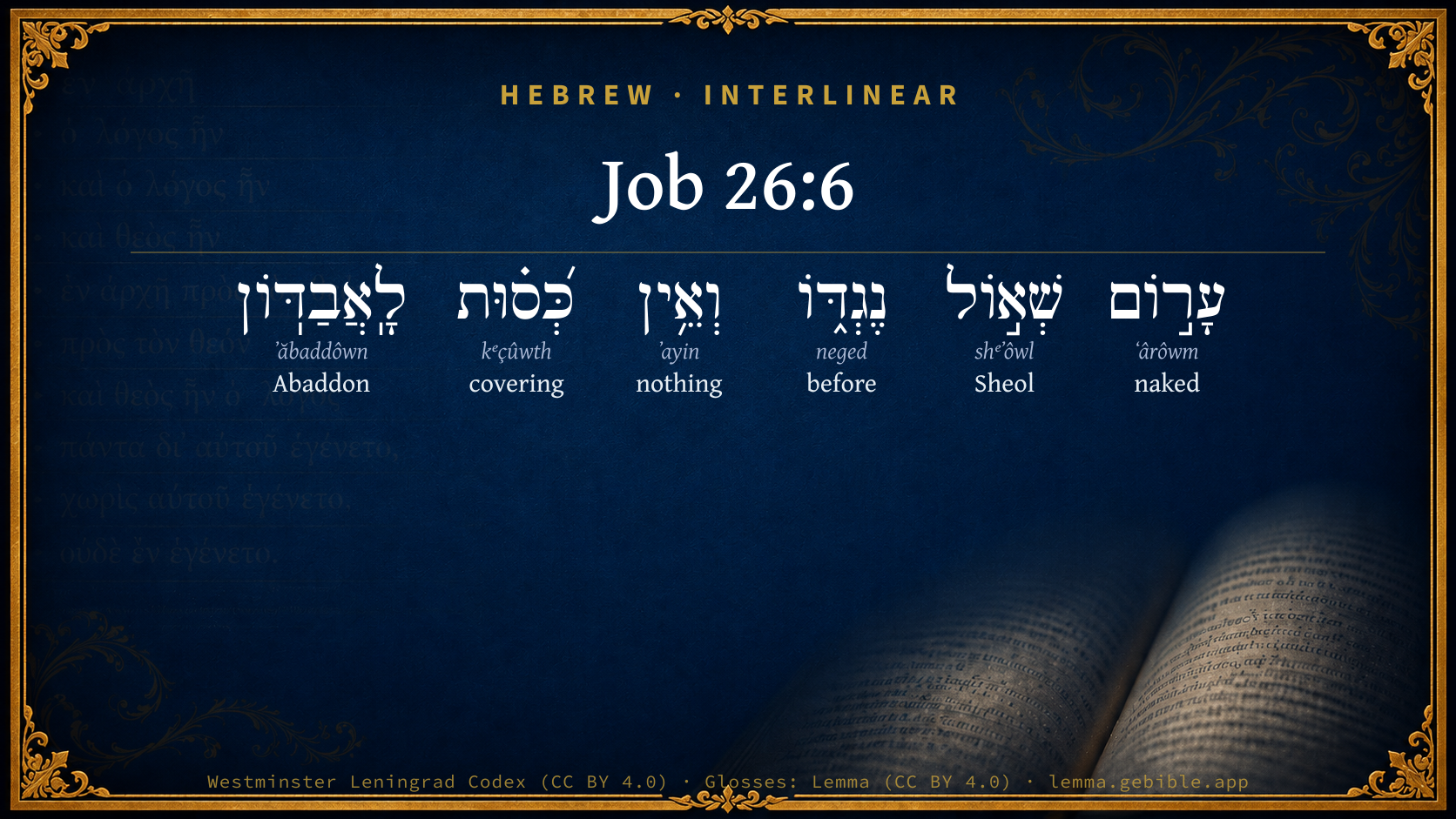
Job 26:6

Hebrew (Westminster Leningrad Codex) Job 26:6 appears in the Hebrew Old Testament. The text above is from the Westminster Leningrad Codex. Each word links to its Strong’s number, a concise gloss, and parsing drawn from the Open Scriptures Hebrew Bible morphology. Click any word for its full Brown-Driver-Briggs (BDB) entry.
Download image
Cite this verse

Job 26:6 (World English Bible). Public Domain. Lemma interlinear Bible study tool, https://lemma.gebible.app/v/job/26/6.

Show BibTeX & RIS
BibTeX
RIS
English Translation
Sheol is naked before God, And Abaddon has no covering.
World English Bible · Public Domain
Highlights
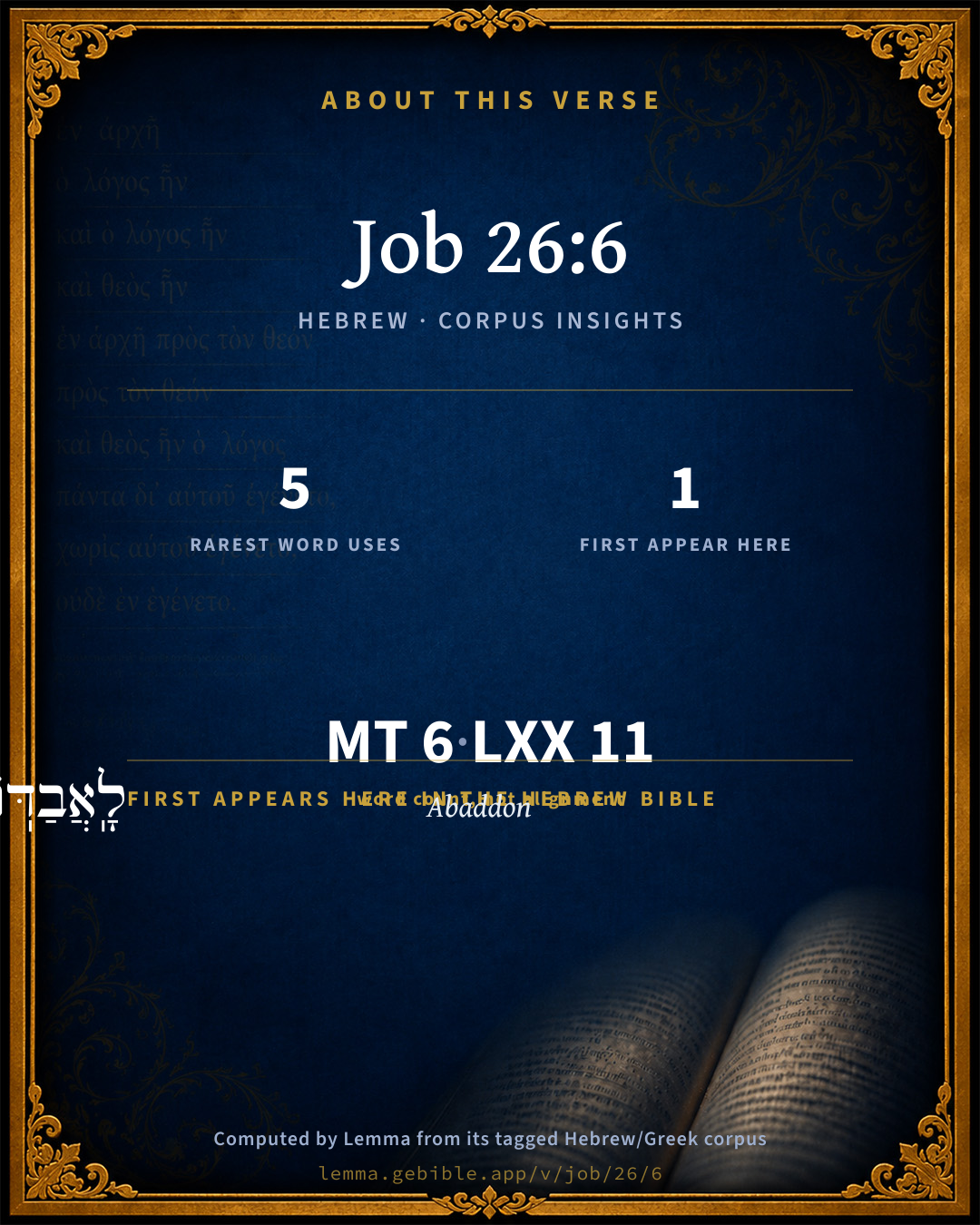
  • 1 first appearance in the Hebrew Bible
Full analysis ↓
Download a study sheet

One document with this verse’s original text, its word-by-word gloss line, the meaning frame, cross-references with their text, attributed commentary, and full source and license credits — printable, and it pastes into notes with its structure intact.

This verse Autodidact and up

Study sheet (.html) Plain text (.txt)

A passage Seminary Student

Up to 50 verses in one chapter. A passage sheet keeps up to 6 commentary sources and 12 cross-references per verse, in the order this page ranks them, and says so on the sheet whenever that leaves anything out. Ask for a single verse and you get the Autodidact verse sheet above.

Everything on this page stays free to read, with no account — the sheet is a download of what is already on screen, not access to it.

Want to remove ads? Support Godless Engineer
Compare translations 3

The same verse in 3 English versions, stacked beneath the original-language interlinear above. Click any original word for its lexicon entry.

Each is an independent rendering of the whole verse — the interlinear is not word-aligned to these translations.

Highlighted words mark where these versions differ — a whole-verse word diff, not a word-by-word alignment.

  • World English Bible Public Domain
    Sheol is naked before God, And Abaddon has no covering.
  • King James Version Public Domain
    Hell is naked before him, and destruction hath no covering.
  • unfoldingWord Literal Text CC BY-SA 4.0
    Sheol naked before him, and no covering to Abaddon,

unfoldingWord Literal Text — © unfoldingWord, licensed CC BY-SA 4.0. Word-aligned USFM3 via Door43 (git.door43.org/unfoldingWord/en_ult).

Versions to compare (up to 4)

3 of 4 selected

Show all 18 translations

Every available English version of this verse, each an independent rendering of the whole verse.

  • World English Bible Public Domain
    Sheol is naked before God, And Abaddon has no covering.
  • Berean Standard Bible Public Domain
    Sheol is naked before God, and Abaddon has no covering.
  • Majority Standard Bible Public Domain
    Sheol is naked before God, and Abaddon has no covering.
  • King James Version Public Domain
    Hell is naked before him, and destruction hath no covering.
  • American Standard Version (1901) Public Domain
    Sheol is naked before `God', And Abaddon hath no covering.
  • Revised Version (1885) Public Domain
    Sheol is naked before him, and Abaddon hath no covering.
  • Geneva Bible (1599) Public Domain
    The graue is naked before him, and there is no couering for destruction.
  • Douay-Rheims (1899) Public Domain
    Hell is naked before him, and there is no covering for destruction.
  • Young's Literal Translation Public Domain
    Naked `is' Sheol over-against Him, And there is no covering to destruction.
  • Literal Standard Version CC BY-SA 4.0
    Sheol [is] naked before Him, || And there is no covering to destruction.
  • Unlocked Literal Bible CC BY-SA 4.0
    Sheol is naked before God; destruction itself has no covering against him.
  • unfoldingWord Literal Text CC BY-SA 4.0
    Sheol naked before him, and no covering to Abaddon,
  • Darby Bible Public Domain
    Sheol is naked before him, and destruction hath no covering.
  • World Messianic Bible Public Domain
    Sheol is naked before God, and Abaddon has no covering.
  • Webster's Bible Public Domain
    Hell is naked before him, and destruction hath no covering.
  • Free Bible Version CC BY-SA 4.0
    Sheol lies naked before God, Abaddon is uncovered.
  • Bible in Basic English Public Domain
    The underworld is uncovered before him, and Destruction has no veil.
  • JPS Tanakh (1917) Public Domain
    The nether-world is naked before Him, and Destruction hath no covering.

Literal Standard Version (2020), Covenant Press — licensed CC BY-SA 4.0. Text via the HelloAO Bible API (eBible.org). Unlocked Literal Bible (unfoldingWord) — licensed CC BY-SA 4.0. Text via the HelloAO Bible API (eBible.org). unfoldingWord Literal Text — © unfoldingWord, licensed CC BY-SA 4.0. Word-aligned USFM3 via Door43 (git.door43.org/unfoldingWord/en_ult). Free Bible Version, Dr. Jonathan Gallagher — licensed CC BY-SA 4.0. Text via the HelloAO Bible API (eBible.org).

Word by word

More ways to search: Search by grammar → Find every occurrence → Compare this word →

Practice this passage: Drill this verse → Learn its vocabulary →

About this verse

These counts appear in no published source. They are computed here, from the morphology-tagged text and Lemma’s own curated glosses. What Lemma adds →

6
words
6
distinct lemmas
Wisdom
section

Notable vocabulary

The rarest word here is לָֽאֲבַדּֽוֹן Abaddon H11 — appearing just 5 times in the whole Hebrew Bible.

First appearance in Scripture

This word makes its first canonical appearance in the Hebrew Bible here:

  • לָֽאֲבַדּֽוֹן Abaddon H11

Shared distinctive vocabulary

לָֽאֲבַדּֽוֹן Abaddon H11 occurs in 5 verses of the Hebrew Bible. Also found in:

Grammatical profile

  • 3 nouns
  • 1 adjective
  • 1 preposition
  • 1 particle

Hebrew & Septuagint length

In English translation the verse runs 10 words from the Hebrew and 10 from the Septuagint (LXX English) — the same length.

A rough comparison of the two English renderings, which tokenize alike — not a word-level alignment.

Word counts can differ between the Hebrew and the Greek without any difference in meaning — e.g. the Hebrew direct-object marker אֵת has no separate Greek word, and Greek often adds the article ὁ.

In the original languages it is 6 Hebrew tokens and 11 Greek tokens — but the two are counted differently (Hebrew bundles its prefixes and suffixes into one token; the Greek is in lemma form), so that isn’t a like-for-like length.

Cross-references

10

Topical passages linked to Job 26:6 in the Treasury of Scripture Knowledge — connected by theme and wording, ordered by reader-vote popularity; previews shown in the World English Bible.

  • Psalms 139:8 If I ascend up into heaven, you are there. If I make my bed in Sheol, behold, you are there!
  • Proverbs 15:11 Sheol and Abaddon are before Yahweh-- How much more then the hearts of the children of men!
  • Hebrews 4:13 There is no creature that is hidden from his sight, but all things are naked and laid open before the eyes of him with whom we have to do.
  • Job 28:22 Destruction and Death say, 'We have heard a rumor of it with our ears.'
  • Amos 9:2 Though they dig into Sheol, there my hand will take them; and though they climb up to heaven, there I will bring them down.
  • Job 11:8 They are high as heaven. What can you do? Deeper than Sheol: what can you know?
  • Job 41:11 Who has first given to me, that I should repay him? Everything under the heavens is mine.
  • Psalms 88:10 Do you show wonders to the dead? Do the dead rise up and praise you? Selah.
  • Psalms 139:11 If I say, "Surely the darkness will overwhelm me; The light around me will be night;"
  • Isaiah 14:9 Sheol from beneath is moved for you to meet you at your coming; it stirs up the dead for you, even all the chief ones of the earth; it has raised up from their thrones all the kings of the nations.

Cross-references courtesy of OpenBible.info (CC BY 4.0).

Hebrew and Greek witnesses Masoretic Hebrew ↔ Greek Septuagint

The same verse in the two great witnesses to the Old Testament, shown verse-for-verse.

These are two independent witnesses, not word-aligned to each other, and the Septuagint is shown in lemma (dictionary) form.

Hebrew Job 26:6 Masoretic · Westminster Leningrad Codex

עָר֣וֹם שְׁא֣וֹל נֶגְדּ֑וֹ וְאֵ֥ין כְּ֝ס֗וּת לָֽאֲבַדּֽוֹן

Sheol is naked before God, And Abaddon has no covering.

World English Bible · Public Domain

Greek LXX Job 26:6 Septuagint · lemma form

γυμνός ὁ ᾅδης ἐπώπιον αὐτός καί οὐ εἰμί περιβόλαιον ὁ ἀπώλεια

Hell is naked before him, and destruction has no covering.

LXX2012 (modern English Septuagint) · Public Domain

On this verse, John Gill's Exposition discusses the Septuagint’s reading. Read the note in Commentary ↓

Hebrew: Westminster Leningrad Codex (CC BY 4.0). Greek: Septuagint (public domain); English from LXX2012 (modern English Septuagint) (Public Domain). How the Septuagint differs from the Hebrew →

Commentary

Notes on Job 26:6 from classic Christian and Jewish commentators (each source and its license shown beneath its notes). The classic Christian expositions comment on the surrounding passage and are grouped to its opening verse, so a note may address several verses; the Jewish commentaries on the Tanakh (Rashi and others) are per-verse, so they appear only where the commentator wrote on this verse.

Lemma curates 59 commentaries, every one of them public domain or Creative Commons licensed, each selected and text-cleaned for this edition rather than reprinted as found. About our sources →

Trapp's Complete Commentary

John Trapp

Job 26:6 Hell [is] naked before him, and destruction hath no covering.

Ver. 6. Hell and destruction are before him] Here beginneth a magnificent and stately description of the majesty of God; and, 1. From his omniscience; 2. From his omnipotence. For the first, "Hell and destruction are before him." Not the grave only, but the nethermost hell, that most abstruse part of the universe, and most remote from heaven, God’s court. Of hell we know nothing save only what the Scripture saith of it in general, that there is a hell, and that the pains of it are endless, easeless, and remediless, &c., but God only knoweth who are in hell, and who is yet to be hereafter hurled into it. It is the saints’ happiness that to them there is no such condemnation, Rom 8:1, that over them this second death hath no power, Rev 20:6. That if hell had already swallowed them up (as they sometimes when deserted feel themselves to be in the very suburbs of it), it could no better hold them than the whale’s stomach could do Jonah. Luk 22:31, "Satan hath desired to have thee"; sc. to hell, but that he shall never have; for they are the redeemed of the Lord, saved from the wrath to come, and may triumphingly sing, Death, where is thy sting? Hell, where is thy victory? &c.

And destruction hath no covering] That is, hell, the place of destruction, the palace of King Abaddon (so the devil is called, Rev 9:11), and so hell is called in this text, because thereinto are thrust all that are destined to destruction, all the brats of fathomless perdition, such as was Judas the traitor, who went to his place, and all wicked ones, who shall surely be turned into hell, with all those that forget God, Psa 9:17. This place is not covered, saith Ferus here, but open to God, for whomsoever he will cast thereinto.

John Trapp, A Commentary or Exposition upon All the Books of the Old and New Testament (1647–1656) — public domain. Text from a community e-Sword module.

Albert Barnes' Notes on the Bible

Hell - Hebrew שׁאול she'ôl, Sheol; Greek ᾅδης Hadēs Hades. The reference is to the abode of departed spirits - the nether world where the dead were congregated; see the notes at Job 10:21-22. It does not mean here, as the word hell does with us, a place of punishment, but the place where all the dead were supposed to be gathered together.

Is naked before him - That is, be looks directly upon that world. It is hidden from us, but not from him. He sees all its inhabitants, knows all their employments, and sways a scepter over them all.

And destruction - Hebrew אבדון 'ăbaddôn, Abaddon; compare Rev 9:11, “And they had a king over them, which is the angel of the bottomless pit, whose name in the Hebrew is Abaddon, but in the Greek tongue hath his name Apollyon.” The Hebrew word means destruction, and then abyss, or place of destruction, and is evidently given here to the place where departed spirits are supposed to reside. The word in this form occurs only here and in Pro 15:11; Psa 88:11; Job 26:6, in all which places it is rendered destruction. The idea here is, not that this is a place where souls are destroyed, but that it is a place similar to destruction - as if all life, comfort, light, and joy, were extinguished.

Hath no covering - There is nothing to conceal it from God. He looks down even on that dark nether world, and sees and knows all that is there. There is a passage somewhat similar to this in Homer, quoted by Longinus as one of unrivaled sublimity, but which by no means surpasses this. It occurs in the Iliad, xx. 61-66:

Εδδεισεν δ ̓ ὑτένερθεϚ ἄναξ ἐνέρων Αιδωνεὺς, κ. τ. λ.

Eddeisen d' hupenerthen anac enerōn Aidōneus, etc.

Deep in the dismal regions of the dead

Th’ infernal monarch reared his horrid head,

Leaped from his throne, lest Neptune’s arm should lay

His dark dominions open to the day,

And pour in light on Pluto’s drear abodes,

Abhorred by men, and dreadful e’en to gods.

Pope

Albert Barnes' Notes on the Bible (1834–1885) — public domain. Text from a community e-Sword/MySword module.

Joseph Benson's Commentary

Job 26:6. Hell is naked before him — Is in his presence, and under his providence. Hell itself, that place of utter darkness, is not hid from his sight. Destruction — The place of destruction, hath no covering — Such as can conceal it from his view.

Joseph Benson's Commentary on the Old and New Testaments (1811–1818) — public domain. Text from a community e-Sword module.

Geneva Bible (1599)

Geneva Bible translators

There is nothing hid in the bottom of the earth but he seeth it.

Meaning, the grave wherein things putrify.

Geneva Bible (1599) marginal notes — public domain. Text via Bolls.life.

Jamieson, Fausset & Brown

Robert Jamieson, A. R. Fausset & David Brown

(Job 38:17; Psa 139:8; Pro 5:11).

destruction--the abode of destruction, that is, of lost souls. Hebrew, Abaddon (Rev 9:11).

no covering--from God's eyes.

Jamieson, Fausset & Brown — Commentary Critical and Explanatory on the Whole Bible (1871) — public domain (CC PDM 1.0). Text via the HelloAO Bible API.

Adam Clarke's Commentary

Verse 6. Hell is naked before him] Sheol, the place of the dead, or of separate spirits, is always in his view. And there is no covering to Abaddon - the place of the destroyer, where destruction reigns, and where those dwell who are eternally separated from God. The ancients thought that hell or Tartarus was a vast space in the centre, or at the very bottom of the earth. So VIRGIL, AEn. lib. vi., ver. 577: -

___________________ Tum Tartarus ipse

Bis patet in praeceps tantum, tenditque sub umbras,

Quantus ad aethereum coeli suspectus Olympum

Hic genus antiquum terrae, Titania pubes,

Fulmine dejecti, fundo volvuntur in imo.

"Full twice as deep the dungeon of the fiends,

The huge Tartarean gloomy gulf, descends

Below these regions, as these regions lie

From the bright realms of yon ethereal sky.

Here roar the Titan race, th' enormous birth;

The ancient offspring of the teeming earth.

Pierced by the burning bolts of old they fell,

And still roll bellowing in the depths of hell."

PITT.

And some have supposed that there is an allusion to this opinion in the above passage, as well as in several others in the Old Testament; but it is not likely that the sacred writers would countenance an opinion that certainly has nothing in fact or philosophy to support it. Yet still a poet may avail himself of popular opinions.

Adam Clarke's Commentary on the Bible (1810–1826) — public domain. Text from a community e-Sword/MySword module.

The Cambridge Bible for Schools and Colleges

gen. ed. J. J. S. Perowne

6. Hell] is in Heb. Sheol, the place where deceased persons congregate, the world beneath. It is not a place of pain, though a dark and dreary abode, ch. Job_10:21-22. Those there are the dead, who still subsist, though they do not live. “Destruction,” Heb. abaddon, is a synonym for Sheol, ch. Job_28:22. This as well as all things is naked to the eyes of Jehovah. Comp. Amo_9:2; Psa_139:8.

The Cambridge Bible for Schools and Colleges (gen. ed. J. J. S. Perowne; Cambridge University Press, 1878–1918) — public domain. Text from a community e-Sword module.

John Gill's Exposition

Hell is naked before him,.... Which may be taken either for the place of the damned, as it sometimes is; and then the sense is, that though it is hidden from men, and they know not where it is, or who are in it, and what is done and suffered there; yet it is all known to God: he knows the place thereof, for it is made, ordained, and prepared by him; he knows who are there, even all the wicked dead, and all the nations that forget God, being cast there by him; he knows the torments they endure, for the smoke of them continually ascends before him; and he knows all their malice and envy, their enmity to him, and blasphemy of him; for thither are they gone down with their weapons of war, and have laid their swords under their heads, Eze 32:27; or for Hades, the invisible world of spirits, or state of the dead, as the Septuagint version renders the word; though that is unseen to men, it is naked and open to the eye of God; or for the grave, in which the bodies of men are laid; which is the frequent sense of the word used, Psa 88:11; and though this is a land of darkness, and where the light is as darkness, yet God can look into it; and the dust of men therein is carefully observed and preserved by him, and will be raised again at the last day; who has the keys of death and hell, or the grave, and can open it at his pleasure, and cause it to give up the dead that are therein:

and destruction hath no covering; and may design the same as before, either hell, the place of the damned, where men are destroyed soul and body with an everlasting destruction; or the grave, which the Targum calls the house of destruction, as it sometimes is, the pit of destruction and corruption; because bodies cast into it corrupt and putrefy, and are destroyed in it; and there is nothing to cover either the one or the other from the all seeing eye of God; see Psa 139:7; as hell is supposed to be under the earth, and the grave is in it, Job is as yet on things below, and from hence rises to those above, in the following words.

John Gill's Exposition of the Whole Bible (1746–1763) — public domain (CC PDM 1.0). Text via the HelloAO Bible API.

Haydock's Catholic Bible Commentary

Hell. The grave. --- Destruction. Hebrew abaddon. (Haydock) --- St. John (Apocalypse ix. 11.) styles the bottomless abyss; (Calmet) or its angel, (Haydock) Abaddon, or Apollyon. It may here be called destruction, (Calmet) as all its victims are lost for ever to every thing that is good. The obscurity of the grave, and even that of hell, can hide nothing from God.

George Leo Haydock (1774–1849), Haydock's Catholic Family Bible and Commentary, 1859 edition — public domain. Excludes Psalms (Douay-Rheims chapter numbering differs from Protestant) and Deuterocanonical books (Catholic canon only).

Matthew Poole's English Annotations

Hell, as this word is frequently used, as Job 11:8; Isa 57:9, &c. And so it seems to be explained by the following word,

destruction, i.e. the place of destruction, which interpreters generally understand of hell, or the place of the damned. Others, the grave, the most secret and obscure places and things. Is naked before him, i.e. it is in his presence, and under his providence. So far am I from imagining that God cannot see through a dark cloud, as you traduced me, Job 22:13, that I very well know that even hell itself, that place of utter darkness, is not hid from his sight.

Destruction, i.e. the place of destruction, as it is also used, Pro 15:11, by a metonymy of the adjunct.

Hath no covering, to wit, such as to keep it out of his sight.

Matthew Poole's English Annotations on the Holy Bible (1683–1685) — public domain. Text from a community e-Sword/MySword module.

Whedon's Commentary on the Bible

Daniel D. Whedon

6. Hell — Hebrew, sheol.

Naked — Compare Heb_4:13.

Destruction — Hebrews Abaddon. The rabbins were led, by Psa_88:11, where the same word is used, to regard Abaddon as the nethermost of the two worlds into which they divided the under world. (See Excursus III, page 74.)

Daniel D. Whedon (gen. ed.), Commentary on the Old and New Testaments (1874–1909) — public domain. Text from a community e-Sword module.

The Pulpit Commentary

Hell is naked before him; i.e. "can hide nothing from his eyes shows all its inmost recesses. And destruction hath no covering; rather, Abaddon hath no covering (see the Revised Version). Abaddon is sometimes "destruction," sometimes "the angel of the bottomless pit", (Rev_9:11) sometimes "the bottomless pit itself". (Pro_15:11) Here the last of these three senses seems to suit best the deepest depth of the bottomless pit is no secret to God," but "naked and opened unto the eyes of him with whom we have to do" (Heb_4:13)

Vers. 6-14. The Divine ways but partially revealed.

Bildad had given Job no comfort. And Job at first (vers. 1-3) retorts upon him a reproof for his unhelpful words. He then bursts into an impressive representation of the wonderful works of God to whom Bildad had referred. The works of God in the heavens, the earth, and the deep sea are great and manifold; so are his works amongst the creatures of his power, of whom the serpent alone is mentioned. But the hidden hand of God Job confesses, and the greatness of the Divine works and ways, of which only a part is revealed. We may take a wider sweep than even Job does, and say

I Parts of the Divine ways are revealed IN THE VISIBLE CREATION. His wonderful works.

II IN HIS WAYS TO THE CHILDREN OF MEN. In the working of that providence that ever guards the interests of the human life.

III IN THE REVELATIONS OF HOLY SCRIPTURE. Here light falls especially

(1) on the Divine Name;

(2) on the mysteries of the Divine providence;

(3) on the spiritual future on God, on human life and duty, on immortality.

Yet with all the teachings it must still be said," How little a portion is heard of him?" We have heard the whisper; "but the thunder of his power who can understand?" A plain duty is to judge of that which is hidden by that which is made known. And the question instantly arises to our lips Are the revelations which God has made of himself and of his ways in nature, in human life, in the Holy Scriptures, such as encourage us to trust in those ways, and in him, where all is covered with clouds and thick darkness? If the revealed things are good and trust worthy, it is most reasonable to demand faith in the hidden and unseen. Faith in the unseen is warranted by

(1) the beauty,

(2) utility,

(3) perfectness,

(4) beneficence of the Divine ways, as they are traceable in the works of the Divine hand; but faith"s highest warrant is in the Divine Name the absolutely good, pure, just, and beneficent One. R.G.

God"s vision of death.

Bildad has just spoken of the exalted dominion of God that reaches to heavenly heights, overawing the very moon and stars. Job now replies, turning his eyes downward, and noticing how the dim underworld is all open to the inspection of God.

I THE DEAD ARE NOT BEYOND THE VISION OF GOD. He lives in light, and they lie in darkness; yet he sees them. There is no escaping from his presence. "If I make my bed in Hades, behold, thou art there". (Psa_139:8)

1. There is no eluding his observation. A man cannot flee from God by dying. Indeed, is not suicide rightly regarded as rushing into the presence of God? No darkness hides from God, for day and night are alike with him, and no change of sphere removes from the reach of him who rules through all the spheres.

2. There is no loss of his notice. No one can be beneath the attention of God too low, too degraded, in too dark and desolate a region to be seen by him. Perhaps this was Job"s thought. He was longing for God to come and vindicate his cause; but he could not but admit that death might come first, for his disease was making fearful inroads on his constitution. Still, he would not lose the chance of meeting God. If not on earth, then it should be after death. God will follow his children wherever they go in the next world, as he follows them in this world.

II GOD"S VISION OF THE DEAD IS OF GREAT CONSEQUENCE TO THEM. If Hades and destruction have no covering before God, this means very much to Hades and destruction. It cannot be the same thing whether we are looked upon by God or not. Surely it means much to know that the abode of death is not deserted by God. God cannot look down into this dark region as a mere spectator. He is everywhere a Life, a Power, an Authority. Therefore we must conclude that the rule of God extends over the unseen world. Certain important consequences flow from this truth.

1. Justice will be done there. God will not allow injustice to go on for ever. The process of rectification is slow; but God is infinitely patient, and he has eternity before him. The unpunished sinner will meet his dreadful deserts in the next world, and the ill-used and misunderstood good man will be vindicated there.

2. Life will be given there. God cannot look on the dead and leave them in their natural darkness. His gaze quickens. If he visits the realm of the dead he will bring about a resurrection. The dead are not cast out, forgotten, left to fade and melt out of all being. God touches them, and they awake, like the frost-bound earth at the touch of spring.

3. Mercy will extend to them. How and to what extent this may be received by the dead is a mystery concerning which we have little or no light. But we know that "the mercy of the Lord endureth for ever." We know that God is changeless. His love is unfailing. He must ever desire the recovery of his children. Yet dogmatic universalism is as false to human nature as it is to the warnings of Scripture. For men may harden themselves against the mercy of God; if they do so on earth, how can we say that they will not do so after death? W.F.A.

The Pulpit Commentary (1880–1919), ed. H.D.M. Spence-Jones & Joseph S. Exell — public domain. Text from a community e-Sword module.

John Wesley's Explanatory Notes

Hell - Is in his presence, and under his providence. Hell itself, that place of utter darkness, is not hid from his sight. Destruction - The place of destruction.

John Wesley, Explanatory Notes Upon the Whole Bible (1754–1765) — public domain. Text via the GEBible commentary corpus.

Scofield Reference Notes

C. I. Scofield

hell

Heb. "Sheol," (See Scofield "Hab 2:5"). Also, Psa 139:8; Psa 139:11; Pro 15:11; Heb 4:13.

The Scofield Reference Bible (1917 edition), notes by C. I. Scofield — public domain. Text from a community e-Sword module.

Rashi

Rabbi Shlomo Yitzchaki (Rashi)

Sheol is naked before Him to know and to see all that is within it.

Rashi on the Tanakh — English translations: “The Judaica Press complete Tanach with Rashi, translated by A. J. Rosenberg” (CC BY 4.0); “Pentateuch with Rashi's commentary by M. Rosenbaum and A.M. Silbermann, 1929-1934” (public domain); “The Metsudah Tanach series, Lakewood, N.J” (CC BY 4.0); and “The Book of Joshua, Metsudah Publications, 1997” (CC BY 4.0). Text via Sefaria.

Lesson kit

Teaching starters — assembled from the data on this page, not authored interpretation. Every prompt links to the verse data it draws on. Edit before teaching.

Job, in the Wisdom, opens this verse with 6 words (6 distinct Hebrew lemmas). Its most distinctive word is ʼăbaddôwn (“Abaddon”). A historical commentator’s framing appears above. Read the whole chapter for the surrounding context.

Discussion questions

  1. The word ʼăbaddôwn carries the sense “Abaddon.” How does it shape the verse?
  2. This is the first place “Abaddon” appears in Scripture (first appears here). What does its debut here establish?
  3. How does Job 28:22, which shares the word «Abaddon», read alongside this verse?
  4. These translations render this verse differently. What is at stake in choosing one wording over another?
  5. Compare how Trapp's Complete Commentary and Albert Barnes' Notes on the Bible read this verse. Where do they agree or differ?

Things to notice

Reading settings

Reading text

Shown beneath each verse's original-language words.

Old Testament
Old Testament edition

Read the OT as the Masoretic Hebrew (MT) or the Greek Septuagint (LXX).

English shown for the Greek Septuagint (in the Hebrew ↔ Greek comparison).

Comparing translations? Open the Compare panel on any verse page to stack up to four side by side.