Job 30:12

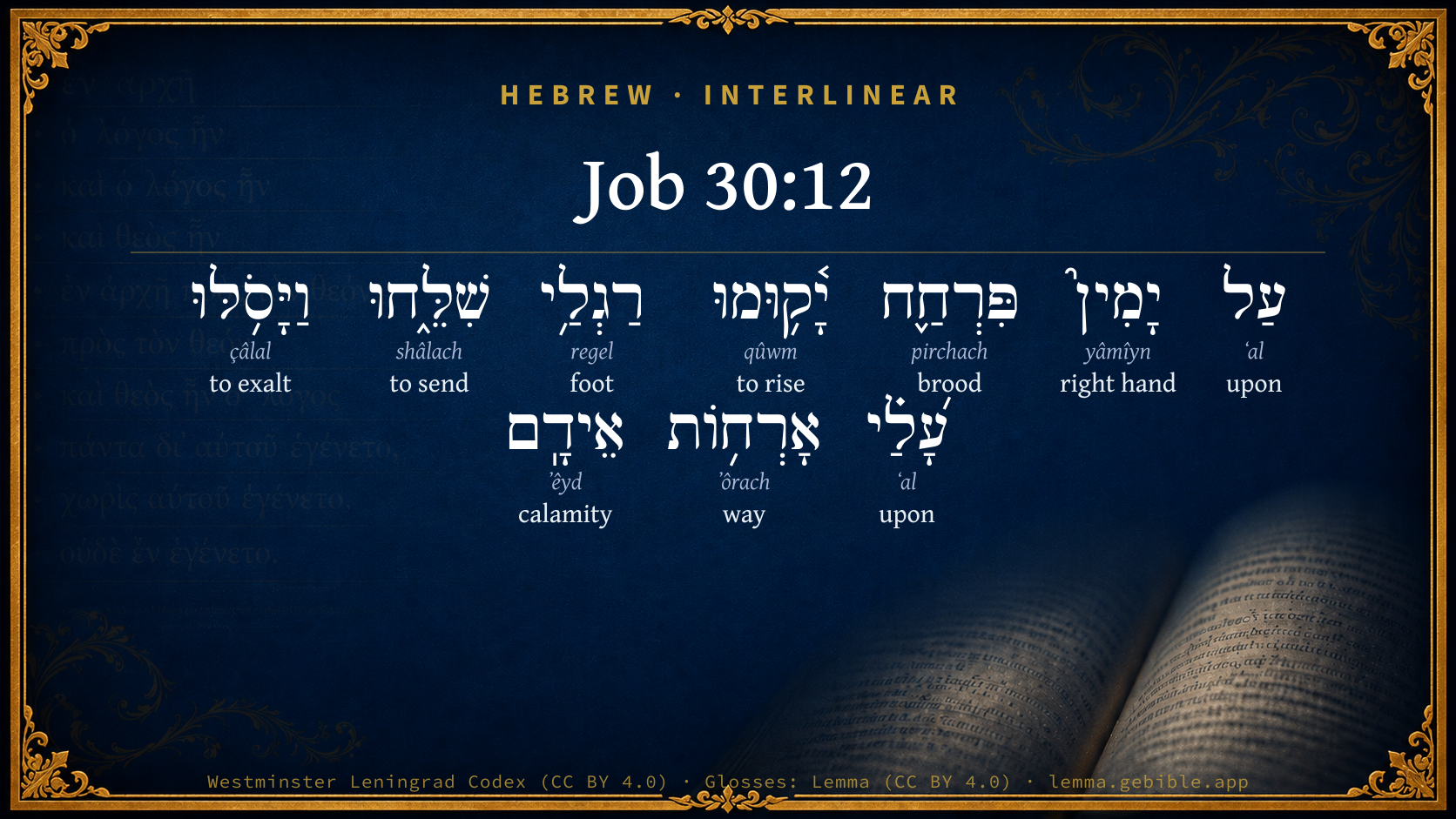
Hebrew (Westminster Leningrad Codex) Job 30:12 appears in the Hebrew Old Testament. The text above is from the Westminster Leningrad Codex. Each word links to its Strong’s number, a concise gloss, and parsing drawn from the Open Scriptures Hebrew Bible morphology. Click any word for its full Brown-Driver-Briggs (BDB) entry.
Download image
Cite this verse

Job 30:12 (World English Bible). Public Domain. Lemma interlinear Bible study tool, https://lemma.gebible.app/v/job/30/12.

Show BibTeX & RIS
BibTeX
RIS
English Translation
On my right hand rise the rabble. They thrust aside my feet, They cast up against me their ways of destruction.
World English Bible · Public Domain
Highlights
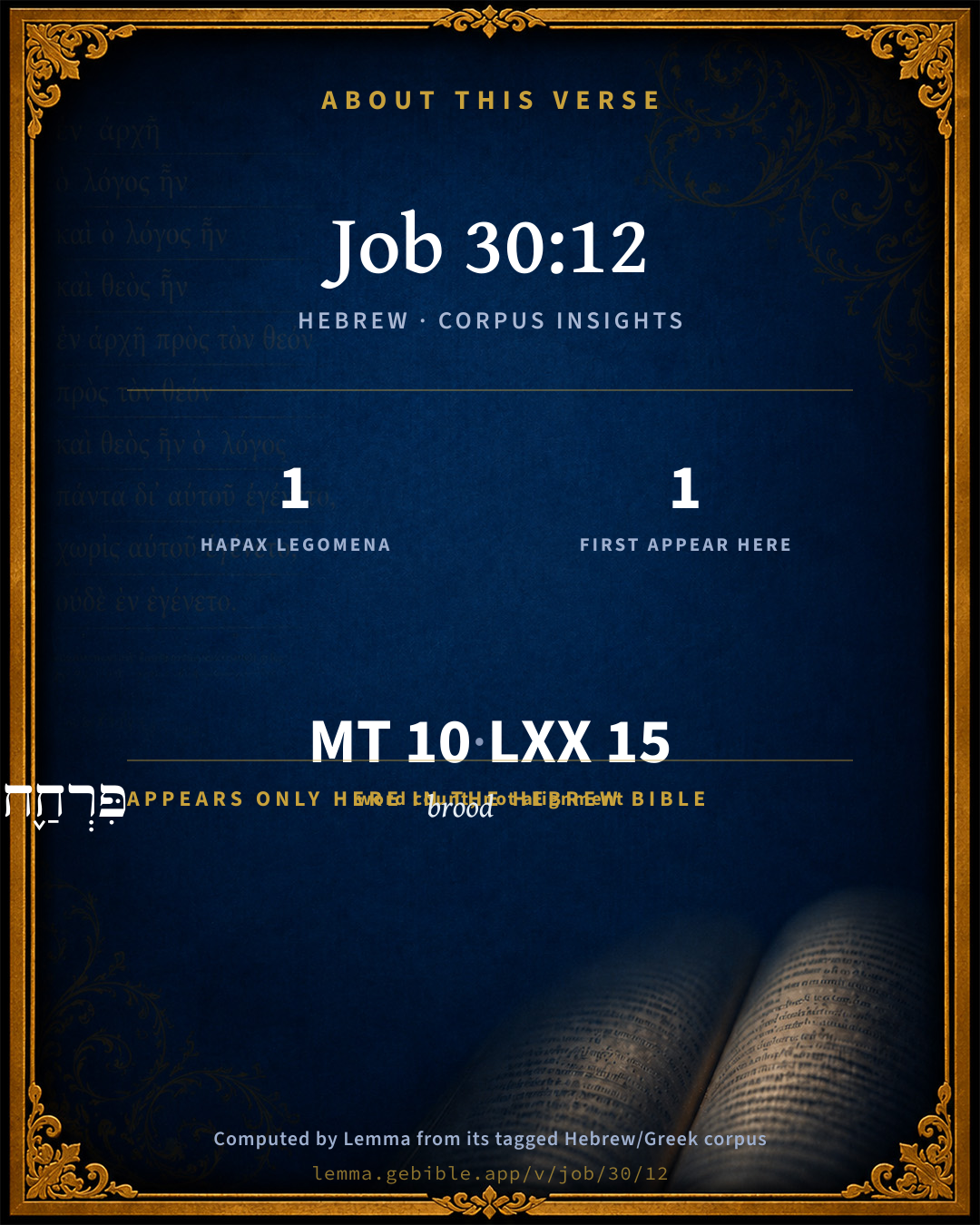
  • 1 hapax legomenon — only here in the Hebrew Bible
  • 1 first appearance in the Hebrew Bible
Full analysis ↓
Download a study sheet

One document with this verse’s original text, its word-by-word gloss line, the meaning frame, cross-references with their text, attributed commentary, and full source and license credits — printable, and it pastes into notes with its structure intact.

This verse Autodidact and up

Study sheet (.html) Plain text (.txt)

A passage Seminary Student

Up to 50 verses in one chapter. A passage sheet keeps up to 6 commentary sources and 12 cross-references per verse, in the order this page ranks them, and says so on the sheet whenever that leaves anything out. Ask for a single verse and you get the Autodidact verse sheet above.

Everything on this page stays free to read, with no account — the sheet is a download of what is already on screen, not access to it.

Want to remove ads? Support Godless Engineer
Compare translations 3

The same verse in 3 English versions, stacked beneath the original-language interlinear above. Click any original word for its lexicon entry.

Each is an independent rendering of the whole verse — the interlinear is not word-aligned to these translations.

Highlighted words mark where these versions differ — a whole-verse word diff, not a word-by-word alignment.

  • World English Bible Public Domain
    On my right hand rise the rabble. They thrust aside my feet, They cast up against me their ways of destruction.
  • King James Version Public Domain
    Upon my right hand rise the youth; they push away my feet, and they raise up against me the ways of their destruction.
  • unfoldingWord Literal Text CC BY-SA 4.0
    On right the brood arise; they thrust aside my foot, and they pile up roads of destruction against me.

unfoldingWord Literal Text — © unfoldingWord, licensed CC BY-SA 4.0. Word-aligned USFM3 via Door43 (git.door43.org/unfoldingWord/en_ult).

Versions to compare (up to 4)

3 of 4 selected

Show all 18 translations

Every available English version of this verse, each an independent rendering of the whole verse.

  • World English Bible Public Domain
    On my right hand rise the rabble. They thrust aside my feet, They cast up against me their ways of destruction.
  • Berean Standard Bible Public Domain
    The rabble arises at my right; they lay snares for my feet and build siege ramps against me.
  • Majority Standard Bible Public Domain
    The rabble arises at my right; they lay snares for my feet and build siege ramps against me.
  • King James Version Public Domain
    Upon my right hand rise the youth; they push away my feet, and they raise up against me the ways of their destruction.
  • American Standard Version (1901) Public Domain
    Upon my right hand rise the rabble; They thrust aside my feet, And they cast up against me their ways of destruction.
  • Revised Version (1885) Public Domain
    Upon my right hand rise the rabble; they thrust aside my feet, and they cast up against me their ways of destruction.
  • Geneva Bible (1599) Public Domain
    The youth rise vp at my right hand: they haue pusht my feete, and haue trode on me as on the paths of their destruction.
  • Douay-Rheims (1899) Public Domain
    At the right hand of my rising, my calamities forthwith arose: they have overthrown my feet, and have overwhelmed me with their paths as with waves.
  • Young's Literal Translation Public Domain
    On the right hand doth a brood arise, My feet they have cast away, And they raise up against me, Their paths of calamity.
  • Literal Standard Version CC BY-SA 4.0
    A brood arises on the right hand, || They have cast away my feet, || And they raise up against me, || Their paths of calamity.
  • Unlocked Literal Bible CC BY-SA 4.0
    Upon my right hand rise the rabble; they drive me away and pile up against me their siege mounds.
  • unfoldingWord Literal Text CC BY-SA 4.0
    On right the brood arise; they thrust aside my foot, and they pile up roads of destruction against me.
  • Darby Bible Public Domain
    At [my] right hand rise the young brood; they push away my feet, and raise up against me their pernicious ways;
  • World Messianic Bible Public Domain
    On my right hand rise the rabble. They thrust aside my feet. They cast their ways of destruction up against me.
  • Webster's Bible Public Domain
    Upon my right hand rise the youth; they push away my feet, and they raise up against me the ways of their destruction.
  • Free Bible Version CC BY-SA 4.0
    The rabble rise up against me, they send me running; like a city under siege they devise ways to destroy me.
  • Bible in Basic English Public Domain
    The lines of his men of war put themselves in order, and make high their ways of destruction against me:
  • JPS Tanakh (1917) Public Domain
    Upon my right hand rise the brood; they entangle my feet, and they cast up against me their ways of destruction.

Literal Standard Version (2020), Covenant Press — licensed CC BY-SA 4.0. Text via the HelloAO Bible API (eBible.org). Unlocked Literal Bible (unfoldingWord) — licensed CC BY-SA 4.0. Text via the HelloAO Bible API (eBible.org). unfoldingWord Literal Text — © unfoldingWord, licensed CC BY-SA 4.0. Word-aligned USFM3 via Door43 (git.door43.org/unfoldingWord/en_ult). Free Bible Version, Dr. Jonathan Gallagher — licensed CC BY-SA 4.0. Text via the HelloAO Bible API (eBible.org).

Word by word

More ways to search: Search by grammar → Find every occurrence → Compare this word →

Practice this passage: Drill this verse → Learn its vocabulary →

About this verse

These counts appear in no published source. They are computed here, from the morphology-tagged text and Lemma’s own curated glosses. What Lemma adds →

10
words
9
distinct lemmas
Wisdom
section

Notable vocabulary

1 hapax legomenon — a word that appears only here in the entire Hebrew Bible:

  • פִּרְחַ֪ח brood H6526

First appearance in Scripture

This word makes its first canonical appearance in the Hebrew Bible here:

  • פִּרְחַ֪ח brood H6526

Shared distinctive vocabulary

וַיָּסֹ֥לּוּ to exalt H5549 occurs in 10 verses of the Hebrew Bible. Also found in:

Grammatical profile

  • 3 verbs
  • 5 nouns
  • 2 prepositions

Verb forms

  • יָ֫ק֥וּמוּ Qal · Imperfect
  • שִׁלֵּ֑חוּ Piel · Perfect
  • וַיָּסֹ֥לּוּ Qal · Sequential Imperfect

Repetition

A word recurs within this verse — often emphatic in Hebrew:

Hebrew & Septuagint length

In English translation the verse runs 21 words from the Hebrew and 28 from the Septuagint (LXX English) — closely comparable.

A rough comparison of the two English renderings, which tokenize alike — not a word-level alignment.

Word counts can differ between the Hebrew and the Greek without any difference in meaning — e.g. the Hebrew direct-object marker אֵת has no separate Greek word, and Greek often adds the article ὁ.

In the original languages it is 10 Hebrew tokens and 15 Greek tokens — but the two are counted differently (Hebrew bundles its prefixes and suffixes into one token; the Greek is in lemma form), so that isn’t a like-for-like length.

Cross-references

4

Topical passages linked to Job 30:12 in the Treasury of Scripture Knowledge — connected by theme and wording, ordered by reader-vote popularity; previews shown in the World English Bible.

  • Job 19:12 His troops come on together, Build a siege ramp against me, And encamp around my tent.
  • Job 19:18 Even young children despise me. If I arise, they speak against me.
  • Psalms 140:4–5 Yahweh, keep me from the hands of the wicked. Preserve me from the violent men who have determined to trip my feet.
  • Isaiah 3:5 The people will be oppressed, Everyone by another, And everyone by his neighbor. The child will behave himself proudly against the old man, And the base against the honorable.

Cross-references courtesy of OpenBible.info (CC BY 4.0).

Hebrew and Greek witnesses Masoretic Hebrew ↔ Greek Septuagint

The same verse in the two great witnesses to the Old Testament, shown verse-for-verse.

These are two independent witnesses, not word-aligned to each other, and the Septuagint is shown in lemma (dictionary) form.

Hebrew Job 30:12 Masoretic · Westminster Leningrad Codex

עַל יָמִין֮ פִּרְחַ֪ח יָ֫ק֥וּמוּ רַגְלַ֥י שִׁלֵּ֑חוּ וַיָּסֹ֥לּוּ עָ֝לַ֗י אָרְח֥וֹת אֵידָֽם

On my right hand rise the rabble. They thrust aside my feet, They cast up against me their ways of destruction.

World English Bible · Public Domain

Greek LXX Job 30:12 Septuagint · lemma form

ἐπί δεξιός βλαστός ἐπι ἀναἵστημι πούς αὐτός ἐκτείνω καί ὁδοποιέω ἐπί ἐγώ τρίβος ἀπώλεια αὐτός

They have risen up against me on the right hand of their offspring; they have stretched out their foot, and directed against me the ways of their destruction.

LXX2012 (modern English Septuagint) · Public Domain

On this verse, Albert Barnes' Notes on the Bible discusses the Septuagint’s reading. Read the note in Commentary ↓

Hebrew: Westminster Leningrad Codex (CC BY 4.0). Greek: Septuagint (public domain); English from LXX2012 (modern English Septuagint) (Public Domain). How the Septuagint differs from the Hebrew →

Commentary

Notes on Job 30:12 from classic Christian and Jewish commentators (each source and its license shown beneath its notes). The classic Christian expositions comment on the surrounding passage and are grouped to its opening verse, so a note may address several verses; the Jewish commentaries on the Tanakh (Rashi and others) are per-verse, so they appear only where the commentator wrote on this verse.

Lemma curates 59 commentaries, every one of them public domain or Creative Commons licensed, each selected and text-cleaned for this edition rather than reprinted as found. About our sources →

Trapp's Complete Commentary

John Trapp

Job 30:12 Upon [my] right [hand] rise the youth; they push away my feet, and they raise up against me the ways of their destruction.

Ver. 12. Upon the right hand rise the youth] Broughton readeth, The springals. The Hebrew hath it, The blossom, or the young birds, Vix puberes, such as are scarcely out of the shell. The youngsters, the boys, scoffed and abused Job. The lawless rout, riding without reins, took a licentious boldness to despise and despite him, because he was ever most severe against their unruly practices.

They push away my feet] They trip up my heels, as we phrase it, and lay me along. Vide admirandam humanae sortis varietatem, saith Brentius here; i.e. See the strange turns of human condition. Job was wont to have the chief seats in the temple, and salutations in the market place; now he cannot have a room anywhere to stand in, but every paltry boy is pushing him down. May it not be said of Job, as it was of that emperor, that he was fortunae pila et lusus? But he saw God in all.

And they raise up against me the ways of their destruction] Allegoria castrensis. Job borroweth this expression from the camp, as he doth many more from other things, whensoever he speaketh of his great afflictions, and the contempt that was cast upon him. Upon me they tread the paths of their unhappiness, so Beza; that is, they make a path in which they may practise that their malapert boldness in doing mischief. They beat their paths by running up and down therein, to undo me, so Vatablus; they cast upon me the causes of their woe, so Broughton.

John Trapp, A Commentary or Exposition upon All the Books of the Old and New Testament (1647–1656) — public domain. Text from a community e-Sword module.

The Biblical Illustrator

Joseph S. Exell

Job_30:12

Upon my right hand rise the youth.

The prospects of life

I. The prospects of life are generally bright. Young people are full of buoyancy, animal spirits, ardent desire, sanguine expectation, high hope: all that is before them takes a colouring from themselves. There is little or no experience of life, by the use of which exaggerated views may be modified, and a correct estimate of the future ensured. Youthful hope often anticipates long life, and it fills up that life with many visions of success and happiness.

II. The prospects of life, to which hope gives such a colouring are often illusive. A fine morning often ends in a wet and stormy day. Projects begun under favourable auspices frequently come to nought. Young people live in a realm of illusions. The young are liable to misapprehension, and need to be prepared for some measure of disappointment. Men at fifty often find that they have failed to reach the height to which at twenty they aspired. Often the secret of failure has been lack of ability, or of perseverance, or of character.

III. A few counsels.

1. The present is a season of preparation for the future. Life is very much what we make it. Then sow now the seeds that shall grow up, and blossom, and fruiten into a good and blessed future.

2. Prepare for the future by the exercise of fidelity to yourself and to God in the present.

3. You need physical preparation for the future. A mans body has much to do with his mind and character. Courage and fortitude derive much support from a healthy physical constitution.

4. You need mental preparation for the future. I have had many opportunities of seeing what men lose for want of education and mental culture, and what they gain by their possession. Increase your knowledge by reading and observation. Strengthen your mental powers by use.

5. Moral and spiritual preparation. Set before yourself a noble object in life. Form a purpose, and seek to fulfil it. Place yourself under the teaching and government of conscience. Have right and fixed principle to guide you. Consecrate yourselves to God, and commit your life to His care. Have faith in Him. (W. Waiters.)

The Biblical Illustrator, edited by Joseph S. Exell (c. 1880s–1900s) — public domain. Text from a community e-Sword module.

Joseph Benson's Commentary

Job 30:12. Upon my right hand — The place of adversaries or accusers in courts of justice, Psa 109:6; Zec 3:1. Or this may be observed to show their boldness and contempt of him, in that they dared to place themselves on his right hand; rise the youth — Hebrew, young striplings. Those who formerly hid themselves from my presence, (Job 29:8,) now rise up, in the way of contempt and opposition, or to accuse and reproach me. They push away my feet — Either, 1st, Properly, they trip up my heels; or, rather, 2d, Metaphorically, they endeavour utterly to overthrow my goings, and to cast me down to the ground. And they raise up against me the ways of their destruction — That is, causeways or banks, alluding to soldiers who cast up banks against the city which they besiege. The meaning is, they prepare, contrive, and use several methods to destroy me. Heath renders the verse, On my right hand their brood start up; they trip up my heels. Their troops of destruction throw up an intrenchment round me.

Joseph Benson's Commentary on the Old and New Testaments (1811–1818) — public domain. Text from a community e-Sword module.

Tyndale Open Study Notes

Tyndale Open Resources

30:12-14 The series of images presented here is drawn from a military advance against a fortified city. Job had already used this image for God’s attack on him (19:10-12). • The word translated traps might refer to siege ramps raised against a city’s walls.

Tyndale Open Study Notes — © Tyndale Open Resources, licensed CC BY-SA 4.0. Text via the HelloAO Bible API.

Geneva Bible (1599)

Geneva Bible translators

That is, they sought by all means how they might destroy me.

Geneva Bible (1599) marginal notes — public domain. Text via Bolls.life.

Jamieson, Fausset & Brown

Robert Jamieson, A. R. Fausset & David Brown

youth--rather, a (low) brood. To rise on the right hand is to accuse, as that was the position of the accuser in court (Zac 3:1; Psa 109:6).

push . . . feet--jostle me out of the way (Job 24:4).

ways of--that is, their ways of (that is, with a view to my) destruction. Image, as in Job 19:12, from a besieging army throwing up a way of approach for itself to a city.

Jamieson, Fausset & Brown — Commentary Critical and Explanatory on the Whole Bible (1871) — public domain (CC PDM 1.0). Text via the HelloAO Bible API.

Adam Clarke's Commentary

Verse 12. Upon my right hand rise the youth] The word פרחח pirchach, which we translate youth, signifies properly buds, or the buttons of trees. Mr. Good has younglings. Younkers would be better, were it not too colloquial.

They push away my feet] They trip up my heels, or they in effect trample me under their feet. They rush upon and overwhelm me. They are violently incensed against me. They roll themselves upon me, התגלגלו hithgalgalu, velut unda impellit undam, as waves of the sea which wash the sand from under the feet, and then swamp the man to the bottom; see Job 30:14.

Adam Clarke's Commentary on the Bible (1810–1826) — public domain. Text from a community e-Sword/MySword module.

Ellicott's Commentary for English Readers

(12) The youth—i.e., the young brood, rabble.

A Bible Commentary for English Readers, edited by Charles John Ellicott (1878–1897) — public domain. Text from a community e-Sword module.

The Cambridge Bible for Schools and Colleges

gen. ed. J. J. S. Perowne

12. This verse reads,

Upon the right hand riseth up a (low) brood,

They push away my feet,

And they cast up against me their ways of destruction.

By “pushing away” his feet, appears to be meant thrusting him away from place to place. The last clause refers to the practice of besiegers casting up a “mount” or raised way on which to approach the beleaguered town and carry destruction to it; such “mounts” are here called “their ways of destruction.”

The Cambridge Bible for Schools and Colleges (gen. ed. J. J. S. Perowne; Cambridge University Press, 1878–1918) — public domain. Text from a community e-Sword module.

John Gill's Exposition

Upon my right hand rise the youth,.... "Springeth", as Mr. Broughton translates the word; such as were just sprung into being, as it were; the word (n) seems to have the signification of young birds that are not fledged; have not got their feathers on them, but are just got out of the shell, as it were; and such were these young men: some render the word the "flower" (o); as if the flower of men, the chief and principal of them, were meant, such as were Job's three friends, who are here distinguished from the mean and baser sort before spoken of; but the word even in this sense signifies young men, who are like buds and flowers just sprung out, or who are beardless boys, or whose beards are just springing out; so the young priests are in the Misnah (p) called "the flowers of the priesthood": now such as these rose up, not in reverence to Job, as the aged before did, but in an hostile way, to oppose, resist, reproach, and deride him; they rose up on his right hand, took the right hand of him, as if they were his superiors and betters; or they stood at his right hand, took the right hand to accuse him, as Satan did at Joshua's; see Psa 109:6;

they push away my feet; they brought heavy charges and violent accusations against him, in order to cast him down, and trample upon him; nor would they suffer him to stand and answer for himself; he could have no justice done him, and so there was no standing for him. If this was to be understood literally, of their pushing at him to throw him down to the ground, or of an attempt trip up his heels, so that his feet were almost gone, and his steps had well nigh slipped, it was very rude and indecent treatment of him indeed:

and they raise up against me the ways of their destruction; as, in besieging a town, mounts, forts, and batteries are raised to destroy it, so those persons made use of all ways and means to destroy Job; or they trod upon him, and made him as a path or causeway to walk upon, in order utterly to destroy him. Mr. Broughton renders the words, "they cast upon me the causes of their woe", imputed all their calamities and miseries to him, reproached him on that account, and now were resolved to revenge themselves on him.

(n) "pullities", Schultens. (o) "Flos", Schmidt, Michaelis. (p) Misn. Sanhedrin, c. 1. sect. 7.

John Gill's Exposition of the Whole Bible (1746–1763) — public domain (CC PDM 1.0). Text via the HelloAO Bible API.

Albert Barnes' Notes on the Bible

Upon my right hand rise the youth - The right hand is the place of honor, and therefore it was felt to be a greater insult that they should occupy even that place. The word rendered “youth” (פרחח pirchach) occurs nowhere else in the Hebrew Scriptures. It is probably from פרח pârach, “to sprout, germinate, blossom”; and hence, would mean “a progeny,” and would be probably applied to beasts. It is rendered by Jerome, “calamities;” by the Septuagint, “Upon the right hand of the progeny, or brood (βλαστοῦ blastou), they rise,” where Schleusner conjectures that βλαστοι_ blastoi should be read, “On the right hand rise a brood or progeny.” Umbreit renders it, “eine Brut ... a brood.” So Rosenmuller, Noyes, and Schultens. The idea then is, that this rabble rose up, even on his right hand, as a brood of wild animals - a mere rabble that impeded his way.

They push away my feet - Instead of giving place for me, they jostle and crowd me from my path. Once the aged and the honorable rose and stood in my presence, and the youth retired at my coming, but now this worthless rabble crowds along with me, jostles me in my goings, and shows me no manner of respect; compare Job 29:8.

And they raise up against me the ways of their destruction - They raise up against me destructive ways, or ways that tend to destroy me. The figure is taken from an advancing army, that casts up ramparts and other means of attack designed for the destruction of a besieged city. They were, in like manner, constantly making advances against Job, and pressing on him in a manner that was designed to destroy him.

Albert Barnes' Notes on the Bible (1834–1885) — public domain. Text from a community e-Sword/MySword module.

Haydock's Catholic Bible Commentary

Forthwith. Hebrew pirchach seems to be translated (Haydock) by three terms, rising, calamities, and forthwith, as it denotes "a bud" which suddenly appears. (Calmet) --- Septuagint Greek: Blaston, "On the right hand of the bud they rose up." (Haydock) --- Hebrew, "Youth stood up on the right," to accuse me; (Psalm cviii. 6.) or, "Scarcely had I begun to flourish, when they rose up," &c. The days of prosperity soon vanished, (Calmet) and young men were ready to insult the distressed, and, as it were, to trip them up. (Menochius) --- Septuagint, "they stretched out their feet and trampled upon me, that they might destroy me." (Haydock) --- They seem to have read (Calmet) regliem, "their feet," though the two last letters are now omitted in Hebrew. (Haydock)

George Leo Haydock (1774–1849), Haydock's Catholic Family Bible and Commentary, 1859 edition — public domain. Excludes Psalms (Douay-Rheims chapter numbering differs from Protestant) and Deuterocanonical books (Catholic canon only).

Matthew Poole's English Annotations

Upon my right hand. This circumstance is noted, either because this was the place of adversaries or accusers in courts of justice, Psa 109:6; Zec 3:1; or to show their boldness and contempt of him, that they durst oppose him even on that side where his chief strength lay.

Rise, to wit, in way of contempt and opposition, or to accuse and reproach me, as my friends now do; as one who by my great, but secret, wickedness have brought these miseries upon myself.

The youth, Heb. young striplings, who formerly hid themselves from my presence, Job 29:8.

They push away my feet; either,

1. Properly, they trip up my heels Or rather,

2. Metaphorically, they endeavour utterly to overwhelm my goings, and to cast me down to the ground.

The ways, i.e. causeways, or banks; so it is a metaphor from soldiers, who raise or cast up banks against the city which they besiege. Or, they raise up a level, or smooth the path by continual treading it; they prepare, and contrive, and use several methods to destroy me.

Of their destruction; either,

1. Passively; so the sense is, they raise or heap upon me, i.e. impute to me, the ways, i.e. the causes, of their ruin; they charge me to be the author of their ruin. Or rather,

2. Actively, of that destruction which they design and carry on against me; which best suits with the whole context, wherein Job is constantly represented as the patient, and wicked men as the agents.

Matthew Poole's English Annotations on the Holy Bible (1683–1685) — public domain. Text from a community e-Sword/MySword module.

Whedon's Commentary on the Bible

Daniel D. Whedon

12. Right hand — The place of vantage. This was the position of the accuser in court. (Zec_3:1.) Evil has the vantage ground here: in heaven, Christ standeth at the right hand of God.

The youth — An expression of contempt — “offspring of beasts,” (Gesenius,) “brats.”

Against me the ways — As in Job_19:12, he compares himself to a place besieged, a favourite figure of Job, and one which he expands in the following two verses.

Daniel D. Whedon (gen. ed.), Commentary on the Old and New Testaments (1874–1909) — public domain. Text from a community e-Sword module.

The Pulpit Commentary

Upon my right hand rise the youth; literally, the brood; i.e. the rabble a crowd of half-grown youths and boys, such as collects in almost any town to hoot and insult a respectable person who is in trouble and helpless. In the East such gatherings are very common and exceedingly annoying. They push away my feet; i.e. they try to throw me down as I walk. They raise up against me the ways of their destruction. They place obstacles in my way, impede my steps, thwart me in every way that they find possible.

The Pulpit Commentary (1880–1919), ed. H.D.M. Spence-Jones & Joseph S. Exell — public domain. Text from a community e-Sword module.

John Wesley's Explanatory Notes

Right hand - This was the place of adversaries or accusers in courts of justice. The youth - Hebrew. young striplings, who formerly hid themselves from my presence, chap. xxix, 8. Push - Metaphorically, they endeavour to overwhelm me. Ways - Cause- ways, or banks: so it is a metaphor from soldiers, who cast up banks, against the city which they besiege. Destruction - To destroy me.

John Wesley, Explanatory Notes Upon the Whole Bible (1754–1765) — public domain. Text via the GEBible commentary corpus.

unfoldingWord translationNotes

Door43 World Missions Community

Connecting Statement:

Job continues to speak about the people who were mocking him.

General Information:

Job speaks about the mockers treating him cruelly as if they were a mob and an army attacking him. (See: Metaphor)

Upon my right hand rise the rabble

"the rabble rise upon my right hand." Possible meanings are 1) rising upon Job's right hand represents attacking his strength. AT: "Gangs of young people attack my strength" or 2) rising upon Job's right hand represents attacking his honor. AT: "Mobs attack my honor" (See: Metonymy and Metaphor)

they drive me away

"they force me to run away"

pile up against me their siege mounds

Armies would pile up mounds of dirt along a city's wall in order to climb over the wall and attack the city. Job speaks of the mockers preparing to attack him as if they were doing that. AT: "prepare to attack me like an army that prepares to attack a city" (See: Metaphor)

They destroy my path

This represents keeping Job from escaping their attack. AT: "They prevent me from escaping from them" (See: Metaphor)

they push forward disaster for me

Here "push forward disaster" represents trying to make disaster happen. AT: "they try to make disaster happen to me" or "they try to destroy me" (See: Metaphor)

men who have no one to hold them back

Here "hold them back" represents stopping them from doing something. AT: "men who have no one to stop them from attacking me" (See: Metaphor)

translationWords

right hand

raise

unfoldingWord translationNotes — © Distant Shores Media and the Door43 World Missions Community, licensed CC BY-SA 4.0. Source: git.door43.org/Door43/en_tn.

Rashi

Rabbi Shlomo Yitzchaki (Rashi)

On my right on my right, stand “little sprouts” as [with] any other simple person, because I am no longer so esteemed in their sight [that they] subordinate themselves before Me.

they push away my feet If the place is crowded, they push me away.

and they cast up against me their ways of destruction Any shameful way [i.e., act] that they have to do, they make their way before me or beside me [to perform it] and they have no fear.

Rashi on the Tanakh — English translations: “The Judaica Press complete Tanach with Rashi, translated by A. J. Rosenberg” (CC BY 4.0); “Pentateuch with Rashi's commentary by M. Rosenbaum and A.M. Silbermann, 1929-1934” (public domain); “The Metsudah Tanach series, Lakewood, N.J” (CC BY 4.0); and “The Book of Joshua, Metsudah Publications, 1997” (CC BY 4.0). Text via Sefaria.

Lesson kit

Teaching starters — assembled from the data on this page, not authored interpretation. Every prompt links to the verse data it draws on. Edit before teaching.

Job, in the Wisdom, opens this verse with 10 words (9 distinct Hebrew lemmas). Its most distinctive word is pirchach (“brood”). A historical commentator’s framing appears above. Read the whole chapter for the surrounding context.

Discussion questions

  1. How does “brood” (pirchach) shape what this verse is saying?
  2. 1 word here appears nowhere else in the Hebrew Bible. Why might the author reach for such rare wording?
  3. This is the first place “brood” appears in Scripture (first appears here). What does its debut here establish?
  4. How does Exodus 9:17, which shares the word «to exalt», read alongside this verse?
  5. What does the repetition of “upon” (2× in this one verse) do in this verse?
  6. These translations render this verse differently; the difference is in the English rendering, not the original. What questions does that raise?
  7. «יָ֫ק֥וּמוּ» is a Qal Imperfect verb. How does that grammatical form shape the action described?
  8. Compare how Trapp's Complete Commentary and The Biblical Illustrator read this verse. Where do they agree or differ?

Things to notice

  • 1 word in this verse appears nowhere else in the Hebrew Bible.
  • 1 word makes its first canonical appearance in Scripture here.
  • This verse counts 10 Hebrew ↔ 15 Greek words.
  • These translations choose different wording for 18 words in this verse.
  • “upon” occurs 2× in this single verse.

Reading settings

Reading text

Shown beneath each verse's original-language words.

Old Testament
Old Testament edition

Read the OT as the Masoretic Hebrew (MT) or the Greek Septuagint (LXX).

English shown for the Greek Septuagint (in the Hebrew ↔ Greek comparison).

Comparing translations? Open the Compare panel on any verse page to stack up to four side by side.