
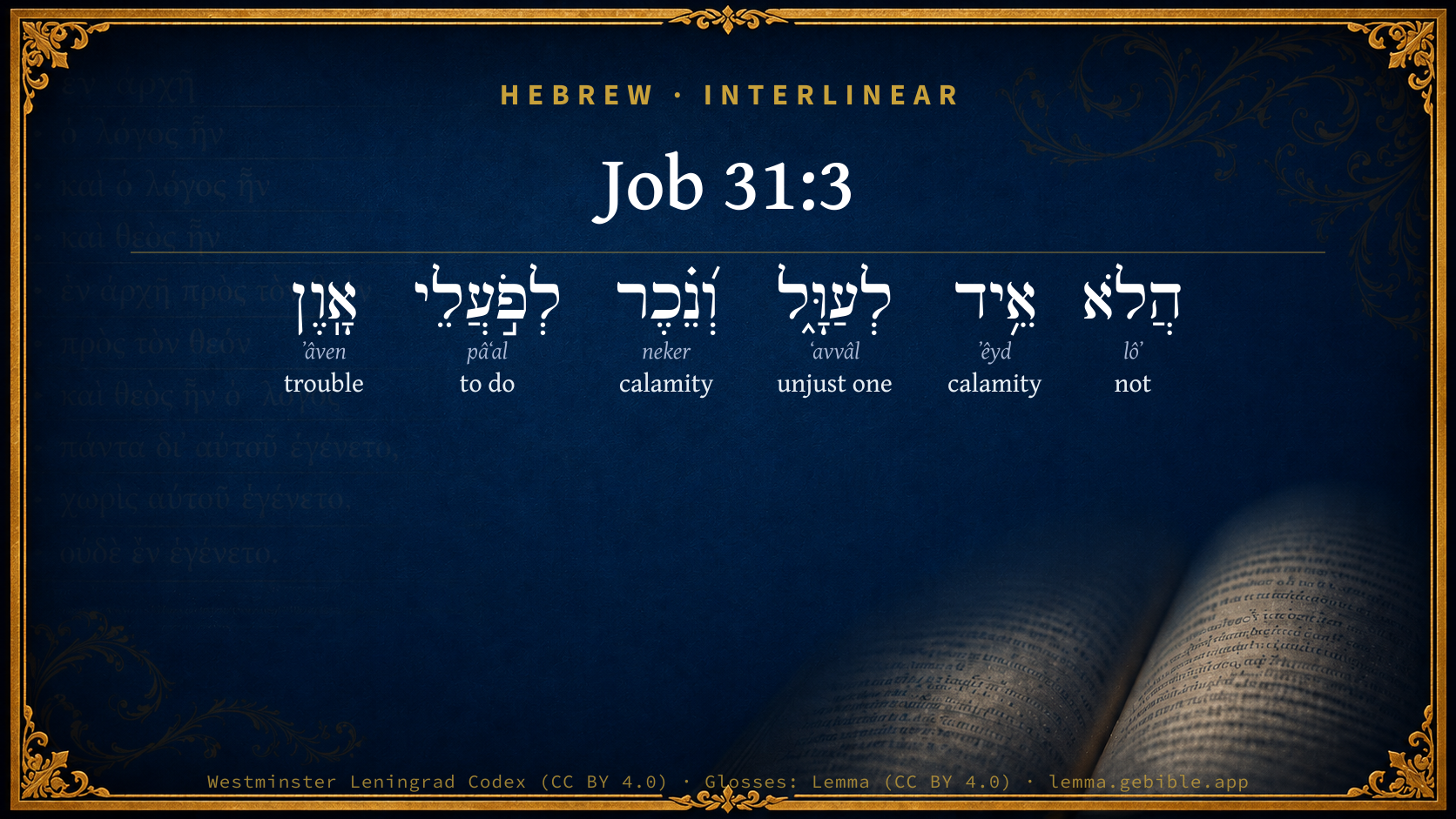
Job 31:3

Hebrew (Westminster Leningrad Codex) Job 31:3 appears in the Hebrew Old Testament. The text above is from the Westminster Leningrad Codex. Each word links to its Strong’s number, a concise gloss, and parsing drawn from the Open Scriptures Hebrew Bible morphology. Click any word for its full Brown-Driver-Briggs (BDB) entry.
Download image
Cite this verse

Job 31:3 (World English Bible). Public Domain. Lemma interlinear Bible study tool, https://lemma.gebible.app/v/job/31/3.

Show BibTeX & RIS
BibTeX
RIS
English Translation
Is it not calamity to the unrighteous, And disaster to the workers of iniquity?
World English Bible · Public Domain
Highlights
  • 1 first appearance in the Hebrew Bible
Full analysis ↓
Download a study sheet

One document with this verse’s original text, its word-by-word gloss line, the meaning frame, cross-references with their text, attributed commentary, and full source and license credits — printable, and it pastes into notes with its structure intact.

This verse Autodidact and up

Study sheet (.html) Plain text (.txt)

A passage Seminary Student

Up to 50 verses in one chapter. A passage sheet keeps up to 6 commentary sources and 12 cross-references per verse, in the order this page ranks them, and says so on the sheet whenever that leaves anything out. Ask for a single verse and you get the Autodidact verse sheet above.

Everything on this page stays free to read, with no account — the sheet is a download of what is already on screen, not access to it.

Want to remove ads? Support Godless Engineer
Compare translations 3

The same verse in 3 English versions, stacked beneath the original-language interlinear above. Click any original word for its lexicon entry.

Each is an independent rendering of the whole verse — the interlinear is not word-aligned to these translations.

Highlighted words mark where these versions differ — a whole-verse word diff, not a word-by-word alignment.

  • World English Bible Public Domain
    Is it not calamity to the unrighteous, And disaster to the workers of iniquity?
  • King James Version Public Domain
    Is not destruction to the wicked? and a strange punishment to the workers of iniquity?
  • unfoldingWord Literal Text CC BY-SA 4.0
    not calamity for the unrighteous and disaster for doers of wickedness?

unfoldingWord Literal Text — © unfoldingWord, licensed CC BY-SA 4.0. Word-aligned USFM3 via Door43 (git.door43.org/unfoldingWord/en_ult).

Versions to compare (up to 4)

3 of 4 selected

Show all 18 translations

Every available English version of this verse, each an independent rendering of the whole verse.

  • World English Bible Public Domain
    Is it not calamity to the unrighteous, And disaster to the workers of iniquity?
  • Berean Standard Bible Public Domain
    Does not disaster come to the unjust and calamity to the workers of iniquity?
  • Majority Standard Bible Public Domain
    Does not disaster come to the unjust and calamity to the workers of iniquity?
  • King James Version Public Domain
    Is not destruction to the wicked? and a strange punishment to the workers of iniquity?
  • American Standard Version (1901) Public Domain
    Is it not calamity to the unrighteous, And disaster to the workers of iniquity?
  • Revised Version (1885) Public Domain
    Is it not calamity to the unrighteous, and disaster to the workers of iniquity?
  • Geneva Bible (1599) Public Domain
    Is not destruction to the wicked and strange punishment to the workers of iniquitie?
  • Douay-Rheims (1899) Public Domain
    Is not destruction to the wicked, and aversion to them that work iniquity?
  • Young's Literal Translation Public Domain
    Is not calamity to the perverse? And strangeness to workers of iniquity?
  • Literal Standard Version CC BY-SA 4.0
    Is not calamity to the perverse? And strangeness to workers of iniquity?
  • Unlocked Literal Bible CC BY-SA 4.0
    I used to think that calamity is for unrighteous people, and that disaster is for doers of wickedness.
  • unfoldingWord Literal Text CC BY-SA 4.0
    not calamity for the unrighteous and disaster for doers of wickedness?
  • Darby Bible Public Domain
    Is not calamity for the unrighteous? and misfortune for the workers of iniquity?
  • World Messianic Bible Public Domain
    Is it not calamity to the unrighteous, and disaster to the workers of iniquity?
  • Webster's Bible Public Domain
    Is not destruction to the wicked? and a strange punishment to the workers of iniquity?
  • Free Bible Version CC BY-SA 4.0
    Isn't it disaster for the wicked and destruction for those who do wrong?
  • Bible in Basic English Public Domain
    Is it not trouble for the sinner, and destruction for the evil-doers?
  • JPS Tanakh (1917) Public Domain
    Is it not calamity to the unrighteous, and disaster to the workers of iniquity?

Literal Standard Version (2020), Covenant Press — licensed CC BY-SA 4.0. Text via the HelloAO Bible API (eBible.org). Unlocked Literal Bible (unfoldingWord) — licensed CC BY-SA 4.0. Text via the HelloAO Bible API (eBible.org). unfoldingWord Literal Text — © unfoldingWord, licensed CC BY-SA 4.0. Word-aligned USFM3 via Door43 (git.door43.org/unfoldingWord/en_ult). Free Bible Version, Dr. Jonathan Gallagher — licensed CC BY-SA 4.0. Text via the HelloAO Bible API (eBible.org).

Word by word

More ways to search: Search by grammar → Find every occurrence → Compare this word →

Practice this passage: Drill this verse → Learn its vocabulary →

About this verse

These counts appear in no published source. They are computed here, from the morphology-tagged text and Lemma’s own curated glosses. What Lemma adds →

6
words
6
distinct lemmas
Wisdom
section

Notable vocabulary

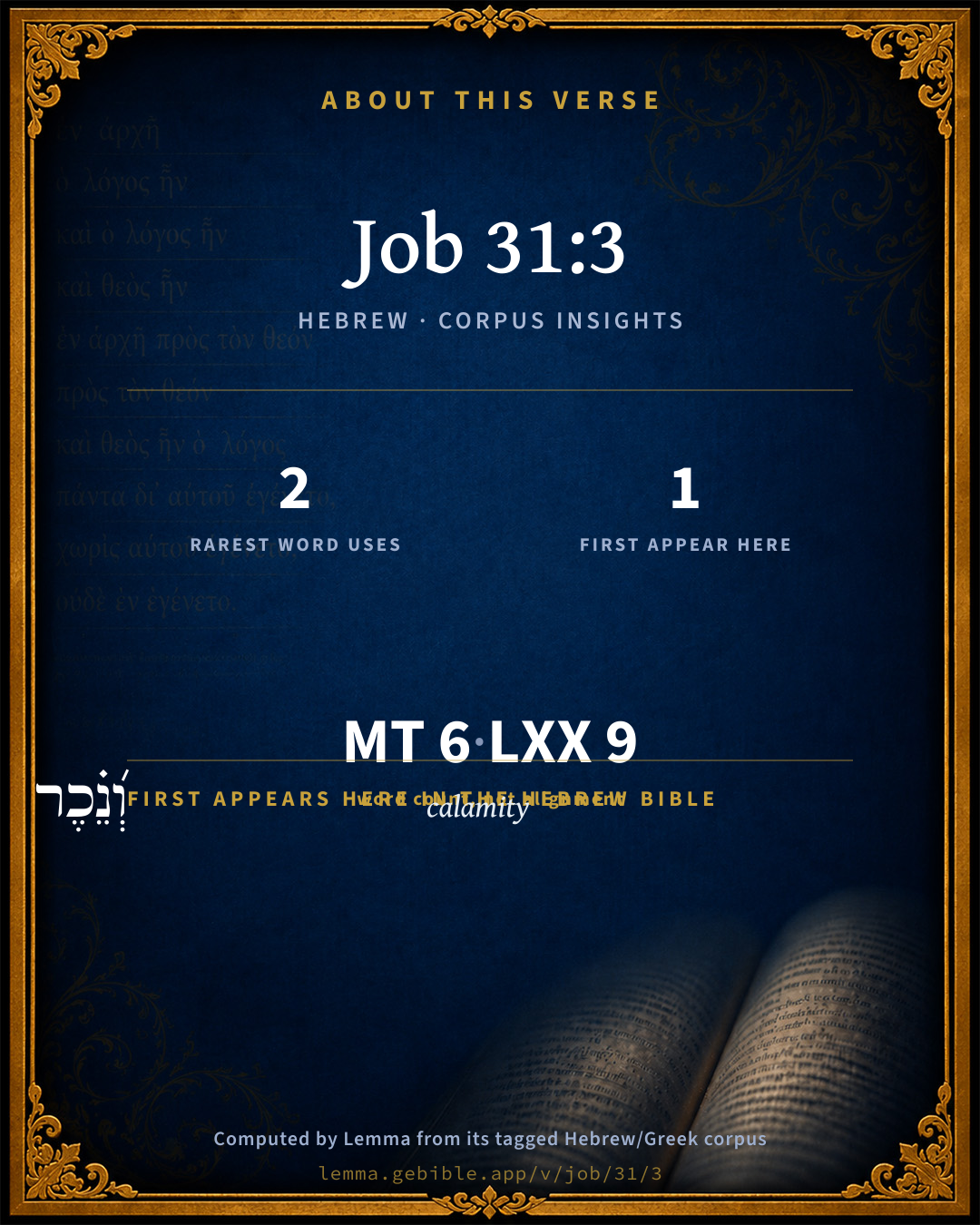
The rarest word here is וְ֝נֵ֗כֶר calamity H5235 — appearing just 2 times in the whole Hebrew Bible.

First appearance in Scripture

This word makes its first canonical appearance in the Hebrew Bible here:

  • וְ֝נֵ֗כֶר calamity H5235

Shared distinctive vocabulary

וְ֝נֵ֗כֶר calamity H5235 occurs in 2 verses of the Hebrew Bible. Also found in:

Grammatical profile

  • 1 verb
  • 4 nouns
  • 1 particle

Verb forms

  • לְפֹ֣עֲלֵי Qal · Participle Active

Hebrew & Septuagint length

In English translation the verse runs 14 words from the Hebrew and 12 from the Septuagint (LXX English) — closely comparable.

A rough comparison of the two English renderings, which tokenize alike — not a word-level alignment.

Word counts can differ between the Hebrew and the Greek without any difference in meaning — e.g. the Hebrew direct-object marker אֵת has no separate Greek word, and Greek often adds the article ὁ.

In the original languages it is 6 Hebrew tokens and 9 Greek tokens — but the two are counted differently (Hebrew bundles its prefixes and suffixes into one token; the Greek is in lemma form), so that isn’t a like-for-like length.

Cross-references

14

Topical passages linked to Job 31:3 in the Treasury of Scripture Knowledge — connected by theme and wording, ordered by reader-vote popularity; previews shown in the World English Bible.

  • Job 21:30 That the evil man is reserved to the day of calamity? That they are led forth to the day of wrath?
  • Job 34:22 There is no darkness, nor thick gloom, Where the workers of iniquity may hide themselves.
  • Psalms 55:23 But you, God, will bring them down into the pit of destruction. Bloodthirsty and deceitful men shall not live out half their days, But I will trust in you.
  • Psalms 73:18 Surely you set them in slippery places. You throw them down to destruction.
  • Proverbs 1:27 When calamity overtakes you like a storm, When your disaster comes on like a whirlwind; When distress and anguish come on you.
  • Proverbs 10:29 The way of Yahweh is a stronghold to the upright, But it is a destruction to the workers of iniquity.
  • Proverbs 21:15 It is joy to the righteous to do justice; But it is a destruction to the workers of iniquity.
  • Isaiah 28:21 For Yahweh will rise up as on Mount Perazim, he will be angry as in the valley of Gibeon; that he may do his work, his strange work, and bring to pass his act, his strange act.
  • Matthew 7:13 "Enter in by the narrow gate; for wide is the gate and broad is the way that leads to destruction, and many are those who enter in by it.
  • Romans 9:22 What if God, willing to show his wrath, and to make his power known, endured with much patience vessels of wrath made for destruction,
  • 1 Thessalonians 5:3 For when they are saying, "Peace and safety," then sudden destruction will come on them, like birth pains on a pregnant woman; and they will in no way escape.
  • 2 Thessalonians 1:9 who will pay the penalty: eternal destruction from the face of the Lord and from the glory of his might,
  • 2 Peter 2:1 But there also arose false prophets among the people, as among you also there will be false teachers, who will secretly bring in destructive heresies, denying even the Master who bought them, bringing on themselves swift destruction.
  • Jude 1:7 Even as Sodom and Gomorrah, and the cities around them, having, in the same way as these, given themselves over to sexual immorality and gone after strange flesh, are set forth as an example, suffering the punishment of eternal fire.

Cross-references courtesy of OpenBible.info (CC BY 4.0).

Hebrew and Greek witnesses Masoretic Hebrew ↔ Greek Septuagint

The same verse in the two great witnesses to the Old Testament, shown verse-for-verse.

These are two independent witnesses, not word-aligned to each other, and the Septuagint is shown in lemma (dictionary) form.

Hebrew Job 31:3 Masoretic · Westminster Leningrad Codex

הֲלֹא אֵ֥יד לְעַוָּ֑ל וְ֝נֵ֗כֶר לְפֹ֣עֲלֵי אָֽוֶן

Is it not calamity to the unrighteous, And disaster to the workers of iniquity?

World English Bible · Public Domain

Greek LXX Job 31:3 Septuagint · lemma form

οὐ ἀπώλεια ὁ ἄδικος καί ἀπαλλοτρίωσις ὁ ποιέω ἀνομία

Alas! destruction to the unrighteous, and rejection to them that do iniquity.

LXX2012 (modern English Septuagint) · Public Domain

On this verse, Albert Barnes' Notes on the Bible discusses the Septuagint’s reading. Read the note in Commentary ↓

Hebrew: Westminster Leningrad Codex (CC BY 4.0). Greek: Septuagint (public domain); English from LXX2012 (modern English Septuagint) (Public Domain). How the Septuagint differs from the Hebrew →

Commentary

Notes on Job 31:3 from classic Christian and Jewish commentators (each source and its license shown beneath its notes). The classic Christian expositions comment on the surrounding passage and are grouped to its opening verse, so a note may address several verses; the Jewish commentaries on the Tanakh (Rashi and others) are per-verse, so they appear only where the commentator wrote on this verse.

Lemma curates 59 commentaries, every one of them public domain or Creative Commons licensed, each selected and text-cleaned for this edition rather than reprinted as found. About our sources →

Trapp's Complete Commentary

John Trapp

Job 31:3 [Is] not destruction to the wicked? and a strange [punishment] to the workers of iniquity?

Ver. 3. Is not destruction to the wicked?] Yes, that is their portion, their inheritance; and so Job makes answer to his own question proposed in the preceding verse. The ruin of impure souls is infallible, unsupportable, unavoidable; if God hath aversion from all other sinners, he hath hatred and horror for the unchaste; such stinking goats shall be set on the left hand, and sent to hell; where they shall have so much the more of punishment as they had here of sensual and sinful pleasure, as sour sauce to their sweet meats, Rev 18:7. Not to speak of the miseries they meet with here, which are not a few: in their souls, hardness of heart, or horror of conscience: in their bodies, foul and loathsome diseases, such as will stick to them when their best friends forsake them: in their names, indelible reproach and infamy; like an iron mole, which nothing can fetch out; like the leprosy, which could never be scraped out of the walls: in their estates, poverty, even to a piece of bread, Pro 6:26. Harlots are poscinummia, crumenimulgae, suck purses, Luk 15:14. In their posterity, as Jericho was built, so is uncleanness plagued, both in the eldest and youngest; it goes through the race, till it have wasted all.

Corpus, opes, animam, famam, vim, lumina, Scortum

Debilitat, perdit, necat, aufert, eripit, orbat.

And a strange punishment to the workers of iniquity?] Even such as is unusual and extraordinary; as upon the Sodomites, who, going after strange flesh, were thrown forth for an example, as Jude hath it, Jdg 1:7. So those Benjamites, Jdg 20:12-15; Jdg 20:43-48; the Trojans; the Lacedemonians at Leuctra; Zimri and Cozbi; Zedekiah and Ahab, Jer 29:22; Eli’s two sons; Heraclius, the emperor; Muleasses, king of Tunis, in Barbary, bereft by his own son Amida (another Absalom), not of his kingdom only, but of his eyes too, put out with a burning hot iron; those eyes of his that had been full of adultery, and could not cease to sin. In Hebrew the same word signifieth both an eye and a fountain; to show, saith one, that from the eye, as a fountain, floweth both sin and misery.

John Trapp, A Commentary or Exposition upon All the Books of the Old and New Testament (1647–1656) — public domain. Text from a community e-Sword module.

Joseph Benson's Commentary

Job 31:3-4. Is not destruction to the wicked? — Destruction is their portion. And a strange punishment — Some extraordinary and dreadful judgment, which of right belongs to them. Hebrew, ונכר, venecher, an alienation, or estrangement, namely, from God and his favour: had I been such a one, I neither should nor could have expected any kindness or mercy from God in a future world, as now I do. Doth not he see my ways? — That is, all my counsels and courses. This was another reason why he was so circumspect and exact in restraining his thoughts, and senses, and whole man from sinful practices, because he knew that God would discern them, and therefore punish them, as he said, Job 31:3.

Joseph Benson's Commentary on the Old and New Testaments (1811–1818) — public domain. Text from a community e-Sword module.

The Pulpit Commentary

Is not destruction to the wicked? The inheritance of the wicked is "destruction ruin both of soul and body. This is what I should have to expect if I yielded myself to the bondage of lust and concupiscence. And a strange punishment to the workers of iniquity? The rare word neker (rkg), translated here by "strange punishment," seems to mean "alienation from God being turned from God"s friend into his enemy (comp. Buxtorf, "Lexicon Hebraicum et Chaldaicum," who explains rkg by "alienatio;" and the comment of Schultens on Job_31:3, "Necer, a Deo alienatio").

The Pulpit Commentary (1880–1919), ed. H.D.M. Spence-Jones & Joseph S. Exell — public domain. Text from a community e-Sword module.

Geneva Bible (1599)

Geneva Bible translators

Job declareth that the fear of God was a bridle to stay him from all wickedness.

Geneva Bible (1599) marginal notes — public domain. Text via Bolls.life.

Jamieson, Fausset & Brown

Robert Jamieson, A. R. Fausset & David Brown

Answer to the question in Job 31:2.

strange--extraordinary.

Jamieson, Fausset & Brown — Commentary Critical and Explanatory on the Whole Bible (1871) — public domain (CC PDM 1.0). Text via the HelloAO Bible API.

Adam Clarke's Commentary

Verse 3. Is not destruction to the wicked] If I had been guilty of such secret hypocritical proceedings, professing faith in the true God while in eye and heart an idolater, would not such a worker of iniquity be distinguished by a strange and unheard-of punishment?

Adam Clarke's Commentary on the Bible (1810–1826) — public domain. Text from a community e-Sword/MySword module.

Ellicott's Commentary for English Readers

(3) Is not—i.e., Is not this the portion of Job_31:2?

A Bible Commentary for English Readers, edited by Charles John Ellicott (1878–1897) — public domain. Text from a community e-Sword module.

John Gill's Exposition

Is not destruction to the wicked?.... It is even to such wicked men, who live in the sin of fornication, and make it their business to ensnare and corrupt virgins; and which is another reason why Job was careful to avoid that sin; wickedness of every sort is the cause of destruction, destruction and misery are in the ways of wicked men, and their wicked ways lead unto it, and issue in it, even destruction of soul and body in hell, which is swift and sudden, and will be everlasting: this is laid up for wicked men among the treasures of God's wrath, and they are reserved that, and there is no way of deliverance from it but by Christ:

and a strange punishment to the workers of iniquity; the iniquity of fornication and whoredom, Pro 30:20; who make it their business to commit it, and live in a continued course of uncleanness and other sins; a punishment, something strange, unusual, and uncommon, as the filthy venereal disease in this world, and everlasting burnings in another; or "alienation" (y), a state of estrangement and banishment from the presence of God and Christ, and from the society of the saints, to all eternity; see Mat 25:46.

(y) "et abalienatio", Munster; "et alienatio", V. L. Pagninus, Montanus, Mercerus, Drusius, Schmidt.

John Gill's Exposition of the Whole Bible (1746–1763) — public domain (CC PDM 1.0). Text via the HelloAO Bible API.

Albert Barnes' Notes on the Bible

Is not destruction to the wicked? - That is, Job says that he was well aware that destruction would overtake the wicked, and that if he had given indulgence to impure desires he could have looked for nothing else. Well knowing this, he says, he had guarded himself in the most careful manner from sin, and had labored with the greatest assiduity to keep his eyes and his heart pure.

And a strange punishment - - ונכר weneker. The word used here, means literally strangeness - a strange thing, something with which we were unacquainted. It is used here evidently in the sense of a strange or unusual punishment; something which does not occur in the ordinary course of events. The sense is, that for the sin here particularly referred to, God would interpose to inflict vengeance in a manner such as did not occur in the ordinary dealings of his providence. There would be some punishment adopted especially to this sin, and which would mark it with his special displeasure. Has it not been so in all ages? The Vulgate renders it, alienatio, and the Septuagint translates it in a similar manner - ἀπαλλοτρίωσις apallotriōsis - and they seem to have understood it as followed by entire alienation from God; an idea which would be every where sustained by a reference to the history of the sin referred to by Job. There is no sin that so much poisons all the fountains of pure feeling in the soul, and none that will so certainly terminate in the entire wreck of character.

Albert Barnes' Notes on the Bible (1834–1885) — public domain. Text from a community e-Sword/MySword module.

Haydock's Catholic Bible Commentary

Aversion of God. Hebrew "strange punishment." (Protestants) Incontinence is a source of much mischief, and of the most dreadful punishments, as the deluge and fate of Sodom evince. (Haydock)

George Leo Haydock (1774–1849), Haydock's Catholic Family Bible and Commentary, 1859 edition — public domain. Excludes Psalms (Douay-Rheims chapter numbering differs from Protestant) and Deuterocanonical books (Catholic canon only).

Matthew Poole's English Annotations

Destruction is their portion, and a strange punishment, some extraordinary and dreadful judgment, which of right and course belongs to them, and only to such as they are, although it hath pleased God out of his sovereign power to inflict it upon me, who have lived in all good conscience before him. Heb. an alienation or estrangement, to wit, from God and from his favour. Had I been such a one, I neither could nor should have expected any kindness or mercy from God, as now I do.

Matthew Poole's English Annotations on the Holy Bible (1683–1685) — public domain. Text from a community e-Sword/MySword module.

Whedon's Commentary on the Bible

Daniel D. Whedon

3. A strange punishment — נכר. The word bears a similar meaning in the Arabic. Thus Mohammed: “He shall visit him with a strange, (nukran,) or awful, penalty.” The punishment of such “workers of iniquity” is strange, extraordinary. The diseases and the remorse that spring from a life of licentiousness are markedly exceptional, and argue peculiar punishment in the next life.

Daniel D. Whedon (gen. ed.), Commentary on the Old and New Testaments (1874–1909) — public domain. Text from a community e-Sword module.

unfoldingWord translationNotes

Door43 World Missions Community

General Information:

Job continues speaking.

Does not God see my ways and count all my steps?

Here "my ways" and "my steps" are metaphors for Job's behavior. Here "see my ways" and "count all my steps" are metaphors for knowing everything Job does. Job uses this question to emphasize that God does know all he does. AT: "Certainly God watches me and knows everything that I do." (See: Metaphor and Rhetorical Question)

Does not God see my ways and count all my steps?

Job may be implying that God should know that Job is righteous and does not deserve calamity and disaster. (See: Assumed Knowledge and Implicit Information)

translationWords

righteous

evil

unfoldingWord translationNotes — © Distant Shores Media and the Door43 World Missions Community, licensed CC BY-SA 4.0. Source: git.door43.org/Door43/en_tn.

Rashi

Rabbi Shlomo Yitzchaki (Rashi)

Is not misfortune, for the unjust He deserves it, not I.

and deliverance Heb. ונכר, after the pattern of (Obadiah 1:12) “[And] you should not have looked on the day of your brother on the day of his being delivered (נכרו).”

Rashi on the Tanakh — English translations: “The Judaica Press complete Tanach with Rashi, translated by A. J. Rosenberg” (CC BY 4.0); “Pentateuch with Rashi's commentary by M. Rosenbaum and A.M. Silbermann, 1929-1934” (public domain); “The Metsudah Tanach series, Lakewood, N.J” (CC BY 4.0); and “The Book of Joshua, Metsudah Publications, 1997” (CC BY 4.0). Text via Sefaria.

Lesson kit

Teaching starters — assembled from the data on this page, not authored interpretation. Every prompt links to the verse data it draws on. Edit before teaching.

Job, in the Wisdom, opens this verse with 6 words (6 distinct Hebrew lemmas). Its most distinctive word is neker (“calamity”). A historical commentator’s framing appears above. Read the whole chapter for the surrounding context.

Discussion questions

  1. How does “calamity” (neker) shape what this verse is saying?
  2. The word “calamity” first appears here in Scripture. What is being introduced at this debut?
  3. Obadiah 1:12 shares the word «calamity» with this verse. How do the two illuminate each other?
  4. These translations render this verse differently; the difference is in the English rendering, not the original. What questions does that raise?
  5. The verb «לְפֹ֣עֲלֵי» is Qal Participle Active. How does its form color the action?
  6. Reading how Trapp's Complete Commentary and Joseph Benson's Commentary read this verse, where do the two commentators agree and where do they part?

Things to notice

Reading settings

Reading text

Shown beneath each verse's original-language words.

Old Testament
Old Testament edition

Read the OT as the Masoretic Hebrew (MT) or the Greek Septuagint (LXX).

English shown for the Greek Septuagint (in the Hebrew ↔ Greek comparison).

Comparing translations? Open the Compare panel on any verse page to stack up to four side by side.