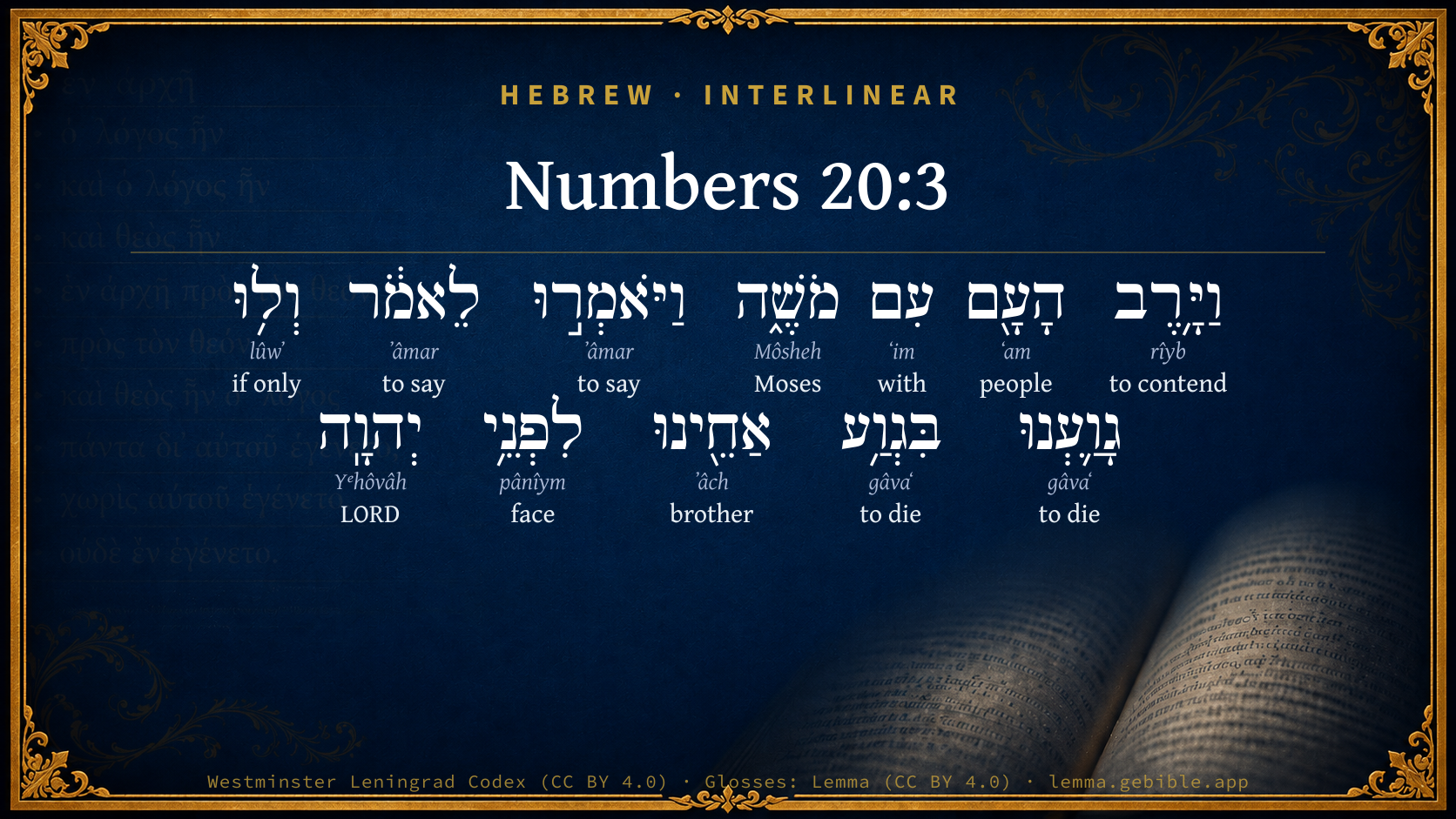
Numbers 20:3

Hebrew (Westminster Leningrad Codex) Numbers 20:3 appears in the Hebrew Old Testament. The text above is from the Westminster Leningrad Codex. Each word links to its Strong’s number, a concise gloss, and parsing drawn from the Open Scriptures Hebrew Bible morphology. Click any word for its full Brown-Driver-Briggs (BDB) entry.
Download image
Cite this verse

Numbers 20:3 (World English Bible). Public Domain. Lemma interlinear Bible study tool, https://lemma.gebible.app/v/numbers/20/3.

Show BibTeX & RIS
BibTeX
RIS
English Translation
The people strove with Moses, and spoke, saying, Would that we had died when our brothers died before Yahweh!
World English Bible · Public Domain
Download a study sheet

One document with this verse’s original text, its word-by-word gloss line, the meaning frame, cross-references with their text, attributed commentary, and full source and license credits — printable, and it pastes into notes with its structure intact.

This verse Autodidact and up

Study sheet (.html) Plain text (.txt)

A passage Seminary Student

Up to 50 verses in one chapter. A passage sheet keeps up to 6 commentary sources and 12 cross-references per verse, in the order this page ranks them, and says so on the sheet whenever that leaves anything out. Ask for a single verse and you get the Autodidact verse sheet above.

Everything on this page stays free to read, with no account — the sheet is a download of what is already on screen, not access to it.

Want to remove ads? Support Godless Engineer
Compare translations 3

The same verse in 3 English versions, stacked beneath the original-language interlinear above. Click any original word for its lexicon entry.

Each is an independent rendering of the whole verse — the interlinear is not word-aligned to these translations.

Highlighted words mark where these versions differ — a whole-verse word diff, not a word-by-word alignment.

  • World English Bible Public Domain
    The people strove with Moses, and spoke, saying, Would that we had died when our brothers died before Yahweh!
  • King James Version Public Domain
    And the people chode with Moses, and spake, saying, Would God that we had died when our brethren died before the LORD!
  • unfoldingWord Literal Text CC BY-SA 4.0
    And the people contended with Moses, and they said, saying, “If only we had expired when our brothers expired to the face of Yahweh!

unfoldingWord Literal Text — © unfoldingWord, licensed CC BY-SA 4.0. Word-aligned USFM3 via Door43 (git.door43.org/unfoldingWord/en_ult).

Versions to compare (up to 4)

3 of 4 selected

Show all 18 translations

Every available English version of this verse, each an independent rendering of the whole verse.

  • World English Bible Public Domain
    The people strove with Moses, and spoke, saying, Would that we had died when our brothers died before Yahweh!
  • Berean Standard Bible Public Domain
    The people quarreled with Moses and said, “If only we had perished with our brothers before the LORD!
  • Majority Standard Bible Public Domain
    The people quarreled with Moses and said, “If only we had perished with our brothers before the LORD!
  • King James Version Public Domain
    And the people chode with Moses, and spake, saying, Would God that we had died when our brethren died before the LORD!
  • American Standard Version (1901) Public Domain
    And the people strove with Moses, and spake, saying, Would that we had died when our brethren died before Jehovah!
  • Revised Version (1885) Public Domain
    And the people strove with Moses, and spake, saying, Would God that we had died when our brethren died before the LORD!
  • Geneva Bible (1599) Public Domain
    And the people chode with Moses, and spake, saying, Would God we had perished, when our brethren died before the Lord.
  • Douay-Rheims (1899) Public Domain
    And making a sedition, they said: Would God we had perished among our brethren before the Lord.
  • Young's Literal Translation Public Domain
    and the people strive with Moses, and speak, saying, `And oh that we had expired when our brethren expired before Jehovah!
  • Literal Standard Version CC BY-SA 4.0
    and the people strive with Moses and speak, saying, “And oh that we had expired when our brothers expired before YHWH!
  • Unlocked Literal Bible CC BY-SA 4.0
    The people complained against Moses. They said, “It would have been better if we had died when our fellow Israelites died in front of Yahweh!
  • unfoldingWord Literal Text CC BY-SA 4.0
    And the people contended with Moses, and they said, saying, “If only we had expired when our brothers expired to the face of Yahweh!
  • Darby Bible Public Domain
    And the people contended with Moses, and spoke, saying, Would that we had died when our brethren died before Jehovah!
  • World Messianic Bible Public Domain
    The people quarreled with Moses, and spoke, saying, “We wish that we had died when our brothers died before the LORD!
  • Webster's Bible Public Domain
    And the people chid with Moses, and spoke, saying, O that we had died when our brethren died before the LORD!
  • Free Bible Version CC BY-SA 4.0
    They argued with Moses, saying, “If only we'd died with our relatives in the Lord's presence!
  • Bible in Basic English Public Domain
    And the people were angry with Moses and said, If only death had overtaken us when our brothers came to their death before the Lord!
  • JPS Tanakh (1917) Public Domain
    And the people strove with Moses, and spoke, saying: 'Would that we had perished when our brethren perished before the LORD!

Literal Standard Version (2020), Covenant Press — licensed CC BY-SA 4.0. Text via the HelloAO Bible API (eBible.org). Unlocked Literal Bible (unfoldingWord) — licensed CC BY-SA 4.0. Text via the HelloAO Bible API (eBible.org). unfoldingWord Literal Text — © unfoldingWord, licensed CC BY-SA 4.0. Word-aligned USFM3 via Door43 (git.door43.org/unfoldingWord/en_ult). Free Bible Version, Dr. Jonathan Gallagher — licensed CC BY-SA 4.0. Text via the HelloAO Bible API (eBible.org).

Word by word

More ways to search: Search by grammar → Find every occurrence → Compare this word →

Practice this passage: Drill this verse → Learn its vocabulary →

גָוַ֛עְנוּ
gâvaʻ
H1478
“to die”
Verb, Qal, Perfect, 1st Person, Common, Plural
Part of Speech
Verb
Stem
Qal
Form
Perfect
Person
1st Person
Gender
Common
Number
Plural
Full BDB Definition

Origin: a primitive root

TWOT: 328

to expire, die, perish, give up the ghost, yield up the ghost, be dead, be ready to die - (Qal) to expire, die, be about to die
  1. וַיָּ֥רֶב rîyb H7378 “and · to contend” Conjunction + Verb, Qal, Sequential Imperfect, 3rd Person, Masculine, Singular
  2. הָעָ֖ם ʻam H5971 “the · people” Particle, Definite Article + Noun, Common, Masculine, Singular, Absolute
  3. עִם ʻim H5973 “with” Preposition
  4. מֹשֶׁ֑ה Môsheh H4872 “Moses” Noun, Proper
  5. וַיֹּאמְר֣וּ ʼâmar H559 “and · to say” Conjunction + Verb, Qal, Sequential Imperfect, 3rd Person, Masculine, Plural
  6. לֵאמֹ֔ר ʼâmar H559 “to say” Preposition + Verb, Qal, Infinitive Construct
  7. וְל֥וּ lûwʼ H3863 “and · if only” Conjunction + Conjunction
  8. בִּגְוַ֥ע gâvaʻ H1478 “in/at · to die” Preposition + Verb, Qal, Infinitive Construct
  9. אַחֵ֖ינוּ ʼâch H251 “brothers · our” Noun, Common, Masculine, Plural, Construct + Suffix, Personal, 1st Person, Common, Plural
  10. לִפְנֵ֥י pânîym H6440 “to/for · face(s) of” Preposition + Noun, Common, Both, Plural, Construct
  11. יְהוָֽה Yᵉhôvâh H3068 “LORD” Noun, Proper

About this verse

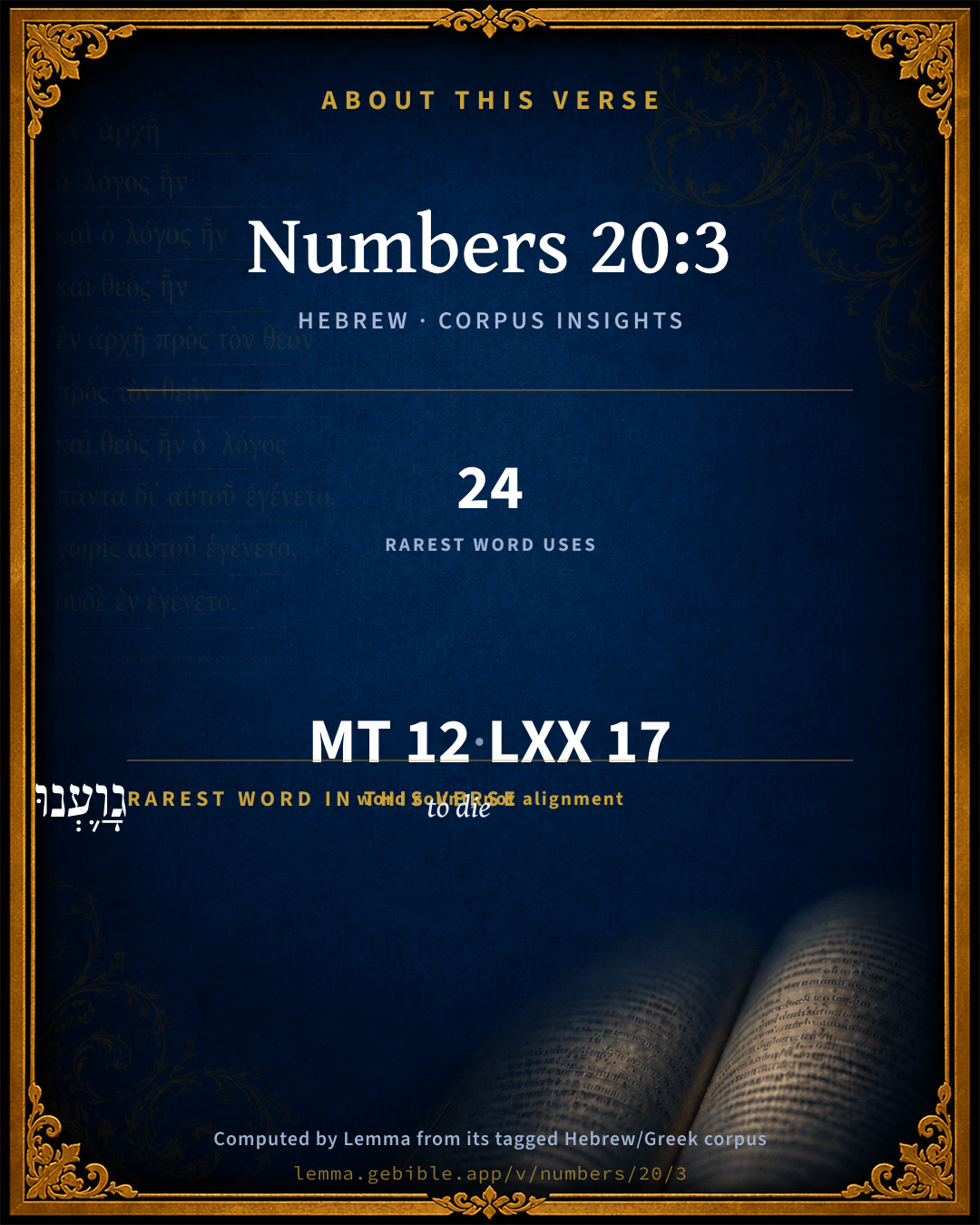
These counts appear in no published source. They are computed here, from the morphology-tagged text and Lemma’s own curated glosses. What Lemma adds →

12
words
10
distinct lemmas
Pentateuch
section

Notable vocabulary

The rarest word here is גָוַ֛עְנוּ to die H1478 — appearing just 24 times in the whole Hebrew Bible.

Shared distinctive vocabulary

גָוַ֛עְנוּ to die H1478 occurs in 23 verses of the Hebrew Bible. Also found in:

Grammatical profile

  • 5 verbs
  • 5 nouns
  • 1 preposition
  • 1 conjunction

Verb forms

  • וַיָּ֥רֶב Qal · Sequential Imperfect
  • וַיֹּאמְר֣וּ Qal · Sequential Imperfect
  • לֵאמֹ֔ר Qal · Infinitive Construct
  • גָוַ֛עְנוּ Qal · Perfect
  • בִּגְוַ֥ע Qal · Infinitive Construct

Repetition

Words recur within this verse — often emphatic in Hebrew:

  • וַיֹּאמְר֣וּ to say H559 ×2
  • גָוַ֛עְנוּ to die H1478 ×2

Hebrew & Septuagint length

In English translation the verse runs 19 words from the Hebrew and 19 from the Septuagint (LXX English) — the same length.

A rough comparison of the two English renderings, which tokenize alike — not a word-level alignment.

Word counts can differ between the Hebrew and the Greek without any difference in meaning — e.g. the Hebrew direct-object marker אֵת has no separate Greek word, and Greek often adds the article ὁ.

In the original languages it is 12 Hebrew tokens and 17 Greek tokens — but the two are counted differently (Hebrew bundles its prefixes and suffixes into one token; the Greek is in lemma form), so that isn’t a like-for-like length.

Cross-references

10

Topical passages linked to Numbers 20:3 in the Treasury of Scripture Knowledge — connected by theme and wording, ordered by reader-vote popularity; previews shown in the World English Bible.

  • Exodus 17:2 Therefore the people quarreled with Moses, and said, "Give us water to drink." Moses said to them, "Why do you quarrel with me? Why do you test Yahweh?"
  • Numbers 14:1–2 All the congregation lifted up their voice, and cried; and the people wept that night.
  • Numbers 16:31–35 It happened, as he made an end of speaking all these words, that the ground split apart that was under them;
  • Exodus 16:2–3 The whole congregation of the children of Israel murmured against Moses and against Aaron in the wilderness;
  • Numbers 11:1 The people were as murmurers, [speaking] evil in the ears of Yahweh: and when Yahweh heard it, his anger was kindled; and the fire of Yahweh burnt among them, and devoured in the uttermost part of the camp.
  • Numbers 11:33–34 While the flesh was yet between their teeth, before it was chewed, the anger of Yahweh was kindled against the people, and Yahweh struck the people with a very great plague.
  • Numbers 16:49 Now those who died by the plague were fourteen thousand and seven hundred, besides those who died about the matter of Korah.
  • Numbers 14:36–37 The men, whom Moses sent to spy out the land, who returned, and made all the congregation to murmur against him, by bringing up an evil report against the land,
  • Job 3:10–11 Because it didn't shut up the doors of my mother's womb, Nor did it hide trouble from my eyes.
  • Lamentations 4:9 Those who are killed with the sword are better than those who are killed with hunger; For these pine away, stricken through, for want of the fruits of the field.

Cross-references courtesy of OpenBible.info (CC BY 4.0).

Hebrew and Greek witnesses Masoretic Hebrew ↔ Greek Septuagint

The same verse in the two great witnesses to the Old Testament, shown verse-for-verse.

These are two independent witnesses, not word-aligned to each other, and the Septuagint is shown in lemma (dictionary) form.

Hebrew Numbers 20:3 Masoretic · Westminster Leningrad Codex

וַיָּ֥רֶב הָעָ֖ם עִם מֹשֶׁ֑ה וַיֹּאמְר֣וּ לֵאמֹ֔ר וְל֥וּ גָוַ֛עְנוּ בִּגְוַ֥ע אַחֵ֖ינוּ לִפְנֵ֥י יְהוָֽה

The people strove with Moses, and spoke, saying, Would that we had died when our brothers died before Yahweh!

World English Bible · Public Domain

Greek LXX Numbers 20:3 Septuagint · lemma form

καί λοιδορέω ὁ λαός πρός μωυσῆς λέγω ὀφείλω ἀποθνήσκω ἐν ὁ ἀπώλεια ὁ ἀδελφός ἐγώ ἔναντι κύριος

And the people reviled Moses, saying, Would we had died in the destruction of our brethren before the Lord!

LXX2012 (modern English Septuagint) · Public Domain

Hebrew: Westminster Leningrad Codex (CC BY 4.0). Greek: Septuagint (public domain); English from LXX2012 (modern English Septuagint) (Public Domain). How the Septuagint differs from the Hebrew →

Targum (Aramaic paraphrase)

2

The Targum is the ancient Jewish Aramaic paraphrase of the Hebrew Scriptures — an interpretive translation, not the Hebrew text itself. Onkelos (literal) and Pseudo-Jonathan (expansive) render the Torah, and Jonathan the Prophets. Coverage is partial: where no permissively-licensed English translation exists for a verse, only the Aramaic is shown. This is verse-level text, not a word-by-word alignment to the Hebrew.

  1. Targum Onkelos Torah (Genesis–Deuteronomy)
    וּנְצָא עַמָא עִם משֶׁה וַאֲמָרוּ לְמֵימָר וּלְוַי דְמִתְנָא בְּמוֹתָא דַאֲחָנָא קֳדָם יְיָ

    (no public-domain English translation for this verse)

    Targum Onkelos — Aramaic: “Onkelos Genesis” (public domain); “Onkelos Exodus” (public domain); “Onkelos Leviticus” (public domain); “Onkelos Numbers” (public domain); “Onkelos Deuteronomy” (public domain). English: “Sefaria Community Translation” (CC0 1.0 (public-domain dedication)); “J.W. Etheridge. The Targums of Onkelos and Jonathan Ben Uzziel on the Pentateuch. London: Longmans, Green, 1862” (public domain). Text via Sefaria.

  2. Targum Pseudo-Jonathan Torah (Genesis–Deuteronomy)
    וּנְצָא עַמָא עַל משֶׁה וַאֲמַרוּ לְמֵימָר הַלְוַאי דְמִיתְנָא כַּד מִיתוּ אֲחָנָא קֳדָם יְיָ

    And they gathered against Mosheh and Aharon, and the people contended with Mosheh, and said, Would that we had died when our brethren died before the Lord!

    Targum Pseudo-Jonathan — Aramaic: “Targum Jonathan on Genesis” (public domain); “Targum Jonathan on Exodus” (public domain); “Targum Jonathan on Leviticus” (public domain); “Targum Jonathan on Numbers” (public domain); “Targum Jonathan on Deuteronomy” (public domain). English: “The Targum of Jonathan ben Uzziel, trans. J. W. Etheridge, London, 1862” (public domain). Text via Sefaria.

Commentary

Notes on Numbers 20:3 from classic Christian and Jewish commentators (each source and its license shown beneath its notes). The classic Christian expositions comment on the surrounding passage and are grouped to its opening verse, so a note may address several verses; the Jewish commentaries on the Tanakh (Rashi and others) are per-verse, so they appear only where the commentator wrote on this verse.

Lemma curates 59 commentaries, every one of them public domain or Creative Commons licensed, each selected and text-cleaned for this edition rather than reprinted as found. About our sources →

Trapp's Complete Commentary

John Trapp

Num 20:3 And the people chode with Moses, and spake, saying, Would God that we had died when our brethren died before the LORD!

Ver. 3. And the people chode.] Wanting both water and patience, they broke the peace with their superiors. {See Trapp on "Num 14:15"}

John Trapp, A Commentary or Exposition upon All the Books of the Old and New Testament (1647–1656) — public domain. Text from a community e-Sword module.

Joseph Benson's Commentary

Num 20:3. Before the Lord — Suddenly, rather than to die such a lingering death. Their sin was much greater than that of their parents, because they should have taken warning by their miscarriages, and by the terrible effects of them, which their eyes had seen.

Joseph Benson's Commentary on the Old and New Testaments (1811–1818) — public domain. Text from a community e-Sword module.

Tyndale Open Study Notes

Tyndale Open Resources

20:3 our brothers! The Israelites identified themselves with Nadab and Abihu (Lev 10:1-5), the gluttons killed by the first plague (Num 11:33), the skeptics who had already died in the wilderness (14:29), the ten unfaithful spies (14:36-37), Korah, Abiram, and Dathan, the 250 prominent men, and the 14,700 who died in the second plague (16:32, 35, 49).

Tyndale Open Study Notes — © Tyndale Open Resources, licensed CC BY-SA 4.0. Text via the HelloAO Bible API.

Ellicott's Commentary for English Readers

(3) Would God that we had died . . . —The reference seems to be to the plague which broke out after the insurrection of Korah. The language of the murmurers is very similar to that which is recorded in Num_16:14, and the word gava (die, or expire), which is twice used in this verse, and which occurs in Num_16:26; Num_16:28, in connection with the history of Korah, Dathan, and Abiram, is found only in one other place throughout the last four books of the Pentateuch—viz., Num_20:29. The probability that that plague was of comparatively recent occurrence, and not separated from the present murmuring by a period of nearly forty years, has been inferred from the use of the word brethren in this verse. The generation which was contemporary with those who perished in the plague which followed the rebellion of Korah is supposed by some to have been almost extinct at the time to which the events recorded in this chapter are commonly referred, and the word fathers, it is alleged, would, in that case, have been more applicable to those who perished than brethren. It may be observed, further, that the inquiry, “Wherefore have ye made us to come up out of Egypt?” is more natural when regarded as the language of the generation which had come up out of Egypt as adults, and who looked back to the exodus as to a recent event, than when regarded as that of a generation of which a large number had been born in the wilderness, and the rest had left Egypt nearly forty years previously. These considerations, however, do not appear to be entitled to much weight. The older portion of the congregation, who would naturally be the spokesmen, would speak of those who perished in the insurrection of Korah as their brethren, whether the event itself was of recent occurrence or not; and the words which are rendered “Why have ye brought up, &c.?” may, with equal propriety, be rendered “Why did ye bring up, &c.?”(Comp. Num_20:16 and Note).

A Bible Commentary for English Readers, edited by Charles John Ellicott (1878–1897) — public domain. Text from a community e-Sword module.

The Cambridge Bible for Schools and Colleges

gen. ed. J. J. S. Perowne

3. And the people strove] The root of the verb (rîbh) is also that of the word Merîbhâh (‘the place of strife’), the name of the place being thus explained by means of a play on words; cf. Num_20:13.

when our brethren died before Jehovah] in the revolt of Korah (ch. 16).

The Cambridge Bible for Schools and Colleges (gen. ed. J. J. S. Perowne; Cambridge University Press, 1878–1918) — public domain. Text from a community e-Sword module.

John Gill's Exposition

And the people chode with Moses,.... Contended with him in a wrangling and litigious manner, showing no reverence nor respect unto his person on account of the dignity of his office, and the many favours they had received from him; and this at a time, when, instead of quarrelling with him, they should have condoled him on the loss of his sister, and bewailed their own loss also of one who had been a prophetess to them, and a leader of them, Mic 6:4.

and spake, saying, would God that we had died when our brethren died before the Lord; either at Taberah by fire, or as Korah and his company in like manner, or as the fourteen thousand and seven hundred by a pestilence, Num 11:1 which they thought a much easier death, either of them, than to die of thirst: they might well call them brethren, not only because of the same nation, and nearly related to them, but because they were of the same temper and disposition, and indeed brethren in iniquity; and they seem to use this appellation, as being of the same sentiments with them, and in vindication of them, and adopt almost their very language; see Num 14:2.

John Gill's Exposition of the Whole Bible (1746–1763) — public domain (CC PDM 1.0). Text via the HelloAO Bible API.

Haydock's Catholic Bible Commentary

Brethren, Core, &c., (chap. xvi. 32,) or with them ho died (chap. xi.) at the graves of lust. (Calmet)

George Leo Haydock (1774–1849), Haydock's Catholic Family Bible and Commentary, 1859 edition — public domain. Excludes Psalms (Douay-Rheims chapter numbering differs from Protestant) and Deuterocanonical books (Catholic canon only).

Matthew Poole's English Annotations

i.e. Suddenly, rather than to die such a lingering and painful death. Their sin was much greater than their parents’ in like case, because they should have taken warning by their miscarriages, and by the terrible effects of them, which their eyes had seen.

Matthew Poole's English Annotations on the Holy Bible (1683–1685) — public domain. Text from a community e-Sword/MySword module.

Whedon's Commentary on the Bible

Daniel D. Whedon

3. Chode with Moses — Greek, railed at; Hebrew, quarrelled with. As the government was a theocracy administered by Moses, this conduct was treason against God.

Would God… we had died — By the sudden stroke of divine wrath. Num_11:1. “Died by the plague before the Lord.” Num_14:37. Vivid in their memories must have been the swallowing up of Korah and two hundred and fifty princes, and the plague on the morrow, which cut down fourteen thousand and seven hundred murmurers. Num_16:32; Num_16:49. In their despair and rage they wickedly wish that they had thus miserably perished.

Daniel D. Whedon (gen. ed.), Commentary on the Old and New Testaments (1874–1909) — public domain. Text from a community e-Sword module.

The Pulpit Commentary

And the people abode with Moses. As their fathers had done in similar circumstances, as recorded in Ex 17. Would God that we had died. See on Num_14:2. When our brethren died before the Lord. This is difficult, because the visitations of God at Kibroth-hattaavah (Num_11:34) and at Kadesh (Num_14:37) had overtaken not their brethren, but their fathers, some thirty-eight years before. On the other hand, the daily mortality which had carried off their brethren is clearly excluded by the phrase, "before the Lord." It may he that the rebellion of Korah happened towards the end of the period of wandering, and that the reference is to the plague which followed it; or it may be that the formula of complaint had become stereotyped, as those of children often do, and was employed from time to time without variation and without definite reference. The latter supposition is strongly supported by the character of the words which follow.

The Pulpit Commentary (1880–1919), ed. H.D.M. Spence-Jones & Joseph S. Exell — public domain. Text from a community e-Sword module.

John Wesley's Explanatory Notes

Before the Lord - Suddenly, rather than to die such a lingering death. Their sin was much greater than that of their parents, because they should have taken warning by their miscarriages, and by the terrible effects of them, which their eyes had seen.

John Wesley, Explanatory Notes Upon the Whole Bible (1754–1765) — public domain. Text via the GEBible commentary corpus.

Rashi

Rabbi Shlomo Yitzchaki (Rashi)

ולו גוענו — means, WOULD THAT WE HAD DIED.

בגוע אחינו means, by the death of our brethren — i.e., by the pestilence. This tells us that death by thirst is worse than that (i.e., than death by pestilence).

בגוע — This is a noun and means the same as במיתת אחינו, “by the death of our brethren”; and it would not be correct to explain (translate) it: “when our brethren died”, for if this were so, it should be voweled to read בִּגְוֹעַ.

Rashi on the Tanakh — English translations: “The Judaica Press complete Tanach with Rashi, translated by A. J. Rosenberg” (CC BY 4.0); “Pentateuch with Rashi's commentary by M. Rosenbaum and A.M. Silbermann, 1929-1934” (public domain); “The Metsudah Tanach series, Lakewood, N.J” (CC BY 4.0); and “The Book of Joshua, Metsudah Publications, 1997” (CC BY 4.0). Text via Sefaria.

Lesson kit

Teaching starters — assembled from the data on this page, not authored interpretation. Every prompt links to the verse data it draws on. Edit before teaching.

Numbers, in the Pentateuch, opens this verse with 12 words (10 distinct Hebrew lemmas). Its most distinctive word is gâvaʻ (“to die”). A historical commentator’s framing appears above. Read the whole chapter for the surrounding context.

Discussion questions

  1. What does “to die” (gâvaʻ) contribute to the verse as a whole?
  2. How does Genesis 6:17, which shares the word «to die», read alongside this verse?
  3. What does the repetition of “to say” (2× in this one verse) do in this verse?
  4. These translations render this verse differently. What is at stake in choosing one wording over another?
  5. «וַיָּ֥רֶב» is a Qal Sequential Imperfect verb. How does that grammatical form shape the action described?
  6. Compare how Trapp's Complete Commentary and Joseph Benson's Commentary read this verse. Where do they agree or differ?

Things to notice

Reading settings

Reading text

Shown beneath each verse's original-language words.

Old Testament
Old Testament edition

Read the OT as the Masoretic Hebrew (MT) or the Greek Septuagint (LXX).

English shown for the Greek Septuagint (in the Hebrew ↔ Greek comparison).

Comparing translations? Open the Compare panel on any verse page to stack up to four side by side.