
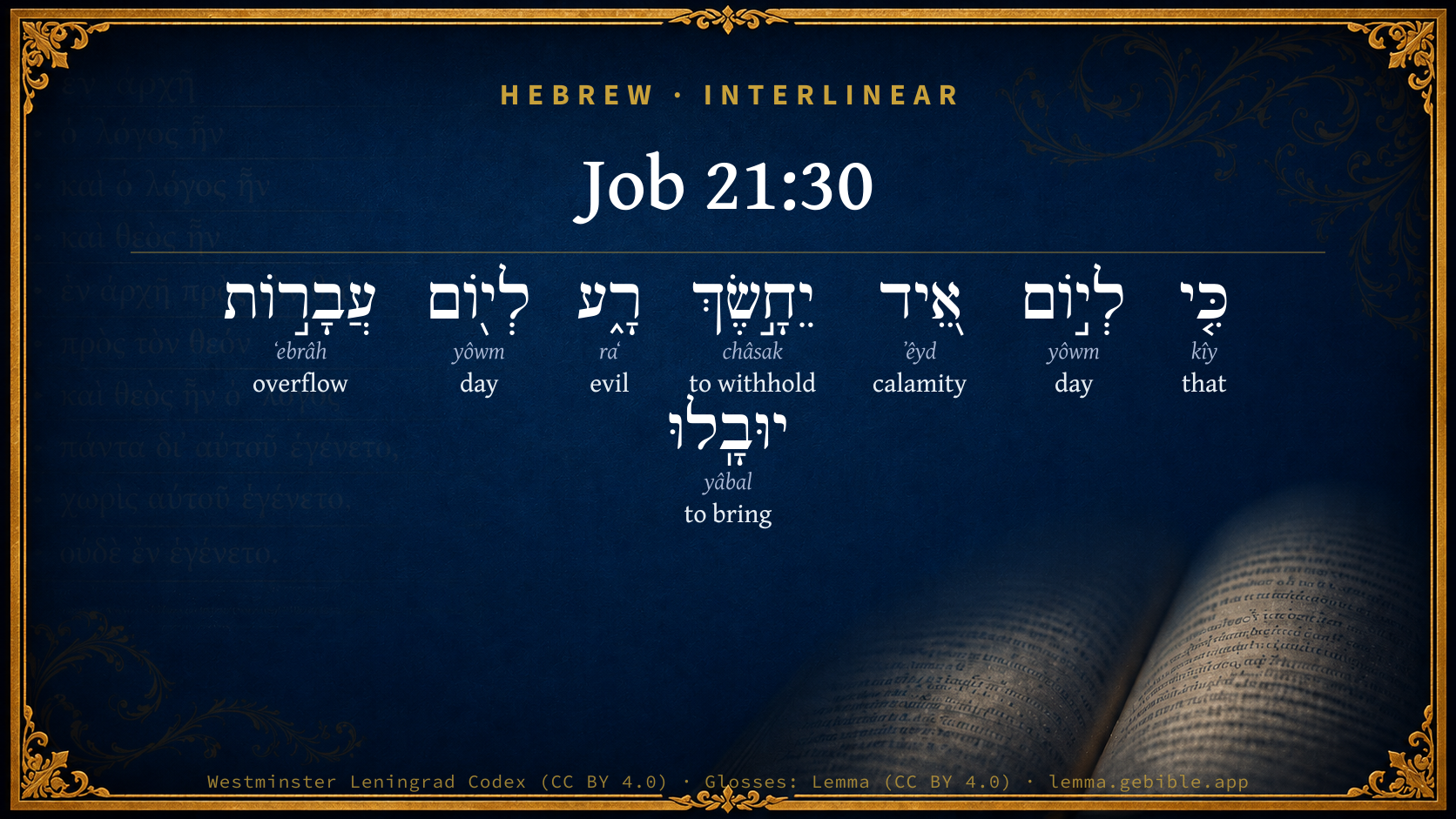
Job 21:30

Hebrew (Westminster Leningrad Codex) Job 21:30 appears in the Hebrew Old Testament. The text above is from the Westminster Leningrad Codex. Each word links to its Strong’s number, a concise gloss, and parsing drawn from the Open Scriptures Hebrew Bible morphology. Click any word for its full Brown-Driver-Briggs (BDB) entry.
Download image
Cite this verse

Job 21:30 (World English Bible). Public Domain. Lemma interlinear Bible study tool, https://lemma.gebible.app/v/job/21/30.

Show BibTeX & RIS
BibTeX
RIS
English Translation
That the evil man is reserved to the day of calamity? That they are led forth to the day of wrath?
World English Bible · Public Domain
Download a study sheet

One document with this verse’s original text, its word-by-word gloss line, the meaning frame, cross-references with their text, attributed commentary, and full source and license credits — printable, and it pastes into notes with its structure intact.

This verse Autodidact and up

Study sheet (.html) Plain text (.txt)

A passage Seminary Student

Up to 50 verses in one chapter. A passage sheet keeps up to 6 commentary sources and 12 cross-references per verse, in the order this page ranks them, and says so on the sheet whenever that leaves anything out. Ask for a single verse and you get the Autodidact verse sheet above.

Everything on this page stays free to read, with no account — the sheet is a download of what is already on screen, not access to it.

Want to remove ads? Support Godless Engineer
Compare translations 3

The same verse in 3 English versions, stacked beneath the original-language interlinear above. Click any original word for its lexicon entry.

Each is an independent rendering of the whole verse — the interlinear is not word-aligned to these translations.

Highlighted words mark where these versions differ — a whole-verse word diff, not a word-by-word alignment.

  • World English Bible Public Domain
    That the evil man is reserved to the day of calamity? That they are led forth to the day of wrath?
  • King James Version Public Domain
    That the wicked is reserved to the day of destruction? they shall be brought forth to the day of wrath.
  • unfoldingWord Literal Text CC BY-SA 4.0
    that the wicked is spared in the day of calamity; in the day of wrath they are brought forth?

unfoldingWord Literal Text — © unfoldingWord, licensed CC BY-SA 4.0. Word-aligned USFM3 via Door43 (git.door43.org/unfoldingWord/en_ult).

Versions to compare (up to 4)

3 of 4 selected

Show all 18 translations

Every available English version of this verse, each an independent rendering of the whole verse.

  • World English Bible Public Domain
    That the evil man is reserved to the day of calamity? That they are led forth to the day of wrath?
  • Berean Standard Bible Public Domain
    Indeed, the evil man is spared from the day of calamity, delivered from the day of wrath.
  • Majority Standard Bible Public Domain
    Indeed, the evil man is spared from the day of calamity, delivered from the day of wrath.
  • King James Version Public Domain
    That the wicked is reserved to the day of destruction? they shall be brought forth to the day of wrath.
  • American Standard Version (1901) Public Domain
    That the evil man is reserved to the day of calamity? That they are led forth to the day of wrath?
  • Revised Version (1885) Public Domain
    That the evil man is reserved to the day of calamity? that they are led forth to the day of wrath?
  • Geneva Bible (1599) Public Domain
    But the wicked is kept vnto the day of destruction, and they shall be brought forth to the day of wrath.
  • Douay-Rheims (1899) Public Domain
    Because the wicked man is reserved to the day of destruction, and he shall be brought to the day of wrath.
  • Young's Literal Translation Public Domain
    That to a day of calamity is the wicked spared. To a day of wrath they are brought.
  • Literal Standard Version CC BY-SA 4.0
    That the wicked is spared to a day of calamity. They are brought to a day of wrath.
  • Unlocked Literal Bible CC BY-SA 4.0
    that the wicked man is kept from the day of calamity, and that he is led away from the day of wrath?
  • unfoldingWord Literal Text CC BY-SA 4.0
    that the wicked is spared in the day of calamity; in the day of wrath they are brought forth?
  • Darby Bible Public Domain
    That the wicked is reserved for the day of calamity? They are led forth to the day of wrath.
  • World Messianic Bible Public Domain
    that the evil man is reserved to the day of calamity, that they are led out to the day of wrath?
  • Webster's Bible Public Domain
    That the wicked is reserved to the day of destruction? they will be brought forth to the day of wrath.
  • Free Bible Version CC BY-SA 4.0
    Wicked people are spared in times of disaster; they are rescued from the day of judgment.
  • Bible in Basic English Public Domain
    How the evil man goes free in the day of trouble, and has salvation in the day of wrath?
  • JPS Tanakh (1917) Public Domain
    That the evil man is reserved to the day of calamity, that they are led forth to the day of wrath?

Literal Standard Version (2020), Covenant Press — licensed CC BY-SA 4.0. Text via the HelloAO Bible API (eBible.org). Unlocked Literal Bible (unfoldingWord) — licensed CC BY-SA 4.0. Text via the HelloAO Bible API (eBible.org). unfoldingWord Literal Text — © unfoldingWord, licensed CC BY-SA 4.0. Word-aligned USFM3 via Door43 (git.door43.org/unfoldingWord/en_ult). Free Bible Version, Dr. Jonathan Gallagher — licensed CC BY-SA 4.0. Text via the HelloAO Bible API (eBible.org).

Word by word

More ways to search: Search by grammar → Find every occurrence → Compare this word →

Practice this passage: Drill this verse → Learn its vocabulary →

About this verse

These counts appear in no published source. They are computed here, from the morphology-tagged text and Lemma’s own curated glosses. What Lemma adds →

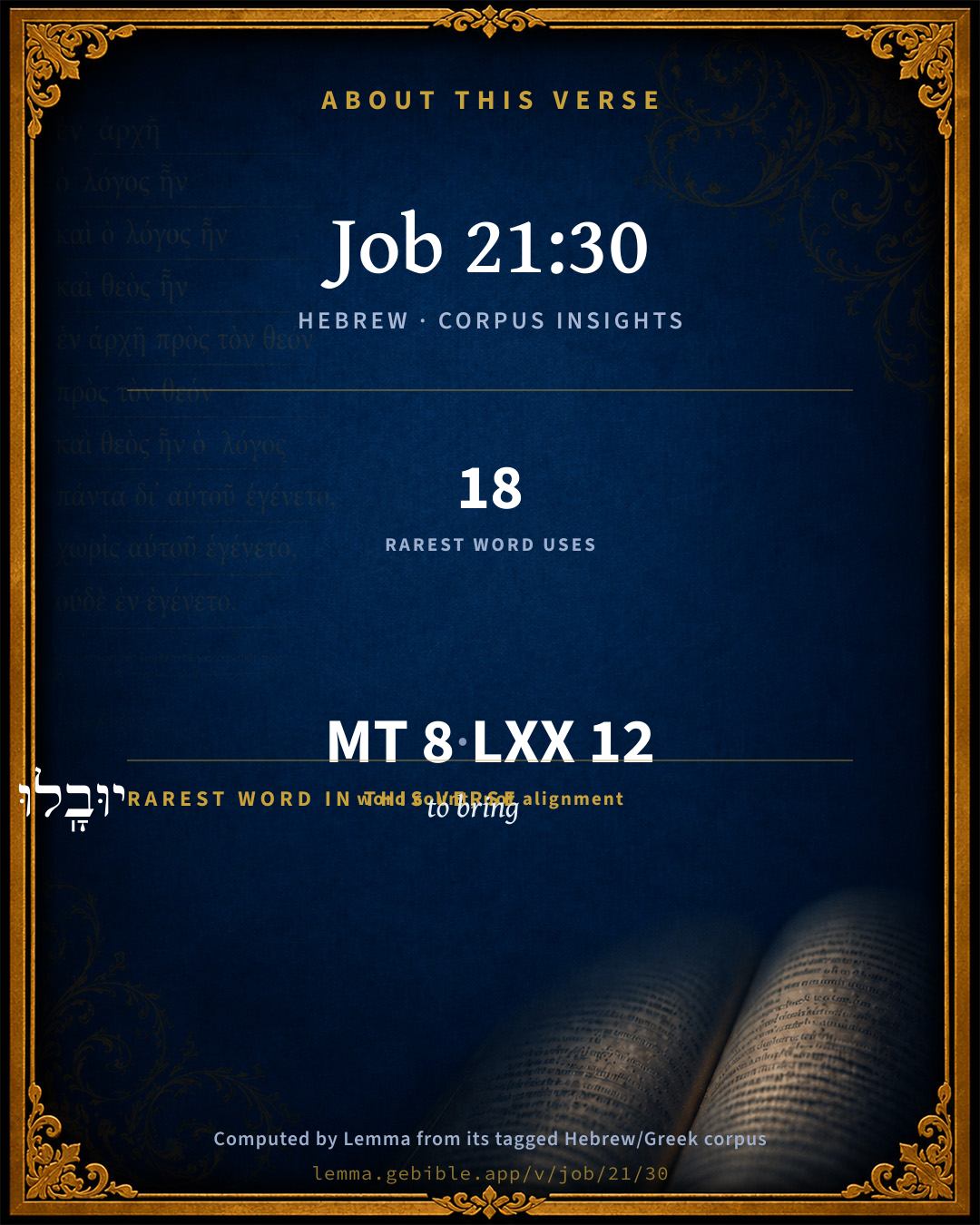
8
words
7
distinct lemmas
Wisdom
section

Notable vocabulary

The rarest word here is יוּבָֽלוּ to bring H2986 — appearing just 18 times in the whole Hebrew Bible.

Shared distinctive vocabulary

יוּבָֽלוּ to bring H2986 occurs in 18 verses of the Hebrew Bible. Also found in:

Grammatical profile

  • 2 verbs
  • 4 nouns
  • 1 adjective
  • 1 conjunction

Verb forms

  • יֵחָ֣שֶׂךְ Niphal · Imperfect
  • יוּבָֽלוּ Hophal · Imperfect

Repetition

A word recurs within this verse — often emphatic in Hebrew:

  • לְי֣וֹם day H3117 ×2

Hebrew & Septuagint length

In English translation the verse runs 21 words from the Hebrew and 20 from the Septuagint (LXX English) — closely comparable.

A rough comparison of the two English renderings, which tokenize alike — not a word-level alignment.

Word counts can differ between the Hebrew and the Greek without any difference in meaning — e.g. the Hebrew direct-object marker אֵת has no separate Greek word, and Greek often adds the article ὁ.

In the original languages it is 8 Hebrew tokens and 12 Greek tokens — but the two are counted differently (Hebrew bundles its prefixes and suffixes into one token; the Greek is in lemma form), so that isn’t a like-for-like length.

Cross-references

11

Topical passages linked to Job 21:30 in the Treasury of Scripture Knowledge — connected by theme and wording, ordered by reader-vote popularity; previews shown in the World English Bible.

  • Proverbs 16:4 Yahweh has made everything for its own end-- Yes, even the wicked for the day of evil.
  • 2 Peter 2:9–17 the Lord knows how to deliver the godly out of temptation and to keep the unrighteous under punishment for the day of judgment;
  • Job 20:28 The increase of his house shall depart; They shall rush away in the day of his wrath.
  • Romans 2:5 But according to your hardness and unrepentant heart you are treasuring up for yourself wrath in the day of wrath, revelation, and of the righteous judgment of God;
  • 2 Peter 3:7 But the heavens that now are, and the earth, by the same word have been stored up for fire, being reserved against the day of judgment and destruction of ungodly men.
  • Psalms 110:5 The Lord is at your right hand. He will crush kings in the day of his wrath.
  • Proverbs 11:4 Riches don't profit in the day of wrath, But righteousness delivers from death.
  • Nahum 1:2 Yahweh is a jealous God and avenges. Yahweh avenges and is full of wrath. Yahweh takes vengeance on his adversaries, and he maintains wrath against his enemies.
  • Zephaniah 1:15 That day is a day of wrath, a day of distress and anguish, a day of trouble and ruin, a day of darkness and gloom, a day of clouds and blackness,
  • Jude 1:13 wild waves of the sea, foaming out their own shame; wandering stars, for whom the blackness of darkness has been reserved forever.
  • Revelation 6:17 for the great day of his wrath has come; and who is able to stand?"

Cross-references courtesy of OpenBible.info (CC BY 4.0).

Hebrew and Greek witnesses Masoretic Hebrew ↔ Greek Septuagint

The same verse in the two great witnesses to the Old Testament, shown verse-for-verse.

These are two independent witnesses, not word-aligned to each other, and the Septuagint is shown in lemma (dictionary) form.

Hebrew Job 21:30 Masoretic · Westminster Leningrad Codex

כִּ֤י לְי֣וֹם אֵ֭יד יֵחָ֣שֶׂךְ רָ֑ע לְי֖וֹם עֲבָר֣וֹת יוּבָֽלוּ

That the evil man is reserved to the day of calamity? That they are led forth to the day of wrath?

World English Bible · Public Domain

Greek LXX Job 21:30 Septuagint · lemma form

ὅτι εἰς ἡμέρα ἀπώλεια κουφίζω ὁ πονηρός εἰς ἡμέρα ὀργή αὐτός ἀποἄγω

For the wicked hastens to the day of destruction: they shall be led away for the day of his vengeance.

LXX2012 (modern English Septuagint) · Public Domain

On this verse, Haydock's Catholic Bible Commentary discusses the Septuagint’s reading. Read the note in Commentary ↓

Hebrew: Westminster Leningrad Codex (CC BY 4.0). Greek: Septuagint (public domain); English from LXX2012 (modern English Septuagint) (Public Domain). How the Septuagint differs from the Hebrew →

Commentary

Notes on Job 21:30 from classic Christian and Jewish commentators (each source and its license shown beneath its notes). The classic Christian expositions comment on the surrounding passage and are grouped to its opening verse, so a note may address several verses; the Jewish commentaries on the Tanakh (Rashi and others) are per-verse, so they appear only where the commentator wrote on this verse.

Lemma curates 59 commentaries, every one of them public domain or Creative Commons licensed, each selected and text-cleaned for this edition rather than reprinted as found. About our sources →

Jamieson, Fausset & Brown

Robert Jamieson, A. R. Fausset & David Brown

Their testimony (referring perhaps to those who had visited the region where Abraham who enjoyed a revelation then lived) is that "the wicked is (now) spared (reserved) against the day of destruction (hereafter)." The Hebrew does not so well agree with [UMBREIT] "in the day of destruction." Job does not deny sinners' future punishment, but their punishment in this life. They have their "good things" now. Hereafter, their lot, and that of the godly, shall be reversed (Luk 16:25). Job, by the Spirit, often utters truths which solve the difficulty under which he labored. His afflictions mostly clouded his faith, else he would have seen the solution furnished by his own words. This answers the objection, that if he knew of the resurrection in Job 19:25, and future retribution (Job 21:30), why did he not draw his reasonings elsewhere from them, which he did not? God's righteous government, however, needs to be vindicated as to this life also, and therefore the Holy Ghost has caused the argument mainly to turn on it at the same time giving glimpses of a future fuller vindication of God's ways.

brought forth--not "carried away safe" or "escape" (referring to this life), as UMBREIT has it.

wrath--literally, "wraths," that is, multiplied and fierce wrath.

Jamieson, Fausset & Brown — Commentary Critical and Explanatory on the Whole Bible (1871) — public domain (CC PDM 1.0). Text via the HelloAO Bible API.

Trapp's Complete Commentary

John Trapp

Job 21:30 That the wicked is reserved to the day of destruction? they shall be brought forth to the day of wrath.

Ver. 30. That the wicked is reserved to the day of destruction?] Here is the passenger’s verdict; viz. that wicked men escape scot free, and flourish for a season; nevertheless their preservation is but a reservation (as Pharaoh, Sennacherib, and others have found it), and if they flourish for the present, it is that they may be destroyed for ever, Psa 92:7. Others read this verse more suitably to the next, thus, That at the day of destruction the wicked is kept back, and they are carried out in the day of wrath; that is, they are oft spared when the testimonies of God’s wrath are rife against others.

John Trapp, A Commentary or Exposition upon All the Books of the Old and New Testament (1647–1656) — public domain. Text from a community e-Sword module.

Geneva Bible (1599)

Geneva Bible translators

Though the wicked flourish here, yet God will punish him in the last day.

Geneva Bible (1599) marginal notes — public domain. Text via Bolls.life.

Adam Clarke's Commentary

Verse 30. That the wicked is reserved to the day of destruction?] Though every one can tell that he has seen the wicked in prosperity, and even spend a long life in it; yet this is no proof that God loves him, or that he shall enjoy a prosperous lot in the next world. There, he shall meet with the day of wrath. There, the wicked shall be punished, and the just rewarded.

Adam Clarke's Commentary on the Bible (1810–1826) — public domain. Text from a community e-Sword/MySword module.

Ellicott's Commentary for English Readers

(30-33) That the wicked. . . .—These verses contain the result of their experience.

A Bible Commentary for English Readers, edited by Charles John Ellicott (1878–1897) — public domain. Text from a community e-Sword module.

The Cambridge Bible for Schools and Colleges

gen. ed. J. J. S. Perowne

30. they shall be brought forth to] Rather, they are led forth in, i. e. led away in safety from the destroying wrath, parallel to “spared” or withholden, in the first clause; cf. Isa_55:12 (led forth), or “conducted,” Psa_45:14.

The Cambridge Bible for Schools and Colleges (gen. ed. J. J. S. Perowne; Cambridge University Press, 1878–1918) — public domain. Text from a community e-Sword module.

John Gill's Exposition

Who shall declare his way to his face?.... Jarchi and Aben Ezra think that Job here returns to God, and speaks of him, as in Job 21:22; signifying that no man can or ought to presume to charge the ways of God in his providence with inequality or injustice, in sparing the wicked now, and reserving them to wrath and destruction hereafter; since he is a sovereign Being, and does what he pleases, and none can hinder him, nor ought any to say to him, what dost thou? nor does he give an account of his matters to the children of men; but this respects the wicked man, and describes his state and condition in this life, as being possessed of such wealth and riches, and living in such grandeur and splendour, and advanced to such places of honour and glory, as to be above the reproof of men; though his way, his course of life, is a very wicked one, and he ought to be told to his face the evil of his way, and the danger he is exposed to by it, and what will be the sad consequence of it; his relations and friends, his neighbours and acquaintance, should labour to convince him of his evil, and reprove him to his face, and endeavour to reclaim him from it; but how few are there that have courage and faithfulness enough to do this, since they are sure to incur his displeasure and hatred, and run the risk of their lives, as John the Baptist lost his for his faithfulness in reproving Herod to his face, for taking to him his brother Philip's wife? Mat 14:3;

and who shall repay him what he hath done? bring him to an account for his crimes, and to just punishment for them; who will venture to bring a charge against him, or enter an action at law, bring him before a court of judicature, and prosecute him, and get judgment passed upon him? as such a man is above all reproof for his sins, he is out of the reach of punishment for them; he lives with impunity, none can punish him but God; and being lifted up with his greatness, he neither fears God nor regards man.

John Gill's Exposition of the Whole Bible (1746–1763) — public domain (CC PDM 1.0). Text via the HelloAO Bible API.

Albert Barnes' Notes on the Bible

That the wicked is reserved to the day of destruction? - He is not punished, as you maintain, at once. He is “kept” with a view to future punishment; and though calamity will certainly overtake him at some time, yet it is not immediate. This was Job’s doctrine in opposition to theirs, and in this he was undoubtedly correct. The only wonder is, that they had not at all seen it sooner, and that it should have been necessary to make this appeal to the testimony of travelers. Rosenmuller, Noyes, and Schultens, understand it as meaning that the wicked are “spared” in the day of destruction, that is, in the day when destruction comes upon other people. This accords well with the argument which Job is maintaining. Yet the word (חשׂך châśak) rather means, especially when followed by ל l, to hold back, reserve, or retain “for” something future; and this is the sentiment which Job was maintaining, that the wicked were not cut off at once, or suddenly overwhelmed with punishment. He did not deny that they would be punished at some period; and that exact justice would be done them. The point of the controversy turned upon the inquiry whether this would come “at once,” or wheather the wicked might not live long in prosperity.

They shall be brought forth - יובלו yûbālû. They shall be led or conducted - as one is to execution. This appears as if Job held to the doctrine of “future” retribution. But when that time would be, or what were his exact views in reference to the future judgment, is not certainly intimated. It is clear, however, from this discussion, that he supposed it would be “beyond” death, for he says that the wicked are prospered in this life: that they go down to the grave and sleep in the tomb; that the clods of the valley are sweet unto them, Job 21:32-33, yet that the judgment, the just retribution, would certainly come. This passage, therefore, seems to be decisive to prove that he held to a state of retribution beyond the grave, where the inequalities of the present life would be corrected, and where people, though prospered here, would be treated as they deserved. This, he says, was the current opinion.

It was that which was brought by travelers, who had gone into other lands. What impropriety is there in supposing that he may refer to some travelers who had gone into the country where Abraham, Isaac, or Jacob had lived, or then lived, and that they had brought this back as the prevalent belief there? To this current faith in that foreign land, he may now appeal as deserving the attention of his friends, and as meeting all that they had said. It “would” meet all that they said. It was the exact truth. It accorded with the course of events. And sustained, as Job says it was, by the prevailing opinion in foreign lands, it was regarded by him as settling the controversy. It is as true now as it was then; and this solution, which could come only from revelation, settles all inquiries about; the rectitude of the divine administration in the dispensation of rewards and punishments. It answers the question,” How is it consistent for God to bestow so many blessings on the wicked, while his own people are so much afflicted?” The answer is, they have “their” good things in this life, and in the future world all these inequalities will be rectified.

Day of wrath - Margin, as in Hebrew “wraths.” The plural form here is probably employed to denote emphasis, and means the same as “fierce wrath.”

Albert Barnes' Notes on the Bible (1834–1885) — public domain. Text from a community e-Sword/MySword module.

Haydock's Catholic Bible Commentary

To the. He will be requited indeed, at last; or rather, when others are in the utmost danger, he will be protected as it were by God. Septuagint, (Calmet) or Theodotion, "the wicked is kept on high," Greek: chouthizetai. All from ver. 28 to 33 inclusively, is marked as an addition to the Septuagint by Grabe, who has supplied many similar omissions, of which Origen and St. Jerome complained. (Haydock)

George Leo Haydock (1774–1849), Haydock's Catholic Family Bible and Commentary, 1859 edition — public domain. Excludes Psalms (Douay-Rheims chapter numbering differs from Protestant) and Deuterocanonical books (Catholic canon only).

Matthew Poole's English Annotations

That the wicked, & c. this is the thing which they might learn of passengers.

Reserved; or, withheld, or kept back, to wit, from falling into common calamities, though in truth he be not so much kept from evil as kept for evil; he is reserved from a less, that he may be swallowed up in a greater misery; as Pharaoh was kept from the other plagues, that he might be drowned in the sea.

They shall be brought: he speaketh of the same person; only the singular number is changed into the plural, possibly to intimate, that although for the present only some wicked men were punished, yet then all of them should suffer. Shall be brought forth, to wit, by the conduct of God’s providence and justice, as malefactors are brought forth from prison to judgment and execution, though they be brought to it slowly, and by degrees, and with some kind of pomp and state, as this word signifies.

To the day of wrath; Heb. to the day of wraths, i.e. of special and extraordinary wrath; either to some terrible and desolating judgments, which God sometimes sends upon wicked princes or people; or to the day of the last and general judgment, which is called in Scripture the day of wrath; for the day of the general resurrection and judgment was not unknown to Job and his friends, as appears from Job 19:25, &c, and other passages of this book.

Matthew Poole's English Annotations on the Holy Bible (1683–1685) — public domain. Text from a community e-Sword/MySword module.

Whedon's Commentary on the Bible

Daniel D. Whedon

30. The wicked is reserved to the day of destruction — Rosenmuller and Delitzsch, in order to harmonize the “tokens” of the wayfaring men with the argument of Job, have rendered the verb יחשׂךְ with ל, reserved to, spared in, as if the substance of this report was, that in days of calamity the wicked escaped. The grammatical construction is against such an interpretation, as Dillmann admits. A like construction of the Kal form of the verb in Job_38:23, is quite decisive, since in the latter case no other interpretation is possible. The preposition ל, to, stands on guard before both yoms, “days,” as if divinely commissioned to exclude all such parasitical intruders as from, in, or at, which the modern rendering demands. Compare Pro_16:4 — “The wicked man for the day (le yom) of trouble.” (See Excursus III by Tayler Lewis in Lange’s Commentary on Job.)

Brought forth — Same word as in Job_21:32, which see. (Comp. the same phrase in Isa_53:7 : יובל ל, “He is brought as a lamb to the slaughter;” also Jer_11:19; Hos_10:6; Hos_12:1, etc.) The sense of antiquity embodied in this narration of the travellers, (30-33 inclusive,) that the punishment of the wicked is after death, is confirmed by the most ancient memorials, as well as by divine revelation, to be a truth beyond dispute.

Daniel D. Whedon (gen. ed.), Commentary on the Old and New Testaments (1874–1909) — public domain. Text from a community e-Sword module.

The Pulpit Commentary

These conclusions are now set forth. They are, that the wicked is reserved for (or rather, spared in) the day of destruction, and that they shall be brought forth to (rather, removed out of the way in) the day of wrath. This, according to Job, was the popular sentiment of his time; and, no doubt, there is in all ages a large mass of fleeting opinion to the same effect. Striking examples of wickedness in high places draw attention, and provoke indignation, and are much talked about; whence arises an idea that such eases are common, and ultimately, by an unscientific generalization in the vulgar mind, that they form the rule, and not the exception to the rule. It requires some power of intellect to take a broad and comprehensive view over the whole of human life, and fairly to strike the balance. Such a view seems to have been taken by Bishop Butler (among others); and the conclusion, reached by calm investigation and philosophic thought, is that, on the whole, ever in this life, the balance of advantage rests with the virtuous, who really prosper more than the wicked, have greater and higher satisfactions, escape numerous forms of suffering, and approach more nearly to happiness. An exact apportionment of happiness and misery to desert is a thing that certainly in this life does not take place; but the tendency of virtue to accumulate to itself other goods is clear; and Job"s pessimistic view is certainly an untrue one, which we may suspect that he maintained, rather from a love of paradox, and from a desire to puzzle and confuse his friends, than from any conviction of its absolute truth.

The reservation of the Divine judgment.

The expositions of these verses are various, and all true homiletics must be based on true exposition. But there is no diversity of opinion amongst expositors as to the final judgment of the wicked. Whatever, therefore, may be the aspect in which it is viewed by the argument of this chapter, it cannot be too loudly declared that judgment upon the wicked is reserved. That a final day of adjudication will come has its aspect of warning to the wrong-doer who temporarily escapes punishment, and its aspect of encouragement to the patient doer of that which is good, who is nevertheless called upon to suffer affliction. The reservation of the Divine judgment

I A WARNING TO THE WICKED NOT TO PRESUME ON A PRESENT EXEMPTION FROM CALAMITY. "Because sentence against an evil work is not executed speedily, therefore the heart of the sons of men is fully set in them to do evil." Thus is man perverse, blind, foolish. The declaration of a final, inevitable judgment is the effectual check upon foolish presumption. The wicked man is a weak man, whose own conscience makes a coward of him. The appeal to his fear and dread is the effectual check upon his carelessness.

II In the reservation of the Divine judgment, THE OPPRESSED RIGHTEOUS ONES MAY FIND A TRUE GROUND OF CONSOLATION. Revenge is not a pious sentiment. To desire punishment upon the wicked from vindictive feelings is far from the pure mind; but he that is unjustly traduced may abide in hope that one day a Divine judgment will bring hidden things to light, and make the righteousness of the falsely accused shine as the light. The Divine judgments being always wise and good and just the judgments of the loving God they will find their echo of approval in the heart of every wise and just man. The final Divine judgments will commend themselves to the utmost tenderness of the human heart; for their absolute rightness will be apparent.

III The reservation of the Divine judgment against wickedness WILL AFFORD OPPORTUNITY FOR THE FINAL VINDICATION OF THE DIVINE WAYS. In his great condescension it may please God to vindicate his dealings with the sons of men, when each will have evidence of the righteousness of his doings. Clouds and darkness may now hide the Divine purpose and the Divine methods of procedure; but all will be clearly revealed, and hidden iniquity be exposed and oppressed goodness vindicated and the Divine ways justified. The certainty, the strictness, the equity, the unbiassed rectitude of the Divine judgment, are causes for dreading it. A lowly, reverent, obedient spirit is the true preparation for the final award. Judgment, though delayed, will not be forgotten. "God shall judge the righteous and the wicked. R.G.

The Pulpit Commentary (1880–1919), ed. H.D.M. Spence-Jones & Joseph S. Exell — public domain. Text from a community e-Sword module.

John Wesley's Explanatory Notes

They - He speaks of the same person; only the singular number is changed into the plural, possibly to intimate, that altho' for the present only some wicked men were punished, yet then all of them should suffer. Brought - As malefactors are brought forth from prison to execution.

John Wesley, Explanatory Notes Upon the Whole Bible (1754–1765) — public domain. Text via the GEBible commentary corpus.

Rashi

Rabbi Shlomo Yitzchaki (Rashi)

That They told you that... the wicked man is reserved for the day of calamity The wicked man is withheld and spared from evil and reserved for the day that is appointed for his calamity, like (below 38:23), “That I have saved for a time of trouble.” I laid them away and spared them to let them know until the day of battle and war.

Rashi on the Tanakh — English translations: “The Judaica Press complete Tanach with Rashi, translated by A. J. Rosenberg” (CC BY 4.0); “Pentateuch with Rashi's commentary by M. Rosenbaum and A.M. Silbermann, 1929-1934” (public domain); “The Metsudah Tanach series, Lakewood, N.J” (CC BY 4.0); and “The Book of Joshua, Metsudah Publications, 1997” (CC BY 4.0). Text via Sefaria.

Lesson kit

Teaching starters — assembled from the data on this page, not authored interpretation. Every prompt links to the verse data it draws on. Edit before teaching.

Job, in the Wisdom, opens this verse with 8 words (7 distinct Hebrew lemmas). Its most distinctive word is yâbal (“to bring”). A historical commentator’s framing appears above. Read the whole chapter for the surrounding context.

Discussion questions

  1. The word yâbal carries the sense “to bring.” How does it shape the verse?
  2. How does Job 10:19, which shares the word «to bring», read alongside this verse?
  3. What does the repetition of “day” (2× in this one verse) do in this verse?
  4. These translations render this verse differently; the difference is in the English rendering, not the original. What questions does that raise?
  5. «יֵחָ֣שֶׂךְ» is a Niphal Imperfect verb. How does that grammatical form shape the action described?
  6. Compare how Jamieson, Fausset & Brown and Trapp's Complete Commentary read this verse. Where do they agree or differ?

Things to notice

Reading settings

Reading text

Shown beneath each verse's original-language words.

Old Testament
Old Testament edition

Read the OT as the Masoretic Hebrew (MT) or the Greek Septuagint (LXX).

English shown for the Greek Septuagint (in the Hebrew ↔ Greek comparison).

Comparing translations? Open the Compare panel on any verse page to stack up to four side by side.