

Philippians 3:19
Greek (Tischendorf 8th ed.) Philippians 3:19 appears in the Greek New Testament. The text above is from the Tischendorf 8th edition. Each word links to its Strong’s number and a concise gloss. Click any word for its full Thayer’s Greek Lexicon entry.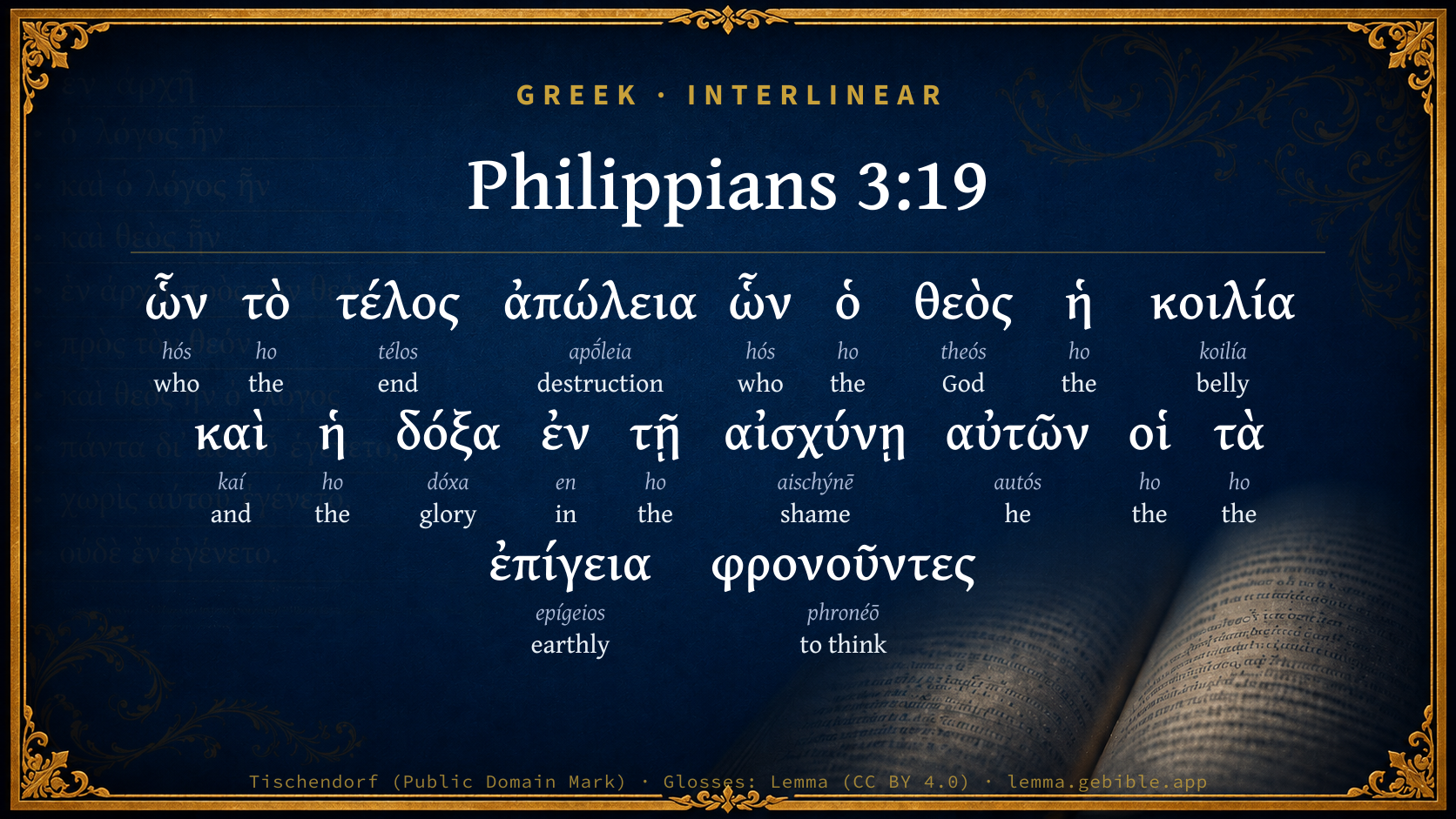
whose end is destruction, whose god is the belly, and whose glory is in their shame, who think about earthly things.
Download a study sheet
One document with this verse’s original text, its word-by-word gloss line, the meaning frame, cross-references with their text, attributed commentary, and full source and license credits — printable, and it pastes into notes with its structure intact.
This verse Autodidact and up
A passage Seminary Student
Up to 50 verses in one chapter. A passage sheet keeps up to 6 commentary sources and 12 cross-references per verse, in the order this page ranks them, and says so on the sheet whenever that leaves anything out. Ask for a single verse and you get the Autodidact verse sheet above.
Everything on this page stays free to read, with no account — the sheet is a download of what is already on screen, not access to it.
Compare translations 3
The same verse in 3 English versions, stacked beneath the original-language interlinear above. Click any original word for its lexicon entry.
Each is an independent rendering of the whole verse — the interlinear is not word-aligned to these translations.
Highlighted words mark where these versions differ — a whole-verse word diff, not a word-by-word alignment.
-
World English Bible Public Domain
whose end is destruction, whose god is the belly, and whose glory is in their shame, who think about earthly things.
-
King James Version Public Domain
Whose end is destruction, whose God is their belly, and whose glory is in their shame, who mind earthly things.)
-
unfoldingWord Literal Text CC BY-SA 4.0
whose end destruction, whose god belly, and glory in their shame, the ones thinking about earthly things.
unfoldingWord Literal Text — © unfoldingWord, licensed CC BY-SA 4.0. Word-aligned USFM3 via Door43 (git.door43.org/unfoldingWord/en_ult).
Show all 19 translations
Every available English version of this verse, each an independent rendering of the whole verse.
-
World English Bible Public Domain
whose end is destruction, whose god is the belly, and whose glory is in their shame, who think about earthly things.
-
Berean Standard Bible Public Domain
Their end is destruction, their god is their belly, and their glory is in their shame. Their minds are set on earthly things.
-
Majority Standard Bible Public Domain
Their end is destruction, their god is their belly, and their glory is in their shame. Their minds are set on earthly things.
-
King James Version Public Domain
Whose end is destruction, whose God is their belly, and whose glory is in their shame, who mind earthly things.)
-
American Standard Version (1901) Public Domain
whose end is perdition, whose god is the belly, and `whose' glory is in their shame, who mind earthly things.
-
Revised Version (1885) Public Domain
whose end is perdition, whose god is the belly, and whose glory is in their shame, who mind earthly things.
-
Geneva Bible (1599) Public Domain
Whose ende is damnation, whose God is their bellie, and whose glorie is to their shame, which minde earthly things.
-
Douay-Rheims (1899) Public Domain
Whose end is destruction; whose God is their belly; and whose glory is in their shame; who mind earthly things.
-
Young's Literal Translation Public Domain
whose end `is' destruction, whose god `is' the belly, and whose glory `is' in their shame, who the things on earth are minding.
-
Literal Standard Version CC BY-SA 4.0
whose end [is] destruction, whose god [is] the belly, and whose glory [is] in their shame, who are minding the things on earth.
-
Unlocked Literal Bible CC BY-SA 4.0
Their end is destruction. For their god is their stomach, and their pride is in their shame. They think about earthly things.
-
unfoldingWord Literal Text CC BY-SA 4.0
whose end destruction, whose god belly, and glory in their shame, the ones thinking about earthly things.
-
Darby Bible Public Domain
whose end [is] destruction, whose god [is] the belly, and [their] glory in their shame, who mind earthly things:)
-
World Messianic Bible Public Domain
whose end is destruction, whose god is the belly, and whose glory is in their shame, who think about earthly things.
-
Webster's Bible Public Domain
Whose end is destruction, whose God is their belly, and whose glory is in their shame, who mind earthly things.)
-
Free Bible Version CC BY-SA 4.0
They will end up being completely lost, these people whose “god” is their physical desires and who are proud of what they should be ashamed of, thinking only about the things of this world.
-
Bible in Basic English Public Domain
Whose end is destruction, whose god is the stomach, and whose glory is in their shame, whose minds are fixed on the things of the earth.
-
Text-Critical English NT CC BY 4.0
Their end is destruction, their god is their belly, and their glory is in their shame. Their minds are set on earthly things.
-
Tyndale New Testament (1534) Public Domain
whose ende is dampnacion whose God is their bely and whose glory is to their shame which are worldely mynded.
Literal Standard Version (2020), Covenant Press — licensed CC BY-SA 4.0. Text via the HelloAO Bible API (eBible.org). Unlocked Literal Bible (unfoldingWord) — licensed CC BY-SA 4.0. Text via the HelloAO Bible API (eBible.org). unfoldingWord Literal Text — © unfoldingWord, licensed CC BY-SA 4.0. Word-aligned USFM3 via Door43 (git.door43.org/unfoldingWord/en_ult). Free Bible Version, Dr. Jonathan Gallagher — licensed CC BY-SA 4.0. Text via the HelloAO Bible API (eBible.org).
Word by word
More ways to search: Search by grammar → Find every occurrence → Compare this word →
Practice this passage: Drill this verse → Learn its vocabulary →
- Appears 6× in the Greek New Testament
- First appears at Luke 14:9
- Part of Speech
- Noun
- Case
- Dative
- Number
- Singular
- Gender
- Feminine
Full Thayer's Definition
- ὧν hós G3739 “who” Relative pronoun, Genitive, Plural, Masculine
- τὸ ho G3588 “the” Article, Nominative, Singular, Neuter
- τέλος télos G5056 “end” Noun, Nominative, Singular, Neuter
- ἀπώλεια apṓleia G684 “destruction” Noun, Nominative, Singular, Feminine
- ὧν hós G3739 “who” Relative pronoun, Genitive, Plural, Masculine
- ὁ ho G3588 “the” Article, Nominative, Singular, Masculine
- θεὸς theós G2316 “God” Noun, Nominative, Singular, Masculine
- ἡ ho G3588 “the” Article, Nominative, Singular, Feminine
- κοιλία koilía G2836 “belly” Noun, Nominative, Singular, Feminine
- καὶ kaí G2532 “and” Conjunction
- ἡ ho G3588 “the” Article, Nominative, Singular, Feminine
- δόξα dóxa G1391 “glory” Noun, Nominative, Singular, Feminine
- ἐν en G1722 “in” Preposition
- τῇ ho G3588 “the” Article, Dative, Singular, Feminine
- αἰσχύνῃ aischýnē G152 “shame” Noun, Dative, Singular, Feminine
- αὐτῶν autós G846 “he” Personal pronoun, Genitive, Plural, Masculine
- οἱ ho G3588 “the” Article, Nominative, Plural, Masculine
- τὰ ho G3588 “the” Article, Accusative, Plural, Neuter
- ἐπίγεια epígeios G1919 “earthly” Adjective, Accusative, Plural, Neuter
- φρονοῦντες phronéō G5426 “to think” Verb, Present, Active, Participle, Nominative, Plural, Masculine
About this verse
These counts appear in no published source. They are computed here, from the morphology-tagged text and Lemma’s own curated glosses. What Lemma adds →
- 20
- words
- 13
- distinct lemmas
- Pauline Epistles
- section
Cross-references
48Topical passages linked to Philippians 3:19 in the Treasury of Scripture Knowledge — connected by theme and wording, ordered by reader-vote popularity; previews shown in the World English Bible.
- Romans 16:18 For those who are such don't serve our Lord, Jesus Christ, but their own belly; and by their smooth and flattering speech, they deceive the hearts of the innocent.
- Romans 8:5–7 For those who live according to the flesh set their minds on the things of the flesh, but those who live according to the Spirit, the things of the Spirit.
- 2 Peter 2:3 In covetousness they will exploit you with deceptive words: whose sentence now from of old doesn't linger, and their destruction will not slumber.
- Colossians 3:2 Set your mind on the things that are above, not on the things that are on the earth.
- Jude 1:12–13 These are hidden rocky reefs in your love feasts when they feast with you, shepherds who without fear feed themselves; clouds without water, carried along by winds; autumn leaves without fruit, twice dead, plucked up by the roots;
- 2 Corinthians 11:15 It is no great thing therefore if his ministers also masquerade as servants of righteousness, whose end will be according to their works.
- 2 Peter 2:1 But there also arose false prophets among the people, as among you also there will be false teachers, who will secretly bring in destructive heresies, denying even the Master who bought them, bringing on themselves swift destruction.
- Hosea 4:7 As they were multiplied, so they sinned against me. I will change their glory into shame.
- 2 Corinthians 11:12 But what I do, that I will do, that I may cut off occasion from them that desire an occasion, that in which they boast, they may be found even as we.
- Galatians 6:13 For even they who receive circumcision don't keep the law themselves, but they desire to have you circumcised, that they may boast in your flesh.
- 2 Peter 2:13 receiving the wages of unrighteousness; people who count it pleasure to revel in the day-time, spots and blemishes, reveling in their deceit while they feast with you;
- Psalms 17:14 From men by your hand, Yahweh, From men of the world, whose portion is in this life. You fill the belly of your cherished ones. Your sons have plenty, And they store up wealth for their children.
- 1 Corinthians 3:3 for you are still fleshly. For insofar as there is jealousy, strife, and factions among you, aren't you fleshly, and don't you walk in the ways of men?
- Revelation 21:8 But for the cowardly, unbelieving, sinners, abominable, murderers, sexually immoral, sorcerers, idolaters, and all liars, their part is in the lake that burns with fire and sulfur, which is the second death."
- Ezekiel 34:3 You eat the fat, and you clothe you with the wool, you kill the fatlings; but you don't feed the sheep.
- Malachi 1:12 "But you profane it, in that you say, 'Yahweh's table is polluted, and its fruit, even its food, is contemptible.'
- 1 Corinthians 5:2 You are puffed up, and didn't rather mourn, that he who had done this deed might be removed from among you.
- 1 Corinthians 5:6 Your boasting is not good. Don't you know that a little yeast leavens the whole lump?
- Philippians 2:21 For they all seek their own, not the things of Jesus Christ.
- 2 Thessalonians 2:8 Then the lawless one will be revealed, whom the Lord will kill with the breath of his mouth, and bring to nothing by the brightness of his coming;
- 2 Thessalonians 2:12 that they all might be judged who didn't believe the truth, but had pleasure in unrighteousness.
- 1 Timothy 6:5 constant friction of people of corrupt minds and destitute of the truth, who suppose that godliness is a means of gain. Withdraw yourself from such.
- 2 Timothy 3:4 traitors, headstrong, conceited, lovers of pleasure rather than lovers of God;
- Titus 1:11–12 whose mouths must be stopped; men who overthrow whole houses, teaching things which they ought not, for dishonest gain's sake.
- 2 Peter 2:17–19 These are wells without water, clouds driven by a storm; for whom the blackness of darkness has been reserved forever.
- Jude 1:16 These are murmurers and complainers, walking after their lusts (and their mouth speaks proud things), showing respect of persons to gain advantage.
- Revelation 22:15 Outside are the dogs, the sorcerers, the sexually immoral, the murderers, the idolaters, and everyone who loves and practices falsehood.
- 1 Samuel 2:11–16 Elkanah went to Ramah to his house. The child did minister to Yahweh before Eli the priest.
- Psalms 4:6–7 Many say, "Who will show us any good?" Yahweh, let the light of your face shine on us.
- Psalms 52:1 Why do you boast of mischief, mighty man? God's loving kindness endures continually.
- Isaiah 56:10–12 His watchmen are blind, they are all without knowledge; they are all mute dogs, they can't bark; dreaming, lying down, loving to slumber.
- Micah 3:5 Thus says Yahweh concerning the prophets who lead my people astray; for those who feed their teeth, they proclaim, "Peace!" and whoever doesn't provide for their mouths, they prepare war against him:
- Micah 3:11 Her leaders judge for bribes, And her priests teach for a price, And her prophets of it tell forturnes for money: Yet they lean on Yahweh, and say, Isn't Yahweh in the midst of us? No disaster will come on us.
- Habakkuk 2:15–16 "Woe to him who gives his neighbor drink, pouring your inflaming wine until they are drunk, so that you may gaze at their naked bodies!
- Matthew 16:23 But he turned, and said to Peter, "Get behind me, Satan! You are a stumbling-block to me, for you are not setting your mind on the things of God, but on the things of men."
- Matthew 25:41 Then he will say also to those on the left hand, 'Depart from me, you cursed, into the eternal fire which is prepared for the devil and his angels;
- Luke 12:19 I will tell my soul, "Soul, you have many goods laid up for many years. Take your ease, eat, drink, be merry."'
- Luke 12:45–46 But if that servant says in his heart, 'My lord delays his coming,' and begins to beat the menservants and the maidservants, and to eat and drink, and to be drunken,
- Luke 16:19 "Now there was a certain rich man, and he was clothed in purple and fine linen, living in luxury every day.
- Luke 18:4 He wouldn't for a while, but afterward he said to himself, 'Though I neither fear God, nor respect man,
- Hebrews 6:6–8 and then fell away, it is impossible to renew them again to repentance; seeing they crucify the Son of God for themselves again, and put him to open shame.
- James 4:16 But now you glory in your boasting. All such boasting is evil.
- Revelation 19:20 The beast was taken, and with him the false prophet who worked the signs in his sight, with which he deceived those who had received the mark of the beast and those who worshiped his image. These two were thrown alive into the lake of fire that burns with sulfur.
- Revelation 20:9–10 They went up over the breadth of the earth, and surrounded the camp of the saints, and the beloved city. Fire came down out of heaven from God, and devoured them.
- Ezekiel 13:19 You have profaned me among my people for handfuls of barley and for pieces of bread, to kill the souls who should not die, and to save the souls alive who should not live, by your lying to my people who listen to lies.
- Romans 6:21 What fruit then did you have at that time in the things of which you are now ashamed? For the end of those things is death.
- Jude 1:4 For there are certain men who crept in secretly, even those who were long ago written about for this condemnation: ungodly men, turning the grace of our God into lasciviousness, and denying our only Master, God, and Lord, Jesus Christ.
- Revelation 18:7 However much she glorified herself, and grew wanton, so much give her of torment and mourning. For she says in her heart, 'I sit a queen, and am no widow, and will in no way see mourning.'
Cross-references courtesy of OpenBible.info (CC BY 4.0).
Lesson kit
Teaching starters — assembled from the data on this page, not authored interpretation. Every prompt links to the verse data it draws on. Edit before teaching.
Philippians, in the Pauline Epistles, opens this verse with 20 words (13 distinct Greek lemmas). Its most distinctive word is aischýnē (“shame”). A historical commentator’s framing appears above. Read the whole chapter for the surrounding context.
Discussion questions
- What does “shame” (aischýnē) contribute to the verse as a whole?
- Luke 14:9 shares the word «shame» with this verse. How do the two illuminate each other?
- “the” occurs 7× in this one verse. What is the effect of the repetition?
- The translations on this page render this verse differently — a whole-verse word diff, not a word-by-word alignment. What might account for the different wordings?
- Reading how The Biblical Illustrator and Tyndale Open Study Notes read this verse, where do the two commentators agree and where do they part?
Things to notice
- These translations choose different wording for 6 words in this verse.
- “the” occurs 7× in this single verse.
- 13 distinct Greek lemmas span 20 words in this verse.
Commentary
Notes on Philippians 3:19 from classic Christian and Jewish commentators (each source and its license shown beneath its notes). The classic Christian expositions comment on the surrounding passage and are grouped to its opening verse, so a note may address several verses; the Jewish commentaries on the Tanakh (Rashi and others) are per-verse, so they appear only where the commentator wrote on this verse.
Lemma curates 59 commentaries, every one of them public domain or Creative Commons licensed, each selected and text-cleaned for this edition rather than reprinted as found. About our sources →
The Biblical Illustrator
Joseph S. Exell
The Biblical Illustrator, edited by Joseph S. Exell (c. 1880s–1900s) — public domain. Text from a community e-Sword module.
Tyndale Open Study Notes
Tyndale Open Resources
Tyndale Open Study Notes — © Tyndale Open Resources, licensed CC BY-SA 4.0. Text via the HelloAO Bible API.
Bengel's Gnomon
Johann Albrecht Bengel
Bengel's Gnomon of the New Testament — English translation (T&T Clark, Edinburgh, 1860) — public domain. Text from a community e-Sword module.
Meyer's Critical & Exegetical Commentary
Heinrich August Wilhelm Meyer
Meyer — Critical and Exegetical Commentary on the New Testament — English translation by Peter Christie, edited by Frederick Crombie (T&T Clark, 1880) — public domain. Text from a community e-Sword module.
Expositor's Greek Testament
ed. W. Robertson Nicoll
The Expositor's Greek Testament, edited by W. Robertson Nicoll (1897–1910) — public domain. Text from a community e-Sword module.
Geneva Bible (1599)
Geneva Bible translators
Geneva Bible (1599) marginal notes — public domain. Text via Bolls.life.
Jamieson, Fausset & Brown
Robert Jamieson, A. R. Fausset & David Brown
Jamieson, Fausset & Brown — Commentary Critical and Explanatory on the Whole Bible (1871) — public domain (CC PDM 1.0). Text via the HelloAO Bible API.
Adam Clarke's Commentary
Adam Clarke's Commentary on the Bible (1810–1826) — public domain. Text from a community e-Sword/MySword module.
John Calvin's Commentaries
John Calvin's Commentaries (1540-1563) — public domain. Text from the Calvin Translation Society English edition (1840s-50s) via the Christian Classics Ethereal Library (ccel.org). Calvin's coverage is partial (roughly two-thirds of the Bible); uncommented books and verses are honest gaps, never fabricated. The 19th-century editor's footnotes and remarks are omitted so the notes are faithfully Calvin's own voice.
Ellicott's Commentary for English Readers
A Bible Commentary for English Readers, edited by Charles John Ellicott (1878–1897) — public domain. Text from a community e-Sword module.
The Cambridge Bible for Schools and Colleges
gen. ed. J. J. S. Perowne
The Cambridge Bible for Schools and Colleges (gen. ed. J. J. S. Perowne; Cambridge University Press, 1878–1918) — public domain. Text from a community e-Sword module.
John Gill's Exposition
John Gill's Exposition of the Whole Bible (1746–1763) — public domain (CC PDM 1.0). Text via the HelloAO Bible API.
Trapp's Complete Commentary
John Trapp
John Trapp, A Commentary or Exposition upon All the Books of the Old and New Testament (1647–1656) — public domain. Text from a community e-Sword module.
Albert Barnes' Notes on the Bible
Albert Barnes' Notes on the Bible (1834–1885) — public domain. Text from a community e-Sword/MySword module.
Matthew Poole's English Annotations
Matthew Poole's English Annotations on the Holy Bible (1683–1685) — public domain. Text from a community e-Sword/MySword module.
Whedon's Commentary on the Bible
Daniel D. Whedon
Daniel D. Whedon (gen. ed.), Commentary on the Old and New Testaments (1874–1909) — public domain. Text from a community e-Sword module.
The Pulpit Commentary
The Pulpit Commentary (1880–1919), ed. H.D.M. Spence-Jones & Joseph S. Exell — public domain. Text from a community e-Sword module.
John Wesley's Explanatory Notes
John Wesley, Explanatory Notes Upon the Whole Bible (1754–1765) — public domain. Text via the GEBible commentary corpus.
The People's New Testament
B. W. Johnson
B. W. Johnson's The People's New Testament with Notes (1889–1891) — public domain. Electronic text from the Christian Classics Ethereal Library (CCEL) ThML edition.
Cambridge Greek Testament for Schools and Colleges
Cambridge Greek Testament for Schools and Colleges (Cambridge University Press, 1896; 21 vols, various authors incl. Carr, Maclear, Plummer, Farrar, Lumby, Moule, M. R. James, Simcox) — public domain. Text from a community e-Sword module.
International Critical Commentary
International Critical Commentary — older volumes (1896–1929), various authors — public domain. Text from a community e-Sword module.
Vincent's Word Studies in the New Testament
Marvin R. Vincent
Marvin R. Vincent, Word Studies in the New Testament (1887–1900) — public domain. Text from a community e-Sword/MySword module.