
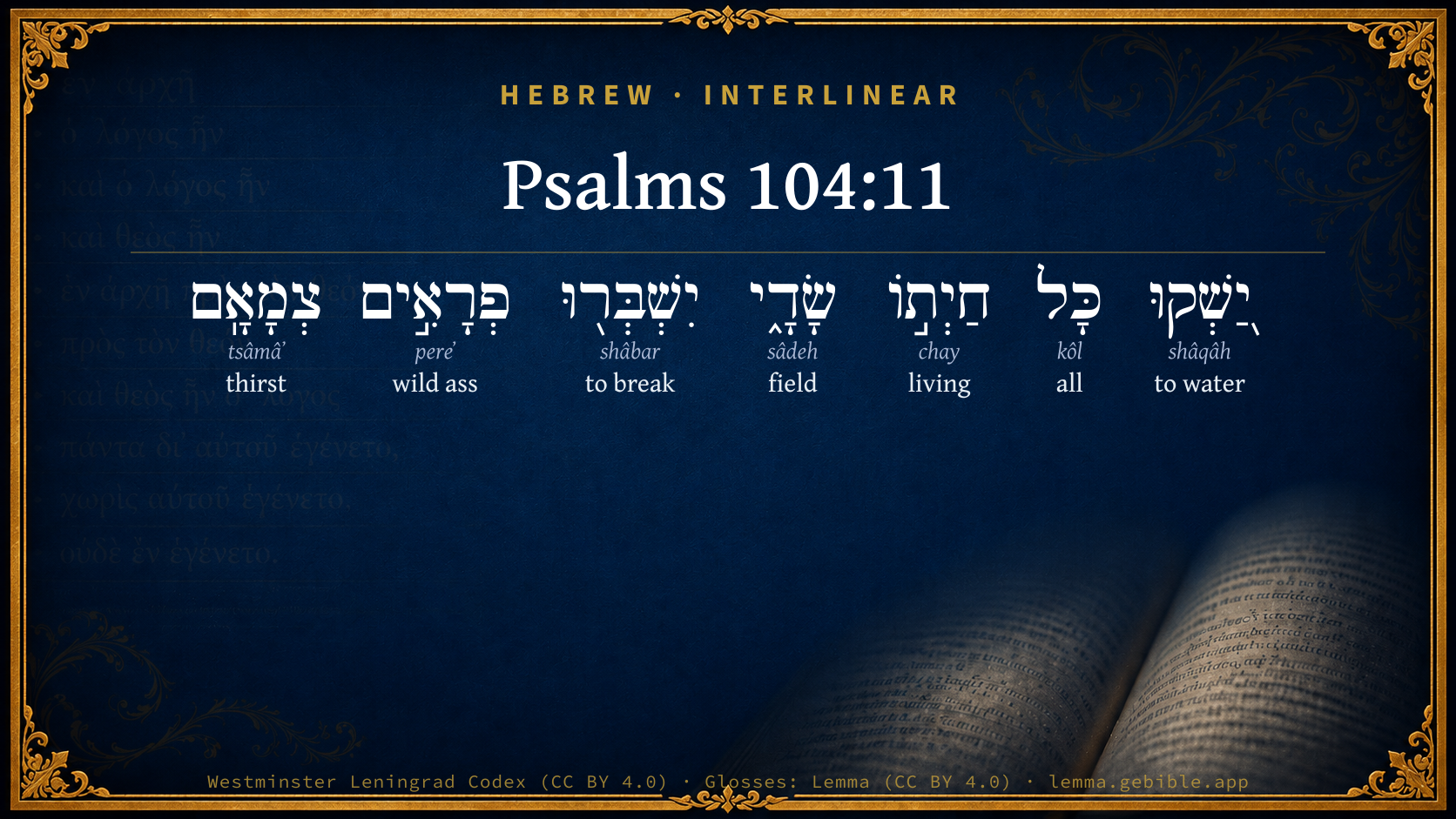
Psalms 104:11

Hebrew (Westminster Leningrad Codex) Psalms 104:11 appears in the Hebrew Old Testament. The text above is from the Westminster Leningrad Codex. Each word links to its Strong’s number, a concise gloss, and parsing drawn from the Open Scriptures Hebrew Bible morphology. Click any word for its full Brown-Driver-Briggs (BDB) entry.
Download image
Cite this verse

Psalms 104:11 (World English Bible). Public Domain. Lemma interlinear Bible study tool, https://lemma.gebible.app/v/psalms/104/11.

Show BibTeX & RIS
BibTeX
RIS
English Translation
They give drink to every animal of the field. The wild donkeys quench their thirst.
World English Bible · Public Domain
Download a study sheet

One document with this verse’s original text, its word-by-word gloss line, the meaning frame, cross-references with their text, attributed commentary, and full source and license credits — printable, and it pastes into notes with its structure intact.

This verse Autodidact and up

Study sheet (.html) Plain text (.txt)

A passage Seminary Student

Up to 50 verses in one chapter. A passage sheet keeps up to 6 commentary sources and 12 cross-references per verse, in the order this page ranks them, and says so on the sheet whenever that leaves anything out. Ask for a single verse and you get the Autodidact verse sheet above.

Everything on this page stays free to read, with no account — the sheet is a download of what is already on screen, not access to it.

Want to remove ads? Support Godless Engineer
Compare translations 3

The same verse in 3 English versions, stacked beneath the original-language interlinear above. Click any original word for its lexicon entry.

Each is an independent rendering of the whole verse — the interlinear is not word-aligned to these translations.

Highlighted words mark where these versions differ — a whole-verse word diff, not a word-by-word alignment.

  • World English Bible Public Domain
    They give drink to every animal of the field. The wild donkeys quench their thirst.
  • King James Version Public Domain
    They give drink to every beast of the field: the wild asses quench their thirst.
  • unfoldingWord Literal Text CC BY-SA 4.0
    They give drink to all his animals of the field; the wild donkeys break their thirst.

unfoldingWord Literal Text — © unfoldingWord, licensed CC BY-SA 4.0. Word-aligned USFM3 via Door43 (git.door43.org/unfoldingWord/en_ult).

Versions to compare (up to 4)

3 of 4 selected

Show all 18 translations

Every available English version of this verse, each an independent rendering of the whole verse.

  • World English Bible Public Domain
    They give drink to every animal of the field. The wild donkeys quench their thirst.
  • Berean Standard Bible Public Domain
    They give drink to every beast of the field; the wild donkeys quench their thirst.
  • Majority Standard Bible Public Domain
    They give drink to every beast of the field; the wild donkeys quench their thirst.
  • King James Version Public Domain
    They give drink to every beast of the field: the wild asses quench their thirst.
  • American Standard Version (1901) Public Domain
    They give drink to every beast of the field; The wild asses quench their thirst.
  • Revised Version (1885) Public Domain
    They give drink to every beast of the field; the wild asses quench their thirst.
  • Geneva Bible (1599) Public Domain
    They shall giue drinke to all the beasts of the fielde, and the wilde asses shall quench their thirst.
  • Douay-Rheims (1899) Public Domain
    All the beasts of the field shall drink: the wild asses shall expect in their thirst.
  • Young's Literal Translation Public Domain
    They water every beast of the field, Wild asses break their thirst.
  • Literal Standard Version CC BY-SA 4.0
    They water every beast of the field, || Wild donkeys break their thirst.
  • Unlocked Literal Bible CC BY-SA 4.0
    They supply water for all the animals of the field; the wild donkeys quench their thirst.
  • unfoldingWord Literal Text CC BY-SA 4.0
    They give drink to all his animals of the field; the wild donkeys break their thirst.
  • Darby Bible Public Domain
    They give drink to every beast of the field; the wild asses quench their thirst.
  • World Messianic Bible Public Domain
    They give drink to every animal of the field. The wild donkeys quench their thirst.
  • Webster's Bible Public Domain
    They give drink to every beast of the field: the wild asses quench their thirst.
  • Free Bible Version CC BY-SA 4.0
    They provide water for all the wild animals, and wild donkeys quench their thirst.
  • Bible in Basic English Public Domain
    They give drink to every beast of the field; the mountain asses come to them for water.
  • JPS Tanakh (1917) Public Domain
    They give drink to every beast of the field, the wild asses quench their thirst.

Literal Standard Version (2020), Covenant Press — licensed CC BY-SA 4.0. Text via the HelloAO Bible API (eBible.org). Unlocked Literal Bible (unfoldingWord) — licensed CC BY-SA 4.0. Text via the HelloAO Bible API (eBible.org). unfoldingWord Literal Text — © unfoldingWord, licensed CC BY-SA 4.0. Word-aligned USFM3 via Door43 (git.door43.org/unfoldingWord/en_ult). Free Bible Version, Dr. Jonathan Gallagher — licensed CC BY-SA 4.0. Text via the HelloAO Bible API (eBible.org).

Word by word

More ways to search: Search by grammar → Find every occurrence → Compare this word →

Practice this passage: Drill this verse → Learn its vocabulary →

About this verse

These counts appear in no published source. They are computed here, from the morphology-tagged text and Lemma’s own curated glosses. What Lemma adds →

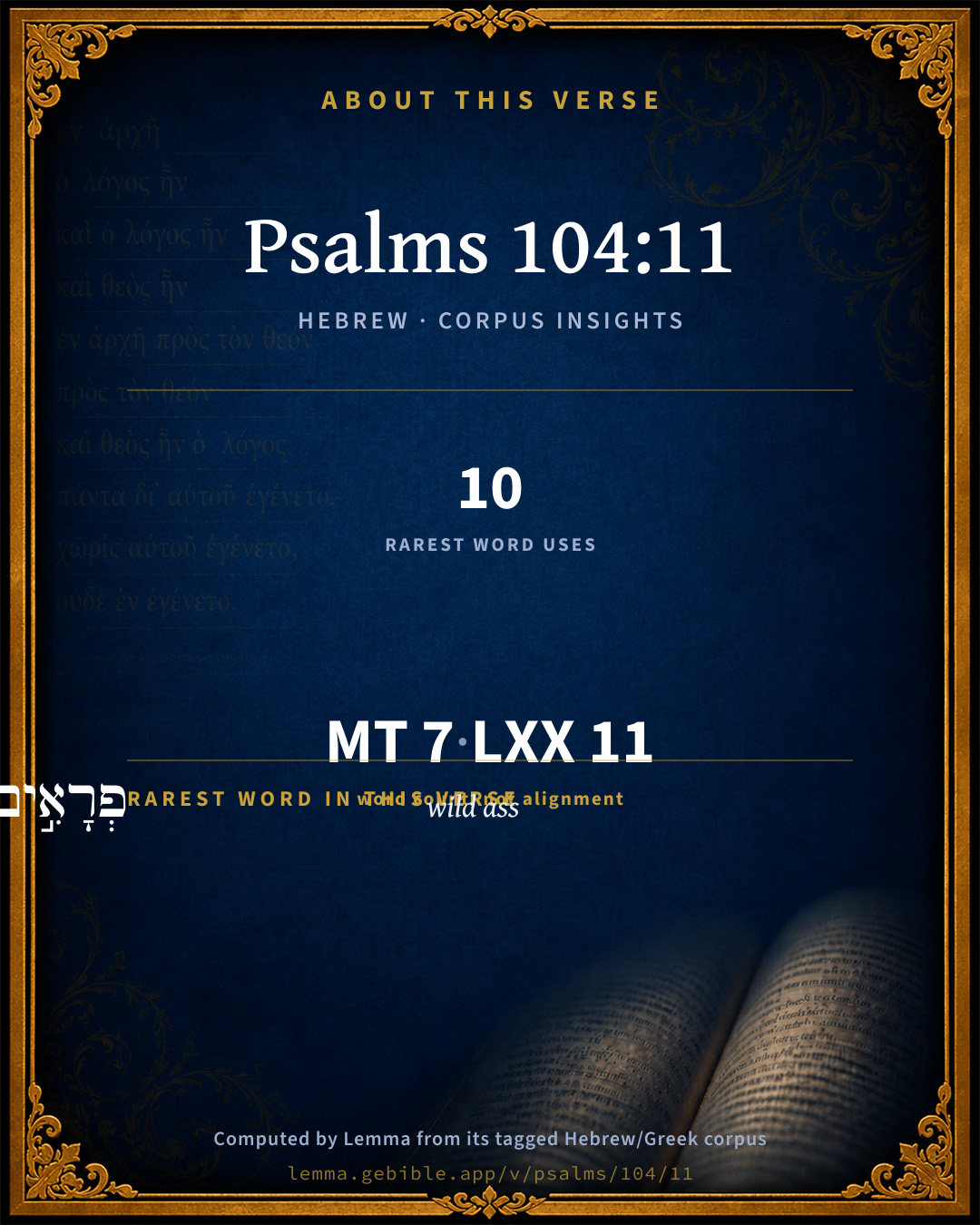
7
words
7
distinct lemmas
Wisdom
section

Notable vocabulary

The rarest word here is פְרָאִ֣ים wild ass H6501 — appearing just 10 times in the whole Hebrew Bible.

Shared distinctive vocabulary

פְרָאִ֣ים wild ass H6501 occurs in 10 verses of the Hebrew Bible. Also found in:

Grammatical profile

  • 2 verbs
  • 5 nouns

Verb forms

  • יַ֭שְׁקוּ Hiphil · Imperfect
  • יִשְׁבְּר֖וּ Qal · Imperfect

Hebrew & Septuagint length

In English translation the verse runs 15 words from the Hebrew and 23 from the Septuagint (LXX English) — closely comparable.

A rough comparison of the two English renderings, which tokenize alike — not a word-level alignment.

Word counts can differ between the Hebrew and the Greek without any difference in meaning — e.g. the Hebrew direct-object marker אֵת has no separate Greek word, and Greek often adds the article ὁ.

In the original languages it is 7 Hebrew tokens and 11 Greek tokens — but the two are counted differently (Hebrew bundles its prefixes and suffixes into one token; the Greek is in lemma form), so that isn’t a like-for-like length.

Cross-references

3

Topical passages linked to Psalms 104:11 in the Treasury of Scripture Knowledge — connected by theme and wording, ordered by reader-vote popularity; previews shown in the World English Bible.

  • Psalms 145:16 You open your hand, And satisfy the desire of every living thing.
  • Job 39:5–8 "Who has set the wild donkey free? Or who has loosened the bonds of the swift donkey,
  • Psalms 104:13 He waters the mountains from his chambers. The earth is filled with the fruit of your works.

Cross-references courtesy of OpenBible.info (CC BY 4.0).

Hebrew and Greek witnesses Masoretic Hebrew ↔ Greek Septuagint

The same verse in the two great witnesses to the Old Testament, shown verse-for-verse.

You’re reading Greek Psalm 103 (Hebrew Psalm 104). The Septuagint counts the superscription, so verse numbers can differ from the Hebrew — chapter-level alignment, not verse-by-verse. Numbering follows Rahlfs.

These are two independent witnesses, not word-aligned to each other, and the Septuagint is shown in lemma (dictionary) form.

Hebrew Psalms 104:11 Masoretic · Westminster Leningrad Codex

יַ֭שְׁקוּ כָּל חַיְת֣וֹ שָׂדָ֑י יִשְׁבְּר֖וּ פְרָאִ֣ים צְמָאָֽם

They give drink to every animal of the field. The wild donkeys quench their thirst.

World English Bible · Public Domain

Greek LXX Greek Psalm 103:11 Septuagint · lemma form

ποτίζω πᾶς ὁ θηρίον ὁ ἀγρός προςδέχομαι ὄναγρος εἰς δίψα αὐτός

They shall give drink to all the wild beasts of the field: the wild asses shall take of them to quench their thirst.

LXX2012 (modern English Septuagint) · Public Domain

Hebrew: Westminster Leningrad Codex (CC BY 4.0). Greek: Septuagint (public domain); English from LXX2012 (modern English Septuagint) (Public Domain). How the Septuagint differs from the Hebrew →

Commentary

Notes on Psalms 104:11 from classic Christian and Jewish commentators (each source and its license shown beneath its notes). The classic Christian expositions comment on the surrounding passage and are grouped to its opening verse, so a note may address several verses; the Jewish commentaries on the Tanakh (Rashi and others) are per-verse, so they appear only where the commentator wrote on this verse.

Lemma curates 59 commentaries, every one of them public domain or Creative Commons licensed, each selected and text-cleaned for this edition rather than reprinted as found. About our sources →

Trapp's Complete Commentary

John Trapp

Psa 104:11 They give drink to every beast of the field: the wild asses quench their thirst.

Ver. 11. They give drink to every beast] A great mercy, as we have lately found in these late dry years, 1653, 1654, wherein God hath given us to know the worth of water by the want of it, Bona sunt a tergo formosissima.

The wild asses] Those hottest creatures, Job 39:8-11.

John Trapp, A Commentary or Exposition upon All the Books of the Old and New Testament (1647–1656) — public domain. Text from a community e-Sword module.

J. A. Alexander on Psalms

Joseph Addison Alexander

11. (Psa 104:11) They water every beast of the field; (at them) wild asses quench their thirst. The subject of the first verb is still the waters. The verb itself means to water, in the sense of giving drink to animals, though sometimes metaphorically applied to irrigation. See Gen 2:10. The form of the parallelism in this verse is peculiar, although not uncommon in Hebrew poetry, the last clause containing a specification of the general statement in the first. What is first said of animals, or wild ones in the general, is then said of the wild ass in particular. Quench, literally break, i.e. subdue, assuage. A derivative noun is applied in Hebrew to corn or grain, as that which breaks or assuages hunger, although most interpreters and lexicographers suppose a reference to the literal breaking or grinding of the corn itself.

Joseph Addison Alexander, The Psalms Translated and Explained (1850) — public domain. Text from a community e-Sword module.

Tyndale Open Study Notes

Tyndale Open Resources

104:11-18 The psalmist celebrates animal, plant, and human life, as well as the Lord’s abundant provision for all of it (Gen 1:9-30).

Tyndale Open Study Notes — © Tyndale Open Resources, licensed CC BY-SA 4.0. Text via the HelloAO Bible API.

Geneva Bible (1599)

Geneva Bible translators

If God provide for the very beasts, much more will he extend his provident care to man.

Geneva Bible (1599) marginal notes — public domain. Text via Bolls.life.

Adam Clarke's Commentary

Verse 11. The wild asses quench their thirst.] The פרא pere, onager or wild ass, differs in nothing from the tame ass, only it has not a broken spirit, and is consequently more lively and active. It is so very swift that no horse except the Arab barb can overtake it. It is a gregarious animal, and they go in troops to feed and to drink. It is very timid, or rather jealous of its liberty, and therefore retires deep into the desert; yet even there the providence of God regards it; springs are provided, and it has the instinct to find them out.

Adam Clarke's Commentary on the Bible (1810–1826) — public domain. Text from a community e-Sword/MySword module.

Ellicott's Commentary for English Readers

(11) Wild asses.—See Job_39:5-8.

A Bible Commentary for English Readers, edited by Charles John Ellicott (1878–1897) — public domain. Text from a community e-Sword module.

The Cambridge Bible for Schools and Colleges

gen. ed. J. J. S. Perowne

11. every beast of the field] Wild animals, as distinguished from domesticated animals, the ‘cattle’ of Psa_104:14.

the wild asses] Mentioned particularly as one of the most striking and beautiful of wild animals. See Davidson’s note on Job_39:7, a passage which may have been in the Psalmist’s mind, for he was evidently familiar with Job. Jeremiah (Jer_14:6) draws a graphic picture of the sufferings of the wild ass in a drought.

quench] Lit. break. Cp. frangere sitim.

The Cambridge Bible for Schools and Colleges (gen. ed. J. J. S. Perowne; Cambridge University Press, 1878–1918) — public domain. Text from a community e-Sword module.

John Gill's Exposition

They give drink to every beast of the field,.... These fountains, springs, and rivers, afford water for all the beasts of the field; who are therefore said to honour and praise the Lord on account of it, Isa 43:19.

The wild asses quench their thirst; or "break" (n) it. Those creatures that live in dry and desert places, and are themselves dry and thirsty; and though so stupid as they be, yet provision of water is made for them, and they are directed where to seek for it, and find it; see Job 39:5. And if God takes care of the beasts of the field, even the most wild and stupid, will he not take care of his own people? He will, and does. He opens rivers in high places, and fountains in the midst of the valleys; he gives waters in the wilderness, and rivers in the desert, to give drink to his people, his chosen, Isa 41:18.

(n) "frangent", Pagninus, Montanus; "frangunt", Vatablus, Cocceius, Gejerus, Michaelis; so Ainsworth.

John Gill's Exposition of the Whole Bible (1746–1763) — public domain (CC PDM 1.0). Text via the HelloAO Bible API.

Albert Barnes' Notes on the Bible

They give drink to every beast of the field - All are thus kept alive. The wild beasts that roam at large, find water thus provided for them.

The wild donkeys quench their thirst - Margin, as in Hebrew, “break.” The meaning is, that the most wild and ungovernable of beasts - those which are farthest from the habits of domesticated animals, and the most independent of any aid derived from man, find abundance everywhere. On the word rendered “wild asses,” and on the habits of the animals here referred to, see the notes at Job 11:12.

Albert Barnes' Notes on the Bible (1834–1885) — public domain. Text from a community e-Sword/MySword module.

Matthew Poole's English Annotations

Which he mentions, partly because they are dry and thirsty creatures; and partly because they live in dry and desolate wildernesses, and are neither ruled nor regarded by men, and are most stupid creatures, and yet are plentifully provided for by the care and bounty of Divine Providence.

Matthew Poole's English Annotations on the Holy Bible (1683–1685) — public domain. Text from a community e-Sword/MySword module.

The Treasury of David

Charles H. Spurgeon

Ver. 11. They give drink to every beast of the field. Who else would water them if the Lord did not? They are his cattle, and therefore he leads them forth to watering. Not one of them is forgotten of him.

The wild asses quench their thirst. The good Lord gives them enough and to spare. They know their Master's crib. Though bit or bridle of man they will not brook, and man denounces them as unteachable, they learn of the Lord, and know better far than man where flows the cooling crystal of which they must drink or die. They are only asses, and wild, yet our heavenly Father careth for them. Will he not also care for us? We see here, also, that nothing is made in vain; though no human lip is moistened by the brooklet in the lone valley, yet are there other creatures which need refreshment, and these slake their thirst at the stream. Is this nothing? Must everything exist for man, or else be wasted? What but our pride and selfishness could have suggested such a notion? It is not true that flowers which blush unseen by human eye are wasting their sweetness, for the bee finds them out, and other winged wanderers live on their luscious juices. Man is but one creature of the many whom the heavenly Father feedeth and watereth.

Ver. 11. The wild asses quench their thirst. It is particularly remarked of the asses, that though they are dull and stupid creatures, yet by Providence they are taught the way to the waters, in the dry and sandy deserts, and that there is no better guide for the thirsty travellers to follow, than to observe the herds of them descending to the streams. Thomas Fenton.

Ver. 11. The wild asses quench their thirst. As evening approached we saw congregated, near a small stream, what appeared to be a large company of dismounted Arabs, their horses standing by them. As we were already near them, and could not have escaped the watchful eye of the Bedouins, we prepared for an encounter. We approached cautiously, and were surprised to see that the horses still remained without their riders; we drew still nearer, when they galloped off towards the desert. They were wild asses. Henry Austin Layard.

Psalms 104:12*

Charles H. Spurgeon's The Treasury of David (1869–1885) — public domain. Psalms only. Text from a community e-Sword/MySword module.

Whedon's Commentary on the Bible

Daniel D. Whedon

11. Beast of the field—A term for land animals in general.

Wild asses— Here mentioned, perhaps, as specimens of animals inhabiting parched deserts, familiar with suffering from thirst, and hence extreme examples of divine care. For their habits, see Job_39:5-8; Isa_32:14

Daniel D. Whedon (gen. ed.), Commentary on the Old and New Testaments (1874–1909) — public domain. Text from a community e-Sword module.

The Pulpit Commentary

They give drink to every beast of the field. God"s mercy is "over all his works". (Psa_145:9) He careth for the whole animal creation. (see Exo_20:10 Exo_23:19 Deu_25:4 Psa_104:27 Psa_145:15, 16 Jon_4:11, etc.) The wild asses quench their thirst. Herodotus (4:192) says that wild asses are apotoii.e. "do not drink" but modern travellers declare the contrary. They drink infrequently, and are so shy, that at such times they rarely fall under human observation.

The Pulpit Commentary (1880–1919), ed. H.D.M. Spence-Jones & Joseph S. Exell — public domain. Text from a community e-Sword module.

John Wesley's Explanatory Notes

Wild asses - Stupid creatures, and yet plentifully provided for by the Divine providence.

John Wesley, Explanatory Notes Upon the Whole Bible (1754–1765) — public domain. Text via the GEBible commentary corpus.

Lesson kit

Teaching starters — assembled from the data on this page, not authored interpretation. Every prompt links to the verse data it draws on. Edit before teaching.

Psalms, in the Wisdom, opens this verse with 7 words (7 distinct Hebrew lemmas). Its most distinctive word is pereʼ (“wild ass”). A historical commentator’s framing appears above. Read the whole chapter for the surrounding context.

Discussion questions

  1. What does “wild ass” (pereʼ) contribute to the verse as a whole?
  2. How does Genesis 16:12, which shares the word «wild ass», read alongside this verse?
  3. These translations render this verse differently. What is at stake in choosing one wording over another?
  4. «יַ֭שְׁקוּ» is a Hiphil Imperfect verb. How does that grammatical form shape the action described?
  5. Compare how Trapp's Complete Commentary and J. A. Alexander on Psalms read this verse. Where do they agree or differ?

Things to notice

Reading settings

Reading text

Shown beneath each verse's original-language words.

Old Testament
Old Testament edition

Read the OT as the Masoretic Hebrew (MT) or the Greek Septuagint (LXX).

English shown for the Greek Septuagint (in the Hebrew ↔ Greek comparison).

Comparing translations? Open the Compare panel on any verse page to stack up to four side by side.