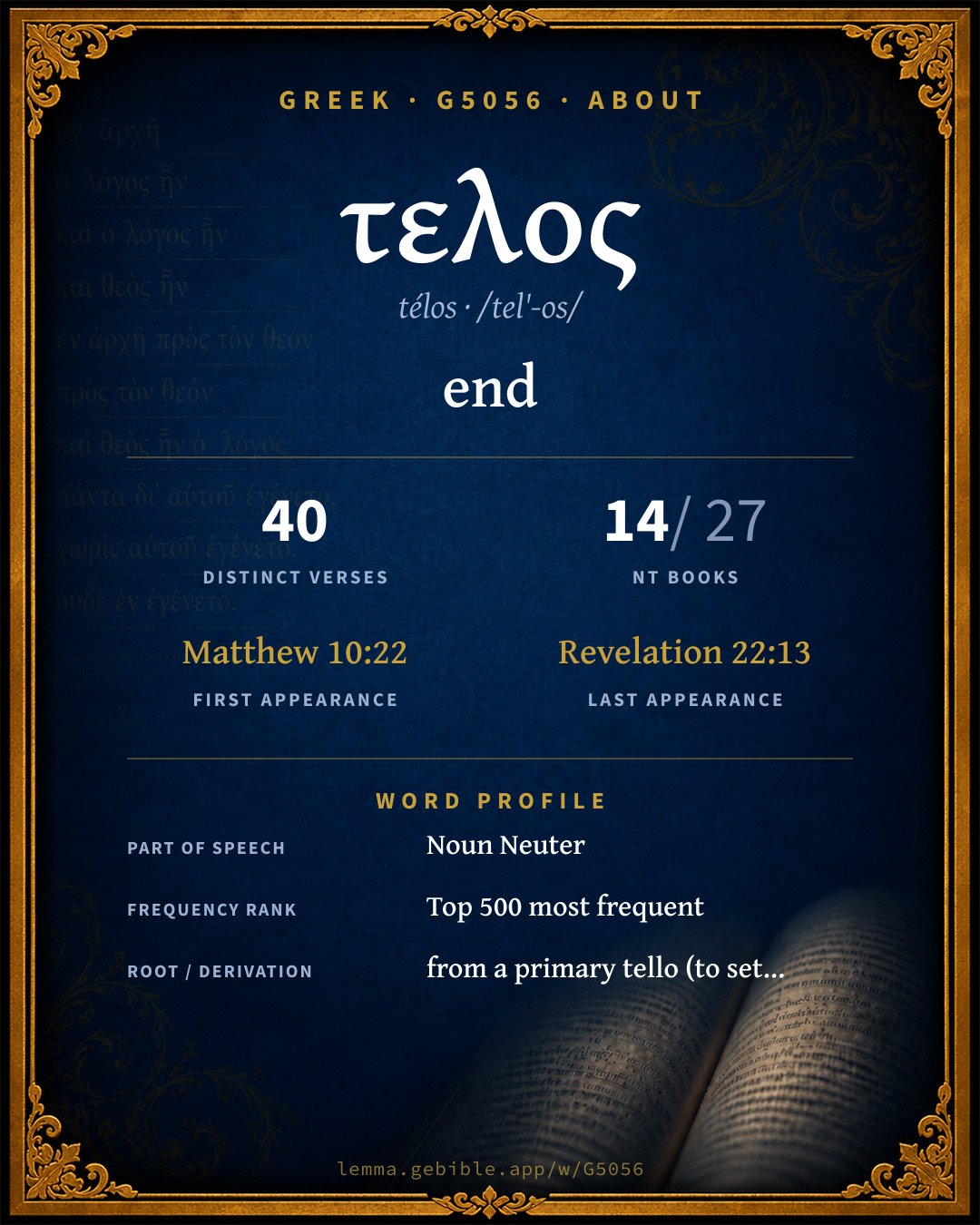
τέλος
end
‘end’ is one of 2 main senses fuller range ↓
Full lexicon entry — Thayer's Greek Lexicon
From Thayer's Greek Lexicon
Where this word appears
See every Nominative-case word in the Greek New Testament →
Grammar key — what these labels mean
Part of speech
- Noun
- A naming word — a person, place, thing, or idea.
Case
- Nominative
- The case of the subject (and the predicate nominative).
- Accusative
- The case of the direct object and of extent.
- Genitive
- The case of source, possession, or “of” — answers “whose / from what.”
Gender
- Neuter
- Grammatically neuter.
Number
- Singular
- One.
- Plural
- More than one.
Grammatical forms
- Noun, Nominative, Singular, Neuter 18 times (44%)
- Noun, Accusative, Singular, Neuter 15 times (37%)
- Noun, Genitive, Singular, Neuter 6 times (15%)
- Noun, Accusative, Plural, Neuter 1 time (2%)
- Noun, Nominative, Plural, Neuter 1 time (2%)
Parsed forms decoded from the imported morphology (Robinson–Tischendorf, public domain), counted across 41 parsed occurrences — not distinct verses.
Every verse where G5056 appears — 40 distinct verses across 14 books. Click any verse to open its interlinear word-by-word view. Verse text shown in the World English Bible for context — . Each verse’s Greek form is shown with its reference; the English is not keyword-highlighted, since the data carries no word-level English alignment. Use “Compare translations” on any verse to read it across multiple English versions. This concordance covers the Greek New Testament; Septuagint (Greek Old Testament) occurrences of this word are not indexed here.
Matthew 6 verses
- Matthew 10:22 τέλος n acc sg neut You will be hated by all men for my name's sake, but he who endures to the end will be saved.
- Matthew 17:25 τέλη n acc pl neut He said, "Yes." When he came into the house, Jesus anticipated him, saying, "What do you think, Simon? From whom do the kings of the earth receive toll or tribute? From their children, or from strangers?"
- Matthew 24:6 τέλος n nom sg neut You will hear of wars and rumors of wars. See that you aren't troubled, for all this must happen, but the end is not yet.
- Matthew 24:13 τέλος n acc sg neut But he who endures to the end, the same will be saved.
- Matthew 24:14 τέλος n nom sg neut This Gospel of the Kingdom will be preached in the whole world for a testimony to all the nations, and then the end will come.
- Matthew 26:58 τέλος n acc sg neut But Peter followed him from a distance, to the court of the high priest, and entered in and sat with the officers, to see the end.
Mark 3 verses
- Mark 3:26 τέλος n acc sg neut If Satan has risen up against himself, and is divided, he can't stand, but has an end.
- Mark 13:7 τέλος n nom sg neut "When you hear of wars and rumors of wars, don't be troubled. For those must happen, but the end is not yet.
- Mark 13:13 τέλος n acc sg neut You will be hated by all men for my name's sake, but he who endures to the end, the same will be saved.
Luke 4 verses
- Luke 1:33 τέλος n nom sg neut and he will reign over the house of Jacob forever. There will be no end to his Kingdom."
- Luke 18:5 τέλος n acc sg neut yet because this widow bothers me, I will defend her, or else she will wear me out by her continual coming.'"
- Luke 21:9 τέλος n nom sg neut When you hear of wars and disturbances, don't be terrified, for these things must happen first, but the end won't come immediately."
- Luke 22:37 τέλος n acc sg neut For I tell you that this which is written must still be fulfilled in me: 'He was counted with the lawless.' For that which concerns me has an end."
John 1 verse
Romans 4 verses
- Romans 6:21 τέλος n nom sg neut What fruit then did you have at that time in the things of which you are now ashamed? For the end of those things is death.
- Romans 6:22 τέλος n nom sg neut But now, being made free from sin, and having become servants of God, you have your fruit of sanctification, and the result of eternal life.
- Romans 10:4 τέλος n nom sg neut For Christ is the fulfillment of the law for righteousness to everyone who believes.
- Romans 13:7 τέλος τέλος n acc sg neut n acc sg neut Give therefore to everyone what you owe: taxes to whom taxes are due; customs to whom customs; respect to whom respect; honor to whom honor.
1 Corinthians 3 verses
- 1 Corinthians 1:8 τέλους n gen sg neut who will also confirm you until the end, blameless in the day of our Lord Jesus Christ.
- 1 Corinthians 10:11 τέλη n nom pl neut Now all these things happened to them by way of example, and they were written for our admonition, on whom the ends of the ages have come.
- 1 Corinthians 15:24 τέλος n nom sg neut Then the end comes, when he will deliver up the Kingdom to God, even the Father; when he will have abolished all rule and all authority and power.
2 Corinthians 3 verses
- 2 Corinthians 1:13 τέλους n gen sg neut For we write no other things to you, than what you read or even acknowledge, and I hope you will acknowledge to the end;
- 2 Corinthians 3:13 τέλος n acc sg neut and not as Moses, who put a veil on his face, that the children of Israel wouldn't look steadfastly on the end of that which was passing away.
- 2 Corinthians 11:15 τέλος n nom sg neut It is no great thing therefore if his ministers also masquerade as servants of righteousness, whose end will be according to their works.
Philippians 1 verse
1 Thessalonians 1 verse
1 Timothy 1 verse
Hebrews 5 verses
- Hebrews 3:6 τέλους n gen sg neut but Christ is faithful as a Son over his house; whose house we are, if we hold fast our confidence and the glorying of our hope firm to the end.
- Hebrews 3:14 τέλους n gen sg neut For we have become partakers of Christ, if we hold fast the beginning of our confidence firm to the end:
- Hebrews 6:8 τέλος n nom sg neut but if it bears thorns and thistles, it is rejected and near being cursed, whose end is to be burned.
- Hebrews 6:11 τέλους n gen sg neut We desire that each one of you may show the same diligence to the fullness of hope even to the end,
- Hebrews 7:3 τέλος n acc sg neut without father, without mother, without genealogy, having neither beginning of days nor end of life, but made like the Son of God), remains a priest continually.
James 1 verse
1 Peter 4 verses
- 1 Peter 1:9 τέλος n acc sg neut receiving the result of your faith, the salvation of your souls.
- 1 Peter 3:8 τέλος n nom sg neut Finally, be all like-minded, compassionate, loving as brothers, tenderhearted, courteous,
- 1 Peter 4:7 τέλος n nom sg neut But the end of all things is near. Therefore be of sound mind, self-controlled, and sober in prayer.
- 1 Peter 4:17 τέλος n nom sg neut For the time has come for judgment to begin at the house of God. If it begins first with us, what will happen to those who don't obey the Gospel of God?
Revelation 3 verses
- Revelation 2:26 τέλους n gen sg neut He who overcomes, and he who keeps my works to the end, to him I will give authority over the nations.
- Revelation 21:6 τέλος n nom sg neut He said to me, "It is done! I am the Alpha and the Omega, the Beginning and the End. I will give freely to him who is thirsty from the spring of the water of life.
- Revelation 22:13 τέλος n nom sg neut I am the Alpha and the Omega, the First and the Last, the Beginning and the End.
About this entry
At a glance — auto-summarized from this page’s data, not written by a person. Every figure links to its source below. This summary describes the numbers; it doesn’t interpret them.
“end” is the headline sense of the Greek noun τελος (télos). Its earliest occurrence is Matthew 10:22. The Greek New Testament uses it across 40 verses — moderately common. Lexicons map it across 2 senses. Related forms include τελειος, τελεσφορεω and τελεω. The sections below give every sense, occurrence, and version rendering.
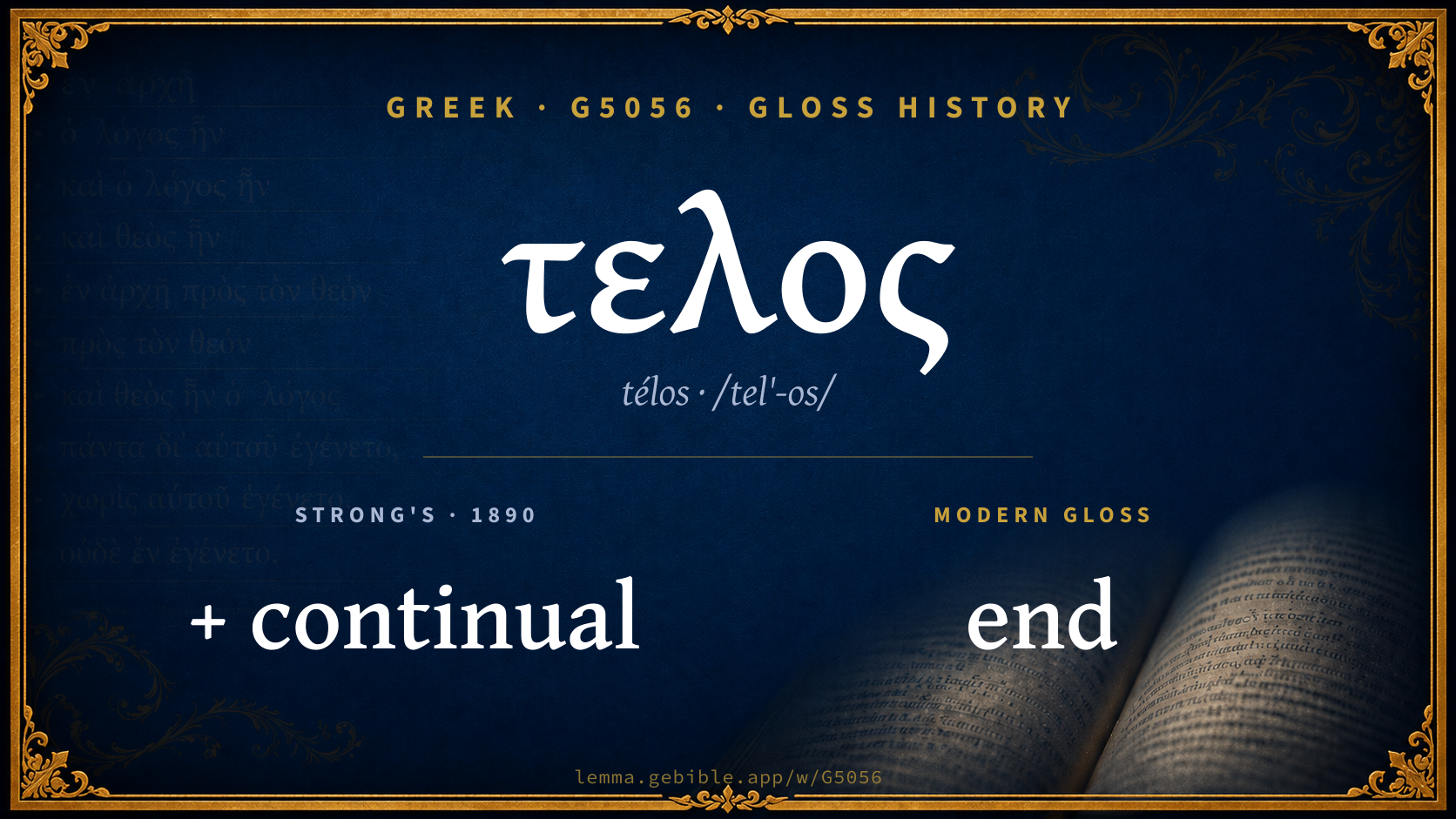
Gloss history
Strong's 1890 vs modern scholarship
About this word
Strong's G5056 catalogs a Greek word from the Greek New Testament.
These counts are not copied from any lexicon or concordance. They are computed here, from the morphology-tagged Greek New Testament. What Lemma adds →
- 40
- distinct verses
- The word appears in 40 distinct verses.
- 14 / 27
- NT books
- The word appears in 14 of 27 New Testament books.
- #364
- by frequency
- Top 500 most frequent Greek words (rank 364 of 5,347 Greek words by occurrence).
View all 40 occurrences in the concordance →
By section of the New Testament
By traditional corpus
Conventional, traditional groupings — biblical authorship is debated, so this is a traditional corpus grouping, not an authorship claim. Some books belong to more than one corpus (Luke is in both the Gospels and the Lukan corpus, and so on), so these shares overlap and need not total 100%. Each figure is a share of the word’s 40 distinct verses.
- Gospels 14 verses · 35%
- Pauline corpus 13 verses · 33%
- Hebrews 5 verses · 13%
- General (Catholic) Epistles 5 verses · 13%
- Lukan (Luke–Acts) 4 verses · 10%
- Johannine 4 verses · 10%
- Revelation 3 verses · 8%
How translations render this word
Counts come from each version’s own published word-to-Strong’s tagging or interlinear alignment — an approximate guide to how each version renders this word, not a word-level alignment the data otherwise carries. Because each total is that version’s own tagged count, the per-version totals vary from one another and need not match the appearance or distinct-verse counts above. These counts may also differ from a printed concordance because Lemma counts each distinctly tagged rendering and does not collapse phrase taggings into a single head-word total. This is a fixed set of word-tagged versions (KJV, ASV, BSB, ULT) and does not change with the reading translation you choose elsewhere. Each version’s license is shown beside its name below (and on Sources).
- King James Version: End 30×, Custom 2×, Shall the end 2×
- American Standard Version: End 30×
- Berean Standard Bible: End 23×, Outcome 5×, Fulfillment 2×
- unfoldingWord Literal Text: End 30×, Outcome 3×, Toll 2×
King James Version Public Domain
Renders G5056 across 41 tagged occurrences — most commonly:
Plus 7 renderings that appear only once — usually multi-word phrases or single function words the recovered tagging swept in, not distinct renderings. Not rendered by a distinct English word in 1 further occurrence.
American Standard Version Public Domain
Renders G5056 across 41 tagged occurrences — most commonly:
Plus 11 renderings that appear only once — usually multi-word phrases or single function words the recovered tagging swept in, not distinct renderings.
Berean Standard Bible Public Domain
Renders G5056 across 39 tagged occurrences — most commonly:
Plus 5 renderings that appear only once — usually multi-word phrases or single function words the recovered tagging swept in, not distinct renderings. Not rendered by a distinct English word in 1 further occurrence.
unfoldingWord Literal Text CC BY-SA 4.0
Renders G5056 across 41 tagged occurrences — most commonly:
Plus 6 renderings that appear only once — usually multi-word phrases or single function words the recovered tagging swept in, not distinct renderings.
Senses in Thayer's
The 2 senses Thayer's distinguishes for this word, in lexicon order (not ranked by frequency or importance). The full entry — with sub-senses — is in the Lexicon Entry tab.
- end
- toll, custom (i.e. indirect tax on goods)
Word origin
Origin: from a primary tello (to set out for a definite point or goal)
From a primary word τέλλω tellō (to set out for a definite point or goal ); properly the point aimed at as a limit that is (by implication) the conclusion of an act or state ( termination [literally figuratively or indefinitely] result [immediate ultimate or prophetic] purpose ); specifically an impost or levy (as paid ): - + continual custom end (-ing) finally uttermost. Compare G5411 .
— Strong’s Exhaustive Concordance (1890), public domain.
Forms in the corpus
The 3 distinct written forms G5056 takes in the Greek New Testament, most frequent first — each parse links to that case’s occurrences in the concordance.
| Form | Parsing | Example | Uses |
|---|---|---|---|
| τέλος télos | Noun, Nominative, Singular, Neuter | Matthew 24:6 | 33 |
| τέλους télous | Noun, Genitive, Singular, Neuter | 1 Corinthians 1:8 | 6 |
| τέλη télē | Noun, Accusative, Plural, Neuter | Matthew 17:25 | 2 |
Same root — word family
Other Thayer's entries built from the same root as G5056, grouped by Strong’s listed origin. These share a root / origin per the lexicon — not necessarily a shared meaning. Each links to that word’s own entry.
Derived from this word
- τελειος téleios G5046 perfect
- τελεσφορεω telesphoréō G5052 to mature
- τελεω teléō G5055 to finish
- τελωνης telṓnēs G5057 tax collector
- τηλαυγως tēlaugōs G5081 from afar clearly
- τολμαω tolmáō G5111 to dare
Compare all same-root words → Showing 4 of 7 — not the complete family. They share a root, not necessarily a meaning.
Septuagint usage
The same Greek word τελος appears 125 times in the Greek Old Testament (Septuagint), across 125 verses in 20 books.
- 125
- LXX occurrences
- Tagged occurrences of this Greek word in the Septuagint.
- 125
- verses
- Distinct Septuagint verses containing this word.
- 20 / 39
- OT books
- The word appears in 20 of the 39 Old Testament books.
Sample Septuagint occurrences
- Genesis 46:4 τέλος
- Leviticus 27:23 τέλος
- Numbers 17:28 τέλος
- Deuteronomy 31:24 τέλος
- Joshua 3:16 τέλος
- Judges 11:39 τέλος
- 2 Samuel 15:7 τέλος
- 2 Kings 8:3 τέλος
- 1 Chronicles 28:9 τέλος
- 2 Chronicles 12:12 τέλος
- Ezra 23:6 τέλος
- Esther 10:1 τέλος
Septuagint occurrences (same lexeme)
Every verse where the same Strong’s number (G5056) appears in the Greek Septuagint — showing the first 50 of 125. Verse text shown in the World English Bible for context; the Greek form is the matched word — the English is not keyword-highlighted.
- Genesis 46:4 τέλος I will go down with you into Egypt. I will also surely bring you up again. Joseph will close your eyes."
- Leviticus 27:23 τέλος then the priest shall reckon to him the worth of your valuation up to the Year of Jubilee; and he shall give your valuation on that day, as a holy thing to Yahweh.
- Numbers 17:28 τέλος
- Numbers 31:28 τέλος Levy a tribute to Yahweh of the men of war who went out to battle: one soul of five hundred, [both] of the persons, and of the oxen, and of the donkeys, and of the flocks:
- Numbers 31:37 τέλος and Yahweh's tribute of the sheep was six hundred seventy-five.
- Numbers 31:38 τέλος The oxen were thirty-six thousand; of which Yahweh's tribute was seventy-two.
- Numbers 31:39 τέλος The donkeys were thirty thousand five hundred; of which Yahweh's tribute was sixty-one.
- Numbers 31:40 τέλος The persons were sixteen thousand; of whom Yahweh's tribute was thirty-two persons.
- Numbers 31:41 τέλος Moses gave the tribute, which was Yahweh's heave-offering, to Eleazar the priest, as Yahweh commanded Moses.
- Deuteronomy 31:24 τέλος It happened, when Moses had made an end of writing the words of this law in a book, until they were finished,
- Deuteronomy 31:30 τέλος Moses spoke in the ears of all the assembly of Israel the words of this song, until they were finished.
- Joshua 3:16 τέλος that the waters which came down from above stood, and rose up in one heap, a great way off, at Adam, the city that is beside Zarethan; and those that went down toward the sea of the Arabah, even the Salt Sea, were wholly cut off: and the people passed over right against Jericho.
- Joshua 8:24 τέλος It happened, when Israel had made an end of killing all the inhabitants of Ai in the field, in the wilderness in which they pursued them, and they were all fallen by the edge of the sword, until they were consumed, that all Israel returned to Ai, and struck it with the edge of the sword.
- Joshua 10:13 τέλος The sun stood still, and the moon stayed, Until the nation had avenged themselves of their enemies. Isn't this written in the book of Jashar? The sun stayed in the midst of the sky, and didn't hurry to go down about a whole day.
- Joshua 10:20 τέλος It happened, when Joshua and the children of Israel had made an end of killing them with a very great slaughter, until they were consumed, and the remnant which remained of them had entered into the fortified cities,
- Judges 11:39 τέλος It happened at the end of two months, that she returned to her father, who did with her according to his vow which he had vowed: and she was a virgin. It was a custom in Israel,
- 2 Samuel 15:7 τέλος It happened at the end of forty years, that Absalom said to the king, please let me go and pay my vow, which I have vowed to Yahweh, in Hebron.
- 2 Samuel 24:8 τέλος So when they had gone back and forth through all the land, they came to Jerusalem at the end of nine months and twenty days.
- 2 Kings 8:3 τέλος It happened at the seven years' end, that the woman returned out of the land of the Philistines: and she went forth to cry to the king for her house and for her land.
- 2 Kings 18:10 τέλος At the end of three years they took it: in the sixth year of Hezekiah, which was the ninth year of Hoshea king of Israel, Samaria was taken.
- 2 Kings 19:23 τέλος By your messengers you have defied the Lord, and have said, With the multitude of my chariots am I come up to the height of the mountains, to the innermost parts of Lebanon; and I will cut down the tall cedars of it, and the choice fir trees of it; and I will enter into his farthest lodging-place, the forest of his fruitful field.
- 1 Chronicles 28:9 τέλος You, Solomon my son, know the God of your father, and serve him with a perfect heart and with a willing mind; for Yahweh searches all hearts, and understands all the imaginations of the thoughts: if you seek him, he will be found of you; but if you forsake him, he will cast you off forever.
- 1 Chronicles 29:19 τέλος and give to Solomon my son a perfect heart, to keep your commandments, your testimonies, and your statutes, and to do all these things, and to build the palace, for which I have made provision.
- 2 Chronicles 12:12 τέλος When he humbled himself, the wrath of Yahweh turned from him, so as not to destroy him altogether: and moreover in Judah there were good things [found].
- 2 Chronicles 18:2 τέλος After certain years he went down to Ahab to Samaria. Ahab killed sheep and oxen for him in abundance, and for the people who were with him, and moved him to go up [with him] to Ramoth-gilead.
- 2 Chronicles 31:1 τέλος Now when all this was finished, all Israel who were present went out to the cities of Judah, and broke in pieces the pillars, and hewed down the Asherim, and broke down the high places and the altars out of all Judah and Benjamin, in Ephraim also and Manasseh, until they had destroyed them all. Then all the children of Israel returned, every man to his possession, into their own cities.
- Ezra 23:6 τέλος
- Esther 10:1 τέλος The king Ahasuerus laid a tribute on the land, and on the isles of the sea.
- Job 6:9 τέλος Even that it would please God to crush me; That he would let loose his hand, and cut me off!
- Job 14:20 τέλος You forever prevail against him, and he passes; You change his face, and send him away.
- Job 20:7 τέλος Yet he shall perish forever like his own dung, Those who have seen him shall say, 'Where is he?'
- Job 20:28 τέλος The increase of his house shall depart; They shall rush away in the day of his wrath.
- Job 23:3 τέλος Oh that I knew where I might find him! That I might come even to his seat!
- Job 23:7 τέλος There the upright might reason with him, So I should be delivered forever from my judge.
- Psalms 4:1 τέλος Answer me when I call, God of my righteousness. Give me relief from my distress. Have mercy on me, and hear my prayer.
- Psalms 5:1 τέλος Give ear to my words, Yahweh. Consider my meditation.
- Psalms 6:1 τέλος Yahweh, don't rebuke me in your anger, Neither discipline me in your wrath.
- Psalms 8:1 τέλος Yahweh, our Lord, how majestic is your name in all the earth, Who has set your glory above the heavens!
- Psalms 9:1 τέλος I will give thanks to Yahweh with my whole heart. I will tell of all your marvelous works.
- Psalms 9:7 τέλος But Yahweh reigns forever. He has prepared his throne for judgment.
- Psalms 9:19 τέλος Arise, Yahweh! Don't let man prevail. Let the nations be judged in your sight.
- Psalms 9:32 τέλος
- Psalms 10:1 τέλος Why do you stand far off, Yahweh? Why do you hide yourself in times of trouble?
- Psalms 11:1 τέλος In Yahweh, I take refuge. How can you say to my soul, "Flee as a bird to your mountain!"
- Psalms 12:1 τέλος Help, Yahweh; for the godly man ceases. For the faithful fail from among the children of men.
- Psalms 12:2 τέλος Everyone lies to his neighbor. They speak with flattering lips, and with a double heart.
- Psalms 13:1 τέλος How long, Yahweh? Will you forget me forever? How long will you hide your face from me?
- Psalms 15:11 τέλος
- Psalms 17:1 τέλος Hear, Yahweh, my righteous plea; Give ear to my prayer, that doesn't go out of deceitful lips.
- Psalms 17:36 τέλος
These are occurrences of the same Greek lexeme (G5056) in the Septuagint — not a translation of any one Hebrew word. The store carries no word-level Hebrew↔Greek alignment, so no Hebrew original is asserted here. Counts come from the recovered LXX Strong's tagging — high-frequency vocabulary is well covered, while rare or late forms may be untagged — so they reflect tagged occurrences and may slightly undercount.