Revelation 21:6

Greek (Tischendorf 8th ed.) Revelation 21:6 appears in the Greek New Testament. The text above is from the Tischendorf 8th edition. Each word links to its Strong’s number and a concise gloss. Click any word for its full Thayer’s Greek Lexicon entry.
Download image
Cite this verse

Revelation 21:6 (World English Bible). Public Domain. Lemma interlinear Bible study tool, https://lemma.gebible.app/v/revelation/21/6.

Show BibTeX & RIS
BibTeX
RIS
English Translation
He said to me, "It is done! I am the Alpha and the Omega, the Beginning and the End. I will give freely to him who is thirsty from the spring of the water of life.
World English Bible · Public Domain
Download a study sheet

One document with this verse’s original text, its word-by-word gloss line, the meaning frame, cross-references with their text, attributed commentary, and full source and license credits — printable, and it pastes into notes with its structure intact.

This verse Autodidact and up

Study sheet (.html) Plain text (.txt)

A passage Seminary Student

Up to 50 verses in one chapter. A passage sheet keeps up to 6 commentary sources and 12 cross-references per verse, in the order this page ranks them, and says so on the sheet whenever that leaves anything out. Ask for a single verse and you get the Autodidact verse sheet above.

Everything on this page stays free to read, with no account — the sheet is a download of what is already on screen, not access to it.

Want to remove ads? Support Godless Engineer
Compare translations 3

The same verse in 3 English versions, stacked beneath the original-language interlinear above. Click any original word for its lexicon entry.

Each is an independent rendering of the whole verse — the interlinear is not word-aligned to these translations.

Highlighted words mark where these versions differ — a whole-verse word diff, not a word-by-word alignment.

  • World English Bible Public Domain
    He said to me, "It is done! I am the Alpha and the Omega, the Beginning and the End. I will give freely to him who is thirsty from the spring of the water of life.
  • King James Version Public Domain
    And he said unto me, It is done. I am Alpha and Omega, the beginning and the end. I will give unto him that is athirst of the fountain of the water of life freely.
  • unfoldingWord Literal Text CC BY-SA 4.0
    And he said to me, “It has happened! I the Alpha and the Omega, the beginning and the end. To the one thirsting I will give freely from the spring of the water of life.

unfoldingWord Literal Text — © unfoldingWord, licensed CC BY-SA 4.0. Word-aligned USFM3 via Door43 (git.door43.org/unfoldingWord/en_ult).

Versions to compare (up to 4)

3 of 4 selected

Show all 19 translations

Every available English version of this verse, each an independent rendering of the whole verse.

  • World English Bible Public Domain
    He said to me, "It is done! I am the Alpha and the Omega, the Beginning and the End. I will give freely to him who is thirsty from the spring of the water of life.
  • Berean Standard Bible Public Domain
    And He told me, “It is done! I am the Alpha and the Omega, the Beginning and the End. To the thirsty I will give freely from the spring of the water of life.
  • Majority Standard Bible Public Domain
    And He told me, “It is done! I am the Alpha and the Omega, the Beginning and the End. To the thirsty I will give freely from the spring of the water of life.
  • King James Version Public Domain
    And he said unto me, It is done. I am Alpha and Omega, the beginning and the end. I will give unto him that is athirst of the fountain of the water of life freely.
  • American Standard Version (1901) Public Domain
    And he said unto me, They are come to pass. I am the Alpha and the Omega, the beginning and the end. I will give unto him that is athirst of the fountain of the water of life freely.
  • Revised Version (1885) Public Domain
    And he said unto me, They are come to pass. I am the Alpha and the Omega, the beginning and the end. I will give unto him that is athirst of the fountain of the water of life freely.
  • Geneva Bible (1599) Public Domain
    And he said vnto me, It is done, I am Alpha and Omega, the beginning and the ende. I wil giue to him that is a thirst, of the well of the water of life freely.
  • Douay-Rheims (1899) Public Domain
    And he said to me: It is done. I am Alpha and Omega; the beginning and the end. To him that thirsteth, I will give of the fountain of the water of life, freely.
  • Young's Literal Translation Public Domain
    and He said to me, `It hath been done! I am the Alpha and the Omega, the Beginning and the End; I, to him who is thirsting, will give of the fountain of the water of the life freely;
  • Literal Standard Version CC BY-SA 4.0
    and He said to me, “It is done! I am the Alpha and the Omega, the Beginning and the End. To him who is thirsting, I will give of the fountain of the water of life freely.
  • Unlocked Literal Bible CC BY-SA 4.0
    He said to me, “These things are done! I am the alpha and the omega, the beginning and the end. To the one who thirsts I will give drink without cost from the spring of the water of life.
  • unfoldingWord Literal Text CC BY-SA 4.0
    And he said to me, “It has happened! I the Alpha and the Omega, the beginning and the end. To the one thirsting I will give freely from the spring of the water of life.
  • Darby Bible Public Domain
    And he said to me, It is done. I am the Alpha and the Omega, the beginning and the end. I will give to him that thirsts of the fountain of the water of life freely.
  • World Messianic Bible Public Domain
    He said to me, “I am the Alef and the Tav, the Beginning and the End. I will give freely to him who is thirsty from the spring of the water of life.
  • Webster's Bible Public Domain
    And he said to me, It is done. I am Alpha and Omega, the beginning and the end. I will give to him that is thirsty of the fountain of the water of life freely.
  • Free Bible Version CC BY-SA 4.0
    Then he said to me, “Everything's done! I am the Alpha and Omega, the beginning and the end. To anyone who is thirsty I will give the free gift of water from the spring of the water of life.
  • Bible in Basic English Public Domain
    And he said to me, It is done. I am the First and the Last, the start and the end. I will freely give of the fountain of the water of life to him who is in need.
  • Text-Critical English NT CC BY 4.0
    He also said to me, “ I am the Alpha and the Omega, the beginning and the end. To him who thirsts I will freely give from the spring of the water of life.
  • Tyndale New Testament (1534) Public Domain
    And he sayde vnto me: it is done I am Alpha and Omega the begynnynge and the ende. I will geve to him that is a thyrst of the well of the water of lyfe fre.

Literal Standard Version (2020), Covenant Press — licensed CC BY-SA 4.0. Text via the HelloAO Bible API (eBible.org). Unlocked Literal Bible (unfoldingWord) — licensed CC BY-SA 4.0. Text via the HelloAO Bible API (eBible.org). unfoldingWord Literal Text — © unfoldingWord, licensed CC BY-SA 4.0. Word-aligned USFM3 via Door43 (git.door43.org/unfoldingWord/en_ult). Free Bible Version, Dr. Jonathan Gallagher — licensed CC BY-SA 4.0. Text via the HelloAO Bible API (eBible.org).

Word by word

More ways to search: Search by grammar → Find every occurrence → Compare this word →

Practice this passage: Drill this verse → Learn its vocabulary →

ἄλφα
A
G1
“alpha”
Noun, Letter (indeclinable)
Part of Speech
Noun · Letter (indeclinable)
Full Thayer's Definition

Origin: of hebrew origin

TDNT: 1:1,*

1. first letter of Greek alphabet 2. Christ is the Alpha to indicate that he is the beginning and the end
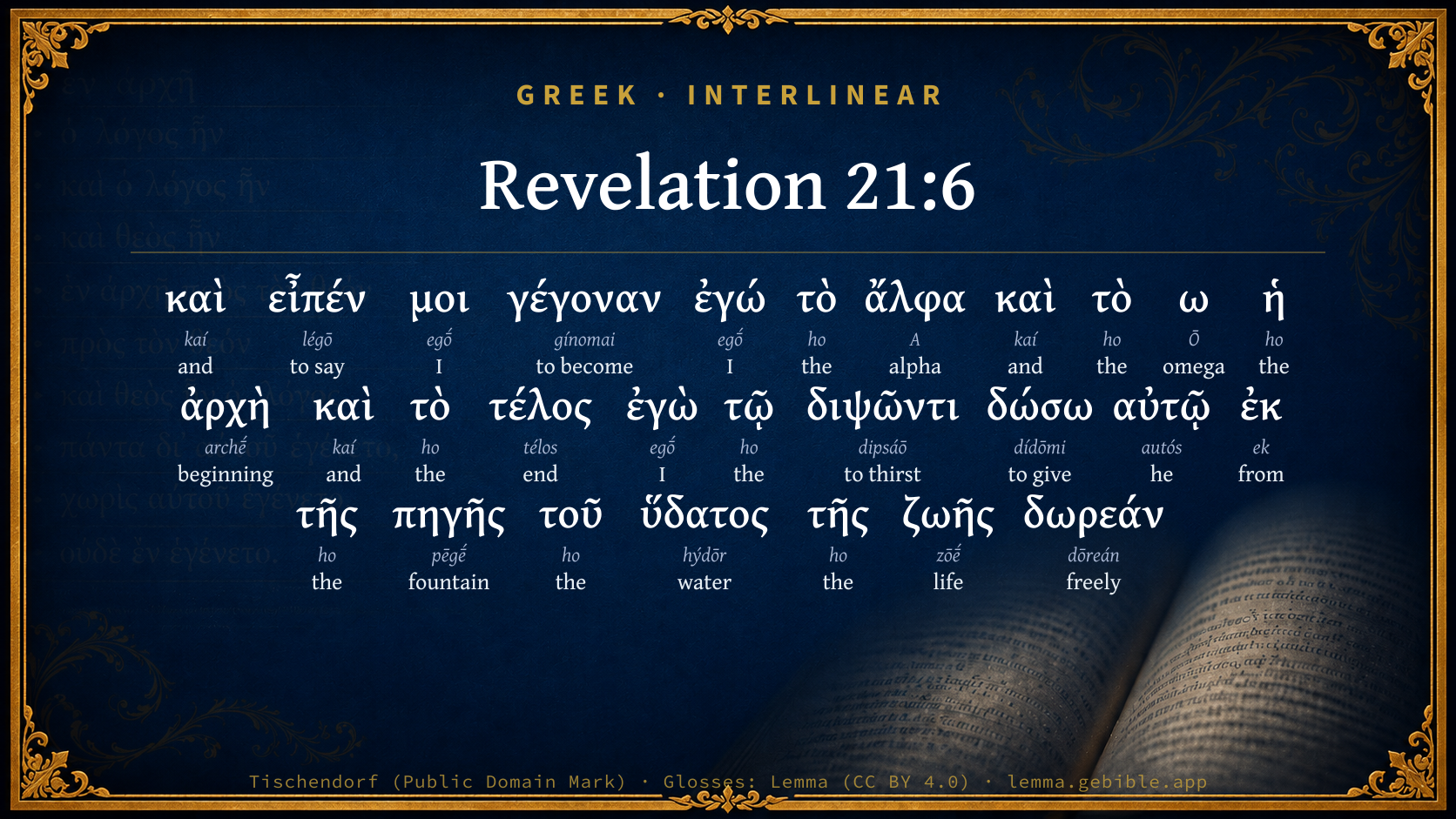
  1. καὶ kaí G2532 “and” Conjunction
  2. εἶπέν légō G3004 “to say” Verb, Aorist, Active, Indicative, 3rd person, Singular
  3. μοι egṓ G1473 “I” Personal pronoun, 1st person, Dative, Singular
  4. γέγοναν gínomai G1096 “to become” Verb, Perfect, Active, Indicative, 3rd person, Plural
  5. ἐγώ egṓ G1473 “I” Personal pronoun, 1st person, Nominative, Singular
  6. τὸ ho G3588 “the” Article, Nominative, Singular, Neuter
  7. καὶ kaí G2532 “and” Conjunction
  8. τὸ ho G3588 “the” Article, Nominative, Singular, Neuter
  9. ω Ō G5598 “omega” Noun, Letter (indeclinable)
  10. ἡ ho G3588 “the” Article, Nominative, Singular, Feminine
  11. ἀρχὴ archḗ G746 “beginning” Noun, Nominative, Singular, Feminine
  12. καὶ kaí G2532 “and” Conjunction
  13. τὸ ho G3588 “the” Article, Nominative, Singular, Neuter
  14. τέλος télos G5056 “end” Noun, Nominative, Singular, Neuter
  15. ἐγὼ egṓ G1473 “I” Personal pronoun, 1st person, Nominative, Singular
  16. τῷ ho G3588 “the” Article, Dative, Singular, Masculine
  17. διψῶντι dipsáō G1372 “to thirst” Verb, Present, Active, Participle, Dative, Singular, Masculine
  18. δώσω dídōmi G1325 “to give” Verb, Future, Active, Indicative, 1st person, Singular
  19. αὐτῷ autós G846 “he” Personal pronoun, Dative, Singular, Masculine
  20. ἐκ ek G1537 “from” Preposition
  21. τῆς ho G3588 “the” Article, Genitive, Singular, Feminine
  22. πηγῆς pēgḗ G4077 “fountain” Noun, Genitive, Singular, Feminine
  23. τοῦ ho G3588 “the” Article, Genitive, Singular, Neuter
  24. ὕδατος hýdōr G5204 “water” Noun, Genitive, Singular, Neuter
  25. τῆς ho G3588 “the” Article, Genitive, Singular, Feminine
  26. ζωῆς zōḗ G2222 “life” Noun, Genitive, Singular, Feminine
  27. δωρεάν dōreán G1432 “freely” Adverb

About this verse

These counts appear in no published source. They are computed here, from the morphology-tagged text and Lemma’s own curated glosses. What Lemma adds →

28
words
17
distinct lemmas
Revelation
section

Notable vocabulary

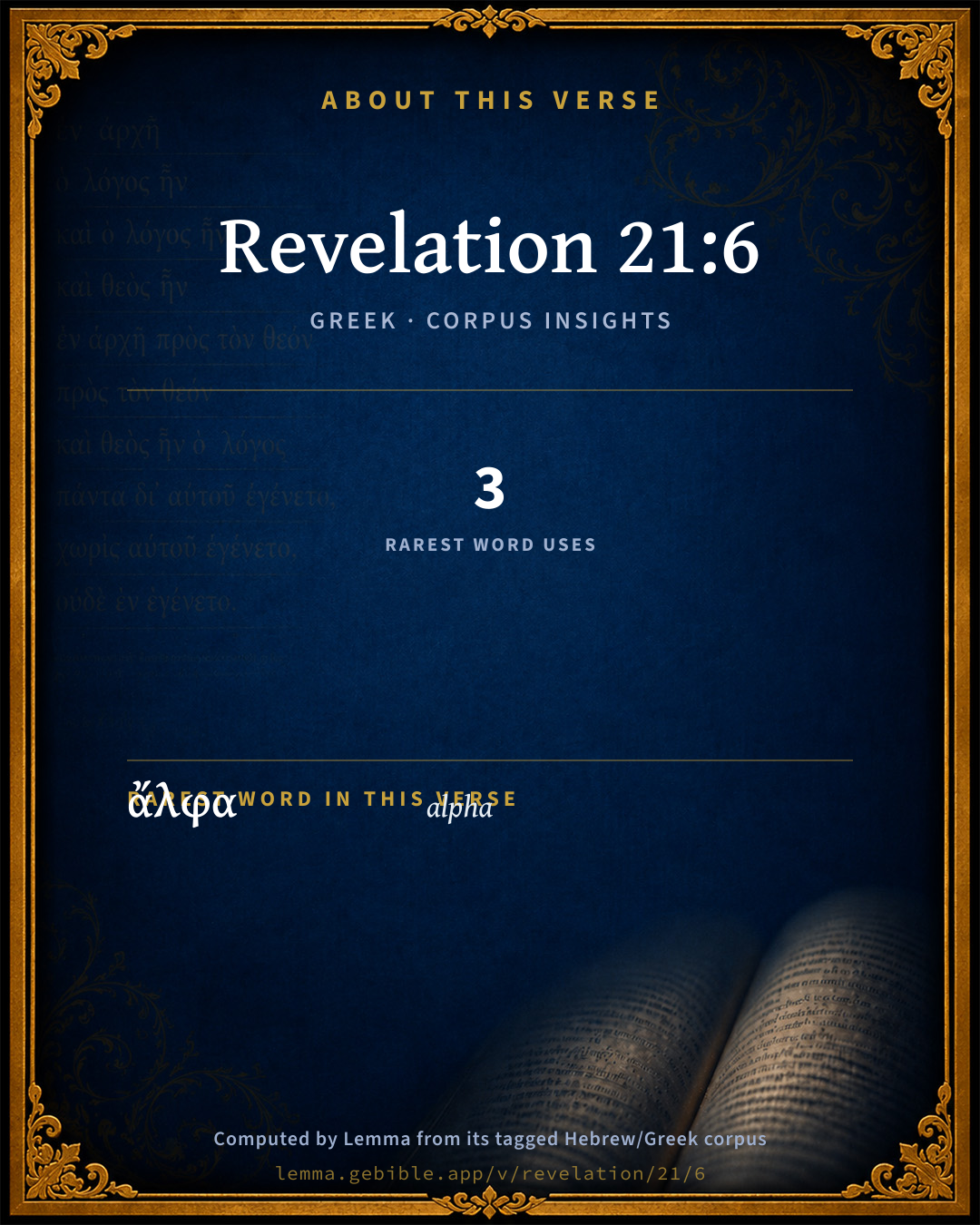
The rarest word here is ἄλφα alpha G1 — appearing just 3 times in the whole Greek New Testament.

Shared distinctive vocabulary

ἄλφα alpha G1 occurs in 3 verses of the Greek New Testament. Also found in:

Repetition

Words recur within this verse:

Cross-references

21

Topical passages linked to Revelation 21:6 in the Treasury of Scripture Knowledge — connected by theme and wording, ordered by reader-vote popularity; previews shown in the World English Bible.

  • John 7:37–38 Now on the last and greatest day of the feast, Jesus stood and cried out, "If anyone is thirsty, let him come to me and drink!
  • John 4:10 Jesus answered her, "If you knew the gift of God, and who it is who says to you, 'Give me a drink,' you would have asked him, and he would have given you living water."
  • Revelation 7:17 for the Lamb who is in the midst of the throne shepherds them, and leads them to springs of waters of life. And God will wipe away every tear from their eyes."
  • John 4:14 but whoever drinks of the water that I will give him will never thirst again; but the water that I will give him will become in him a well of water springing up to eternal life."
  • Psalms 36:9 For with you is the spring of life. In your light shall we see light.
  • Romans 8:32 He who didn't spare his own Son, but delivered him up for us all, how would he not also with him freely give us all things?
  • Isaiah 55:1–3 Ho, everyone who thirsts, come you to the waters, and he who has no money; come you, buy, and eat; yes, come, buy wine and milk without money and without price.
  • Revelation 1:8 "I am the Alpha and the Omega," says the Lord God, "who is and who was and who is to come, the Almighty."
  • Revelation 22:17 The Spirit and the bride say, "Come!" He who hears, let him say, "Come!" He who is thirsty, let him come. He who desires, let him take the water of life freely.
  • Romans 3:24 being justified freely by his grace through the redemption that is in Christ Jesus;
  • Revelation 16:17 The seventh poured out his bowl into the air. A loud voice came forth out of the temple of heaven, from the throne, saying, "It is done!"
  • Revelation 22:13 I am the Alpha and the Omega, the First and the Last, the Beginning and the End.
  • Isaiah 12:3 Therefore with joy you shall draw water out of the wells of salvation.
  • 1 John 5:4–5 For whatever is born of God overcomes the world. This is the victory that has overcome the world: your faith.
  • Revelation 1:17 When I saw him, I fell at his feet like a dead man. He laid his right hand on me, saying, "Don't be afraid. I am the first and the last,
  • Jeremiah 2:13 For my people have committed two evils: they have forsaken me, the spring of living waters, and hewed them out cisterns, broken cisterns, that can hold no water.
  • 1 Corinthians 2:12 But we received, not the spirit of the world, but the Spirit which is from God, that we might know the things that were freely given to us by God.
  • Revelation 10:6 and swore by him who lives forever and ever, who created heaven and the things that are in it, the earth and the things that are in it, and the sea and the things that are in it, that there will no longer be delay,
  • Joel 3:18 It will happen in that day, That the mountains will drop down sweet wine, The hills will flow with milk, All the brooks of Judah will flow with waters; And a fountain will come forth from the house of Yahweh, And will water the valley of Shittim.
  • Hosea 14:4 "I will heal their waywardness. I will love them freely; For my anger is turned away from him.
  • 1 Corinthians 3:12 But if anyone builds on the foundation with gold, silver, costly stones, wood, hay, or stubble;

Cross-references courtesy of OpenBible.info (CC BY 4.0).

Commentary

Notes on Revelation 21:6 from classic Christian and Jewish commentators (each source and its license shown beneath its notes). The classic Christian expositions comment on the surrounding passage and are grouped to its opening verse, so a note may address several verses; the Jewish commentaries on the Tanakh (Rashi and others) are per-verse, so they appear only where the commentator wrote on this verse.

Lemma curates 59 commentaries, every one of them public domain or Creative Commons licensed, each selected and text-cleaned for this edition rather than reprinted as found. About our sources →

Joseph Benson's Commentary

Rev 21:6-8. And he “that sat upon the throne” said to me, It is done — All that the prophets have spoken is fulfilled. This is the consummation of all things: and now all the promises of God, and the desires of his faithful servants, shall be fully accomplished I am Alpha, &c. — Greek, το αλφα, και το ωμεγα, the Alpha and the Omega; the beginning and the end — The latter clause explains the former; the everlasting. I will give unto him that is athirst — That sincerely and earnestly desires it; of the fountain of the water of life — Refreshing consolation, which shall abundantly satisfy his most enlarged desires and most exalted expectations; happiness which shall ever flow in upon him, as water from a perpetually flowing fountain; freely — Δωρεαν, as a free, unmerited gift. He that overcometh — To do which is much more than to thirst; shall inherit all things — Which I have made: the whole creation shall be laid open to his enjoyment. And I will be his God — A source of complete and everlasting blessedness to him; and he shall be my son — And consequently mine heir: the inheritor of my eternal kingdom, yea, and a joint-heir with my only-begotten and well- beloved Son. But the fearful and unbelieving — Who have not courage to face the difficulties which an open profession of my religion requires, and therefore do not overcome; and the abominable — All who indulge themselves in abominable vices to gratify their lusts; and murderers — Of the bodies, souls, or reputation of their fellow-creatures; and whoremongers, sorcerers, idolaters, and all liars — All who allow themselves, in their words or actions, to violate the eternal and immutable laws of truth and righteousness; shall have their part in the lake, &c. — All these shall have their portion with Satan, to whose party they joined themselves, and whose will they obeyed; and shall with him undergo the punishment of the secured death. Let this therefore be recorded, that every future generation of men may carefully peruse and seriously consider it; that every sincere believer, however weak, may be encouraged, and that every obstinate sinner may be terrified, and, if possible, awakened; and that none, in the day of my final judgment, may complain that they have not been warned and cautioned, with the greatest plainness and the greatest solemnity.

Joseph Benson's Commentary on the Old and New Testaments (1811–1818) — public domain. Text from a community e-Sword module.

MacLaren's Expositions of Holy Scripture

Alexander MacLaren

Revelation

CHRIST’S FINISHED AND UNFINISHED WORK

Joh 19:30. - Rev 21:6.

One of these sayings was spoken from the Cross, the other from the Throne. The Speaker of both is the same. In the one, His voice ‘then shook the earth,’ as the rending rocks testified; in the other, His voice ‘will shake not the earth only but also heaven’; for ‘new heavens and a new earth’ accompanied the proclamation. In the one, like some traveller ready to depart, who casts a final glance over his preparations, and, satisfied that nothing is omitted, gives his charioteer the signal and rolls away, Jesus Christ looked back over His life’s work, and, knowing that it was accomplished, summoned His servant Death, and departed. In the other, He sets His seal to the closed book of the world’s history, and ushers in a renovated universe. The one masks the completion of the work on which the world’s redemption rests, the other marks the completion of the age-long process by which the world’s redemption is actually realised. The one proclaims that the foundation is laid, the other that the headstone is set on the finished building. The one bids us trust in a past perfected work; the other bids us hope in the perfect accomplishment of the results of that work. Taken singly, these sayings are grand; united, they suggest thoughts needed always, never more needful than to-day.

I. We see here the work which was finished on the Cross.

The Evangelist gives great significance to the words of my first text, as is shown by his statement in a previous verse: ‘Jesus, knowing that all things were now accomplished, said, I thirst,’ and then-’It is finished.’ That is to say, there is something in that dying voice a great deal deeper and more wonderful than the ordinary human utterance with which a dying man might say, ‘It is all over now. I have done,’ for this utterance came from the consciousness that all things had been accomplished by Him, and that He had done His life’s work.

Now, there, taking the words even in their most superficial sense, we come upon the strange peculiarity which marks off the life of Jesus Christ from every other life that was ever lived. There are no loose ends left, no unfinished tasks drop from His nerveless hands, to be taken up and carried on by others. His life is a rounded whole, with everything accomplished that had been endeavoured, and everything done that had been commanded. ‘His hands have laid the foundation; His hands shall also finish.’ He alone of the sons of men, in the deepest sense, completed His task, and left nothing for successors. The rest of us are taken away when we have reared a course or two of the structure, the dream of building which brightened our youth. The pen drops from paralysed hands in the middle of a sentence, and a fragment of a book is left. The painter’s brush falls with his palette at the foot of his easel, and but the outline of what he conceived is on the canvas. All of us leave tasks half done, and have to go away before the work is completed. The half-polished columns that lie at Baalbec are but a symbol of the imperfection of every human life. But this Man said, ‘It is finished,’ and ‘gave up the ghost.’ Now, if we ponder on what lies in that consciousness of completion, I think we find, mainly, three things.

Christ rendered a complete obedience. All through His life we see Him, hearing with the inward ear the solemn voice of the Father, and responding to it with that ‘I must’ which runs through all His days, from the earliest dawning of consciousness, when He startled His mother with ‘I must be about My Father’s business,’ until the very last moments. In that obedience to the all-present necessity which He cheerfully embraced and perfectly discharged, there was no flaw. He alone of men looks back upon a life in which His clear consciousness detected neither transgression nor imperfection. In the midst of His career He could front His enemies with ‘Which of you convinceth Me of sin?’ and no man then, and no man in all the generations that have elapsed since-though some have been blind enough to try it, and malicious enough to utter their attempts,-has been able to answer the challenge. In the midst of His career He said, ‘I do always the things that please Him’; and nobody then or since has been able to lay his finger upon an act of His in which, either by excess or defect, or contrariety, the will of God has not been fully represented. At the beginning of His career He said, in answer to the Baptist’s remonstrance, ‘It becometh us to fulfil all righteousness,’ and at the end of His career He looked back, and knowing that He had thus done what became Him-namely, fulfilled it all-He said, ‘It is finished!’

The utterance further expresses Christ’s consciousness of having completed the revelation of God. Jesus Christ has made known the Father, and the generations since have added nothing to His revelation. The very people, to-day, that turn away from Christianity, in the name of higher conceptions of the divine nature, owe their conceptions of it to the Christ from whom they turn. Not in broken syllables; not ‘at sundry times and in divers manners,’ but with the one perfect, full-toned name of God on His lips, and vocal in His life, He has declared the Father unto us. In the course of His career He said, ‘He that hath seen Me hath seen the Father’; and, looking back on His life of manifestation of God, He proclaimed, ‘It is finished!’ And the world has since, with all its thinking, added nothing to the name which Christ has declared.

The utterance farther expresses His consciousness of having made a completed, atoning Sacrifice. Remember that the words of my first text followed that awful cry that came from the darkness, and as by one lightning flash, show us the waves and billows rolling over His head. ‘My God! My God! why hast Thou forsaken Me?’ In that infinitely pathetic and profound utterance, to the interpretation of which our powers go but a little way, Jesus Christ blends together, in the most marvellous fashion, desolation and trust, the consciousness that God is His God, and the consciousness that He is bereft of the light of His presence. Brethren! I know of no explanation of these words which does justice to both the elements that are intertwined so intimately in them, except the old one, which listens to Him as they come from His quivering lip, and says, ‘The Lord hath made to meet on Him the iniquity of us all.’

Ah, brethren! unless there was something a great deal more than the physical shrinking from physical death in that piteous cry, Jesus Christ did not die nearly as bravely as many a poor, trembling woman who, at the stake or the block, has owed her fortitude to Him. Many a blood-stained criminal has gone out of life with less tremor than that which, unless you take the explanation that Scripture suggests of the cry, marred the last hours of Jesus Christ. Having drained the cup, He held it up inverted when He said ‘It is finished!’ and not a drop trickled down the edge. He drank it that we might never need to drink it; and so His dying voice proclaimed that ‘by one offering for sin for ever,’ He ‘obtained eternal redemption’ for us.

II. Now, secondly, note the work which began from the Cross.

Between my two texts lie untold centuries, and the whole development of the consequences of Christ’s death, like some great valley stretching between twin mountain-peaks on either side, which from some points of view will be foreshortened and invisible, but when gazed down upon, is seen to stretch widely leagues broad, from mountain ridge to mountain ridge. So my two texts, by the fact that millenniums have to interpose between the time when ‘It is finished!’ is spoken, and the time when ‘It is done!’ can be proclaimed from the Throne, imply that the interval is filled by a continuous work of our Lord’s, which began at the moment when the work on the Cross ended.

Now it has very often been the case, as I take leave to think, that the interpretation of the former of these two texts has been of such a kind as to distort the perspective of Christian truth, and to obscure the fact of that continuous work of our Lord’s. Therefore it may not be out of place if, in a sentence or two, I recall to you the plain teaching of the New Testament upon this matter. ‘It is finished!’ Yes; and as the lower course of some great building is but the foundation for the higher, when ‘finished’ it is but begun. The work which, in one aspect, is the close, in another aspect is the commencement of Christ’s further activity. What did He say Himself, when He was here with His disciples? ‘I will not leave you comfortless, I will come to you.’ What was the last word that came fluttering down, like an olive leaf, into the bosoms of the men as they stood with uplifted faces gazing upon Him as He disappeared? ‘Lo! I am with you alway, even to the end of the ages.’ What is the keynote of the book which carries on the story of the Gospels in the history of the militant Church? ‘The former treatise have I made. . . of all that Jesus began both to do and to teach, until the day in which He was taken up’-and, being taken up, continued, in a new form, both the doing and the teaching. Thus that book, misnamed the Acts of the Apostles, sets Him forth as the Worker of all the progress of the Church. Who is it that ‘adds to the Church daily such as were being saved?’ The Lord. Who is it that opened the hearts of the hearers to the message? The Lord. Who is it that flings wide the prison-gates when His persecuted servants are in chains? The Lord. Who is it that bids one man attach himself to the chariot of the eunuch of Ethiopia, and another man go and bear witness in Rome? The Lord. Through the whole of that book there runs the keynote, as its dominant thought, that men are but the instruments, and the hand that wields them is Christ’s, and that He who wrought the finished work that culminated on Calvary is operating a continuous work through the ages from His Throne.

Take that last book of Scripture, which opens with a view of the ascended Christ ‘walking in the midst of the seven candlesticks, and holding the stars in His right hand;’ which further draws aside the curtains of the heavenly sanctuary, and lets us see ‘the Lamb in the midst of the Throne,’ opening the seven seals-that is to say, setting loose for their progress through the world the forces that make the history of humanity, and which culminates in the vision of the final battle in which the Incarnate Word of God goes forth to victory, with all the armies of heaven following Him. Are not its whole spirit and message that Jesus Christ, the Lamb who is the Antagonist of the Beast, is working through all the history of the world, and will work till its kingdoms are ‘become the kingdoms of our God and of His Christ?’

Now, that continuous operation of Jesus Christ in the midst of men is not to be weakened down to the mere continued influence of the truths which He proclaimed, or the Gospel which He brought. There is something a great deal more than the diminishing vibrations of a force long since set in operation, and slowly ceasing to act. Dead teachers do still ‘rule our spirits from their urns’; but it is no dead Christ who, by the influence of what He did when He was living, sways the world and comforts His Church; it is a living Christ who to-day is working in His people, by His Spirit. Further, He works on the world through His people by the Word; they plant and water, He ‘gives the increase.’ And He is working in the world, for His Church and for the world, by His wielding of all power that is given to Him, in heaven and on earth. So that the work that is done upon earth He doeth it all Himself; and Christian people unduly limit the sphere of Christ’s operations when they look back only to the Cross, and talk about a ‘finished work’ there, and forget that that finished work there is but the vestibule of the continuous work that is being done to-day.

Christian people! The present work of Christ needs working servants. We are here in order to carry on His work. The Apostle ventured to say that he was appointed ‘to fill up that which is behind of the sufferings of Christ’; we may well venture to say that we are here mainly to apply to the world the benefits resulting from the finished work upon the Cross. The accomplishment of redemption, and the realisation of the accomplished redemption, are two wholly different things. Christ has done the one. He says to us, ‘You are honoured to help Me to do the other.’ According to the accurate rendering of a great saying of the Old Testament, ‘Take no rest, and give Him no rest, till He establish and make Jerusalem a praise in the earth, Christ’s work is finished; there is nothing for us to do with it but trust it. Christ’s work is going on; come to His help. Ye are fellow-labourers with and to the Incarnate Truth.

III. I need not say more than a word about the third thought, suggested by these texts-viz., the completion of the work which began on the Cross.

‘It is done!’ That lies, no man knows how far, ahead of us. As surely as astronomers tell us that all this universe is hastening towards a central point, so surely ‘that far-off divine event’ is that ‘to which the whole creation moves.’ It is the blaze of light which fills the distant end of the dim vista of human history. Its elements are in part summed up in the context-the tabernacle of God with men, the perfected fellowship of the human with the divine, the housing of men in the very home and heart of God; ‘a new heaven and a new earth,’ a renovated universe; the removal of all evil, suffering, sorrow, sin, and tears. These things are to be, and shall be, when He says ‘It is done!’

Brethren! nothing else than such an issue can be the end of Creation, for nothing else than such is the purpose of God for man, and God is not going to be beaten by the world and the devil. Nothing else than such can be the issue of the Cross; for ‘He shall see of the travail of His soul, and shall be satisfied,’ and Christ is not going to labour in vain, and spend His life, and give His breath and His blood for nought.

Nothing but the work finished on the Cross guarantees the coming of that perfected issue. I know not where else there is hope for mankind, looking on the history of humanity, except in that great message, that Jesus Christ, the Son of God, has come, has died, lives for ever, and is the world’s King and Lord.

So for ourselves, in regard to the one part of the work, let us listen to Him saying ‘It is finished!’ abandon all attempts to eke it out by additions of our own, and cast ourselves on the finished Revelation, the finished Obedience, the finished Atonement, made once for all on the Cross. But as for the continuous work going on through the ages, let us cast ourselves into it with earnestness, self-sacrifice, consecration, and continuity, for we are fellow-workers with Christ, and Christ will work in, with, and for us if we will work for Him.

Alexander MacLaren, Expositions of Holy Scripture (1904–1910) — public domain. Text from a community e-Sword module.

Tyndale Open Study Notes

Tyndale Open Resources

21:6 God restates Jesus’ final words from the cross, It is finished! (John 19:30; cp. Rev 16:17), connecting Christ’s death with the assurance of eternal life. • I am the Alpha and the Omega: With the first and last letters of the Greek alphabet, John portrays God as encompassing total reality and total truth. God was from the Beginning (see Gen 1:1; cp. John 1:1-2) and is also the End (see Rev 1:8; 22:13). • Because Christ is supreme and in charge of all things (see Rom 9:5; 1 Cor 15:28; Eph 1:22-23; 4:5-6), he dispenses the water of life to all who are thirsty for it (see study note on Rev 7:16-17; see also Isa 55:1; John 4:10; 7:37-38).

Tyndale Open Study Notes — © Tyndale Open Resources, licensed CC BY-SA 4.0. Text via the HelloAO Bible API.

Bengel's Gnomon

Johann Albrecht Bengel

Rev 21:6. Τὸ ἄλφα καὶ τὸ Ω, ἡ ἀρχὴ καὶ τὸ τέλος) A glorious title of God. The former clause is explained by the latter.

Bengel's Gnomon of the New Testament — English translation (T&T Clark, Edinburgh, 1860) — public domain. Text from a community e-Sword module.

Geneva Bible (1599)

Geneva Bible translators

The description of the Church is of three sorts, by the abolishing of old things: by the being of present things in God, that is of things eternal and by the communication of all good things with the godly, verse 6. If so be they shall strive manfully, verse 7. But the reprobate are excluded from thence, verse 8.

Geneva Bible (1599) marginal notes — public domain. Text via Bolls.life.

Jamieson, Fausset & Brown

Robert Jamieson, A. R. Fausset & David Brown

It is done--the same Greek as in Rev 16:17. "It is come to pass." So Vulgate reads with English Version. But A reads, "They ('these words,' Rev 21:5) are come to pass." All is as sure as if it actually had been fulfilled for it rests on the word of the unchanging God. When the consummation shall be, God shall rejoice over the work of His own hands, as at the completion of the first creation God saw everything that He had made, and behold it was very good (Gen 1:31).

Alpha . . . Omega--Greek in A and B, "the Alpha . . . the Omega" (Rev 1:18).

give unto . . . athirst . . . water of life-- (Rev 22:17; Isa 12:3; Isa 55:1; Joh 4:13-14; Joh 7:37-38). This is added lest any should despair of attaining to this exceeding weight of glory. In our present state we may drink of the stream, then we shall drink at the Fountain.

freely--Greek, "gratuitously": the same Greek as is translated, "(They hated Me) without a cause," Joh 15:25. As gratuitous as was man's hatred of God, so gratuitous is God's love to man: there was every cause in Christ why man should love Him, yet man hated Him; there was every cause in man why (humanly speaking) God should have hated man, yet God loved man: the very reverse of what might be expected took place in both cases. Even in heaven our drinking at the Fountain shall be God's gratuitous gift.

Jamieson, Fausset & Brown — Commentary Critical and Explanatory on the Whole Bible (1871) — public domain (CC PDM 1.0). Text via the HelloAO Bible API.

Adam Clarke's Commentary

Verse 6. It is done.] All is determined, and shall be fulfilled in due time. The great drama is finished, and what was intended is now completed; referring to the period alluded to by the angel.

I am Alpha and Omega] See Clarke on Re 1:8.

The fountain of the water of life] See on Joh 4:10; Joh 4:14; Joh 7:37, &c.

The rabbins consider the fountain of the world to come as one of the particular blessings of a future state. In Sanhedrim, Aboth R. Nathan, c. 31, it is said, "He will show them the excellency of the fountain of the future world, that they may accurately see and consider, and say, Wo to us! what good have we lost! and our race is cut off from the face of the earth."

Adam Clarke's Commentary on the Bible (1810–1826) — public domain. Text from a community e-Sword/MySword module.

Ellicott's Commentary for English Readers

(6) And he said unto me, It is done.—Or, rather, They (the things promised) have come to pass. He spake, and it was done. The assurance is made trebly sure. “I am making all things new.” “These words are true.” “They are fulfilled.” “Twice,” says Bengel, “twice it is said in this book ‘It is done.’ First at the completion of the wrath of God in Rev_16:17, and here again at the making of all things new.”

I am Alpha and Omega, the beginning and the end . . .—The definite article must be placed before Alpha and Omega. I am the Alpha and the Omega, the beginning and the end. He is the Alpha and Omega, whose words are faithful and true, and He is the beginning and the end, who is before all things and by whom all things consist (Col_1:17; Joh_1:1). He finishes as well as begins. He who begins the good work will perform it (Php_1:6; Col_1:20); all grace flows from Him; and all love flows back to Him, who is Love, who is the cause and end of all, who first makes us, and lastly makes us rest in Him. All the unsatisfied yearnings of the heart may find satisfaction in Him. Hence, perhaps, this promise, I to him that thirsteth will give out of the spring of the water of life freely. No promise shall fail—the needy and thirsty so often invited to Him may find fresh springs of life in Him. (Comp. Isa_55:1; Joh_4:10-14; Joh_7:37-38.) The blessing is promised freely, as an unbought gift, without money and without price. This is the genius of the good news of God—the gift is free to all. He who understands this will not be afraid to say, “Nothing in my hand I bring;” and he who says this will be he who will also say, “What things were gain to me, those I counted loss for Christ,” so that he who brings everything brings nothing; and he who brings nothing brings everything, knowing that all is nothing.

A Bible Commentary for English Readers, edited by Charles John Ellicott (1878–1897) — public domain. Text from a community e-Sword module.

The Cambridge Bible for Schools and Colleges

gen. ed. J. J. S. Perowne

6. It is done] We should read the plural: the word therefore is not an exact repetition of that in Rev_16:17. If we ask, what is the subject to this verb, “They are come into being,” perhaps the best answer is “all things.” The new universe of which the creating Word has just gone forth, has now been made, “and God sees that it is good.”

Alpha and Omega] As in Rev_1:8 (not 11), Rev_22:13. Here, as in the former passage, it is God the Father that speaks.

of the fountain of the water of life] See Rev_7:17 and note, Rev_22:1 : also our Lord’s words in St John’s Gospel, Joh_4:14, Joh_7:38. The last quoted passage is, with a touching grotesqueness confounded with this in the Epistle describing the Martyrs of Gaul (Eus. H. E. v. i. 18).

freely] i.e. not “abundantly,” but gratis: cf. Isa_55:1.

The Cambridge Bible for Schools and Colleges (gen. ed. J. J. S. Perowne; Cambridge University Press, 1878–1918) — public domain. Text from a community e-Sword module.

John Gill's Exposition

And he said unto me, it is done,.... The end of all things is come; it is all over with the first heaven and earth; these are no more, and the new heaven and earth are finished: there seems to be an allusion to the old creation, he spake, and it was done, Psa 33:9. The whole election of grace is completed; every individual vessel of mercy is called by grace; all the saints are brought with Christ, and their bodies raised, and living saints changed, and all together are as a bride prepared for her husband; and the nuptials are now solemnized; all the promises and prophecies relating to the glorious state of the church are now fulfilled; the mystery of God, spoken by his servants, is finished; the kingdom of Christ is complete, and all other kingdoms are destroyed; the day of redemption is come; the salvation of the saints is perfect; what was finished on the cross, by way of impetration, is now done as to application; all are saved with an everlasting salvation.

I am Alpha and Omega, the beginning and the end; which are expressive of the primacy, perfection, and eternity of Christ; of his being the sum and substance, the first cause and last end of all things, relating both to the old and new world, to things temporal and spiritual; See Gill on Rev 1:8.

I will give unto him that is athirst of the fountain of the water of life freely; he that is athirst is one that is so not in a natural, much less in a sinful, but in a spiritual sense; who as he has thirsted after Christ, and salvation by him; after pardon of sin, and a justifying righteousness; after communion with Christ, and conformity to him, and a greater degree of knowledge of him; so after the glories of his kingdom, and the happiness of a future state: to such an one Christ promises to give such large measures of grace and glory, and in such abundance, as will continue to refresh and delight, and as may be compared to a fountain of living water, namely, for refreshment, abundance, and continuance; and all this he will give "freely", without money, and without price; for as pardon, and righteousness, and the whole of salvation, are all of free grace, so are all the enjoyments of the kingdom state, the riches, honours, and glories of it, and eternal life itself; also plentifully, and in great abundance, and answers to the Hebrew word see Num 11:5.

John Gill's Exposition of the Whole Bible (1746–1763) — public domain (CC PDM 1.0). Text via the HelloAO Bible API.

Trapp's Complete Commentary

John Trapp

6 And he said unto me, It is done. I am Alpha and Omega, the beginning and the end. I will give unto him that is athirst of the fountain of the water of life freely.

Ver. 6. It is done] As the punishment of the wicked, Rev 16:17; {See Trapp on "Rev 16:17"} so the reward of the righteous is performed and accomplished.

I will give unto him] Whereas some good soul might say, I would it were once done. Have patience (saith God), I will shortly give unto him that is athirst to drink of that torrent of pleasure, that runs at my right hand, without any either let or loathing.

" Clitorio quicunque sitim de fonte levarit,

Vina fugit, gaudetque meris abstemius undis."

Ovid. Metam.

Of the water of life, freely] But merit mongers will not have it freely; therefore they shall go without it. Caelum gratis non accipiam, I will not accept heaven for nothing, saith Vega.

John Trapp, A Commentary or Exposition upon All the Books of the Old and New Testament (1647–1656) — public domain. Text from a community e-Sword module.

Albert Barnes' Notes on the Bible

And he said unto me - That is, he that sat on the throne - the Messiah.

It is done - It is finished, complete; or, still more expressively, “it is” - γέγοναν gegonan. An expression remarkably similar to this occurs in Joh 19:30, when the Saviour on the cross said, “It is finished.” The meaning in the passage before us evidently is, “The great work is accomplished; the arrangement of human affairs is complete. The redeemed are gathered in; the wicked are cut off; truth is triumphant, and all is now complete - prepared for the eternal state of things.”

I am Alpha and Omega, the beginning and the end - This language makes it morally certain that the speaker here is the Lord Jesus, for it is the very language which he uses of himself in Rev 1:11. See its meaning explained in the notes on Rev 1:8. If it is applied to him here, it proves that he is divine, for in the following verse (7) The speaker says that he would be a God to him who should “overcome.” The meaning of the language as used here, regarded as spoken by the Redeemer at the consummation of all things, and as his people are about entering into the abodes of blessedness, is, “I am now indeed the Alpha and the Omega - the first and the last. The attributes implied in this language which I claimed for myself are now verified in me, and it is seen that these properly belong to me. The scheme for setting up a kingdom in the lost world began in me, and it ends in me - the glorious and triumphant king.”

I will give unto him that is athirst - See the Mat 5:6 note; Joh 4:14; Joh 7:37 notes.

Of the fountain of the water of life - An image often used in the Scriptures to represent salvation. It is compared with a fountain that flows in abundance, where all may freely slake their thirst.

Freely - Without money and without price (Isa 55:1 note; Joh 7:37 note); the common representation in the Scriptures. The meaning here is, not that he would do this in the future, but that he had shown that this was his character, as he had claimed, in the same way as he had shown that he was the Alpha and the Omega. The freeness and the fulness of salvation will be one of the most striking things made manifest when the immense hosts of the redeemed shall be welcomed to their eternal abodes.

Albert Barnes' Notes on the Bible (1834–1885) — public domain. Text from a community e-Sword/MySword module.

Haydock's Catholic Bible Commentary

It is done. The state of Christ’s Church on earth, and in this world, is now finished; and the time is come to reward the good, and to punish the wicked in the lake burning with fire and brimstone, in hell, with the devils for all eternity. (Witham) --- This living water is God himself, of which the saints shall be inebriated at the source; i.e. in God himself. Enviable moment, when all the designs of God upon Jesus Christ and upon his Church will be accomplished: but how little thought of now! And how can we hope to be inebriated at this source of God above, if we do not aspire after it whilst we are in this dreary desert here below? He who begins and finishes gratuitously here below the work of our faith, crowns it still more liberally in heaven.

George Leo Haydock (1774–1849), Haydock's Catholic Family Bible and Commentary, 1859 edition — public domain. Excludes Psalms (Douay-Rheims chapter numbering differs from Protestant) and Deuterocanonical books (Catholic canon only).

Matthew Poole's English Annotations

And he said unto me, It is done; the world is at an end, and all my threatenings against my enemies, and promises to my people, are now fulfilled, in the eternal damnation of the one, and deliverance and salvation of the other.

I am Alpha and Omega, the beginning and the end: I first made the world, and I have put a period to it. I first gave out those promises and threatenings, and I have now fulfilled them.

I will give unto him that is athirst of the fountain of the water of life freely; and my people who have thirsted after my righteousness and salvation, now have it freely, and shall drink, and drink abundantly.

Matthew Poole's English Annotations on the Holy Bible (1683–1685) — public domain. Text from a community e-Sword/MySword module.

Whedon's Commentary on the Bible

Daniel D. Whedon

6. And he—The sitter upon the throne.

It is done—The great plan and work of redemption are completed.

Alpha and Omega—Without a beginning or ending, he is the origin and completion of all things, as of this great plan.

I will give—The divine speaker in these two verses describes the past and settled, in terms of the future: that is, he places himself at the origin, when the conditions of salvation were laid, utters them in the future tense, and thereby describes the fulfillment that has now and forever taken place. So in Rev_18:4-21, (where see notes,) the accomplished fall of Babylon is described in the future tense.

Daniel D. Whedon (gen. ed.), Commentary on the Old and New Testaments (1874–1909) — public domain. Text from a community e-Sword module.

The Pulpit Commentary

And he said unto me, It is done; and he said unto me, They are come to pass (Revised Version). It is uncertain what is the nominative intended. It may be the "words" just mentioned; or the incidents described in vers. 1-5; or the Divine promises and judgments in general. The analogy of Rev_16:17 supports the last, but it is not conclusive. I am Alpha and Omega, the Beginning and the End; the Alpha and the Omega. As the book opens, so it closes, with the solemn assurance of the certainty and unchangeableness of God"s eternal promises. (cf. Rev_1:8 Rev_22:13) The second clause interprets the first; a third form of expressing the same idea occurs in Rev_22:13, "the First and the Last." I will give unto him that is athirst of the fountain of the water of life freely. The same ideas are repeated in Rev_22:13-17. Again the symbolism of the prophet (cf. ver. 3). There is also another reminiscence of Rev_7:17 (cf. also ver. 4 of this chapter). In exactly the same sense the words, "living water," are used in Joh_4:10. (cf. also Mat_5:6, "thirst after righteousness

The free salvation.

"I will give freely." "What! free?" says one, "When I have to watch and pray, to struggle and strive, if I am to obtain the crown of life? How can it be free when I have thus to strain every energy in order to make it mine"?" But the very fact that you do thus strive shows that you have already drunk of this water of life. It is the energy of that grace working in you. If you had never drunk at all you would not be thus "striving against sin." It is from life, because of it, that you are thus aroused. If you were dead you would make no effort at all. So that the conflict you endure is no proof against the freeness of the water of life, but rather for it. And the conflict would not be so severe if you obeyed the laws of the conflict. If you come to it but partly equipped, no wonder you are at a disadvantage. Matthew Henry says, "If a beast have to draw a load, a yoke will help him." But if the yoke be only half on, he will find the work much harder. And so with us. Christ says, "Take my yoke upon you, and learn of me." But if we will only half wear his yoke, if we are seeking to compromise with the world, no wonder that our Christian life is hard." Still, that we struggle at all proves that Christ"s grace has been given, and is not withdrawn. Now, our text says that this grace which bringeth salvation, and which is here called "the water of life," is freely given. Now note

I MEN ARE SLOW TO BELIEVE THIS. Of course, those who are not "athirst" don"t think anything at all about the matter. They don"t care for salvation, and, therefore, the conditions of its bestowal are no concern to them. But there are those many, thank God who "thirst," but who are slow to believe in this "freeness" of the gift of the water of life. Now, why is this? Perhaps it is:

1. They cannot feel that God is good. They know he has a right to be "hard" with them, and they think he is so. Earthly fathers would be hard with children who have behaved as they have done, and so it is concluded the heavenly Father will be likewise. They are slow to forgive: will not he be?

2. Their pride. They would like to bring something in return character, conduct, gifts, prayers.

3. The laws of their common life tell against this belief. Nothing for nothing is the law of life. In the sweat of their brow they must eat bread. They must pay the price for whatsoever they want. And they think so is it with this blessing that they desire.

4. The mass of mankind everywhere and always have disbelieved. Certainly there is no religion, and never has been anywhere, whose terms are like those in the text. And the mass of those who profess this one explain these terms away. The opinion of mankind is, and ever has been, against this freeness. Such are some of the reasons why many who "thirst" are yet slow to believe.

II BUT YET THERE IS GREAT REASON WHY THEY SHOULD BELIEVE. All God"s best and greatest gifts are free.

1. Life itself. We certainly paid nothing for that, but is it not precious to us? How we struggle to preserve, adorn, and prolong it!

2. And all the essentials of life. The air we breathe, the water we drink, the light and warmth of the sun, the land which produces our food, these were all freely given, though, indeed, man, in his selfishness, has hindered that freeness so far as he can, and, doubtless, would far more were it but in his power.

3. And all that makes life blessed. The mind, with all its powers; the affections, which are the solace and sweeteners of life; the sense and love of the beautiful, in art, in nature; conscience, the guide of life; all these are given freely, and they are God"s best earthly gifts, and are free. Therefore this gift the "water of life," which is more precious than all may well be free likewise. Furthermore:

4. It is the Lord who giveth. Shall he descend to bargain with man, to let man transact with him his salvation? For him there can be but one relationship in which he stands to us in this matter. He must, because he is what he is, freely give.

5. And the gift itself, how could it be purchased? If it were but of slender worth man might, perhaps, find a price; but being what it is, what can purchase it?

6. And we being what we are, altogether without righteousness, merit, or claim, whence have we that which we could bring as compensation for this gift? Therefore, if there be that which may make us question the freeness of this gift, there is far more to make us believe therein.

III AND HOW BLESSED THE BELIEF! For:

1. There are none to whom we may not go with the gospel message. Were there limitations, terms, and conditions, we could not invite all.

2. It kills the power of sin. To grieve One who has shown such mercy and grace is felt to be impossible. What he hates we must hate, and what he loves we must love.

3. It inspires us with holy purpose. It is a continual spur to all Christian endeavour. It is ever prompting the question, "Lord, what wilt thou have me to do?

4. It imparts a blessed satisfaction. "He that drinketh of the water that I shall give him," said our Lord, "shall never thirst." He will thirst for ore of that water, but never for aught beside.

5. It fosters humility, and frowns upon and forbids all pride. "Where is boasting? It is excluded." So said St. Paul, and reason and experience prove his saying true.

IV BUT THE QUESTION IS DO WE BELIEVE? Believing, according to a good theological, if not etymological, definition, is what a man "lives by." Therefore a mere mental assent is not believing. But if we believe, if we live by this faith, then we shall be joyful, holy, strong, beneficent. These will be the natural outcome of a life sustained by this belief. What shall a man say if at the last he be found unsaved when he might have freely partaken of this living water had he chosen so to do? Let us go at once and take thereof. If never before, then now; if before, then again and yet again. S. C.

The Pulpit Commentary (1880–1919), ed. H.D.M. Spence-Jones & Joseph S. Exell — public domain. Text from a community e-Sword module.

John Wesley's Explanatory Notes

And he - That sat upon the throne. Said to me, It is done - All that the prophets had spoken; all that was spoken, chap. iv, 1. We read this expression twice in this prophecy: first, chap. xvi, 17, at the fulfilling of the wrath of God; and here, at the making all things new. I am the Alpha and the Omega, the beginning and the end - The latter explains the former: the Everlasting. I will give to him that thirsteth - The Lamb saith the same, chap. xxii, 17.

John Wesley, Explanatory Notes Upon the Whole Bible (1754–1765) — public domain. Text via the GEBible commentary corpus.

The People's New Testament

B. W. Johnson

6. It is done. All things are come to pass. I am the Alpha and the Omega. See notes on 1:8. This shows that the speaker is Christ.

B. W. Johnson's The People's New Testament with Notes (1889–1891) — public domain. Electronic text from the Christian Classics Ethereal Library (CCEL) ThML edition.

Expositor's Greek Testament

ed. W. Robertson Nicoll

“Tis done, all is over” (sc. οὗτοι οἱ λόγοι or πάντα ). The perfecting of God’s work is followed, as in Isaiah 54-56, by a liberal promise of satisfaction to all spiritual desire, and the three ideas of consolation, eternal refreshment, and Divine fellowship are thus conjoined as in Rev 7:14-17 . Compare the fontal passage in Philo, de migrat Abr. § 6 πηγὴ δὲ , ἀφʼ ἧς ὀμβρεῖ τὸ ἀγαθά , ἡ τοῦ φιλοδώρου Θεοῦ σύνοδός ἐστιν . οὗ χάριν ἐπισφραγιζόμενος τὰ τῶν εὐεργεσιῶν φησιν , Εσομαι μετὰ σοῦ . The promise implies (like Isa 44:3 , not Isa 55:1 ) that thirst is accompanied by readiness and eagerness to accept the boon, which is free (6) and full ( πάντα ) and filial (Rev 21:7 ). The thirst fox God is opposed to the unbelief and vice which quench it, just as the victorious life is contrasted with the craven spirit which shrinks from the hardships and demands of faith. Similarly the life of strenuous obedience now enters on its majority; it comes into an estate of filial confidence to the great God, bestowed on all who acquit themselves nobly in their probation. By a rare touch (since Rev 3:22 ) in the Apocalypse, the individual Christian is singled out. Usually the writer is interested in the general body of Christians. Here, however, as in 2 3, religious individualism aptly follows the idea of personal promise and encouragement ( cf. Rev 22:17 ), as afterwards of judgment (Rev 22:11-12 ).

The Expositor's Greek Testament, edited by W. Robertson Nicoll (1897–1910) — public domain. Text from a community e-Sword module.

Cambridge Greek Testament for Schools and Colleges

6. εἶπεν. א has λέγει, Primas[806] dicit.

[806] Primasius, edited by Haussleiter.

γέγοναν. With אcA, 38 γεγόνασιν. Iren[807]int. facta sunt. Text. Rec[808] has γέγονε with vg[809] factum est; א*B2P 1 Or. γέγονα; אcc cop[810] æth[811] omit.

[807] St Irenaeus in the old Latin Version.

[808] Rec. Textus Receptus as printed by Scrivener.

[809] Vulgate.

[810] Coptic.

[811] Aethiopic Version.

ἐγώ εἰμι. With A vg[812] Primas[813]; אB2P Cyp[814] omit εἰμι, Or. omits ἐγώ εἰμι.

[812] Vulgate.

[813] Primasius, edited by Haussleiter.

[814] St Cyprian as quoted by Haussleiter.

δωρεάν. א* has δωρεάς.

6. γέγοναν. But for the plural an exact repetition of Rev 16:17. If we ask, what is the subject to this verb, “They have come into being,” perhaps the best answer is “all things.” The new universe of which the creating Word has just gone forth, has now been made, “and God sees that it is good.”

τὸ ἄλφα καὶ τὸ ὦ. As in Rev 1:8 (not 11s) Rev 22:13. Here as in the former passage it is God the Father that speaks.

τῆς … ζωῆς. See Rev 7:17 and note, Rev 22:1: also our Lord’s words in St John’s Gospel, Joh 4:14, Joh 7:38. The last quoted passage is combined with this in the Epistle describing the Martyrs of Gaul (Eus. H. E. v.i.18). The writer (as pointed out in Camb. Texts and Studies 1, 2, p. 98) followed a punctuation which makes Christ (not the believer) the fount of living waters.

δωρεάν. Cf. Isa 55:1, ἄνευ ἀργυρίου καὶ τιμῆς.

Cambridge Greek Testament for Schools and Colleges (Cambridge University Press, 1896; 21 vols, various authors incl. Carr, Maclear, Plummer, Farrar, Lumby, Moule, M. R. James, Simcox) — public domain. Text from a community e-Sword module.

Vincent's Word Studies in the New Testament

Marvin R. Vincent

It is done [γεγονεν] . The correct reading is gegonan they are come to pass; i e., these words.

Alpha and Omega. Both have the article, "the alpha," etc. See on ch. Rev 1:8. Unto him that is athirst. Compare Isa 55:1.

Fountain [πηγης] . See on Joh 4:6.

Of the water of life. See Joh 4:10, 14. Compare Isa 12:3.

Marvin R. Vincent, Word Studies in the New Testament (1887–1900) — public domain. Text from a community e-Sword/MySword module.

Lesson kit

Teaching starters — assembled from the data on this page, not authored interpretation. Every prompt links to the verse data it draws on. Edit before teaching.

Revelation, in the Revelation, opens this verse with 28 words (17 distinct Greek lemmas). Its most distinctive word is A (“alpha”). A historical commentator’s framing appears above. Read the whole chapter for the surrounding context.

Discussion questions

  1. What does “alpha” (A) contribute to the verse as a whole?
  2. Revelation 1:8 shares the word «alpha» with this verse. How do the two illuminate each other?
  3. “the” occurs 8× in this one verse. What is the effect of the repetition?
  4. These translations render this verse differently. What is at stake in choosing one wording over another?
  5. Reading how Joseph Benson's Commentary and MacLaren's Expositions of Holy Scripture read this verse, where do the two commentators agree and where do they part?

Things to notice

Reading settings

Reading text

Shown beneath each verse's original-language words.

Old Testament
Old Testament edition

Read the OT as the Masoretic Hebrew (MT) or the Greek Septuagint (LXX).

English shown for the Greek Septuagint (in the Hebrew ↔ Greek comparison).

Comparing translations? Open the Compare panel on any verse page to stack up to four side by side.