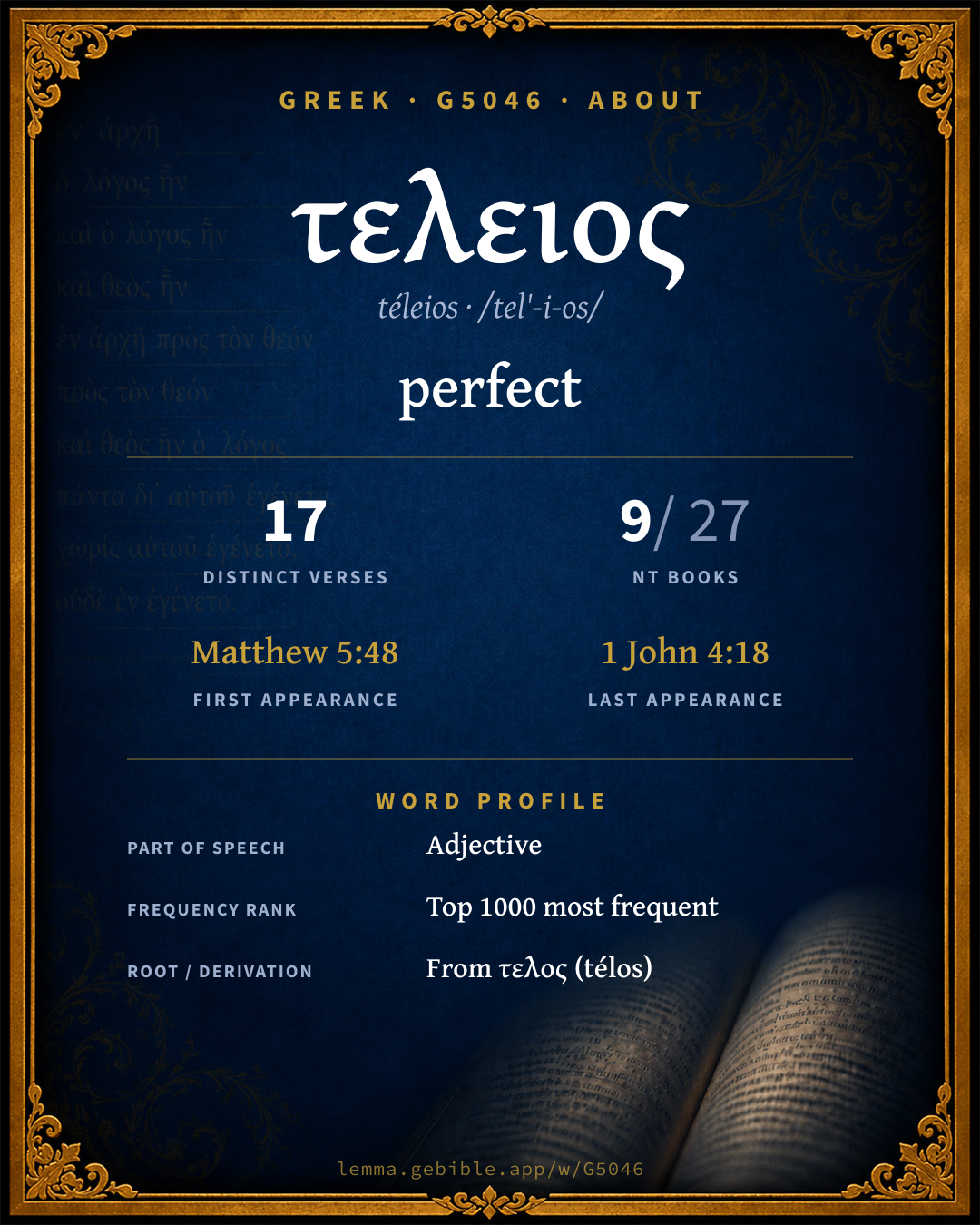
τέλειος
perfect
‘perfect’ is one of 4 main senses fuller range ↓
Full lexicon entry — Thayer's Greek Lexicon
From Thayer's Greek Lexicon
Where this word appears
See every Nominative-case word in the Greek New Testament →
Grammar key — what these labels mean
Part of speech
- Adjective
- A word that describes or qualifies a noun.
Case
- Nominative
- The case of the subject (and the predicate nominative).
- Accusative
- The case of the direct object and of extent.
- Dative
- The case of the indirect object, means, or location — “to / for / with / in.”
- Genitive
- The case of source, possession, or “of” — answers “whose / from what.”
Gender
- Masculine
- Grammatically masculine.
- Neuter
- Grammatically neuter.
- Feminine
- Grammatically feminine.
Number
- Plural
- More than one.
- Singular
- One.
Degree
- Comparative
- Expresses a greater degree (“greater,” “more”).
Grammatical forms 9 distinct
- Adjective, Nominative, Plural, Masculine 5 times (26%)
- Adjective, Accusative, Singular, Masculine 3 times (16%)
- Adjective, Nominative, Singular, Masculine 3 times (16%)
- Adjective, Accusative, Singular, Neuter 2 times (11%)
- Adjective, Nominative, Singular, Neuter 2 times (11%)
- Adjective, Dative, Plural, Masculine 1 time (5%)
- Adjective, Genitive, Plural, Masculine 1 time (5%)
- Adjective, Genitive, Singular, Feminine, Comparative 1 time (5%)
+1 more form (1 occurrence)
Parsed forms decoded from the imported morphology (Robinson–Tischendorf, public domain), counted across 19 parsed occurrences — not distinct verses.
Every verse where G5046 appears — 17 distinct verses across 9 books. Click any verse to open its interlinear word-by-word view. Verse text shown in the World English Bible for context — . Each verse’s Greek form is shown with its reference; the English is not keyword-highlighted, since the data carries no word-level English alignment. Use “Compare translations” on any verse to read it across multiple English versions. This concordance covers the Greek New Testament; Septuagint (Greek Old Testament) occurrences of this word are not indexed here.
Matthew 2 verses
- Matthew 5:48 τέλειοι τέλειός adj nom pl masc adj nom sg masc Therefore you shall be perfect, just as your Father in heaven is perfect.
- Matthew 19:21 τέλειος adj nom sg masc Jesus said to him, "If you want to be perfect, go, sell what you have, and give to the poor, and you will have treasure in heaven; and come, follow me."
Romans 1 verse
1 Corinthians 3 verses
- 1 Corinthians 2:6 τελείοις adj dat pl masc We speak wisdom, however, among those who are full grown; yet a wisdom not of this world, nor of the rulers of this world, who are coming to nothing.
- 1 Corinthians 13:10 τέλειον adj acc sg neut but when that which is complete has come, then that which is partial will be done away with.
- 1 Corinthians 14:20 τέλειοι adj nom pl masc Brothers, don't be children in thoughts, yet in malice be babies, but in thoughts be mature.
Ephesians 1 verse
Philippians 1 verse
Colossians 2 verses
- Colossians 1:28 τέλειον adj acc sg masc whom we proclaim, admonishing every man and teaching every man in all wisdom, that we may present every man perfect in Christ Jesus;
- Colossians 4:12 τέλειοι adj nom pl masc Epaphras, who is one of you, a servant of Christ, salutes you, always striving for you in his prayers, that you may stand perfect and complete in all the will of God.
Hebrews 2 verses
- Hebrews 5:14 τελείων adj gen pl masc But solid food is for those who are full grown, who by reason of use have their senses exercised to discern good and evil.
- Hebrews 9:11 τελειοτέρας adj gen sg fem comp But Christ having come as a high priest of the coming good things, through the greater and more perfect tabernacle, not made with hands, that is to say, not of this creation,
James 4 verses
- James 1:4 τέλειον τέλειοι adj acc sg neut adj nom pl masc Let endurance have its perfect work, that you may be perfect and complete, lacking in nothing.
- James 1:17 τέλειον adj nom sg neut Every good gift and every perfect gift is from above, coming down from the Father of lights, with whom can be no variation, nor turning shadow.
- James 1:25 τέλειον adj acc sg masc But he who looks into the perfect law, the law of freedom, and continues, not being a hearer who forgets but a doer of the work, this man will be blessed in what he does.
- James 3:2 τέλειος adj nom sg masc For in many things we all stumble. If anyone doesn't stumble in word, the same is a perfect man, able to bridle the whole body also.
1 John 1 verse
About this entry
At a glance — auto-summarized from this page’s data, not written by a person. Every figure links to its source below. This summary describes the numbers; it doesn’t interpret them.
τελειος — transliterated téleios — is a Greek adjective carrying the sense “perfect.” Its lexical range runs to 4 senses. It appears 17 verses across 9 books of the Greek New Testament, among its uncommon vocabulary. Debuting at Matthew 5:48, it then recurs through the corpus. Related forms include τελος, τελεσφορεω and τελεω. Each statement above links to its evidence; the full detail follows below.
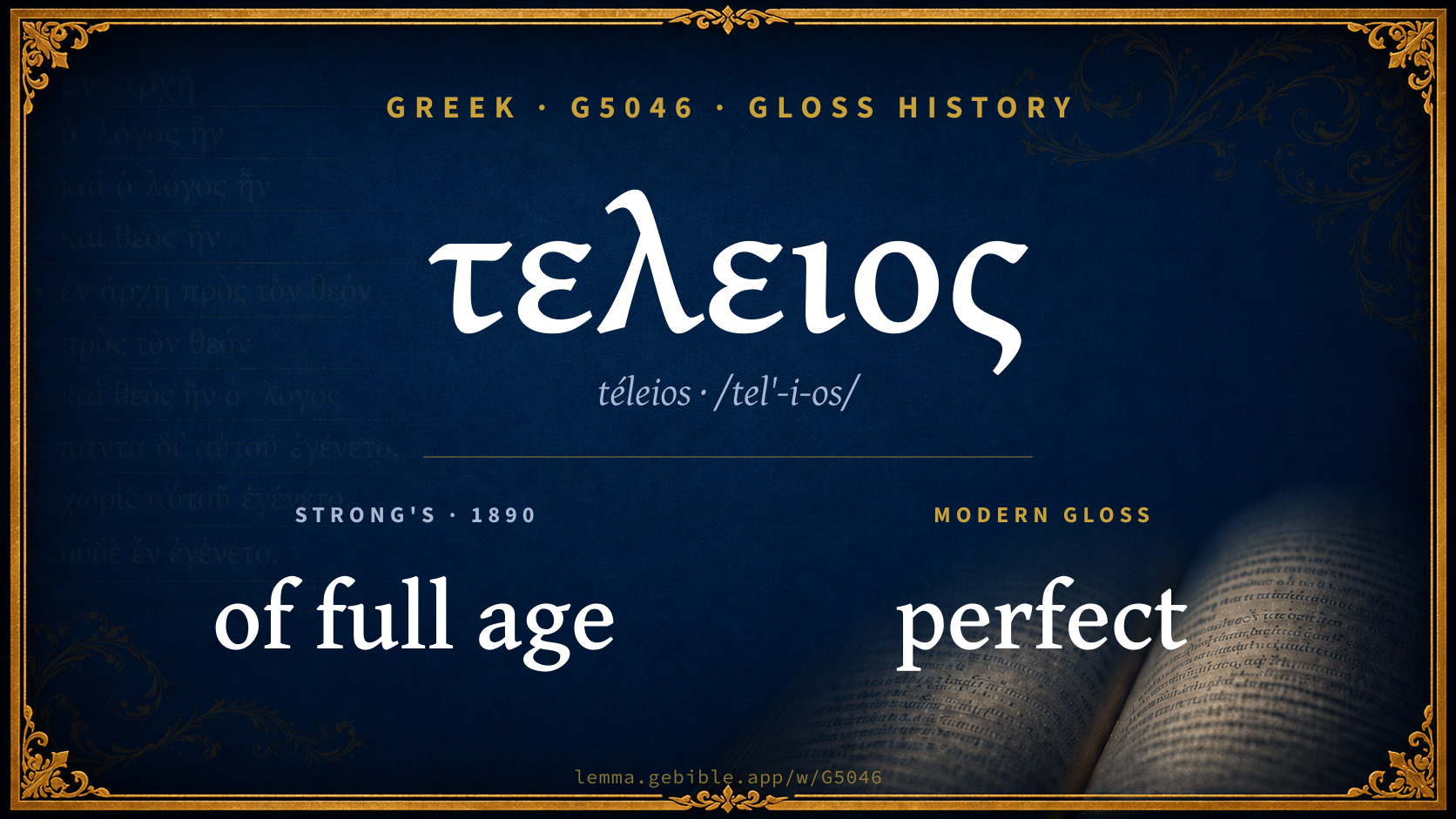
Gloss history
Strong's 1890 vs modern scholarship
About this word
Strong's G5046 catalogs a Greek word from the Greek New Testament.
These counts are not copied from any lexicon or concordance. They are computed here, from the morphology-tagged Greek New Testament. What Lemma adds →
- 17
- distinct verses
- The word appears in 17 distinct verses.
- 9 / 27
- NT books
- The word appears in 9 of 27 New Testament books.
- #644
- by frequency
- Top 1000 most frequent Greek words (rank 644 of 5,347 Greek words by occurrence).
View all 17 occurrences in the concordance →
Most concentrated in
- James 4 verses 24%
- 1 Corinthians 3 verses 18%
- Matthew 2 verses 12%
By section of the New Testament
By traditional corpus
Conventional, traditional groupings — biblical authorship is debated, so this is a traditional corpus grouping, not an authorship claim. Some books belong to more than one corpus (Luke is in both the Gospels and the Lukan corpus, and so on), so these shares overlap and need not total 100%. Each figure is a share of the word’s 17 distinct verses.
- Pauline corpus 8 verses · 47%
- General (Catholic) Epistles 5 verses · 29%
- Gospels 2 verses · 12%
- Hebrews 2 verses · 12%
- Johannine 1 verse · 6%
How translations render this word
Counts come from each version’s own published word-to-Strong’s tagging or interlinear alignment — an approximate guide to how each version renders this word, not a word-level alignment the data otherwise carries. Because each total is that version’s own tagged count, the per-version totals vary from one another and need not match the appearance or distinct-verse counts above. These counts may also differ from a printed concordance because Lemma counts each distinctly tagged rendering and does not collapse phrase taggings into a single head-word total. This is a fixed set of word-tagged versions (KJV, ASV, BSB, ULT) and does not change with the reading translation you choose elsewhere. Each version’s license is shown beside its name below (and on Sources).
- King James Version: Perfect 12×
- American Standard Version: Perfect 12×, Fullgrown 2×
- Berean Standard Bible: Perfect 10×, Mature 7×
- unfoldingWord Literal Text: Perfect 11×, Mature 3×, Complete 2×
King James Version Public Domain
Renders G5046 across 19 tagged occurrences — most commonly:
Plus 7 renderings that appear only once — usually multi-word phrases or single function words the recovered tagging swept in, not distinct renderings.
American Standard Version Public Domain
Renders G5046 across 19 tagged occurrences — most commonly:
Plus 5 renderings that appear only once — usually multi-word phrases or single function words the recovered tagging swept in, not distinct renderings.
Berean Standard Bible Public Domain
Renders G5046 across 19 tagged occurrences — most commonly:
Plus 2 renderings that appear only once — usually multi-word phrases or single function words the recovered tagging swept in, not distinct renderings.
unfoldingWord Literal Text CC BY-SA 4.0
Renders G5046 across 19 tagged occurrences — most commonly:
Plus 3 renderings that appear only once — usually multi-word phrases or single function words the recovered tagging swept in, not distinct renderings.
Senses in Thayer's
The 4 senses Thayer's distinguishes for this word, in lexicon order (not ranked by frequency or importance). The full entry — with sub-senses — is in the Lexicon Entry tab.
- brought to its end, finished
- wanting nothing necessary to completeness
- perfect
- that which is perfect
Word origin
Derived from τελος (télos) (G5056) — end.
Forms in the corpus
The 8 distinct written forms G5046 takes in the Greek New Testament, most frequent first — each parse links to that case’s occurrences in the concordance.
| Form | Parsing | Example | Uses |
|---|---|---|---|
| τέλειον téleion | Adjective, Accusative, Singular, Masculine | Ephesians 4:13 | 7 |
| τέλειοι téleioi | Adjective, Nominative, Plural, Masculine | Matthew 5:48 | 5 |
| τέλειος téleios | Adjective, Nominative, Singular, Masculine | Matthew 19:21 | 2 |
| τέλειός téleiós | Adjective, Nominative, Singular, Masculine | Matthew 5:48 | 1 |
| τελεία teleía | Adjective, Nominative, Singular, Feminine | 1 John 4:18 | 1 |
| τελείοις teleíois | Adjective, Dative, Plural, Masculine | 1 Corinthians 2:6 | 1 |
| τελείων teleíōn | Adjective, Genitive, Plural, Masculine | Hebrews 5:14 | 1 |
| τελειοτέρας teleiotéras | Adjective, Genitive, Singular, Feminine, Comparative | Hebrews 9:11 | 1 |
Same root — word family
Other Thayer's entries built from the same root as G5046, grouped by Strong’s listed origin. These share a root / origin per the lexicon — not necessarily a shared meaning. Each links to that word’s own entry.
Derives from
Shares the same root
- τελεσφορεω telesphoréō G5052 to mature
- τελεω teléō G5055 to finish
- τελωνης telṓnēs G5057 tax collector
- τηλαυγως tēlaugōs G5081 from afar clearly
- τολμαω tolmáō G5111 to dare
Derived from this word
- τελειοτης teleiótēs G5047 perfection
- τελειοω teleióō G5048 to perfect
- τελειως teleíōs G5049 perfectly
Compare all same-root words → Showing 4 of 10 — not the complete family. They share a root, not necessarily a meaning.
Septuagint usage
The same Greek word τελειος appears 17 times in the Greek Old Testament (Septuagint), across 17 verses in 11 books.
- 17
- LXX occurrences
- Tagged occurrences of this Greek word in the Septuagint.
- 17
- verses
- Distinct Septuagint verses containing this word.
- 11 / 39
- OT books
- The word appears in 11 of the 39 Old Testament books.
Sample Septuagint occurrences
- Genesis 6:9 τέλειος
- Exodus 12:5 τέλειος
- Deuteronomy 18:13 τέλειος
- Judges 20:26 τέλειος
- 2 Samuel 22:26 τέλειος
- 1 Kings 8:61 τέλειος
- 1 Chronicles 25:8 τέλειος
- Ezra 2:63 τέλειος
- Psalms 138:22 τέλειος
- Song of Solomon 5:2 τέλειος
- Jeremiah 13:19 τέλειος
Septuagint occurrences (same lexeme)
Every verse where the same Strong’s number (G5046) appears in the Greek Septuagint. Verse text shown in the World English Bible for context; the Greek form is the matched word — the English is not keyword-highlighted.
- Genesis 6:9 τέλειος This is the history of the generations of Noah. Noah was a righteous man, blameless among the people of his time. Noah walked with God.
- Exodus 12:5 τέλειος Your lamb shall be without blemish, a male a year old. You shall take it from the sheep, or from the goats:
- Deuteronomy 18:13 τέλειος You shall be perfect with Yahweh your God.
- Judges 20:26 τέλειος Then all the children of Israel, and all the people, went up, and came to Bethel, and wept, and sat there before Yahweh, and fasted that day until even; and they offered burnt-offerings and peace-offerings before Yahweh.
- Judges 21:4 τέλειος It happened on the next day that the people rose early, and built there an altar, and offered burnt offerings and peace-offerings.
- 2 Samuel 22:26 τέλειος With the merciful you will show yourself merciful; With the perfect man you will show yourself perfect;
- 1 Kings 8:61 τέλειος Let your heart therefore be perfect with Yahweh our God, to walk in his statutes, and to keep his commandments, as at this day.
- 1 Kings 11:4 τέλειος For it happened, when Solomon was old, that his wives turned away his heart after other gods; and his heart was not perfect with Yahweh his God, as was the heart of David his father.
- 1 Kings 15:3 τέλειος He walked in all the sins of his father, which he had done before him; and his heart was not perfect with Yahweh his God, as the heart of David his father.
- 1 Kings 15:14 τέλειος But the high places were not taken away: nevertheless the heart of Asa was perfect with Yahweh all his days.
- 1 Chronicles 25:8 τέλειος They cast lots for their offices, all alike, as well the small as the great, the teacher as the scholar.
- 1 Chronicles 28:9 τέλειος You, Solomon my son, know the God of your father, and serve him with a perfect heart and with a willing mind; for Yahweh searches all hearts, and understands all the imaginations of the thoughts: if you seek him, he will be found of you; but if you forsake him, he will cast you off forever.
- Ezra 2:63 τέλειος The governor said to them, that they should not eat of the most holy things, until there stood up a priest with Urim and with Thummim.
- Psalms 138:22 τέλειος
- Song of Solomon 5:2 τέλειος I was asleep, but my heart was awake. It is the voice of my beloved who knocks: Open to me, my sister, my love, my dove, my undefiled; For my head is filled with dew, My hair with the dampness of the night.
- Song of Solomon 6:9 τέλειος My dove, my perfect one, is unique. She is her mother's only daughter. She is the favorite one of her who bore her. The daughters saw her, and called her blessed, The queens and the concubines, and they praised her.
- Jeremiah 13:19 τέλειος The cities of the South are shut up, and there is none to open them: Judah is carried away captive, all of it; it is wholly carried away captive.
These are occurrences of the same Greek lexeme (G5046) in the Septuagint — not a translation of any one Hebrew word. The store carries no word-level Hebrew↔Greek alignment, so no Hebrew original is asserted here. Counts come from the recovered LXX Strong's tagging — high-frequency vocabulary is well covered, while rare or late forms may be untagged — so they reflect tagged occurrences and may slightly undercount.