
Job 6:9

Hebrew (Westminster Leningrad Codex) Job 6:9 appears in the Hebrew Old Testament. The text above is from the Westminster Leningrad Codex. Each word links to its Strong’s number, a concise gloss, and parsing drawn from the Open Scriptures Hebrew Bible morphology. Click any word for its full Brown-Driver-Briggs (BDB) entry.
Download image
Cite this verse

Job 6:9 (World English Bible). Public Domain. Lemma interlinear Bible study tool, https://lemma.gebible.app/v/job/6/9.

Show BibTeX & RIS
BibTeX
RIS
English Translation
Even that it would please God to crush me; That he would let loose his hand, and cut me off!
World English Bible · Public Domain
Highlights Full analysis ↓
Download a study sheet

One document with this verse’s original text, its word-by-word gloss line, the meaning frame, cross-references with their text, attributed commentary, and full source and license credits — printable, and it pastes into notes with its structure intact.

This verse Autodidact and up

Study sheet (.html) Plain text (.txt)

A passage Seminary Student

Up to 50 verses in one chapter. A passage sheet keeps up to 6 commentary sources and 12 cross-references per verse, in the order this page ranks them, and says so on the sheet whenever that leaves anything out. Ask for a single verse and you get the Autodidact verse sheet above.

Everything on this page stays free to read, with no account — the sheet is a download of what is already on screen, not access to it.

Want to remove ads? Support Godless Engineer
Compare translations 3

The same verse in 3 English versions, stacked beneath the original-language interlinear above. Click any original word for its lexicon entry.

Each is an independent rendering of the whole verse — the interlinear is not word-aligned to these translations.

Highlighted words mark where these versions differ — a whole-verse word diff, not a word-by-word alignment.

  • World English Bible Public Domain
    Even that it would please God to crush me; That he would let loose his hand, and cut me off!
  • King James Version Public Domain
    Even that it would please God to destroy me; that he would let loose his hand, and cut me off!
  • unfoldingWord Literal Text CC BY-SA 4.0
    and may God be willing and may he crush me, may he loose his hand and cut me off!

unfoldingWord Literal Text — © unfoldingWord, licensed CC BY-SA 4.0. Word-aligned USFM3 via Door43 (git.door43.org/unfoldingWord/en_ult).

Versions to compare (up to 4)

3 of 4 selected

Show all 18 translations

Every available English version of this verse, each an independent rendering of the whole verse.

  • World English Bible Public Domain
    Even that it would please God to crush me; That he would let loose his hand, and cut me off!
  • Berean Standard Bible Public Domain
    that God would be willing to crush me, to unleash His hand and cut me off!
  • Majority Standard Bible Public Domain
    that God would be willing to crush me, to unleash His hand and cut me off!
  • King James Version Public Domain
    Even that it would please God to destroy me; that he would let loose his hand, and cut me off!
  • American Standard Version (1901) Public Domain
    Even that it would please God to crush me; That he would let loose his hand, and cut me off!
  • Revised Version (1885) Public Domain
    Even that it would please God to crush me; that he would let loose his hand, and cut me off!
  • Geneva Bible (1599) Public Domain
    That is, that God would destroy me: that he would let his hand go, and cut me off.
  • Douay-Rheims (1899) Public Domain
    And that he that hath begun may destroy me, that he may let loose his hand, and cut me off?
  • Young's Literal Translation Public Domain
    That God would please -- and bruise me, Loose His hand and cut me off!
  • Literal Standard Version CC BY-SA 4.0
    That God would please—and bruise me, || Loose His hand and cut me off!
  • Unlocked Literal Bible CC BY-SA 4.0
    that it would please God to crush me once, that he would let loose his hand and cut me off from this life!
  • unfoldingWord Literal Text CC BY-SA 4.0
    and may God be willing and may he crush me, may he loose his hand and cut me off!
  • Darby Bible Public Domain
    And that it would please +God to crush me, that he would let loose his hand and cut me off!
  • World Messianic Bible Public Domain
    even that it would please God to crush me; that he would let loose his hand, and cut me off!
  • Webster's Bible Public Domain
    Even that it would please God to destroy me; that he would let loose his hand, and cut me off!
  • Free Bible Version CC BY-SA 4.0
    that God would be willing to crush me to death, that he would just let me die!
  • Bible in Basic English Public Domain
    If only he would be pleased to put an end to me; and would let loose his hand, so that I might be cut off!
  • JPS Tanakh (1917) Public Domain
    Even that it would please God to crush me; that He would let loose His hand, and cut me off!

Literal Standard Version (2020), Covenant Press — licensed CC BY-SA 4.0. Text via the HelloAO Bible API (eBible.org). Unlocked Literal Bible (unfoldingWord) — licensed CC BY-SA 4.0. Text via the HelloAO Bible API (eBible.org). unfoldingWord Literal Text — © unfoldingWord, licensed CC BY-SA 4.0. Word-aligned USFM3 via Door43 (git.door43.org/unfoldingWord/en_ult). Free Bible Version, Dr. Jonathan Gallagher — licensed CC BY-SA 4.0. Text via the HelloAO Bible API (eBible.org).

Word by word

More ways to search: Search by grammar → Find every occurrence → Compare this word →

Practice this passage: Drill this verse → Learn its vocabulary →

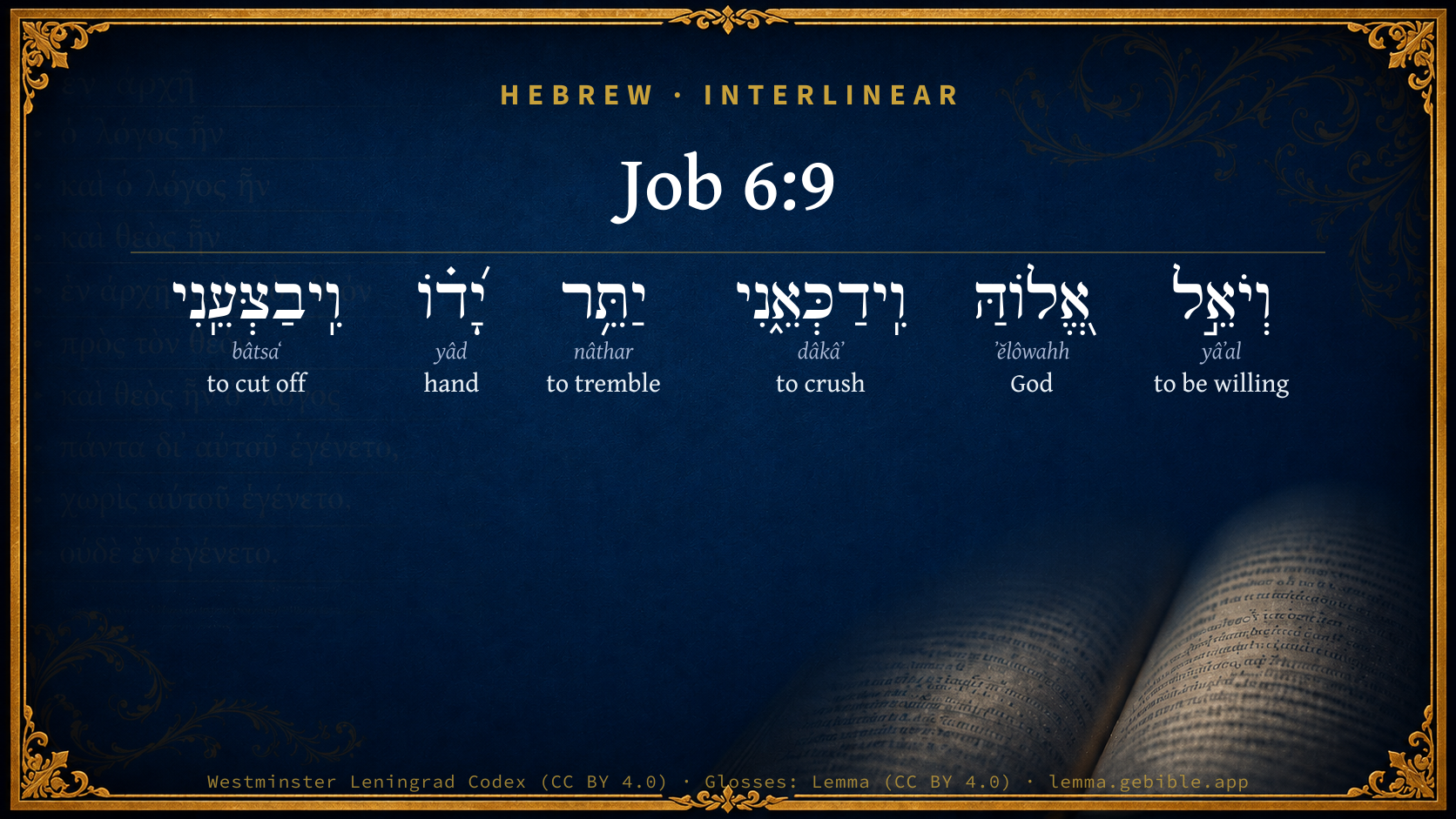
יַתֵּ֥ר
nâthar
H5425
“to tremble”
Verb, Hiphil, Jussive, 3rd Person, Masculine, Singular
Part of Speech
Verb
Stem
Hiphil
Form
Jussive
Person
3rd Person
Gender
Masculine
Number
Singular
Full BDB Definition

Origin: a primitive root

TWOT: 1448 , 1449

to start up, tremble, shake, spring up - (Qal) to start up - (Piel) to leap - (Hiphil) to cause to start up - to loose, let loose, undo, be free, be loose - (Hiphil) - to unfasten, loosen - to set free, unbind
  1. וְיֹאֵ֣ל yâʼal H2974 “and · to be willing” Conjunction + Verb, Hiphil, Jussive, 3rd Person, Masculine, Singular
  2. אֱ֭לוֹהַּ ʼĕlôwahh H433 “God” Noun, Common, Masculine, Singular, Absolute
  3. וִֽידַכְּאֵ֑נִי dâkâʼ H1792 “and · to crush · me” Conjunction + Verb, Piel, Imperfect, 3rd Person, Masculine, Singular + Suffix, Personal, 1st Person, Common, Singular
  4. יָ֝ד֗וֹ yâd H3027 “hand · his” Noun, Common, Both, Singular, Construct + Suffix, Personal, 3rd Person, Masculine, Singular
  5. וִֽיבַצְּעֵֽנִי bâtsaʻ H1214 “and · to cut off · me” Conjunction + Verb, Piel, Imperfect, 3rd Person, Masculine, Singular + Suffix, Personal, 1st Person, Common, Singular

About this verse

These counts appear in no published source. They are computed here, from the morphology-tagged text and Lemma’s own curated glosses. What Lemma adds →

6
words
6
distinct lemmas
Wisdom
section

Notable vocabulary

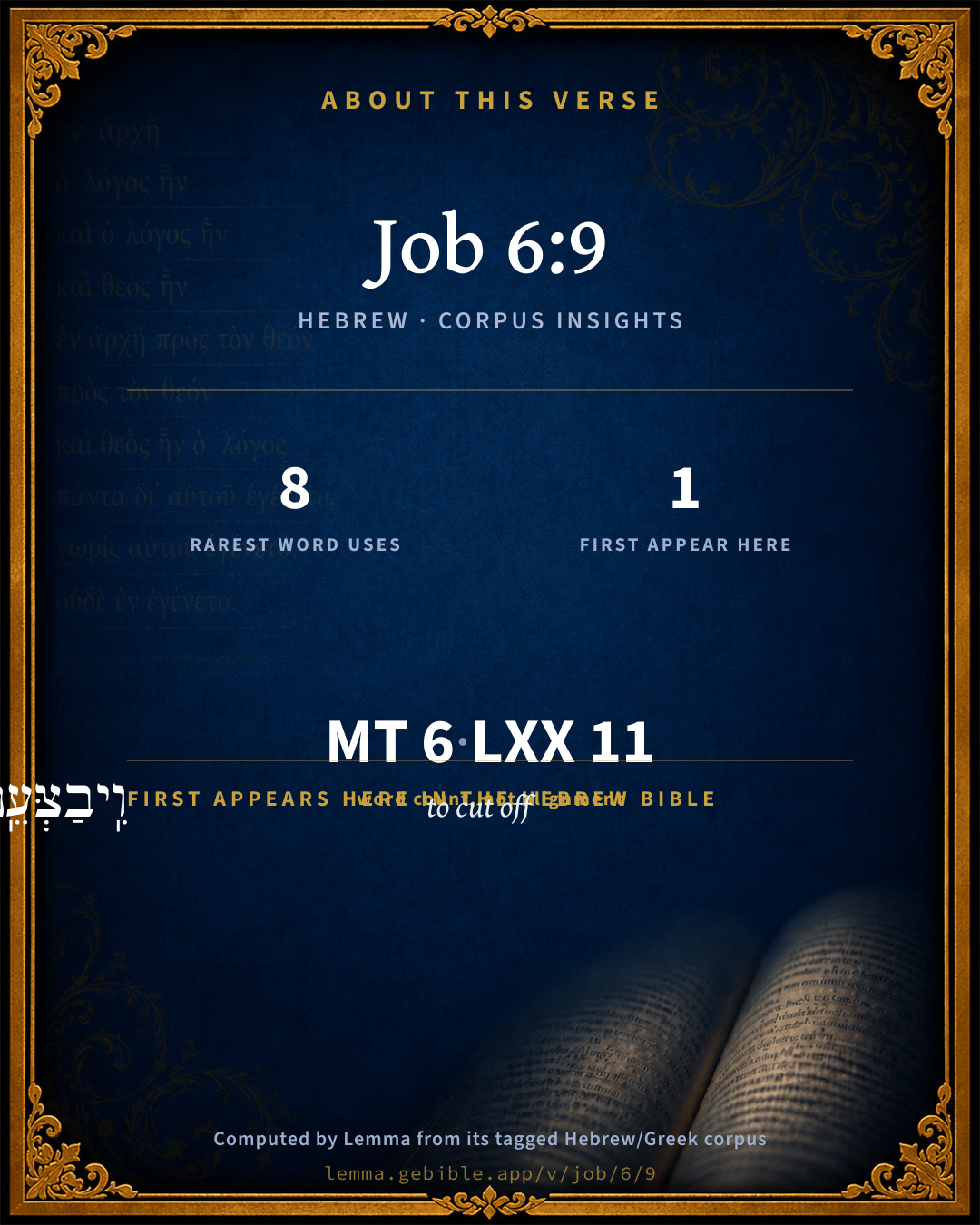
The rarest word here is יַתֵּ֥ר to tremble H5425 — appearing just 8 times in the whole Hebrew Bible.

First appearance in Scripture

This word makes its first canonical appearance in the Hebrew Bible here:

  • וִֽיבַצְּעֵֽנִי to cut off H1214

Shared distinctive vocabulary

יַתֵּ֥ר to tremble H5425 occurs in 8 verses of the Hebrew Bible. Also found in:

Grammatical profile

  • 4 verbs
  • 2 nouns

Verb forms

  • וְיֹאֵ֣ל Hiphil · Jussive
  • וִֽידַכְּאֵ֑נִי Piel · Imperfect
  • יַתֵּ֥ר Hiphil · Jussive
  • וִֽיבַצְּעֵֽנִי Piel · Imperfect

Hebrew & Septuagint length

In English translation the verse runs 20 words from the Hebrew and 14 from the Septuagint (LXX English) — the Septuagint runs noticeably shorter here. See the side-by-side →

A rough comparison of the two English renderings, which tokenize alike — not a word-level alignment.

Word counts can differ between the Hebrew and the Greek without any difference in meaning — e.g. the Hebrew direct-object marker אֵת has no separate Greek word, and Greek often adds the article ὁ.

In the original languages it is 6 Hebrew tokens and 11 Greek tokens — but the two are counted differently (Hebrew bundles its prefixes and suffixes into one token; the Greek is in lemma form), so that isn’t a like-for-like length.

Cross-references

11

Topical passages linked to Job 6:9 in the Treasury of Scripture Knowledge — connected by theme and wording, ordered by reader-vote popularity; previews shown in the World English Bible.

  • 1 Kings 19:4 But he himself went a day's journey into the wilderness, and came and sat down under a juniper tree: and he requested for himself that he might die, and said, It is enough; now, O Yahweh, take away my life; for I am not better than my fathers.
  • Jonah 4:3 Therefore now, Yahweh, take, I beg you, my life from me; for it is better for me to die than to live."
  • Job 7:15–16 So that my soul chooses strangling, Death rather than my bones.
  • Isaiah 48:10–13 Behold, I have refined you, but not as silver; I have chosen you in the furnace of affliction.
  • Jonah 4:8 It happened, when the sun arose, that God prepared a sultry east wind; and the sun beat on Jonah's head, so that he fainted, and requested for himself that he might die, and said, "It is better for me to die than to live."
  • Numbers 11:14–15 I am not able to bear all this people alone, because it is too heavy for me.
  • Job 3:20–22 "Why is light given to him who is in misery, Life to the bitter in soul,
  • Job 14:13 "Oh that you would hide me in Sheol, That you would keep me secret, until your wrath is past, That you would appoint me a set time, and remember me!
  • Job 19:21 "Have pity on me, have pity on me, you my friends; For the hand of God has touched me.
  • Psalms 32:4 For day and night your hand was heavy on me. My strength was sapped in the heat of summer. Selah.
  • Revelation 9:6 In those days people will seek death, and will in no way find it. They will desire to die, and death will flee from them.

Cross-references courtesy of OpenBible.info (CC BY 4.0).

Hebrew and Greek witnesses Masoretic Hebrew ↔ Greek Septuagint

The same verse in the two great witnesses to the Old Testament, shown verse-for-verse.

Here the Septuagint runs noticeably shorter than the Hebrew — LXX2012 (modern English Septuagint) 14 words vs World English Bible 20. A rough length comparison of the two English translations, not a word-level alignment — read both below.

These are two independent witnesses, not word-aligned to each other, and the Septuagint is shown in lemma (dictionary) form.

Hebrew Job 6:9 Masoretic · Westminster Leningrad Codex

וְיֹאֵ֣ל אֱ֭לוֹהַּ וִֽידַכְּאֵ֑נִי יַתֵּ֥ר יָ֝ד֗וֹ וִֽיבַצְּעֵֽנִי

Even that it would please God to crush me; That he would let loose his hand, and cut me off!

World English Bible · Public Domain

Greek LXX Job 6:9 Septuagint · lemma form

ἄρχω ὁ κύριος τιτρώσκω ἐγώ εἰς τέλος δέ μή ἐγώ ἀνααἱρέω

Let the Lord begin and wound me, but let him not utterly destroy me.

LXX2012 (modern English Septuagint) · Public Domain

On this verse, John Gill's Exposition discusses the Septuagint’s reading. Read the note in Commentary ↓

Hebrew: Westminster Leningrad Codex (CC BY 4.0). Greek: Septuagint (public domain); English from LXX2012 (modern English Septuagint) (Public Domain). How the Septuagint differs from the Hebrew →

Commentary

Notes on Job 6:9 from classic Christian and Jewish commentators (each source and its license shown beneath its notes). The classic Christian expositions comment on the surrounding passage and are grouped to its opening verse, so a note may address several verses; the Jewish commentaries on the Tanakh (Rashi and others) are per-verse, so they appear only where the commentator wrote on this verse.

Lemma curates 59 commentaries, every one of them public domain or Creative Commons licensed, each selected and text-cleaned for this edition rather than reprinted as found. About our sources →

Trapp's Complete Commentary

John Trapp

Job 6:9 Even that it would please God to destroy me; that he would let loose his hand, and cut me off!

Ver. 9. That it would please God to destroy me] That is, to despatch me out of this world, and send me to a better. A dissolution would be far more acceptable to Job than that restitution which Eliphaz seemed to promise him, Job 5:24. It is as if Job should say, Take you the world among you, since you like it so well; I have more than enough of it; I am neither fond of life, nor afraid of death, but the clean contrary; I had rather die than dine, and crave no greater favour than to have more weight laid upon me that I may die out of hand. Feri, Domine, feri; nam a peccatis absolutus sum, as Luther once said, Strike, Lord, strike deep; for thou hast pardoned my sins, and wilt save my soul.

That he would let loose his hand] That now seemeth tied, or bound behind him. Manus ligari videtur quando parcit, saith Vatablus. God had chained up Satan, and strictly charged him not to take away Job’s life; but this is it that Job would fain have done. Mortality he would account no small mercy; he desired nothing more than to be dissolved, and to be with Christ; he might do it, because he knew that his Redeemer lived, &c. So might Simeon, because he had seen God’s salvation; and so might Paul, who had fought a good fight, and kept the faith. But how could Plato say, in the eighth of his laws, The communion of the soul with the body is not better than the dissolution, as I would say, if I were to speak in earnest? Kοινωνια ψυχη και αωματι διαλυσεως ουκ εστι κρειττων, ως εγω φαιην αν σπουδη λεγων. His master, Socrates, when to die, was nothing so confident; for he shut up his last speech with these words, as both Plato himself and Cicero tell us, Tempus est iam hinc abire, It is now high time for us to go hence; for me to die, and for you to live longer; and whether of these two is the better the gods immortal know; hominem quidem arbitror scire neminem, it is above the knowledge, I believe, of any man living. Thus he; but Job was better persuaded; otherwise he would have been better advised than thus earnestly to have desired death.

And cut me off!] Avide me absumat quasi ex morte mea ingens lucrum reportaturus (Pineda). Let him greedily cut me off (so the word signifieth), even as if he were to have some great gain, or get some rich booty by my blood.

John Trapp, A Commentary or Exposition upon All the Books of the Old and New Testament (1647–1656) — public domain. Text from a community e-Sword module.

Tyndale Open Study Notes

Tyndale Open Resources

6:9 At one time, both Moses and Elijah wished that God would kill them (Num 11:15; 1 Kgs 19:4).

Tyndale Open Study Notes — © Tyndale Open Resources, licensed CC BY-SA 4.0. Text via the HelloAO Bible API.

Jamieson, Fausset & Brown

Robert Jamieson, A. R. Fausset & David Brown

destroy--literally, "grind" or "crush" (Isa 3:15).

let loose his hand--God had put forth His hand only so far as to wound the surface of Job's flesh (Job 1:12; Job 2:6); he wishes that hand to be let loose, so as to wound deeply and vitally.

cut me off--metaphor from a weaver cutting off the web, when finished, from the thrum fastening it to the loom (Isa 38:12).

Jamieson, Fausset & Brown — Commentary Critical and Explanatory on the Whole Bible (1871) — public domain (CC PDM 1.0). Text via the HelloAO Bible API.

Adam Clarke's Commentary

Verse 9. Let loose his hand] A metaphor taken from an archer drawing his arrow to the head, and then loosing his hold, that the arrow may fly to the mark. See on Job 6:4.

Adam Clarke's Commentary on the Bible (1810–1826) — public domain. Text from a community e-Sword/MySword module.

Ellicott's Commentary for English Readers

(9) Even that it would please God . . .—The sequence of thought in these verses is obscure and uncertain. The speaker may mean that, notwithstanding all that might befall him, his consolation would still be that he had never denied the words of the Holy One. The words “I would harden myself in sorrow” are the most doubtful, not occurring elsewhere in Scripture. Some render the two clauses, “I would exult, or rejoice, in pain that spareth not;” but “Let him not spare,” or “Though he spare not,” seems preferable. Others render, “Though I burn in sorrow.”

A Bible Commentary for English Readers, edited by Charles John Ellicott (1878–1897) — public domain. Text from a community e-Sword module.

John Gill's Exposition

Then should I yet have comfort,.... Either before death, and in the midst of all his pains and sorrows, being in view of it as near at hand, and sure and certain; could he but be assured of its near approach, he could exult in his afflictions; it would be an alleviation of his trouble, that he should be soon out of it; and he would sit and sing upon the brink of eternity, and say, "O death, where is thy sting! O grave, where is thy victory?" Co1 15:55; his sufferings being just at an end, and being comfortably persuaded of a happy future state, and a glorious resurrection, see Job 19:25; or after death, when destroyed and cut off by it; and he hereby signifies as if he expected no comfort on this side death and the grave; that is, no temporal comfort, his comforts were gone, his substance, his children, and health, and he had no hope of the restoration of them, Eliphaz had suggested; but he believed, that though he now had his evil things, as Lazarus since, yet after death should be comforted with the presence of God, in which is fulness of joy; with the discoveries of his love, as a broad river to swish in; with a glory that should be on him, and revealed in him, with which "the sufferings of this present time are not worthy to be compared", Rom 8:18; and with the company of angels, and glorified saints, as well as be freed from all bodily disorders and pains, and death itself, from all sin, and sorrow, from Satan's temptations, divine desertions, doubts, and fears:

yea, I would harden myself in sorrow; meaning either upon the first news of death's being near at hand, he would harden himself against all pains and pangs of death; when those should beset him around, and he should find trouble and sorrow through them, he would not regard them, but most cheerfully and patiently bear them, and most courageously go through them, not at all intimidated by them, or by death, and the most terrible agonies of it: or "though I should be hot, burn", or "be burnt in sorrow" or "pain" (o), as some render it; or parched with pain, as Mr. Broughton; though I should be still more and more inflamed with these burning ulcers upon me, or be dried up with a burning fever, or my body cast into a fire, and be scorched and burnt in the flames of it, I should not value it; I could bear the most excruciating pains, and sharpest torments, could I but be assured I should die. Some observe, that the word signifies to "leap" (p); and so the Septuagint render it; and then the sense is, that he should leap for joy, as men do when they are elevated at good news, or possess what is exceeding grateful to them, was it certain to him he should die quickly; and so the Targum interprets it of exultation. The word in the Arabic language, as a good judge (q) of it observes, is used of the prancing and pawing of a horse, which makes the ground to shake; he strikes with his foot, and which as done in the midst of a battle, mocking at fear, at the rattling quiver, and glittering spear and shield, is most beautifully described in Job 39:21 in like manner, Job suggests, he should rejoice in the view of death, and mock at the fear of it: or this may respect the happiness he should enjoy after death; for in the Syriac and Arabic versions the words are rendered, "and I shall be perfected in virtue"; and the word used has the signification of solidity, confirmation, stability, and perfection; and to this sense it is rendered by some (r), though to different purposes; and after this suffering state is over, the saints will be established, settled and perfected in all virtue, in knowledge, holiness, and happiness: therefore

let him not spare; laying on his blows thicker and heavier, till he has beaten me to pieces, and utterly destroyed me, a petition the reverse of David's, Psa 39:13; his desire is to have it done quickly and thoroughly, neither to spare him any longer, nor abate in measure, but strike him immediately, and that effectually, so as to dispatch him at once:

for I have not concealed the words of the Holy One; that is, of God, as some (t) supply it, whose name is holy, who is holy in his nature, and in all his works, and is eminently glorious in the perfection of his holiness; for though there are holy men and holy angels, there are none holy as the Lord: his "words" are the doctrines delivered out by him concerning Christ the promised seed, and salvation by him, which were spoken of by the mouth of all the prophets from the beginning of the world, of which Job had knowledge, Job 19:25; see Gen 3:15 Luk 1:70; and the duties of religion enjoined men in those early times; which Sephorno refers to the laws and commandments given to the sons of Noah; of which See Gill on Gen 9:4; Here everything is included, both with respect to doctrine and practice, then revealed unto the sons of men, all which Job had a special regard unto: he embraced, professed, and practised them; he did not hide them from himself, or shut his eyes to the evidence of them, and smother within him the light he had; nor did he conceal them from others, but communicated the knowledge of them among his neighbours, as far as he could reach; he was not ashamed to profess the true religion of God; he held fast, and did not deny the faith in the midst of a dark and Heathenish country, and he lived up to his profession and principles in his life and conversation: now having a testimony of a good conscience within him, that he, through the grace of God, had acted a sincere and upright part in the affair of religion, and having knowledge of a living Redeemer, and faith in him, and in his justifying righteousness, he was not afraid of death, come when it would, and in whatsoever shape: and whereas his friends had suggested that he was a hypocrite and a wicked man, his conscience bore witness to the contrary; and to let them know they were mistaken in him, he signifies, he was not afraid to die, yea, he desired it; he cared not how soon he left the world, and appeared before God, the Judge of all, since the truth of grace was in him, and the righteousness of Christ upon him, and he had not, through the course of his profession of religion, departed wickedly from his God, his truths and ordinances. Some (u) read this in connection with the first clause, putting the rest in a parenthesis: "this is yet my comfort (though or when I am burned or parched with pain, and he spares not), that I have not concealed the words of the Holy One".

(o) "calefaciam", Pagninus, Bolducius; "flagrem", Vatablus; "exaestuo", Junius & Tremellius; "urar", Drusius, Mercerus; so Gersom, Kimchi, Peritsol, & Ben Melech. (p) Sept. "saltarem prae gaudio"; so some in Munster. (q) "Et pede terram quatium cum exultatione", Schultens. (r) "Consolidescam", Montanus; "corroboror", Beza; so Aben Ezra. (t) Vatablus, Tigurine version, Michaelis. (u) So Vatablus, Mercerus, Codurcus, Cocceius.

John Gill's Exposition of the Whole Bible (1746–1763) — public domain (CC PDM 1.0). Text via the HelloAO Bible API.

Albert Barnes' Notes on the Bible

Even that it would please God to destroy me - To put me to death, and to release me from my sorrows; compare Job 3:20-21. The word rendered “destroy” here (דכא dâkâ') means properly to break in pieces, to crush, to trample under foot, to make small by bruising. Here the sense is, that Job wished that God would crush him, so as to take his life. The Septuagint renders it “wound” - τρωσάτω trōsatō. The Chaldee renders it, “Let God, who has begun to make me poor, loose his hand and make me rich.”

That he would let loose his hand - Job here represents the hand of God as bound or confined. He wishes that that fettered hand were released, and were so free in its inflictions that he might be permitted to die.

And cut me off - This expression, says Gesenius (Lexicon on the word בצע betsa‛), is a metaphor derived from a weaver, who, when his web is finished, cuts it off from the thrum by which it is fastened to the loom; see the notes at Isa 38:12. The sense is, that Job wished that God would wholly finish his work, and that as he had begun to destroy him he would complete it.

Albert Barnes' Notes on the Bible (1834–1885) — public domain. Text from a community e-Sword/MySword module.

Haydock's Catholic Bible Commentary

Off, and release me from this state of misery and danger. (Haydock) --- He is ready to die cheerfully, if it be God’s will. (Calmet) --- Septuagint, "May the Lord, who has begun, wound me, but not take me away finally. Yea, let my city, over which I have exulted, be my grave. I will not spare, for I have not belied a word of my holy God." (Haydock)

George Leo Haydock (1774–1849), Haydock's Catholic Family Bible and Commentary, 1859 edition — public domain. Excludes Psalms (Douay-Rheims chapter numbering differs from Protestant) and Deuterocanonical books (Catholic canon only).

Matthew Poole's English Annotations

To destroy me; to end my days and calamities together. That he would let loose his hand; which is now as it were bound up or restrained from giving me that deadly blow which I desire. Oh that he would restrain himself and his hand no longer, but let it fall upon me with all its might, so as to

cut me off as it follows.

Matthew Poole's English Annotations on the Holy Bible (1683–1685) — public domain. Text from a community e-Sword/MySword module.

Whedon's Commentary on the Bible

Daniel D. Whedon

9. Please God to destroy me — With God is the determination of life and death. The command, “Thou shalt not kill,” includes self-destruction. In all his sufferings Job never intimates a thought of taking his own life. The old Hebrew mind would have spurned the effeminacy that expresses itself in the “Morals of Seneca;” — that mind was strong to bear the ills of life so long as it pleased God. In the entire Old Testament there is no trace of suicide apart from war, unless the case of Ahithophel be an exception.

And cut me off — Allusion is here made to the weaver, who, when the web is woven, cuts off the thread from the thrum which fastens the web to the loom. Compare Isa_38:12.

Daniel D. Whedon (gen. ed.), Commentary on the Old and New Testaments (1874–1909) — public domain. Text from a community e-Sword module.

The Pulpit Commentary

Even that it would please God to destroy me; or, to crush me (Revised Version) break me in pieces" (Lee). That he would let loose his hand; or, put forth his hand stretch it out against me threateningly." And cut me off. "Cut me off bit by bit" (Lee); comp. Isa_38:12, where the same word is used of a weaver, who cuts the threads of his loom one by one, until the whole is liberated and comes away.

The Pulpit Commentary (1880–1919), ed. H.D.M. Spence-Jones & Joseph S. Exell — public domain. Text from a community e-Sword module.

John Wesley's Explanatory Notes

Destroy - To end my days and calamities together.

John Wesley, Explanatory Notes Upon the Whole Bible (1754–1765) — public domain. Text via the GEBible commentary corpus.

Rashi

Rabbi Shlomo Yitzchaki (Rashi)

desire and may He want.

and crush me [This is] an expression of death.

enlarge his hand May He enlarge His hand with His plague like (Exod. 9:3), “Behold God’s hand is.”

and finish me off Heb. ויבצעני, and finish me off, as in (Lam. 2:17), “He has carried out (בצע) His word,” and (Zech. 4:9), “and his hands shall finish it (תבצענה).”

Rashi on the Tanakh — English translations: “The Judaica Press complete Tanach with Rashi, translated by A. J. Rosenberg” (CC BY 4.0); “Pentateuch with Rashi's commentary by M. Rosenbaum and A.M. Silbermann, 1929-1934” (public domain); “The Metsudah Tanach series, Lakewood, N.J” (CC BY 4.0); and “The Book of Joshua, Metsudah Publications, 1997” (CC BY 4.0). Text via Sefaria.

Lesson kit

Teaching starters — assembled from the data on this page, not authored interpretation. Every prompt links to the verse data it draws on. Edit before teaching.

Job, in the Wisdom, opens this verse with 6 words (6 distinct Hebrew lemmas). Its most distinctive word is nâthar (“to tremble”). The Greek Septuagint runs shorter here. A historical commentator’s framing appears above. Read the whole chapter for the surrounding context.

Discussion questions

  1. The word nâthar carries the sense “to tremble.” How does it shape the verse?
  2. The word “to cut off” first appears here in Scripture. What is being introduced at this debut?
  3. Leviticus 11:21 shares the word «to tremble» with this verse. How do the two illuminate each other?
  4. Compared with the Hebrew, the Septuagint runs shorter here. What questions does that raise?
  5. These translations render this verse differently; the difference is in the English rendering, not the original. What questions does that raise?
  6. The verb «וְיֹאֵ֣ל» is Hiphil Jussive. How does its form color the action?
  7. Reading how Trapp's Complete Commentary and Tyndale Open Study Notes read this verse, where do the two commentators agree and where do they part?

Things to notice

Reading settings

Reading text

Shown beneath each verse's original-language words.

Old Testament
Old Testament edition

Read the OT as the Masoretic Hebrew (MT) or the Greek Septuagint (LXX).

English shown for the Greek Septuagint (in the Hebrew ↔ Greek comparison).

Comparing translations? Open the Compare panel on any verse page to stack up to four side by side.