1 Peter 1:9

Greek (Tischendorf 8th ed.) 1 Peter 1:9 appears in the Greek New Testament. The text above is from the Tischendorf 8th edition. Each word links to its Strong’s number and a concise gloss. Click any word for its full Thayer’s Greek Lexicon entry.
Download image
Cite this verse

1 Peter 1:9 (World English Bible). Public Domain. Lemma interlinear Bible study tool, https://lemma.gebible.app/v/1-peter/1/9.

Show BibTeX & RIS
BibTeX
RIS
English Translation
receiving the result of your faith, the salvation of your souls.
World English Bible · Public Domain
Download a study sheet

One document with this verse’s original text, its word-by-word gloss line, the meaning frame, cross-references with their text, attributed commentary, and full source and license credits — printable, and it pastes into notes with its structure intact.

This verse Autodidact and up

Study sheet (.html) Plain text (.txt)

A passage Seminary Student

Up to 50 verses in one chapter. A passage sheet keeps up to 6 commentary sources and 12 cross-references per verse, in the order this page ranks them, and says so on the sheet whenever that leaves anything out. Ask for a single verse and you get the Autodidact verse sheet above.

Everything on this page stays free to read, with no account — the sheet is a download of what is already on screen, not access to it.

Want to remove ads? Support Godless Engineer
Compare translations 3

The same verse in 3 English versions, stacked beneath the original-language interlinear above. Click any original word for its lexicon entry.

Each is an independent rendering of the whole verse — the interlinear is not word-aligned to these translations.

Highlighted words mark where these versions differ — a whole-verse word diff, not a word-by-word alignment.

  • World English Bible Public Domain
    receiving the result of your faith, the salvation of your souls.
  • King James Version Public Domain
    Receiving the end of your faith, even the salvation of your souls.
  • unfoldingWord Literal Text CC BY-SA 4.0
    receiving for yourselves the outcome of your faith, salvation of your souls.

unfoldingWord Literal Text — © unfoldingWord, licensed CC BY-SA 4.0. Word-aligned USFM3 via Door43 (git.door43.org/unfoldingWord/en_ult).

Versions to compare (up to 4)

3 of 4 selected

Show all 19 translations

Every available English version of this verse, each an independent rendering of the whole verse.

  • World English Bible Public Domain
    receiving the result of your faith, the salvation of your souls.
  • Berean Standard Bible Public Domain
    now that you are receiving the goal of your faith, the salvation of your souls.
  • Majority Standard Bible Public Domain
    now that you are receiving the goal of your faith, the salvation of your souls.
  • King James Version Public Domain
    Receiving the end of your faith, even the salvation of your souls.
  • American Standard Version (1901) Public Domain
    receiving the end of your faith, `even' the salvation of `your' souls.
  • Revised Version (1885) Public Domain
    receiving the end of your faith, even the salvation of your souls.
  • Geneva Bible (1599) Public Domain
    Receiuing the ende of your faith, euen the saluation of your soules.
  • Douay-Rheims (1899) Public Domain
    Receiving the end of your faith, even the salvation of your souls.
  • Young's Literal Translation Public Domain
    receiving the end of your faith -- salvation of souls;
  • Literal Standard Version CC BY-SA 4.0
    receiving the outcome of the faith—salvation of your souls;
  • Unlocked Literal Bible CC BY-SA 4.0
    You are now receiving for yourselves the result of your faith, the salvation of your souls.
  • unfoldingWord Literal Text CC BY-SA 4.0
    receiving for yourselves the outcome of your faith, salvation of your souls.
  • Darby Bible Public Domain
    receiving the end of your faith, [the] salvation of [your] souls.
  • World Messianic Bible Public Domain
    receiving the result of your faith, the salvation of your souls.
  • Webster's Bible Public Domain
    Receiving the end of your faith, even the salvation of your souls.
  • Free Bible Version CC BY-SA 4.0
    Your reward for trusting in him is that you will be saved!
  • Bible in Basic English Public Domain
    For so you have the true end of your faith, even the salvation of your souls.
  • Text-Critical English NT CC BY 4.0
    because you are receiving the end result of your faith—the salvation of your souls.
  • Tyndale New Testament (1534) Public Domain
    receavynge the ende of youre fayth the salvacion of youre soules.

Literal Standard Version (2020), Covenant Press — licensed CC BY-SA 4.0. Text via the HelloAO Bible API (eBible.org). Unlocked Literal Bible (unfoldingWord) — licensed CC BY-SA 4.0. Text via the HelloAO Bible API (eBible.org). unfoldingWord Literal Text — © unfoldingWord, licensed CC BY-SA 4.0. Word-aligned USFM3 via Door43 (git.door43.org/unfoldingWord/en_ult). Free Bible Version, Dr. Jonathan Gallagher — licensed CC BY-SA 4.0. Text via the HelloAO Bible API (eBible.org).

Word by word

More ways to search: Search by grammar → Find every occurrence → Compare this word →

Practice this passage: Drill this verse → Learn its vocabulary →

κομιζόμενοι
komízō
G2865
“to care for”
Verb, Present, Middle, Participle, Nominative, Plural, Masculine
Part of Speech
Verb
Tense
Present
Voice
Middle
Mood
Participle
Case
Nominative
Number
Plural
Gender
Masculine
Full Thayer's Definition

Origin: from a primary komeo (to tend, i.e. take care of)

TDNT: None

1. to care for, take care of, provide for 2. to take up or carry away in order to care for and preserve 3. to carry away, bear off 4. to carry, bear, bring to, to carry away for one's self, to carry off what is one's own, to bring back a. to receive, obtain: the promised blessing b. to receive what was previously one's own, to get back, receive back, recover
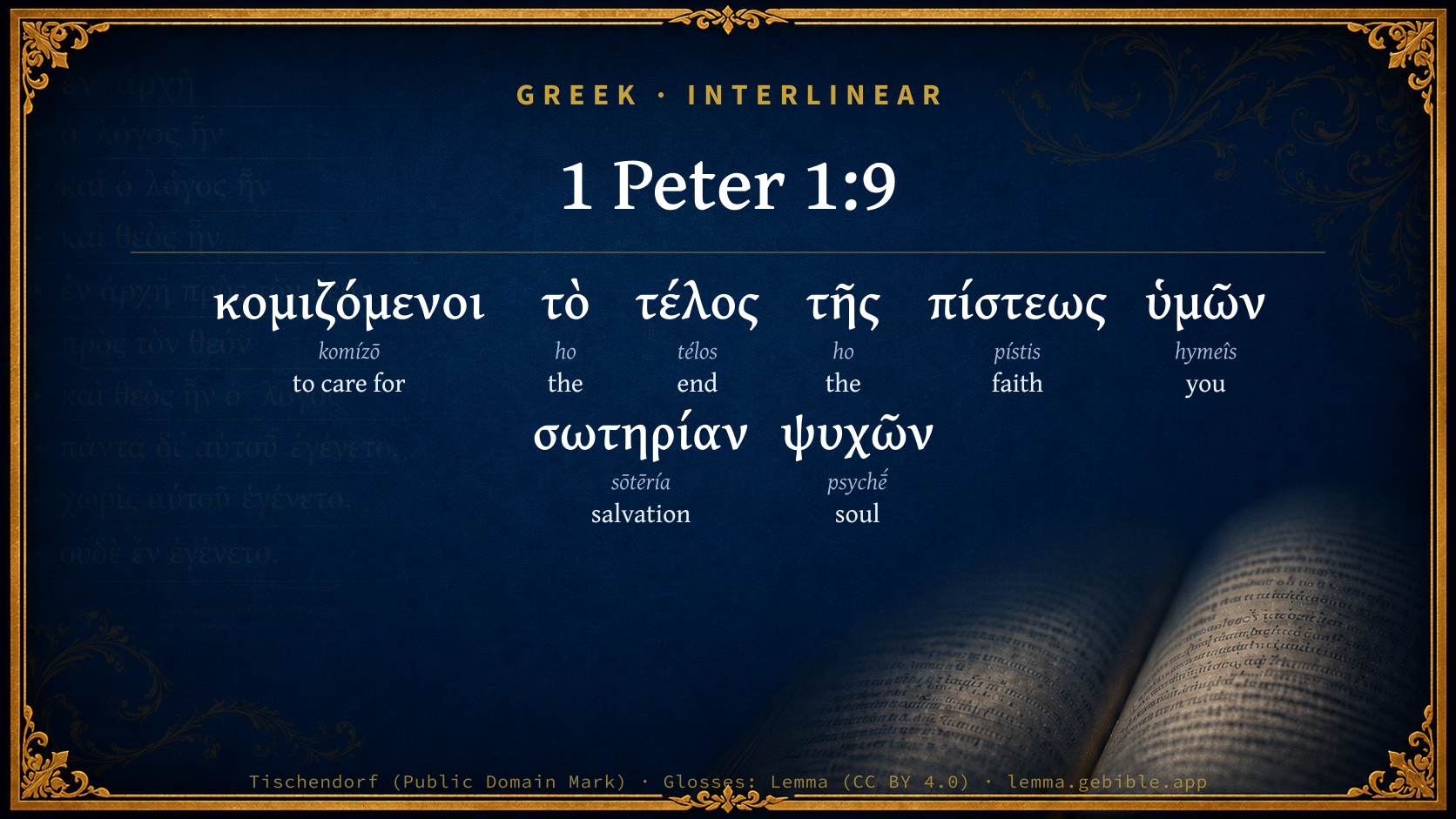
  1. τὸ ho G3588 “the” Article, Accusative, Singular, Neuter
  2. τέλος télos G5056 “end” Noun, Accusative, Singular, Neuter
  3. τῆς ho G3588 “the” Article, Genitive, Singular, Feminine
  4. πίστεως pístis G4102 “faith” Noun, Genitive, Singular, Feminine
  5. ὑμῶν hymeîs G5210 “you” Personal pronoun, 2nd person, Genitive, Plural
  6. σωτηρίαν sōtēría G4991 “salvation” Noun, Accusative, Singular, Feminine
  7. ψυχῶν psychḗ G5590 “soul” Noun, Genitive, Plural, Feminine

About this verse

These counts appear in no published source. They are computed here, from the morphology-tagged text and Lemma’s own curated glosses. What Lemma adds →

8
words
7
distinct lemmas
General Epistles
section

Notable vocabulary

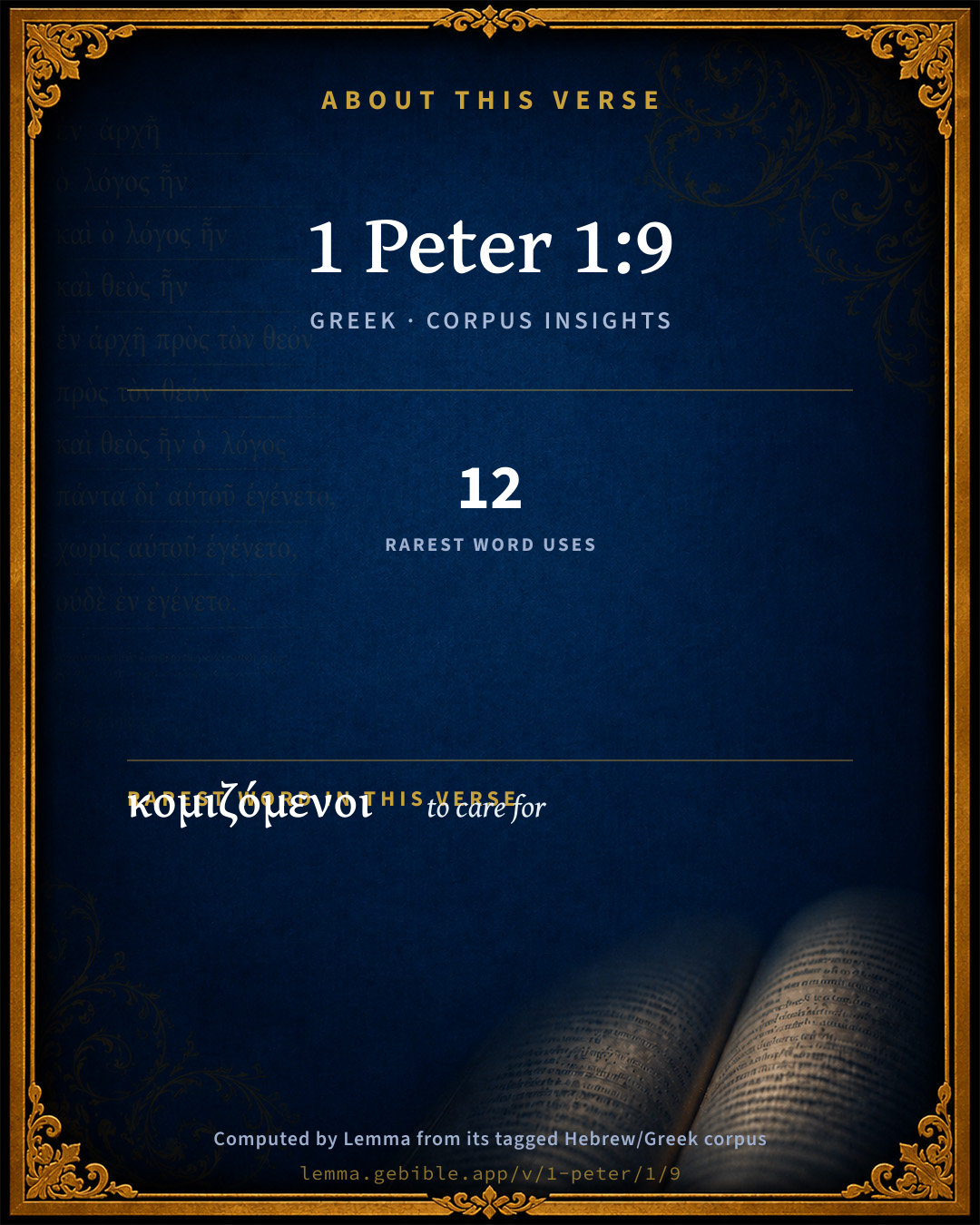
The rarest word here is κομιζόμενοι to care for G2865 — appearing just 12 times in the whole Greek New Testament.

Shared distinctive vocabulary

κομιζόμενοι to care for G2865 occurs in 12 verses of the Greek New Testament. Also found in:

Repetition

A word recurs within this verse:

Cross-references

3

Topical passages linked to 1 Peter 1:9 in the Treasury of Scripture Knowledge — connected by theme and wording, ordered by reader-vote popularity; previews shown in the World English Bible.

  • Romans 6:22 But now, being made free from sin, and having become servants of God, you have your fruit of sanctification, and the result of eternal life.
  • James 1:21 Therefore, putting away all filthiness and overflowing of wickedness, receive with humility the implanted word, which is able to save your souls.
  • Hebrews 11:13 These all died in faith, not having received the promises, but having seen them and embraced them from afar, and having confessed that they were strangers and pilgrims on the earth.

Cross-references courtesy of OpenBible.info (CC BY 4.0).

Commentary

Notes on 1 Peter 1:9 from classic Christian and Jewish commentators (each source and its license shown beneath its notes). The classic Christian expositions comment on the surrounding passage and are grouped to its opening verse, so a note may address several verses; the Jewish commentaries on the Tanakh (Rashi and others) are per-verse, so they appear only where the commentator wrote on this verse.

Lemma curates 59 commentaries, every one of them public domain or Creative Commons licensed, each selected and text-cleaned for this edition rather than reprinted as found. About our sources →

Tyndale Open Study Notes

Tyndale Open Resources

1:9 salvation of your souls: The Greek word translated souls often refers to the whole person and not just to some part or aspect of the person (Matt 20:28; Mark 8:35). Salvation affects our whole person, not the inner person only.

Tyndale Open Study Notes — © Tyndale Open Resources, licensed CC BY-SA 4.0. Text via the HelloAO Bible API.

Bengel's Gnomon

Johann Albrecht Bengel

1Pe 1:9. Κομιζόμενοι, receiving) now, at present.—τῆς πίστεως, of faith) 1Pe 1:8.—ψυχῶν, of your souls) It is the soul especially which is saved: the body shares in the resurrection.

Bengel's Gnomon of the New Testament — English translation (T&T Clark, Edinburgh, 1860) — public domain. Text from a community e-Sword module.

Meyer's Critical & Exegetical Commentary

Heinrich August Wilhelm Meyer

1Pe_1:9. κομιζόμενοι τὸ τέλος κ.τ.λ.] gives the reason of that joy; the participle links itself simply on to ἀγαλλιᾶσθε, inasmuch as ye obtain, etc., and supplies confirmation that what is here spoken of is not present, but future joy. It is arbitrary to interpret, with de Wette and Brückner: inasmuch as ye are destined to obtain; or with Steiger: inasmuch as even now in foretaste ye obtain. Joined with the future present ἀγαλλιᾶσθε, the participle must also be in the present.[67] Cf. with this passage, more especially chap. 1Pe_5:4.

ΚΟΜΊΖΕΙΝ: obtain (cf. chap. 1Pe_5:4), is in the N. T. frequently used of the obtaining of what will be assigned to man at the last judgment; 2Pe_2:13; 2Co_5:10; Eph_6:8; Col_3:25. Steinmeyer incorrectly explains the word: secum portare.

τὸ τέλος, not the reward = ΜΙΣΘΌς (Beza, Vorstius, etc.), neither is it the reward of victory (Hofmann);[68] but it is the end of faith, that to which it is directed; see Cremer, s.v.

τῆς πίστεως ὑμῶν] refers back to πιστεύοντες, 1Pe_1:8.

σωτηρίαν ψυχῶν] The salvation is indeed one already present; but here is meant the Christians completed salvation, of which they shall be partakers, ἐν καιρῷ ἐσχάτῳ (1Pe_1:5).

On ψυχῶν, Bengel remarks: anima praecipue salvatur: corpus in resurrectione participat; cf. Jam_1:21; Joh_12:25; Luk_21:19.

[67] Winer, in the 5th ed. (p. 403), gives the same interpretation as de Wette; in the 6th (p. 306 [E. T. 429]) and the 7th (p. 330), on the other hand: as receiving (they are that already in the assurance of faith). Schott: since ye are about to, or on the way to, gather in(!) like a harvest the end of your faith. Schott is clearly wrong when he asserts that if the apostle had had the future joy in his mind, he must have written κομισάμενοι on account of the δεδοξασμένῃ, because the attaining of the end of salvation, which is still in the act of being accomplished, could not be placed parallel with the final glorification which has already taken place, since there is nothing unreasonable in the idea that the joy of the Christians is glorified when they receive the end of their salvation.

[68] The expression κομίζειν indeed shows that Peter pictured to himself the τέλος of faith as a trophy, but not that τέλος literally means: trophy.

Meyer — Critical and Exegetical Commentary on the New Testament — English translation by Peter Christie, edited by Frederick Crombie (T&T Clark, 1880) — public domain. Text from a community e-Sword module.

Expositor's Greek Testament

ed. W. Robertson Nicoll

1Pe 1:9 . The connexion with mention of persecution suggests that the writer is here thinking of the saying, in your patience ye shall win your souls and perhaps also of the contrast between the persecuton who has only power over the body. Whatever happen to the body the conclusion the consummation of their faith is assured them. κομιζόμενοι implies that already they are receiving what is due to them ( cf. 1Pe 5:4 ) and therefore they rejoice with Hannah in God the Saviour. In the Attic Orators who use a refined form of colloquial Greek the verb is common in the sense of recovering debts, as in Mat 25:27 , ἐκομισάμην ἂν τὸ ἐμόν . St. Paul applies it to future recompense (2Co 5:10 , ἵνα κομίσηται ἕκαστος τὰ διὰ τοῦ σώματος ; Eph 6:8 ; Col 3:25 ; cf. 2Ma 8:33 , τὸν ἄξιον τῆς δυσσεβείας ἐκομίσατο μισθόν ); in Heb 3:4 , it is used of receiving promises. τὸ τέλος . The common meaning fulfilment or consummation gives a fair sense but the connection with κομιζόμενοι is thus somewhat strange. The parallel of 1Pe 1:4 , taken with Pindar, Ol. x(xi.) 81, Δόρυκλος δʼ ἔφερε πυγμᾶς τέλος , suggests as a possible rendering because ye receive the reward . The Septuagint, again (Num 31:28 , etc.), uses τ . to translate מבס = proportion to be paid, tax . And this use is well established in Greek literature for τὰ τέλη , cf. λυσιτελεῖν , etc. Accordingly Suidas defines τέλος as τὸ διδόμενον τοῖς βασιλεῦσι . The particular connotations can hardly be pressed here but these uses give some colour of support to the Syriac rendering recompense and the mercedem of Augustine; cf. Rom 6:22 . σωτηρίαν ψυχῶν ͂ = σωτηρίαν above. ψυχῶν is added to console the readers for their sufferings in accordance with Mar 8:35 , ὃς δʼ ἂν ἀπολέσει τὴν ψυχὴν αὐτοῦ ἕνεκεν τοῦ εὐαγγελίου σώσει αὐτήν = Joh 12:25 ; cf. Luk 21:19 ; Jas 1:21 . The soul for St. Peter is the self or personality as for Jesus Himself.

The Expositor's Greek Testament, edited by W. Robertson Nicoll (1897–1910) — public domain. Text from a community e-Sword module.

Cambridge Greek Testament for Schools and Colleges

9. κομιζόμενοι. The middle voice denotes either receiving back a possession, Mat 25:27, or receiving a promised gift, Heb 10:36; Heb 11:39, and probably Heb 11:19, that Abraham received his long promised son figuratively out of death because his own body and that of Sarah were “as good as dead,” or receiving a reward earned, 2Co 5:10; Eph 6:8; Col 3:25; 1Pe 5:4.

So here by faith in the long prepared σωτηρία Christians do receive already some of the blessings of that σωτηρία which is the goal of that faith—namely, the deliverance, the passage from death into life of man’s true self, the divine life or soul of which his bodily life is but the image.

τῆς πίστεως. The insertion of the article does not necessarily mean “your faith” nor “the Faith” in the sense of the doctrines of the Christian Faith, although the faith which is implied certainly means Christian faith in God’s mercy through Christ.

A noun in the genitive governed by another noun bearing an article generally takes the article. But τῆς πίστεως in 1Pe 1:7; 1Pe 1:9 may refer back to διὰ πίστεως in 1Pe 1:5 = the above-named faith; cf. Rom 3:29, ἐκ πίστεως … διὰ τῆς πίστεως; Jas 2:14-15, πίστιν … ἡ πίστις.

Cambridge Greek Testament for Schools and Colleges (Cambridge University Press, 1896; 21 vols, various authors incl. Carr, Maclear, Plummer, Farrar, Lumby, Moule, M. R. James, Simcox) — public domain. Text from a community e-Sword module.

Geneva Bible (1599)

Geneva Bible translators

Or, reward.

Geneva Bible (1599) marginal notes — public domain. Text via Bolls.life.

Jamieson, Fausset & Brown

Robert Jamieson, A. R. Fausset & David Brown

Receiving--in sure anticipation; "the end of your faith," that is, its crowning consummation, finally completed "salvation" (Peter here confirms Paul's teaching as to justification by faith): also receiving now the title to it and the first-fruits of it. In Pe1 1:10 the "salvation" is represented as already present, whereas "the prophets" had it not as yet present. It must, therefore, in this verse, refer to the present: Deliverance now from a state of wrath: believers even now "receive salvation," though its full "revelation" is future.

of . . . souls--The immortal soul was what was lost, so "salvation" primarily concerns the soul; the body shall share in redemption hereafter; the soul of the believer is saved already: an additional proof that "receiving . . . salvation" is here a thing present.

Jamieson, Fausset & Brown — Commentary Critical and Explanatory on the Whole Bible (1871) — public domain (CC PDM 1.0). Text via the HelloAO Bible API.

Adam Clarke's Commentary

Verse 9. Receiving the end of your faith] Ye are put in possession of the salvation of your souls, which was the thing presented to your faith, when ye were called by the Gospel of Christ. Your faith has had a proper issue, and has been crowned with a proper recompense. The word τελος, end, is often used so as to imply the issue or reward of any labour or action.

Salvation of your souls.] The object of the Jewish expectations in their Messiah was the salvation or deliverance of their bodies from a foreign yoke; but the true Messiah came to save the soul from the yoke of the devil and sin. This glorious salvation these believers had already received.

Adam Clarke's Commentary on the Bible (1810–1826) — public domain. Text from a community e-Sword/MySword module.

John Calvin's Commentaries

9 Receiving the end of your faith He reminds the faithful where they ought to direct all their thoughts, even to eternal salvation. For this world holds all our affections ensnared by is allurements; this life and all things belonging to the body are great impediments, which prevent us from applying our minds to the contemplation of the future and spiritual life. Hence the Apostle sets before us this future life as a subject of deep meditation, and he indirectly intimates that the loss of all other things is to be deemed as nothing, provided our souls be saved. By saying receiving, he takes away all doubt, in order that they might more cheerfully go on, being certain of obtaining salvation. In the meantime, however, he shews what the end of faith is, lest they should be over-anxious, because it is as yet deferred. For our adoption ought now to satisfy us; nor ought we to ask to be introduced before the time into the possession of our inheritance. We may also take the end for reward; but the meaning would be the same. For we learn from the Apostle’s words, that salvation is not otherwise obtained than by faith; and we know that faith leans on the sole promise of gratuitous adoption; but if it be so, doubtless salvation is not owing to the merits of works, nor can it be hoped for on their account.

But why does he mention souls only, when the glory of a resurrection is promised to our bodies? As the soul is immortal, salvation is properly ascribed to it, as Paul sometimes is wont to speak, —

“That the soul may be saved in the day of the Lord.” (1 Corinthians 5:5.)

But it is the same as though he had said “Eternal salvation.” For there is an implied comparison between it and the mortal and fading life which belongs to the body. At the same time, the body is not excluded from a participation of glory when annexed to the soul.

John Calvin's Commentaries (1540-1563) — public domain. Text from the Calvin Translation Society English edition (1840s-50s) via the Christian Classics Ethereal Library (ccel.org). Calvin's coverage is partial (roughly two-thirds of the Bible); uncommented books and verses are honest gaps, never fabricated. The 19th-century editor's footnotes and remarks are omitted so the notes are faithfully Calvin's own voice.

Ellicott's Commentary for English Readers

(9) Receiving the end of your faith.—The “end of our faith” means, the object to which our faith is directed, the thing we believed for. And “faith” catches up the “believing” of last verse, so that, in reading, the accent of the sentence falls on “end,” not on “faith;” and the whole clause is added to justify the statement that we rejoice with a joy which has already attained its full perfection. The reason is, he says, because we receive already, in the present life, the object of all this trusting without sight; we need not wait till the next world to attain our glorification.

The salvation of your souls.—It might be simply, salvation of souls, including other men’s besides our own, but the context is against it, and the absence of articles is characteristic of St. Peter. It seems at first sight not a very exalted object for our faith to work to, the deliverance, or safety, of our own souls. And yet our Lord fully recognises the instinct of the higher self-preservation as that to which the ultimate appeal must be made (Mat_16:25-26). He could give His own soul a ransom for many (Mat_20:28); He could save others and not Himself (Mat_27:42); St. Paul could wish himself accursed from Christ for his brethren’s sake, “that they might be saved” (Rom_9:3; Rom_10:1); Moses could ask to be “blotted out of the book” (Exo_32:32); and yet the fact remains, that in seeking our own welfare, in the highest sense, we are fulfilling a primal law of our being, imposed upon us by the Creator. We are bound to make that our first object, if it were only to gratify Him who has no pleasure in the death of him that dieth, even if we could possibly divest ourselves of all “selfish” interest in the matter.

“A charge to keep I have,

A God to glorify;

A never-dying soul to save,

And fit it for the sky.”

The Buddhist longing for Nirvana is as far as possible removed from the healthy spirit of Christianity. “Salvation” here seems to have widened its meaning since 1Pe_1:5; while there the main thought was final deliverance from the afflictions of life, here the salvation is said to be received in the very midst of all these afflictions. The addition of the word “souls,” appears to make the difference. For the soul, there is present salvation, because persecutions, &c., do not touch it, and it is capable of the most complete emancipation from the evils of sin (Mat_1:21; Luk_1:69; Luk_1:71; Luk_1:75; Rom_6:14; Rom_7:24-25.) Salvation, then, is the restoration of man to the ideal excellence from which he was fallen: it contains—here, at any rate—no allusion to “damnation” as an opposite.

A Bible Commentary for English Readers, edited by Charles John Ellicott (1878–1897) — public domain. Text from a community e-Sword module.

The Cambridge Bible for Schools and Colleges

gen. ed. J. J. S. Perowne

9. receiving the end of your faith] The question has been raised whether these words refer to the present or the future. It has been urged on the one hand that the word for “receiving” applied in 2Co_5:10, and perhaps in Heb_10:36, Eph_6:8, to the ultimate issue of God’s judgment, excludes the former. On the other hand, it may be replied that it is arbitrary to limit the last two passages to the final judgment, and that the tense both of “rejoice” and “receiving” is definitely present. On the whole therefore there is no adequate reason against taking the words in their natural and obvious meaning. Those to whom the Apostle wrote were thought of as already receiving, very really, though not, it might be, in its ultimate fulness, that which was the “end” or “goal” of their faith, and that goal was found in the “salvation” of their “souls”—the deliverance of their moral being (in this instance the word includes “spirit,” though elsewhere it is distinguished from it) from the burden of guilt, the sense of condemnation, the misery and discord of alienation from God.

The Cambridge Bible for Schools and Colleges (gen. ed. J. J. S. Perowne; Cambridge University Press, 1878–1918) — public domain. Text from a community e-Sword module.

John Gill's Exposition

Receiving the end of your faith, even the salvation of your souls. Which is a just and sufficient ground of joy and rejoicing. "Salvation" intends spiritual and eternal salvation; that which God appointed his people to from all eternity, which is obtained by Christ, applied by the Spirit, and will be fully enjoyed in heaven: this is the salvation "of souls": which are of more worth than a world; and the redemption of which is precious, and requires a great price, and for which a great price is paid, as in Pe1 1:18. It is rightly supplied in our version by "your", as in the Syriac, Arabic, and Ethiopic versions; though the Vulgate Latin version only reads, "the salvation of souls"; and which is to be understood, not to the exclusion of bodies, for God has designed the salvation of them; and Christ has procured the redemption of them; and these will be preserved unto the coming of Christ, being united to him; and will be raised by him, and with their souls enjoy everlasting happiness with him; though, in the present state of things, salvation rather takes place in the soul than in the body, which is exposed to various labours, afflictions, and diseases; but the chief design of the phrase is, to distinguish this salvation from a corporeal and temporal one: and so the Jews use the phrase , "the salvation of the soul" (z), in opposition to, and distinction from, a mere bodily one; and it intends a salvation from sin, Satan, the law, and its curses; from hell, the second death, and wrath to come, and every spiritual enemy: which is the end of faith; or, as the Syriac version renders it, "the reward of faith"; not that faith is the cause of salvation, or meritorious of it; for that itself is the gift of God, and is rather a part of salvation, and, at most, but the means of perceiving an interest in it, and of enjoying the comfort of it; and is what will issue in it, and in the full enjoyment of it; when faith will both have its end and scope, and be at an end, being exchanged for fruition; just as a reward is given at the end of a man's labours: hence it is called "the end", Pro 23:18 and even now salvation is the end of faith, in like sense as Christ is the end of the law: as the law has its full accomplishment, and all its ends answered in Christ, so faith has its end, and all it looks for, desires, and wants, in salvation by Christ: and which is now "receiving"; for the saints not only shall receive, and enjoy the full possession of it hereafter, but they have it now; it is not only appointed to them, and wrought out for them, but is brought near, set before them, and applied to them, and put into the hands of faith by the Spirit of God; they have it in faith and hope, by which they are already saved; and in Christ their head and representative, in whom they are set down in heavenly places; and besides, they have the beginning, firstfruits, earnest, and pledge of it in their own hearts, as well as a right unto, and a meetness for the perfect possession of it hereafter; all which is matter of joy unspeakable, and full of glory,

(z) Tzeror Hammor, fol. 168. 4.

John Gill's Exposition of the Whole Bible (1746–1763) — public domain (CC PDM 1.0). Text via the HelloAO Bible API.

Trapp's Complete Commentary

John Trapp

9 Receiving the end of your faith, even the salvation of your souls.

Ver. 9. The end of your faith] The period and perfection, the reward and meed of it, in all fulness. See Psa 19:12; Pro 22:4. Some grapes of Canaan God gave them beforehand, to sustain them, not to satisfy them.

John Trapp, A Commentary or Exposition upon All the Books of the Old and New Testament (1647–1656) — public domain. Text from a community e-Sword module.

Albert Barnes' Notes on the Bible

Receiving the end of your faith, even the salvation of your souls - The result or object of your faith; that is, what your faith is designed and adapted to secure. Compare the notes at Rom 10:4. The word rendered receiving is used here as indicating that they would surely obtain that. They even now had such peace and joy in believing, that it furnished undoubted evidence that they would be saved; and such that it might be said that even now they were saved. The condition of one who is a true Christian here is so secure that it may even now be called salvation.

Albert Barnes' Notes on the Bible (1834–1885) — public domain. Text from a community e-Sword/MySword module.

Matthew Poole's English Annotations

Receiving; either this word is to be taken improperly, and by an enallage, the future being put for the present tense; q.d. Being about to receive; or rather properly, in the present tense, and then it intimates the certainty of the thing spoken of.

The end of your faith; i.e. the scope to which faith tends, or the reward of faith.

The salvation; either:

1. Salvation more generally taken, which is begun in this life, Eph 2:8; Tit 3:5; or rather:

2. Complete final salvation in the other, as 1Pe 1:5; and then the sense is, either, ye rejoice that ye shall certainly receive the full salvation of your souls, or, ye rejoice that ye do receive that salvation, viz. in the promises of it, in those graces of the Spirit wrought in you, which begin this salvation, and are the pledges of it, and in the certain assurance of it.

Of your souls; i.e. by a usual synecdoche, the salvation of your persons.

Matthew Poole's English Annotations on the Holy Bible (1683–1685) — public domain. Text from a community e-Sword/MySword module.

Whedon's Commentary on the Bible

Daniel D. Whedon

9. Receiving… salvation—A present salvation, testified to by the renewing Holy Spirit. It differs from that in 1Pe_1:5 only in degree. This saves now—that in the day of judgment; this saves from sin, its guilt and power—that “from wrath” and hell, (Rom_5:9;) this saves the soul— that saves both soul and body; this is salvation begun—that is salvation finished forever.

Daniel D. Whedon (gen. ed.), Commentary on the Old and New Testaments (1874–1909) — public domain. Text from a community e-Sword module.

The Pulpit Commentary

Receiving the end of your faith, even the salvation of your souls. The present participle "receiving" (komizomenoi) implies that the believer realizes the deep blessing of salvation gradually while he is being saved as one of oiJ swzomenoi. (Act_2:47) Salvation is present as well as future. "By grace ye are saved through faith"; (Eph_2:8) "According to his mercy he saved us". (Tit_3:5) God"s elect receive it in various measures now; in its blessed fullness it will be manifested hereafter. It is the end which faith ever holds in view, pressing towards it as the prize of the high calling. It is the salvation especially of souls; for, as Bengel says," Anima praecipue salvatur; corpus in resurreetione participat.

Vers. 9-12.

Soul-salvation.

The thought of soul-salvation in these verses is at once deeper and broader than that contained in ver. 5 of this chapter. There it was mainly deliverance from evil, and deliverance from evil of the individual soul. Here there is the reaching a blessed destiny, and that by many.

I THE GREAT WORTH OF SOUL-SALVATION. This is seen:

1. From the illustrious beings interested in it.

(1) Prophets.

(2) Angels.

(3) Apostles.

(4) The Holy Spirit.

From this it follows, first, that soul-salvation is no modern invention, it was known to ancient prophets; no mean conception, it was the theme of exalted angels; no obscure dream, it was proclaimed by well-known apostles; no earth-born scheme, it was a revelation of the Holy Spirit. But the worth of soul-salvation is seen:

2. By our knowledge of the Savior by whom salvation came. Christ is Christianity. The Savior is the revelation of the worth of salvation.

(1) In his sufferings (Ver. 11).

(2) In his following glories (Ver. 11):

his conquest of temptation; his resurrection; his ascension; his triumphs by his Church; the restitution of all things.

II THE GRADUAL DEVELOPMENT OF THE REVELATION OF SOUL-SALVATION. It has dawned upon us who now have its noontide brightness, just as every day brightens to noon gradually. In this passage we are reminded how it was:

1. Predicted. By prophets who were taught

1. gradually and separately;

2. often unconsciously; but

3. divinely. We have it as:

4. Fully declared. It was plainly "announced" and is widely "preached.

III THE SIMPLE MEANS OF ATTAINING SOUL-SALVATION. "Faith" (Ver. 9). Salvation is the thing we trust for, and to which trust tends. It is not only assent of the mind, though it is that. Nor only consent of the heart, though it is also that. But it is response of the will. "Believe, and be saved. U.R.T.

The Pulpit Commentary (1880–1919), ed. H.D.M. Spence-Jones & Joseph S. Exell — public domain. Text from a community e-Sword module.

John Wesley's Explanatory Notes

Receiving - Now already. Salvation - From all sin into all holiness, which is the qualification for, the forerunner and pledge of, eternal salvation.

John Wesley, Explanatory Notes Upon the Whole Bible (1754–1765) — public domain. Text via the GEBible commentary corpus.

Scofield Reference Notes

C. I. Scofield

salvation

(See Scofield "Rom 1:16").

The Scofield Reference Bible (1917 edition), notes by C. I. Scofield — public domain. Text from a community e-Sword module.

Burkitt's Expository Notes on the New Testament

William Burkitt

Observe, 1. The end, that is, the reward, of a Christian’s faith; it is the salvation of his soul; of his soul eminently, but not exclusively, of body and soul both. The complete salvation of soul and body both with Christ in heaven, shall be the end and reward of the believer’s faith.

Observe, 2. The diligent search into, and enquiry after, the nature of this salvation, which was made by the prophets of the Old Testament: Of which salvation the prophets have enquired and searched diligently; that is, by prayer, meditation, and study, they searched after the farther and clearer knowledge of this great salvation, and the kingdom of the Messiah, when should be the time of his sufferings and humiliation, which were to precede his glory and exaltation.

Observe, 3. The success of this their enquiry and search: they were answered by God, and received this revelation from him, that they themselves were not the men that should see the Messiah, and his special kingdom; and that the things which they prophesied of, were not to be fulfilled in their own times, but in after-times; and accordingly the things foretold by the prophets, he assures them, were clearly manifested to them by the apostles, who were endowed with an extraordinary measure of the Holy Spirit, sent down upon them at the day of Pentecost: Unto whom it was revealed, that not unto themselves, but unto us, they did minister the things now reported unto you.

Observe, lastly, The sublimity and transcendant excellency of those gospel mysteries which are now revealed; they are so ravishing and transporting, that the holy angels desire to pry into them: Which things the angels desire to look into.

Learn thence, That the glorious mystery of man’s redemption and salvation, by the incarnation of our Lord Jesus Christ, is an object worthy of the adoring angels. They admire the person of the Redeemer, they admire the author and contriver of the work of redeemption, they admire the subjects redeemed, the admire the manner and method of our redemption, they admire the finally glorious state which the redeemed are brought into, and possessed of, and they pry into these things, as the cherubims looked upon the ark, with a curious and accurate inspection, with an earnest and affectionate inspection; they holily admire the wisdom of this glorious contrivance, though even their raised and enlarged capacities can never be able fully to comprehend it.

William Burkitt's Expository Notes on the New Testament (1700–1703) — public domain. Text from a community e-Sword module.

The People's New Testament

B. W. Johnson

9. The end of your faith. The object of the gospel, “the faith,” and of their faith was salvation.

B. W. Johnson's The People's New Testament with Notes (1889–1891) — public domain. Electronic text from the Christian Classics Ethereal Library (CCEL) ThML edition.

Alford’s Greek Testament

Henry Alford

9.] receiving (the word κομιζόμενοι quite forbids the sense of ‘present realizing:’ in every one of the reff. it betokens the ultimate reception of glory or condemnation from the Lord. Here it is, ‘receiving (pres.) as you then, in a blessed eternity, will be receiving’) the end of your faith (that, to which your faith ultimately looked forward: see, besides reff. Rom 6:21, Rom 6:22. Cf. Æschyl. Choeph. 874, μάχης γὰρ δὴ κεκύρωται τέλος), salvation of (your) souls (the great inclusive description of future blessedness: the ψυχή being the central personality of the man. See reff.).

Henry Alford, The Greek Testament (1849–1861) — public domain. Text from a community e-Sword module.

Lesson kit

Teaching starters — assembled from the data on this page, not authored interpretation. Every prompt links to the verse data it draws on. Edit before teaching.

1 Peter, in the General Epistles, opens this verse with 8 words (7 distinct Greek lemmas). Its most distinctive word is komízō (“to care for”). A historical commentator’s framing appears above. Read the whole chapter for the surrounding context.

Discussion questions

  1. What does “to care for” (komízō) contribute to the verse as a whole?
  2. How does Matthew 25:27, which shares the word «to care for», read alongside this verse?
  3. What does the repetition of “the” (2× in this one verse) do in this verse?
  4. These translations render this verse differently; the difference is in the English rendering, not the original. What questions does that raise?
  5. Compare how Tyndale Open Study Notes and Bengel's Gnomon read this verse. Where do they agree or differ?

Things to notice

  • These translations choose different wording for 5 words in this verse.
  • “the” occurs 2× in this single verse.
  • 7 distinct Greek lemmas span 8 words in this verse.

Reading settings

Reading text

Shown beneath each verse's original-language words.

Old Testament
Old Testament edition

Read the OT as the Masoretic Hebrew (MT) or the Greek Septuagint (LXX).

English shown for the Greek Septuagint (in the Hebrew ↔ Greek comparison).

Comparing translations? Open the Compare panel on any verse page to stack up to four side by side.