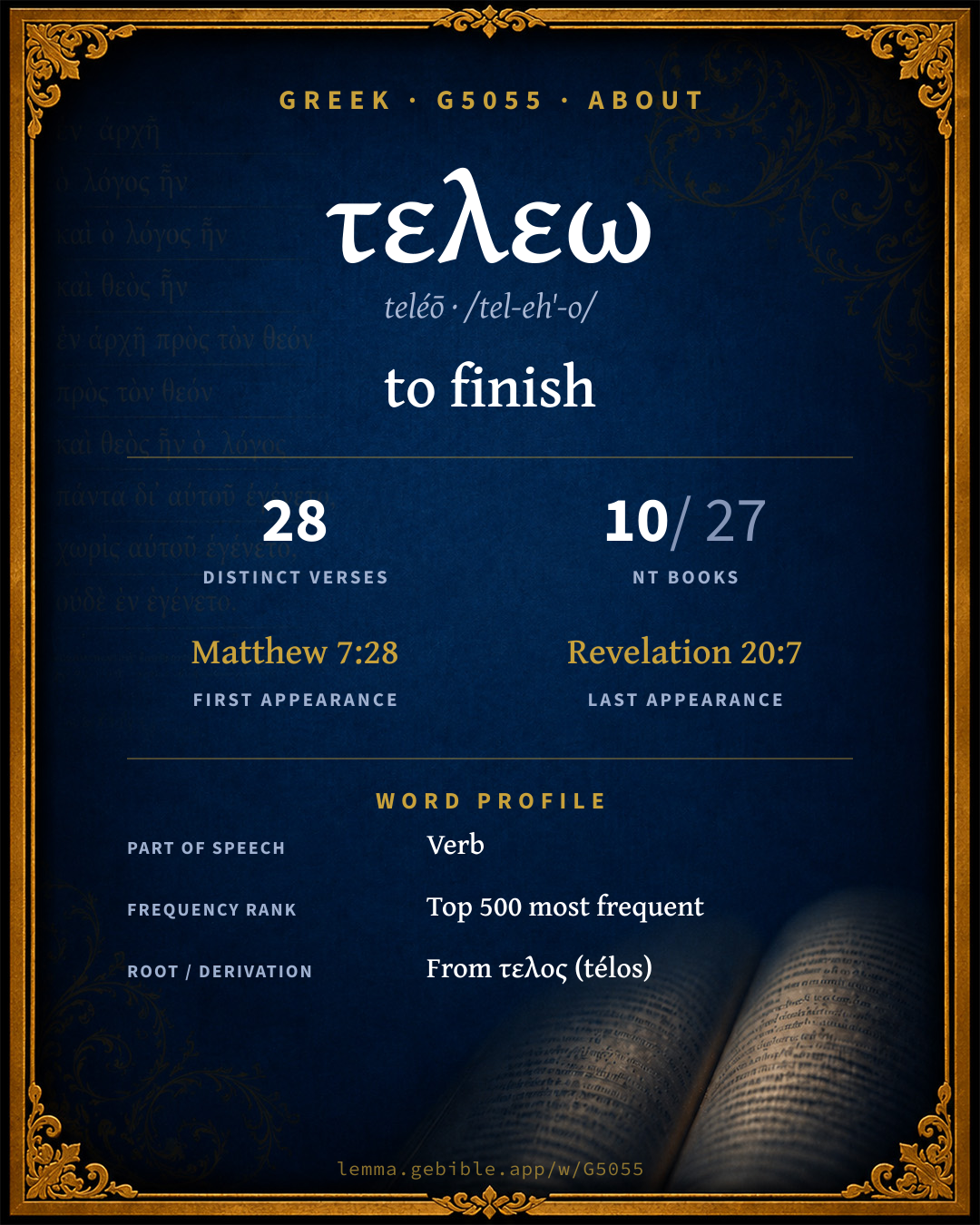
τελέω
to finish
‘to finish’ is one of 3 main senses fuller range ↓
Full lexicon entry — Thayer's Greek Lexicon
From Thayer's Greek Lexicon
Where this word appears
See every Aorist-tense verb in the Greek New Testament →
Grammar key — what these labels mean
Part of speech
- Verb
- An action or state-of-being word.
Tense
- Aorist
- Action viewed as a simple whole, without regard to duration — often past (perfective aspect).
- Present
- Ongoing or general action in present time (imperfective aspect).
- Perfect
- A completed past action with continuing present results.
- Future
- Action expected in future time.
Voice
- Active
- The subject performs the action.
- Passive
- The subject receives the action.
Mood
- Indicative
- States a fact or asks a factual question (the mood of reality).
- Subjunctive
- Expresses probability, purpose, or possibility (the mood of contingency).
- Infinitive
- A verbal noun (“to write”), unmarked for person or number.
- Participle
- A verbal adjective (“writing,” “having written”).
Case
- Nominative
- The case of the subject (and the predicate nominative).
Person
- 3rd person
- The one spoken about (“he / she / it / they”).
- 2nd person
- The one addressed (“you”).
- 1st person
- The speaker (“I / we”).
Gender
- Feminine
- Grammatically feminine.
Number
- Singular
- One.
- Plural
- More than one.
Grammatical forms 16 distinct
- Verb, Aorist, Active, Indicative, 3rd person, Singular 5 times (18%)
- Verb, Aorist, Passive, Subjunctive, 3rd person, Singular 4 times (14%)
- Verb, Aorist, Active, Indicative, 3rd person, Plural 2 times (7%)
- Verb, Aorist, Active, Subjunctive, 2nd person, Plural 2 times (7%)
- Verb, Aorist, Passive, Indicative, 3rd person, Singular 2 times (7%)
- Verb, Present, Active, Indicative, 2nd person, Plural 2 times (7%)
- Verb, Perfect, Passive, Indicative, 3rd person, Singular 2 times (7%)
- Verb, Aorist, Active, Subjunctive, 3rd person, Plural 1 time (4%)
+8 more forms (8 occurrences)
Parsed forms decoded from the imported morphology (Robinson–Tischendorf, public domain), counted across 28 parsed occurrences — not distinct verses.
Every verse where G5055 appears — 28 distinct verses across 10 books. Click any verse to open its interlinear word-by-word view. Verse text shown in the World English Bible for context — . Each verse’s Greek form is shown with its reference; the English is not keyword-highlighted, since the data carries no word-level English alignment. Use “Compare translations” on any verse to read it across multiple English versions. This concordance covers the Greek New Testament; Septuagint (Greek Old Testament) occurrences of this word are not indexed here.
Matthew 7 verses
- Matthew 7:28 ἐτέλεσεν aor act ind 3sg It happened, when Jesus had finished saying these things, that the multitudes were astonished at his teaching,
- Matthew 10:23 τελέσητε aor act subj 2pl But when they persecute you in this city, flee into the next, for most assuredly I tell you, you will not have gone through the cities of Israel, until the Son of Man has come.
- Matthew 11:1 ἐτέλεσεν aor act ind 3sg It happened that when Jesus had finished directing his twelve disciples, he departed from there to teach and preach in their cities.
- Matthew 13:53 ἐτέλεσεν aor act ind 3sg It happened that when Jesus had finished these parables, he departed from there.
- Matthew 17:24 τελεῖ pres act ind 3sg When they had come to Capernaum, those who collected the didrachma coins came to Peter, and said, "Doesn't your teacher pay the didrachma?"
- Matthew 19:1 ἐτέλεσεν aor act ind 3sg It happened when Jesus had finished these words, he departed from Galilee, and came into the borders of Judea beyond the Jordan.
- Matthew 26:1 ἐτέλεσεν aor act ind 3sg It happened, when Jesus had finished all these words, that he said to his disciples,
Luke 4 verses
- Luke 2:39 ἐτέλεσαν aor act ind 3pl When they had accomplished all things that were according to the law of the Lord, they returned into Galilee, to their own city, Nazareth.
- Luke 12:50 τελεσθῇ aor pass subj 3sg But I have a baptism to be baptized with, and how distressed I am until it is accomplished!
- Luke 18:31 τελεσθήσεται fut pass ind 3sg He took the twelve aside, and said to them, "Behold, we are going up to Jerusalem, and all the things that are written through the prophets concerning the Son of Man will be completed.
- Luke 22:37 τελεσθῆναι aor pass inf For I tell you that this which is written must still be fulfilled in me: 'He was counted with the lawless.' For that which concerns me has an end."
John 2 verses
- John 19:28 τετέλεσται perf pass ind 3sg After this, Jesus, seeing that all things were now finished, that the Scripture might be fulfilled, said, "I am thirsty."
- John 19:30 τετέλεσται perf pass ind 3sg When Jesus therefore had received the vinegar, he said, "It is finished." He bowed his head, and gave up his spirit.
Acts 1 verse
Romans 2 verses
- Romans 2:27 τελοῦσα pres act ptcp nom sg fem Won't the uncircumcision which is by nature, if it fulfills the law, judge you, who with the letter and circumcision are a transgressor of the law?
- Romans 13:6 τελεῖτε pres act ind 2pl For this reason you also pay taxes, for they are ministers of God's service, attending continually on this very thing.
2 Corinthians 1 verse
Galatians 1 verse
2 Timothy 1 verse
James 1 verse
Revelation 8 verses
- Revelation 10:7 ἐτελέσθη aor pass ind 3sg but in the days of the voice of the seventh angel, when he is about to sound, then the mystery of God is finished, as he declared to his servants, the prophets.
- Revelation 11:7 τελέσωσιν aor act subj 3pl When they have finished their testimony, the beast that comes up out of the abyss will make war with them, and overcome them, and kill them.
- Revelation 15:1 ἐτελέσθη aor pass ind 3sg I saw another great and marvelous sign in the sky: seven angels having the seven last plagues, for in them God's wrath is finished.
- Revelation 15:8 τελεσθῶσιν aor pass subj 3pl The temple was filled with smoke from the glory of God, and from his power. No one was able to enter into the temple, until the seven plagues of the seven angels would be finished.
- Revelation 17:17 τελεσθήσονται fut pass ind 3pl For God has put in their hearts to do what he has in mind, and to be of one mind, and to give their kingdom to the beast, until the words of God should be accomplished.
- Revelation 20:3 τελεσθῇ aor pass subj 3sg and cast him into the abyss, and shut it, and sealed it over him, that he should deceive the nations no more, until the thousand years were finished. After this, he must be freed for a short time.
- Revelation 20:5 τελεσθῇ aor pass subj 3sg The rest of the dead didn't live until the thousand years were finished. This is the first resurrection.
- Revelation 20:7 τελεσθῇ aor pass subj 3sg And after the thousand years, Satan will be released from his prison,
About this entry
At a glance — auto-summarized from this page’s data, not written by a person. Every figure links to its source below. This summary describes the numbers; it doesn’t interpret them.
τελεω — transliterated teléō — is a Greek verb carrying the sense “to finish.” Its earliest occurrence is Matthew 7:28. It appears 28 verses across 10 books of the Greek New Testament, among its moderately common vocabulary. More than a quarter of its appearances fall in Revelation. Thayer's distinguishes 3 senses for it. Each statement above links to its evidence; the full detail follows below.
Gloss history
Strong's 1890 vs modern scholarship

About this word
Strong's G5055 catalogs a Greek word from the Greek New Testament.
These counts are not copied from any lexicon or concordance. They are computed here, from the morphology-tagged Greek New Testament. What Lemma adds →
- 28
- distinct verses
- The word appears in 28 distinct verses.
- 10 / 27
- NT books
- The word appears in 10 of 27 New Testament books.
- #485
- by frequency
- Top 500 most frequent Greek words (rank 485 of 5,347 Greek words by occurrence).
View all 28 occurrences in the concordance →
Most concentrated in
- Revelation 8 verses 29%
- Matthew 7 verses 25%
- Luke 4 verses 14%
By section of the New Testament
By traditional corpus
Conventional, traditional groupings — biblical authorship is debated, so this is a traditional corpus grouping, not an authorship claim. Some books belong to more than one corpus (Luke is in both the Gospels and the Lukan corpus, and so on), so these shares overlap and need not total 100%. Each figure is a share of the word’s 28 distinct verses.
- Gospels 13 verses · 46%
- Johannine 10 verses · 36%
- Revelation 8 verses · 29%
- Lukan (Luke–Acts) 5 verses · 18%
- Pauline corpus 5 verses · 18%
- General (Catholic) Epistles 1 verse · 4%
How translations render this word
Counts come from each version’s own published word-to-Strong’s tagging or interlinear alignment — an approximate guide to how each version renders this word, not a word-level alignment the data otherwise carries. Because each total is that version’s own tagged count, the per-version totals vary from one another and need not match the appearance or distinct-verse counts above. These counts may also differ from a printed concordance because Lemma counts each distinctly tagged rendering and does not collapse phrase taggings into a single head-word total. This is a fixed set of word-tagged versions (KJV, ASV, BSB, ULT) and does not change with the reading translation you choose elsewhere. Each version’s license is shown beside its name below (and on Sources).
- King James Version: Had finished 3×, Be accomplished 2×, Fulfil 2×
- American Standard Version: Had finished 4×, Is finished 3×, Should be finished 3×
- Berean Standard Bible: Had finished 4×, Were complete 2×, Will be fulfilled 2×
- unfoldingWord Literal Text: Had finished 3×, They had completed 2×, Were ended 2×
King James Version Public Domain
Renders G5055 across 30 tagged occurrences — most commonly:
Plus 21 renderings that appear only once — usually multi-word phrases or single function words the recovered tagging swept in, not distinct renderings.
American Standard Version Public Domain
Renders G5055 across 29 tagged occurrences — most commonly:
Plus 15 renderings that appear only once — usually multi-word phrases or single function words the recovered tagging swept in, not distinct renderings.
Berean Standard Bible Public Domain
Renders G5055 across 28 tagged occurrences — most commonly:
Plus 20 renderings that appear only once — usually multi-word phrases or single function words the recovered tagging swept in, not distinct renderings.
unfoldingWord Literal Text CC BY-SA 4.0
Renders G5055 across 32 tagged occurrences — most commonly:
Plus 23 renderings that appear only once — usually multi-word phrases or single function words the recovered tagging swept in, not distinct renderings.
Senses in Thayer's
The 3 senses Thayer's distinguishes for this word, in lexicon order (not ranked by frequency or importance). The full entry — with sub-senses — is in the Lexicon Entry tab.
- to bring to a close, to finish, to end
- to perform, execute, complete, fulfil, (so that the thing done corresponds to what has been said, the order, command…
- of tribute "It is finished or paid" John 19:30
Word origin
Derived from τελος (télos) (G5056) — end.
From G5056 ; to end that is complete execute conclude discharge (a debt): - accomplish make an end expire fill up finish go over pay perform.
— Strong’s Exhaustive Concordance (1890), public domain.
Forms in the corpus
The 16 distinct written forms G5055 takes in the Greek New Testament, most frequent first — each parse links to that tense’s occurrences in the concordance.
Same root — word family
Other Thayer's entries built from the same root as G5055, grouped by Strong’s listed origin. These share a root / origin per the lexicon — not necessarily a shared meaning. Each links to that word’s own entry.
Derives from
Shares the same root
- τελειος téleios G5046 perfect
- τελεσφορεω telesphoréō G5052 to mature
- τελωνης telṓnēs G5057 tax collector
- τηλαυγως tēlaugōs G5081 from afar clearly
- τολμαω tolmáō G5111 to dare
Derived from this word
Compare all same-root words → Showing 4 of 8 — not the complete family. They share a root, not necessarily a meaning.
Septuagint usage
The same Greek word τελεω appears 14 times in the Greek Old Testament (Septuagint), across 14 verses in 6 books.
- 14
- LXX occurrences
- Tagged occurrences of this Greek word in the Septuagint.
- 14
- verses
- Distinct Septuagint verses containing this word.
- 6 / 39
- OT books
- The word appears in 6 of the 39 Old Testament books.
Sample Septuagint occurrences
- Numbers 25:3 τελέω
- Ruth 2:21 τελέω
- Ezra 1:1 τελέω
- Psalms 105:28 τελέω
- Daniel 4:26 τελέω
- Hosea 4:14 τελέω
Septuagint occurrences (same lexeme)
Every verse where the same Strong’s number (G5055) appears in the Greek Septuagint. Verse text shown in the World English Bible for context; the Greek form is the matched word — the English is not keyword-highlighted.
- Numbers 25:3 τελέω Israel joined himself to Baal Peor: and the anger of Yahweh was kindled against Israel.
- Numbers 25:5 τελέω Moses said to the judges of Israel, Kill you everyone his men who have joined themselves to Baal Peor.
- Ruth 2:21 τελέω Ruth the Moabitess said, Yes, he said to me, You shall keep fast by my young men, until they have ended all my harvest.
- Ruth 3:18 τελέω Then said she, "Sit still, my daughter, until you know how the matter will fall; for the man will not rest, until he has finished the thing this day."
- Ezra 1:1 τελέω Now in the first year of Cyrus king of Persia, that the word of Yahweh by the mouth of Jeremiah might be accomplished, Yahweh stirred up the spirit of Cyrus king of Persia, so that he made a proclamation throughout all his kingdom, and [put it] also in writing, saying,
- Ezra 5:16 τελέω Then came the same Sheshbazzar, and laid the foundations of the house of God which is in Jerusalem: and since that time even until now has it been in building, and yet it is not completed.
- Ezra 6:15 τελέω This house was finished on the third day of the month Adar, which was in the sixth year of the reign of Darius the king.
- Ezra 7:12 τελέω Artaxerxes, king of kings, to Ezra the priest, the scribe of the law of the God of heaven, perfect and so forth.
- Ezra 9:1 τελέω Now when these things were done, the princes drew near to me, saying, The people of Israel, and the priests and the Levites, have not separated themselves from the peoples of the lands, [doing] according to their abominations, even of the Canaanites, the Hittites, the Perizzites, the Jebusites, the Ammonites, the Moabites, the Egyptians, and the Amorites.
- Ezra 10:17 τελέω They made an end with all the men who had married foreign women by the first day of the first month.
- Ezra 16:15 τελέω
- Psalms 105:28 τελέω He sent darkness, and made it dark. They didn't rebel against his words.
- Daniel 4:26 τελέω Whereas they commanded to leave the stump of the roots of the tree; your kingdom shall be sure to you, after that you shall have known that the heavens do rule.
- Hosea 4:14 τελέω I will not punish your daughters when they play the prostitute, Nor your brides when they commit adultery; Because the men consort with prostitutes, And they sacrifice with the shrine prostitutes; And the people that does not understand will come to ruin.
These are occurrences of the same Greek lexeme (G5055) in the Septuagint — not a translation of any one Hebrew word. The store carries no word-level Hebrew↔Greek alignment, so no Hebrew original is asserted here. Counts come from the recovered LXX Strong's tagging — high-frequency vocabulary is well covered, while rare or late forms may be untagged — so they reflect tagged occurrences and may slightly undercount.