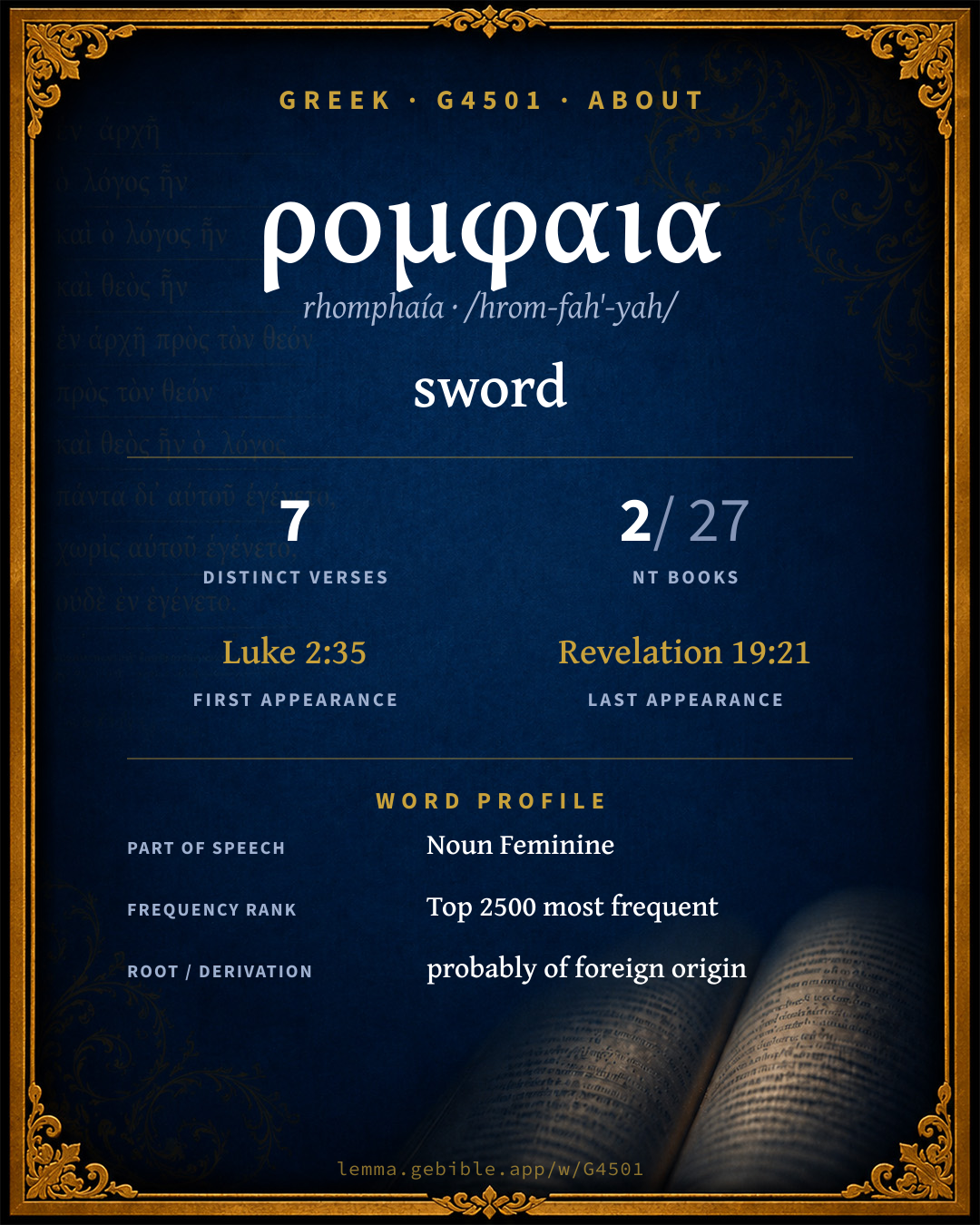
ῥομφαία
sword
‘sword’ is one of 2 main senses fuller range ↓
Full lexicon entry — Thayer's Greek Lexicon
From Thayer's Greek Lexicon
Where this word appears
See every Dative-case word in the Greek New Testament →
Grammar key — what these labels mean
Part of speech
- Noun
- A naming word — a person, place, thing, or idea.
Case
- Dative
- The case of the indirect object, means, or location — “to / for / with / in.”
- Nominative
- The case of the subject (and the predicate nominative).
- Accusative
- The case of the direct object and of extent.
Gender
- Feminine
- Grammatically feminine.
Number
- Singular
- One.
2 verses where G4501 appears in the Nominative case in the Book of Revelation. Filtered view — show all forms. Click any verse to open its interlinear word-by-word view. Verse text shown in the World English Bible for context — . Each verse’s Greek form is shown with its reference; the English is not keyword-highlighted, since the data carries no word-level English alignment. Use “Compare translations” on any verse to read it across multiple English versions. This concordance covers the Greek New Testament; Septuagint (Greek Old Testament) occurrences of this word are not indexed here.
Revelation
- Revelation 1:16 ῥομφαία n nom sg fem He had seven stars in his right hand. Out of his mouth proceeded a sharp two-edged sword. His face was like the sun shining at its brightest.
- Revelation 19:15 ῥομφαία n nom sg fem Out of his mouth proceeds a sharp, double-edged sword, that with it he should strike the nations. He will rule them with a rod of iron. He treads the winepress of the fierceness of the wrath of God, the Almighty.
About this entry
At a glance — auto-summarized from this page’s data, not written by a person. Every figure links to its source below. This summary describes the numbers; it doesn’t interpret them.
At its core, ρομφαια (rhomphaía) means “sword.” Its uses cluster heavily in Revelation (86% of all occurrences). With 7 verses in 2 books, it is an uncommon word in the Greek New Testament. Scripture first uses it in Luke 2:35. Ranging over 2 senses, it is not a single-sense word. Each statement above links to its evidence; the full detail follows below.
Gloss history
Strong's 1890 vs modern scholarship
About this word
Strong's G4501 catalogs a Greek word from the Greek New Testament.
These counts are not copied from any lexicon or concordance. They are computed here, from the morphology-tagged Greek New Testament. What Lemma adds →
- 7
- distinct verses
- The word appears in 7 distinct verses.
- 2 / 27
- NT books
- The word appears in 2 of 27 New Testament books.
- #1,358
- by frequency
- Top 2500 most frequent Greek words (rank 1,358 of 5,347 Greek words by occurrence).
View all 7 occurrences in the concordance →
Most concentrated in
- Revelation 6 verses 86%
- Luke 1 verse 14%
By section of the New Testament
By traditional corpus
Conventional, traditional groupings — biblical authorship is debated, so this is a traditional corpus grouping, not an authorship claim. Some books belong to more than one corpus (Luke is in both the Gospels and the Lukan corpus, and so on), so these shares overlap and need not total 100%. Each figure is a share of the word’s 7 distinct verses.
- Johannine 6 verses · 86%
- Revelation 6 verses · 86%
- Gospels 1 verse · 14%
- Lukan (Luke–Acts) 1 verse · 14%
How translations render this word
Counts come from each version’s own published word-to-Strong’s tagging or interlinear alignment — an approximate guide to how each version renders this word, not a word-level alignment the data otherwise carries. Because each total is that version’s own tagged count, the per-version totals vary from one another and need not match the appearance or distinct-verse counts above. These counts may also differ from a printed concordance because Lemma counts each distinctly tagged rendering and does not collapse phrase taggings into a single head-word total. This is a fixed set of word-tagged versions (KJV, ASV, BSB, ULT) and does not change with the reading translation you choose elsewhere. Each version’s license is shown beside its name below (and on Sources).
- King James Version: Sword 7×
- American Standard Version: Sword 7×
- Berean Standard Bible: Sword 7×
- unfoldingWord Literal Text: Sword 7×, A 2×
King James Version Public Domain
Renders G4501 across 7 tagged occurrences — most commonly:
American Standard Version Public Domain
Renders G4501 across 8 tagged occurrences — most commonly:
Plus 1 rendering that appears only once — usually multi-word phrases or single function words the recovered tagging swept in, not distinct renderings.
Berean Standard Bible Public Domain
Renders G4501 across 7 tagged occurrences — most commonly:
unfoldingWord Literal Text CC BY-SA 4.0
Renders G4501 across 9 tagged occurrences — most commonly:
Senses in Thayer's
The 2 senses Thayer's distinguishes for this word, in lexicon order (not ranked by frequency or importance). The full entry — with sub-senses — is in the Lexicon Entry tab.
- a large sword
- properly a long Thracian javelin, also a kind of long sword wont to be worn on the right shoulder
Word origin
Origin: probably of foreign origin
Probably of foreign origin; a sabre that is a long and broad cutlass (any weapon of the kind literally or figuratively): - sword.
— Strong’s Exhaustive Concordance (1890), public domain.
Forms in the corpus
The 3 distinct written forms G4501 takes in the Greek New Testament, most frequent first — each parse links to that case’s occurrences in the concordance.
| Form | Parsing | Example | Uses |
|---|---|---|---|
| ῥομφαία rhomphaía | Noun, Nominative, Singular, Feminine | Luke 2:35 | 3 |
| ῥομφαίᾳ rhomphaía | Noun, Dative, Singular, Feminine | Revelation 2:16 | 3 |
| ῥομφαίαν rhomphaían | Noun, Accusative, Singular, Feminine | Revelation 2:12 | 1 |
Septuagint usage
The same Greek word ρομφαια appears 205 times in the Greek Old Testament (Septuagint), across 189 verses in 27 books.
- 205
- LXX occurrences
- Tagged occurrences of this Greek word in the Septuagint.
- 189
- verses
- Distinct Septuagint verses containing this word.
- 27 / 39
- OT books
- The word appears in 27 of the 39 Old Testament books.
Sample Septuagint occurrences
- Genesis 3:24 ῥομφαία
- Exodus 5:21 ῥομφαία
- Numbers 22:23 ῥομφαία
- Joshua 5:13 ῥομφαία
- Judges 1:8 ῥομφαία
- 1 Samuel 2:33 ῥομφαία
- 2 Samuel 1:12 ῥομφαία
- 1 Kings 1:51 ῥομφαία
- 2 Kings 3:23 ῥομφαία
- 1 Chronicles 10:4 ῥομφαία
- 2 Chronicles 20:9 ῥομφαία
- Ezra 9:7 ῥομφαία
Septuagint occurrences (same lexeme)
Every verse where the same Strong’s number (G4501) appears in the Greek Septuagint — showing the first 50 of 189. Verse text shown in the World English Bible for context; the Greek form is the matched word — the English is not keyword-highlighted.
- Genesis 3:24 ῥομφαία So he drove out the man; and he placed Cherubs at the east of the garden of Eden, and the flame of a sword which turned every way, to guard the way to the tree of life.
- Exodus 5:21 ῥομφαία and they said to them, "May Yahweh look at you, and judge, because you have made us a stench to be abhorred in the eyes of Pharaoh, and in the eyes of his servants, to put a sword in their hand to kill us."
- Exodus 32:27 ῥομφαία He said to them, "Thus says Yahweh, the God of Israel, 'Every man put his sword on his thigh, and go back and forth from gate to gate throughout the camp, and every man kill his brother, and every man his companion, and every man his neighbor."
- Numbers 22:23 ῥομφαία The donkey saw the angel of Yahweh standing in the way, with his sword drawn in his hand; and the donkey turned aside out of the way, and went into the field: and Balaam struck the donkey, to turn her into the way.
- Numbers 31:8 ῥομφαία They killed the kings of Midian with the rest of their slain: Evi, and Rekem, and Zur, and Hur, and Reba, the five kings of Midian: Balaam also the son of Beor they killed with the sword.
- Joshua 5:13 ῥομφαία It happened, when Joshua was by Jericho, that he lifted up his eyes and looked, and, behold, there stood a man over against him with his sword drawn in his hand: and Joshua went to him, and said to him, Are you for us, or for our adversaries?
- Joshua 6:21 ῥομφαία They utterly destroyed all that was in the city, both man and woman, both young and old, and ox, and sheep, and donkey, with the edge of the sword.
- Joshua 8:24 ῥομφαία It happened, when Israel had made an end of killing all the inhabitants of Ai in the field, in the wilderness in which they pursued them, and they were all fallen by the edge of the sword, until they were consumed, that all Israel returned to Ai, and struck it with the edge of the sword.
- Joshua 24:12 ῥομφαία I sent the hornet before you, which drove them out from before you, even the two kings of the Amorites; not with your sword, nor with your bow.
- Judges 1:8 ῥομφαία The children of Judah fought against Jerusalem, and took it, and struck it with the edge of the sword, and set the city on fire.
- Judges 1:25 ῥομφαία He shown them the entrance into the city; and they struck the city with the edge of the sword; but they let the man go and all his family.
- Judges 4:15 ῥομφαία Yahweh confused Sisera, and all his chariots, and all his host, with the edge of the sword before Barak; and Sisera alighted from his chariot, and fled away on his feet.
- Judges 4:16 ῥομφαία But Barak pursued after the chariots, and after the host, to Harosheth of the Gentiles: and all the host of Sisera fell by the edge of the sword; there was not a man left.
- Judges 7:14 ῥομφαία His fellow answered, This is nothing else save the sword of Gideon the son of Joash, a man of Israel: into his hand God has delivered Midian, and all the host.
- Judges 7:20 ῥομφαία The three companies blew the trumpets, and broke the pitchers, and held the torches in their left hands, and the trumpets in their right hands with which to blow; and they cried, The sword of Yahweh and of Gideon.
- Judges 7:22 ῥομφαία They blew the three hundred trumpets, and Yahweh set every man's sword against his fellow, and against all the host; and the host fled as far as Beth-shittah toward Zererah, as far as the border of Abel Meholah, by Tabbath.
- Judges 8:10 ῥομφαία Now Zebah and Zalmunna were in Karkor, and their hosts with them, about fifteen thousand men, all who were left of all the host of the children of the east; for there fell one hundred twenty thousand men who drew sword.
- Judges 8:20 ῥομφαία He said to Jether his firstborn, Up, and kill them. But the youth didn't draw his sword; for he feared, because he was yet a youth.
- Judges 9:54 ῥομφαία Then he called hastily to the young man his armor bearer, and said to him, Draw your sword, and kill me, that men not say of me, A woman killed him. His young man thrust him through, and he died.
- Judges 18:27 ῥομφαία They took that which Micah had made, and the priest whom he had, and came to Laish, to a people quiet and secure, and struck them with the edge of the sword; and they burnt the city with fire.
- Judges 19:29 ῥομφαία When he was come into his house, he took a knife, and laid hold on his concubine, and divided her, limb by limb, into twelve pieces, and sent her throughout all the borders of Israel.
- Judges 20:2 ῥομφαία The chiefs of all the people, even of all the tribes of Israel, presented themselves in the assembly of the people of God, four hundred thousand footmen who drew sword.
- Judges 20:15 ῥομφαία The children of Benjamin were numbered on that day out of the cities twenty-six thousand men who drew the sword, besides the inhabitants of Gibeah, who were numbered seven hundred chosen men.
- Judges 20:17 ῥομφαία The men of Israel, besides Benjamin, were numbered four hundred thousand men who drew sword: all these were men of war.
- Judges 20:25 ῥομφαία Benjamin went forth against them out of Gibeah the second day, and destroyed down to the ground of the children of Israel again eighteen thousand men; all these drew the sword.
- Judges 20:35 ῥομφαία Yahweh struck Benjamin before Israel; and the children of Israel destroyed of Benjamin that day twenty-five thousand one hundred men: all these drew the sword.
- Judges 20:37 ῥομφαία The liers-in-wait hurried, and rushed on Gibeah; and the liers-in-wait drew themselves along, and struck all the city with the edge of the sword.
- Judges 20:46 ῥομφαία So that all who fell that day of Benjamin were twenty-five thousand men who drew the sword; all these [were] men of valor.
- Judges 20:48 ῥομφαία The men of Israel turned again on the children of Benjamin, and struck them with the edge of the sword, both the entire city, and the cattle, and all that they found: moreover all the cities which they found they set on fire.
- Judges 21:10 ῥομφαία The congregation sent there twelve thousand men of the most valiant, and commanded them, saying, Go and strike the inhabitants of Jabesh Gilead with the edge of the sword, with the women and the little ones.
- 1 Samuel 2:33 ῥομφαία The man of yours, [whom] I shall not cut off from my altar, [shall be] to consume your eyes, and to grieve your heart; and all the increase of your house shall die in the flower of their age.
- 1 Samuel 13:19 ῥομφαία Now there was no smith found throughout all the land of Israel; for the Philistines said, Lest the Hebrews make them swords or spears:
- 1 Samuel 13:22 ῥομφαία So it came to pass in the day of battle, that there was neither sword nor spear found in the hand of any of the people who were with Saul and Jonathan: but with Saul and with Jonathan his son was there found.
- 1 Samuel 14:20 ῥομφαία Saul and all the people who were with him were gathered together, and came to the battle: and, behold, every man's sword was against his fellow, [and there was] a very great confusion.
- 1 Samuel 15:8 ῥομφαία He took Agag the king of the Amalekites alive, and utterly destroyed all the people with the edge of the sword.
- 1 Samuel 15:33 ῥομφαία Samuel said, As your sword has made women childless, so shall your mother be childless among women. Samuel hewed Agag in pieces before Yahweh in Gilgal.
- 1 Samuel 17:19 ῥομφαία Now Saul, and they, and all the men of Israel, were in the valley of Elah, fighting with the Philistines.
- 1 Samuel 17:25 ῥομφαία The men of Israel said, Have you seen this man who is come up? surely to defy Israel is he come up: and it shall be, that the man who kills him, the king will enrich him with great riches, and will give him his daughter, and make his father's house free in Israel.
- 1 Samuel 17:27 ῥομφαία The people answered him after this manner, saying, So shall it be done to the man who kills him.
- 1 Samuel 17:31 ῥομφαία When the words were heard which David spoke, they rehearsed them before Saul; and he sent for him.
- 1 Samuel 21:9 ῥομφαία The priest said, The sword of Goliath the Philistine, whom you killed in the valley of Elah, behold, it is here wrapped in a cloth behind the ephod: if you will take that, take it; for there is no other except that here. David said, There is none like that; give it me.
- 1 Samuel 21:10 ῥομφαία David arose, and fled that day for fear of Saul, and went to Achish the king of Gath.
- 1 Samuel 22:10 ῥομφαία He inquired of Yahweh for him, and gave him food, and gave him the sword of Goliath the Philistine.
- 1 Samuel 22:13 ῥομφαία Saul said to him, Why have you conspired against me, you and the son of Jesse, in that you have given him bread, and a sword, and have inquired of God for him, that he should rise against me, to lie in wait, as at this day?
- 1 Samuel 22:19 ῥομφαία Nob, the city of the priests, struck he with the edge of the sword, both men and women, children and nursing babies, and oxen and donkeys and sheep, with the edge of the sword.
- 1 Samuel 25:13 ῥομφαία David said to his men, Gird you on every man his sword. They girded on every man his sword; and David also girded on his sword: and there went up after David about four hundred men; and two hundred abode by the baggage.
- 1 Samuel 31:4 ῥομφαία Then said Saul to his armor bearer, Draw your sword, and thrust me through therewith, lest these uncircumcised come and thrust me through, and abuse me. But his armor bearer would not; for he was sore afraid. Therefore Saul took his sword, and fell on it.
- 1 Samuel 31:5 ῥομφαία When his armor bearer saw that Saul was dead, he likewise fell on his sword, and died with him.
- 2 Samuel 1:12 ῥομφαία and they mourned, and wept, and fasted until even, for Saul, and for Jonathan his son, and for the people of Yahweh, and for the house of Israel; because they were fallen by the sword.
- 2 Samuel 1:22 ῥομφαία From the blood of the slain, from the fat of the mighty, The bow of Jonathan didn't turn back, The sword of Saul didn't return empty.
These are occurrences of the same Greek lexeme (G4501) in the Septuagint — not a translation of any one Hebrew word. The store carries no word-level Hebrew↔Greek alignment, so no Hebrew original is asserted here. Counts come from the recovered LXX Strong's tagging — high-frequency vocabulary is well covered, while rare or late forms may be untagged — so they reflect tagged occurrences and may slightly undercount.