
1 Samuel 17:25

Hebrew (Westminster Leningrad Codex) 1 Samuel 17:25 appears in the Hebrew Old Testament. The text above is from the Westminster Leningrad Codex. Each word links to its Strong’s number, a concise gloss, and parsing drawn from the Open Scriptures Hebrew Bible morphology. Click any word for its full Brown-Driver-Briggs (BDB) entry.
Download image
Cite this verse

1 Samuel 17:25 (World English Bible). Public Domain. Lemma interlinear Bible study tool, https://lemma.gebible.app/v/1-samuel/17/25.

Show BibTeX & RIS
BibTeX
RIS
English Translation
The men of Israel said, Have you seen this man who is come up? surely to defy Israel is he come up: and it shall be, that the man who kills him, the king will enrich him with great riches, and will give him his daughter, and make his father's house free in Israel.
World English Bible · Public Domain
Download a study sheet

One document with this verse’s original text, its word-by-word gloss line, the meaning frame, cross-references with their text, attributed commentary, and full source and license credits — printable, and it pastes into notes with its structure intact.

This verse Autodidact and up

Study sheet (.html) Plain text (.txt)

A passage Seminary Student

Up to 50 verses in one chapter. A passage sheet keeps up to 6 commentary sources and 12 cross-references per verse, in the order this page ranks them, and says so on the sheet whenever that leaves anything out. Ask for a single verse and you get the Autodidact verse sheet above.

Everything on this page stays free to read, with no account — the sheet is a download of what is already on screen, not access to it.

Want to remove ads? Support Godless Engineer
Compare translations 3

The same verse in 3 English versions, stacked beneath the original-language interlinear above. Click any original word for its lexicon entry.

Each is an independent rendering of the whole verse — the interlinear is not word-aligned to these translations.

Highlighted words mark where these versions differ — a whole-verse word diff, not a word-by-word alignment.

  • World English Bible Public Domain
    The men of Israel said, Have you seen this man who is come up? surely to defy Israel is he come up: and it shall be, that the man who kills him, the king will enrich him with great riches, and will give him his daughter, and make his father's house free in Israel.
  • King James Version Public Domain
    And the men of Israel said, Have ye seen this man that is come up? surely to defy Israel is he come up: and it shall be, that the man who killeth him, the king will enrich him with great riches, and will give him his daughter, and make his father's house free in Israel.
  • unfoldingWord Literal Text CC BY-SA 4.0
    And the men of Israel said, “Have you seen this man coming up? Indeed coming up to taunt Israel! And it will be, the man who strikes him, the king will make him wealthy great wealth, and he will give his daughter to him, and he will make the house of his father free in Israel.”

unfoldingWord Literal Text — © unfoldingWord, licensed CC BY-SA 4.0. Word-aligned USFM3 via Door43 (git.door43.org/unfoldingWord/en_ult).

Versions to compare (up to 4)

3 of 4 selected

Show all 18 translations

Every available English version of this verse, each an independent rendering of the whole verse.

  • World English Bible Public Domain
    The men of Israel said, Have you seen this man who is come up? surely to defy Israel is he come up: and it shall be, that the man who kills him, the king will enrich him with great riches, and will give him his daughter, and make his father's house free in Israel.
  • Berean Standard Bible Public Domain
    Now the men of Israel had been saying, “Do you see this man who keeps coming out to defy Israel? To the man who kills him the king will give great riches. And he will give him his daughter in marriage and exempt his father’s house from taxation in Israel.”
  • Majority Standard Bible Public Domain
    Now the men of Israel had been saying, “Do you see how this man keeps coming out to defy Israel? To the man who kills him the king will give great riches. And he will give him his daughter in marriage and exempt his father’s house from taxation in Israel.”
  • King James Version Public Domain
    And the men of Israel said, Have ye seen this man that is come up? surely to defy Israel is he come up: and it shall be, that the man who killeth him, the king will enrich him with great riches, and will give him his daughter, and make his father's house free in Israel.
  • American Standard Version (1901) Public Domain
    And the men of Israel said, Have ye seen this man that is come up? surely to defy Israel is he come up: and it shall be, that the man who killeth him, the king will enrich him with great riches, and will give him his daughter, and make his father's house free in Israel.
  • Revised Version (1885) Public Domain
    And the men of Israel said, Have ye seen this man that is come up? surely to defy Israel is he come up: and it shall be, that the man who killeth him, the king will enrich him with great riches, and will give him his daughter, and make his father’s house free in Israel.
  • Geneva Bible (1599) Public Domain
    For euery man of Israel saide, Sawe yee not this man that commeth vp? euen to reuile Israel is he come vp: and to him that killeth him, wil the king giue great riches, and will giue him his daughter, yea, and make his fathers house free in Israel.
  • Douay-Rheims (1899) Public Domain
    And some one of Israel said: Have you seen this man that is come up, for he is come up to defy Israel. And the man that shall slay him, the king will enrich with great riches, and will give him his daughter, and will make his father's house free from tribute in Israel.
  • Young's Literal Translation Public Domain
    And the men of Israel say, `Have ye seen this man who is coming up? for, to reproach Israel he is coming up, and it hath been -- the man who smiteth him, the king doth enrich him with great riches, and his daughter he doth give to him, and his father's house doth make free in Israel.'
  • Literal Standard Version CC BY-SA 4.0
    And the men of Israel say, “Have you seen this man who is coming up? For he is coming up to reproach Israel, and it has been—the man who strikes him, the king enriches him with great riches, and he gives his daughter to him, and makes his father’s house free in Israel.”
  • Unlocked Literal Bible CC BY-SA 4.0
    The men of Israel said, “Have you seen this man who has come up? He has come to challenge Israel. The king will give great riches to the man who kills him, and he will give his daughter to him in marriage, and will make his father's house free from taxation in Israel.”
  • unfoldingWord Literal Text CC BY-SA 4.0
    And the men of Israel said, “Have you seen this man coming up? Indeed coming up to taunt Israel! And it will be, the man who strikes him, the king will make him wealthy great wealth, and he will give his daughter to him, and he will make the house of his father free in Israel.”
  • Darby Bible Public Domain
    And the men of Israel said, Have ye seen this man that comes up? for to defy Israel is he come up: and it shall be, that the man who smites him, him will the king enrich with great riches, and will give him his daughter, and make his father's house free in Israel.
  • World Messianic Bible Public Domain
    The men of Israel said, “Have you seen this man who has come up? He has surely come up to defy Israel. The king will give great riches to the man who kills him, and will give him his daughter, and will make his father’s house tax-free in Israel.”
  • Webster's Bible Public Domain
    And the men of Israel said, Have ye seen this man that hath come up? surely to defy Israel hath he come: and it shall be, that the man who shall kill him, the king will enrich him with great riches, and will give him his daughter, and make his father's house free in Israel.
  • Free Bible Version CC BY-SA 4.0
    “Have you seen this man who keeps on coming out to mock Israel?” they asked. “The king will make the man who kills him really rich. He will also give him his daughter in marriage, and his family will live tax-free in Israel.”
  • Bible in Basic English Public Domain
    And the men of Israel said, Have you seen this man? Clearly he has come out to put shame on Israel: and it is certain that if any man overcomes him, the king will give that man great wealth, and will give him his daughter, and make his father's family free in Israel.
  • JPS Tanakh (1917) Public Domain
    And the men of Israel said: 'Have ye seen this man that is come up? surely to taunt Israel is he come up; and it shall be, that the man who killeth him, the king will enrich him with great riches, and will give him his daughter, and make his father's house free in Israel.'

Literal Standard Version (2020), Covenant Press — licensed CC BY-SA 4.0. Text via the HelloAO Bible API (eBible.org). Unlocked Literal Bible (unfoldingWord) — licensed CC BY-SA 4.0. Text via the HelloAO Bible API (eBible.org). unfoldingWord Literal Text — © unfoldingWord, licensed CC BY-SA 4.0. Word-aligned USFM3 via Door43 (git.door43.org/unfoldingWord/en_ult). Free Bible Version, Dr. Jonathan Gallagher — licensed CC BY-SA 4.0. Text via the HelloAO Bible API (eBible.org).

Word by word

More ways to search: Search by grammar → Find every occurrence → Compare this word →

Practice this passage: Drill this verse → Learn its vocabulary →

יַעְשְׁרֶ֥נּוּ
ʻâshar
H6238
“to become rich · us”
Verb, Hiphil, Imperfect, 3rd Person, Masculine, Singular + Suffix, Personal, 1st Person, Common, Plural
Part of Speech
Verb
Stem
Hiphil
Form
Imperfect
Person
3rd Person
Gender
Masculine
Number
Singular
Full BDB Definition

Origin: a primitive root

TWOT: 1714

to be or become rich or wealthy, enrich, pretend to be rich - (Qal) to be or become rich - (Hiphil) - to make rich - to gain riches - (Hithpael) to enrich oneself, pretend to be rich
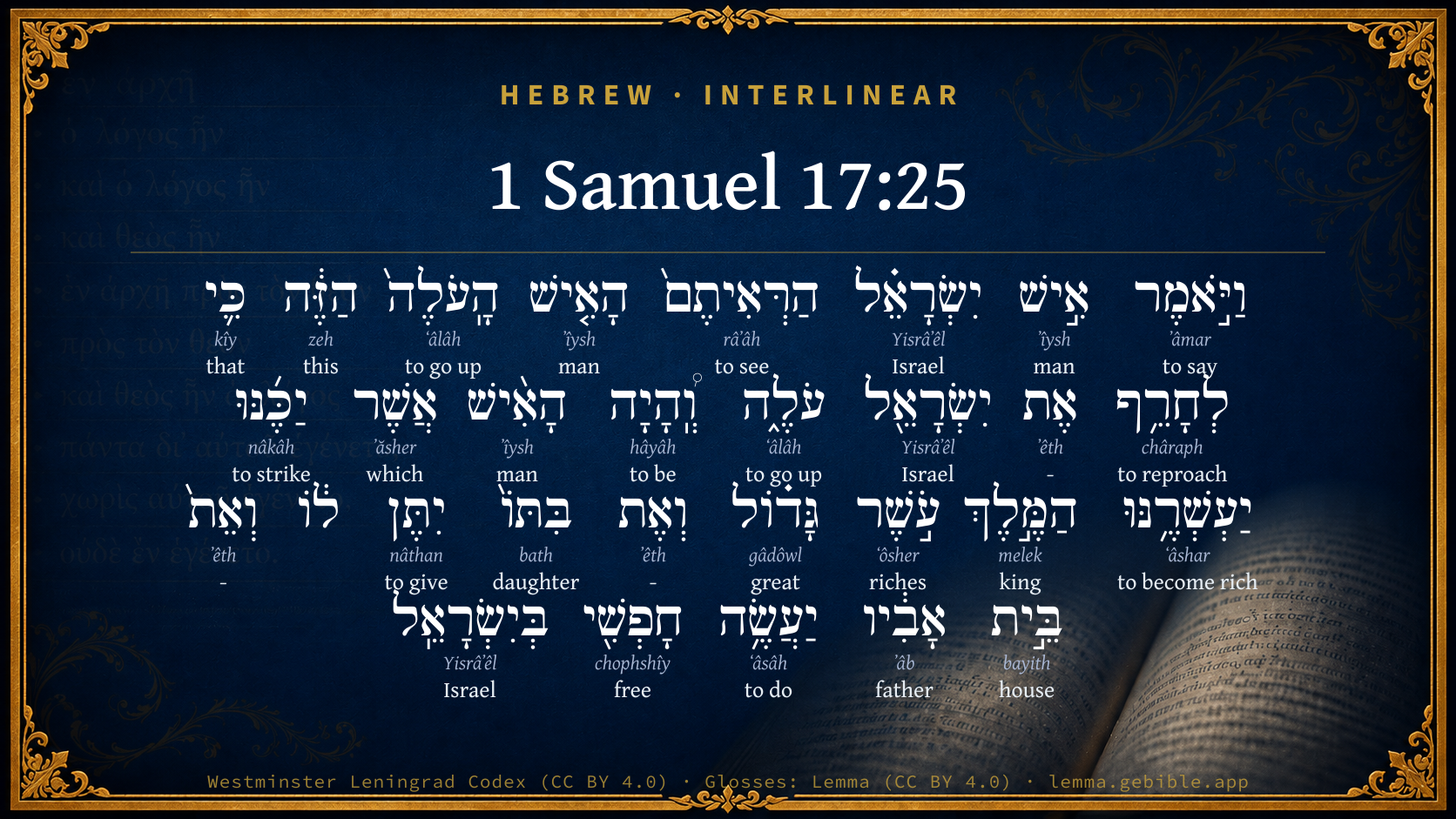
  1. וַיֹּ֣אמֶר ʼâmar H559 “and · to say” Conjunction + Verb, Qal, Sequential Imperfect, 3rd Person, Masculine, Singular
  2. אִ֣ישׁ ʼîysh H376 “man of” Noun, Common, Masculine, Singular, Construct
  3. יִשְׂרָאֵ֗ל Yisrâʼêl H3478 “Israel” Noun, Proper
  4. הַרְּאִיתֶם֙ râʼâh H7200 “to see” Particle, Interrogative + Verb, Qal, Perfect, 2nd Person, Masculine, Plural
  5. הָאִ֤ישׁ ʼîysh H376 “the · man” Particle, Definite Article + Noun, Common, Masculine, Singular, Absolute
  6. הָֽעֹלֶה֙ ʻâlâh H5927 “the · going up” Particle, Definite Article + Verb, Qal, Participle Active, Masculine, Singular, Absolute
  7. הַזֶּ֔ה zeh H2088 “the · this” Particle, Definite Article + Pronoun, Demonstrative, Masculine, Singular
  8. כִּ֛י kîy H3588 “that” Conjunction
  9. לְחָרֵ֥ף châraph H2778 “to reproach” Preposition + Verb, Piel, Infinitive Construct
  10. אֶת ʼêth H853 “-” Particle, Direct Object
  11. יִשְׂרָאֵ֖ל Yisrâʼêl H3478 “Israel” Noun, Proper
  12. עֹלֶ֑ה ʻâlâh H5927 “going up” Verb, Qal, Participle Active, Masculine, Singular, Absolute
  13. וְֽ֠הָיָה hâyâh H1961 “and · to be” Conjunction + Verb, Qal, Perfect, 3rd Person, Masculine, Singular
  14. הָאִ֨ישׁ ʼîysh H376 “the · man” Particle, Definite Article + Noun, Common, Masculine, Singular, Absolute
  15. אֲשֶׁר ʼăsher H834 “which” Particle, Relative
  16. יַכֶּ֜נּוּ nâkâh H5221 “to strike · him” Verb, Hiphil, Imperfect, 3rd Person, Masculine, Singular + Suffix, Personal, 3rd Person, Masculine, Singular
  17. הַמֶּ֣לֶךְ melek H4428 “the · king” Particle, Definite Article + Noun, Common, Masculine, Singular, Absolute
  18. עֹ֣שֶׁר ʻôsher H6239 “riches” Noun, Common, Masculine, Singular, Absolute
  19. גָּד֗וֹל gâdôwl H1419 “great” Adjective, Adjective, Masculine, Singular, Absolute
  20. וְאֶת ʼêth H853 “and · -” Conjunction + Particle, Direct Object
  21. בִּתּוֹ֙ bath H1323 “daughter · his” Noun, Common, Feminine, Singular, Construct + Suffix, Personal, 3rd Person, Masculine, Singular
  22. יִתֶּן nâthan H5414 “to give” Verb, Qal, Imperfect, 3rd Person, Masculine, Singular
  23. וְאֵת֙ ʼêth H853 “and · -” Conjunction + Particle, Direct Object
  24. בֵּ֣ית bayith H1004 “house of” Noun, Common, Masculine, Singular, Construct
  25. אָבִ֔יו ʼâb H1 “father · his” Noun, Common, Masculine, Singular, Construct + Suffix, Personal, 3rd Person, Masculine, Singular
  26. יַעֲשֶׂ֥ה ʻâsâh H6213 “to do” Verb, Qal, Imperfect, 3rd Person, Masculine, Singular
  27. חָפְשִׁ֖י chophshîy H2670 “free” Adjective, Adjective, Masculine, Singular, Absolute
  28. בְּיִשְׂרָאֵֽל Yisrâʼêl H3478 “in/at · Israel” Preposition + Noun, Proper

About this verse

These counts appear in no published source. They are computed here, from the morphology-tagged text and Lemma’s own curated glosses. What Lemma adds →

30
words
22
distinct lemmas
Historical
section

Notable vocabulary

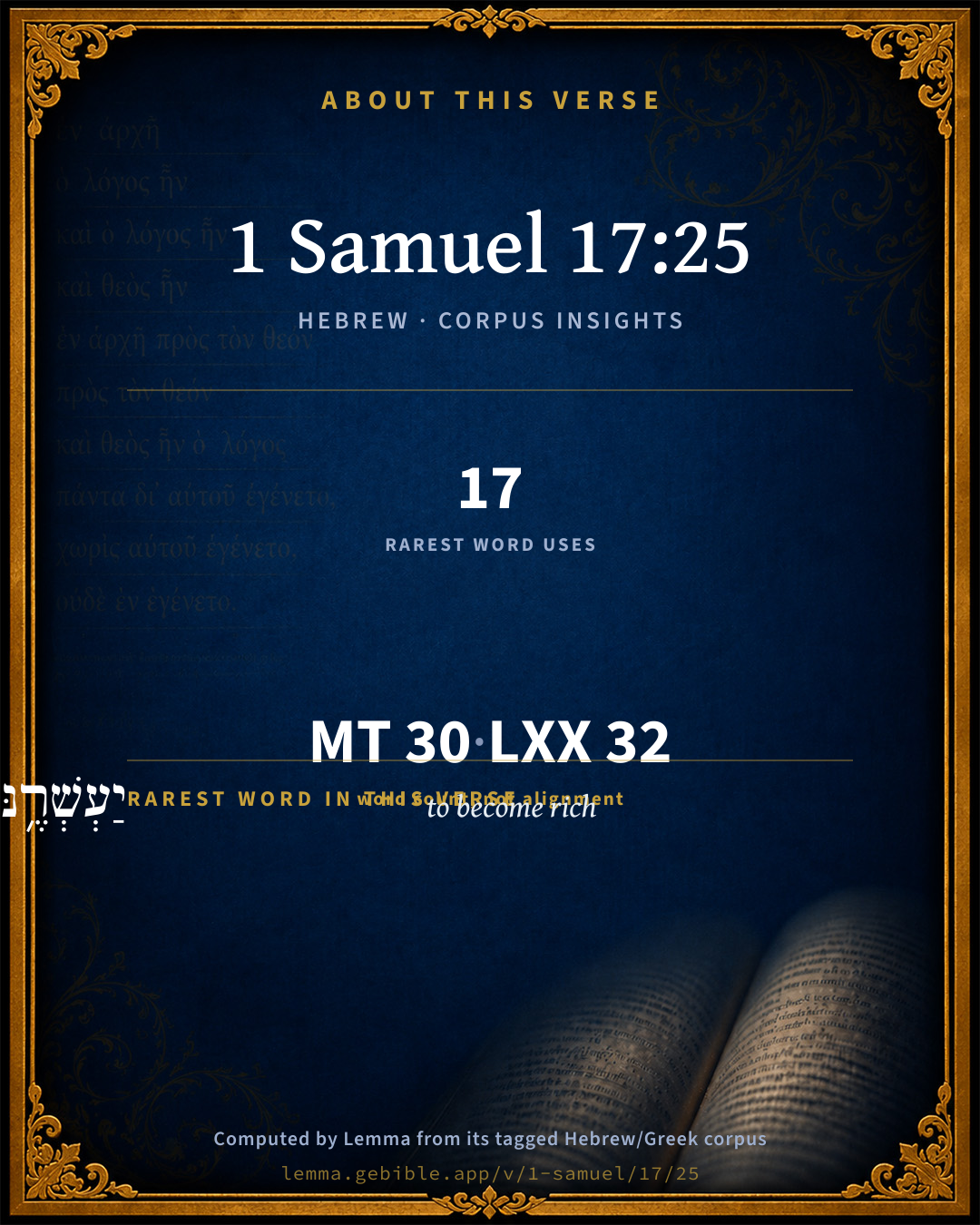
The rarest word here is יַעְשְׁרֶ֥נּוּ to become rich H6238 — appearing just 17 times in the whole Hebrew Bible.

Shared distinctive vocabulary

יַעְשְׁרֶ֥נּוּ to become rich H6238 occurs in 17 verses of the Hebrew Bible. Also found in:

Grammatical profile

  • 10 verbs
  • 11 nouns
  • 2 adjectives
  • 1 pronoun
  • 1 preposition
  • 1 conjunction
  • 4 particles

Verb forms

  • וַיֹּ֣אמֶר Qal · Sequential Imperfect
  • הַרְּאִיתֶם֙ Qal · Perfect
  • הָֽעֹלֶה֙ Qal · Participle Active
  • לְחָרֵ֥ף Piel · Infinitive Construct
  • עֹלֶ֑ה Qal · Participle Active
  • וְֽ֠הָיָה Qal · Perfect
  • יַכֶּ֜נּוּ Hiphil · Imperfect
  • יַעְשְׁרֶ֥נּוּ Hiphil · Imperfect
  • יִתֶּן Qal · Imperfect
  • יַעֲשֶׂ֥ה Qal · Imperfect

Repetition

Words recur within this verse — often emphatic in Hebrew:

  • אִ֣ישׁ man H376 ×3
  • יִשְׂרָאֵ֗ל Israel H3478 ×3
  • הָֽעֹלֶה֙ to go up H5927 ×2

Hebrew & Septuagint length

In English translation the verse runs 54 words from the Hebrew and 57 from the Septuagint (LXX English) — closely comparable.

A rough comparison of the two English renderings, which tokenize alike — not a word-level alignment.

Word counts can differ between the Hebrew and the Greek without any difference in meaning — e.g. the Hebrew direct-object marker אֵת has no separate Greek word, and Greek often adds the article ὁ.

In the original languages it is 30 Hebrew tokens and 32 Greek tokens — but the two are counted differently (Hebrew bundles its prefixes and suffixes into one token; the Greek is in lemma form), so that isn’t a like-for-like length.

Cross-references

9

Topical passages linked to 1 Samuel 17:25 in the Treasury of Scripture Knowledge — connected by theme and wording, ordered by reader-vote popularity; previews shown in the World English Bible.

  • Joshua 15:16 Caleb said, He who strikes Kiriath Sepher, and takes it, to him will I give Achsah my daughter as wife.
  • Revelation 2:7 He who has an ear, let him hear what the Spirit says to the assemblies. To him who overcomes I will give to eat of the tree of life, which is in the Paradise of my God.
  • Revelation 3:12 He who overcomes, I will make him a pillar in the temple of my God, and he will go out from there no more. I will write on him the name of my God, and the name of the city of my God, the new Jerusalem, which comes down out of heaven from my God, and my own new name.
  • 1 Samuel 18:17–27 Saul said to David, Behold, my elder daughter Merab, her will I give you as wife: only be valiant for me, and fight Yahweh's battles. For Saul said, Don't let my hand be on him, but let the hand of the Philistines be on him.
  • Ezra 7:24 Also we inform you, that touching any of the priests and Levites, the singers, porters, Nethinim, or servants of this house of God, it shall not be lawful to impose tribute, custom, or toll, on them.
  • Matthew 17:26 Peter said to him, "From strangers." Jesus said to him, "Therefore the children are exempt.
  • Revelation 2:17 He who has an ear, let him hear what the Spirit says to the assemblies. To him who overcomes, to him I will give of the hidden manna, and I will give him a white stone, and on the stone a new name written, which no one knows but he who receives it.
  • Revelation 3:5 He who overcomes will be arrayed in white garments, and I will in no way blot his name out of the book of life, and I will confess his name before my Father, and before his angels.
  • Revelation 3:21 He who overcomes, I will give to him to sit down with me on my throne, as I also overcame, and sat down with my Father on his throne.

Cross-references courtesy of OpenBible.info (CC BY 4.0).

Hebrew and Greek witnesses Masoretic Hebrew ↔ Greek Septuagint

The same verse in the two great witnesses to the Old Testament, shown verse-for-verse.

These are two independent witnesses, not word-aligned to each other, and the Septuagint is shown in lemma (dictionary) form.

Hebrew 1 Samuel 17:25 Masoretic · Westminster Leningrad Codex

וַיֹּ֣אמֶר אִ֣ישׁ יִשְׂרָאֵ֗ל הַרְּאִיתֶם֙ הָאִ֤ישׁ הָֽעֹלֶה֙ הַזֶּ֔ה כִּ֛י לְחָרֵ֥ף אֶת יִשְׂרָאֵ֖ל עֹלֶ֑ה וְֽ֠הָיָה הָאִ֨ישׁ אֲשֶׁר יַכֶּ֜נּוּ יַעְשְׁרֶ֥נּוּ הַמֶּ֣לֶךְ עֹ֣שֶׁר גָּד֗וֹל וְאֶת בִּתּוֹ֙ יִתֶּן ל֔וֹ וְאֵת֙ בֵּ֣ית אָבִ֔יו יַעֲשֶׂ֥ה חָפְשִׁ֖י בְּיִשְׂרָאֵֽל

The men of Israel said, Have you seen this man who is come up? surely to defy Israel is he come up: and it shall be, that the man who kills him, the king will enrich him with great riches, and will give him his daughter, and make his father's house free in Israel.

World English Bible · Public Domain

Greek LXX 1 Samuel 17:25 Septuagint · lemma form

καί εἶπον δαυίδ πρός ὁ ἀλλόφυλος σύ ἔρχομαι πρός ἐγώ ἐν ῥομφαία καί ἐν δόρυ καί ἐν ἀσπίς καΐἐγώ πορεύομαι πρός σύ ἐν ὄνομα κύριος σαβαωθ θεός παράταξις ἰσραήλ ὅς ὀνειδίζω σήμερον

And the men of Israel said, Have you⌃ seen this man that comes up? for he has reproached Israel and has come up; and it shall be that the man who shall strike him, the king shall enrich him with great wealth and shall give him his daughter, and shall make his father’s house free in Israel.

LXX2012 (modern English Septuagint) · Public Domain

Hebrew: Westminster Leningrad Codex (CC BY 4.0). Greek: Septuagint (public domain); English from LXX2012 (modern English Septuagint) (Public Domain). How the Septuagint differs from the Hebrew →

Targum (Aramaic paraphrase)

1

The Targum is the ancient Jewish Aramaic paraphrase of the Hebrew Scriptures — an interpretive translation, not the Hebrew text itself. Onkelos (literal) and Pseudo-Jonathan (expansive) render the Torah, and Jonathan the Prophets. Coverage is partial: where no permissively-licensed English translation exists for a verse, only the Aramaic is shown. This is verse-level text, not a word-by-word alignment to the Hebrew.

  1. Targum Jonathan Prophets (Joshua–Malachi)
    וַאֲמַר אֱנַשׁ יִשְׂרָאֵל הַחֲזֵיתוּן גַבְרָא דְסָלִיק הָדֵין אֲרֵי לְחַסָדָא יַת יִשְׂרָאֵל סְלִיק וִיהֵי גַבְרָא דְיִקְטְלִינֵיהּ יַעֲתְּרִינֵיהּ מַלְכָּא עוֹתַר סַגִי וְיַת בְּרַתֵּיהּ יִתֵּן לֵיהּ וְיַת בֵּית אֲבוּהִי יַעֲבֵּיד חוֹרִין רַבְרְבִין בְּיִשְׂרָאֵל:

    (no public-domain English translation for this verse)

    Targum Jonathan — Aramaic: “Mikraot Gedolot” (public domain). English: “Sefaria Community Translation” (CC0 1.0 (public-domain dedication)); “London "Chaldee Paraphrase," 1871” (public domain). Text via Sefaria.

Commentary

Notes on 1 Samuel 17:25 from classic Christian and Jewish commentators (each source and its license shown beneath its notes). The classic Christian expositions comment on the surrounding passage and are grouped to its opening verse, so a note may address several verses; the Jewish commentaries on the Tanakh (Rashi and others) are per-verse, so they appear only where the commentator wrote on this verse.

Lemma curates 59 commentaries, every one of them public domain or Creative Commons licensed, each selected and text-cleaned for this edition rather than reprinted as found. About our sources →

Trapp's Complete Commentary

John Trapp

1Sa 17:25 And the men of Israel said, Have ye seen this man that is come up? surely to defy Israel is he come up: and it shall be, [that] the man who killeth him, the king will enrich him with great riches, and will give him his daughter, and make his father’s house free in Israel.

Ver. 25. And it shall be, that the man who killeth him.] They talk of the reward, but dare not undertake the combat. So those that have not hearts to believe, yet can say there is glory laid up for the faithful.

The king will enrich him, &c.] But poor David found it otherwise.

“ Pollicitis dives quilibet esse potest. ”

And make his father’s house free.] Enfranchise and ennoble it, making them all gentlemen.

John Trapp, A Commentary or Exposition upon All the Books of the Old and New Testament (1647–1656) — public domain. Text from a community e-Sword module.

Joseph Benson's Commentary

1Sa 17:25-26. The king will make his father’s house free — Free from all those tributes and charges which either the court or the camp required. Who is this uncircumcised Philistine? &c. — Thus David expresses a high indignation that they, who were the servants of the living God, and fought under his banners, should be thus terrified by the great bulk of this idolater, as if the strength of God were not greater than that of this giant.

Joseph Benson's Commentary on the Old and New Testaments (1811–1818) — public domain. Text from a community e-Sword module.

Geneva Bible (1599)

Geneva Bible translators

From taxes and payments.

Geneva Bible (1599) marginal notes — public domain. Text via Bolls.life.

Jamieson, Fausset & Brown

Robert Jamieson, A. R. Fausset & David Brown

make his father's house free in Israel--His family should be exempted from the impositions and services to which the general body of the Israelites were subjected.

Jamieson, Fausset & Brown — Commentary Critical and Explanatory on the Whole Bible (1871) — public domain (CC PDM 1.0). Text via the HelloAO Bible API.

Ellicott's Commentary for English Readers

(25) And make his father’s house free in Israel.—Among the lavish offers Saul made to the one who should vanquish the giant was this, “The family of the successful combatant should be free in Israel.” The exact signification here of the Hebrew word rendered “free” is disputed. The simple meaning would seem to be freedom from personal service in the army and elsewhere, what in mediaeval history is known by the general term Corvée. It also probably includes a certain exemption from taxation or enforced contributions to war expenses.

Ewald goes still further, and considers that the royal. promise included the elevation of the house of the victorious warrior to noble rank, as henceforth they would be “free”—“freeholders,” a family released from the ordinary service of subjects; and this high distinction, the great German scholar considers, would easily come to be looked upon as hereditary, and thus such favoured houses would form an intermediate stage between the king and the simple subject. Although it is clear that a wonderful advance in the internal development of the kingdom of the children of Israel had taken place in Saul’s reign, yet it is doubtful if the government of the first king was as yet sufficiently organised to justify us in accepting, in its fulness, the conclusion of the ingenious comment of Ewald here. It does not appear from the narrative that these promises were ever fulfilled by Saul in the case of the house of Jesse.

A Bible Commentary for English Readers, edited by Charles John Ellicott (1878–1897) — public domain. Text from a community e-Sword module.

The Cambridge Bible for Schools and Colleges

gen. ed. J. J. S. Perowne

25. will give him his daughter] Compare Caleb’s offer, Jos_15:16. Saul procrastinated about fulfilling the promise, and imposed further conditions (1Sa_18:17 ff.).

make his father’s house free] Probably exemption from taxes and personal services to the king is meant. Cp. 1Sa_8:11 ff.

The Cambridge Bible for Schools and Colleges (gen. ed. J. J. S. Perowne; Cambridge University Press, 1878–1918) — public domain. Text from a community e-Sword module.

John Gill's Exposition

And the men of Israel said,.... To one another:

have ye seen this man that is come up? taken notice of him, and observed him?

surely to defy Israel is he come up; to challenge them to fight with him, and upbraid them with cowardice that they did not:

and it shall be that the man who killeth him; this, and what follows, they said to encourage any person to engage with him, though none of them cared to encounter him themselves:

the king will enrich him with great riches; give him a large gratuity, make a present of a great sum of money to him:

and will give him his daughter to be his wife, in like manner as Caleb promised to give his daughter in marriage to the person that should take Kirjathsepher, Jdg 1:12,

and make his father's house free in Israel; from all tributes, taxes, levies, impositions, king's service, and duty; or, as the Targum,"make his father's house freemen, nobles;''raise it to the rank of nobility.

John Gill's Exposition of the Whole Bible (1746–1763) — public domain (CC PDM 1.0). Text via the HelloAO Bible API.

Albert Barnes' Notes on the Bible

Free in Israel - In all the other passages (fifteen) where this word occurs, it means free, as opposed to being a slave (Deu 15:12-13, Deu 15:18, etc.) Here it may imply a freedom from all such services and burdens as are spoken of in 1Sa 8:11-17.

Albert Barnes' Notes on the Bible (1834–1885) — public domain. Text from a community e-Sword/MySword module.

Haydock's Catholic Bible Commentary

Tribute, and all public charges, which may be burdensome. (Calmet) --- It does not appear that these words are addressed to any one in particular, nor that the king had authorized such a declaration. (Haydock) --- Yet the people all persisted in the same declaration, so that a promise must have been made. (Menochius) --- It was never at least fulfilled. (Haydock) --- Christ having overcome the devil, receives the Church for his spouse. (Worthington)

George Leo Haydock (1774–1849), Haydock's Catholic Family Bible and Commentary, 1859 edition — public domain. Excludes Psalms (Douay-Rheims chapter numbering differs from Protestant) and Deuterocanonical books (Catholic canon only).

Matthew Poole's English Annotations

It is observable, that Saul in his great distress doth not encourage himself in God, nor seek his counsel or favour by prayers and sacrifices, but expects relief from men only. This was one effect and sign of the departure of God’s Spirit from him.

Make his father’s house free; free from all those tributes and charges which either the court or the camp required.

Matthew Poole's English Annotations on the Holy Bible (1683–1685) — public domain. Text from a community e-Sword/MySword module.

Whedon's Commentary on the Bible

Daniel D. Whedon

25. The man who killeth him, the king will enrich — It is every way probable that in his dismay and terror before the challenge of Goliath, Saul had made such offers as are here specified; but the fact that we have no record of their fulfilment has been construed into an argument against the genuineness of this section. This argument at best is only one from silence. But in reply we urge that Saul’s inquiry respecting David’s father, (vers. 55-58,) and his proposal to give him his daughter in marriage, (1Sa_18:17,) seem to have been made in direct reference to the promises here recorded, and all apparent failure to redeem his promise is sufficiently accounted for by Saul’s passionate jealousy at the honours David received from the people. 1Sa_18:6-9.

Make his father’s house free in Israel — Free from taxation and public burdens; and elevated to the rank of royalty.

Daniel D. Whedon (gen. ed.), Commentary on the Old and New Testaments (1874–1909) — public domain. Text from a community e-Sword module.

The Pulpit Commentary

Vers. 25-27. To defy Israel. Rather, "to cast scorn on," "to dishonour Israel" (see on ver. 10). The king will enrich him with great riches,... and make his father"s house free in Israel. Many years must have elapsed before Saul could thus have developed the powers of the crown, and the last words show that contributions were levied from all the households in Israel for the support of the king and his retinue. There had manifestly been a great advance since the day when Jesse sent the king a few loaves of bread, a skin of wine, and a kid. (1Sa_16:20) Still we cannot imagine that Saul had introduced taxes, nor was the political organisation of the State ripe enough for so advanced a state of things. The words more probably refer to freedom from personal service in the army and elsewhere; though it is quite possible that on special occasions contributions may have been levied, and presents, no doubt, were constantly being made to the king, though on no regular system. Taketh away the reproach. The noun formed from the verb rendered defy in ver. 10, where see note. Uncircumcised. See on 1Sa_14:6. David, like Jonathan, sees a ground of confidence in the uncovenanted relation of the Philistine towards God. The living God. A second ground of confidence. The god of the Philistines was a lifeless idol; Jehovah a Being who proved his existence by his acts. So shall it be done. As the people all answer David"s inquiries in the same way, Saul had evidently made a proclamation to this effect, which we may suppose he fulfilled, though not in the frankest manner. (1Sa_18:17, 1Sa_18:27)

The Pulpit Commentary (1880–1919), ed. H.D.M. Spence-Jones & Joseph S. Exell — public domain. Text from a community e-Sword module.

John Wesley's Explanatory Notes

Free - Free from all those tributes and charges which either the court or the camp required.

John Wesley, Explanatory Notes Upon the Whole Bible (1754–1765) — public domain. Text via the GEBible commentary corpus.

unfoldingWord translationNotes

Door43 World Missions Community

Have you seen this man who has come up?

The soldiers were saying this to draw one another's attention to the man Goliath. AT: "Look at this man who has come up!" (See: Rhetorical Question)

The king

This refers to the king of Israel. AT: "Our king" (See: Assumed Knowledge and Implicit Information)

his daughter

This refers to the king's daughter.

to him ... his father's house

The words "him" and "his" refer to the man who kills Goliath.

will make his father's house free from taxation in Israel

The word "house" refers to the household or family. AT: "will no longer require his family to pay taxes" (See: Metonymy)

translationWords

Israel

king

ancestor

house

tax

unfoldingWord translationNotes — © Distant Shores Media and the Door43 World Missions Community, licensed CC BY-SA 4.0. Source: git.door43.org/Door43/en_tn.

Rashi

Rabbi Shlomo Yitzchaki (Rashi)

He will exempt. From the listed royal obligations.

Rashi on the Tanakh — English translations: “The Judaica Press complete Tanach with Rashi, translated by A. J. Rosenberg” (CC BY 4.0); “Pentateuch with Rashi's commentary by M. Rosenbaum and A.M. Silbermann, 1929-1934” (public domain); “The Metsudah Tanach series, Lakewood, N.J” (CC BY 4.0); and “The Book of Joshua, Metsudah Publications, 1997” (CC BY 4.0). Text via Sefaria.

Lesson kit

Teaching starters — assembled from the data on this page, not authored interpretation. Every prompt links to the verse data it draws on. Edit before teaching.

1 Samuel, in the Historical, opens this verse with 30 words (22 distinct Hebrew lemmas). Its most distinctive word is ʻâshar (“to become rich”). A historical commentator’s framing appears above. Read the whole chapter for the surrounding context.

Discussion questions

  1. The word ʻâshar carries the sense “to become rich.” How does it shape the verse?
  2. How does Genesis 14:23, which shares the word «to become rich», read alongside this verse?
  3. What does the repetition of “man” (3× in this one verse) do in this verse?
  4. The translations on this page render this verse differently — a whole-verse word diff, not a word-by-word alignment. What might account for the different wordings?
  5. «וַיֹּ֣אמֶר» is a Qal Sequential Imperfect verb. How does that grammatical form shape the action described?
  6. Compare how Trapp's Complete Commentary and Joseph Benson's Commentary read this verse. Where do they agree or differ?

Things to notice

Reading settings

Reading text

Shown beneath each verse's original-language words.

Old Testament
Old Testament edition

Read the OT as the Masoretic Hebrew (MT) or the Greek Septuagint (LXX).

English shown for the Greek Septuagint (in the Hebrew ↔ Greek comparison).

Comparing translations? Open the Compare panel on any verse page to stack up to four side by side.