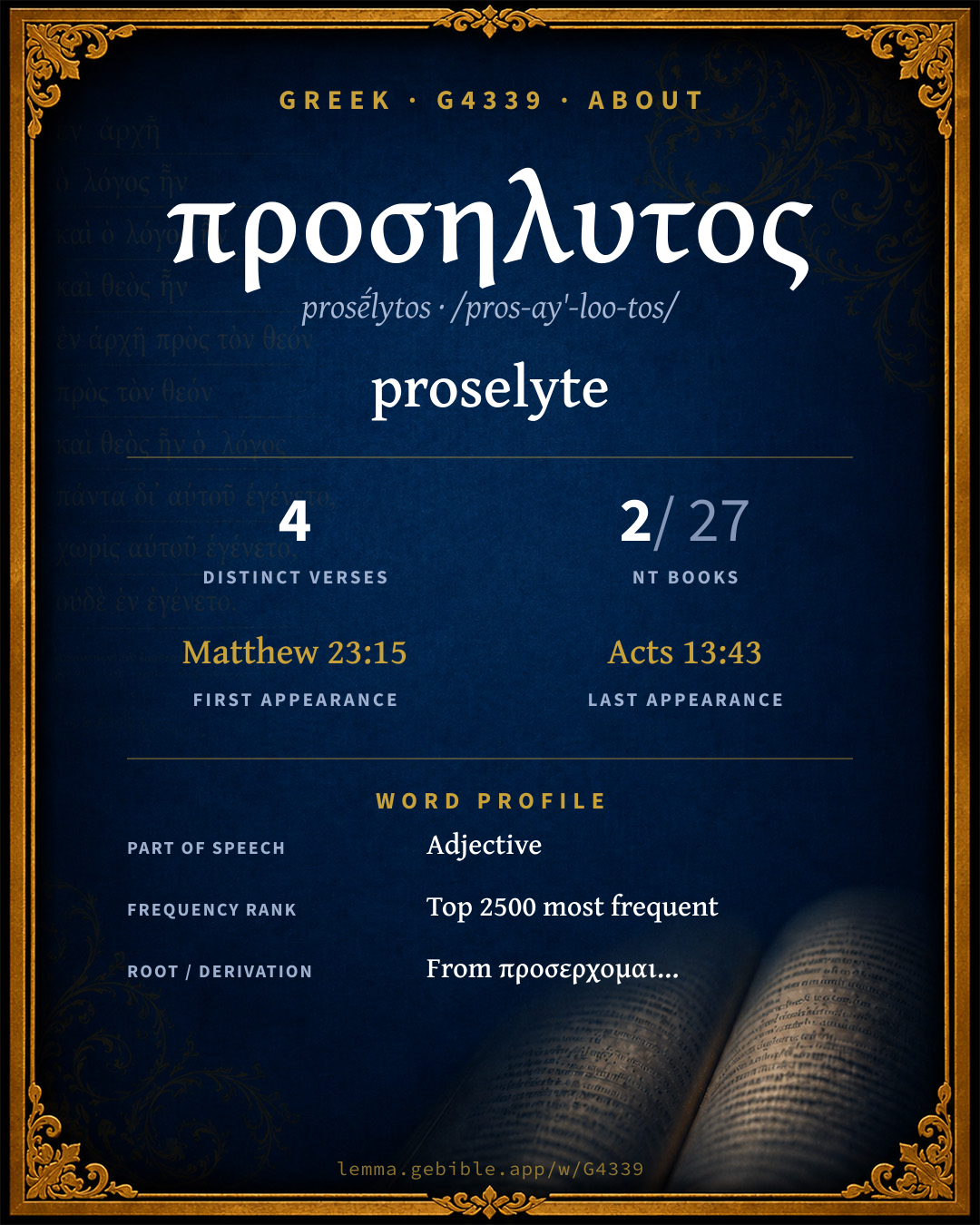
προσήλυτος
proselyte
‘proselyte’ is one of 2 main senses fuller range ↓
Full lexicon entry — Thayer's Greek Lexicon
From Thayer's Greek Lexicon
Where this word appears
See every Accusative-case word in the Greek New Testament →
Grammar key — what these labels mean
Part of speech
- Noun
- A naming word — a person, place, thing, or idea.
Case
- Accusative
- The case of the direct object and of extent.
- Genitive
- The case of source, possession, or “of” — answers “whose / from what.”
- Nominative
- The case of the subject (and the predicate nominative).
Gender
- Masculine
- Grammatically masculine.
Number
- Singular
- One.
- Plural
- More than one.
2 distinct verses where G4339 appears in the Accusative case, across 2 books. Filtered view — show all forms. Click any verse to open its interlinear word-by-word view. Verse text shown in the World English Bible for context — . Each verse’s Greek form is shown with its reference; the English is not keyword-highlighted, since the data carries no word-level English alignment. Use “Compare translations” on any verse to read it across multiple English versions. This concordance covers the Greek New Testament; Septuagint (Greek Old Testament) occurrences of this word are not indexed here.
Matthew 1 verse
Acts 1 verse
About this entry
At a glance — auto-summarized from this page’s data, not written by a person. Every figure links to its source below. This summary describes the numbers; it doesn’t interpret them.
“proselyte” is the headline sense of the Greek adjective προσηλυτος (prosḗlytos). A scarce word — 4 verses in all of the Greek New Testament. More than three-quarters of its appearances fall in Acts. Scripture first uses it in Matthew 23:15. Catalogued under 2 senses, its meaning is not single-sense. See the sense tree, 4-verse concordance, and the renderings breakdown below.
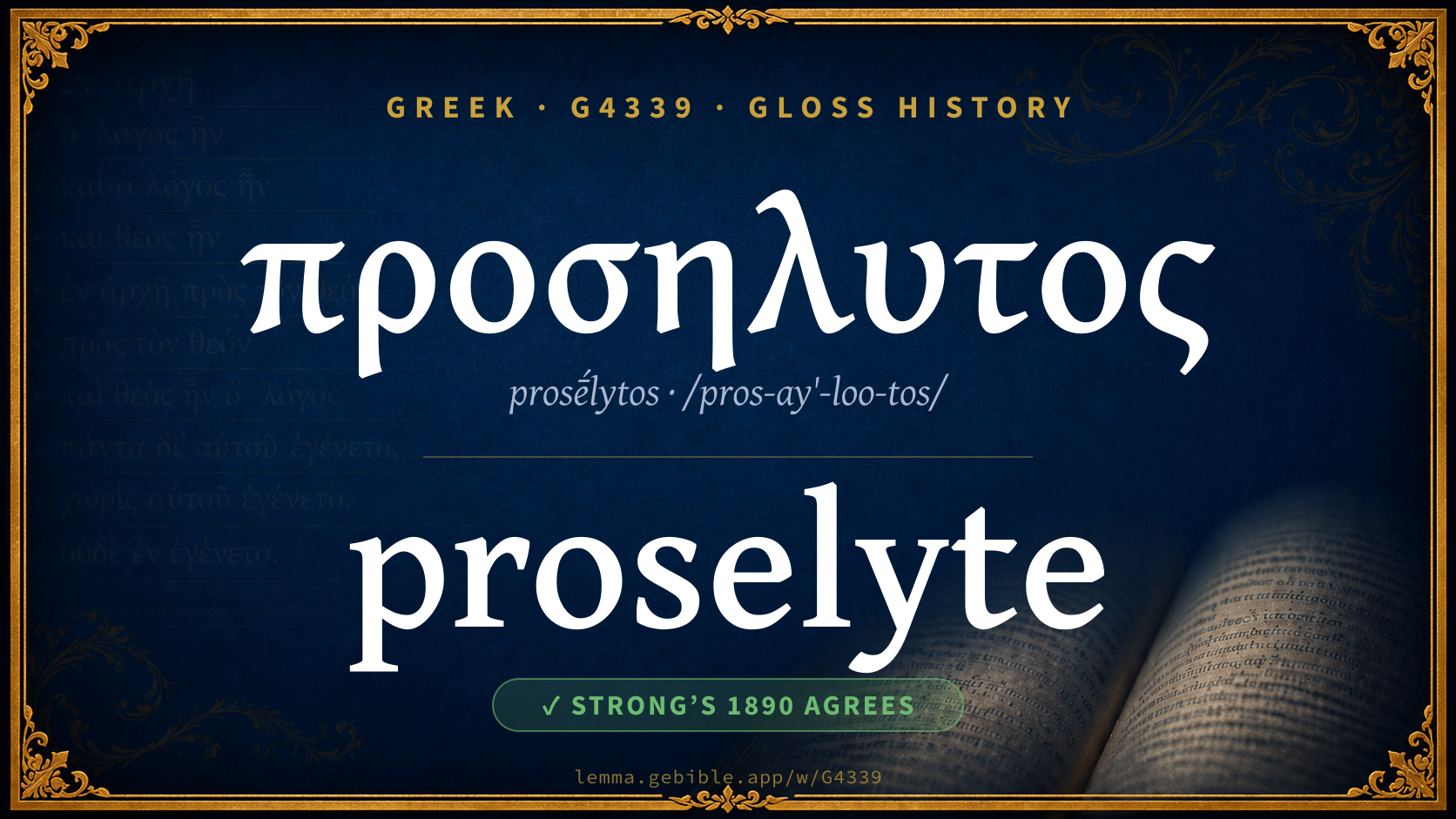
Gloss history
Strong's 1890 vs modern scholarship
About this word
Strong's G4339 catalogs a Greek word from the Greek New Testament.
These counts are not copied from any lexicon or concordance. They are computed here, from the morphology-tagged Greek New Testament. What Lemma adds →
- 4
- distinct verses
- The word appears in 4 distinct verses.
- 2 / 27
- NT books
- The word appears in 2 of 27 New Testament books.
- #1,877
- by frequency
- Top 2500 most frequent Greek words (rank 1,877 of 5,347 Greek words by occurrence).
View all 4 occurrences in the concordance →
By traditional corpus
Conventional, traditional groupings — biblical authorship is debated, so this is a traditional corpus grouping, not an authorship claim. Some books belong to more than one corpus (Luke is in both the Gospels and the Lukan corpus, and so on), so these shares overlap and need not total 100%. Each figure is a share of the word’s 4 distinct verses.
- Lukan (Luke–Acts) 3 verses · 75%
- Gospels 1 verse · 25%
How translations render this word
Counts come from each version’s own published word-to-Strong’s tagging or interlinear alignment — an approximate guide to how each version renders this word, not a word-level alignment the data otherwise carries. Because each total is that version’s own tagged count, the per-version totals vary from one another and need not match the appearance or distinct-verse counts above. These counts may also differ from a printed concordance because Lemma counts each distinctly tagged rendering and does not collapse phrase taggings into a single head-word total. This is a fixed set of word-tagged versions (KJV, ASV, BSB, ULT) and does not change with the reading translation you choose elsewhere. Each version’s license is shown beside its name below (and on Sources).
- King James Version: Proselyte 2×, Proselytes 2×
- American Standard Version: Proselyte 2×, Proselytes 2×
- Berean Standard Bible: Convert 2×, Converts to judaism 2×
- unfoldingWord Literal Text: Proselyte 2×, Proselytes 2×
King James Version Public Domain
Renders G4339 across 4 tagged occurrences — most commonly:
American Standard Version Public Domain
Renders G4339 across 4 tagged occurrences — most commonly:
Berean Standard Bible Public Domain
Renders G4339 across 4 tagged occurrences — most commonly:
unfoldingWord Literal Text CC BY-SA 4.0
Renders G4339 across 4 tagged occurrences — most commonly:
Senses in Thayer's
The 2 senses Thayer's distinguishes for this word, in lexicon order (not ranked by frequency or importance). The full entry — with sub-senses — is in the Lexicon Entry tab.
- a stranger, alien
- one who has come over from a Gentile religion to Judaism
Word origin
Derived from προσερχομαι (prosérchomai) (G4334) — to draw near.
From the alternate of G4334 ; an arriver from a foreign region that is (specifically) an acceder ( convert ) to Judaism (proselyte): - proselyte.
— Strong’s Exhaustive Concordance (1890), public domain.
Forms in the corpus
The 3 distinct written forms G4339 takes in the Greek New Testament, most frequent first — each parse links to that case’s occurrences in the concordance.
| Form | Parsing | Example | Uses |
|---|---|---|---|
| προσήλυτον prosḗlyton | Noun, Accusative, Singular, Masculine | Matthew 23:15 | 2 |
| προσήλυτοι prosḗlytoi | Noun, Nominative, Plural, Masculine | Acts 2:10 | 1 |
| προσηλύτων prosēlýtōn | Noun, Genitive, Plural, Masculine | Acts 13:43 | 1 |
Septuagint usage
The same Greek word προσηλυτος appears 84 times in the Greek Old Testament (Septuagint), across 72 verses in 13 books.
- 84
- LXX occurrences
- Tagged occurrences of this Greek word in the Septuagint.
- 72
- verses
- Distinct Septuagint verses containing this word.
- 13 / 39
- OT books
- The word appears in 13 of the 39 Old Testament books.
Sample Septuagint occurrences
- Exodus 12:48 προσήλυτος
- Leviticus 16:29 προσήλυτος
- Numbers 9:14 προσήλυτος
- Deuteronomy 1:16 προσήλυτος
- Joshua 9:2 προσήλυτος
- 1 Chronicles 22:2 προσήλυτος
- 2 Chronicles 2:16 προσήλυτος
- Psalms 93:6 προσήλυτος
- Isaiah 54:15 προσήλυτος
- Jeremiah 7:6 προσήλυτος
- Ezekiel 14:7 προσήλυτος
- Zechariah 7:10 προσήλυτος
Septuagint occurrences (same lexeme)
Every verse where the same Strong’s number (G4339) appears in the Greek Septuagint — showing the first 50 of 72. Verse text shown in the World English Bible for context; the Greek form is the matched word — the English is not keyword-highlighted.
- Exodus 12:48 προσήλυτος When a stranger shall live as a foreigner with you, and will keep the Passover to Yahweh, let all his males be circumcised, and then let him come near and keep it; and he shall be as one who is born in the land: but no uncircumcised person shall eat of it.
- Exodus 12:49 προσήλυτος One law shall be to him who is born at home, and to the stranger who lives as a foreigner among you."
- Exodus 20:10 προσήλυτος but the seventh day is a Sabbath to Yahweh your God. You shall not do any work in it, you, nor your son, nor your daughter, your man-servant, nor your maid-servant, nor your cattle, nor your stranger who is within your gates;
- Exodus 22:20 προσήλυτος "He who sacrifices to any god, except to Yahweh only, shall be utterly destroyed.
- Exodus 23:9 προσήλυτος "You shall not oppress an alien, for you know the heart of an alien, seeing you were aliens in the land of Egypt.
- Exodus 23:12 προσήλυτος "Six days you shall do your work, and on the seventh day you shall rest, that your ox and your donkey may have rest, and the son of your handmaid, and the alien may be refreshed.
- Leviticus 16:29 προσήλυτος "It shall be a statute to you forever: in the seventh month, on the tenth day of the month, you shall afflict your souls, and shall do no manner of work, the native-born, or the stranger who lives as a foreigner among you:
- Leviticus 17:3 προσήλυτος Whatever man there is of the house of Israel, who kills an ox, or lamb, or goat, in the camp, or who kills it outside the camp,
- Leviticus 17:8 προσήλυτος "You shall say to them, 'Any man there is of the house of Israel, or of the strangers who live as foreigners among them, who offers a burnt offering or sacrifice,
- Leviticus 17:10 προσήλυτος "'Any man of the house of Israel, or of the strangers who live as foreigners among them, who eats any kind of blood, I will set my face against that soul who eats blood, and will cut him off from among his people.
- Leviticus 17:12 προσήλυτος Therefore I have said to the children of Israel, "No person among you shall eat blood, neither shall any stranger who lives as a foreigner among you eat blood."
- Leviticus 17:13 προσήλυτος "'Whatever man there is of the children of Israel, or of the strangers who live as foreigners among them, who takes in hunting any animal or bird that may be eaten; he shall pour out its blood, and cover it with dust.
- Leviticus 17:15 προσήλυτος "'Every person that eats what dies of itself, or that which is torn by animals, whether he is native-born or a foreigner, he shall wash his clothes, and bathe himself in water, and be unclean until the evening: then he shall be clean.
- Leviticus 18:26 προσήλυτος You therefore shall keep my statutes and my ordinances, and shall not do any of these abominations; neither the native-born, nor the stranger who lives as a foreigner among you;
- Leviticus 19:10 προσήλυτος You shall not glean your vineyard, neither shall you gather the fallen grapes of your vineyard; you shall leave them for the poor and for the foreigner. I am Yahweh your God.
- Leviticus 19:33 προσήλυτος "'If a stranger lives as a foreigner with you in your land, you shall not do him wrong.
- Leviticus 19:34 προσήλυτος The stranger who lives as a foreigner with you shall be to you as the native-born among you, and you shall love him as yourself; for you lived as foreigners in the land of Egypt. I am Yahweh your God.
- Leviticus 20:2 προσήλυτος "Moreover, you shall tell the children of Israel, 'Anyone of the children of Israel, or of the strangers who live as foreigners in Israel, who gives any of his seed to Molech; he shall surely be put to death. The people of the land shall stone him with stones.
- Leviticus 22:18 προσήλυτος "Speak to Aaron, and to his sons, and to all the children of Israel, and say to them, 'Whoever is of the house of Israel, or of the foreigners in Israel, who offers his offering, whether it be any of their vows, or any of their freewill offerings, which they offer to Yahweh for a burnt offering;
- Leviticus 23:22 προσήλυτος "'When you reap the harvest of your land, you shall not wholly reap into the corners of your field, neither shall you gather the gleanings of your harvest: you shall leave them for the poor, and for the foreigner. I am Yahweh your God.'"
- Leviticus 24:16 προσήλυτος He who blasphemes the name of Yahweh, he shall surely be put to death; all the congregation shall certainly stone him: the foreigner as well as the native-born, when he blasphemes the Name, shall be put to death.
- Leviticus 24:22 προσήλυτος You shall have one kind of law, for the foreigner as well as the native-born: for I am Yahweh your God.'"
- Leviticus 25:23 προσήλυτος "'The land shall not be sold in perpetuity, for the land is mine; for you are strangers and live as foreigners with me.
- Leviticus 25:35 προσήλυτος "'If your brother has become poor, and his hand can't support him among you; then you shall uphold him. As a stranger and a sojourner he shall live with you.
- Leviticus 25:47 προσήλυτος "'If a stranger or sojourner with you becomes rich, and your brother beside him has grown poor, and sells himself to the stranger or foreigner living among you, or to a member of the stranger's family;
- Numbers 9:14 προσήλυτος If a foreigner lives among you, and desires to keep the Passover to Yahweh; according to the statute of the Passover, and according to its ordinance, so shall he do. You shall have one statute, both for the foreigner, and for him who is born in the land.'"
- Numbers 15:14 προσήλυτος If a stranger lives as a foreigner with you, or whoever may be among you throughout your generations, and will offer an offering made by fire, of a sweet savor to Yahweh; as you do, so he shall do.
- Numbers 15:15 προσήλυτος For the assembly, there shall be one statute for you, and for the stranger who lives as a foreigner [with you], a statute forever throughout your generations: as you are, so shall the foreigner be before Yahweh.
- Numbers 15:16 προσήλυτος One law and one ordinance shall be for you, and for the stranger who lives as a foreigner with you.
- Numbers 15:26 προσήλυτος and all the congregation of the children of Israel shall be forgiven, and the stranger who lives as a foreigner among them; for in respect of all the people it was done unwittingly.
- Numbers 15:29 προσήλυτος You shall have one law for him who does anything unwittingly, for him who is home-born among the children of Israel, and for the stranger who lives as a foreigner among them.
- Numbers 15:30 προσήλυτος But the soul who does anything with a high hand, whether he is home-born or a foreigner, the same blasphemes Yahweh; and that soul shall be cut off from among his people.
- Numbers 19:10 προσήλυτος He who gathers the ashes of the heifer shall wash his clothes, and be unclean until the even: and it shall be to the children of Israel, and to the stranger who lives as a foreigner among them, for a statute forever.
- Numbers 35:15 προσήλυτος For the children of Israel, and for the stranger and for the foreigner living among them, shall these six cities be for refuge; that everyone who kills any person unwittingly may flee there.
- Deuteronomy 1:16 προσήλυτος I charged your judges at that time, saying, Hear [the causes] between your brothers, and judge righteously between a man and his brother, and the foreigner who is living with him.
- Deuteronomy 5:14 προσήλυτος but the seventh day is a Sabbath to Yahweh your God: [in it] you shall not do any work, you, nor your son, nor your daughter, nor your man-servant, nor your maid-servant, nor your ox, nor your donkey, nor any of your cattle, nor your stranger who is within your gates; that your man-servant and your maid-servant may rest as well as you.
- Deuteronomy 10:18 προσήλυτος He does execute justice for the fatherless and widow, and loves the foreigner, in giving him food and clothing.
- Deuteronomy 10:19 προσήλυτος Therefore love the foreigner; for you were foreigners in the land of Egypt.
- Deuteronomy 12:18 προσήλυτος but you shall eat them before Yahweh your God in the place which Yahweh your God shall choose, you, and your son, and your daughter, and your man-servant, and your maid-servant, and the Levite who is within your gates: and you shall rejoice before Yahweh your God in all that you put your hand to.
- Deuteronomy 14:29 προσήλυτος and the Levite, because he has no portion nor inheritance with you, and the foreigner living among you, and the fatherless, and the widow, who are within your gates, shall come, and shall eat and be satisfied; that Yahweh your God may bless you in all the work of your hand which you do.
- Deuteronomy 16:11 προσήλυτος and you shall rejoice before Yahweh your God, you, and your son, and your daughter, and your man-servant, and your maid-servant, and the Levite who is within your gates, and the foreigner, and the fatherless, and the widow, who are in the midst of you, in the place which Yahweh your God shall choose, to cause his name to dwell there.
- Deuteronomy 16:14 προσήλυτος and you shall rejoice in your feast, you, and your son, and your daughter, and your man-servant, and your maid-servant, and the Levite, and the foreigner, and the fatherless, and the widow, who are within your gates.
- Deuteronomy 24:14 προσήλυτος You shall not oppress a hired servant who is poor and needy, whether he be of your brothers, or of your foreigners who are in your land within your gates:
- Deuteronomy 24:17 προσήλυτος You shall not wrest the justice [due] to the foreigner, [or] to the fatherless, nor take the widow's clothing to pledge;
- Deuteronomy 24:19 προσήλυτος When you reap your harvest in your field, and have forgot a sheaf in the field, you shall not go again to get it: it shall be for the foreigner, for the fatherless, and for the widow; that Yahweh your God may bless you in all the work of your hands.
- Deuteronomy 24:20 προσήλυτος When you beat your olive tree, you shall not go over the boughs again: it shall be for the foreigner, for the fatherless, and for the widow.
- Deuteronomy 24:21 προσήλυτος When you gather [the grapes of] your vineyard, you shall not glean it after you: it shall be for the foreigner, for the fatherless, and for the widow.
- Deuteronomy 26:11 προσήλυτος and you shall rejoice in all the good which Yahweh your God has given to you, and to your house, you, and the Levite, and the foreigner who is in the midst of you.
- Deuteronomy 26:12 προσήλυτος When you have made an end of tithing all the tithe of your increase in the third year, which is the year of tithing, then you shall give it to the Levite, to the foreigner, to the fatherless, and to the widow, that they may eat within your gates, and be filled.
- Deuteronomy 26:13 προσήλυτος You shall say before Yahweh your God, I have put away the holy things out of my house, and also have given them to the Levite, and to the foreigner, to the fatherless, and to the widow, according to all your commandment which you have commanded me: I have not transgressed any of your commandments, neither have I forgotten them:
These are occurrences of the same Greek lexeme (G4339) in the Septuagint — not a translation of any one Hebrew word. The store carries no word-level Hebrew↔Greek alignment, so no Hebrew original is asserted here. Counts come from the recovered LXX Strong's tagging — high-frequency vocabulary is well covered, while rare or late forms may be untagged — so they reflect tagged occurrences and may slightly undercount.