Zechariah 7:10

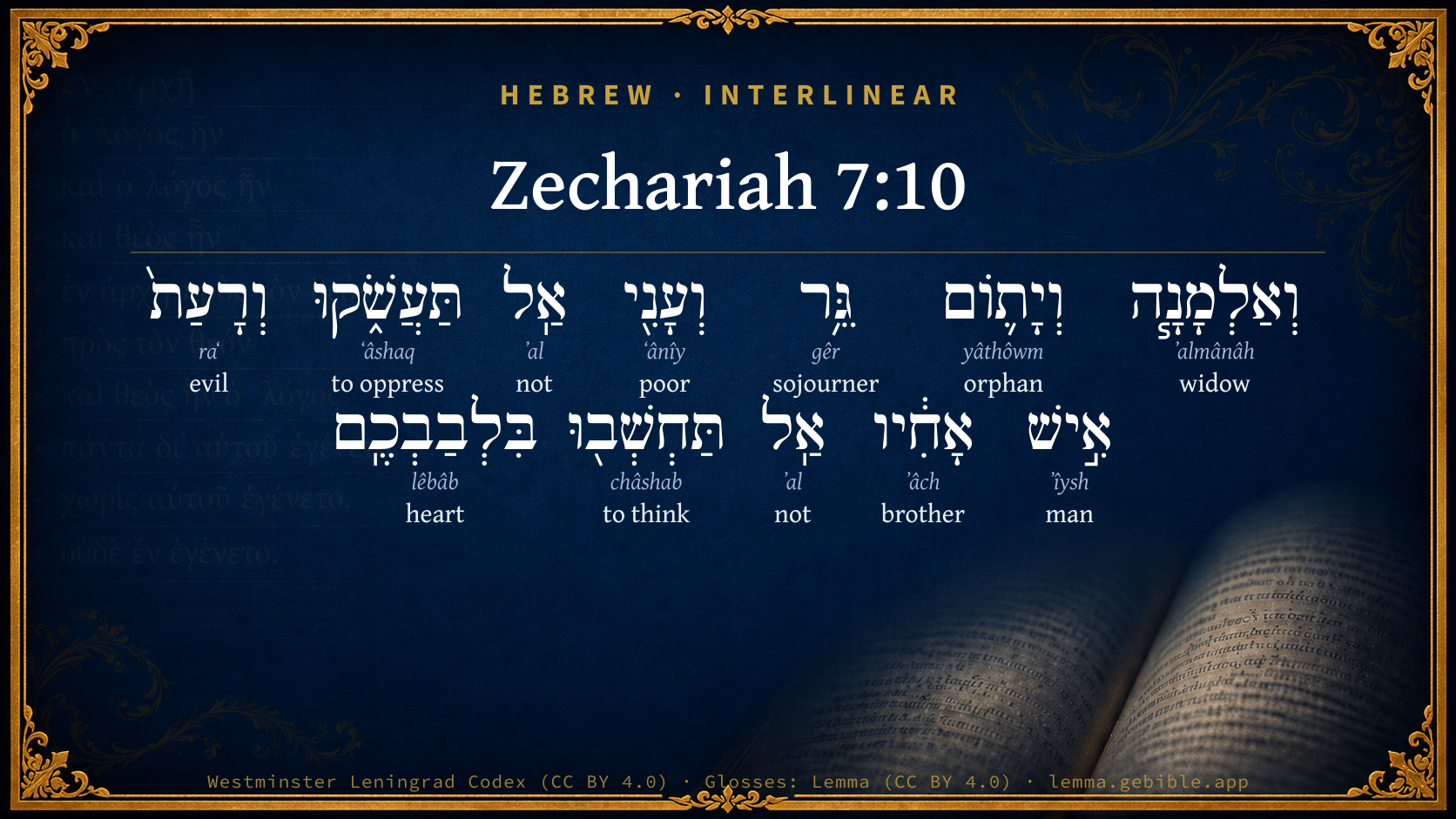
Hebrew (Westminster Leningrad Codex) Zechariah 7:10 appears in the Hebrew Old Testament. The text above is from the Westminster Leningrad Codex. Each word links to its Strong’s number, a concise gloss, and parsing drawn from the Open Scriptures Hebrew Bible morphology. Click any word for its full Brown-Driver-Briggs (BDB) entry.
Download image
Cite this verse

Zechariah 7:10 (World English Bible). Public Domain. Lemma interlinear Bible study tool, https://lemma.gebible.app/v/zechariah/7/10.

Show BibTeX & RIS
BibTeX
RIS
English Translation
Don't oppress the widow, nor the fatherless, the foreigner, nor the poor; and let none of you devise evil against his brother in your heart.'
World English Bible · Public Domain
Download a study sheet

One document with this verse’s original text, its word-by-word gloss line, the meaning frame, cross-references with their text, attributed commentary, and full source and license credits — printable, and it pastes into notes with its structure intact.

This verse Autodidact and up

Study sheet (.html) Plain text (.txt)

A passage Seminary Student

Up to 50 verses in one chapter. A passage sheet keeps up to 6 commentary sources and 12 cross-references per verse, in the order this page ranks them, and says so on the sheet whenever that leaves anything out. Ask for a single verse and you get the Autodidact verse sheet above.

Everything on this page stays free to read, with no account — the sheet is a download of what is already on screen, not access to it.

Want to remove ads? Support Godless Engineer
Compare translations 3

The same verse in 3 English versions, stacked beneath the original-language interlinear above. Click any original word for its lexicon entry.

Each is an independent rendering of the whole verse — the interlinear is not word-aligned to these translations.

Highlighted words mark where these versions differ — a whole-verse word diff, not a word-by-word alignment.

  • World English Bible Public Domain
    Don't oppress the widow, nor the fatherless, the foreigner, nor the poor; and let none of you devise evil against his brother in your heart.'
  • King James Version Public Domain
    And oppress not the widow, nor the fatherless, the stranger, nor the poor; and let none of you imagine evil against his brother in your heart.
  • unfoldingWord Literal Text CC BY-SA 4.0
    And the widow and the orphan, the foreigner, and the poor. may you not oppress And the evil of each man his brother may you not devise in your hearts.’

unfoldingWord Literal Text — © unfoldingWord, licensed CC BY-SA 4.0. Word-aligned USFM3 via Door43 (git.door43.org/unfoldingWord/en_ult).

Versions to compare (up to 4)

3 of 4 selected

Show all 18 translations

Every available English version of this verse, each an independent rendering of the whole verse.

  • World English Bible Public Domain
    Don't oppress the widow, nor the fatherless, the foreigner, nor the poor; and let none of you devise evil against his brother in your heart.'
  • Berean Standard Bible Public Domain
    Do not oppress the widow or the fatherless, the foreigner or the poor. And do not plot evil in your hearts against one another.’
  • Majority Standard Bible Public Domain
    Do not oppress the widow or the fatherless, the foreigner or the poor. And do not plot evil in your hearts against one another.’
  • King James Version Public Domain
    And oppress not the widow, nor the fatherless, the stranger, nor the poor; and let none of you imagine evil against his brother in your heart.
  • American Standard Version (1901) Public Domain
    and oppress not the widow, nor the fatherless, the sojourner, nor the poor; and let none of you devise evil against his brother in your heart.
  • Revised Version (1885) Public Domain
    and oppress not the widow, nor the fatherless, the stranger, nor the poor; and let none of you imagine evil against his brother in your heart.
  • Geneva Bible (1599) Public Domain
    And oppresse not the widowe, nor the fatherles, the stranger nor the poore, and let none of you imagine euil against his brother in your heart.
  • Douay-Rheims (1899) Public Domain
    And oppress not the widow, and the fatherless, and the stranger, and the poor: and let not a man devise evil in his heart against his brother.
  • Young's Literal Translation Public Domain
    And widow, and fatherless, Sojourner, and poor, ye do not oppress, And the calamity of one another ye do not devise in your heart.
  • Literal Standard Version CC BY-SA 4.0
    And do not oppress widow, and fatherless, || Sojourner, and poor, || And you do not devise the calamity of one another in your heart.
  • Unlocked Literal Bible CC BY-SA 4.0
    About the widow and orphan, the foreigner, and the poor person—do not oppress them, and let none of you plot any harm against another in your heart.'
  • unfoldingWord Literal Text CC BY-SA 4.0
    And the widow and the orphan, the foreigner, and the poor. may you not oppress And the evil of each man his brother may you not devise in your hearts.’
  • Darby Bible Public Domain
    and oppress not the widow and the fatherless, the stranger and the afflicted; and let none of you imagine evil against his brother in your heart.
  • World Messianic Bible Public Domain
    Don’t oppress the widow, the fatherless, the foreigner, nor the poor; and let none of you devise evil against his brother in your heart.’
  • Webster's Bible Public Domain
    And oppress not the widow, nor the fatherless, the stranger, nor the poor; and let none of you imagine evil against his brother in your heart.
  • Free Bible Version CC BY-SA 4.0
    Don't exploit those who are widowed or fatherless, foreigners or the poor. Don't think up ways of mistreating one other.
  • Bible in Basic English Public Domain
    Do not be hard on the widow, or the child without a father, on the man from a strange country, or on the poor; let there be no evil thought in your heart against your brother.
  • JPS Tanakh (1917) Public Domain
    and oppress not the widow, nor the fatherless, the stranger, nor the poor; and let none of you devise evil against his brother in your heart.

Literal Standard Version (2020), Covenant Press — licensed CC BY-SA 4.0. Text via the HelloAO Bible API (eBible.org). Unlocked Literal Bible (unfoldingWord) — licensed CC BY-SA 4.0. Text via the HelloAO Bible API (eBible.org). unfoldingWord Literal Text — © unfoldingWord, licensed CC BY-SA 4.0. Word-aligned USFM3 via Door43 (git.door43.org/unfoldingWord/en_ult). Free Bible Version, Dr. Jonathan Gallagher — licensed CC BY-SA 4.0. Text via the HelloAO Bible API (eBible.org).

Word by word

More ways to search: Search by grammar → Find every occurrence → Compare this word →

Practice this passage: Drill this verse → Learn its vocabulary →

תַּעֲשֹׁ֑קוּ
ʻâshaq
H6231
“to oppress”
Verb, Qal, Jussive, 2nd Person, Masculine, Plural
Part of Speech
Verb
Stem
Qal
Form
Jussive
Person
2nd Person
Gender
Masculine
Number
Plural
Full BDB Definition

Origin: a primitive root (comp. H6229 )

TWOT: 1713

to press upon, oppress, violate, defraud, do violence, get deceitfully, wrong, extort - (Qal) - to oppress, wrong, extort - to oppress - (Pual) to be exploited, be crushed
  1. וְאַלְמָנָ֧ה ʼalmânâh H490 “and · widow” Conjunction + Noun, Common, Feminine, Singular, Absolute
  2. וְיָת֛וֹם yâthôwm H3490 “and · orphan” Conjunction + Noun, Common, Masculine, Singular, Absolute
  3. גֵּ֥ר gêr H1616 “sojourner” Noun, Common, Masculine, Singular, Absolute
  4. וְעָנִ֖י ʻânîy H6041 “and · poor” Conjunction + Adjective, Adjective, Masculine, Singular, Absolute
  5. אַֽל ʼal H408 “not” Particle, Negative
  6. וְרָעַת֙ raʻ H7451 “and · evil of” Conjunction + Noun, Common, Feminine, Singular, Construct
  7. אִ֣ישׁ ʼîysh H376 “man” Noun, Common, Masculine, Singular, Absolute
  8. אָחִ֔יו ʼâch H251 “brother · his” Noun, Common, Masculine, Singular, Construct + Suffix, Personal, 3rd Person, Masculine, Singular
  9. אַֽל ʼal H408 “not” Particle, Negative
  10. תַּחְשְׁב֖וּ châshab H2803 “to think” Verb, Qal, Jussive, 2nd Person, Masculine, Plural
  11. בִּלְבַבְכֶֽם lêbâb H3824 “in/at · heart · your” Preposition + Noun, Common, Masculine, Singular, Construct + Suffix, Personal, 2nd Person, Masculine, Plural

About this verse

These counts appear in no published source. They are computed here, from the morphology-tagged text and Lemma’s own curated glosses. What Lemma adds →

12
words
11
distinct lemmas
Prophets
section

Shared distinctive vocabulary

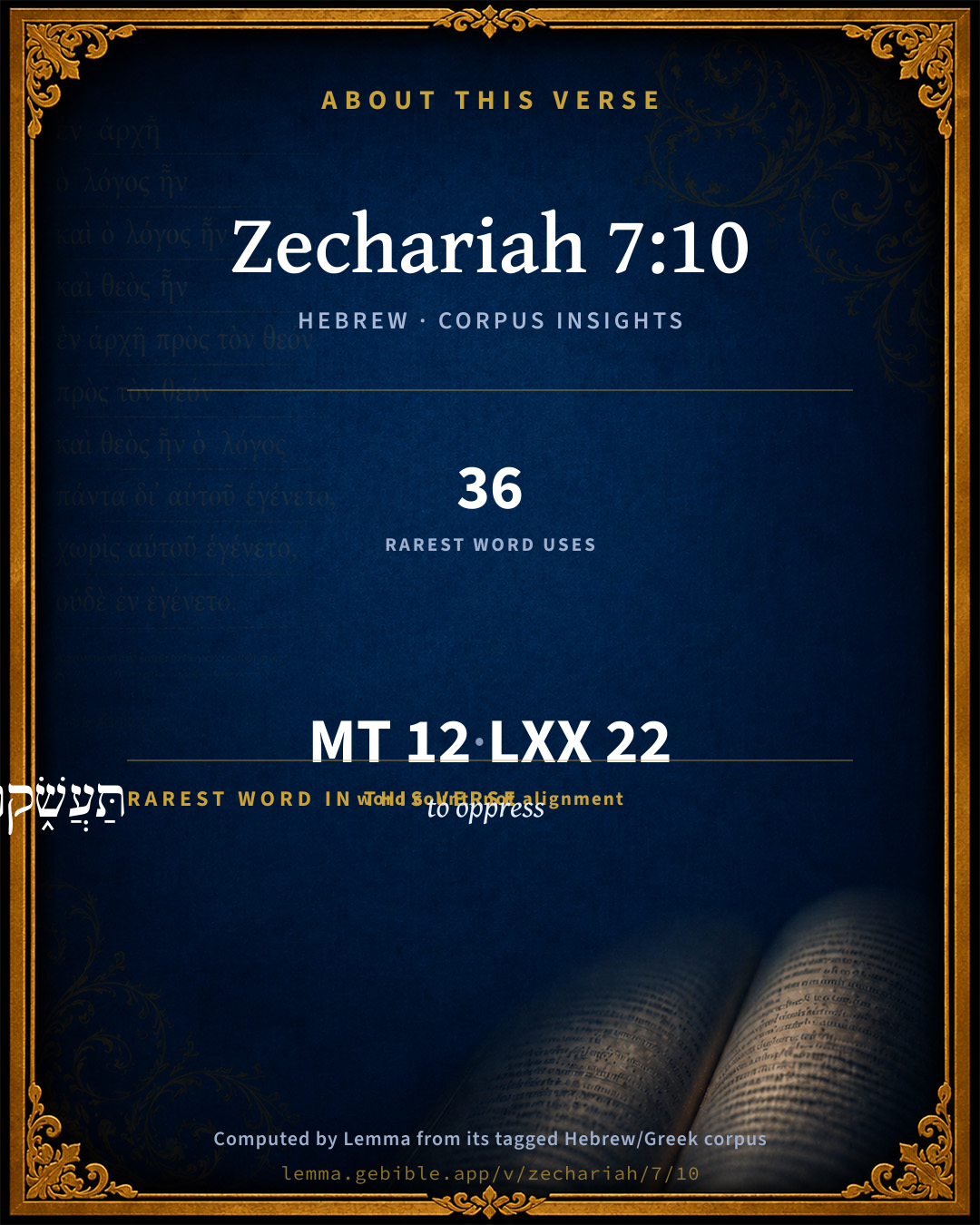
תַּעֲשֹׁ֑קוּ to oppress H6231 occurs in 35 verses of the Hebrew Bible. Also found in:

Grammatical profile

  • 2 verbs
  • 7 nouns
  • 1 adjective
  • 2 particles

Verb forms

  • תַּעֲשֹׁ֑קוּ Qal · Jussive
  • תַּחְשְׁב֖וּ Qal · Jussive

Repetition

A word recurs within this verse — often emphatic in Hebrew:

  • אַֽל not H408 ×2

Hebrew & Septuagint length

In English translation the verse runs 25 words from the Hebrew and 29 from the Septuagint (LXX English) — closely comparable.

A rough comparison of the two English renderings, which tokenize alike — not a word-level alignment.

Word counts can differ between the Hebrew and the Greek without any difference in meaning — e.g. the Hebrew direct-object marker אֵת has no separate Greek word, and Greek often adds the article ὁ.

In the original languages it is 12 Hebrew tokens and 22 Greek tokens — but the two are counted differently (Hebrew bundles its prefixes and suffixes into one token; the Greek is in lemma form), so that isn’t a like-for-like length.

Cross-references

34

Topical passages linked to Zechariah 7:10 in the Treasury of Scripture Knowledge — connected by theme and wording, ordered by reader-vote popularity; previews shown in the World English Bible.

  • Jeremiah 5:28 They are grew fat, they shine: yes, they overpass in deeds of wickedness; they don't plead the cause, the cause of the fatherless, that they may prosper; and the right of the needy they don't judge.
  • Deuteronomy 27:19 Cursed be he who wrests the justice [due] to the foreigner, fatherless, and widow. All the people shall say, Amen.
  • Psalms 21:11 For they intended evil against you. They plotted evil against you which cannot succeed.
  • Psalms 72:4 He will judge the poor of the people. He will save the children of the needy, And will break the oppressor in pieces.
  • Proverbs 22:22–23 Don't exploit the poor, because he is poor; And don't crush the needy in court;
  • Isaiah 1:16–17 Wash yourselves, make yourself clean. Put away the evil of your doings from before my eyes; Cease to do evil.
  • Isaiah 1:23 Your princes are rebellious, and companions of thieves. Everyone loves bribes, and follows after rewards. They don't judge the fatherless, Neither does the cause of the widow come to them.
  • James 5:4 Behold, the wages of the laborers who mowed your fields, which you have kept back by fraud, cry out, and the cries of those who reaped have entered into the ears of the Lord of Hosts.
  • 1 John 3:15 Whoever hates his brother is a murderer, and you know that no murderer has eternal life remaining in him.
  • Exodus 23:9 "You shall not oppress an alien, for you know the heart of an alien, seeing you were aliens in the land of Egypt.
  • Deuteronomy 24:14–18 You shall not oppress a hired servant who is poor and needy, whether he be of your brothers, or of your foreigners who are in your land within your gates:
  • Psalms 140:2 Those who devise mischief in their hearts. They continually gather themselves together for war.
  • Proverbs 3:29 Don't devise evil against your neighbor, Seeing he dwells securely by you.
  • Proverbs 6:18 A heart that devises wicked schemes, Feet that are swift in running to mischief,
  • Proverbs 23:10–11 Don't move the ancient boundary stone. Don't encroach on the fields of the fatherless:
  • Jeremiah 11:19–20 But I was like a gentle lamb that is led to the slaughter; and I didn't know that they had devised devices against me, [saying], Let us destroy the tree with the fruit of it, and let us cut him off from the land of the living, that his name may be no more remembered.
  • Jeremiah 18:18 Then said they, Come, and let us devise devices against Jeremiah; for the law shall not perish from the priest, nor counsel from the wise, nor the word from the prophet. Come, and let us strike him with the tongue, and let us not give heed to any of his words.
  • Jeremiah 22:15–17 Shall you reign, because you strive to excel in cedar? Didn't your father eat and drink, and do justice and righteousness? then it was well with him.
  • Ezekiel 22:7 In you have they set light by father and mother; in the midst of you have they dealt by oppression with the foreigner; in you have they wronged the fatherless and the widow.
  • Ezekiel 22:12 In you have they taken bribes to shed blood; you have taken interest and increase, and you have greedily gained of your neighbors by oppression, and have forgotten me, says the Lord Yahweh.
  • Ezekiel 22:29 The people of the land have used oppression, and exercised robbery; yes, they have vexed the poor and needy, and have oppressed the foreigner wrongfully.
  • Amos 4:1 Listen to this word, you cows of Bashan, who are on the mountain of Samaria, who oppress the poor, who crush the needy, who tell their lords, "Bring, and let us drink."
  • Amos 5:11–12 Forasmuch therefore as you trample on the poor, And take taxes from him of wheat: You have built houses of hewn stone, But you will not dwell in them. You have planted pleasant vineyards, But you shall not drink their wine.
  • Micah 2:1–3 Woe to those who devise iniquity And work evil on their beds! When the morning is light, they practice it, Because it is in the power of their hand.
  • Micah 3:1–4 I said, "Please listen, you heads of Jacob, And rulers of the house of Israel: Isn't it for you to know justice?
  • Zephaniah 3:1–3 Woe to her who is rebellious and polluted, the oppressing city!
  • Zechariah 8:17 and let none of you devise evil in your hearts against his neighbor, and love no false oath: for all these are things that I hate," says Yahweh.
  • Malachi 3:5 I will come near to you to judgment; and I will be a swift witness against the sorcerers, and against the adulterers, and against the perjurers, and against those who oppress the hireling in his wages, the widow, and the fatherless, and who deprive the foreigner of justice, and don't fear me," says Yahweh of Hosts.
  • Matthew 23:13 "Woe to you, scribes and Pharisees, hypocrites! For you devour widows' houses, and as a pretense you make long prayers. Therefore you will receive greater condemnation.
  • Mark 7:21–23 For from within, out of the hearts of men, proceed evil thoughts, adulteries, sexual sins, murders, thefts,
  • 1 Corinthians 6:10 nor thieves, nor covetous, nor drunkards, nor slanderers, nor extortioners, will inherit the Kingdom of God.
  • James 1:14–15 But each one is tempted, when he is drawn away by his own lust, and enticed.
  • Exodus 22:21–24 "You shall not wrong an alien, neither shall you oppress him, for you were aliens in the land of Egypt.
  • Psalms 36:4 He plots iniquity on his bed. He sets himself in a way that is not good; He doesn't abhor evil.

Cross-references courtesy of OpenBible.info (CC BY 4.0).

Hebrew and Greek witnesses Masoretic Hebrew ↔ Greek Septuagint

The same verse in the two great witnesses to the Old Testament, shown verse-for-verse.

These are two independent witnesses, not word-aligned to each other, and the Septuagint is shown in lemma (dictionary) form.

Hebrew Zechariah 7:10 Masoretic · Westminster Leningrad Codex

וְאַלְמָנָ֧ה וְיָת֛וֹם גֵּ֥ר וְעָנִ֖י אַֽל תַּעֲשֹׁ֑קוּ וְרָעַת֙ אִ֣ישׁ אָחִ֔יו אַֽל תַּחְשְׁב֖וּ בִּלְבַבְכֶֽם

Don't oppress the widow, nor the fatherless, the foreigner, nor the poor; and let none of you devise evil against his brother in your heart.'

World English Bible · Public Domain

Greek LXX Zechariah 7:10 Septuagint · lemma form

καί χήρα καί ὀρφανός καί προσήλυτος καί πένης μή καταδυναστεύω καί κακία ἕκαστος ὁ ἀδελφός αὐτός μή μνησικακέω ἐν ὁ καρδία σύ

and oppress not the widow, or the fatherless, or the stranger, or the poor; and let not one of you remember in his heart the injury of his brother.

LXX2012 (modern English Septuagint) · Public Domain

On this verse, Jamieson, Fausset & Brown discusses the Septuagint’s reading. Read the note in Commentary ↓

Hebrew: Westminster Leningrad Codex (CC BY 4.0). Greek: Septuagint (public domain); English from LXX2012 (modern English Septuagint) (Public Domain). How the Septuagint differs from the Hebrew →

Targum (Aramaic paraphrase)

1

The Targum is the ancient Jewish Aramaic paraphrase of the Hebrew Scriptures — an interpretive translation, not the Hebrew text itself. Onkelos (literal) and Pseudo-Jonathan (expansive) render the Torah, and Jonathan the Prophets. Coverage is partial: where no permissively-licensed English translation exists for a verse, only the Aramaic is shown. This is verse-level text, not a word-by-word alignment to the Hebrew.

  1. Targum Jonathan Prophets (Joshua–Malachi)
    וְאַרְמְלָא וִיתָם וְגִיוֹר וּמִסְכֵּן לָא תֵינְסוּן וּבִישַׁת גְבַר עִם אֲחוּהִי לָא תַחְשְׁבוּן בְּלִבְּכוֹן:

    (no public-domain English translation for this verse)

    Targum Jonathan — Aramaic: “Mikraot Gedolot” (public domain). English: “Sefaria Community Translation” (CC0 1.0 (public-domain dedication)); “London "Chaldee Paraphrase," 1871” (public domain). Text via Sefaria.

Commentary

Notes on Zechariah 7:10 from classic Christian and Jewish commentators (each source and its license shown beneath its notes). The classic Christian expositions comment on the surrounding passage and are grouped to its opening verse, so a note may address several verses; the Jewish commentaries on the Tanakh (Rashi and others) are per-verse, so they appear only where the commentator wrote on this verse.

Lemma curates 59 commentaries, every one of them public domain or Creative Commons licensed, each selected and text-cleaned for this edition rather than reprinted as found. About our sources →

Trapp's Complete Commentary

John Trapp

Zec 7:10 And oppress not the widow, nor the fatherless, the stranger, nor the poor; and let none of you imagine evil against his brother in your heart.

Ver. 10. And oppress not the widow, nor the fatherless] Widows and orphans are God’s clients, taken into his special protection.

The stranger] Whose right is so sacred, saith one, that there was never nation so barbarous that would violate the same.

Nor the poor] Whose misery moves compassion without an orator. In the Low Countries they may not beg, but only look pitifully. To grind the faces of such is barbarous cruelty; to wrong them, or but wrangle with them, is called man-eating, Psa 14:4.

And let none of you imagine evil against his brother in your heart] For though you never act it, yet Fecit quisque quantum voluit, He does anything whatever he wished, saith Seneca. It is said, Jos 24:9 "Balak arose and fought with Israel," and yet the story saith nothing so. Sed fieri dicitur quod tentatur aut intenditur, saith Ribera upon Amo 9:5. He did not, because he dared not; yet he is said to have done it because he had a mind to do it. A man may die of an inward bleeding; so of heart sins, which are maioris reatus, greater guilt, as we see in devils, though outward sins are maioris infamiae, greater dishonour, as the schools well observe.

John Trapp, A Commentary or Exposition upon All the Books of the Old and New Testament (1647–1656) — public domain. Text from a community e-Sword module.

Tyndale Open Study Notes

Tyndale Open Resources

7:10 Widows, orphans, foreigners, and the poor often did not have access to the legal protection afforded the average citizen (cp. Deut 24:14, 17-18). Fasting and social justice should go hand in hand (see Isa 58:6-7).

Tyndale Open Study Notes — © Tyndale Open Resources, licensed CC BY-SA 4.0. Text via the HelloAO Bible API.

Jamieson, Fausset & Brown

Robert Jamieson, A. R. Fausset & David Brown

imagine evil--that is, devise evil. The Septuagint takes it, Harbor not the desire of revenge (Lev 19:18). "Devise evil against one another" is simpler (Psa 36:4; Mic 2:1).

Jamieson, Fausset & Brown — Commentary Critical and Explanatory on the Whole Bible (1871) — public domain (CC PDM 1.0). Text via the HelloAO Bible API.

Adam Clarke's Commentary

Verse 10. Evil against his brother in your heart.] Do not indulge an unfavourable opinion of another: do not envy him; do not harbour an unbrotherly feeling towards him.

Adam Clarke's Commentary on the Bible (1810–1826) — public domain. Text from a community e-Sword/MySword module.

John Calvin's Commentaries

He mentions here some other duties, but for the same purpose of showing, that the fear of God is not proved by ceremonies, but by acting justly towards our brethren, and not by abstaining only from doing wrong, but by being ready to help the miserable. As widows, and orphans, and strangers are exposed as it were to plunder, Moses often in the law recommends them to favor, and shows that God cares for them, and will be their defender, when by one injured. So also the Prophet speaks here expressly of widows, and orphans, and strangers, that the Jews might understand, not only that they were to take heed, lest any one, being wronged, should complain, or lest any one should retaliate an injury, but that they were to observe integrity before God; for the ungodly are often terrified by fear, and refrain from doing mischief, because they know that there will be an avenger. Hence it comes that the rich and the opulent are safe from all injuries, because they are surrounded and fortified by strong defences; but the widows and the orphans are not thus able to repel wrongs. This is the reason why the Prophet prefers here to mention widows, and orphans, and strangers, rather than to speak indiscriminately of all the people. For the import of the whole is, as I have reminded you, that the fear of God is not really proved, except when a person cleaves to what is just and right, and is not restrained by fear or shame, but discharges his duty as it were in the presence of God and of his angels, so that he shows favor to the poor and miserable, who are without any to help them. But as I have elsewhere explained this subject more at large, it is enough now briefly to touch on it. Let us proceed —

John Calvin's Commentaries (1540-1563) — public domain. Text from the Calvin Translation Society English edition (1840s-50s) via the Christian Classics Ethereal Library (ccel.org). Calvin's coverage is partial (roughly two-thirds of the Bible); uncommented books and verses are honest gaps, never fabricated. The 19th-century editor's footnotes and remarks are omitted so the notes are faithfully Calvin's own voice.

Ellicott's Commentary for English Readers

(10) And let none of you imagine evil against his brother in your heart.—Better, and imagine not evil against one another in your heart. The LXX., (καὶ κακίαν ἕκαστος τοῦ ἀδελφοῦ αὐτοῦ μὴ μνησικακείτω), and Auth. Version are here grammatically incorrect, the pronoun being not here (as it is in Zec_8:17) the nominative but objective case, as is shown by the collocation.

A Bible Commentary for English Readers, edited by Charles John Ellicott (1878–1897) — public domain. Text from a community e-Sword module.

John Gill's Exposition

Yea, they made their hearts as an adamant stone,.... The word here used is translated a "diamond" in Jer 17:1 and it is said to be harder than a flint, Eze 3:9. The Jewish writers say (g) it is a worm like a barley corn, so strong as to cut the hardest stones in pieces; Moses (they say) used it in hewing the stones for the two tables of the law, and in fitting the precious stones in the ephod; and Solomon in cutting the stones for the building of the temple; and is so hard that it cannot be broken by iron: and as hard is naturally the heart of man, and which becomes more so by sinning, and obstinate persisting in it, that nothing can remove the hardness of it but the powerful and efficacious grace of God: as hard as the adamant is, it is to be softened by the blood of a goat, as naturalists says (h); so the blood of Christ sprinkled on the heart, and a sense of forgiveness of sin by it, will soften the hardest heart:

lest they should hear the law, and the words which the Lord of hosts hath seat in his Spirit by the former prophets; the words of reproof, admonition, caution, and exhortation, which Jeremiah and others were sent to deliver to them, under the influence of the Spirit of God:

therefore came a great wrath from the Lord of hosts; which brought the Chaldeans upon them, who carried them captive into Babylon.

(g) Misn. Sota, c. 9. sect. 12. Pirke Abot. c. 5. sect. 5. & Maimon. & Bartenora in ib. Kimchi in 1 Reg. vi. 7. Jarchi in Isa. v. 6. (h) Pausan. Arcadica, sive l. 8. p. 485. Plin. Nat. Hist. l. 37. c. 4.

John Gill's Exposition of the Whole Bible (1746–1763) — public domain (CC PDM 1.0). Text via the HelloAO Bible API.

Albert Barnes' Notes on the Bible

And oppress not - He had commanded positive acts of love; he now forbids every sort of unlove. “He that oppresseth the poor,” Solomon had said, “reproacheth his Maker. The widow, the orphan, the stranger, the afflicted” Pro 24:31, are, throughout the law, the special objects of God’s care. This was the condition which God made by Jeremiah; “If ye thoroughly amend your ways and your doings, if ye thoroughly execute judgment between a man and his neighbor; if ye oppress not the stranger the fatherless and the widow, and shed not innocent blood in this place, neither walk after other gods to your hurt, then will I cause you to dwell in this, place” Jer 7:5-7. It was on the breach of the covenant to set their brethren free in the year of release, that God said; “I proclaim a liberty for you to the sword, to the pestilence and to the famine, and I will make you to be removed into all the kingdoms of the earth” Jer 34:17.

And let none of you imagine - that is, “devise, as, by Micah, God retorted the evil upon them. They “devised evil on their beds; therefore, behold, against this family do I devise an evil, from which ye shall not remove your necks” Mic 2:1, Mic 2:3.

Albert Barnes' Notes on the Bible (1834–1885) — public domain. Text from a community e-Sword/MySword module.

Haydock's Catholic Bible Commentary

Devise. Septuagint, "wickedly remember in your hearts each one the evil of his brother." (Haydock)

George Leo Haydock (1774–1849), Haydock's Catholic Family Bible and Commentary, 1859 edition — public domain. Excludes Psalms (Douay-Rheims chapter numbering differs from Protestant) and Deuterocanonical books (Catholic canon only).

Matthew Poole's English Annotations

Oppress not; do not first misreport their persons, their actions, and their cases, and on that pretence do them wrong, and oppress them: it is double oppression, to oppress by false information, and then condemn; the first is an oppression of righteousness, the next is oppression of the righteous.

The widow, i.e.: a catalogue of helpless ones, who are under the peculiar tutelage of God, Exo 22:21,22; Deu 10:18; 14:29; 24:17,19; Isa 1:17,23, &c.

Let none of you imagine evil against his brother in your heart; neither think ill of, nor wish ill to, nor plot evil against, one another.

Matthew Poole's English Annotations on the Holy Bible (1683–1685) — public domain. Text from a community e-Sword/MySword module.

The Pulpit Commentary

Oppress not the widow, etc.; (Exo_22:21, 22 Deu_10:18, Deu_10:19) Vulgate, nolite calumniari, where calumniari is used in the sense "to vex, torment." Imagine evil against his brother in year heart. God"s Law forbids even a thought of revenge or injury against a neighbour, for this is only the first step to wrong doing. (comp. Mic_2:1) Septuagint, Kakian ekastov tou adelfou autou mh mnhsikakeitw en taiv kardiav umwn , "Let none of you remember in your hearts the malice of your brother."

The Pulpit Commentary (1880–1919), ed. H.D.M. Spence-Jones & Joseph S. Exell — public domain. Text from a community e-Sword module.

John Wesley's Explanatory Notes

Imagine evil - Neither think ill of, or with ill to, nor plot evil against one another.

John Wesley, Explanatory Notes Upon the Whole Bible (1754–1765) — public domain. Text via the GEBible commentary corpus.

Lesson kit

Teaching starters — assembled from the data on this page, not authored interpretation. Every prompt links to the verse data it draws on. Edit before teaching.

Zechariah, in the Prophets, opens this verse with 12 words (11 distinct Hebrew lemmas). Its most distinctive word is ʻâshaq (“to oppress”). A historical commentator’s framing appears above. Read the whole chapter for the surrounding context.

Discussion questions

  1. What does “to oppress” (ʻâshaq) contribute to the verse as a whole?
  2. How does Leviticus 6:2, which shares the word «to oppress», read alongside this verse?
  3. What does the repetition of “not” (2× in this one verse) do in this verse?
  4. These translations render this verse differently. What is at stake in choosing one wording over another?
  5. «תַּעֲשֹׁ֑קוּ» is a Qal Jussive verb. How does that grammatical form shape the action described?
  6. Compare how Trapp's Complete Commentary and Tyndale Open Study Notes read this verse. Where do they agree or differ?

Things to notice

Reading settings

Reading text

Shown beneath each verse's original-language words.

Old Testament
Old Testament edition

Read the OT as the Masoretic Hebrew (MT) or the Greek Septuagint (LXX).

English shown for the Greek Septuagint (in the Hebrew ↔ Greek comparison).

Comparing translations? Open the Compare panel on any verse page to stack up to four side by side.