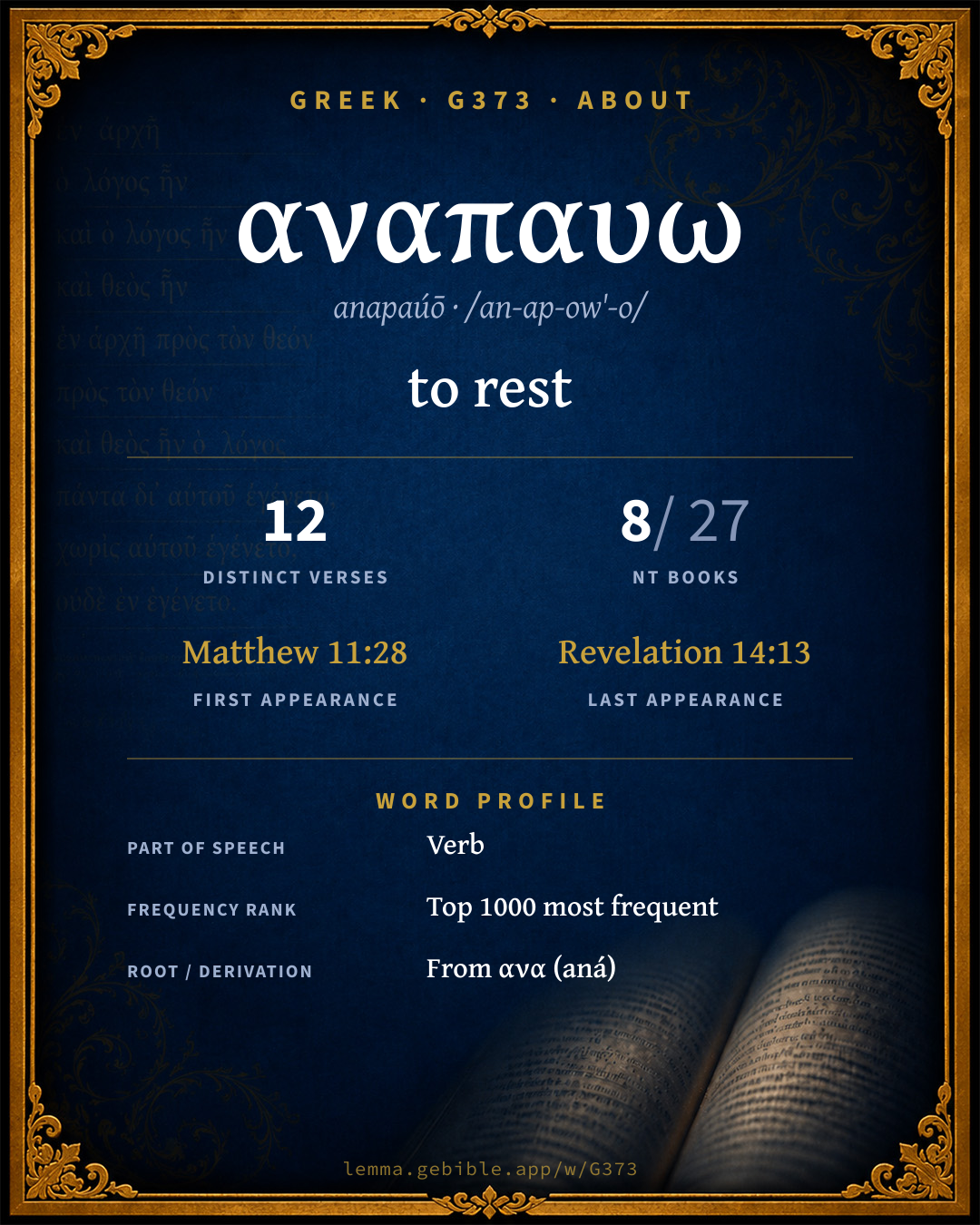
ἀναπαύω
to rest
‘to rest’ is one of 3 main senses fuller range ↓
Full lexicon entry — Thayer's Greek Lexicon
From Thayer's Greek Lexicon
Where this word appears
See every Aorist-tense verb in the Greek New Testament →
Grammar key — what these labels mean
Part of speech
- Verb
- An action or state-of-being word.
Tense
- Present
- Ongoing or general action in present time (imperfective aspect).
- Perfect
- A completed past action with continuing present results.
- Future
- Action expected in future time.
- Aorist
- Action viewed as a simple whole, without regard to duration — often past (perfective aspect).
Voice
- Middle
- The subject acts on or for itself, or with special interest in the action.
- Passive
- The subject receives the action.
- Active
- The subject performs the action.
Mood
- Indicative
- States a fact or asks a factual question (the mood of reality).
- Imperative
- Expresses a command or request.
- Subjunctive
- Expresses probability, purpose, or possibility (the mood of contingency).
Person
- 2nd person
- The one addressed (“you”).
- 3rd person
- The one spoken about (“he / she / it / they”).
- 1st person
- The speaker (“I / we”).
Number
- Plural
- More than one.
- Singular
- One.
Grammatical forms 10 distinct
- Verb, Present, Middle, Indicative, 2nd person, Plural 2 times (17%)
- Verb, Perfect, Passive, Indicative, 3rd person, Singular 2 times (17%)
- Verb, Future, Passive, Indicative, 3rd person, Plural 1 time (8%)
- Verb, Aorist, Active, Indicative, 3rd person, Plural 1 time (8%)
- Verb, Aorist, Active, Imperative, 2nd person, Singular 1 time (8%)
- Verb, Aorist, Middle, Imperative, 2nd person, Plural 1 time (8%)
- Verb, Aorist, Middle, Subjunctive, 3rd person, Plural 1 time (8%)
- Verb, Future, Active, Indicative, 1st person, Singular 1 time (8%)
+2 more forms (2 occurrences)
Parsed forms decoded from the imported morphology (Robinson–Tischendorf, public domain), counted across 12 parsed occurrences — not distinct verses.
Every verse where G373 appears — 12 distinct verses across 8 books. Click any verse to open its interlinear word-by-word view. Verse text shown in the World English Bible for context — . Each verse’s Greek form is shown with its reference; the English is not keyword-highlighted, since the data carries no word-level English alignment. Use “Compare translations” on any verse to read it across multiple English versions. This concordance covers the Greek New Testament; Septuagint (Greek Old Testament) occurrences of this word are not indexed here.
Matthew 2 verses
- Matthew 11:28 ἀναπαύσω fut act ind 1sg "Come to me, all you who labor and are heavily burdened, and I will give you rest.
- Matthew 26:45 ἀναπαύεσθε pres mid ind 2pl Then he came to his disciples, and said to them, "Sleep on now, and take your rest. Behold, the hour is at hand, and the Son of Man is betrayed into the hands of sinners.
Mark 2 verses
- Mark 6:31 ἀναπαύσασθε aor mid impv 2pl He said to them, "You come apart into a deserted place, and rest awhile." For there were many coming and going, and they had no leisure so much as to eat.
- Mark 14:41 ἀναπαύεσθε pres mid ind 2pl He came the third time, and said to them, "Sleep on now, and take your rest. It is enough. The hour has come. Behold, the Son of Man is betrayed into the hands of sinners.
Luke 1 verse
1 Corinthians 1 verse
2 Corinthians 1 verse
Philemon 2 verses
1 Peter 1 verse
Revelation 2 verses
- Revelation 6:11 ἀναπαύσωνται aor mid subj 3pl A long white robe was given to each of them. They were told that they should rest yet for a while, until their fellow servants and their brothers, who would also be killed even as they were, should complete their course.
- Revelation 14:13 ἀναπαήσονται fut pass ind 3pl I heard the voice from heaven saying, "Write, 'Blessed are the dead who die in the Lord from now on.'" "Yes," says the Spirit, "that they may rest from their labors; for their works follow with them."
About this entry
At a glance — auto-summarized from this page’s data, not written by a person. Every figure links to its source below. This summary describes the numbers; it doesn’t interpret them.
The Greek verb αναπαυω centers on the idea of “to rest.” Its earliest occurrence is Matthew 11:28. It turns up in 12 verses across 8 books, an uncommon footprint. Thayer's distinguishes 3 senses for it. It shares a root with ανα, αναβαινω and αναβαλλομαι. For the data behind this summary, explore the sense tree and the renderings breakdown below.
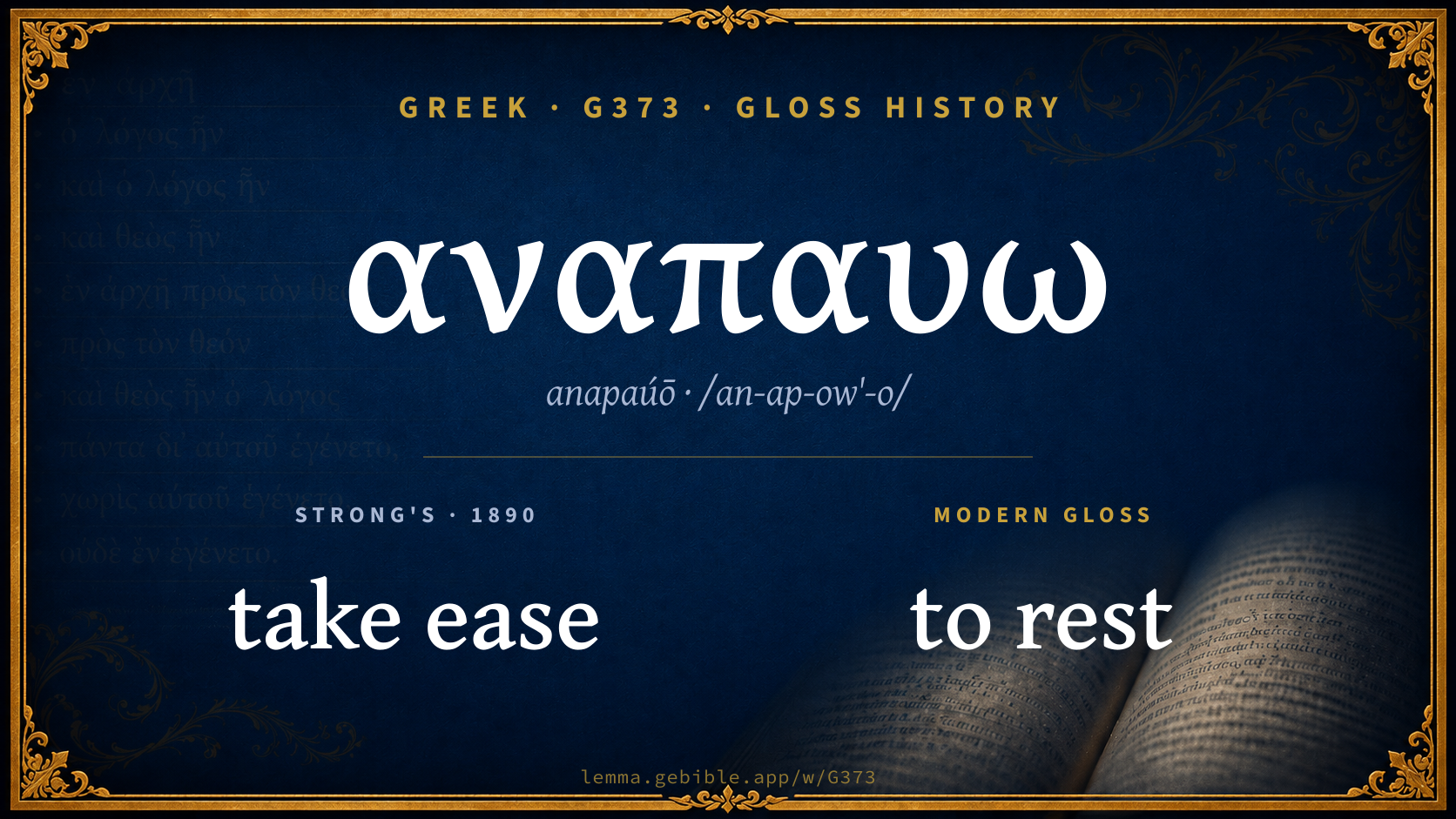
Gloss history
Strong's 1890 vs modern scholarship
About this word
Strong's G373 catalogs a Greek word from the Greek New Testament.
These counts are not copied from any lexicon or concordance. They are computed here, from the morphology-tagged Greek New Testament. What Lemma adds →
- 12
- distinct verses
- The word appears in 12 distinct verses.
- 8 / 27
- NT books
- The word appears in 8 of 27 New Testament books.
- #904
- by frequency
- Top 1000 most frequent Greek words (rank 904 of 5,347 Greek words by occurrence).
View all 12 occurrences in the concordance →
By section of the New Testament
By traditional corpus
Conventional, traditional groupings — biblical authorship is debated, so this is a traditional corpus grouping, not an authorship claim. Some books belong to more than one corpus (Luke is in both the Gospels and the Lukan corpus, and so on), so these shares overlap and need not total 100%. Each figure is a share of the word’s 12 distinct verses.
- Gospels 5 verses · 42%
- Pauline corpus 4 verses · 33%
- Johannine 2 verses · 17%
- Revelation 2 verses · 17%
- Lukan (Luke–Acts) 1 verse · 8%
- General (Catholic) Epistles 1 verse · 8%
How translations render this word
Counts come from each version’s own published word-to-Strong’s tagging or interlinear alignment — an approximate guide to how each version renders this word, not a word-level alignment the data otherwise carries. Because each total is that version’s own tagged count, the per-version totals vary from one another and need not match the appearance or distinct-verse counts above. These counts may also differ from a printed concordance because Lemma counts each distinctly tagged rendering and does not collapse phrase taggings into a single head-word total. This is a fixed set of word-tagged versions (KJV, ASV, BSB, ULT) and does not change with the reading translation you choose elsewhere. Each version’s license is shown beside its name below (and on Sources).
- King James Version: Rest 2×, Take your rest 2×
- American Standard Version: Rest 3×
- Berean Standard Bible: Resting 2×
- unfoldingWord Literal Text: Rest 2×, Resting 2×
King James Version Public Domain
Renders G373 across 13 tagged occurrences — most commonly:
Plus 9 renderings that appear only once — usually multi-word phrases or single function words the recovered tagging swept in, not distinct renderings.
American Standard Version Public Domain
Renders G373 across 15 tagged occurrences — most commonly:
Plus 12 renderings that appear only once — usually multi-word phrases or single function words the recovered tagging swept in, not distinct renderings.
Berean Standard Bible Public Domain
Renders G373 across 12 tagged occurrences — most commonly:
Plus 10 renderings that appear only once — usually multi-word phrases or single function words the recovered tagging swept in, not distinct renderings.
unfoldingWord Literal Text CC BY-SA 4.0
Renders G373 across 13 tagged occurrences — most commonly:
Plus 9 renderings that appear only once — usually multi-word phrases or single function words the recovered tagging swept in, not distinct renderings.
Senses in Thayer's
The 3 senses Thayer's distinguishes for this word, in lexicon order (not ranked by frequency or importance). The full entry — with sub-senses — is in the Lexicon Entry tab.
- to cause or permit one to cease from any movement or labour in order to recover and collect his strength
- to give rest, refresh, to give one's self rest, take rest
- to keep quiet, of calm and patient expectation
Word origin
Derived from ανα (aná) (G303) — among.
Forms in the corpus
The 10 distinct written forms G373 takes in the Greek New Testament, most frequent first — each parse links to that tense’s occurrences in the concordance.
| Form | Parsing | Example | Uses |
|---|---|---|---|
| ἀναπέπαυται anapépautai | Verb, Perfect, Passive, Indicative, 3rd person, Singular | 2 Corinthians 7:13 | 2 |
| ἀναπαύεσθε anapaúesthe | Verb, Present, Middle, Indicative, 2nd person, Plural | Matthew 26:45 | 2 |
| ἀνάπαυσόν anápausón | Verb, Aorist, Active, Imperative, 2nd person, Singular | Philemon 1:20 | 1 |
| ἀνέπαυσαν anépausan | Verb, Aorist, Active, Indicative, 3rd person, Plural | 1 Corinthians 16:18 | 1 |
| ἀναπαήσονται anapaḗsontai | Verb, Future, Passive, Indicative, 3rd person, Plural | Revelation 14:13 | 1 |
| ἀναπαύεται anapaúetai | Verb, Present, Middle, Indicative, 3rd person, Singular | 1 Peter 4:14 | 1 |
| ἀναπαύου anapaúou | Verb, Present, Middle, Imperative, 2nd person, Singular | Luke 12:19 | 1 |
| ἀναπαύσασθε anapaúsasthe | Verb, Aorist, Middle, Imperative, 2nd person, Plural | Mark 6:31 | 1 |
| ἀναπαύσω anapaúsō | Verb, Future, Active, Indicative, 1st person, Singular | Matthew 11:28 | 1 |
| ἀναπαύσωνται anapaúsōntai | Verb, Aorist, Middle, Subjunctive, 3rd person, Plural | Revelation 6:11 | 1 |
Same root — word family
Other Thayer's entries built from the same root as G373, grouped by Strong’s listed origin. These share a root / origin per the lexicon — not necessarily a shared meaning. Each links to that word’s own entry.
Derives from
Shares the same root
- αναβαινω anabaínō G305 to ascend
- αναβαλλομαι anabállomai G306 to delay
- αναβιβαζω anabibázō G307 to draw up
- αναβλεπω anablépō G308 to look up
- αναβοαω anaboáō G310 to cry out
- αναγγελλω anangéllō G312 to announce
- αναγενναω anagennáō G313 to be born again
- αναγινωσκω anaginṓskō G314 to recognize
- αναγκη anánkē G318 necessity
- αναγνωριζομαι anagnōrízomai G319 to recognize
- αναγω anágō G321 to lead up
- αναδεικνυμι anadeíknymi G322 to proclaim
- αναδεχομαι anadéchomai G324 to take up
- αναδιδωμι anadídōmi G325 to give forth
- αναζαω anazáō G326 to live again
- αναζητεω anazētéō G327 to search out
- αναζωννυμι anazṓnnymi G328 to gird up
- αναζωπυρεω anazōpyréō G329 to inflame
- αναθαλλω anathállō G330 to sprout up
- αναθεωρεω anatheōréō G333 to observe
- αναιρεω anairéō G337 to take away
- ανακαθιζω anakathízō G339 to sit up
- ανακαινιζω anakainízō G340 to renew
- ανακαινοω anakainóō G341 to make new
+51 more words share this root (not shown).
Derived from this word
Compare all same-root words → Showing 4 of 78 — not the complete family. They share a root, not necessarily a meaning.
Septuagint usage
The same Greek word αναπαυω appears 72 times in the Greek Old Testament (Septuagint), across 68 verses in 23 books.
- 72
- LXX occurrences
- Tagged occurrences of this Greek word in the Septuagint.
- 68
- verses
- Distinct Septuagint verses containing this word.
- 23 / 39
- OT books
- The word appears in 23 of the 39 Old Testament books.
Sample Septuagint occurrences
- Genesis 5:29 ἀναπαύω
- Exodus 23:12 ἀναπαύω
- Leviticus 25:2 ἀναπαύω
- Numbers 11:25 ἀναπαύω
- Deuteronomy 5:14 ἀναπαύω
- 1 Samuel 16:16 ἀναπαύω
- 2 Samuel 7:11 ἀναπαύω
- 1 Kings 5:18 ἀναπαύω
- 2 Kings 2:15 ἀναπαύω
- 1 Chronicles 22:9 ἀναπαύω
- Ezra 19:28 ἀναπαύω
- Esther 9:16 ἀναπαύω
Septuagint occurrences (same lexeme)
Every verse where the same Strong’s number (G373) appears in the Greek Septuagint — showing the first 50 of 68. Verse text shown in the World English Bible for context; the Greek form is the matched word — the English is not keyword-highlighted.
- Genesis 5:29 ἀναπαύω and he named him Noah, saying, "This same will comfort us in our work and in the toil of our hands, because of the ground which Yahweh has cursed."
- Genesis 29:2 ἀναπαύω He looked, and behold, a well in the field, and, behold, three flocks of sheep lying there by it. For out of that well they watered the flocks. The stone on the well's mouth was great.
- Genesis 49:14 ἀναπαύω "Issachar is a strong donkey, Lying down between the saddlebags.
- Exodus 23:12 ἀναπαύω "Six days you shall do your work, and on the seventh day you shall rest, that your ox and your donkey may have rest, and the son of your handmaid, and the alien may be refreshed.
- Leviticus 25:2 ἀναπαύω "Speak to the children of Israel, and tell them, 'When you come into the land which I give you, then the land shall keep a Sabbath to Yahweh.
- Numbers 11:25 ἀναπαύω Yahweh came down in the cloud, and spoke to him, and took of the Spirit that was on him, and put it on the seventy elders: and it happened that when the Spirit rested on them, they prophesied, but they did so no more.
- Numbers 11:26 ἀναπαύω But there remained two men in the camp, the name of the one was Eldad, and the name of the other Medad: and the Spirit rested on them; and they were of those who were written, but had not gone out to the Tent; and they prophesied in the camp.
- Numbers 24:9 ἀναπαύω He couched, he lay down as a lion, As a lioness; who shall rouse him up? Blessed be everyone who blesses you, Cursed be everyone who curses you.
- Deuteronomy 5:14 ἀναπαύω but the seventh day is a Sabbath to Yahweh your God: [in it] you shall not do any work, you, nor your son, nor your daughter, nor your man-servant, nor your maid-servant, nor your ox, nor your donkey, nor any of your cattle, nor your stranger who is within your gates; that your man-servant and your maid-servant may rest as well as you.
- Deuteronomy 28:65 ἀναπαύω Among these nations shall you find no ease, and there shall be no rest for the sole of your foot: but Yahweh will give you there a trembling heart, and failing of eyes, and pining of soul;
- Deuteronomy 33:20 ἀναπαύω Of Gad he said, Blessed be he who enlarges Gad: He dwells as a lioness, Tears the arm, yes, the crown of the head.
- 1 Samuel 16:16 ἀναπαύω Let our lord now command your servants who are before you, to seek out a man who is a skillful player on the harp: and it shall happen, when the evil spirit from God is on you, that he shall play with his hand, and you shall be well.
- 2 Samuel 7:11 ἀναπαύω and [as] from the day that I commanded judges to be over my people Israel; and I will cause you to rest from all your enemies. Moreover Yahweh tells you that Yahweh will make you a house.
- 1 Kings 5:18 ἀναπαύω Solomon's builders and Hiram's builders and the Gebalites did fashion them, and prepared the timber and the stones to build the house.
- 2 Kings 2:15 ἀναπαύω When the sons of the prophets who were at Jericho over against him saw him, they said, The spirit of Elijah does rest on Elisha. They came to meet him, and bowed themselves to the ground before him.
- 2 Kings 5:18 ἀναπαύω In this thing Yahweh pardon your servant: when my master goes into the house of Rimmon to worship there, and he leans on my hand, and I bow myself in the house of Rimmon, when I bow myself in the house of Rimmon, Yahweh pardon your servant in this thing.
- 2 Kings 7:2 ἀναπαύω Then the captain on whose hand the king leaned answered the man of God, and said, Behold, if Yahweh should make windows in heaven, might this thing be? He said, Behold, you shall see it with your eyes, but shall not eat of it.
- 2 Kings 7:17 ἀναπαύω The king appointed the captain on whose hand he leaned to have the charge of the gate: and the people trod on him in the gate, and he died as the man of God had said, who spoke when the king came down to him.
- 1 Chronicles 22:9 ἀναπαύω Behold, a son shall be born to you, who shall be a man of rest; and I will give him rest from all his enemies round about; for his name shall be Solomon, and I will give peace and quietness to Israel in his days:
- 1 Chronicles 22:18 ἀναπαύω Isn't Yahweh your God with you? Hasn't he given you rest on every side? for he has delivered the inhabitants of the land into my hand; and the land is subdued before Yahweh, and before his people.
- Ezra 19:28 ἀναπαύω
- Esther 9:16 ἀναπαύω The other Jews who were in the king's provinces gathered themselves together, and stood for their lives, and had rest from their enemies, and killed of those who hated them seventy-five thousand; but they didn't lay their hand on the spoil.
- Esther 9:17 ἀναπαύω [This was done] on the thirteenth day of the month Adar; and on the fourteenth day of the same they rested, and made it a day of feasting and gladness.
- Esther 9:18 ἀναπαύω But the Jews who were in Shushan assembled together on the thirteenth [day] of it, and on the fourteenth of it; and on the fifteenth [day] of the same they rested, and made it a day of feasting and gladness.
- Esther 9:22 ἀναπαύω as the days in which the Jews had rest from their enemies, and the month which was turned to them from sorrow to gladness, and from mourning into a good day; that they should make them days of feasting and gladness, and of sending portions one to another, and gifts to the needy.
- Job 2:9 ἀναπαύω Then his wife said to him, "Do you still maintain your integrity? Renounce God, and die."
- Job 3:13 ἀναπαύω For now should I have lain down and been quiet. I should have slept, then I would have been at rest,
- Job 3:17 ἀναπαύω There the wicked cease from troubling; There the weary are at rest.
- Job 3:26 ἀναπαύω I am not at ease, neither am I quiet, neither have I rest; But trouble comes."
- Job 10:20 ἀναπαύω Aren't my days few? Cease then, Leave me alone, that I may find a little comfort,
- Job 13:13 ἀναπαύω "Be silent, leave me alone, that I may speak. Let come on me what will.
- Job 32:20 ἀναπαύω I will speak, that I may be refreshed. I will open my lips and answer.
- Proverbs 21:16 ἀναπαύω The man who wanders out of the way of understanding Shall rest in the assembly of the dead.
- Proverbs 21:20 ἀναπαύω There is precious treasure and oil in the dwelling of the wise; But a foolish man swallows it up.
- Proverbs 29:17 ἀναπαύω Correct your son, and he will give you peace; Yes, he will bring delight to your soul.
- Ecclesiastes 7:9 ἀναπαύω Don't be hasty in your spirit to be angry, for anger rests in the bosom of fools.
- Isaiah 7:19 ἀναπαύω They shall come, and shall all rest in the desolate valleys, in the clefts of the rocks, on all thorn-hedges, and on all pastures.
- Isaiah 11:2 ἀναπαύω The Spirit of Yahweh shall rest on him, the spirit of wisdom and understanding, the spirit of counsel and might, the spirit of knowledge and of the fear of Yahweh.
- Isaiah 11:6 ἀναπαύω The wolf shall dwell with the lamb, and the leopard shall lie down with the kid; and the calf and the young lion and the fattened calf together; and a little child shall lead them.
- Isaiah 13:20 ἀναπαύω It shall never be inhabited, neither shall it be lived in from generation to generation: neither shall the Arabian pitch tent there; neither shall shepherds make their flocks to lie down there.
- Isaiah 13:21 ἀναπαύω But wild animals of the desert shall lie there; and their houses shall be full of doleful creatures; and ostriches shall dwell there, and wild goats shall dance there.
- Isaiah 14:1 ἀναπαύω For Yahweh will have compassion on Jacob, and will yet choose Israel, and set them in their own land: and the foreigner shall join himself with them, and they shall cleave to the house of Jacob.
- Isaiah 14:4 ἀναπαύω that you shall take up this parable against the king of Babylon, and say, How has the oppressor ceased! the golden city ceased!
- Isaiah 14:7 ἀναπαύω The whole earth is at rest, [and] is quiet: they break forth into singing.
- Isaiah 14:30 ἀναπαύω The firstborn of the poor shall feed, and the needy shall lie down in safety; and I will kill your root with famine, and your remnant shall be killed.
- Isaiah 27:10 ἀναπαύω For the fortified city is solitary, a habitation deserted and forsaken, like the wilderness: there shall the calf feed, and there shall he lie down, and consume the branches of it.
- Isaiah 32:16 ἀναπαύω Then justice shall dwell in the wilderness; and righteousness shall abide in the fruitful field.
- Isaiah 32:18 ἀναπαύω My people shall abide in a peaceable habitation, and in safe dwellings, and in quiet resting-places.
- Isaiah 34:14 ἀναπαύω The wild animals of the desert shall meet with the wolves, and the wild goat shall cry to his fellow; yes, the night-monster shall settle there, and shall find her a place of rest.
- Isaiah 34:17 ἀναπαύω He has cast the lot for them, and his hand has divided it to them by line: they shall possess it forever; from generation to generation shall they dwell therein.
These are occurrences of the same Greek lexeme (G373) in the Septuagint — not a translation of any one Hebrew word. The store carries no word-level Hebrew↔Greek alignment, so no Hebrew original is asserted here. Counts come from the recovered LXX Strong's tagging — high-frequency vocabulary is well covered, while rare or late forms may be untagged — so they reflect tagged occurrences and may slightly undercount.