
Philemon 1:20

Greek (Tischendorf 8th ed.) Philemon 1:20 appears in the Greek New Testament. The text above is from the Tischendorf 8th edition. Each word links to its Strong’s number and a concise gloss. Click any word for its full Thayer’s Greek Lexicon entry.
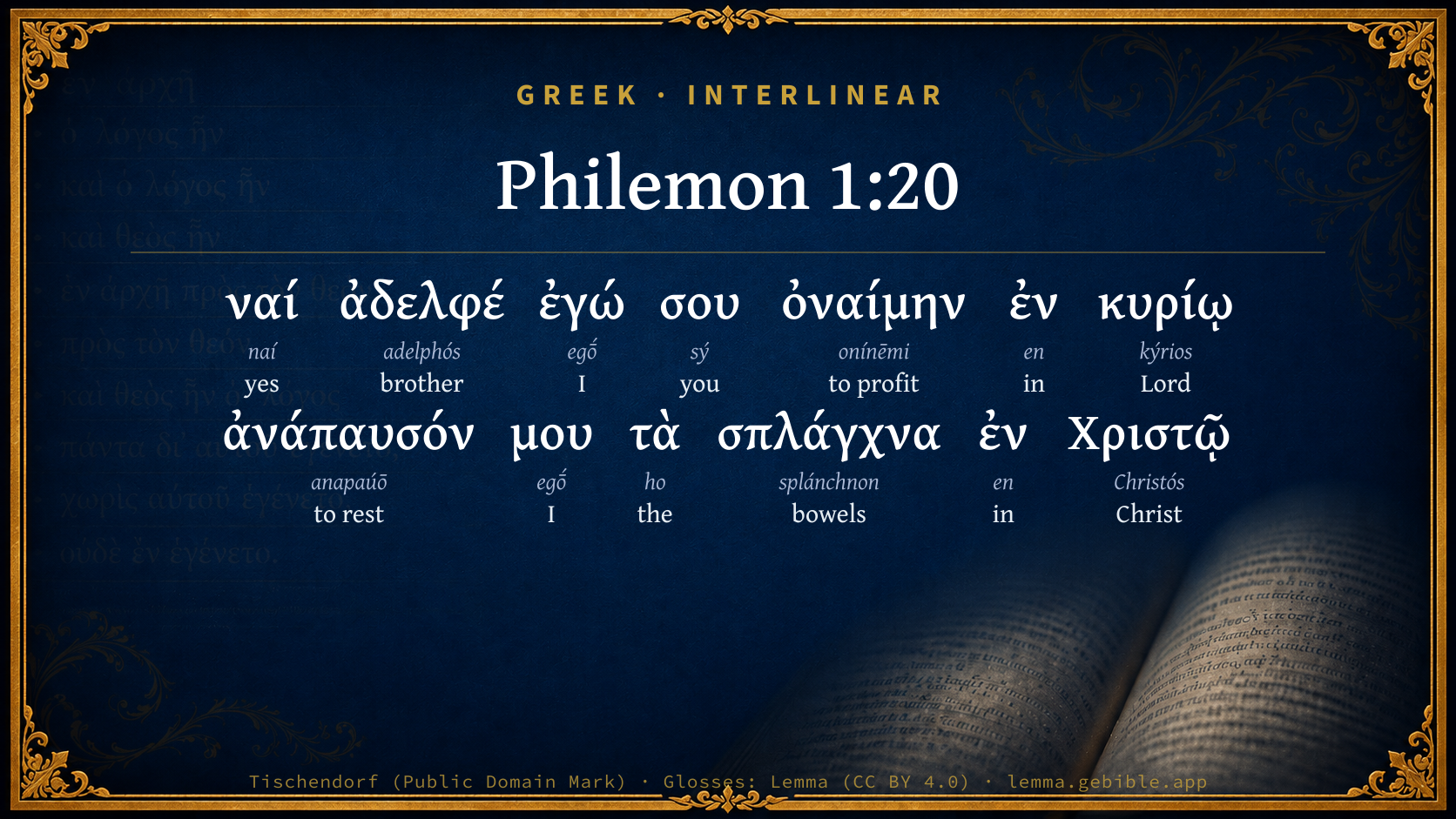
Download image
Cite this verse

Philemon 1:20 (World English Bible). Public Domain. Lemma interlinear Bible study tool, https://lemma.gebible.app/v/philemon/1/20.

Show BibTeX & RIS
BibTeX
RIS
English Translation
Yes, brother, let me have joy from you in the Lord. Refresh my heart in the Lord.
World English Bible · Public Domain
Highlights
  • 1 hapax legomenon — only here in the Greek New Testament
  • 1 first appearance in the Greek New Testament
Full analysis ↓
Download a study sheet

One document with this verse’s original text, its word-by-word gloss line, the meaning frame, cross-references with their text, attributed commentary, and full source and license credits — printable, and it pastes into notes with its structure intact.

This verse Autodidact and up

Study sheet (.html) Plain text (.txt)

A passage Seminary Student

Up to 50 verses in one chapter. A passage sheet keeps up to 6 commentary sources and 12 cross-references per verse, in the order this page ranks them, and says so on the sheet whenever that leaves anything out. Ask for a single verse and you get the Autodidact verse sheet above.

Everything on this page stays free to read, with no account — the sheet is a download of what is already on screen, not access to it.

Want to remove ads? Support Godless Engineer
Compare translations 3

The same verse in 3 English versions, stacked beneath the original-language interlinear above. Click any original word for its lexicon entry.

Each is an independent rendering of the whole verse — the interlinear is not word-aligned to these translations.

Highlighted words mark where these versions differ — a whole-verse word diff, not a word-by-word alignment.

  • World English Bible Public Domain
    Yes, brother, let me have joy from you in the Lord. Refresh my heart in the Lord.
  • King James Version Public Domain
    Yea, brother, let me have joy of thee in the Lord: refresh my bowels in the Lord.
  • unfoldingWord Literal Text CC BY-SA 4.0
    Yes, brother, may I benefit from you in the Lord; refresh my inner parts in Christ.

unfoldingWord Literal Text — © unfoldingWord, licensed CC BY-SA 4.0. Word-aligned USFM3 via Door43 (git.door43.org/unfoldingWord/en_ult).

Versions to compare (up to 4)

3 of 4 selected

Show all 19 translations

Every available English version of this verse, each an independent rendering of the whole verse.

  • World English Bible Public Domain
    Yes, brother, let me have joy from you in the Lord. Refresh my heart in the Lord.
  • Berean Standard Bible Public Domain
    Yes, brother, let me have some benefit from you in the Lord. Refresh my heart in Christ.
  • Majority Standard Bible Public Domain
    Yes, brother, let me have some benefit from you in the Lord. Refresh my heart in the Lord.
  • King James Version Public Domain
    Yea, brother, let me have joy of thee in the Lord: refresh my bowels in the Lord.
  • American Standard Version (1901) Public Domain
    Yea, brother, let me have joy of thee in the Lord: refresh my heart in Christ.
  • Revised Version (1885) Public Domain
    Yea, brother, let me have joy of thee in the Lord: refresh my heart in Christ.
  • Geneva Bible (1599) Public Domain
    Yea, brother, let mee obteine this pleasure of thee in the Lord: comfort my bowels in the Lord.
  • Douay-Rheims (1899) Public Domain
    Yea, brother. May I enjoy thee in the Lord. Refresh my bowels in the Lord.
  • Young's Literal Translation Public Domain
    Yes, brother, may I have profit of thee in the Lord; refresh my bowels in the Lord;
  • Literal Standard Version CC BY-SA 4.0
    Yes, brother, may I have profit of you in the LORD; refresh my yearnings in the LORD;
  • Unlocked Literal Bible CC BY-SA 4.0
    Yes, brother, do me a favor in the Lord; refresh my heart in Christ.
  • unfoldingWord Literal Text CC BY-SA 4.0
    Yes, brother, may I benefit from you in the Lord; refresh my inner parts in Christ.
  • Darby Bible Public Domain
    Yea, brother, *I* would have profit of *thee* in [the] Lord: refresh my bowels in Christ.
  • World Messianic Bible Public Domain
    Yes, brother, let me have joy from you in the Lord. Refresh my heart in the Lord.
  • Webster's Bible Public Domain
    Yes, brother, let me have joy of thee in the Lord: refresh my bowels in the Lord.
  • Free Bible Version CC BY-SA 4.0
    Yes, brother, I'm expecting this favor from you in the Lord; please make me happy in Christ.
  • Bible in Basic English Public Domain
    So brother, let me have joy of you in the Lord: give new life to my heart in Christ.
  • Text-Critical English NT CC BY 4.0
    Yes, brother, let me have some benefit from yoʋ in the Lord. Refresh my heart in the Lord.
  • Tyndale New Testament (1534) Public Domain
    Even so brother let me enioye the in the Lorde. Comforte my bowels in the Lorde.

Literal Standard Version (2020), Covenant Press — licensed CC BY-SA 4.0. Text via the HelloAO Bible API (eBible.org). Unlocked Literal Bible (unfoldingWord) — licensed CC BY-SA 4.0. Text via the HelloAO Bible API (eBible.org). unfoldingWord Literal Text — © unfoldingWord, licensed CC BY-SA 4.0. Word-aligned USFM3 via Door43 (git.door43.org/unfoldingWord/en_ult). Free Bible Version, Dr. Jonathan Gallagher — licensed CC BY-SA 4.0. Text via the HelloAO Bible API (eBible.org).

Word by word

More ways to search: Search by grammar → Find every occurrence → Compare this word →

Practice this passage: Drill this verse → Learn its vocabulary →

ὀναίμην
onínēmi
G3685
“to profit”
Verb, Aorist, Middle deponent, Optative, 1st person, Singular
Part of Speech
Verb
Tense
Aorist
Voice
Middle deponent
Mood
Optative
Person
1st person
Number
Singular
Full Thayer's Definition

Origin: a prolonged form of an apparently primary verb (onomai, to slur), for which another prolonged form (onao) is used as an alternate in some tenses [unless indeed it be identical with the base of G3686 through the idea of notoriety]

TDNT: None

1. to be useful, to profit, help 2. to receive profit or advantage, be helped [or have joy]
  1. ναί naí G3483 “yes” Particle
  2. ἀδελφέ adelphós G80 “brother” Noun, Vocative, Singular, Masculine
  3. ἐγώ egṓ G1473 “I” Personal pronoun, 1st person, Nominative, Singular
  4. σου sý G4771 “you” Personal pronoun, 2nd person, Genitive, Singular
  5. ἐν en G1722 “in” Preposition
  6. κυρίῳ kýrios G2962 “Lord” Noun, Dative, Singular, Masculine
  7. ἀνάπαυσόν anapaúō G373 “to rest” Verb, Aorist, Active, Imperative, 2nd person, Singular
  8. μου egṓ G1473 “I” Personal pronoun, 1st person, Genitive, Singular
  9. τὰ ho G3588 “the” Article, Accusative, Plural, Neuter
  10. σπλάγχνα splánchnon G4698 “bowels” Noun, Accusative, Plural, Neuter
  11. ἐν en G1722 “in” Preposition
  12. Χριστῷ Christós G5547 “Christ” Noun, Dative, Singular, Masculine

About this verse

These counts appear in no published source. They are computed here, from the morphology-tagged text and Lemma’s own curated glosses. What Lemma adds →

13
words
11
distinct lemmas
Pauline Epistles
section

Notable vocabulary

1 hapax legomenon — a word that appears only here in the entire Greek New Testament:

  • ὀναίμην to profit G3685

First appearance in Scripture

This word makes its first canonical appearance in the Greek New Testament here:

  • ὀναίμην to profit G3685

Shared distinctive vocabulary

σπλάγχνα bowels G4698 occurs in 11 verses of the Greek New Testament. Also found in:

Repetition

Words recur within this verse:

Cross-references

13

Topical passages linked to Philemon 1:20 in the Treasury of Scripture Knowledge — connected by theme and wording, ordered by reader-vote popularity; previews shown in the World English Bible.

  • Philemon 1:7 For we have much joy and comfort in your love, because the hearts of the saints have been refreshed through you, brother.
  • 3 John 1:4 I have no greater joy than this, to hear about my children walking in truth.
  • Philemon 1:12 I am sending him back. Therefore receive him, that is, my own heart,
  • Hebrews 13:17 Obey your leaders and submit to them, for they watch on behalf of your souls, as those who will give account, that they may do this with joy, and not with groaning, for that would be unprofitable for you.
  • 2 Corinthians 2:2 For if I make you sorry, then who will make me glad but he who is made sorry by me?
  • 2 Corinthians 7:4–7 Great is my boldness of speech toward you. Great is my boasting on your behalf. I am filled with comfort. I overflow with joy in all our affliction.
  • 2 Corinthians 7:13 Therefore we have been comforted. In our comfort we rejoiced the more exceedingly for the joy of Titus, because his spirit has been refreshed by you all.
  • Philippians 1:8 For God is my witness, how I long after all of you in the tender mercies of Christ Jesus.
  • Philippians 2:1–2 If there is therefore any exhortation in Christ, if any consolation of love, if any fellowship of the Spirit, if any tender mercies and compassion,
  • Philippians 4:1 Therefore, my brothers, beloved and longed for, my joy and crown, so stand firm in the Lord, my beloved.
  • 1 Thessalonians 2:19–20 For what is our hope, or joy, or crown of rejoicing? Isn't it even you, before our Lord Jesus at his coming?
  • 1 Thessalonians 3:7–9 for this cause, brothers, we were comforted over you in all our distress and affliction through your faith.
  • 1 John 3:17 But whoever has the world's goods, and sees his brother in need, and closes his heart of compassion against him, how does the love of God remain in him?

Cross-references courtesy of OpenBible.info (CC BY 4.0).

Where the printed editions differ

1 variant

Places in this verse where the major printed Greek editions disagree on the wording in a way that affects the translation — a comparison of editions, not a manuscript-by-manuscript collation. The editions are the modern critical texts (Nestlé-Aland 28/27, SBL, Westcott-Hort, Tregelles, Tyndale House) and the traditional texts behind the KJV (the Textus Receptus and the Byzantine/Majority text). It is not a claim about which reading is original.

  1. Different wording
    Χριστῷ.

    “Christ.”

    In NA28NA27TynSBLWHTreg Not in TRByz

    κυρίῳ (kuriō) 'Lord' occurs in traditional manuscripts (TR+Byz) instead of Χριστῷ.¶ (Christō) 'Christ.' in older manuscripts (NA28+NA27+Tyn+SBL+WH+Treg)

Textual data: Translators Amalgamated Greek New Testament (STEPBible TAGNT) · CC BY 4.0.

Commentary

Notes on Philemon 1:20 from classic Christian and Jewish commentators (each source and its license shown beneath its notes). The classic Christian expositions comment on the surrounding passage and are grouped to its opening verse, so a note may address several verses; the Jewish commentaries on the Tanakh (Rashi and others) are per-verse, so they appear only where the commentator wrote on this verse.

Lemma curates 59 commentaries, every one of them public domain or Creative Commons licensed, each selected and text-cleaned for this edition rather than reprinted as found. About our sources →

The Biblical Illustrator

Joseph S. Exell

Phm_1:20

Let me have joy of thee in the lord--In that thou doest what thou doest through the grace of Christ, through His dwelling in thee, and particularly thou imitatest Him in the breaking of bonds and freeing the captive.

(M. F. Sadler, M. A.)

Christ the true sphere of action

If Philemon receives his slave for Christs sake and in the strength of that communion with Christ which fits for all virtue, and so for this good deed a deed which is of too high and rare a strain of goodness for his unaided nature then in Christ he will be helpful to the apostle. In that case, the phrase expresses the element or sphere in which the act is done. But it may apply rather, or even also, to Paul, and then it expresses the element or sphere in which he is helped and refreshed. In communion with Jesus, taught and inspired by Him, the apostle is brought to such true and tender sympathy with the runaway that his heart is refreshed, as by a cup of cold water, by kindness shown to him. Such keen sympathy is as much beyond the reach of nature as Philemons kindness would be. Both are in Christ. (A. Maclaren, D. D.)

Provoked to virtue by a good example

Let me have profit of thee. There is here a play on the slaves name, and the words are equivalent to, Be thou to me an Onesimus. He would extinguish the rising feeling of conscious merit and of boasting Philemon might entertain in compliance, and reminds him that by such compliance he would still be less helpful to him than had been Onesimus. He had Pauls messenger, servant, fellow worshipper, and friend, and all he would have Philemon do was so to act as not to allow one of so despised a class to surpass him in generosity. It is good for men that are provoked to emulation by the Christian virtues of those around them. Their presence slays pride and inflames zeal, and invites to effort and to prayer, and makes it matter for shame even should slender abilities and advantages cast superior endowments into shade, should a Philemon be surpassed in Christian feeling and usefulness by an Onesimus. (R. Nisbet, D. D.)

The Biblical Illustrator, edited by Joseph S. Exell (c. 1880s–1900s) — public domain. Text from a community e-Sword module.

The Preacher's Complete Homiletical Commentary

Joseph S. Exell (gen. ed.)

CRITICAL AND EXPLANATORY NOTES

Phm_1:20. Let me have joy.—The apostle appeals to what has been a customary thing with Philemon (Phm_1:7). The verb is at the root of the name Onesimus.

Phm_1:21. Thou wilt also do more than I say.—What would he do? Set Onesimus at liberty? If so, this reserve is eminently characteristic of the gospel. Slavery is never directly attacked as such, but principles are inculcated which must prove fatal to it (Lightfoot).

Phm_1:22. Prepare me also a lodging “There is a gentle compulsion in this mention of a personal visit to Colossæ. The apostle would thus be able to see for himself that Philemon had not disappointed his expectations” (Lightfoot). What would one not have given to be present if ever Philemon did play the host to Paul afterwards, Onesimus being “one of them that sat at meat with him”!

MAIN HOMILETICS OF THE PARAGRAPH.—Phm_1:20-25

Christian Entreaty—

I. Is based on the joy which an act of kindness affords.—“Let me have joy of thee in the Lord” (Phm_1:20). It would weigh with a nature like Philemon’s that compliance with the request would give pleasure to Paul: it would help him in his own Christian experience. “Refresh my heart in the Lord.” It is an inducement to be kind that it will please those we love; but the highest motive for doing good is that it will please God. It stirs the heart to duty when it knows that every act of goodness gladdens the heart of God.

II. Has confidence in the generous response of the Christian spirit.—“Having confidence in thy obedience … knowing that thou wilt also do more than I say” (Phm_1:21). The Christian heart cannot withstand the appeal of unselfish love. It responds quickly, not as rendering a slow, mechanical obedience, but as if eager to lavish its wealth of generosity and do more than it is asked. “When love enjoins, there should be trust in its tones. It will act like a magnet to draw reluctant feet into the path of duty. A will which mere authority could not bend, like iron when cold, may be made flexible when warmed by this gentle heat. If parents oftener let their children feel that they had confidence in their obedience, they would seldom have to complain of their disobedience” (Maclaren).

III. Is more likely to succeed with the immediate prospect of a personal interview (Phm_1:22).—A letter at the best is but a cold, formal vehicle to convey the heart’s desires. The prospect of Paul visiting Colossæ in person would tend to secure a kindly reception for Onesimus. But the apostle does not write as if he had any doubt on that score. He looks forward to the pleasure of social and Christian intercourse with one whose generosity is undoubted, and hopes that the prayers of the Church in Philemon’s household on his behalf may be answered in his liberation, so that he may soon be with them. The joy of once more meeting his father in the gospel would make Philemon eager to gratify his wishes. So the prospect of one day seeing Christ as He is should inspire us with eagerness to fulfil all His wishes concerning us.

IV. Concludes with salutations and prayer (Phm_1:23-25).—Epaphras, who had been sent by the Colossian Church to minister to the wants of Paul, and who was so closely identified with the apostle as to be called his “fellow-prisoner,” is naturally mentioned; and he, along with two Jews and two Gentiles, joins in the Christian greeting. The parting prayer is suggestive. In the beginning of the epistle Paul invoked grace upon the household “from God our Father and the Lord Jesus Christ”; now he represents that grace as the gift of Christ. “In Him all the stooping, bestowing love of God is gathered that from Him it may be poured on the world. That grace is not diffused like stellar light through some nebulous heaven, but concentrated in the Sun of Righteousness, who is the Light of men. That fire is piled on a hearth that from it warmth may ray out to all that are in the house. The grace of Christ is the best bond of family life. Here it is prayed for on behalf of all the group, the husband, wife, child, and the friends in their home-church. Like grains of sweet incense cast on an altar flame and making fragrant what was already holy, that grace sprinkled on the household fire will give it an odour of a sweet smell, grateful to men and acceptable to God” (Maclaren).

Lessons.—

1. The Christian is ever ready to plead for the unfortunate.

2. Love is generous both in its gifts and expectations.

3. Love prompts and then rejoices in every act of kindness.

GERM NOTES ON THE VERSES

Phm_1:20. The Stimulating Power of Kindness—

I. Excites the best affections.

II. Creates the holiest joy.

III. Intensifies our appreciation of the power and love of God.

Phm_1:21-22. The Expectations of Love—

I. Inspire confidence in the goodness of others (Phm_1:21).

II. Are realised beyond all power of expression (Phm_1:21).

III. Yearn for personal fellowship (Phm_1:22).

IV. Are fed by belief in the power of prayer.

Phm_1:23-25. Christian Salutations—

I. Indicate the unity and reality of the Christian brotherhood.

II. Are tokens of genuine mutual affection.

III. Are prompted by the affluent realisation of Divine grace.

The Preacher's Complete Homiletical Commentary (gen. ed. Joseph S. Exell; Funk & Wagnalls, c. 1892) — public domain (pre-1929). A full-Bible homiletical/sermon-outline anthology covering 65 of 66 books (2 John is absent from the source module). Text from a community e-Sword module.

MacLaren's Expositions of Holy Scripture

Alexander MacLaren

THE EPISTLE TO PHILEMON

VI.

Phm 1:20-25 {R.V.}

WE have already had occasion to point out that Paul’s pleading with Philemon, and the motives which he adduces, are expressions, on a lower level, of the greatest principles of Christian ethics. If the closing salutations be left out of sight for the moment, there are here three verses, each containing a thought which needs only to be cast into its most general form to show itself as a large Christian truth.

I. Verse 20 gives the final moving form of the Apostle’s request.

Onesimus disappears, and the final plea is based altogether on the fact that compliance will pleasure and help Paul. There is but the faintest gleam of a possible allusion to the former in the use of the verb from which the name Onesimus is derived - "Let me have have help of thee"; as if he had said, "Be you an Onesimus, a helpful one to me, as I trust he is going to be to you."

"Refresh my heart" points back to v. 7, "The hearts of the saints have been refreshed by thee" and lightly suggests that Philemon should do for Paul what he had done for many others. But the Apostle does not merely ask help and refreshing; he desires that they should be of a right Christian sort "In Christ" is very significant. If Philemon receives his slave for Christ’s sake and in the strength of that communion with Christ which fits for all virtue, and so for this good deed - a deed which is of too high and rare a strain of goodness for his unaided nature, - then "in Christ" he will be helpful to the Apostle. In that case the phrase expresses the element or sphere in which the act is done. But it may apply rather, or even also, to Paul, and then it expresses the element or sphere in which he is helped and refreshed. In communion with Jesus, taught and inspired by Him, the Apostle is brought to such true and tender sympathy with the runaway that his heart is refreshed, as by a cup of cold water, by kindness shown to him. Such keen sympathy is as much beyond the reach of nature as Philemon’s kindness would be. Both are "in Christ." Union with Him refines selfishness, and makes men quick to feel another’s sorrows and joys as theirs, after the pattern of Him who makes the case of God’s fugitives His own. It makes them easy to be entreated and ready to forgive. So to be in Him is to be sympathetic like Paul, and placable as He would have Onesimus. "In Christ" carries in it the secret of all sweet humanities and beneficence, is the spell which calls out fairest charity, and is the only victorious antagonist of harshness and selfishness.

The request for the sake of which the whole letter is written is here put as a kindness to Paul himself, and thus an entirely different motive is appealed to. "Surely you would be glad to give me pleasure. Then do this thing which I ask you." It is permissible to seek to draw to virtuous acts by such a motive, and to reinforce higher reasons by the desire to please dear ones, or to win the approbation of the wise and good. It must be rigidly kept as a subsidiary motive, and distinguished from the mere love of applause. Most men have some one whose opinion of their acts is a kind of embodied conscience, and whose satisfaction is reward. But pleasing the dearest and purest among men can never be more than at most a crutch to help lameness or a spur to stimulate.

If however this motive be lifted to the higher level, and these words thought of as Paul’s echo of Christ’s appeal to those who love Him, they beautifully express the peculiar blessedness of Christian ethics. The strongest motive, the very mainspring and pulsing heart of Christian duty, is to please Christ. His language to His followers is not, "Do this because it is right," but, "Do this because it pleaseth Me," They have a living Person to gratify, not a mere law of duty to obey. The help which is given to weakness by the hope of winning golden opinions from, or giving pleasure to, those whom men love is transferred in the Christian relation to Jesus. So the cold thought of duty is warmed, and the weight of obedience to a stony, impersonal law is lightened, and a new power is enlisted on the side of goodness, which sways more mightily than all the abstractions of duty. The Christ Himself makes His appeal to men in the same tender fashion as Paul to Philemon. He will move to holy obedience by the thought - wonderful as it is - that it gladdens Him. Many a weak heart has been braced and made capable of heroisms of endurance and effort, and of angel deeds of mercy, all beyond its own strength, by that great thought, "We labour that, whether present or absent, we may be well-pleasing to Him."

II. Verse 21 exhibits love commanding, in the confidence of love obeying.

"Having confidence in thine obedience I write unto thee, knowing that thou wilt do even beyond what I say." In v. 8 the Apostle had waived his right to enjoin, because he had rather speak the speech of love, and request. But here, with the slightest possible touch, he just lets the note of authority sound for a single moment, and then passes into the old music of affection and trust. He but names the word "obedience," and that in such a way as to present it as the child of love, and the privilege of his friend. He trusts Philemon’s obedience, because he knows his love, and is sure that it is love of such a sort as will not stand on the exact measure, but will delight in giving it "pressed down and running over."

What could he mean by "do more than I say"? Was he hinting at emancipation, which he would rather have to come from Philemon’s own sense of what was due to the slave who was now a brother, than be granted, perhaps hesitatingly, in deference to his request? Possibly, but more probably he had no definite thing in his mind, but only desired to express his loving confidence in his friend’s willingness to please him. Commands given in such a tone, where authority audibly trusts the subordinate, are far more likely to be obeyed than if they were shouted with the hoarse voice of a drill-sergeant. Men will do much to fulfill generous expectations. Even debased natures will respond to such appeal; and if they see that good is expected from them, that will go far to evoke it Some masters have always good servants, and part of the "secret is that they trust them to obey." England expects "fulfilled itself. When love enjoins there should be trust in its tones. It will act like a magnet to draw reluctant feet into the path of duty. A will which mere authority could not bend like iron when cold; - may be made flexible when warmed by this gentle heat. If parents oftener let their children feel that they had confidence in their obedience, they would seldomer have to complain of their disobedience.

Christ’s commands follow, or rather set, this pattern. He trusts His servants, and speaks to them in a voice softened and confiding. He tells them His wish, and commits Himself and His cause to His disciples’ love.

Obedience beyond the strict limits of command will always be given by love. It is a poor, grudging service which weighs obedience as a chemist does some precious medicine, and is careful that not the hundredth part of a grain more than the prescribed amount shall be doled out A hired workman will fling down his lifted trowel full of mortar at the firs’ stroke of the clock, though it would be easier to lay it on the bricks; but where affection moves the hand, it is delight to add something over and above to bare duty. The artist who loves his work; put many a touch on it beyond the minimum which will fulfil his contract. Those who adequately feel the power of Christian motives will not be anxious to find the least that they durst, but the most that they can do. If obvious duty requires them to go a mile, they will rather go two, than be scrupulous to stop as soon as they see the milestone. A child who is always trying to find out how little would satisfy his father cannot have much love. Obedience to Christ is joy, peace, love. The grudging servants are limiting their possession of these, by limiting their active surrender of themselves. They seem to be afraid of having too much of these blessings. A heart truly touched by the love of Jesus Christ will not seek to know the lowest limit of duty, but the highest possibility of service.

"Give all thou canst; high heaven rejects the lore

Of nicely calculated less or more."

III. Verse 22 may be summed up as the language of love, hoping for reunion.

"Withal prepare me a lodging: for I hope that through your prayers I shall be granted unto you." We do not know whether the Apostle’s expectation was fulfilled. Believing that he was set free from his first imprisonment, and that his second was separated from it by a considerable interval, during which he visited Macedonia and Asia Minor, we have yet nothing to show whether or not he reached Colossae; but whether fulfilled or not, the expectation of meeting would tend to secure compliance with his request, and would be all the more likely to do so, for the very delicacy with which it is stated, so as not to seem to be mentioned for the sake of adding force to his intercession.

The limits of Paul’s expectation as to the power of his brethren’s prayers for temporal blessings are worth noting. He does believe that these good people in Colosse could help him by prayer for his liberation, but he does not believe that their prayer will certainly be heard. In some circles much is said now about "the prayer of faith" - a phrase which, singularly enough, is in such cases almost confined to prayers for external blessings, - and about its power to bring money for work which the person praying believes to be desirable, or to send away diseases. But surely there can be no "faith" without a definite Divine word to lay hold of. Faith and God’s promise are correlative; and unless a man has God’s plain promise that A. B. will be cured by his prayer, the belief that he will is not faith, but something deserving a much less noble name. The prayer of faith is not forcing our wills on God, but bending our wills to God’s, The prayer which Christ has taught in regard to all outward things is, "Not my will but Thine be done," and, "May Thy will become mine." That is the prayer of faith, which is always answered. The Church prayed for Peter, and he was delivered; the Church, no doubt, prayed for Stephen, and he was stoned. Was then the prayer for him refused? Not so, but if it were prayer at all, the inmost meaning of it was "be it as Thou wilt"; and that was accepted and answered. Petitions for outward blessings, whether for the petitioner or for others, are to be presented with submission; and the highest confidence which can be entertained concerning them is that which Paul here expresses: "I hope that through your prayers I shall be set free."

The prospect of meeting enhances the force of the Apostle’s wish; nor are Christians without an analogous motive to give weight to their obligations to their Lord. Just as Paul quickened Philemon’s loving wish to serve him by the thought that he might have the gladness of seeing him before long, so Christ quickens His servant’s diligence by the thought that before very many days He will come, or they will go - at any rate, they will be with Him - and He will see what they have been doing in His absence. Such a prospect should increase diligence, and should not inspire terror. It is a mark of true Christians that they "love His appearing." Their hearts should glow at the hope of meeting. That hope should make work happier and lighter. When a husband has been away at sea, the prospect of his return makes the wife sing at her work, and take more pains or rather pleasure with it, because his eye is to see it. So should it be with the bride in the prospect of her bridegroom’s return. The Church should not be driven to unwelcome duties by the fear of a strict judgment, but drawn to large, cheerful service, by the hope of spreading her work before her returning Lord.

Thus, on the whole, in this letter, the central springs of Christian service are touched, and the motives used to sway Philemon are the echo of the motives which Christ uses to sway men. The keynote of all is love. Love beseeches when it might command. To love we owe our own selves beside. Love will do nothing without the glad consent of him to whom it speaks, and cares for no service which IS of necessity. Its finest wine is not made from juice which is pressed out of the grapes, but from that which flows from them for very ripeness. Love identifies itself with those who need its help, and treats kindnesses to them as done to itself. Love finds joy and heart solace in willing, though it be imperfect, service. Love expects more than it asks. Love hopes for reunion, and by the hope makes its wish more weighty. These arc the points of Paul’s pleading with Philemon, Are they not the elements of Christ’s pleading with His friends.’

He too prefers the tone of friendship to that of authority. To Him His servants owe themselves, and remain for ever in His debt, after all payment of reverence and thankful self-surrender. He does not count constrained service as service at all, and has only volunteers in His army. He makes Himself one with the needy, and counts kindness to the least as done to Him. He binds Himself to repay and overpay all sacrifice in His service. He finds delight in His people’s work. He asks them to prepare an abode for Him in their own hearts, and in souls opened by their agency for His entrance. He has gone to prepare a mansion for them, and He comes to receive account of their obedience and to crown their poor deeds. It is impossible to suppose that Paul’s pleading for Philemon failed. How much less powerful is Christ’s, even with those who love Him best."

IV. The parting greetings may be very briefly considered, for much that would have naturally been said about them has already presented itself in dealing with the similar salutations in the epistle to Colossae.

The same people send messages here as there; only Jesus called Justus being omitted, probably for no other reason than because he was not at hand at the moment Epaphras is naturally mentioned singly, as being a Colossian, and therefore more closely connected with Philemon than were the others. After him come the two Jews and the two Gentiles, as in Colossians.

The parting benediction ends the letter. At the beginning of the epistle Paul invoked grace upon the household "from God our Father and the Lord Jesus Christ." Now he conceives of it as Christ’s gift. In him all the stooping, bestowing love of God is gathered, that from Him it may be poured on the world. That grace is not diffused like stellar light, through some nebulous heaven, but concentrated in the Sun of Righteousness, who is the light of men. That fire is piled on a hearth that, from it, warmth may ray out to all that are in the house.

That grace has man’s spirit for the field of its highest operation. Thither it can enter, and there it can abide, in union more close and communion more real and blessed than aught else can attain. The spirit which has the grace of Christ with it can never be utterly solitary or desolate.

The grace of Christ is the best bond of family life. Here it is prayed for on behalf of all the group, the husband, wife, child, and the friends in their home Church. Like grains of sweet incense cast on an altar flame, and making fragrant what was already holy, that grace sprinkled on the household fire will give it an odour of a sweet smell, grateful to men and acceptable to God.

That wish is the purest expression of Christian friendship, of which the whole letter is so exquisite an example. Written as it is about a common, every-day matter, which could have been settled without a single religious reference, it is saturated with Christian thought and feeling. So it becomes an example of how to blend Christian sentiment with ordinary affairs, and to carry a Christian atmosphere everywhere. Friendship and social intercourse will be all the nobler and happier, if pervaded by such a tone. Such words as these closing ones would be a sad contrast to much of the intercourse of professedly Christian men. But every Christian ought by his life to be, as it were, floating the grace of God to others sinking for want of it to lay hold of, and all his speech should be of a piece with this benediction.

A Christian’s life should be "an epistle of Christ" written with His own hand, wherein dim eyes might read the transcript of His own gracious love, and through all his words and deeds should shine the image of his Master, even as it does through the delicate tendernesses and gracious pleadings of this pure pearl of a letter, which the slave, become a brother, bore to the responsive hearts in quiet Colossae.

Alexander MacLaren, Expositions of Holy Scripture (1904–1910) — public domain. Text from a community e-Sword module.

The Expositor's Bible

Chapter 5 Part 6

Phm_1:20-25 (R.V.)

We have already had occasion to point out that Pauls pleading with Philemon, and the motives which he adduces, are expressions, on a lower level, of the greatest principles of Christian ethics. If the closing salutations be left out of sight for the moment, there are here three verses, each containing a thought which needs only to be cast into its most general form to show itself as a large Christian truth.

I. Phm_1:20 gives the final moving form of the Apostles request. Onesimus disappears, and the final plea is based altogether on the fact that compliance will pleasure and help Paul. There is but the faintest gleam of a possible allusion to the former in the use of the verb from which the name Onesimus is derived-"Let me have help of thee"; as if he had said, "Be you a Onesimus, a helpful one to me, as I trust he is going to be to you." "Refresh my heart" points back to Phm_1:7, "The hearts of the saints have been refreshed by thee," and lightly suggests that Philemon should do for Paul what he had done for many others. But the Apostle does not merely ask help and refreshing; he desires that they should be of a right Christian sort. "In Christ" is very significant. If Philemon receives his slave for Christs sake and in the strength of that communion with Christ which fits for all virtue, and so for this good deed-a deed which is of too high and rare a strain of goodness for his unaided nature, -then "in Christ" he will be helpful to the Apostle. In that case the phrase expresses the element or sphere in which the act is done. But it may apply rather, or even also, to Paul, and then it expresses the element or sphere in which he is helped and refreshed. In communion with Jesus, taught and inspired by Him, the Apostle is brought to such true and tender sympathy with the runaway that his heart is refreshed, as by a cup of cold water, by kindness shown to him. Such keen sympathy is as much beyond the reach of nature as Philemons kindness would be. Both are "in Christ." Union with Him refines selfishness, and makes men quick to feel anothers sorrows and joys as theirs, after the Pattern of Him who makes the case of Gods fugitives His own. It makes them easy to be entreated and ready to forgive. So to be in Him is to be sympathetic like Paul, and placable as He would have Onesimus. "In Christ" carries in it the secret of all sweet humanities and beneficence, is the spell which calls out fairest charity, and is the only victorious antagonist of harshness and selfishness.

The request for the sake of which the whole letter is written is here put as a kindness to Paul himself, and thus an entirely different motive is appealed to. "Surely you would be glad to give me pleasure. Then do this thing which I ask you." It is permissible to seek to draw to virtuous acts by such a motive, and to reinforce higher reasons by the desire to please dear ones, or to win the approbation of the wise and good. It must be rigidly kept as a subsidiary motive, and distinguished from the mere love of applause. Most men have some one whose opinion of their acts is a kind of embodied conscience, and whose satisfaction is reward. But pleasing the dearest and purest among men can never be more than at most a crutch to help lameness or a spur to stimulate.

If, however, this motive be lifted to the higher level, and these words thought of as Pauls echo of Christs appeal to those who love Him, they beautifully express the peculiar blessedness of Christian ethics. The strongest motive, the very mainspring and pulsing heart of Christian duty, is to please Christ. His language to His followers is not, "Do this because it is right," but, "Do this because it pleaseth Me." They have a living Person to gratify, not a mere law of duty to obey. The help which is given to weakness by the hope of winning golden opinions from, or giving pleasure to, those whom men love is transferred in the Christian relation to Jesus. So the cold thought of duty is warmed, and the weight of obedience to a stony impersonal law is lightened, and a new power is enlisted on the side of goodness, which sways more mightily than all the abstractions of duty. The Christ Himself makes His appeal to men, in the same tender fashion as Paul to Philemon. He will move to holy obedience by the thought-wonderful as it is-that it gladdens Him. Many a weak heart has been braced and made capable of heroisms of endurance and effort, and of angel deeds of mercy, all beyond its own strength, by that great thought, "We labour that, whether present or absent, we may be well pleasing to Him."

II. Phm_1:21 exhibits love commanding, in the confidence of love obeying. "Having confidence in thine obedience I write unto thee, knowing that thou wilt do even beyond what I say." In Phm_1:8 the Apostle had waived his right to enjoin, because he had rather speak the speech of love, and request. But here, with the slightest possible touch, he just lets the note of authority sound for a single moment, and then passes into the old music of affection and trust. He but names the word "obedience," and that in such a way as to present it as the child of love, and the privilege of his friend. He trusts Philemons obedience, because he knows his love, and is sure that it is love of such a sort as will not stand on the exact measure, but will delight in giving it "pressed down and running over."

What could he mean by "do more than I say"? Was he hinting at emancipation, which he would rather have to come from Philemons own sense of what was due to the slave who was now a brother, than be granted, perhaps hesitatingly, in deference to his request? Possibly, but more probably he had no definite thing in his mind, but only desired to express his loving confidence in his friends willingness to please him. Commands given in such a tone, where authority audibly trusts the subordinate, are far more likely to be obeyed than if they were shouted with the hoarse voice of a drill sergeant. Men will do much to fulfil generous expectations. Even debased natures will respond to such appeal; and if they see that good is expected from them, that will go far to evoke it. Some masters have always good servants, and part of the secret is that they trust them to obey. "England expects" fulfilled itself. When love enjoins there should be trust in its tones. It will act like a magnet to draw reluctant feet into the path of duty. A will which mere authority could not bend, like iron when cold, may be made flexible when warmed by this gentle heat. If parents oftener let their children feel that they had confidence in their obedience, they would seldomer have to complain of their disobedience.

Christs commands follow, or rather set, this pattern. He trusts His servants, and speaks to them in a voice softened and confiding. He tells them His wish, and commits Himself and His cause to His disciples love.

Obedience beyond the strict limits of command will always be given by love. It is a poor, grudging service which weighs obedience as a chemist does some precious medicine, and is careful that not the hundredth part of a grain more than the prescribed amount shall be doled out. A hired workman will fling down his lifted trowel, full of mortar, at the first stroke of the clock, though it would be easier to lay it on the bricks; but where affection moves the hand, it is delight to add something over and above to bare duty. The artist who loves his work will put many a touch on it beyond the minimum which will fulfil his contract. Those who adequately feel the power of Christian motives will not be anxious to find the least that they durst, but the most that they can do. If obvious duty requires them to go a mile, they will rather go two, than be scrupulous to stop as soon as they see the milestone. A child who is always trying to find out how little would satisfy his father cannot have much love. Obedience to Christ is joy, peace, love. The grudging servants are limiting their possession of these by limiting their active surrender of themselves. They seem to be afraid of having too much of these blessings. A heart truly touched by the love of Jesus Christ will not seek to know the lowest limit of duty, but the highest possibility of service.

"Give all thou canst; high heaven rejects the lore Of nicely calculated less or more."

III. Phm_1:22 may be summed up as the language of love, hoping for reunion. "Withal prepare me a lodging: for I hope that through your prayers I shall be granted unto you." We do not know whether the Apostles expectation was fulfilled. Believing that he was set free from his first imprisonment, and that his second was separated from it by a considerable interval, during which he visited Macedonia and Asia Minor, we have yet nothing to show whether or not he reached Colossae; but whether fulfilled or not, the expectation of meeting would tend to secure compliance with his request, and would be all the more likely to do so, for the very delicacy with which it is stated, so as not to seem to be mentioned for the sake of adding force to his intercession.

The limits of Pauls expectation as to the power of his brethrens prayers for temporal blessings are worth noting. He does believe that these good people in Colossae could help him by prayer for his liberation, but he does not believe that their prayer will certainly be heard. In some circles much is said now about "the prayer of faith"-a phrase which, singularly enough, is in such cases almost confined to prayers for external blessings, -and about its power to bring money for work which the person praying believes to be desirable, or to send away diseases. But surely there can be no "faith" without a definite Divine word to lay hold of. Faith and Gods promise are correlative; and unless a man has Gods plain promise that A. B. will be cured by his prayer, the belief that he will is not faith, but something deserving a much less noble name. The prayer of faith is not forcing our wills on God, but bending our wills to Gods. The prayer which Christ has taught in regard to all outward things is, "Not my will, but Thine, be done," and, "May Thy will become mine." That is the prayer of faith, which is always answered. The Church prayed for Peter, and he was delivered; the Church, no doubt, prayed for Stephen, and he was stoned. Was then the prayer for him refused? Not so, but if it were prayer at all, the inmost meaning of it was "be it as Thou wilt"; and that was accepted and answered. Petitions for outward blessings, whether for the petitioner or for others, are to be presented with submission; and the highest confidence which can be entertained concerning them is that which Paul here expresses: "I hope that through your prayers I shall be set free."

The prospect of meeting enhances the force of the Apostles wish; nor are Christians without an analogous motive to give weight to their obligations to their Lord. Just as Paul quickened Philemons loving wish to serve him by the thought that he might have the gladness of seeing him before long, so Christ quickens His servants diligence by the thought that before very many days He will come, or they will go at any rate, they will be with Him, - and He will see what they have been doing in His absence. Such aprospect should increase diligence, and should not inspire terror. It is a mark of true Christians that they "love His appearing." Their hearts should glow at the hope of meeting. That hope should make work happier and lighter. When a husband has been away at sea, the prospect of his return makes the wife sing at her work, and take more pains or rather pleasure with it, because his eye is to see it. So should it be with the bride in the prospect of her bridegrooms return. The Church should not be driven to unwelcome duties by the fear of a strict judgment, but drawn to large, cheerful service, by the hope of spreading her work before her returning Lord.

Thus, on the whole, in this letter, the central springs of Christian service are touched, and the motives used to sway Philemon are the echo of the motives which Christ uses to sway men. The keynote of all is love. Love beseeches when it might command. To love we owe our own selves beside. Love will do nothing without the glad consent of him to whom it speaks, and cares for no service which is of necessity. Its finest wine is not made from juice which is pressed out of the grapes, but from that which flows from them for very ripeness. Love identifies itself with those who need its help, and treats kindnesses to them as done to itself. Love finds joy and heart solace in willing, though it be imperfect, service. Love expects more than it asks. Love hopes for reunion, and by the hope makes its wish more weighty. These are the points of Pauls pleading with Philemon. Are they not the elements of Christs pleading with His friends?

He too prefers the tone of friendship to that of authority. To Him His servants owe themselves, and remain forever in His debt, after all payment of reverence and thankful self-surrender. He does not count constrained service as service at all, and has only volunteers in His army. He makes Himself one with the needy, and counts kindness to the least as done to Him. He binds Himself to repay and overpay all sacrifices in His service. He finds delight in His peoples work. He asks them to prepare an abode for Him in their own hearts, and in souls opened by their agency for His entrance. He has gone to prepare a mansion for them, and He comes to receive account of their obedience and to crown their poor deeds. It is impossible to suppose that Pauls pleading for Philemon failed. How much less powerful is Christs, even with those who love Him best?

IV. The parting greetings may be very briefly considered, for much that would have naturally been said about them has already presented itself in dealing with the similar salutations in the Epistle to Colossae. The same people send messages here as there; only Jesus called Justus being omitted, probably for no other reason than because he was not at hand at the moment. Epaphras is naturally mentioned singly, as being a Colossian, and therefore more closely connected with Philemon than were the others. After him come the two Jews and the two Gentiles, as in Colossians.

The parting benediction ends the letter. At the beginning of the epistle Paul invoked grace upon the household "from God our Father and the Lord Jesus Christ." Now he conceives of it as Christs gift. In him all the stooping, bestowing love of God is gathered, that from Him it may be poured on the world. That grace is not diffused like stellar light, through some nebulous heaven, but concentrated in the Sun of Righteousness, who is the light of men. That fire is piled on a hearth that, from it, warmth may ray out to all that are in the house.

That grace has mans spirit for the field of its highest operation. Thither it can enter, and there it can abide, in union more close and communion more real and blessed than aught else can attain. The spirit which has the grace of Christ with it can never be utterly solitary or desolate.

The grace of Christ is the best bond of family life. Here it is prayed for on behalf of all the group, the husband, wife, child, and the friends in their home Church. Like grains of sweet incense cast on an altar flame, and making fragrant what was already holy, that grace sprinkled on the household fire will give it an odour of a sweet smell, grateful to men and acceptable to God. That wish is the purest expression of Christian friendship, of which the whole letter is so exquisite an example. Written as it is about a common, every day matter, which could have been settled without a single religious reference, it is saturated with Christian thought and feeling. So it becomes an example of how to blend Christian sentiment with ordinary affairs, and to carry a Christian atmosphere everywhere. Friendship and social intercourse will be all the nobler and happier, if pervaded by such a tone. Such words as these closing ones would be a sad contrast to much of the intercourse of professedly Christian men. But every Christian ought by his life to be, as it were, floating the grace of God to others sinking for want of it to lay hold of, and all his speech should be of a piece with this benediction.

A Christians life should be "an epistle of Christ" written with His own hand, wherein dim eyes might read the transcript of His own gracious love, and through all his words and deeds should shine the image of his Master, even as it does through the delicate tendernesses and gracious pleadings of this pure pearl of a letter, which the slave, become a brother, bore to the responsive hearts in quiet Colossae.

William Robertson Nicoll, ed., The Expositor's Bible (London: Hodder & Stoughton, 1887–1910) — public domain. 65 of 66 books (1 Corinthians is not separately keyed, as that volume carries no machine-parseable verse references); section-level commentary keyed to the opening verse. Introductory and overview sections not keyed to a specific passage are excluded.

Tyndale Open Study Notes

Tyndale Open Resources

1:20 do me this favor: Or let me have this benefit; Greek onaimēn (“favor, benefit”) might be a play on the name Onesimus, which can mean “beneficial” (cp. 1:11).

Tyndale Open Study Notes — © Tyndale Open Resources, licensed CC BY-SA 4.0. Text via the HelloAO Bible API.

Bengel's Gnomon

Johann Albrecht Bengel

Phm 1:20. Ἐγὼ, I) Thou shouldst have had profit from Onesimus, I should now have it from thee.—ὀναίμην, let me profit) An allusion to the name of Onesimus.—ἀνάπαυσον, refresh) by receiving Onesimus.

Bengel's Gnomon of the New Testament — English translation (T&T Clark, Edinburgh, 1860) — public domain. Text from a community e-Sword module.

Meyer's Critical & Exegetical Commentary

Heinrich August Wilhelm Meyer

Phm_1:20. Yea, brother, I would fain have profit of thee in the Lord.

ναί] not beseeching (Grotius and many), but confirmatory (comp. on Mat_15:27), as always: verily, certainly. It confirms, however, not the preceding κ. σεαυτ. μοι προσοφείλεις (de Wette and Hofmann, following Elsner),against which may be urged the emphatically prefixed ἐγώ (it must in that case logically have run: σοῦ ἐγὼ ὀναίμ.),but the whole intercession for Onesimus, in which Paul has made the cause of the latter his own.[79] He, he himself, would fain have joy at the hands of his friend Philemon in the granting of this request; himself (not, it might be, merely Onesimus) is Philemon to make happy by this compliance.

ὀναίμην] Expression of the wish, that this might take place (Kühner, II. 1, p. 193); hence the counter-remark of Hofmann that it is not I would fain, but may I, is unmeaning. Comp. Eur. Hec. 997: ἥκιστʼ ὀναίμην τοῦ παρόντος, Ignat. Ephesians 2 : ὀναίμην ὑμῶν διὰ παντός, Romans 5 : ὀναίμην τῶν θηρίων … εὔχομαι κ.τ.λ. On the expression very current from Homers time (Odyss. xix. 68, ii. 33), ὀνίναμαί τινος, to have advantage from a thing or person, to profit thereby, comp. Wetstein; on the different verbal forms of the word, Lobeck, ad Phryn. p. 12 f.; Kühner, I. p. 879 f. In the N.T. it is ἅπαξ λεγόμ.; but the very choice of the peculiar word supports the usual hypothesis (although not recognised by de Wette, Bleek, and Hofmann) that Paul intended an allusion to the name Onesimus.[80] There is the additional circumstance that the emphatic ἘΓΏ ingeniously gives point to the antithetic glance back at him, for whom he has made request; comp. also Wiesinger, Ellicott, Winer.

ἐν κυρίῳ] gives to the notion of the ὈΝΑΊΜΗΝ its definite Christian character. Just so the following ἐν Χριστῷ. Neither means: for the sake of (Beza, Grotius, Flatt, and others). No profit of any other kind whatever does Paul wish for himself from Philemon, but that, the enjoyment of which has its ground in Christ as the ethical element. Comp. χαίρειν ἐν κυρίῳ, and the like.

ἈΝΆΠΑΥΣΟΝ Κ.Τ.Λ.] let me not wish in vain this ἘΓΏ ΣΟΥ ὈΝΑΊΜ. ἘΝ ΚΥΡ.! Refresh (by a forgiving and loving reception of Onesimus) my heart; τὰ σπλάγχνα, seat of loving emotion, of the love concerned for Onesimus, comp. Phm_1:7; not an expression of love to Philemon (Oecumenius, Theophylact), nor yet a designation of Onesimus (Phm_1:12), as is maintained by Jerome, Estius, Storr, Heinrichs, Flatt, and others.

[79] With this ναί, ἀδελφέ the humorous tone has died away, and, when Paul now inserts the need of his own heart and his hearty confidence as to the compliance of his friend, the intercession receives the seal of its trustful assurance of success, and therewith its close. Chrysostom already aptly observes that the ναί, ἀδελφέ applies generally to the προσλαβοῦ requested, so that the apostle ἀφεὶς τὸν χαριεντισμὸν πάλιν ἔχεται τῶν πρότερων τῶν σπουδαίων.

[80] The allusion would have been more easily seized, if Paul had written in some sach way as: ναί, ἀδελφέ, ἐμοὶ σὺ ὀνήσιμος εἴης. But, as he has expressed it, it is more delicate and yet palpable enough, especially for the friend of whom he makes the request.

Meyer — Critical and Exegetical Commentary on the New Testament — English translation by Peter Christie, edited by Frederick Crombie (T&T Clark, 1880) — public domain. Text from a community e-Sword module.

Expositor's Greek Testament

ed. W. Robertson Nicoll

Phm 1:20 . ναί : cf. Phi 4:3 , ναὶ ἐρωτῶ καὶ σέ . ἀδελφέ : an affectionate appeal, cf. Gal 3:15 ; Gal 6:1-18 . ἐγώ : “The emphatic ἐγώ identifies the cause of Onesimus with his own” (Lightfoot). σου ὀναίμην : ἅπ . λεγ . in N.T., it occurs once in the Septuagint ( Sir 30:2 ), and several times in the Ignatian Epp. (Eph 2:2 , Magn. ii. 12, Rom. Phm 1:2 , Pol. i. 1, vi. 2). Ὀν . is a play on the name Onesimus, lit., “May I have profit of thee”; Lightfoot says that the common use of the word ὀναίμην would suggest the thought of filial offices, and gives a number of instances of its use. It is the only proper optative in the N.T. which is not in the third person (Moulton, Grammar of N.T. Greek , p. 195). ἀνάπαυσον : see note on Phm 1:7 . ἐν Χριστῷ : St. Paul refers to the real source from which the ἀναπαύειν gets its strength.

The Expositor's Greek Testament, edited by W. Robertson Nicoll (1897–1910) — public domain. Text from a community e-Sword module.

Geneva Bible (1599)

Geneva Bible translators

Good brother let me obtain this benefit at thine hand.

Geneva Bible (1599) marginal notes — public domain. Text via Bolls.life.

Jamieson, Fausset & Brown

Robert Jamieson, A. R. Fausset & David Brown

let me--"me" is emphatic: "Let me have profit (so Greek 'for joy,' onainen, referring to the name Onesimus, 'profitable') from thee, as thou shouldst have had from Onesimus"; for "thou owest thine ownself to me."

in the Lord--not in worldly gain, but in thine increase in the graces of the Lord's Spirit [ALFORD].

my bowels--my heart. Gratify my feelings by granting this request.

in the Lord--The oldest manuscripts read, "in Christ," the element or sphere in which this act of Christian love naturally ought to have place.

Jamieson, Fausset & Brown — Commentary Critical and Explanatory on the Whole Bible (1871) — public domain (CC PDM 1.0). Text via the HelloAO Bible API.

Adam Clarke's Commentary

Verse 20. Yea, brother] It is even so, that thou art thus indebted to me. Let me have joy of thee, in forgiving Onesimus, and receiving him into thy favour. In the words εγε σου οναιμην, which we should translate, let me have PROFIT of thee, there is an evident paronomasia, or play on the name of Onesimus. See on Phlm 1:2; Phlm 1:11.

Refresh my bowels] Gratify the earnest longing of my soul in this. I ask neither thy money nor goods; I ask what will enrich, not impoverish, thee to give.

Adam Clarke's Commentary on the Bible (1810–1826) — public domain. Text from a community e-Sword/MySword module.

John Calvin's Commentaries

20 Yea, brother. This affirmation is used in order to increase the ardor of the exhortation; as if he had said — “Now shall it be clearly proved that there hath been no variance between thee and me, but that, on the contrary, thou art sincerely attached to me, and that all that thou hadst is at my disposal, if thou pardon offenses and receive into favor him who is so closely related to me.”

Refresh my bowels in the Lord. He again repeats the same form of expressions which he had previously employed. Hence we infer that the faith of the gospel does not overturn civil government, or set aside the power and authority which masters have over slaves. For Philemon was not a man of the ordinary rank, but a fellow-laborer of Paul in cultivating Christ’s vineyard; and yet that power over a slave which was permitted by the law is not taken away, but he is only commanded to receive him kindly by granting forgiveness, and is even humbly besought by Paul to restore him to his former condition.

When Paul pleads so humbly in behalf of another, we are reminded how far distant they are from true repentance who obstinately excuse their vices, or who, without shame and without tokens of humility, acknowledge indeed that they have sinned, but in such a manner as if they had never sinned. When Onesimus saw so distinguished an apostle of Christ plead so eagerly in his behalf, he, must undoubtedly have been much more humbled, that he might bend the heart of his master to be merciful to him. To the same purpose is the excuse which he offers (Philemon 1:21) for writing so boldly, because he knew that Philemon would do more than he had been requested.

John Calvin's Commentaries (1540-1563) — public domain. Text from the Calvin Translation Society English edition (1840s-50s) via the Christian Classics Ethereal Library (ccel.org). Calvin's coverage is partial (roughly two-thirds of the Bible); uncommented books and verses are honest gaps, never fabricated. The 19th-century editor's footnotes and remarks are omitted so the notes are faithfully Calvin's own voice.

Ellicott's Commentary for English Readers

(20) Let me have joy of thee.—Properly, may I have pleasure, or profit, from thee: a phrase used especially of the mingled pleasure and help derived from children. (See Dr. Lightfoot’s Note on this passage.) The word “I” is emphatic. St. Paul puts himself forward to plead for Onesimus, what he himself could not plead. Nor can it be accidental that the word “profit” is the root of the name Onesimus. St. Paul says, in effect, “May I find thee (as I have found him) a true Onesimus.”

A Bible Commentary for English Readers, edited by Charles John Ellicott (1878–1897) — public domain. Text from a community e-Sword module.

The Cambridge Bible for Schools and Colleges

gen. ed. J. J. S. Perowne

20. Yea] So (in the Greek) Mat_15:27; Php_4:3.

brother] Again the word of love and honour, as in Phm_1:7.

let me have joy of thee] We may render, less warmly, “Let me reap benefit of thee.” So the Geneva Version; “Let me obteyne this fruit of thee.” But the Greek usage of the verb before us here, in the optative, in which it often conveys a “God bless you,” favours the text. He does not merely ask to be served, but to be made very happy.—Tyndale renders, “Let me enioie thee.”

Latin Versions, Ita, frater, ego te fruar; which Wyclif, mistaking, renders, “so brother I schal use thee.”

in the Lord] All is “in Him” for His living members.

refresh my bowels] Refresh, or rest, my heart. See on Phm_1:7 above.

in the Lord] Read undoubtedly, in Christ.

The Cambridge Bible for Schools and Colleges (gen. ed. J. J. S. Perowne; Cambridge University Press, 1878–1918) — public domain. Text from a community e-Sword module.

John Gill's Exposition

Yea, brother, let me have joy of thee in the Lord,.... Through the apostle was his spiritual father, having been the instrument of his conversion, yet he calls him his brother, as being a partaker of the same grace, and a minister of the same Gospel; and intimates to him, that should he grant his request, and receive his servant again, it would give him great joy and pleasure, and that not of a carnal, but of a spiritual kind, even joy in the Lord; he should rejoice in the presence of the Lord, and before him, concerning him; he should rejoice in his faith in the Lord, and love for him, and obedience to him; all which would be discovered in such a conduct: the Syriac version renders it, as an assurance to himself,

I shall be refreshed by thee in our Lord; not doubting but that he would gratify him in the thing he asked of him, which would be a refreshment to him; the Vulgate Latin version renders it, "may I enjoy thee in the Lord": meaning not his company and presence, either in this world, or in the world to come; but that he might enjoy or receive the favour from him he had petitioned him for, for the Lord's sake; the Arabic version renders it, as a reason why he should do it, "I have been profitable to thee in the Lord"; confirming what he had said before, that he owed himself to him; he having been useful to him in bringing him to the knowledge of Christ, and faith in him; and the Ethiopic version refers it to a promise, "I will repay in our Lord"; in spiritual things in our Lord, if not in things temporal:

refresh my bowels in the Lord; or "in Christ"; as the Alexandrian copy, the Syriac and Ethiopic versions, read; and by his "bowels", he either means Onesimus, as in Plm 1:12 who, in a spiritual sense, came forth out of his bowels; or else himself, his soul, his spirit, his inward parts; and so the Ethiopic version renders it, "refresh my soul"; and the sense is, that he desired in the Lord, and for his sake, that he would receive Onesimus again, which would give him an inward pleasure, and refresh his spirit; and indeed he intimates, that nothing could be more cheering and reviving to him.

John Gill's Exposition of the Whole Bible (1746–1763) — public domain (CC PDM 1.0). Text via the HelloAO Bible API.

Trapp's Complete Commentary

John Trapp

20 Yea, brother, let me have joy of thee in the Lord: refresh my bowels in the Lord.

Ver. 20. Yea, brother, let me have joy] οναιμην, or benefit by thee; an elegant allusion it is in the original to the name of Onesimus; and it is as if the apostle embracing Philemon, and hanging about his neck, should say, I pray thee now let me be so far beholden to thee.

John Trapp, A Commentary or Exposition upon All the Books of the Old and New Testament (1647–1656) — public domain. Text from a community e-Sword module.

Albert Barnes' Notes on the Bible

Yea, brother, let me have joy of thee in the Lord - “By showing me this favor in receiving my friend and brother as I request.” The phrase “in the Lord,” here seems to mean that, if this request was granted, he would recognize the hand of the Lord in it, and would receive it as a favor from him.

Refresh my bowels in the Lord - The “bowels,” in the Scriptures, are uniformly spoken of as the seat of the affections - meaning commonly the upper viscera, embracing the heart and the lungs; compare the notes at Isa 16:11. The reason is, that in any deep emotion this part of our frame is peculiarly affected, or we feel it there. Compare Robinson’s Lex. on the word σπλάγχνον splangchnon See this illustrated at length in Sir Charles Bell’s” Anatomy of Expression,” p. 85, following Ed. London, 1844. The idea here is, that Paul had such a tender affection for Onesimus as to give him great concern and uneasiness. The word rendered “refresh” - ἀνάπαυσόν anapauson - means “to give rest to, to give repose, to free from sorrow or care;” and the sense is, that by receiving Onesimus, Philemon would cause the deep and anxious feelings of Paul to cease, and he would be calm and happy; compare the notes at Phm 1:7.

Albert Barnes' Notes on the Bible (1834–1885) — public domain. Text from a community e-Sword/MySword module.

Haydock's Catholic Bible Commentary

Yea, brother: may I enjoy thee in the Lord, enjoy the fruits of thy friendship and love for me, and rejoice with thee. In this refresh my bowels in the Lord, grant me this satisfaction. I have written freely, and with confidence in thy obedience; that is, ready compliance, in giving him and me more than I ask, to wit, his freedom. After this, he was made a deacon, and, as some say, a bishop and a martyr. See St. Jerome, and Tillemont in his art. 45. on St. Paul, and his notes 70, 71. (Witham)

George Leo Haydock (1774–1849), Haydock's Catholic Family Bible and Commentary, 1859 edition — public domain. Excludes Psalms (Douay-Rheims chapter numbering differs from Protestant) and Deuterocanonical books (Catholic canon only).

Matthew Poole's English Annotations

Yea, brother: the particle ναι is used in swearing, affirming, persuading, entreating, the latter seemeth here most proper; as much as, of all love, brother.

Let me have joy of thee in the Lord; it will rejoice my heart to see thee charitable and obedient to my monitions, let me have a spiritual joy from thy satisfying of me in what I desire.

Refresh my bowels in the Lord; either Onesimus, whom he had called his bowels, Phm 1:12; or, my inward man.

Matthew Poole's English Annotations on the Holy Bible (1683–1685) — public domain. Text from a community e-Sword/MySword module.

Whedon's Commentary on the Bible

Daniel D. Whedon

20. Yea, brother—Earnestly and repetitively emphasizing the request.

Refresh—Rather, αναπαυσον, compose; stop the anxious commotion of my bowels, my emotions.

Daniel D. Whedon (gen. ed.), Commentary on the Old and New Testaments (1874–1909) — public domain. Text from a community e-Sword module.

The Pulpit Commentary

Yea, indeed, brother, let me have joy of thee. This word onaimhn is from the same root as the word "Onesimus," and the apostle, more suo, relaxing into his friendly familiar manner after the grave and touching language of the last few verses, plays upon the word. Let me have profit of thee let me have Onesimus of thee. In the Lord. (comp. 1Co_10:31) The phrase is twice repeated in this verse, and is very characteristic of St. Paul. But A, C, D, F, G, I, read en Christo in the second clause. a has been altered, cw for kw , second.; "refresh my heart in Christ" (Revised Version).

A plea for personal consideration.

The apostle now becomes more personal in his urgency. "Yea, brother, let me have joy of thee in the Lord: refresh my heart in Christ.

I CHRISTIANS OUGHT TO AIM AT THE SPIRITUAL GRATIFICATION OF EACH OTHER. It is not well to make the hearts of the righteous sad. (Eze_13:22) The apostle had care and anxiety and sadness enough to depress him, and it was natural he should seek some fresh joy from the obedience of his disciples.

II THE OBEDIENCE OF CHRISTIANS IS A GREAT SOURCE OF REFRESHING TO MINISTERS. The ready obedience of Philemon would revive the drooping spirit of the apostle, and inspire him with fresh vigor. As the refreshing was to be "in the Lord" as the aim of all a Christian"s actions, so we see how constantly the apostle rejoiced and gloried in the Lord, and commended his example to his converts and to Christians generally. T.C.

The Pulpit Commentary (1880–1919), ed. H.D.M. Spence-Jones & Joseph S. Exell — public domain. Text from a community e-Sword module.

John Wesley's Explanatory Notes

Refresh my bowels in Christ - Give me the most exquisite and Christian pleasure.

John Wesley, Explanatory Notes Upon the Whole Bible (1754–1765) — public domain. Text via the GEBible commentary corpus.

Burkitt's Expository Notes on the New Testament

William Burkitt

Observe here, 1. A pathetic repetition of our apostle’s former petition, with the force and strength of a fresh and additional argument. Thus, "O my brother, that which revives me in a prison, and refreshes my bowels, now I am in bonds, that assuredly thou oughtest to do; but thy remitting and receiving Onesimus will thus refresh me, therefore do it."

Learn thence, That whatsoever Christians know will rejoice the hearts and revive the spirits, of one another, ought in mutual condescension and kindness to be performed each towards other upon their mutual requests. How unnatural it is for one member to vex and grieve another! as unbecoming is it in the body spiritual as it is in the body natural. Brother let me have joy in the Lord, refresh my bowels in the Lord.

Observe, 2. Our apostle’s holy confidence in Philemon’s obedience and compliance; Having confidence in thy obedience, I know thou wilt do more than I say. See here what credit and honour conscience and obedience puts upon a man: Philemon’s good conscience occasioned St. Paul’s confidence: it is a special honour when the general course of a man’s life is so steady, so uniform, and even, that either our ministers or pious friends dare to be confident in us, vouch for us, and engage for our obedience and compliance with whatever becomes us.

Observe, 3. St. Paul having finished his request for Onesimus, speaks one word for himself, namely, that a lodging might be prepared for him; hoping, it seems, for a deliverance out of prison by the help of the church’s prayers. Prepare me a lodging. Religion is no enemy to hospitality; nay, it requires it, and encourages it, Rom 12:13 Heb 13:2. It is a duty imcumbant upon all, but especially ministers: but an unkind world takes care that some have scarce bread sufficient for their families, much less have an ability for hospitality, or indeed for those necessary acts of charity which are required by God and expected by man, to render their labours amongst their people both acceptable and successful. The ministers of God, when they ask bread of some, they give them a stone, and when they demand their dues of others, they sting like a scorpion; but, blessed be God, it is not thus universally.

Note, lastly, what it was St. Paul grounded his expectation of deliverance upon, namely, the help and benefit of the church’s prayers: I trust through your prayers I shall be given unto you.

Learn that our deliverance from trouble is to be expected and sought by the means of the prayers of such as fear God; yet mark, Though prayer obtains much, yet it merits nothing at God’s hand. I trust through your prayers I shall be given, that is, freely given unto you; though we obtain blessings by prayer, yet not for the merit of our prayers. If mercy were due to us, thankfulness were not due to God.

William Burkitt's Expository Notes on the New Testament (1700–1703) — public domain. Text from a community e-Sword module.

Godbey's Commentary on the New Testament

William B. Godbey

20. “Yea, brother, I rejoice over thee in the Lord; refresh my heart in Christ. Having confidence in thy obedience, I have written unto you, knowing that thou wilt do above those things which I say.” Paul runs on Philemon the argumentum a fortiori, having asked so much of him in behalf of his restored fugitive slave—i.e., his manumission and joyful reception in the brotherhood of Christ—he now climaxes all of these demands by the affirmation of his unwavering confidence in Philemon, not only to verify them all, but to go far beyond. With this triumphant conclusion of complete victory for Onesimus in the home of his old master, he now drops the subject, and proceeds to anticipate a happy visit that delightful Christian home, which, in the good providence of God, he doubtless enjoyed after his acquittal in his first trial at Rome, when he went East on his long farewell peregrinations among the Churches of Asia and Europe. Among the Christian workers in Paul’s mission at Rome at the time of this writing we see Demas, who afterward, in the track of Judas, went back to Satan for filthy lucre. I awfully fear Judas and Demas have many clerical successors at the present day, alienated from the God they once loved and ruined by the love of money.

William B. Godbey, Commentary on the New Testament (1896–1900) — public domain. Text from a community e-Sword module.

The People's New Testament

B. W. Johnson

20. Let me have joy of thee. By learning that you have cheerfully granted all I ask in this letter.

B. W. Johnson's The People's New Testament with Notes (1889–1891) — public domain. Electronic text from the Christian Classics Ethereal Library (CCEL) ThML edition.

Cambridge Greek Testament for Schools and Colleges

20. ναί. In Php 4:3 it similarly “introduces an affectionate appeal.” Possibly it = “yes, you owe so much.” But far better as accepting the situation (Mat 11:26) that he has proposed. It thus = “yes, I am sure that you will welcome Onesimus back, freely and without payment from me.”

ἀδελφέ, Phm 1:7. “It is the entreaty of a brother to a brother on behalf of a brother” (Lightfoot).

ἐγώ σου ὀναίμην. ἐλώ is emphatic. Thou wast once profited by me, now may I get profit from thee by thy treatment of Onesimus. ὀνίνημι here only in the N.T. and in the LXX. of the Hebrew canonical books. But twice in the Apocrypha, viz. Tob 3:8 (B), Sir 30:2. This unique use of the verb by St Paul makes the allusion to the meaning of Onesimus (Phm 1:11) practically certain. For the possibility that it also especially connotes the benefits that a father receives from a son (here Paul from Philemon) see many quott. in Lightfoot, among them the passage in Ecclus.

ἐν κυρίῳ. (Phm 1:16.)

ἀνάπαυσόν μου τὰ σπλάγχνα. Repeat in my case what you have so often done to others (Phm 1:7). Some have curiously understood σπλάγχνα here as in Phm 1:12 and supposed that St Paul prays that Onesimus may be refreshed.

ἐν Χριστῷ, with ἀνάπαυσον. The phrase is added both as stating the only sphere of true refreshment (cf. Mat 11:28), and as carrying with it a solemn appeal.

Cambridge Greek Testament for Schools and Colleges (Cambridge University Press, 1896; 21 vols, various authors incl. Carr, Maclear, Plummer, Farrar, Lumby, Moule, M. R. James, Simcox) — public domain. Text from a community e-Sword module.

Alford’s Greek Testament

Henry Alford

20.] ναί, as so often when we make requests, asserts our assent with the subject of the request: so Php 4:3, al. ἐγώ and σοῦ are both emphatic—and the unusual word ὀναίμην, thus thrown into the background, is an evident allusion to the name Ὀνήσιμος. “The form ὀναίμην is similarly used by Ignatius (Polyc. 1, 6, pp. 720, 725; Magn. 12, p. 672, al.),—once (Eph_2, p. 645), curiously enough, but apparently by mere accident, after a mention of an Onesimus.” Ellicott. (Lobeck, on Phryn., p. 12, gives a complete account of the forms and tenses of this verb which are in use.) The sentiment itself is a reference to σεαυτόν μοι προσοφείλεις:—this being so, let me have profit of thee.

ἐν κυρίῳ,—not in worldly gain, but in the Lord—in thine increase and richness in the graces of His Spirit.

ἀνάπαυσον …] refresh (viz. by acceding to my request) my heart (as above—the seat of the affections. τὰ σπλάγχνα μου must not for a moment be imagined, with Jer., Est., Schrader, al., to designate Onesimus, who was so called in ver. 12: which would be most unnatural) in Christ (as ἐν κυρίῳ above).

Henry Alford, The Greek Testament (1849–1861) — public domain. Text from a community e-Sword module.

International Critical Commentary

20. ναὶ, ἀδελφέ: ‘yea, brother.’ Ναὶ is a particle of confirmation. See on Php 4:3, and comp. Mat 15:27; Rom 3:29; Rev 14:13. It confirms the request in vs. 17.

ἐγώ σου ὀναίμην ἐν κυρίῳ: ‘let me have profit from thee in the Lord.’ The ἐγώ is emphatic. Receive him, and so may I be profited. I ask for him as a favor to myself. This emphasis delicately points to Onesimus, and the allusion is strengthened by the play on his name in ὀναίμην. Ὀνίνασθαι ‘to have profit or advantage.’ Only here in N.T. It is common in class. with the genitive of that from which profit accrues. See Hom. Il. xvi. 31; Od. xix. 68; Eurip. Med. 1025, 1348: Aristoph. Thesm. 469. Also Ign. Polyc. i., vi.; Mag. ii., xii; Eph. ii.

ἐν κυρίῳ: Not material advantage, but advantage accruing from their both being in Christ, and from the act as a Christian act.

ἀναπαυσόν: see on vs. 7.

μου τὰ σπλάγχνα: ‘my heart.’ Not a designation of Onesimus. (Comp. vs. 12.)

International Critical Commentary — older volumes (1896–1929), various authors — public domain. Text from a community e-Sword module.

Vincent's Word Studies in the New Testament

Marvin R. Vincent

Yea [ναι] . A confirmatory particle, gathering up the whole previous intercession for Onesimus. So Mt 11:26. even so; Rev., yea. Luk 11:51, verily; Rev., yea. Luk 12:5, yea.

Let me have joy [οναιμην] . Or help. Lit., may I profit. Again a play upon the name Onesimus. The verb is frequently used with reference to filial doties. Ignatius employs it, in one instance, directly after an allusion to another Onesimus (Ephesians, 2.).

Marvin R. Vincent, Word Studies in the New Testament (1887–1900) — public domain. Text from a community e-Sword/MySword module.

Lightfoot's Colossians and Philemon

J. B. Lightfoot

ἵνα μὴ λέγω] ‘not to say’, as 2 Cor. ix. 4. There is a suppressed thought, ‘though indeed you cannot fairly claim repayment’, ‘though indeed you owe me (ὀφείλεις) as much as this’, on which the ἵνα μὴ κ.τ.λ. is dependent. Hence προσοφέιλεις ‘owest besides’; for this is the common meaning of the word.

σεαυτόν] St Paul was his spiritual father, who had begotten him in the faith, and to whom therefore he owed his being; comp. Plato Legg. iv. p. 717 B ὡς θέμις ὀφέιλοντα ἀποτίνειν τὰ πρῶτά τε καὶ μέγιστα ὀφειλήματα ... νομίζειν δὲ, ἃ κέκτῃται καὶ ἔχει, πάντα εἶναι τῶν γεννησάντων ... ἀρχόμενον ἀπὸ τῆς οὐσίας, δεύτερα τὰ τοῦ σώματος, τρίτα τὰ τῆς ψυχῆς, ἀποτίνοντα δανείσματα κ.τ.λ.

20. ναί] introducing an affectionate appeal as in Phil. iv. 3 ναὶ ἐρωτῶ καὶ σέ.

ἀδελφέ] It is the entreaty of a brother to a brother on behalf of a brother (ver. 16). For the pathetic appeal involved in the word see the notes on Gal. iii. 15, vi. 1, 18; and comp. ver. 7.

ἐγώ] ‘I seem to be entreating for Onesimus; but I am pleading for myself: the favour will be done to me’; comp. ver. 17 προσλαβοῦ αὐτὸν ὡς ἐμέ. The emphatic ἐγώ identifies the cause of Onesimus with his own.

σου ὀναίμην] ‘may I have satisfaction, find comfort in thee’, i.e. ‘may I receive such a return from thee, as a father has a right to expect from his child.’ The common use of the word ὀναίμην would suggest the thought of filial offices; e.g. Arist. Thesm. 469 οὕτως ὀναίμην τῶν τέκνων , Lucian Philops. 27 πρὸς τὴν ὄψιν τῶν υἱέων , οὕτως ὀναίμην, ἔφη, τούτων, Ps-Ignat. Hero 6 ὀναίμην σου, παιδίον ποθεινόν, Synes. Ep. 44 οὕτω τῆς ἱερᾶς φιλοσοφίας ὀναίμην καὶ προσέτι τῶν παιδίων τῶν ἐμαυτοῦ, with other passages quoted in Wetstein. So too for ὄνασθαι, ὄνησις, compare Eur. Med. 1025 sq. πρὶν σφῷν ὄνασθαι ... ἄλλως ἄρ’ ὑμᾶς, ὦ τέκν’ , ἐξεθρεψάμην, Alc. 333 ἅλις δὲ παίδων · τῶν δ’ ὄνησιν )εύχομαι θεοῖς γενέσθαι, Philem. Inc. 64 (IV. p. 55 Meineke) ἔτεκές με, μῆτερ, καὶ γένοιτό σοι τέκνων ὄνησις , ὥσπερ καὶ δίκαίον ἐστί σοι, Ecclus. xxx. 2 ὁ παιδεύων τὸν ὑὶον αὐτοῦ ὀνήσεται ἐπ’ αὐτῷ (the only passage in the LXX where the word occurs). The prayer ὀναίμην σου, ὀναίμην ὑμῶν, etc., occurs several times in Ignatius; Polyc. 1, 6, Magn. 2, 12, Ephes. 2. It is not unlikely that ὀναίμην here involves a reference to the name Onesimus; see the note on ver. 11. The Hebrew fondness for playing on names makes such an allusion at least possible.

J. B. Lightfoot, St Paul's Epistles to the Colossians and Philemon: a revised text with introductions, notes and dissertations (London: Macmillan, 1875) — public domain. Electronic text from Project Gutenberg (ebook #50857). Covers Colossians and Philemon only (the verse-by-verse notes; introductions and dissertations are omitted); Lightfoot's companion Galatians and Philippians volumes are not included, as the available public-domain scans carry garbled Greek that cannot be faithfully reproduced.

Lesson kit

Teaching starters — assembled from the data on this page, not authored interpretation. Every prompt links to the verse data it draws on. Edit before teaching.

Philemon, in the Pauline Epistles, opens this verse with 13 words (11 distinct Greek lemmas). Its most distinctive word is onínēmi (“to profit”). A historical commentator’s framing appears above. Read the whole chapter for the surrounding context.

Discussion questions

  1. What does “to profit” (onínēmi) contribute to the verse as a whole?
  2. 1 word here appears nowhere else in the Greek New Testament. Why might the author reach for such rare wording?
  3. This is the first place “to profit” appears in Scripture (first appears here). What does its debut here establish?
  4. How does Luke 1:78, which shares the word «bowels», read alongside this verse?
  5. What does the repetition of “I” (2× in this one verse) do in this verse?
  6. These translations render this verse differently; the difference is in the English rendering, not the original. What questions does that raise?
  7. Compare how The Biblical Illustrator and The Preacher's Complete Homiletical Commentary read this verse. Where do they agree or differ?

Things to notice

  • 1 word in this verse appears nowhere else in the Greek New Testament.
  • 1 word makes its first canonical appearance in Scripture here.
  • These translations choose different wording for 15 words in this verse.
  • “I” occurs 2× in this single verse.
  • 11 distinct Greek lemmas span 13 words in this verse.

Reading settings

Reading text

Shown beneath each verse's original-language words.

Old Testament
Old Testament edition

Read the OT as the Masoretic Hebrew (MT) or the Greek Septuagint (LXX).

English shown for the Greek Septuagint (in the Hebrew ↔ Greek comparison).

Comparing translations? Open the Compare panel on any verse page to stack up to four side by side.