κακία
malice
also: malignity, ill-will, desire to injure fuller range ↓
Full lexicon entry — Thayer's Greek Lexicon
From Thayer's Greek Lexicon
Where this word appears
See every Dative-case word in the Greek New Testament →
Grammar key — what these labels mean
Part of speech
- Noun
- A naming word — a person, place, thing, or idea.
Case
- Dative
- The case of the indirect object, means, or location — “to / for / with / in.”
- Genitive
- The case of source, possession, or “of” — answers “whose / from what.”
- Accusative
- The case of the direct object and of extent.
- Nominative
- The case of the subject (and the predicate nominative).
Gender
- Feminine
- Grammatically feminine.
Number
- Singular
- One.
Grammatical forms
- Noun, Dative, Singular, Feminine 4 times (36%)
- Noun, Genitive, Singular, Feminine 4 times (36%)
- Noun, Accusative, Singular, Feminine 2 times (18%)
- Noun, Nominative, Singular, Feminine 1 time (9%)
Parsed forms decoded from the imported morphology (Robinson–Tischendorf, public domain), counted across 11 parsed occurrences — not distinct verses.
Every verse where G2549 appears — 11 distinct verses across 9 books. Click any verse to open its interlinear word-by-word view. Verse text shown in the World English Bible for context — . Each verse’s Greek form is shown with its reference; the English is not keyword-highlighted, since the data carries no word-level English alignment. Use “Compare translations” on any verse to read it across multiple English versions. This concordance covers the Greek New Testament; Septuagint (Greek Old Testament) occurrences of this word are not indexed here.
Matthew 1 verse
Acts 1 verse
Romans 1 verse
1 Corinthians 2 verses
- 1 Corinthians 5:8 κακίας n gen sg fem Therefore let us keep the feast, not with old yeast, neither with the yeast of malice and wickedness, but with the unleavened bread of sincerity and truth.
- 1 Corinthians 14:20 κακίᾳ n dat sg fem Brothers, don't be children in thoughts, yet in malice be babies, but in thoughts be mature.
Ephesians 1 verse
Colossians 1 verse
Titus 1 verse
James 1 verse
1 Peter 2 verses
About this entry
At a glance — auto-summarized from this page’s data, not written by a person. Every figure links to its source below. This summary describes the numbers; it doesn’t interpret them.
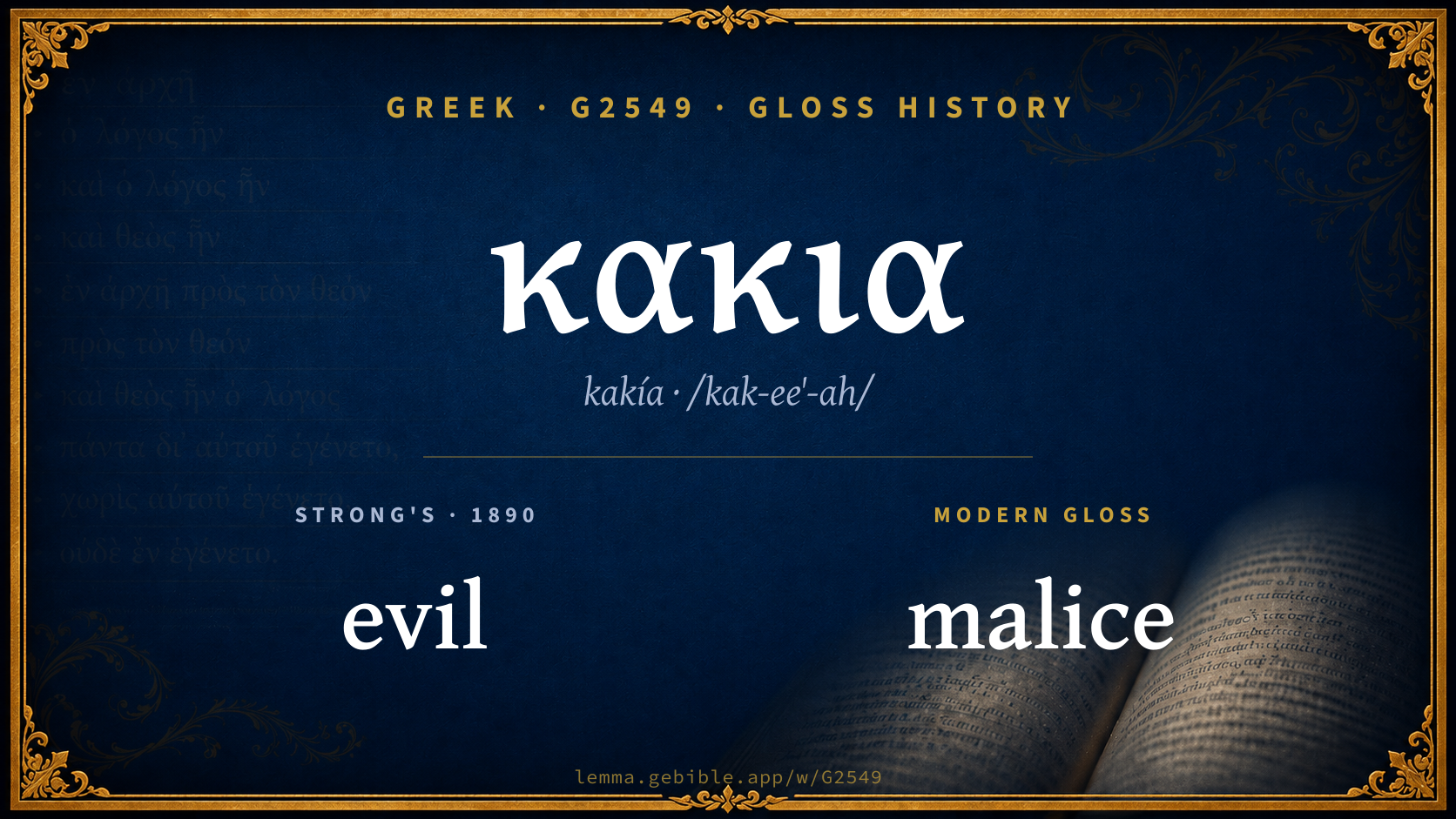
At its core, κακια (kakía) means “malice.” Where the King James Version says “malice,” newer translations reach for “evil” (unfoldingWord Literal Text); the renderings breakdown has the detail. It appears 11 verses across 9 books of the Greek New Testament, among its uncommon vocabulary. First canonically at Matthew 6:34, it enters the text early. Not a single-sense word, it carries 3 senses, among them “malignity”, “ill-will”, and “desire to injure”. Dig into 11-verse concordance and the renderings breakdown below.
Gloss history
Strong's 1890 vs modern scholarship
About this word
Strong's G2549 catalogs a Greek word from the Greek New Testament.
These counts are not copied from any lexicon or concordance. They are computed here, from the morphology-tagged Greek New Testament. What Lemma adds →
- 11
- distinct verses
- The word appears in 11 distinct verses.
- 9 / 27
- NT books
- The word appears in 9 of 27 New Testament books.
- #978
- by frequency
- Top 1000 most frequent Greek words (rank 978 of 5,347 Greek words by occurrence).
View all 11 occurrences in the concordance →
Most concentrated in
- 1 Corinthians 2 verses 18%
- 1 Peter 2 verses 18%
- Matthew 1 verse 9%
By section of the New Testament
By traditional corpus
Conventional, traditional groupings — biblical authorship is debated, so this is a traditional corpus grouping, not an authorship claim. Some books belong to more than one corpus (Luke is in both the Gospels and the Lukan corpus, and so on), so these shares overlap and need not total 100%. Each figure is a share of the word’s 11 distinct verses.
- Pauline corpus 6 verses · 55%
- General (Catholic) Epistles 3 verses · 27%
- Gospels 1 verse · 9%
- Lukan (Luke–Acts) 1 verse · 9%
How translations render this word
Counts come from each version’s own published word-to-Strong’s tagging or interlinear alignment — an approximate guide to how each version renders this word, not a word-level alignment the data otherwise carries. Because each total is that version’s own tagged count, the per-version totals vary from one another and need not match the appearance or distinct-verse counts above. These counts may also differ from a printed concordance because Lemma counts each distinctly tagged rendering and does not collapse phrase taggings into a single head-word total. This is a fixed set of word-tagged versions (KJV, ASV, BSB, ULT) and does not change with the reading translation you choose elsewhere. Each version’s license is shown beside its name below (and on Sources).
- King James Version: Malice 6×, Maliciousness 2×
- American Standard Version: Malice 5×, Wickedness 4×
- Berean Standard Bible: Malice 5×, Evil 3×
- unfoldingWord Literal Text: Evil 6×, Malice 2×, Wickedness 2×
King James Version Public Domain
Renders G2549 across 11 tagged occurrences — most commonly:
Plus 3 renderings that appear only once — usually multi-word phrases or single function words the recovered tagging swept in, not distinct renderings.
American Standard Version Public Domain
Renders G2549 across 11 tagged occurrences — most commonly:
Plus 2 renderings that appear only once — usually multi-word phrases or single function words the recovered tagging swept in, not distinct renderings.
Berean Standard Bible Public Domain
Renders G2549 across 11 tagged occurrences — most commonly:
Plus 3 renderings that appear only once — usually multi-word phrases or single function words the recovered tagging swept in, not distinct renderings.
unfoldingWord Literal Text CC BY-SA 4.0
Renders G2549 across 12 tagged occurrences — most commonly:
Plus 2 renderings that appear only once — usually multi-word phrases or single function words the recovered tagging swept in, not distinct renderings.
Senses in Thayer's
The 3 senses Thayer's distinguishes for this word, in lexicon order (not ranked by frequency or importance). The full entry — with sub-senses — is in the Lexicon Entry tab.
- malignity, malice, ill-will, desire to injure
- wickedness, depravity
- evil, trouble
Word origin
Derived from κακος (kakós) (G2556) — evil.
From G2556 ; badness that is (subjectively) depravity or (actively) malignity or (passively) trouble : - evil malice (-iousness) naughtiness wickedness.
— Strong’s Exhaustive Concordance (1890), public domain.
Forms in the corpus
The 4 distinct written forms G2549 takes in the Greek New Testament, most frequent first — each parse links to that case’s occurrences in the concordance.
| Form | Parsing | Example | Uses |
|---|---|---|---|
| κακίας kakías | Noun, Genitive, Singular, Feminine | Acts 8:22 | 4 |
| κακίᾳ kakía | Noun, Dative, Singular, Feminine | Romans 1:29 | 4 |
| κακίαν kakían | Noun, Accusative, Singular, Feminine | Colossians 3:8 | 2 |
| κακία kakía | Noun, Nominative, Singular, Feminine | Matthew 6:34 | 1 |
Same root — word family
Other Thayer's entries built from the same root as G2549, grouped by Strong’s listed origin. These share a root / origin per the lexicon — not necessarily a shared meaning. Each links to that word’s own entry.
Derives from
Shares the same root
- ηττον hḗtton G2276 less
- κακοηθεια kakoḗtheia G2550 maliciousness
- κακολογεω kakologéō G2551 to revile
- κακοπαθεια kakopátheia G2552 suffering
- κακοποιος kakopoiós G2555 evildoer
- κακουργος kakoûrgos G2557 malefactor
- κακουχεω kakouchéō G2558 to treat ill
- κακοω kakóō G2559 to oppress
- κακως kakōs G2560 miserable
- χειρων cheírōn G5501 worse
Compare all same-root words → Showing 4 of 12 — not the complete family. They share a root, not necessarily a meaning.
Septuagint usage
The same Greek word κακια appears 102 times in the Greek Old Testament (Septuagint), across 99 verses in 25 books.
- 102
- LXX occurrences
- Tagged occurrences of this Greek word in the Septuagint.
- 99
- verses
- Distinct Septuagint verses containing this word.
- 25 / 39
- OT books
- The word appears in 25 of the 39 Old Testament books.
Sample Septuagint occurrences
- Genesis 6:5 κακία
- Exodus 22:22 κακία
- Deuteronomy 31:18 κακία
- Judges 20:34 κακία
- 1 Samuel 6:9 κακία
- 2 Samuel 3:25 κακία
- 1 Kings 1:52 κακία
- 2 Kings 6:33 κακία
- 1 Chronicles 21:8 κακία
- 2 Chronicles 7:22 κακία
- Esther 8:3 κακία
- Job 17:5 κακία
Septuagint occurrences (same lexeme)
Every verse where the same Strong’s number (G2549) appears in the Greek Septuagint — showing the first 50 of 99. Verse text shown in the World English Bible for context; the Greek form is the matched word — the English is not keyword-highlighted.
- Genesis 6:5 κακία Yahweh saw that the wickedness of man was great in the earth, and that every imagination of the thoughts of his heart was only evil continually.
- Genesis 31:52 κακία May this heap be a witness, and the pillar be a witness, that I will not pass over this heap to you, and that you will not pass over this heap and this pillar to me, for harm.
- Exodus 22:22 κακία "You shall not take advantage of any widow or fatherless child.
- Exodus 23:2 κακία You shall not follow a crowd to do evil; neither shall you testify in court to side with a multitude to pervert justice;
- Exodus 32:12 κακία Why should the Egyptians speak, saying, 'He brought them forth for evil, to kill them in the mountains, and to consume them from the surface of the earth?' Turn from your fierce wrath, and repent of this evil against your people.
- Exodus 32:14 κακία Yahweh repented of the evil which he said he would do to his people.
- Deuteronomy 31:18 κακία I will surely hide my face in that day for all the evil which they shall have worked, in that they are turned to other gods.
- Judges 20:34 κακία There came over against Gibeah ten thousand chosen men out of all Israel, and the battle was sore; but they didn't know that evil was close on them.
- 1 Samuel 6:9 κακία Behold; if it goes up by the way of its own border to Beth-shemesh, then he has done us this great evil: but if not, then we shall know that it is not his hand that struck us; it was a chance that happened to us."
- 1 Samuel 12:17 κακία Isn't it wheat harvest today? I will call to Yahweh, that he may send thunder and rain; and you shall know and see that your wickedness is great, which you have done in the sight of Yahweh, in asking you a king.
- 1 Samuel 12:19 κακία All the people said to Samuel, Pray for your servants to Yahweh your God, that we not die; for we have added to all our sins [this] evil, to ask us a king.
- 1 Samuel 12:20 κακία Samuel said to the people, "Don't be afraid; you have indeed done all this evil; yet don't turn aside from following Yahweh, but serve Yahweh with all your heart:
- 1 Samuel 12:25 κακία But if you shall still do wickedly, you shall be consumed, both you and your king."
- 1 Samuel 20:7 κακία If he says, 'It is well;' your servant shall have peace: but if he be angry, then know that evil is determined by him.
- 1 Samuel 20:9 κακία Jonathan said, Far be it from you; for if I should at all know that evil were determined by my father to come on you, then wouldn't I tell you that?
- 1 Samuel 20:33 κακία Saul cast his spear at him to strike him. By this Jonathan knew that his father was determined to put David to death.
- 1 Samuel 23:9 κακία David knew that Saul was devising mischief against him; and he said to Abiathar the priest, Bring here the ephod.
- 1 Samuel 24:12 κακία Yahweh judge between me and you, and Yahweh avenge me of you; but my hand shall not be on you.
- 1 Samuel 25:17 κακία Now therefore know and consider what you will do; for evil is determined against our master, and against all his house: for he is such a worthless fellow that one can't speak to him.
- 1 Samuel 25:28 κακία Please forgive the trespass of your handmaid: for Yahweh will certainly make my lord a sure house, because my lord fights the battles of Yahweh; and evil shall not be found in you all your days.
- 1 Samuel 25:39 κακία When David heard that Nabal was dead, he said, Blessed be Yahweh, who has pleaded the cause of my reproach from the hand of Nabal, and has kept back his servant from evil: and the evil-doing of Nabal has Yahweh returned on his own head. David sent and spoke concerning Abigail, to take her to him as wife.
- 1 Samuel 29:6 κακία Then Achish called David, and said to him, As Yahweh lives, you have been upright, and your going out and your coming in with me in the host is good in my sight; for I have not found evil in you since the day of your coming to me to this day: nevertheless the lords don't favor you.
- 1 Samuel 29:7 κακία Therefore now return, and go in peace, that you not displease the lords of the Philistines.
- 2 Samuel 3:25 κακία You know Abner the son of Ner, that he came to deceive you, and to know your going out and your coming in, and to know all that you do.
- 2 Samuel 3:39 κακία I am this day weak, though anointed king; and these men the sons of Zeruiah are too hard for me. May Yahweh reward the evil-doer according to his wickedness."
- 2 Samuel 13:16 κακία She said to him, Not so, because this great wrong in putting me forth is [worse] than the other that you did to me. But he would not listen to her.
- 2 Samuel 15:14 κακία David said to all his servants who were with him at Jerusalem, Arise, and let us flee; for else none of us shall escape from Absalom: make speed to depart, lest he overtake us quickly, and bring down evil on us, and strike the city with the edge of the sword.
- 2 Samuel 16:8 κακία Yahweh has returned on you all the blood of the house of Saul, in whose place you have reigned; and Yahweh has delivered the kingdom into the hand of Absalom your son; and, behold, you are [taken] in your own mischief, because you are a man of blood.
- 2 Samuel 24:16 κακία When the angel stretched out his hand toward Jerusalem to destroy it, Yahweh repented him of the evil, and said to the angel who destroyed the people, It is enough; now stay your hand. The angel of Yahweh was by the threshing floor of Araunah the Jebusite.
- 1 Kings 1:52 κακία Solomon said, If he shall show himself a worthy man, there shall not a hair of him fall to the earth; but if wickedness be found in him, he shall die.
- 1 Kings 2:44 κακία The king said moreover to Shimei, You know all the wickedness which your heart is privy to, that you did to David my father: therefore Yahweh shall return your wickedness on your own head.
- 1 Kings 9:9 κακία and they shall answer, Because they forsook Yahweh their God, who brought forth their fathers out of the land of Egypt, and laid hold on other gods, and worshiped them, and served them: therefore has Yahweh brought all this evil on them.
- 1 Kings 11:25 κακία He was an adversary to Israel all the days of Solomon, besides the mischief that Hadad [did]: and he abhorred Israel, and reigned over Syria.
- 1 Kings 13:33 κακία After this thing Jeroboam didn't return from his evil way, but made again from among all the people priests of the high places: whoever would, he consecrated him, that there might be priests of the high places.
- 1 Kings 16:7 κακία Moreover by the prophet Jehu the son of Hanani came the word of Yahweh against Baasha, and against his house, both because of all the evil that he did in the sight of Yahweh, to provoke him to anger with the work of his hands, in being like the house of Jeroboam, and because he struck him.
- 1 Kings 20:29 κακία They encamped one over against the other seven days. So it was, that in the seventh day the battle was joined; and the children of Israel killed of the Syrians one hundred thousand footmen in one day.
- 1 Kings 21:7 κακία Jezebel his wife said to him, Do you now govern the kingdom of Israel? arise, and eat bread, and let your heart be merry: I will give you the vineyard of Naboth the Jezreelite.
- 2 Kings 6:33 κακία While he was yet talking with them, behold, the messenger came down to him: and he said, Behold, this evil is of Yahweh; why should I wait for Yahweh any longer?
- 2 Kings 14:10 κακία You have indeed struck Edom, and your heart has lifted you up: glory of it, and abide at home; for why should you meddle to [your] hurt, that you should fall, even you, and Judah with you?
- 1 Chronicles 21:8 κακία David said to God, I have sinned greatly, in that I have done this thing: but now, put away, I beg you, the iniquity of your servant; for I have done very foolishly.
- 1 Chronicles 21:15 κακία God sent an angel to Jerusalem to destroy it: and as he was about to destroy, Yahweh saw, and he repented him of the evil, and said to the destroying angel, It is enough; now stay your hand. The angel of Yahweh was standing by the threshing floor of Ornan the Jebusite.
- 2 Chronicles 7:22 κακία They shall answer, Because they forsook Yahweh, the God of their fathers, who brought them forth out of the land of Egypt, and laid hold on other gods, and worshiped them, and served them: therefore has he brought all this evil on them.
- 2 Chronicles 25:19 κακία You say, Behold, you have struck Edom; and your heart lifts you up to boast: abide now at home; why should you meddle to [your] hurt, that you should fall, even you, and Judah with you?
- Esther 8:3 κακία Esther spoke yet again before the king, and fell down at his feet, and begged him with tears to put away the mischief of Haman the Agagite, and his device that he had devised against the Jews.
- Job 17:5 κακία He who denounces his friends for a prey, Even the eyes of his children shall fail.
- Job 20:12 κακία "Though wickedness is sweet in his mouth, Though he hide it under his tongue,
- Job 22:5 κακία Isn't your wickedness great? Neither is there any end to your iniquities.
- Psalms 35:5 κακία Let them be as chaff before the wind, Yahweh's angel driving them on.
- Psalms 49:19 κακία He shall go to the generation of his fathers. They shall never see the light.
- Psalms 51:3 κακία For I know my transgressions. My sin is constantly before me.
These are occurrences of the same Greek lexeme (G2549) in the Septuagint — not a translation of any one Hebrew word. The store carries no word-level Hebrew↔Greek alignment, so no Hebrew original is asserted here. Counts come from the recovered LXX Strong's tagging — high-frequency vocabulary is well covered, while rare or late forms may be untagged — so they reflect tagged occurrences and may slightly undercount.