
Romans 1:29

Greek (Tischendorf 8th ed.) Romans 1:29 appears in the Greek New Testament. The text above is from the Tischendorf 8th edition. Each word links to its Strong’s number and a concise gloss. Click any word for its full Thayer’s Greek Lexicon entry.
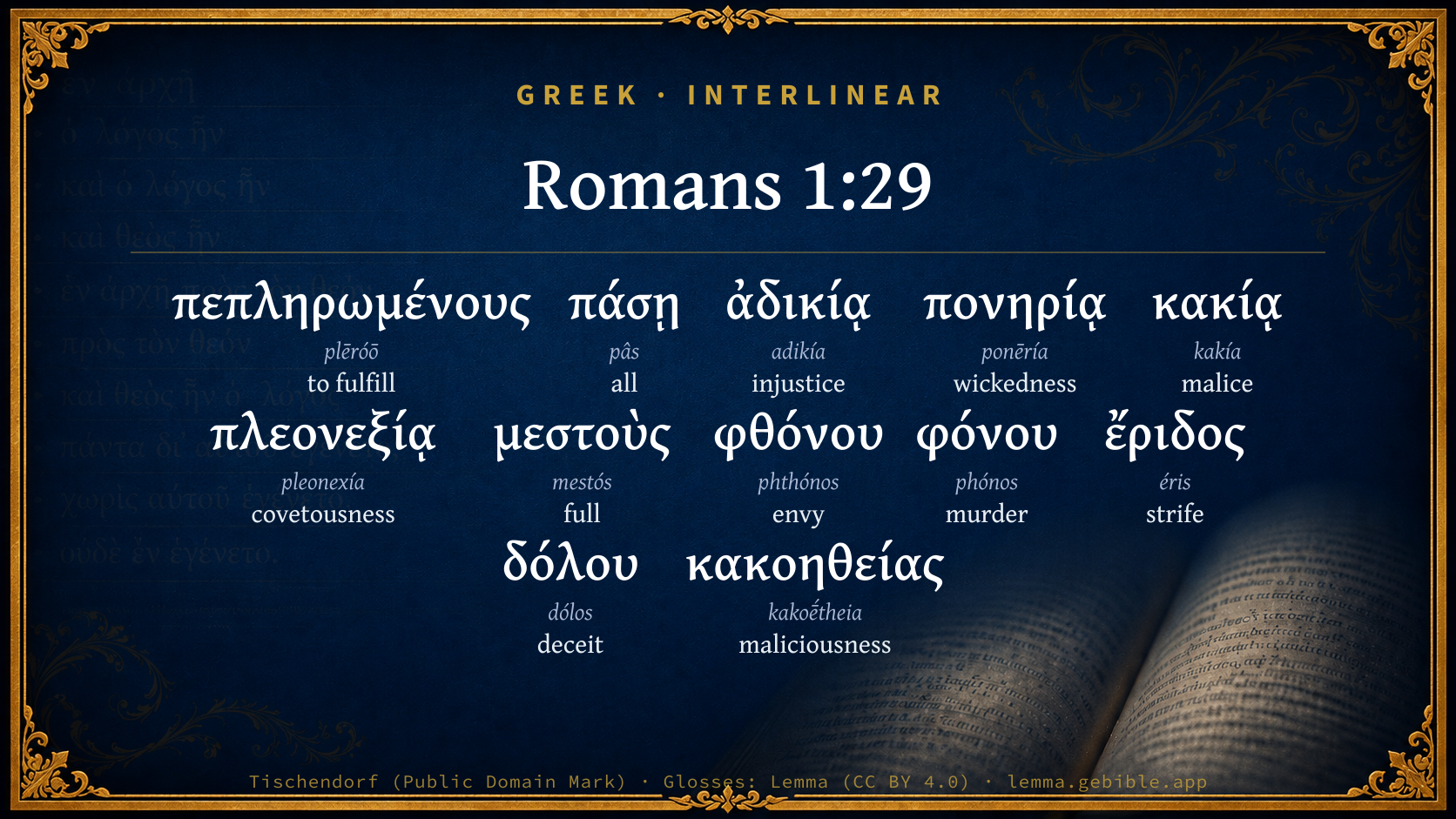
Download image
Cite this verse

Romans 1:29 (World English Bible). Public Domain. Lemma interlinear Bible study tool, https://lemma.gebible.app/v/romans/1/29.

Show BibTeX & RIS
BibTeX
RIS
English Translation
being filled with all unrighteousness, sexual immorality, wickedness, covetousness, maliciousness; full of envy, murder, strife, deceit, evil habits, secret slanderers,
World English Bible · Public Domain
Highlights
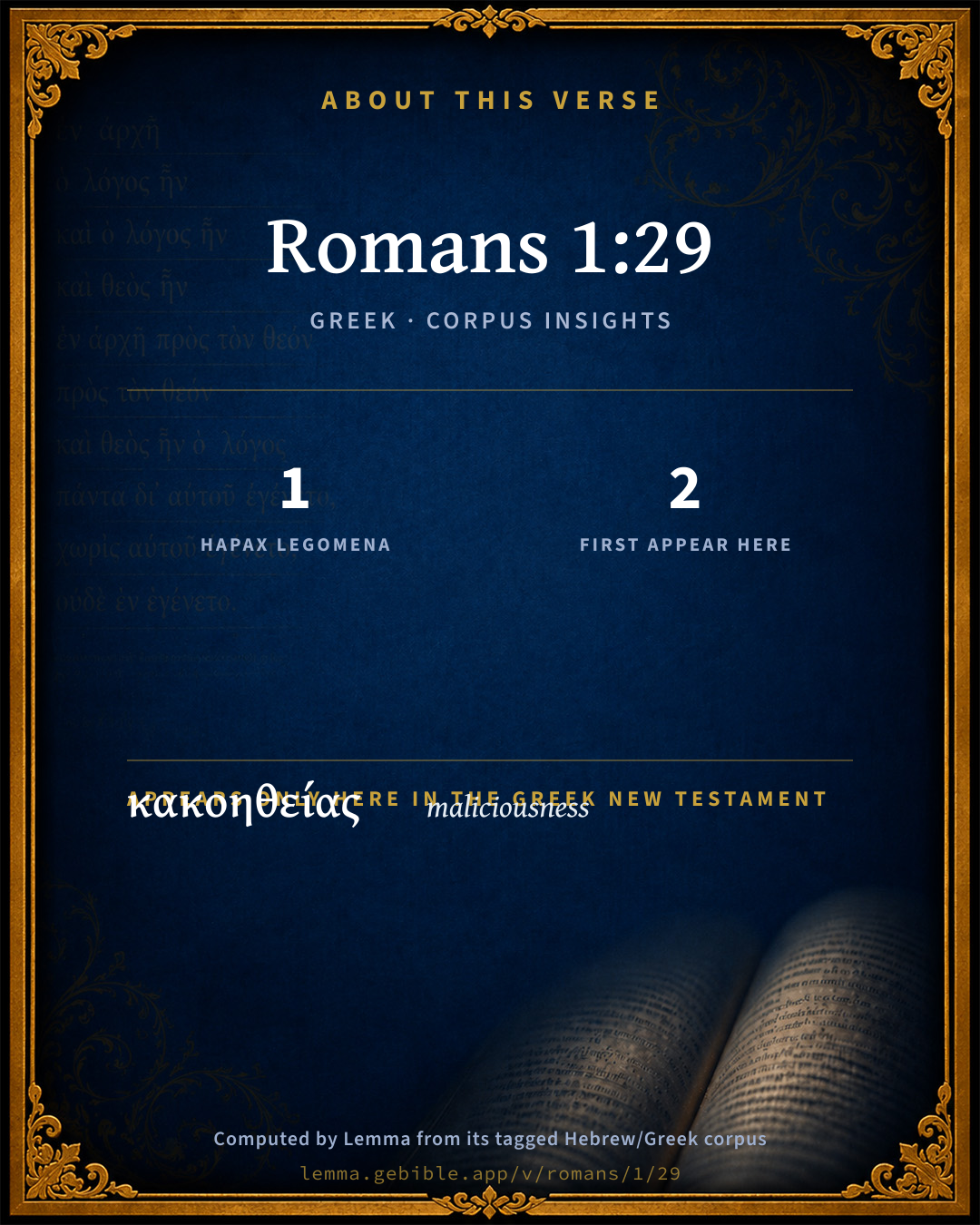
  • 1 hapax legomenon — only here in the Greek New Testament
  • 2 first appearances in the Greek New Testament
Full analysis ↓
Download a study sheet

One document with this verse’s original text, its word-by-word gloss line, the meaning frame, cross-references with their text, attributed commentary, and full source and license credits — printable, and it pastes into notes with its structure intact.

This verse Autodidact and up

Study sheet (.html) Plain text (.txt)

A passage Seminary Student

Up to 50 verses in one chapter. A passage sheet keeps up to 6 commentary sources and 12 cross-references per verse, in the order this page ranks them, and says so on the sheet whenever that leaves anything out. Ask for a single verse and you get the Autodidact verse sheet above.

Everything on this page stays free to read, with no account — the sheet is a download of what is already on screen, not access to it.

Want to remove ads? Support Godless Engineer
Compare translations 3

The same verse in 3 English versions, stacked beneath the original-language interlinear above. Click any original word for its lexicon entry.

Each is an independent rendering of the whole verse — the interlinear is not word-aligned to these translations.

Highlighted words mark where these versions differ — a whole-verse word diff, not a word-by-word alignment.

  • World English Bible Public Domain
    being filled with all unrighteousness, sexual immorality, wickedness, covetousness, maliciousness; full of envy, murder, strife, deceit, evil habits, secret slanderers,
  • King James Version Public Domain
    Being filled with all unrighteousness, fornication, wickedness, covetousness, maliciousness; full of envy, murder, debate, deceit, malignity; whisperers,
  • unfoldingWord Literal Text CC BY-SA 4.0
    filled with all unrighteousness, wickedness, covetousness, malice, they are full of envy, murder, strife, deceit, evil intent. gossips,

unfoldingWord Literal Text — © unfoldingWord, licensed CC BY-SA 4.0. Word-aligned USFM3 via Door43 (git.door43.org/unfoldingWord/en_ult).

Versions to compare (up to 4)

3 of 4 selected

Show all 19 translations

Every available English version of this verse, each an independent rendering of the whole verse.

  • World English Bible Public Domain
    being filled with all unrighteousness, sexual immorality, wickedness, covetousness, maliciousness; full of envy, murder, strife, deceit, evil habits, secret slanderers,
  • Berean Standard Bible Public Domain
    They have become filled with every kind of wickedness, evil, greed, and depravity. They are full of envy, murder, strife, deceit, and malice. They are gossips,
  • Majority Standard Bible Public Domain
    They have become filled with every kind of wickedness, sexual immorality, evil, greed, and depravity. They are full of envy, murder, strife, deceit, and malice. They are gossips,
  • King James Version Public Domain
    Being filled with all unrighteousness, fornication, wickedness, covetousness, maliciousness; full of envy, murder, debate, deceit, malignity; whisperers,
  • American Standard Version (1901) Public Domain
    being filled with all unrighteousness, wickedness, covetousness, maliciousness; full of envy, murder, strife, deceit, malignity; whisperers,
  • Revised Version (1885) Public Domain
    being filled with all unrighteousness, wickedness, covetousness, maliciousness; full of envy, murder, strife, deceit, malignity; whisperers,
  • Geneva Bible (1599) Public Domain
    Being full of all vnrighteousnesse, fornication, wickednes, couetousnes, maliciousnes, full of enuie, of murder, of debate, of deceit, taking all things in the euill part, whisperers,
  • Douay-Rheims (1899) Public Domain
    Being filled with all iniquity, malice, fornication, avarice, wickedness, full of envy, murder, contention, deceit, malignity, whisperers,
  • Young's Literal Translation Public Domain
    having been filled with all unrighteousness, whoredom, wickedness, covetousness, malice; full of envy, murder, strife, deceit, evil dispositions; whisperers,
  • Literal Standard Version CC BY-SA 4.0
    having been filled with all unrighteousness, whoredom, wickedness, covetousness, malice; full of envy, murder, strife, deceit, evil dispositions; whisperers,
  • Unlocked Literal Bible CC BY-SA 4.0
    They have been filled with all unrighteousness, wickedness, covetousness, and malice. They are full of envy, murder, strife, deceit, and evil intentions. They are gossips,
  • unfoldingWord Literal Text CC BY-SA 4.0
    filled with all unrighteousness, wickedness, covetousness, malice, they are full of envy, murder, strife, deceit, evil intent. gossips,
  • Darby Bible Public Domain
    being filled with all unrighteousness, wickedness, covetousness, malice; full of envy, murder, strife, deceit, evil dispositions; whisperers,
  • World Messianic Bible Public Domain
    being filled with all unrighteousness, sexual immorality, wickedness, covetousness, malice; full of envy, murder, strife, deceit, evil habits, secret slanderers,
  • Webster's Bible Public Domain
    Being filled with all unrighteousness, fornication, wickedness, covetousness, maliciousness; full of envy, murder, debate, deceit, malignity; whisperers,
  • Free Bible Version CC BY-SA 4.0
    They filled themselves with all that's wrong: evil, greed, hate, envy, murder, quarreling, deception, malice, and gossip.
  • Bible in Basic English Public Domain
    Being full of all wrongdoing, evil, desire for the goods of others, hate, envy, putting to death, fighting, deceit, cruel ways, evil talk, and false statements about others;
  • Text-Critical English NT CC BY 4.0
    They are filled with all unrighteousness, fornication, evil, covetousness, and malice. They are full of envy, murder, strife, deceit, and maliciousness. They are gossips,
  • Tyndale New Testament (1534) Public Domain
    beinge full of all vnrighteous doinge of fornicacio wickednes coveteousnes maliciousnes full of envie morther debate disseyte evill condicioned whisperers

Literal Standard Version (2020), Covenant Press — licensed CC BY-SA 4.0. Text via the HelloAO Bible API (eBible.org). Unlocked Literal Bible (unfoldingWord) — licensed CC BY-SA 4.0. Text via the HelloAO Bible API (eBible.org). unfoldingWord Literal Text — © unfoldingWord, licensed CC BY-SA 4.0. Word-aligned USFM3 via Door43 (git.door43.org/unfoldingWord/en_ult). Free Bible Version, Dr. Jonathan Gallagher — licensed CC BY-SA 4.0. Text via the HelloAO Bible API (eBible.org).

Word by word

More ways to search: Search by grammar → Find every occurrence → Compare this word →

Practice this passage: Drill this verse → Learn its vocabulary →

κακοηθείας
kakoḗtheia
G2550
“maliciousness”
Noun, Genitive, Singular, Feminine
Part of Speech
Noun
Case
Genitive
Number
Singular
Gender
Feminine
Full Thayer's Definition

Origin: from a compound of G2556 and G2239

TDNT: 11:05,4

1. bad character, depravity of heart and life 2. malignant subtlety, malicious craftiness
  1. πεπληρωμένους plēróō G4137 “to fulfill” Verb, Perfect, Passive, Participle, Accusative, Plural, Masculine
  2. πάσῃ pâs G3956 “all” Adjective, Dative, Singular, Feminine
  3. ἀδικίᾳ adikía G93 “injustice” Noun, Dative, Singular, Feminine
  4. πονηρίᾳ ponēría G4189 “wickedness” Noun, Dative, Singular, Feminine
  5. κακίᾳ kakía G2549 “malice” Noun, Dative, Singular, Feminine
  6. πλεονεξίᾳ pleonexía G4124 “covetousness” Noun, Dative, Singular, Feminine
  7. μεστοὺς mestós G3324 “full” Adjective, Accusative, Plural, Masculine
  8. φθόνου phthónos G5355 “envy” Noun, Genitive, Singular, Masculine
  9. φόνου phónos G5408 “murder” Noun, Genitive, Singular, Masculine
  10. ἔριδος éris G2054 “strife” Noun, Genitive, Singular, Feminine
  11. δόλου dólos G1388 “deceit” Noun, Genitive, Singular, Masculine

About this verse

These counts appear in no published source. They are computed here, from the morphology-tagged text and Lemma’s own curated glosses. What Lemma adds →

12
words
12
distinct lemmas
Pauline Epistles
section

Notable vocabulary

1 hapax legomenon — a word that appears only here in the entire Greek New Testament:

  • κακοηθείας maliciousness G2550

First appearance in Scripture

These words make their first canonical appearance in the Greek New Testament here:

  • ἔριδος strife G2054
  • κακοηθείας maliciousness G2550

Shared distinctive vocabulary

πονηρίᾳ wickedness G4189 occurs in 7 verses of the Greek New Testament. Also found in:
Cross-references

4

Topical passages linked to Romans 1:29 in the Treasury of Scripture Knowledge — connected by theme and wording, ordered by reader-vote popularity; previews shown in the World English Bible.

  • 2 Corinthians 12:20 For I am afraid that by any means, when I come, I might find you not the way I want to, and that I might be found by you as you don't desire; that by any means there would be strife, jealousy, outbursts of anger, factions, slander, whisperings, proud thoughts, riots;
  • Proverbs 16:28 A perverse man stirs up strife. A whisperer separates close friends.
  • Psalms 41:7 All who hate me whisper together against me. They imagine the worst for me.
  • Proverbs 26:20 For lack of wood a fire goes out; Without gossip, a quarrel dies down.

Cross-references courtesy of OpenBible.info (CC BY 4.0).

Where the printed editions differ

1 variant

Places in this verse where the major printed Greek editions disagree on the wording in a way that affects the translation — a comparison of editions, not a manuscript-by-manuscript collation. The editions are the modern critical texts (Nestlé-Aland 28/27, SBL, Westcott-Hort, Tregelles, Tyndale House) and the traditional texts behind the KJV (the Textus Receptus and the Byzantine/Majority text). It is not a claim about which reading is original.

  1. Extra text
    πορνείᾳ,

    “sexual immorality”

    In TRByz Not in NA28NA27TynSBLWHTreg

    πορνείᾳ, (porneia) 'sexual immorality' is only in traditional manuscripts (TR+Byz)

Textual data: Translators Amalgamated Greek New Testament (STEPBible TAGNT) · CC BY 4.0.

Commentary

Notes on Romans 1:29 from classic Christian and Jewish commentators (each source and its license shown beneath its notes). The classic Christian expositions comment on the surrounding passage and are grouped to its opening verse, so a note may address several verses; the Jewish commentaries on the Tanakh (Rashi and others) are per-verse, so they appear only where the commentator wrote on this verse.

Lemma curates 59 commentaries, every one of them public domain or Creative Commons licensed, each selected and text-cleaned for this edition rather than reprinted as found. About our sources →

The Biblical Illustrator

Joseph S. Exell

Rom_1:29-31

Being filled with all unrighteousness.

The prevalence of evil

All is full of crime and vice; there is more committed than can be healed by punishment. A monstrous prize contest of wickedness is going on. The desire to sin increases, and shame decreases day by day. Vice is no longer practised secretly, but in open view. Vileness gains in every street and in every breast to such an extent that conscience has become not only rare but extinct. (Seneca.)

Wickedness.

With and without the gospel

The worst kind of religion is no religion at all; and these men, living in ease and luxury, indulging themselves in the amusement of going without religion, may be thankful that they live in the lands where the gospel they neglect has tamed the beastliness and ferocity of the men who, but for Christianity, might long ago have eaten their carcasses like the South Sea Islanders, or cut off their heads and tanned their hides like the monsters of the French Revolution. When the microscopic search of scepticism, which has hunted the heavens and sounded the seas to disprove the existence of a Creator, has turned its attention to human society, and has found a place on this planet ten miles square where a decent man can live in decency, comfort, and security, supporting and educating his children unspoiled and unpolluted--a place where age is reverenced, infancy respected, manhood respected, womanhood honoured, and human life held in duo regard; when sceptics can find such a place ten miles square on this globe, where the gospel of Christ has not gone and cleared the way and laid the foundations and made decency and security possible, it will then be in order for the sceptical literati to move thither and then ventilate their views. But so long as these very men are dependent upon the religion which they discard for every privilege they enjoy, they may well hesitate a little before they seek to rob the Christian of his hope and humanity of its faith in that Saviour who alone has given to man that hope of life eternal which makes life tolerable and society possible, and robs death of its terrors and the grave of its gloom. (J. R. Lowell.)

Spreading tendency of sin

I need not, I suppose, spend any time in illustrating the vividness and truthfulness of that metaphor which compares any kind of evil in a mans character to the silently, gradually, surely working leaven. The cancer spreads; the fungus creeps steadily through the rotting timber; the smallest hidden speck of evil in a mans nature has in it a demoniacal transforming and assimilating power which works underground, unconsciously even to the man himself, until some strain of temptation and stress of trial comes; and lo! he finds that what he thought was solid timber is all eaten out in the heart of it, and has no strength to resist or to bear. The smallest sin may corrupt a mans whole nature, and change, as it were, the chemical composition of every part of it; though in itself it be but an infinitesimal and almost invisible atom that has been dropped into the hole. (A. Maclaren, D. D.)

Whisperers, backbiters.--

Detraction

These two words agree that they both wound the fame of our neighbour, and they both do it behind his back or in his absence. But they differ--

1. In that whispering doth it secretly and closely, but backbiting openly.

2. Whispering tendeth to breed strife among our friends, but backbiting to our general disgrace before the world. The one seeketh to deprive us of the goodwill of our friends, the other to destroy our service. They are often conjoined (2Co_12:20).

I. What is detraction?

1. The nature of it in general. It is an unjust violation of anothers reputation. God, that hath bidden me to love my neighbour as myself, doth therein bid me to be tender not only of his person and goods, but of his good name. Therefore certainly this is--

(1) A sin against God, who hath forbidden us to bear false witness against our neighbour, and to speak evil of others without a cause (Eph_4:31);

(2) A wrong to man because it robbeth him of his good name, which is so deservedly esteemed by all that would do anything for God in the world (Pro_22:1; Ecc_7:1).

(3) The causes it proceedeth from are--

(a) Malice and ill-will, which prompteth us to speak falsely of others, so to make them odious, or do them wrong or hurt. Now, to hate our brother is inconsistent with that charity which the love of Christ should beget in us (1Pe_4:8; 2Pe_1:7);

(b) Uncharitable credulity, whereby men easily believe a false report, and so convey it to others (Jer_20:10);

(c) Rashness and unruliness of tongue (Jam_1:26). Possibly it may not come from downright malice, but (Pro_11:13) whisperers must be talking, and be it true or false, out it comes;

(d) Passion for our different interests and opinions. Bitter envying (Jam_3:14) hath made mad work in the world as to strifes, and confusions, and quarrels, and bloodsheds, and persecutions. But usually it venteth itself in evil-speaking (2Co_12:20).

2. The kinds of it are two in the text.

(1) Whispering, which is privy defamation of our brother. Now this is a great sin--

(a) Because it is here reckoned among those which reigned among the heathen, and God hath expressly forbidden to His people (Lev_19:16; Jer_11:4).

(b) It is against natural equity, because they do that to others which they would not have done to themselves (Mat_7:2).

(c) It is a cause of much mischief in the world, as--Grief to the party wronged (Pro_18:8); much debate and strife (Pro_26:20; Pro_16:28; Pro_6:19); sometimes even the destruction of anothers life (Eze_22:9; 1Sa_22:9). But here ariseth a question, whether all private complaints and informations against others come under the name of whispering? I answer--No, with these cautions--

(i) If the party be duly admonished; for, before we go any further, the rule is (Mat_18:15).

(ii) If it be made to such as have power to redress the fault by the most discreet and gentle means (Gen_37:2).

(iii) If the complainer seeketh nothing but the amendment of the party.

(iv) If he grieve that he hath cause to complain, and pray for his conversion.

3. Backbiting is a more public speaking evil of our absent brother, to the impairing of his credit. Now, this may be done--

(1) With respect to the good things found in him. There are four degrees in this:

(a) When we deny them. This is not only to wrong our neighbour, but to rob God of His own praise.

(b) When we lessen them. To extenuate and clip anothers due praise is envy, but in honour to prefer them above ourselves is charity and humility (Php_2:3; Rom_12:10).

(c) When we but deprave them by supposing a sinister intention (Job_1:9).

(d) When we enviously suppress them.

(2) With respect to evil supposed to be committed by them.

(a) When we publish their secret slips, which in charity we ought to conceal (Pro_11:13).

(b) When, in relating any evil action of another, we use harder terms than are required, and make beams of motes, and mountains of mole hills. We should lessen sins all that we can (Act_3:17).

II. The heinousness of the sin.

1. In general, that is evident from what is said already. I shall urge two arguments more.

(1) That men shall be called to an account for these sins as well as others (Jud_1:15; 1Pe_4:4-5).

(2) It is the property of a citizen of Zion not to be given to backbiting (Psa_15:3).

2. More particularly, it is the more heinous.

(1) From the person against whom it is committed. As suppose the godly and irreprovable for the main, who by their life and conversation have the best right to honour and esteem (Psa_64:3; Num_12:8; 1Ti_3:7). Against these it is not only unjust, but noxious and hurtful to Gods service.

(2) From the persons before whom the slander is brought; so that they are deprived not only of private friendships, but the favour and countenance of these under whose protection they have their life and service (Est_3:8; Psa_52:1).

(3) From the end of it. Some men have no direct intention of mischief, but are given to tattling. It is a great sin in them, and an unprofitable waste of time; but it is a greater in those that make it their business to disgrace others or sow discord.

(4) From the effect or great hurt that followeth, be it loss of estate, as in the case of Mephibosheth, or a general trouble and persecution on the people of God. When their good names are buried their persons cannot long subsist afterward with any degree of service.

Conclusion: Note--

1. How good natured Christianity is, and befriendeth human societies; it condemneth not only sins against God, but sins against our neighbour (Php_4:8).

2. That we should not speak evil of others behind their backs, but tell them their faults plainly in love and wisdom, nor encourage others in this sin (Pro_25:23). (T. Manton, D. D.)

Haters of God.--

Hatred of God

Enemies of God in heart and work (Rom_8:7). Hatred of God is the essence of sin, as the love of God is the essence of holiness. Hatred to God is shown in dislike--

1. To His character as just and holy.

2. To His government as opposed to evil-doers.

3. To His laws as forbidding what is sinful.

4. To His people as bearing His image.

Hatred of God is the cause of mens rejection of Christ (Joh_15:21-24). Written in characters of blood in times of persecution (Psa_79:2-3). Shows the intense wickedness and madness of the human heart. God is hated who is supremely excellent, and mans greatest benefactor. An unholy nature is at the root of such hatred, which is aggravated by conscious guilt and dread of God. It is only overcome by the belief of Gods love as seen in Christ. (T. Robinson, D. D.)

Hatred of God: its futility

The inventions of a hater of God are as the proud engines and presumptuous artillery of a Titanic warfare of defiance against Heaven, which recoil on himself, like mountains which are hurled back on the heads of the giants who attempted to scale the skies, and which crushed them beneath the ruins. (Bp. Chr. Wordsworth.)

The Biblical Illustrator, edited by Joseph S. Exell (c. 1880s–1900s) — public domain. Text from a community e-Sword module.

Tyndale Open Study Notes

Tyndale Open Resources

1:29-31 This list of sins follows a popular Hellenistic literary form called a vice list. While not exhaustive, it reminds readers of various forms that evil might take.

Tyndale Open Study Notes — © Tyndale Open Resources, licensed CC BY-SA 4.0. Text via the HelloAO Bible API.

Bengel's Gnomon

Johann Albrecht Bengel

Rom 1:29. Πεπληρωμένους) a word of large meaning; μεστοὺς follows presently after.—ἀδικίᾳ, with unrighteousness) This word, the opposite of righteousness, is put in the first place; unmerciful is put in the last [Rom 1:31]. Righteousness has [as its necessary fruit], life; unrighteousness, death, Rom 1:32. The whole enumeration shows a wise arrangement, as follows: nine members of it respecting the affections; two in reference to men’s conversation; three respecting God, a man’s own self, and his neighbour; two regarding a man’s management of affairs; and six respecting relative ties. Comp. as regards the things contrary to these, ch. Rom 12:9, etc.—πορνέιᾳ) I have now, for a long time, acknowledged that this word should be retained.[16] It does not appear certain, that it was not read by Clemens Romanus.—πονηρίᾳ—κακίᾳ)[17] ΠΟΝΗΡΊΑ is the perverse wickedness of a man, who delights in injuring another, without any advantage to himself: κακία is the vicious disposition, which prevents a man from conferring any good on another.—πλεονεξια denotes avarice, properly so called, as we often find it in the writings of Paul: otherwise [were πλεονεξία not taken in the sense avarice] this sin would be blamed by him rather rarely. But he usually joins it with impurity; for man [in his natural state] seeks his food for enjoyment, outside of God, in the material creature, either in the way of pleasure, or else avarice; he tries to appropriate the good that belongs to another.—κακοηθείας), ΚΑΚΟΉΘΕΙΑ, ΚΑΚΊΑ ΚΕΚΡΥΜΜΈΝΗ. Ammonius explains this as “wickedly inveighing against all that belongs to others; exhibiting himself troublesome to another.”

[16] Although the margin of the larger edition (A. 1734), contains the opinion, that it should be omitted. The 2d ed. corresponds with the Gnomon and the German Version.—E.B. [AC, and apparently B, Memph. Version, omit πορνέιᾳ. But ΛGfg Vulg. insert it.—ED.]

[17] πονηρία Th. ὁ παρέχων πόνους, “one who puts others to trouble,” aptness in mischief. κακία is the evil habit of mind; πονηρία, the outcoming of it: Opp. to χρηστός; as κακός to ἀγαθός. Κακοήθεια, as distinct from these, is not, as Engl. Vers. ‘malignity,’ but taking everything in the evil part; Arist. Rhet. ii. 13; arising from a baseness or evil ἦθος in the man himself.—See Trench’s Gr. Test. Syn.—ED.

Bengel's Gnomon of the New Testament — English translation (T&T Clark, Edinburgh, 1860) — public domain. Text from a community e-Sword module.

Meyer's Critical & Exegetical Commentary

Heinrich August Wilhelm Meyer

Rom_1:29-31. Πεπληρωμένους πάσῃ ἀδικίᾳ] a more precise definition of ποιεῖν τὰ μὴ καθήκ.: as those who are full of every unrighteousness (Rom_1:18). This is the general statement, and all the points subsequently introduced are its several species, so that μεστοὺς φθόνου and then ψιθυριστὰς κ.τ.λ[536] are appositions to πεπληρ. π. ἀδικ. Similar catalogues of sins are 2Co_12:20; Gal_5:19 ff.; Eph_5:3 f.; 1Ti_1:9 f.; 2Ti_3:2 ff.

πονηρίᾳ.… κακίᾳ] malignity (malice), comp Eph_4:31; Col_3:8; Tit_3:3.… vileness (meanness), the latter, in Aristotle and other writers, opposed to ἁρετή, and translated in Cicero, Tusc. iv. 15, 34, by vitiositas. Comp 1Co_5:8.

φόνου] Conceived here as the thought which has filled the man, the μερμηρίζειν φόνον, Homer, Od. xix. 2, comp Act_9:1. On the paronomasia with φθόνου comp Gal_5:21. The latter is just the σημεῖον φύσεως παντάπασι πονηρᾶς, Dem. 499, 21.

κακοηθείας] malicious disposition, whose peculiarity it is ἐπὶ τὸ χεῖρον ὑπολαμβάνειν τὰ πάντα (Aristotle, Rhet. ii. 13). As the context requires a special vice, we may not adopt, with Erasmus, Calvin, and Homberg, the general signification perversitas, corruptio morum (Xen. Cyn. xiii. 16; Dem. 542, 11; Plat. Rep. p. 348 D). See regarding the word generally Homberg, Parerg. p. 196; Kypke, II. p. 155 f.

ψιθυρ.] whisperers, talebearers, consequently secret slanderers (Dem. 1358, 6); but κατάλαλοι, calumniators, detractors generally, not precisely open ones (Theophylact, Köllner, de Wette and others). Comp ψιθυρισμούς τε καὶ καταλαλιάς, Clem. Cor. i. 35. The construction of καταλάλους as an adjective with ψιθυρ. (Hofmann), must be rejected, because none of the other elements has an adjectival definition annexed to it, and because καταλάλ. would not add to the notion of ψιθυρ. anything characteristic in the way of more precise definition. ψιθυρ. would be better fitted to form a limiting definition of καταλ. But in 2Co_12:20 also, both ideas stand independently side by side.

θεοστυγεῖς] hated by God, Deo odibiles (Vulgate). This passive rendering of the word which belongs especially to the tragedians (Pollux, i. 21), so that it is equivalent to Θεῷ ἐχθαιρόμενος (comp Soph. Aj. 458), is clearly attested by the usus loquendi as the only correct one. See Eurip. Troad. 1213, Cycl. 395, 598, Neophr. ap. Stob. serm. 20, p. 172. Comp θεοστύγητος in Aesch. Choeph. 635, Fritzsche in loc[544], and Wetstein. Since no passage whatever supports the active signification, and since even Suidas and Oecumenius clearly betray that they knew the active meaning adopted by them to be a deviation from the usage of the ancient writers,[545] we must reject, with Koppe, Rückert, Fritzsche, de Wette, Philippi, Baumgarten-Crusius, and Hofmann, the interpretation, Dei osores, that has been preferred by the majority since the time of Theodoret.[546] Even the analogous forms that have been appealed to, θεομισής, βροτοστυγής (Aesch. Choeph. 51, Prom. 799), are to be taken as passives, and therefore testify against the active interpretation.[547] Comp θεοβλαβής, stricken of God, Herod. viii. 137, al[549] In particular, θεομισής is quite the same as θεοστυγής, the opposite of θεοφιλής, beloved of God. (See Plat. Rep. p. 612 E, Euth. p. 8 A; Dem. 1486, ult.; Arist. Ran. 443.) Comp θεῷ μισητοί, Wis_14:9; and, as regards the idea, the Homeric ὅς κε θεοῖσιν ἀπέχθηται μακάρεσσιν, Od. κ. 74. The accentuation θεοστύγης, approved of even by Grotius and Beza, to distinguish it from the passive θεοστυγης, is nothing but an ancient (Suidas) unsupported fiction. See Buttmann, II. p. 371, Winer, p. 53 [E. T. 61]. God-hating is expressed by μισόθεος, Lucian, Tim. 35, Aesch. Ag. 1090; comp φιλόθεος, God-loving. The adoption, nevertheless, of the active sense was occasioned by the consideration: ut in passivo positum dicatur, nulla est ratio, quum P. hic homines ex vitiis evidentibus reos faciat, Calvin; but even granting a certain unsuitableness in the passive sense, still we should not be justified in giving an explanation contrary to the usus loquendi; we should be obliged to abide by the view that Paul had mixed up a less suitable term among the others. But this objection is diminished, if we take θεοστ., in accordance with the idea of divine holiness, as a characteristic designation of infamous evil-doers in general. So Fritzsche, and also Philippi. Comp Plat. Legg. viii. p. 838 B: θεομισῆ.… καὶ αἰσχρῶν αἴσχιστα. And it vanishes altogether, if, leaving the word in its strict signification, hated of God, we recognise in it a summary judgment of moral indignation respecting all the preceding particulars; so that, looking back on these, it forms a resting point in the disgraceful catalogue, the continuation of which is then carried on by ὑβριστὰς κ.τ.λ[553] According to Hofmann, ΘΕΟΣΤΥΓ. is an adjective qualifying ὑβριστάς. But we do not see why precisely this single point[554] in the entire catalogue, insolence (the notion of which is not to be arbitrarily heightened, so as to make it denote the man-despiser who treads upon his fellows), among so many particulars, some of them even worse, should be accompanied by an epithet, and one, too, of so extreme severity.

The continuation begins with a threefold description of self-exaltation, and that in a descending climax. Regarding the distinction between ὑβρισταί, the insolent (qui prae superbia non solum contemnunt alios, sed etiam contumeliose tractant, comp 1Ti_1:13), ὑπερήφανοι, the proud (who, proud of real or imaginary advantages, despise others), and ἀλαζόνες (boasters, swaggerers, without exactly intending to despise or insult others with their vainglory), see Tittmann, Synon. N. T. p. 73 f. Comp Grotius and Wetstein; on ἀλαζ. especially Ruhnk. a[557] Tim. p. 28, Ast, a[558] Theophr. Char. 23. If ὑπερηφ. be taken as adjective with the latter (Hofmann), then the vice, which is invariably and intrinsically immoral,[559] would be limited merely to a particular mode of it.

ἐφευρ. κακῶν] devisers (Anacr. xli. 3) of evil things, quite general; not to be limited to things of luxury, with Grotius; nor, with Hofmann, to evils which they desire to do to others. Comp 2Ma_7:31, and the passages from Philo in Loesner; also Tacit. Ann. iv. 11, and Virg. Aen. ii. 161.

ἀσυνέτους] irrational, unreflecting, who, in what they do and leave undone, are not determined by the σύνεσις, by morally intelligent insight. Luther rightly says: Mr. Unreason going rashly to work [Hans Unvernunft, mit dem Kopfe hindurch]. So also Sir_15:7. The rendering devoid of conscience (according to Suidas) deviates from the proper signification of the word.

ἀσυνθέτους] makes a paronomasia with the foregoing, and means, not unsociable (Castalio, Tittmann, Ewald, comp Hofmann), for which there is no warrant of usage, but covenant-breakers (Jer_3:8; Jer_3:10 f.; Suidas, Hesychius; see also Dem. 383, 6). On ἀστόργ. (without the natural affection of love) and ἈΝΕΛΕΉΜ. (unmerciful), see Tittmann, Synon. p. 69.

The succession of the accumulated particulars is not arranged according to a systematic scheme, and the construction of such a scheme leads to arbitrary definition of the import of individual points; but still their distribution is so far in accordance with approximate categories, that there are presented:1st, The general heathen vices, πεπληρωμένους.… κακίᾳ; 2nd, dispositions inimical to others, μεστοὺς.… κακοηθείας, and calumniatory speeches, ψιθυρ., καταλάλ.; both series concluding with the general ΘΕΟΣΤΥΓΕῖς; then, 3rd, The arrogant character, ὑβριστὰς.… ἀλαζόνας; and finally, 4th, A series of negative particulars (all with a privative), but headed by the positive, general ἐφευρ. κακῶν. This negative series portrays the want of dutiful affection in family life (ΓΟΝ. ἈΠΕΙΘ.), of intelligence (ἈΣΥΝΈΤ.), fidelity (ἈΣΥΝΘ.), and love (ἈΣΤΌΡΓ. ἈΝΕΛ.),consequently the want of every principle on which moral action is based.

[536] .τ.λ. καὶ τὰ λοιπά.

[544] n loc. refers to the note of the commentator or editor named on the particular passage.

[545] Suidas says: Θεοστυγεῖς θεομίσητοι, οἱ ὑπὸ Θεοῦ μισούμενοι καὶ οἱ Θεὸν μισοῦντες· παρὰ δὲ τῷ ἀποστόλῳ θεοστυγεῖς οὐχὶ οἱ ὑπὸ Θεοῦ μισοῦμενοι, ἀλλʼ οἱ μισοῦντες τὸν Θεὸν. Oecumenius: Θεοστυγεῖς δὲ οὐ τοὺς ὑπὸ Θεοῦ μισουμένους, οὐ γὰρ αὐτῷ τοῦτο δεῖξαι πρόκειται νῦν, ἀλλὰ τοὺς μισοῦντας Θεὸν. These negative definitions, which both give, manifestly point to the use of the word in other authors, from which Paul here departs. It is doubtful whether Clement, Cor. I. 35, where there is an echo of our passage, had in view the active or the passive sense of θεοστυγεῖς. He uses indeed the evidently active θεοστυγία, but adds at the close of the list of sins: ταῦτα οἱ πράσσοντες στυγητοὶ τῷ Θεῷ ὑπάρχουσιν. Chrysostom does not express his opinion regarding the word.

[546] The Dei osores was taken to refer to the heathen vice of wrath against the gods conceived as possessing human passions. See Grotius and Reiche. Others have understood it variously. Tholuck thinks of accusers of providence, Promethean characters; Ewald, of blasphemers of God; Calvin, of those who have a horror of God on account of His righteousness. Thus there is introduced into the general expression what the context gives no hint of. This applies also to Luthers gloss: the real Epicureans, who live as if there were no God.

[547] Even in Clem. Hom. i. 12, there is nothing whatever in the connection opposed to the passive rendering of θεοστυγεῖς.

[549] l. and others; and other passages; and other editions.

[553] .τ.λ. καὶ τὰ λοιπά.

[554] For neither καταλάλ. nor ὑπερηφ. are to be taken as adjectives. See on those words. Hofmann seems to have adopted such a view, merely in order to gain analogies in the text for his inappropriate treatment of the objectionable θεοστυγεῖς as an adjective.

[557] d refers to the note of the commentator or editor named on the particular passage.

[558] d refers to the note of the commentator or editor named on the particular passage.

[559] See Xen. Mem. i. 7, 1 ff., where ἀλαζονεία is the antithesis of ἀρετή. It belongs to the category of the ψεύδεσθαι, Aesch. adv. Ctesiph. 99; Plat. Lys. p. 218 D. Compare also 2Ti_3:2; Clem. Cor. I. 35.

Meyer — Critical and Exegetical Commentary on the New Testament — English translation by Peter Christie, edited by Frederick Crombie (T&T Clark, 1880) — public domain. Text from a community e-Sword module.

Hodge's Commentary on Romans, Ephesians & First Corinthians

Charles Hodge

Rom_1:29-31

Being filled with all unrighteousness, fornication, wickedness, etc. The accusative πεπληρωμένους is connected with αὐτοὺς of the preceding verse. He gave them up, filled with all righteousness; or it depends on the preceding infinitive ποιεῖν, so that they, filled with all unrighteousness, should commit, etc. It is not so connected with παρέδωκεν, as to imply that God gave them up after they were thus corrupt, but it is so connected with ποιεῖν as to express the consequence of Gods abandoning them to do the things which are not convenient. The crimes here mentioned were not of rare occurrence. The heathen were filled with them. They not only abounded, but in many cases were palliated and even justified. Dark as the picture here drawn is, it is not so dark as that presented by the most distinguished Greek and Latin authors, of their own countrymen. Commentators have collected a fearful array of passages from the ancient writers, which more than sustain the account given by the apostle. We select a single passage from, Senca de Ira, 2:8: Omnia sceleribus ac vitiis plena sunt; plus committitur quàm quod possit coercitione sanari. Certatur ingenti quodam nequitiae, certamine; major quotidie peccandi cupiditas, minor verecundia est. Expulso melioris aequiorisque respectn, quocunque visum est, libido se impingit; nec furtiva jam scelera sunt, praeter oculos eunt. Adeoque in publicum missa nequitia est, et in omnium pectoribus evaluit, ut ionocentia non rara, sed nulla sit. Numquid enim singuli aut panci rupere legenm undique, velut signo dato, ad fas nefasque miscendum coorti sunt. What Paul says of the ancient heathen world, is found to be true in all its essential features of men of all generations. Wherever men have existed, there have they shown themselves to be sinners, ungodly and unrighteous, and therefore justly exposed to the wrath of God. Of the vices with which the heathen were filled, πορνεία, fornication, stands first as the most prominent; πονρία, malice, the disposition to inflict evil; πλεονεχία, rapacity, the desire to have more than is our due; κακία, malignity, malice in exercise; φθόνος and φόνος, envy and murder, united either from similarity in sound or because the former tends to the latter; ἔρις, δόλος, contention and fraud, nearly related evils. The primary meaning of δόλος is a bait, food exposed to entrap an animal; then the disposition to deceive, or an act of deception; κακοήθεια (κακός and ἦθοϚ), malevolence, the disposition to make the worst of everything; ψιθυριστής, a whisperer, clandestine slanderer; κατάλαλος, a detractor, one who speaks against others; θεστυγής, hateful to God, or hating God. Usage is in favor of the passive sense, the connection of the active. All wicked men, and not any one particular class, are the objects of the divine displeasure. To meet this difficulty, Meyer proposes to make this word a mere qualification of the preceding, God-abhorred detractors. This, however, is out of keeping with the whole passage. The great majority of commentators adopt the active sense. Then follow three designations, expressive of the different forms of pride, ὑβρισταί, the insolent; υπερήφανοι, the self-conceited; ἀλαζόνυς, boasters: ἐφευρεταὶ κακῶν, inventors of crimes; γονεῦσιν ἀπειθεῖς, disobedient to parents. That such should be included in this fearful list, shows the light in which filial disobedience is regarded by the sacred writers. In Rom_1:31, all the words begin with the ἀ privative, ἀσυνέτους, without (σύνεσιϚ) insight into moral or religious things, i.e., blinded, besotted, so as to think evil good, and good evil; ἀσυνθέτους, perfidious; ἀστόργους, those in whom the natural affection for parents or children is suppressed; ἀσπόνδους, implacable; ἀνελεήμονας, without pity.

Charles Hodge — Commentary on Romans (1835), First Corinthians (1857), and Ephesians (1856) — public domain. Text from a community e-Sword module.

Adam Clarke's Commentary

Verse 29. Being filled with all unrighteousness] αδικια, every vice contrary to justice and righteousness.

Fornication] πορνεια, all commerce between the sexes out of the bounds of lawful marriage. Some of the best MSS. omit this reading; and others have ακαθαρσια, uncleanness.

Wickedness] πονηρια, malignity, that which is oppressive to its possessor and to its object; from πονος, labour, toil, c.

Covetousness] πλεονεξια, from πλειον, more, and εξω, I will have the intense love or lust of gain; the determination to be rich; the principle of a dissatisfied and discontented soul.

Maliciousness] κακια, malice, ill-will; what is radically and essentially vicious.

Full of envy] φθονου, from φθινω, to wither, decay, consume, pine away, c. "pain felt and malignity conceived at the sight of excellence or happiness in another." A fine personification of this vice is found in OVID METAM. lib. ii. ver. 768-781, which I shall here insert, with Mr. Addison's elegant and nervous translation.

------------------Videt intus edentem

Vipereas carnes, vitiorum alimenta suorum

Invidiam: visaque oculos avertit. At illa

Surgit humo pigra: semesarumque relinquit

Corpora serpentum, passuque incedit inerti.

Utgue deam vidit formaque armisque decoram,

Ingemuit: vultumque ima ad suspiria duxit.

Pallor in ORE sedet: macies in CORPORE toto:

Nusquam recta acies: livent rubigine dentes:

Pectora felle virent: lingua est suffusa veneno.

Risus abest, nisi quem visi movere dolores:

Nec fruitur somno, vigilacibus excita curis:

Sed videt ingratos, intabescitque videndo

Successus hominum; carpitgue et carpitur una;

Suppliciumque suum est.

-----A poisonous morsel in her teeth she chewed,

And gorged the flesh of vipers for her food.

Minerva loathing, turned away her eye.

The hideous monster, rising heavily,

Came stalking forward with a sullen pace,

And left her mangled offals on the place.

Soon as she saw the goddess gay and bright,

She fetched a groan at such a cheerful sight.

Livid and meagre were her looks, her eye

In foul distorted glances turned awry;

A hoard of gall her inward parts possessed,

And spread a greenness o'er her canker'd breast;

Her teeth were brown with rust, and from her tongue

In dangling drops the stringy poison hung.

She never smiles but when the wretched weep;

Nor lulls her malice with a moment's sleep:

Restless in spite while watchful to destroy,

She pines and sickens at another's joy;

Foe to herself, distressing and distressed,

She bears her own tormentor in her breast.

Murder] φονου, taking away the life of another by any means; mortal hatred; for he that hates his brother in his heart is a murderer.

Debate] εριδος, contention, discord, c. Of this vile passion the Greeks made a goddess.

Deceit] δολου, lying, falsity, prevarication, imposition, c. from δελω, to take with a bait.

Malignity] κακοηθειας, from κακος, evil, and ηθος, a custom bad customs, founded in corrupt sentiment, producing evil habits, supported by general usage. It is generally interpreted, a malignity of mind, which leads its possessor to put the worst construction on every action; ascribing to the best deeds the worst motives.

Whisperers] ψιθυριστος, secret detractors; those who, under pretended secrecy, carry about accusations against their neighbours, whether true or false; blasting their reputation by clandestine tittle-tattle. This word should be joined to the succeeding verse.

The whispering is well expressed by the Greek word ψιθυριστας, psithuristas.

Adam Clarke's Commentary on the Bible (1810–1826) — public domain. Text from a community e-Sword/MySword module.

John Calvin's Commentaries

29. Understand by unrighteousness, the violation of justice among men, by not rendering to each his due. I have rendered πονηρίαν, according to the opinion of Ammonium, wickedness; for he teaches us that πονηρον, the wicked, is δραστίκον κακου, the doer of evil. The word (nequitia) then means practiced wickedness, or licentiousness in doing mischief: but maliciousness (malitia) is that depravity and obliquity of mind which leads us to do harm to our neighbour. For the word πορνείαν, which Paul uses, I have put lust, (libidinem.) I do not, however, object, if one prefers to render it fornication; but he means the inward passion as well as the outward act. The words avarice, envy, and murder, have nothing doubtful in their meaning. Under the word strife, (contentione,) he includes quarrels, fightings, and seditions. We have rendered κακοηθείαν, perversity, (perversitatem;) which is a notorious and uncommon wickedness; that is, when a man, covered over, as it were, with hardness, has become hardened in a corrupt course of life by custom and evil habit.

John Calvin's Commentaries (1540-1563) — public domain. Text from the Calvin Translation Society English edition (1840s-50s) via the Christian Classics Ethereal Library (ccel.org). Calvin's coverage is partial (roughly two-thirds of the Bible); uncommented books and verses are honest gaps, never fabricated. The 19th-century editor's footnotes and remarks are omitted so the notes are faithfully Calvin's own voice.

Ellicott's Commentary for English Readers

(29, 30) Whisperers, backbiters.—In the Greek the idea of secresy is contained chiefly in the first of these words. “Secret backbiters and slanderers of every kind.”

A Bible Commentary for English Readers, edited by Charles John Ellicott (1878–1897) — public domain. Text from a community e-Sword module.

The Cambridge Bible for Schools and Colleges

gen. ed. J. J. S. Perowne

29. fornication] This word is to be omitted.

maliciousness] Same word as 1Pe_2:1, (where E. V. “malice,”) 16. The Gr. is a wider word than these English words; evil in its largest sense, but specially, moral evil.

full of envy] Lit. brimful; a word as strong as possible.

malignity] Our “ill-nature” exactly.

The Cambridge Bible for Schools and Colleges (gen. ed. J. J. S. Perowne; Cambridge University Press, 1878–1918) — public domain. Text from a community e-Sword module.

John Gill's Exposition

Being filled with all unrighteousness,.... From hence, to the end of the chapter, follows a large and black list and catalogue of the sad characters of the Gentiles, and of the best men they had among them; for the apostle is all along speaking, not of the common people, but of their wise professors, and moral instructors; than which there never was a more wicked set of men that ever lived upon the face of the earth; who under the guise of morality were guilty of the greatest pride and covetousness, and of the most filthy debaucheries imaginable: they were "filled with all unrighteousness". This word includes in it all manner of sin and wickedness in general; fitly expresses the condition of fallen men, destitute of a righteousness; designs every violation of the law respecting our neighbour; and is opposed to that vain conceit of righteousness which these men had: particular branches of it follow; as,

fornication; which sometimes includes adultery and an unchastity; simple fornication was not reckoned a sin among the Gentiles:

wickedness; or mischief, which intends not so much the internal wickedness of the heart, as that particular vice, by which a man is inclined and studies to do hurt, to others, as Satan does:

covetousness; this may intend every insatiable lust, and particularly the sin which goes by this name, and is the root of all evil, and was a reigning sin among the Gentiles. Seneca, the famous moralist, was notoriously guilty of this vice, being one of the greatest usurers that ever lived:

maliciousness; the word denotes either the iniquity of nature in which men are conceived and born; or that desire of revenge in men, for which some are very notorious:

envy; at the superior knowledge and learning, wealth and riches, happiness, and outward prosperity of others:

murder: which sometimes arose from envy, wherefore they are put together. There is an elegant "paranomasia" in the Greek text:

debate; strife about words more than things, and more for vain glory, and a desire of victory, than for truth:

deceit; through their empty notions of philosophy; hence "philosophy and vain deceit" go together, Col 2:8; making large pretences to morality, when they were the vilest of creatures:

malignity; moroseness; having no courteousness nor affability in them, guilty of very ill manners; as particularly they were who were of the sect of the Cynics. Now they are said to be "filled with", and "full of", these things; not filled by God, but by Satan and themselves; and it denotes the aboundings of wickedness in them, and which was insatiable. The apostle goes on to describe them, as

whisperers; who made mischief among friends, by privately suggesting, and secretly insinuating things into the mind of one to the prejudice of another.

John Gill's Exposition of the Whole Bible (1746–1763) — public domain (CC PDM 1.0). Text via the HelloAO Bible API.

Trapp's Complete Commentary

John Trapp

29 Being filled with all unrighteousness, fornication, wickedness, covetousness, maliciousness; full of envy, murder, debate, deceit, malignity; whisperers,

Ver. 29. With all unrighteousness] The mother of all the ensuing misrule.

Wickedness] The Syrian saith, "bitterness." See Jer 2:19. The word πονηρια may be rendered troublesomeness, as the devil is called ο πονηρος, the troublesome one, the molester of God’s people; restless in himself and disquieting others.

Envy, murder] Three such alliterations are found in this black beadroll. {a} {b} The apostle seems delighted with them, as was likewise the prophet Isaiah. Of which noble two, I may well say as one doth of Demosthenes and Cicero, Demosthenes Ciceroni praeripuit ne esset primus orator, Cicero Demostheni, ne solus.

Malignity] Or, morosity, crossness, ill conditions; or an evil disposition, that taketh everything the worst way; whereas a better disposition would make a better exposition, and take things by the right handle.

Whisperers] These are worse than backbiters, because they work underground, like as the wind that creeps in the chinks and crevices in a wall, or the cracks in a window, prove commonly more dangerous than a storm that meets a man in the face upon the champaign. A vento percolato, et ab inimico reconciliato libera nos.

{a} πορνεια, πονηρια. φθονου, φονου. ασυνετους, ασυνθετους. κακοηθεια, κακια.

{b} A list of persons to be specially prayed for ŒD

John Trapp, A Commentary or Exposition upon All the Books of the Old and New Testament (1647–1656) — public domain. Text from a community e-Sword module.

Albert Barnes' Notes on the Bible

Being filled - That is, the things which he specifies were common or abounded among them. This is a strong phrase, denoting that these things were so often practiced as that it might be said they were full of them. We have a phrase like this still, when we say of one that he is full of mischief, etc.

Unrighteousness - ἀδικία adikia. This is a word denoting injustice, or iniquity in general. The particular specifications of the iniquity follow.

Fornication - This was a common and almost universal sin among the ancients, as it is among the moderns. The word denotes all illicit sexual intercourse. That this was a common crime among the ancient pagan, it would be easy to show, were it proper, even in relation to their wisest and most learned men. They who wish to see ample evidence of this charge may find it in Tholuck’s “Nature and Moral Influence of Heathenism,” in the Biblical Repository, vol. ii. p. 441-464.

Wickedness - The word used here denotes a desire of injuring others; or, as we should express it, malice. It is that depravity and obliquity of mind which strives to produce injury on others. (Calvin.)

Covetousness - Avarice, or the desire of obtaining what belongs to others. This vice is common in the world; but it would be particularly so where the other vices enumerated here abounded, and people were desirous of luxury, and the gratification of their senses. Rome was particularly desirous of the wealth of other nations, and hence, its extended wars, and the various evils of rapine and conquest.

Licentiousness - κακία kakia. This word denotes evil in general; rather the act of doing wrong than the desire which was expressed before by the word “wickedness.”

Full of envy - “Pain, uneasiness, mortification, or discontent, excited by another’s prosperity, accompanied with some degree of hatred or malignity, and often with a desire or an effort to depreciate the person, and with pleasure in seeing him depressed” (Webster). This passion is so common still, that it is not necessary to attempt to prove that it was common among the ancients. It seems to be natural to the human heart. It is one of the most common manifestations of wickedness, and shows clearly the deep depravity of man. Benevolence rejoices at the happiness of others, and seeks to promote it. But envy exists almost everywhere, and in almost every human bosom:

“All human virtue, to its latest breath,

Finds envy never conquered but by death.”

Pope.

Murder - “The taking of human life with premeditated malice by a person of a sane mind.” This is necessary to constitute murder now, but the word used here denotes all manslaughter, or taking human life, except what occurs as the punishment of crime. It is scarcely necessary to show that this was common among the Gentiles. It has prevailed in all communities, but it was particularly prevalent in Rome. It is necessary only to refer the reader to the common events in the Roman history of assassinations, deaths by poison, and the destruction of slaves. But in a special manner the charge was properly alleged against them, on account of the inhuman contests of the gladiators in the amphitheaters. These were common at Rome, and constituted a favorite amusement with the people. Originally captives, slaves, and criminals were trained up for combat; but it afterward became common for even Roman citizens to engage in these bloody combats, and Nero at one show exhibited no less than four hundred senators and six hundred knights as gladiators.

The fondness for this bloody spectacle continued until the reign of Constantine the Great, the first Christian emperor, by whom they were abolished about six hundred years after the original institution. “Several hundred, perhaps several thousand, victims were annually slaughtered in the great cities of the empire.” Gibbon’s Decline and Fall, chapter xxx. 404 a.d. As an instance of what might occur in this inhuman spectacle, we may refer to what took place on such an occasion in the reign of Probus (281 a.d.). During his triumph, near 700 gladiators were reserved to shed each other’s blood for the amusement of the Roman people. But “disdaining to shed their blood for the amusement of the populace, they killed their keepers, broke from their place of confinement, and filled the streets of Rome with blood and confusion.” Gibbon’s Decline and Fall, chapter 12. With such views and with such spectacles before them, it is not wonderful that murder was regarded as a matter of little consequence, and hence, this crime prevailed throughout the world.

Debate - Our word debate does not commonly imply evil. It denotes commonly discussion for elucidating truth; or for maintaining a proposition, as the debates in Parliament, etc. But the word in the original meant also contention, strife, altercation, connected with anger and heated zeal; Rom 13:13; 1Co 1:11; 1Co 3:3; 2Co 12:20; Gal 5:20; Phi 1:15; 1Ti 6:4; Tit 3:9. This contention and strife would, of course, follow from malice and covetousness, etc.

Deceit - This denotes fraud, falsehood, etc. That this was common is also plain. The Cretans are testified by one of the Greek poets to have been always liars. Tit 1:12. Juvenal charges the same thing on the Romans. (Sat. iii. 41.) “What,” says he, “should I do at Rome? I cannot lie.” Intimating that if he were there, it would follow, of course, that he would be expected to be false. The same thing is still true. Writers on India tell us that the word of a Hindu even under oath is not to be regarded; and the same thing occurs in most pagan countries.

Malignity - This word signifies here, not malignity in general, but that particular species of it which consists in misinterpreting the words or actions of others, or putting the worst construction on their conduct.

Whisperers - Those who secretly, and in a sly manner, by hints and inuendoes, detract from others, or excite suspicion of them. It does not mean those who openly calumniate, but that more dangerous class who give hints of evil in others, who affect great knowledge, and communicate the evil report under an injunction of secrecy, knowing that it will be divulged. This class of people abounds everywhere, and there is scarcely any one more dangerous to the peace or happiness of society.

Albert Barnes' Notes on the Bible (1834–1885) — public domain. Text from a community e-Sword/MySword module.

Haydock's Catholic Bible Commentary

Being filled with all iniquity. He passeth to many other sins and crimes of the heathens. (Witham)

George Leo Haydock (1774–1849), Haydock's Catholic Family Bible and Commentary, 1859 edition — public domain. Excludes Psalms (Douay-Rheims chapter numbering differs from Protestant) and Deuterocanonical books (Catholic canon only).

Matthew Poole's English Annotations

Now follow the sins against the second table, which reigned amongst the Gentiles; amongst which

unrighteousness is as the fountain, from whence the rest as streams do flow. This is the genus that comprehends all the evils hereafter enumerated. It is not to be supposed that all the following vices were found in every individual person; but the meaning is, that all were guilty of some, and some were guilty of all of them.

Fornication, wickedness; in the Greek there is all elegant paronomasia, πορνεια, πονηρια. So there are two more in the following verses, φθονου, φονου, ασυνετοι, ασυνθετοι. The design of the apostle is, to set down a particular vice; therefore, instead of wickedness, some read troublesomeness, or a desire to procure trouble and molestation to another. The devil is called οο πονηρος, the troublesome one.

Maliciousness; or, mischievousness, the better to distinguish it from envy.

Malignity; or, morosity and churlishness, taking all things in the worser part.

Whisperers: whisperers speak evil privily of others; backbiters, openly.

Matthew Poole's English Annotations on the Holy Bible (1683–1685) — public domain. Text from a community e-Sword/MySword module.

Whedon's Commentary on the Bible

Daniel D. Whedon

29. Filled with all unrighteousness—When the sensual vices prevail the cruel and bloody vices are sure to accompany. When the laws of modesty are triumphantly set at naught, and men and women, glorying in shame, invent extravagant modes of sensuality, every other law, human and divine, is broken with the same triumphant license. Hence the apostle, after having fully pictured the sexual demoralization, proceeds to represent the moral anarchy that succeeds, in a list, with little recognisable order, of the vices of a heathenized community.

Fornication—Omitted by best authorities, it is amply included in the previous verses.

Debate—Strife.

Whisperers— Secret slanderers.

Daniel D. Whedon (gen. ed.), Commentary on the Old and New Testaments (1874–1909) — public domain. Text from a community e-Sword module.

The Pulpit Commentary

Vers. 29-31. Being filled with all unrighteousness, fornication, wickedness, covetousness, maliciousness; full of envy, murder, strife, deceit, malignity; whisperers, backbiters, hated of God, despiteful (rather, insolent), proud, boasters, inventors of evil things, disobedient to parents, without understanding, covenant-breakers, without natural affection implacable, unmerciful. Here not personal uncleanness only, but general and utter disregard of moral restraints and obligations (too prevalent, doubtless, at that time in civilized heathendom), is pointed out as the final judicial issue. The words used do not seem to be arranged on any exact system, but to have been written down as they occurred to the writer, being intended to be as comprehensive as possible. Among them those put above within brackets rest on weak authority. Pleonexia , translated here, as usually elsewhere, "covetousness," means generally "inordinate desire," not necessarily of riches; and St. Paul seems generally to use it with reference to inordinate lust, (cf. Eph_4:19 Col_3:3; also 1Th_4:6 1Th_5:3; and 2Pe_2:14; and, for pleonekthv , Eph_5:5, The word yeostugeiv , both from its formation (compare yeofilhv and filoyeov , with other instances) and its ordinary use in classical Greek (it occurs here only in the New Testament) must certainly be taken to mean "God-hated," not "God haters." It seems suggested here by the previous katalalouv , being (we may suppose) used commonly of the delatores who are known to have been a special pest of society at that period of Roman history. Alford quotes Tacitus, "Ann.," 6:7, where they are called "Principi quidem grati, et Deo exosi; also Philo, "Ap Damascen.," Diaboloi kai yeiav apopemptoi caritov oi thinw diabolikhan yeostugeiv te kai yeomiseiv panth . In ver. 31 the collocation of asunetouv and asunyetouv seems to have been suggested by similarity of sound, there being no apparent link of ideas. The latter word is rightly translated in the Authorized Version, as is also asondouv; asunyetouv being one who breaks treaties, "faithless;" ajspondouv, one who refuses to enter into a truce or treaty, "implacable."

The Pulpit Commentary (1880–1919), ed. H.D.M. Spence-Jones & Joseph S. Exell — public domain. Text from a community e-Sword module.

John Wesley's Explanatory Notes

Filled with all injustice - This stands in the first place; unmercifulness, in the last. Fornication - Includes here every species of uncleanness. Maliciousness - The Greek word properly implies a temper which delights in hurting another, even without any advantage to itself.

John Wesley, Explanatory Notes Upon the Whole Bible (1754–1765) — public domain. Text via the GEBible commentary corpus.

Burkitt's Expository Notes on the New Testament

William Burkitt

Here the apostle sums up the sins which the Heathens committed against the second table, or against their neighbour; not that every particular person was guilty of all these black crimes, but all were guilty of some, and some perhaps were guilty of all or most of them.

Learn hence, That the heart of man doth natually swarm and abound with stange and monstrous lusts and abominations. Lord! what a swarm is here! and yet there are multitudes more in the depths of the heart. Whatever abominations were found in the hearts and lives of Heathens and Sodomites, and the most profligate wretches under heaven, are radically and seminally in our corrupt and degenerate natures, Out of the heart proceed evil thoughts, murders, adulteries, &c. Mat 15:19 What are our lusts, but so many toads spitting of venom and spawning of poison? Oh deplorable degradation!

Learn, 2. How much sadder is the condition which unregenerate souls abide in, who remain in and under the power and dominion, the vassalage and slavery of these imperious lusts, which perpetually rage within them, and incessantly contest and scuffle for the throne.

Learn 3. To stand astonished at the heart-changing grace of God, which has delivered thee from so dismal a condition. Oh! fall down and kiss the feet of mercy: adore the sovereignty and freeness of divine grace, which stept in so seasonably to thy rescue. Lord! what black imaginations, what vile affections, what hellish desires, what monstrous abominations were lodged in my heart and nature, before regeneration wrought a change!

Oh that ever the Holy Ghost should set his eyes upon any of the sinful offspring of apostate Adam; in whom were legions of unclean lusts, and whose nature was become the sink and seed-plot of all sin.

Observe lastly, Two particular sins, which of all others seem most monstrous in these Heathens.

1. They were haters of God, not of his essence, being and goodness, but haters of his holiness, justice and providence.

2. They were without natural affection. This appeared by sacrificing their children to their idols; and exposing themselves and their dearest relations to ruin. No sooner did we fall out with God, but we fell out with ourselves and one another.

William Burkitt's Expository Notes on the New Testament (1700–1703) — public domain. Text from a community e-Sword module.

Godbey's Commentary on the New Testament

William B. Godbey

29. “Is filled with all unrighteousness, wickedness, vice and covetousness.” Those who go to heaven must have the fullness of grace in entire sanctification, while in a similar manner Satan ripens his people for hell, by filling them with the very diabolical attributes which congenialize them for the society of hell. “Full of envy, murder, deceitfulness, strife, and evil affections.” These black vices are germinally born in humanity by the fall. Afterward they reach maturity by practice, ripening the soul for hell. In this probation all people are fast rushing to dramatically opposite destinies, diverging incessantly either from another; the one class in due time getting full salvation and ripening for heaven, and the other class, full deterioration and maturing for hell. There is no medium; we must all go one way or the other. So you have your choice between full salvation and full damnation. Which will you have?

William B. Godbey, Commentary on the New Testament (1896–1900) — public domain. Text from a community e-Sword module.

McGarvey & Pendleton's Commentaries

J. W. McGarvey

being filled with all unrighteousness, wickedness, covetousness [inordinate desire to accumulate property regardless of the rights of others: a sin which is not condemned by the laws of any country on the globe, and which is the source of unrest in all nations], maliciousness [a readiness to commit crime without provocation, a chronic state of illwill and misanthropy]; full of envy, murder, strife, deceit, malignity; whisperers [talebearers, those who slander covertly, chiefly by insinuation-- Pro_16:28 ]

J. W. McGarvey (with Philip Y. Pendleton), Commentaries on the New Testament (The Fourfold Gospel, 1914; Acts; and the epistles) — public domain. Text from a community e-Sword/MySword module.

The People's New Testament

B. W. Johnson

29. Being filled. The characteristics of those given over to a reprobate mind are now described. Whisperers. Secret slanderers.

B. W. Johnson's The People's New Testament with Notes (1889–1891) — public domain. Electronic text from the Christian Classics Ethereal Library (CCEL) ThML edition.

unfoldingWord translationNotes

Door43 World Missions Community

They have been filled with

You can translate this in an active form. AT: "They have in them a strong desire for" or "They strongly desire to do deeds of" (See: Active or Passive)

They are full of envy, murder, strife, deceit, and evil intentions

You can translate this in an active form. AT: "Many are constantly envying other people ... Many constantly desire to murder people ... to cause arguments and quarrels among people ... to deceive others ... to speak hatefully about others" (See: Active or Passive)

slanderers

A slanderer says false things about another person in order to damage that person's reputation.

inventing ways of doing evil

"thinking of new ways to do evil things to others"

translationWords

righteous

evil

envy

deceive

gossip

disobey

trust

mercy

unfoldingWord translationNotes — © Distant Shores Media and the Door43 World Missions Community, licensed CC BY-SA 4.0. Source: git.door43.org/Door43/en_tn.

Cambridge Greek Testament for Schools and Colleges

29. This catalogue of sins emphasises the false relations of man to man as following upon the false relation of men to GOD and the false conception of the proper use of man’s own nature. The classification is only partially systematic, 29 a the mental dispositions, 29 b–31 the dispositions seen in various kinds of action.

Cambridge Greek Testament for Schools and Colleges (Cambridge University Press, 1896; 21 vols, various authors incl. Carr, Maclear, Plummer, Farrar, Lumby, Moule, M. R. James, Simcox) — public domain. Text from a community e-Sword module.

Alford’s Greek Testament

Henry Alford

29-31.] πεπληρωμένους belongs to the subject of ποιεῖν, understood.

The reading πορνείᾳ appears to have arisen out of πονηρίᾳ, and is placed by some mss. after that word, by some after κακίᾳ, omitting πον. The Apostle can hardly have written it here, treating as he does all these immoralities of the heart and conscience as results of, and flowing from, the licentious practices of idolatry above specified.

Accurate distinctions of ethical meaning can hardly be found for all these words. Without requiring such, or insisting on each excluding the rest, I have collected the most interesting notices respecting them. Umbreit has illustrated their LXX usage and Hebrew equivalents.

ἀδικίᾳ] Perhaps a general term, comprehending all that follow: such would be according to the usage of the Epistle: but perhaps to be confined to the stricter import of injustice; of which on the part of the Romans, Wetst. gives abundant testimonies.

πονηρίᾳ] Ammonius interprets τὸ πονηρόν, τὸ δραστικὸν κακοῦ,—used therefore more of the tempter and seducer to evil.

πλεονεξίᾳ] covetousness (not as 1Th 4:6, see there), of which the whole provincial government and civil life of the Romans at the time was full. ‘Quando | major avaritiæ patuit sinus?’ exclaims Juvenal, soon after this. Sat. i. 87.

κακίᾳ] more the passive side of evil—the capability of and proclivity to evil,—the opposite to ἀρετή:—so Arist. Eth. Nic. ii. 3. 6, ὑπόκειται ἄρα ἡ ἀρετὴ εἶναι.… τῶν βελτίστων πρακτική· ἡ δὲ κακία, τοὐναντίον.

φθόνου and φόνου are probably put together from similarity of sound. So Eurip. Troad. 770 ff., ὦ Τυνδάρειον ἔρνος, οὔποτʼ εἶ Διὸς πολλῶν δὲ πατέρων φημί σʼ ἐκπεφυκέναι, Ἀλάστορος μὲν πρῶτον, εἶτα δὲ φθόνου, φόνου τε, θανάτου θʼ, ὅσα τε γῆ τρέφει κακά.

κακοηθείας] Sea reff.

ψιθυρ. secret maligners,—καταλ. open slanderers. The distinction attempted to be set up by Suidas and others, between θεομισής, ὑπὸ θεοῦ μισούμενος, and θεομίσης, ὁ μισῶν τὸν θεόν, has been applied to θεοστυγεῖς also, which has therefore been written θεοστύγεις. But the distinction is untenable; all compound adjectives in ης being oxyton.

θεοστυγής is never found in an active sense, ‘hater of God,’ but always in a passive, hated by God (cf. Eur. Troad. 1205, ἡ θεοστυγὴς Ἑλένη: Cycl. 395, τῷ θεοστυγεῖ ᾅδου μαγείρῳ: ib. 598: so θεοφιλής, Demosth. 1486 ult.: εὐτυχεστάτην πασῶν πόλεων τὴν ὑμετέραν νομίζω καὶ θεοφιλεστάτην: and Æsch. Eum. 831); and such is apparently the sense here. The order of crimes enumerated would be broken, and one of a totally different kind inserted between καταλάλους and ὑβριστάς, if θεοστ. is to signify ‘haters of God.’ But on the other supposition,—if any crime was known more than another as ‘hated by the gods,’ it was that of ‘delatores,’ abandoned persons who circumvented and ruined others by a system of malignant espionage and false information. And the crime was one which the readers of this part of Roman history know to have been the pest of the state; see Tacitus, Ann. vi. 7, where he calls the delatores ‘Principi quidem grati, et Deo exosi.’ So also Philo, ap. Damascen. (quoted by Wetst.) διάβολοι καὶ θείας ἀποπέμπτοι χάριτος, οἱ τὴν αὐτὴν ἐκείνῳ διαβολικὴν νοσοῦντες κακοτεχνίαν, θεοστυγεῖς τε καὶ θεομισεῖς πάντη. It does not follow that the delatores only are intended, but the expression may be used to include all those abandoned persons who were known as Diis exosi, who were employed in pursuits hateful and injurious to their kind. So Wetst., Meyer, Rückert, Fritzsche, De Wette:—the majority of Commentators incline to the active sense,—so Theodoret, Œc., Erasm., Luther, Calv., Beza, Estius, Grot., Tholuck, Reiche, &c.

ὑβριστάς] opposed by Xenoph. Mem. i. ana Apol. Socr. to σώφρων, ‘a discreet and modest man:’ but here perhaps, as said by Paul of himself, ref. 1 Tim., ‘qui contumeliâ afficit,’ ‘an insulting person.’

ὑπερηφάνους] ἐστὶ δὲ ὑπερηφανία καταφρόνησίς τις πλὴν αὑτοῦ τῶν ἄλλων, Theophr. Char. 34. It may be observed that Aristotle, Rhet. ii. 16, mentions ὑβρισταί and ὑπερήφανοι as examples of τῷ πλούτῳ ἃ ἕπεται ἤθη.

ἀλαζόνας] see reff. δοκεῖ δὲ καὶ ἀλαζὼν εἶναι ὁ θρασὺς καὶ προσποιητικὸς ἀνδρείας, Aristot. Eth. Nic. iii. 10. δοκεῖ δὴ ὁ μὲν ἀλαζὼν προσποιητικὸς τῶν ἐνδόξων εἶναι, καὶ μὴ ὑπαρχόντων, καὶ μειζόνων ἢ ὑπάρχει.… (ἕνεκα δόξης καὶ τιμῆς).… καὶ γὰρ ἡ ὑπερβολὴ καὶ ἡ λίαν ἔλλειψις ἀλαζονικόν, Ibid. iv. 13.

ἐφευρ. κακ.] ‘Sejanus omnium facinorum repertor habebatur,’ Tacit. Ann. iv. 11:—‘scelerumque inventor Ulixes,’ Virg. Æn. ii. 161: στασιάρχαι, φιλοπράγμονες, κακῶν εὑρεταί, ταραξιπόλιδες, Philo in Flacc. § 4, vol. ii. p. 520:—πάσης κακίας εὑρετής (of Antiochus ), 2 Macc. 7:31.

ἀσυνέτους, destitute of (moral) understanding, see Col 1:9, and reff. Here perhaps suggested by the similarity of sound to ἀσυνθέτους, without good faith, οὐκ ἐμμένοντας ταῖς συνθήκαις, Suid. and In the same sense, εὐσυνθετεῖν and ἀσυνθετεῖν are opposed by Chrysippus and Plutarch (see Wetst.).

ἀστόργους] μὴ ἀγαπῶντάς τινα, Hesych. And Athenæus, speaking of οἱ καλούμενοι ὄρνιθες μελεαγρίδες,—ἐστὶ δὲ ἄστοργον πρὸς τὰ ἔκγονα τὸ ὄρνεον, καὶ ὀλιγωρεῖ τῶν νεωτέρων, xiv. p. 655 c. “In hac urbe nemo liberos tollit, quia, quisquis suos hæredes habet, nec ad cœnas nec ad spectacula admittitur.” Petronius, 116. (Wetst.)

Henry Alford, The Greek Testament (1849–1861) — public domain. Text from a community e-Sword module.

International Critical Commentary

29. We must beware of attempting to force the catalogue which follows into a logical order, though here and there a certain amount of grouping is noticeable. The first four are general terms for wickedness; then follows a group headed by the alliterative φθόνου, φόνου, with other kindred vices; then two forms of backbiting; then a group in descending climax of sins of arrogance; then a somewhat miscellaneous assortment, in which again alliteration plays a part.

ἀδικίᾳ: a comprehensive term, including all that follows.

πορνείᾳ: om. א A B K; probably suggested by similarity in sound to πονηρίᾳ.

πονηρίᾳ: contains the idea of ‘active mischief’ (Hatch, Bibl. Gk. p. 77 f.; Trench, Syn. p. 303). Dr. T. K. Abbott (Essays, p. 97) rather contests the assignment of this specific meaning to πονηρία; and no doubt the use of the word is extremely wide: but where definition is needed it is in this direction that it must be sought.

κακίᾳ: as compared with πονηρία denotes rather inward viciousness of disposition (Trench, Syn. p. 36 f.).

The MSS. vary as to the order of the three words πονηρίᾳ, πλεονεξίᾳ, κακίᾳ, WH. text RV. retain this order with BL, &c., Harcl. Arm., Bas. Greg.-Nyss. al.: Tisch. WH. marg. read πονηρ. κακ. πλεον. with א A, Pesh. al.: WH. marg. also recognizes κακ. πονηρ. πλεον. with C, Boh. al.

πλεονεξίᾳ. On the attempt which is sometimes made to give to this word the sense of ‘impurity’ see Lft. on Col. iii.5. The word itself means only ‘selfish greed,’ which may however be exhibited under circumstances where impurity lies near at hand: e.g. in 1Th 4:6 πλεονεκτεῖ is used of adultery, but rather as a wrong done to another than as a vice.

κακοηθείας: the tendency to put the worst construction upon everything (Arist. Rhet. ii.13; cf. Trench, Syn. p. 38). The word occurs several times in 3 and 4 Maccabees.

29. πεπληρωμένους πάσῃ ἀδικίᾳ, πονηρίᾳ, πλεονεξίᾳ, κακίᾳ, μεστοὺς φθόνου, φόνου, ἔριδος, δόλου, κακοηθείας, ψιθυριστάς, καταλάλους, θεοστυγεῖς, ὑβριστάς, ὑπερηφάνους, ἀλαζόνας, ἐφευρετὰς κακῶν, γονεῦσιν ἀπειθεῖς, ἀσυνέτους, ἀσυνθέτους, ἀστόργους, ἀνελεήμονας. 25. πάντα δὲ ἐπιμὶξ ἔχει αἷμα καὶ φόνος κλοπὴ καὶ δόλος, φθορά, ἀπιστία, τάραχος, ἐπιορκία, θόρυβος ἀγαθῶν, 26. χάριτος ἀμνησία, ψυχῶν μιασμός, γενέσεως (sex) ἐναλλαγή, γάμων ἀταξία, μοιχεία καὶ ἀσέλγεια.

International Critical Commentary — older volumes (1896–1929), various authors — public domain. Text from a community e-Sword module.

Godet's Commentaries

Frédéric Louis Godet

Vv. 29a. “Being filled with every kind of unrighteousness, perverseness, maliciousness, covetousness.”

In the following enumeration we need not seek a rigorously systematic order. Paul evidently lets his pen run on as if he thought that, of all the bad terms which should present themselves, none would be out of place or exaggerated. But in this apparent disorder one can detect a certain grouping, a connection through the association of ideas.

The first group which we have detached in our translation embraces four terms; according to the T. R., five. But the word πορνεία, uncleanness, should evidently be rejected; for it is wanting in many Mjj.; it is displaced in some others; finally, the subject has been exhausted in what precedes.

The phrase: “all sort of unrighteousness,” embraces collectively the whole following enumeration: πονηρία, perverseness, denotes the bad instinct of the heart; κακία, maliciousness, the deliberate wickedness which takes pleasure in doing harm; πλεονεξία, covetousness (the desire of having more πλέον ἔχειν), the passion for money, which does not scruple to lay hold of the possessions of its neighbor to augment its own. The participle πεπληρωμένους, filled, at the head of this first group, is in apposition to the understood subject of ποιεῖν.

The four terms of this first group thus refer to injustices committed against the well-being and property of our neighbor.

Vv. 29b. “Full of envy, murder, strife, deceit, bitterness.”

These five terms form again a natural group, which embraces all the injustices whereby the person of our neighbor is injured. The adjective μεστούς, full of (properly, stuffed), on which this group depends, indicates a change of idea from the preceding. As an adjective, it denotes solely the present attribute, while the preceding participle implied the process of growth which had led to the state described. The similarity of sound in the two Greek words: φθόνου, envy, and φόνου, murder, has led to their being often combined also in the classics; besides, envy leads to murder, as is shown by the example of Cain. If envy does not go the length of making away with him whose advantages give us umbrage, it seeks at least to trouble him with deception in the enjoyment of his wealth; this is expressed by ἔρις, strife, quarrelling; finally, in this course one seeks to injure his neighbor by deceiving him (δόλος, deceit), or to render his life miserable by bitterness of temper (κακοήθεια).

Frédéric Louis Godet — Commentaries on Luke, John, Romans, and 1 Corinthians — English translation (T&T Clark, Edinburgh, 1870s–1890s) — public domain. Text from a community e-Sword module.

Lesson kit

Teaching starters — assembled from the data on this page, not authored interpretation. Every prompt links to the verse data it draws on. Edit before teaching.

Romans, in the Pauline Epistles, opens this verse with 12 words (12 distinct Greek lemmas). Its most distinctive word is kakoḗtheia (“maliciousness”). A historical commentator’s framing appears above. Read the whole chapter for the surrounding context.

Discussion questions

  1. How does “maliciousness” (kakoḗtheia) shape what this verse is saying?
  2. This verse holds 1 word here found nowhere else in the Greek New Testament. What might the rare word draw attention to?
  3. 2 words here appear for the first time in Scripture. What is being introduced at this debut?
  4. Matthew 22:18 shares the word «wickedness» with this verse. How do the two illuminate each other?
  5. These translations render this verse differently; the difference is in the English rendering, not the original. What questions does that raise?
  6. Reading how The Biblical Illustrator and Tyndale Open Study Notes read this verse, where do the two commentators agree and where do they part?

Things to notice

  • 1 word in this verse appears nowhere else in the Greek New Testament.
  • 2 words make their first canonical appearance in Scripture here.
  • These translations choose different wording for 16 words in this verse.
  • 12 distinct Greek lemmas span 12 words in this verse.

Reading settings

Reading text

Shown beneath each verse's original-language words.

Old Testament
Old Testament edition

Read the OT as the Masoretic Hebrew (MT) or the Greek Septuagint (LXX).

English shown for the Greek Septuagint (in the Hebrew ↔ Greek comparison).

Comparing translations? Open the Compare panel on any verse page to stack up to four side by side.