
Colossians 3:8

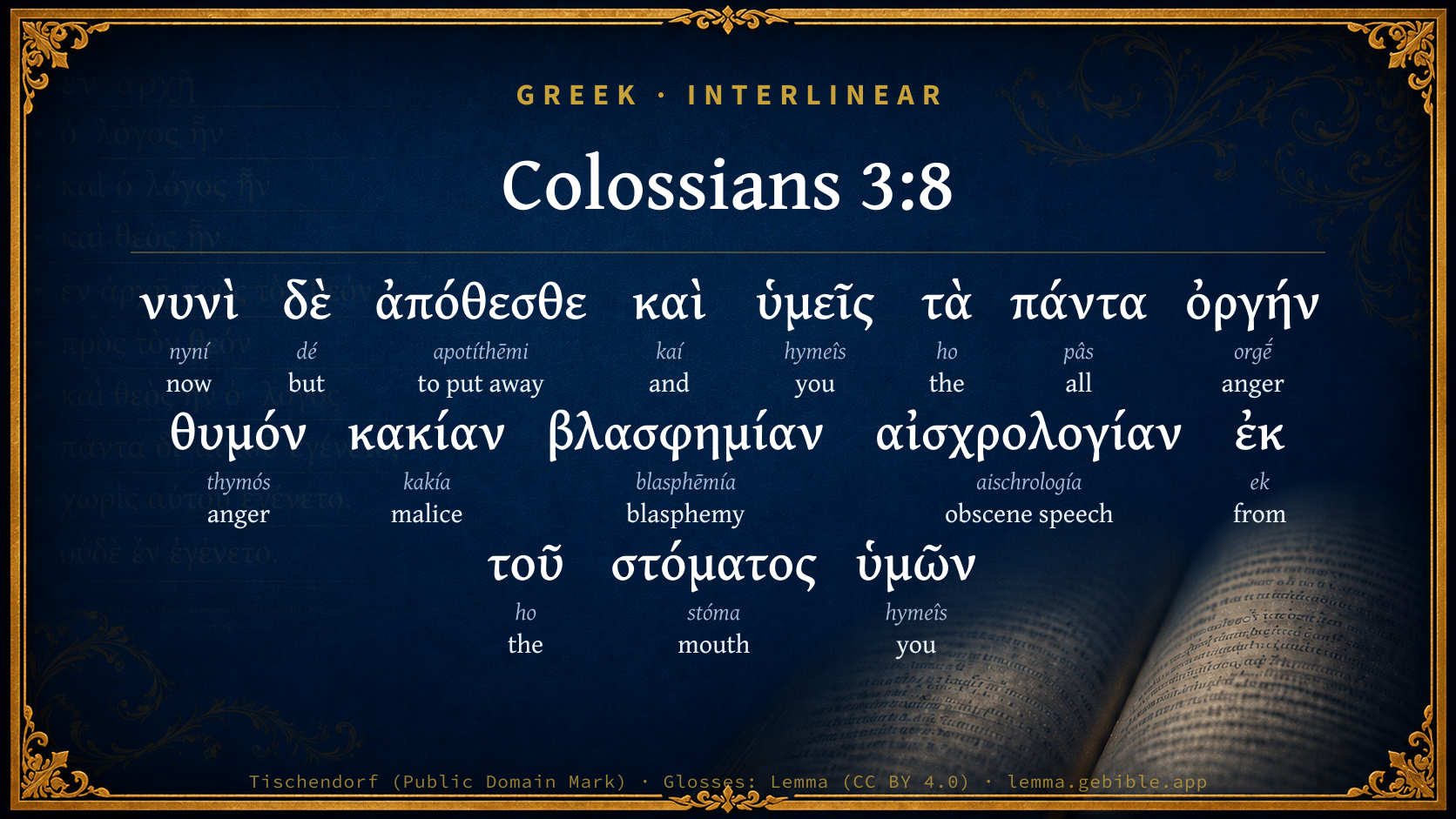
Greek (Tischendorf 8th ed.) Colossians 3:8 appears in the Greek New Testament. The text above is from the Tischendorf 8th edition. Each word links to its Strong’s number and a concise gloss. Click any word for its full Thayer’s Greek Lexicon entry.
Download image
Cite this verse

Colossians 3:8 (World English Bible). Public Domain. Lemma interlinear Bible study tool, https://lemma.gebible.app/v/colossians/3/8.

Show BibTeX & RIS
BibTeX
RIS
English Translation
but now you also put them all away: anger, wrath, malice, slander, and shameful speaking out of your mouth.
World English Bible · Public Domain
Highlights
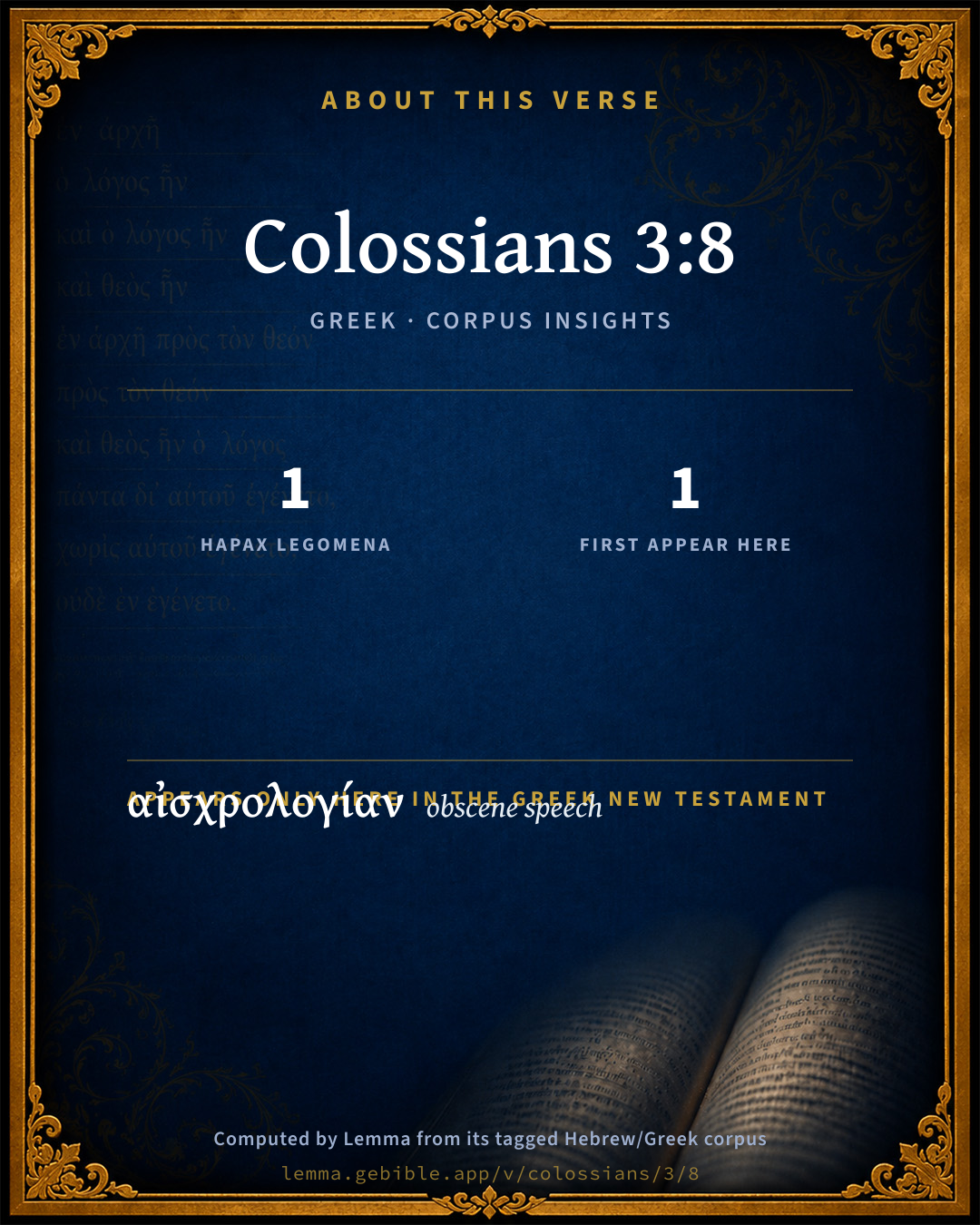
  • 1 hapax legomenon — only here in the Greek New Testament
  • 1 first appearance in the Greek New Testament
Full analysis ↓
Download a study sheet

One document with this verse’s original text, its word-by-word gloss line, the meaning frame, cross-references with their text, attributed commentary, and full source and license credits — printable, and it pastes into notes with its structure intact.

This verse Autodidact and up

Study sheet (.html) Plain text (.txt)

A passage Seminary Student

Up to 50 verses in one chapter. A passage sheet keeps up to 6 commentary sources and 12 cross-references per verse, in the order this page ranks them, and says so on the sheet whenever that leaves anything out. Ask for a single verse and you get the Autodidact verse sheet above.

Everything on this page stays free to read, with no account — the sheet is a download of what is already on screen, not access to it.

Want to remove ads? Support Godless Engineer
Compare translations 3

The same verse in 3 English versions, stacked beneath the original-language interlinear above. Click any original word for its lexicon entry.

Each is an independent rendering of the whole verse — the interlinear is not word-aligned to these translations.

Highlighted words mark where these versions differ — a whole-verse word diff, not a word-by-word alignment.

  • World English Bible Public Domain
    but now you also put them all away: anger, wrath, malice, slander, and shameful speaking out of your mouth.
  • King James Version Public Domain
    But now ye also put off all these; anger, wrath, malice, blasphemy, filthy communication out of your mouth.
  • unfoldingWord Literal Text CC BY-SA 4.0
    But now you must also lay aside all —wrath, anger, evil desire, slander, obscene speech from your mouth.

unfoldingWord Literal Text — © unfoldingWord, licensed CC BY-SA 4.0. Word-aligned USFM3 via Door43 (git.door43.org/unfoldingWord/en_ult).

Versions to compare (up to 4)

3 of 4 selected

Show all 19 translations

Every available English version of this verse, each an independent rendering of the whole verse.

  • World English Bible Public Domain
    but now you also put them all away: anger, wrath, malice, slander, and shameful speaking out of your mouth.
  • Berean Standard Bible Public Domain
    But now you must put aside all such things as these: anger, rage, malice, slander, and filthy language from your lips.
  • Majority Standard Bible Public Domain
    But now you must put aside all such things as these: anger, rage, malice, slander, and filthy language from your lips.
  • King James Version Public Domain
    But now ye also put off all these; anger, wrath, malice, blasphemy, filthy communication out of your mouth.
  • American Standard Version (1901) Public Domain
    but now do ye also put them all away: anger, wrath, malice, railing, shameful speaking out of your mouth:
  • Revised Version (1885) Public Domain
    But now put ye also away all these; anger, wrath, malice, railing, shameful speaking out of your mouth:
  • Geneva Bible (1599) Public Domain
    But now put ye away euen all these things, wrath, anger, maliciousnes, cursed speaking, filthie speaking, out of your mouth.
  • Douay-Rheims (1899) Public Domain
    But now put you also all away: anger, indignation, malice, blasphemy, filthy speech out of your mouth.
  • Young's Literal Translation Public Domain
    but now put off, even ye, the whole -- anger, wrath, malice, evil-speaking, filthy talking -- out of your mouth.
  • Literal Standard Version CC BY-SA 4.0
    but now put off, even you, the whole—anger, wrath, malice, slander, filthy talking—out of your mouth.
  • Unlocked Literal Bible CC BY-SA 4.0
    But now you must get rid of all these things—wrath, anger, evil intentions, insults, and obscene speech from your mouth.
  • unfoldingWord Literal Text CC BY-SA 4.0
    But now you must also lay aside all —wrath, anger, evil desire, slander, obscene speech from your mouth.
  • Darby Bible Public Domain
    But now, put off, *ye* also, all [these] things, wrath, anger, malice, blasphemy, vile language out of your mouth.
  • World Messianic Bible Public Domain
    but now you must put them all away: anger, wrath, malice, slander, and shameful speaking out of your mouth.
  • Webster's Bible Public Domain
    But now ye also put off all these; anger, wrath, malice, blasphemy, filthy communication out of your mouth.
  • Free Bible Version CC BY-SA 4.0
    but now you should get rid of such things as anger, rage, wickedness, abuse, and using obscenities.
  • Bible in Basic English Public Domain
    But now it is right for you to put away all these things; wrath, passion, bad feeling, curses, unclean talk;
  • Text-Critical English NT CC BY 4.0
    But now you must put them all aside: wrath, anger, malice, slander, and filthy language from your mouth.
  • Tyndale New Testament (1534) Public Domain
    But now put ye also awaye from you all thynges wrath fearsnes maliciousnes cursed speakynge filthy speakynge out of youre mouthes.

Literal Standard Version (2020), Covenant Press — licensed CC BY-SA 4.0. Text via the HelloAO Bible API (eBible.org). Unlocked Literal Bible (unfoldingWord) — licensed CC BY-SA 4.0. Text via the HelloAO Bible API (eBible.org). unfoldingWord Literal Text — © unfoldingWord, licensed CC BY-SA 4.0. Word-aligned USFM3 via Door43 (git.door43.org/unfoldingWord/en_ult). Free Bible Version, Dr. Jonathan Gallagher — licensed CC BY-SA 4.0. Text via the HelloAO Bible API (eBible.org).

Word by word

More ways to search: Search by grammar → Find every occurrence → Compare this word →

Practice this passage: Drill this verse → Learn its vocabulary →

αἰσχρολογίαν
aischrología
G148
“obscene speech”
Noun, Accusative, Singular, Feminine
Part of Speech
Noun
Case
Accusative
Number
Singular
Gender
Feminine
Full Thayer's Definition

Origin: from G150 and G3056

TDNT: None

1. foul speaking, low and obscene speech
  1. νυνὶ nyní G3570 “now” Adverb
  2. δὲ dé G1161 “but” Conjunction
  3. ἀπόθεσθε apotíthēmi G659 “to put away” Verb, Aorist, Middle, Imperative, 2nd person, Plural
  4. καὶ kaí G2532 “and” Conjunction
  5. ὑμεῖς hymeîs G5210 “you” Personal pronoun, 2nd person, Nominative, Plural
  6. τὰ ho G3588 “the” Article, Accusative, Plural, Neuter
  7. πάντα pâs G3956 “all” Adjective, Accusative, Plural, Neuter
  8. ὀργήν orgḗ G3709 “anger” Noun, Accusative, Singular, Feminine
  9. θυμόν thymós G2372 “anger” Noun, Accusative, Singular, Masculine
  10. κακίαν kakía G2549 “malice” Noun, Accusative, Singular, Feminine
  11. βλασφημίαν blasphēmía G988 “blasphemy” Noun, Accusative, Singular, Feminine
  12. ἐκ ek G1537 “from” Preposition
  13. τοῦ ho G3588 “the” Article, Genitive, Singular, Neuter
  14. στόματος stóma G4750 “mouth” Noun, Genitive, Singular, Neuter
  15. ὑμῶν hymeîs G5210 “you” Personal pronoun, 2nd person, Genitive, Plural

About this verse

These counts appear in no published source. They are computed here, from the morphology-tagged text and Lemma’s own curated glosses. What Lemma adds →

16
words
14
distinct lemmas
Pauline Epistles
section

Notable vocabulary

1 hapax legomenon — a word that appears only here in the entire Greek New Testament:

  • αἰσχρολογίαν obscene speech G148

First appearance in Scripture

This word makes its first canonical appearance in the Greek New Testament here:

  • αἰσχρολογίαν obscene speech G148

Shared distinctive vocabulary

ἀπόθεσθε to put away G659 occurs in 9 verses of the Greek New Testament. Also found in:
Repetition

Words recur within this verse:

Cross-references

34

Topical passages linked to Colossians 3:8 in the Treasury of Scripture Knowledge — connected by theme and wording, ordered by reader-vote popularity; previews shown in the World English Bible.

  • Ephesians 4:29 Let no corrupt speech proceed out of your mouth, but such as is good for building up as the need may be, that it may give grace to those who hear.
  • Ephesians 4:22 that you put away, as concerning your former way of life, the old man, that grows corrupt after the lusts of deceit;
  • James 1:20–21 for the anger of man doesn't produce the righteousness of God.
  • Ephesians 5:4 nor filthiness, nor foolish talking, nor jesting, which are not appropriate; but rather giving of thanks.
  • Colossians 3:5 Put to death therefore your members which are on the earth: sexual immorality, uncleanness, depraved passion, evil desire, and covetousness, which is idolatry;
  • Ephesians 4:26 "Be angry, and don't sin." Don't let the sun go down on your wrath,
  • Ephesians 4:31–32 Let all bitterness, wrath, anger, outcry, and slander, be put away from you, with all malice.
  • Hebrews 12:1 Therefore let us also, seeing we are surrounded by so great a cloud of witnesses, lay aside every weight and the sin which so easily entangles us, and let us run with patience the race that is set before us,
  • Proverbs 29:22 An angry man stirs up strife, And a wrathful man abounds in sin.
  • Colossians 3:9 Don't lie to one another, seeing that you have put off the old man with his doings,
  • 1 Peter 2:1 Putting away therefore all wickedness, all deceit, hypocrisies, envies, and all evil speaking,
  • 1 Corinthians 3:3 for you are still fleshly. For insofar as there is jealousy, strife, and factions among you, aren't you fleshly, and don't you walk in the ways of men?
  • 2 Corinthians 12:20 For I am afraid that by any means, when I come, I might find you not the way I want to, and that I might be found by you as you don't desire; that by any means there would be strife, jealousy, outbursts of anger, factions, slander, whisperings, proud thoughts, riots;
  • Psalms 37:8 Cease from anger, and forsake wrath. Don't fret, it leads only to evildoing.
  • Matthew 5:22 But I tell you, that everyone who is angry with his brother without a cause shall be in danger of the judgment; and whoever shall say to his brother, 'Raca!' shall be in danger of the council; and whoever shall say, 'You fool!' shall be in danger of the fire of Gehenna.
  • James 3:4–6 Behold, the ships also, though they are so big and are driven by fierce winds, are yet guided by a very small rudder, wherever the pilot desires.
  • James 3:14–16 But if you have bitter jealousy and selfish ambition in your heart, don't boast and don't lie against the truth.
  • Proverbs 17:14 The beginning of strife is like breaching a dam, Therefore stop contention before quarreling breaks out.
  • Romans 13:13 Let us walk properly, as in the day; not in reveling and drunkenness, not in sexual promiscuity and lustful acts, and not in strife and jealousy.
  • Galatians 5:15 But if you bite and devour one another, be careful that you don't consume one another.
  • Mark 7:22 covetings, wickedness, deceit, lustful desires, an evil eye, blasphemy, pride, and foolishness.
  • Galatians 5:20 idolatry, sorcery, hatred, strife, jealousies, outbursts of anger, rivalries, divisions, heresies,
  • Galatians 5:26 Let's not become conceited, provoking one another, and envying one another.
  • 1 Timothy 1:13 although I was before a blasphemer, a persecutor, and insolent. However, I obtained mercy, because I did it ignorantly in unbelief.
  • 1 Timothy 1:20 of whom is Hymenaeus and Alexander; whom I delivered to Satan, that they might be taught not to blaspheme.
  • 2 Timothy 2:23–24 But refuse foolish and ignorant questionings, knowing that they generate strife.
  • James 2:7 Don't they blaspheme the honorable name by which you are called?
  • 2 Peter 2:18 For, uttering great swelling words of emptiness, they entice in the lusts of the flesh, by licentiousness, those who are indeed escaping from those who live in error;
  • Jude 1:8 Yet in like manner these also in their dreaming defile the flesh, despise authority, and slander celestial beings.
  • Leviticus 24:11–16 The son of the Israelite woman blasphemed the Name, and cursed; and they brought him to Moses. His mother's name was Shelomith, the daughter of Dibri, of the tribe of Dan.
  • Proverbs 19:19 A hot-tempered man must pay the penalty, For if you rescue him, you must do it again.
  • Revelation 16:9 People were scorched with great heat, and people blasphemed the name of God who has the power over these plagues. They didn't repent and give him glory.
  • Jude 1:13 wild waves of the sea, foaming out their own shame; wandering stars, for whom the blackness of darkness has been reserved forever.
  • 2 Peter 2:7 and delivered righteous Lot, who was very distressed by the lustful life of the wicked

Cross-references courtesy of OpenBible.info (CC BY 4.0).

Commentary

Notes on Colossians 3:8 from classic Christian and Jewish commentators (each source and its license shown beneath its notes). The classic Christian expositions comment on the surrounding passage and are grouped to its opening verse, so a note may address several verses; the Jewish commentaries on the Tanakh (Rashi and others) are per-verse, so they appear only where the commentator wrote on this verse.

Lemma curates 59 commentaries, every one of them public domain or Creative Commons licensed, each selected and text-cleaned for this edition rather than reprinted as found. About our sources →

Matthew Henry's Commentary

As we are to mortify inordinate appetites, so we are to mortify inordinate passions (Col 3:8): But now you also put off all these, anger wrath, malice; for these are contrary to the design of the gospel, as well as grosser impurities; and, though they are more spiritual wickedness, have not less malignity in them. The gospel religion introduces a change of the higher as well as the lower powers of the soul, and supports the dominion of right reason and conscience over appetite and passion. Anger and wrath are bad, but malice is worse, because it is more rooted and deliberate; it is anger heightened and settled. And, as the corrupt principles in the heart must be cut off, so the product of them in the tongue; as blasphemy, which seems there to mean, not so much speaking ill of God as speaking ill of men, giving ill language to them, or raising ill reports of them, and injuring their good name by any evil arts, - filthy communication, that is, all lewd and wanton discourse, which comes from a polluted mind in the speaker and propagates the same defilements in the hearers, - and lying: Lie not one to another (Col 3:9), for it is contrary both to the law of truth and the law of love, it is both unjust and unkind, and naturally tends to destroy all faith and friendship among mankind. Lying makes us like the devil (who is the father of lies), and is a prime part of the devil's image upon our souls; and therefore we are cautioned against this sin by this general reason: Seeing you have put off the old man with his deeds, and have put on the new man, Col 3:10. The consideration that we have by profession put away sin and espoused the cause and interest of Christ, that we have renounced all sin and stand engaged to Christ, should fortify us against this sin of lying. Those who have put off the old man have put it off with its deeds; and those who have put on the new man must put on all its deeds - not only espouse good principles but act them in a good conversation. The new man is said to be renewed in knowledge, because an ignorant soul cannot be a good soul. Without knowledge the heart cannot be good, Pro 19:2. The grace of God works upon the will and affections by renewing the understanding. Light is the first thing in the new creation, as it was in the first: after the image of him who created him. It was the honour of man in innocence that he was made after the image of God; but that image was defaced and lost by sin, and is renewed by sanctifying grace: so that a renewed soul is something like what Adam was in the day he was created. In the privilege and duty of sanctification there is neither Greek nor Jew, circumcision nor uncircumcision, Barbarian, Scythian, bond nor free, Col 3:11. There is now no difference arising from different country or different condition and circumstance of life: it is as much the duty of the one as of the other to be holy, and as much the privilege of the one as of the other to receive from God the grace to be so. Christ came to take down all partition-walls, that all might stand on the same level before God, both in duty and privilege. And for this reason, because Christ is all in all. Christ is a Christian's all, his only Lord and Saviour, and all his hope and happiness. And to those who are sanctified, one as well as another and whatever they are in other respects, he is all in all, the Alpha and Omega, the beginning and the end: he is all in all things to them.

Matthew Henry's Commentary on the Whole Bible (1708–1710) — public domain (CC PDM 1.0). Text via the HelloAO Bible API.

Matthew Poole's English Annotations

But now ye also put off all these: having minded them of their former condition under paganism in a state of sin, while they served various sensual lusts, he doth here in their present circumstances under Christianity in a state of grace, show them that, now they professed to walk as children of light, Rom 13:12; Eph 5:8, with 1Th 5:5,8, they were more strongly obliged to lay aside those inordinate affections which were more spiritual Eph 4:22; some of which he doth instance in, viz. anger; whereby he doth not mean the passion itself, Eph 4:26, with Eph 4:31, but the inordinacy of it, being a vindictive appetite to hurt another unjustly for some affront conceived to be given or occasioned by him.

Wrath; indignation, Rom 2:8, a sudden, hasty, and vehement commotion of the offended mind apprehending an injury, when it shows itself in the countenance in a manner and measure unbecoming a Christian, as in them who with rage thrust Christ out of the city, Luk 4:28,29, with Eph 4:31.

Malice; connoting both the evil habit and the vicious act: now though this word be taken oftentimes more generally, for that mischievous vitiosity and venom which runs through all the passions of the soul, reaching to all sins, 1Co 5:8; 14:20; yet here it seems to be taken more specially, for a secret malignity of rooted anger and continued wrath, remembering injuries, meditating revenge, and watching for an occasion to vent it, being much the same with that which the apostle in a parallel Epistle calls bitterness, Eph 4:31, compared with other places, Gen 4:5; Rom 1:29; Tit 3:3; 1Pe 2:1. After he had urged the laying aside of heart evils as the cause, he moves to the laying aside those of the tongue, viz.

blasphemy, which in a like place we render evil speaking, Eph 4:31; the original word, according to the notation of it, doth signify the hurt of any one’s good name, which when it respects God we do more strictly call blasphemy. When it respects our neighbour, though more largely it be so, defamation, Rom 3:8; 1Co 4:13; Tit 3:2; yet more strictly, if it be done secretly, it is detraction or backbiting; more openly, reviling or slandering, Mat 15:19; Mar 7:22; 1Ti 6:4.

Filthy communication out of your mouth: obscene discourse, dishonest talk, should not come into the Christian’s mouth, Col 4:6; see on Eph 4:29; 5:4; wanton, lewd, and unclean speeches should not proceed from a Christian’s tongue, 1Co 15:33.

Matthew Poole's English Annotations on the Holy Bible (1683–1685) — public domain. Text from a community e-Sword/MySword module.

Joseph Benson's Commentary

Col 3:8-11. But now ye also — Being converted to the pure, peaceable, and devout religion of the Lord Jesus; put off — Mortify; all these corrupt passions and lusts; anger, &c. — See on Eph 4:31; blasphemy — Or evil speaking, as the word may be properly rendered; for it includes not only impious speeches with regard to God, which is the highest degree of malignant language, but all railing and reproachful speeches against our fellow-creatures, and even speaking of the faults of absent persons, when not necessary for the caution of others, or when no good end is likely to be answered thereby. Filthy communication — The word αισχρολογια, so rendered, seems to signify the same with λογος σαπρος, rotten discourse, mentioned Eph 4:29, where see the note. And was there need to warn even believers in Christ against such gross and palpable sins as are here named? O what is man, till fully renewed in the spirit of his mind! Lie not one to another — Either in trade and business, or common conversation; seeing ye have put off the old man — That which (Col 2:11) is called the body of the sins of the flesh, and is there said to be put off by the circumcision of Christ, by Christ’s circumcising men’s hearts, or making them new creatures. The apostle means that when they professed to believe in Christ, and to offer themselves to baptism, that they might be members of the Christian Church, they had professed to put off the old man with his deeds; that is, the evil practices belonging thereto. And have put on the new man — Have professed to receive a new nature, and to manifest it by new dispositions and a new behaviour; which is renewed in, or by the means of, knowledge — Namely, spiritual and divine knowledge, the knowledge of God and Christ, and of the divine word and will; after the image of him that created him — Even of God, who is the great standard of all moral perfection, and who, in the first creation, made man after his own image. See on Eph 4:22-24. Where — In which case it matters not what a man is externally, whether Jew or Gentile — Circumcised or uncircumcised; barbarian — Void of all the advantages of education, yea, or Scythian — Of all barbarians most barbarous; bond — A slave, subjected to the will of his master, or freeman — Who has his actions in his own power: but Christ is in all — Who are thus renewed, and is all things to them, connected with their salvation, the source of all their wisdom and grace, holiness and happiness; he is instead of all they want, and better than all the things which they possess besides him.

Joseph Benson's Commentary on the Old and New Testaments (1811–1818) — public domain. Text from a community e-Sword module.

The Pulpit Commentary

But now do ye put away indeed all these (things) (ver. 9; Col_2:11; Eph_4:22, Eph_4:25; Rom_13:12 1Pe_2:1) The thought of the death of the old life gives place to that of the divesting of the old habit; the new life wears a new dress, Mark the triumphant emphasis in "but now!" (opposed to the "once" of ver. 8), characteristic of the writer (comp. Col 1, 21, 26; Rom_3:21 Rom_6:22, etc.) Tanta ("all these things," "the whole" of them) summarizes the vices specified in ver. 5, and forms the starting point of another series, in which malice predominates, as impurity in the previous list; anger, wrath, malice, evil speaking, foul speech from your mouth (Eph_4:26-31 Eph_5:4; Rom_1:29-31; Gal_5:20, Gal_5:21; Tit_3:3) There is a similar order and division between these two chief classes of sin in the parallel passages. In Eph_4:31, 32 and 5:3-5 the order is reversed. "Anger" (ojrgh) is ascribed to God in ver. 6. (comp. Eph_4:26; Heb_10:30) (On "anger" and "wrath" (or "rage"), see ver. 6.) The latter is once ascribed to God by St. Paul, (Rom_2:8) more frequently in the Apocalypse. In man it is universally condemned. (For kakia, malignity, badness of disposition, comp. (Rom_1:29; 1Co_14:20; Tit_3:3; see Trench"s "Synonyms. Blasfhmia, in its original sense, includes injurious speech of any kind, either against man or God. (see Rom_3:8 Rom_14:16; 1Co_10:30; Tit_3:2) Aijscrov in aijscrologia (only here in the New Testament) denotes, like the English "foul," either "scurrilous" or "filthy." The former kind of speech is suggested by the foregoing blasphemia; but especially in such an atmosphere as that of Greek city life, scurrility commonly runs into filthiness. In Eph_5:4, where a slightly different word occurs, the latter idea is prominent. The two last vices, being sins of speech, must be put away "out of your mouth." "Your" bears the emphasis in the Greek; such utterance is quite unfit for a Christian mouth. (comp. Eph_4:29 Eph_5:3, Eph_5:4; Jam_3:10; and the prohibition of lying in the next verse)

Vers. 8, 9.

A warning against social sins.

The sins already noticed are personal; the sins now to be specified arise in connection with man"s social relationships. "But now put ye also away all these: anger, wrath, malice, railing, shameful speaking out of your mouth. Lie not one to another." These sins, again, divide themselves into two classes three of each:

(1) sins of inward feeling;

(2) sins of outward expression.

I SINS OF INWARD FEELING. "Anger, wrath, malice.

1. Anger and wrath. There is an anger that is righteous. "Be angry and sin. (Eph_4:26) Even our Lord was angry as he looked upon the Pharisees. (Mar_3:5) But the anger here condemned is sinful. It is a settled feeling of hatred as distinguished from wrath, which is more passionate and transient.

(1) We are warned against both. "Cease from anger, leave off wrath, fret not thyself to do evil". (Psa_37:8) We are not to give place to them. (Rom_12:19) "Be not hasty in thy spirit to be angry". (Ecc_7:11) We ought to be "slow to wrath". (Jam_1:19) We ought not "to let the sun go down upon it.

(2) They lay the heart open to the devil. (Eph_4:17)

(3) They grieve the Spirit of God. (Eph_4:30, Eph_4:31)

(4) They intercept prayer. (1Ti_2:8)

2. Malice. This is the vicious habit of mind that delights in injury to others.

(1) It is the sign of an unregenerate nature (Tit_3:3; 1Jn_2:9)

(2) It springs from pride and envy. (Pro_13:10)

(3) It is entirely opposed to that love that "worketh no ill to his neighbour". (Rom_13:10)

(4) It grieves the Holy Spirit. (Eph_4:30, Eph_4:31)

II SINS OF OUTWARD EXPRESSION. "Railing, shameful speaking out of your mouth. Lie not one to another.

1. Railing. This is "the strife of words.

(1) It is speaking evil of men, and springs from envy or malice. The tongue of the railer is compared to the sting of adders, to a sharp sword, to arrows.

(2) It leads to reprisals; for "if ye bite and devour one another, take heed lest ye be consumed one of another". (Gal_5:15)

(3) The Judge will condemn the railer. (Jam_5:9)

(4) It hinders the success of the Word. (1Pe_2:1, 1Pe_2:2) We ought, therefore, to "put far from us a froward mouth and perverse lips". (Pro_4:24)

1. Shameful speaking. This applies to foul abuse, not to obscene language. While railing is the expression of angry and malicious feeling, this is the expression of coarse contempt and insolence.

2. Falsehood. This habit is to be put off; for:

(1) It is that of the devil, who is the father of lies. (Joh_8:44)

(2) God hates it. (Pro_12:22)

(3) It is a breach of the social contract. (Eph_4:25)

(4) It shuts out from heaven. (Rev_22:15) Let us pray God to remove far from us vanity and lies. T.C. (Pro_3:8)

Vers. 8-11.

The new life in Christ the death warrant to old sins.

The apostle still employs the most powerful motives possible in his exhortations to personal holiness. His figures and illustrations vary ("Ye died; ye were raised with Christ; therefore put your sins to death. "Ye put off your old nature and put on a new nature; therefore put away your old sins).

I OLD SINS TO BE PUT AWAY. From the sins of the flesh Paul passes on to sins of the spirit and the tongue. There are two groups.

1. Anger, wrath, malice. Discriminate between these. Orgh may be a right state of mind (Mar_3:5; Eph_4:26) but is easily depraved into a criminal anger, or into qumov (wrath, passion), or kakia (malice which wishes or seeks to do injury). In fact, all our evil principles may be said to be good principles fallen and debased. Selfishness is fallen self love; envy is depraved emulation; revenge is fallen resentment; sinful anger is righteous indignation degraded and debased. The lawfulness of anger must be determined by its direction, its degree, and its motive. In the daily struggle against various forms of sinful anger, we may give the following hints.

(l) When passion rises in the soul, let it not overflow through the lips. Suppress the mutiny within the citadel (Psa_17:3 Psa_39:1; Jam_1:19)

(2) Let the battle be fought in sight of the cross and in memory of the provocations we have given to God. (Eph_4:31, Eph_4:32)

(3) Rely on Christ"s power to save now. (Tit_2:14)

2. Railing," "shameful speaking," lying. Among the commonest forms of these fruits of an evil heart (Mat_12:34) we note: "Backbiting," reckless detraction, i.e. seeking to draw a person down from the reputation he enjoys. (It is not necessary or lawful to speak all we know against a person, though many act as though they were at perfect liberty to utter it, if only it is true.) Attributing wrong motives a very common form of "shameful speaking," a gross breach of "charity", (1Co_13:7) and an arrogant claim to a "discerning of spirits." Exaggerations; false advertisements; conventional falsehoods in business (Mat_5:37; 2Co_1:12, 2Co_1:17, 2Co_1:18; Eph_4:25)

II THE DEATH WARRANT OF THESE OLD SINS. Covet not, rail not, lie not, etc., "seeing ye have put off," etc. Two truths are taught.

1. We profess to be enjoying a new life. So complete is the change it is described as a change of nature ("old man new man"), a new creation (2Co_5:17; Gal_6:15) a new birth, a new resurrection. Of this new life we learn:

(1) It is Divine in its origin ("him that created him").

(2) Progressive in its nature ("being renewed unto knowledge"), like a statue becoming more and more like the ideal of the sculptor; or a youth maturing into manhood; or a pupil growing into intimate acquaintance with his master"s deepest thoughts (Joh_17:3; Rom_12:2; 2Co_4:16; Eph_3:16-19; Php_3:9-14)

(3) God like in its character. ("after the image," etc., Eph_4:24) A renewed saint is more God like than an unfallen Adam. (Rom_5:21) The issue of this progressive growth "unto knowledge" and mature Christian character is seen in Eph_4:13-16. Everything connected with that new life is in deadly antagonism to every kind of sin, which must be "put away," like slothful habits by the scholar, or "weight" by the runner. Sin is like poison to the new life we profess to enjoy, depressing vitality if it does not extinguish life altogether.

2. In this life Christ claims supremacy. (Ver. 11.) Dr. Lightfoot suggests that the distinctions here said to be abolished were selected with special reference to the circumstances of the Colossian Church: to the Judaizing of some, to the Gnostic pride of others who despised the unlettered; and that his relation at the time he wrote to the slave Onesimus led him to add "bondman, freeman." The unity of the race and the brotherhood of men are distinctly Christian doctrines. "The head of every man is Christ". (1Co_11:3) Our union and subordination to him constitute our equality with one another in the world of grace. (Mat_23:8-10) For all earthly distinctions sink into insignificance compared with his supremacy and his presence in us all.

(1) "Christ is all:" he is "all" to God (Col_1:19; cf. Mat_3:17) as the only begotten Son, the one atoning Sacrifice ("the Lamb of God"), the only Mediator, the appointed Judge (Joh_5:22, Joh_5:23; Act_17:31) Contrast the limitations attached to Abraham, the friend of God, (Gen_18:18-33) and Moses, who was "faithful as a servant," but could not redeem his brethren, (Exo_32:32, Exo_32:33) and "the fulness" of Christ. (Heb_9:26 Heb_10:10-14) Being "all" to God, he is all to us; the Centre and Circumference of truth; the Alpha and Omega of our life; "the Author and Finisher of our faith." He is a Saviour in whom "dwelleth all the fulness," etc., (Col_2:9) "in whom are hid," etc., (Col_2:3) who is "full of grace and truth," whose love "passeth knowledge," whose blood "cleanseth from all sin," and "who of God is made unto us," etc.. (1Co_1:30)

(2) Christ is "in all in all of us; for he comes to save, to conquer, to reign, to share his very life with us. (Gal_2:20) Where he comes, sin must go; he can brook no rival; for "in all things he must have the preeminence." And he is in all things: "He fills all things". (Eph_1:23 Eph_4:10) A sense of the all-pervading presence and power of Christ should

(a) abase the Christian tempted to be proud of birth, purse, or brain;

(b) give dignity to the lowliest disciple in whom the Son of God dwells;

(c) pledge us to ceaseless strife against every form of sin. E.S.P.

The Pulpit Commentary (1880–1919), ed. H.D.M. Spence-Jones & Joseph S. Exell — public domain. Text from a community e-Sword module.

Tyndale Open Study Notes

Tyndale Open Resources

3:8 get rid of (literally take off): Taking off clothes is a metaphor for ridding our lives of practices that interfere with our walk with the Lord (see Rom 13:12; Eph 4:22, 25; Heb 12:1; Jas 1:21; 1 Pet 2:1).

Tyndale Open Study Notes — © Tyndale Open Resources, licensed CC BY-SA 4.0. Text via the HelloAO Bible API.

Bengel's Gnomon

Johann Albrecht Bengel

Col 3:8. Καὶ ὑμεῖς, ye also) This answers to the ye also, Col 3:7. In Col 3:7 it was, ye also, as well as the other “children of unbelief” (‘disobedience’). In Col 3:8 it is, ye also, as well as other believers.—τὰπάντα) all old things, especially anger, etc. So in the antithesis, above all, Col 3:14.—ὀργὴν, θυμὸν, anger, harshness or cruelty [Beng. translates θύμον, sœvitia, Engl. Vers., wrath]) Eph 4:31 [where also θυμον is sœvitia, harshness].—κακίαν) faults connected with the mind [evil-disposition]; for example, suspicion, perversity, impatience [Engl. Vers. renders it malice].—βλασφημίαν, αἰσχρολογίαν, blasphemy, filthy communication) The words, Out of your mouth, have respect to these two.

Bengel's Gnomon of the New Testament — English translation (T&T Clark, Edinburgh, 1860) — public domain. Text from a community e-Sword module.

Meyer's Critical & Exegetical Commentary

Heinrich August Wilhelm Meyer

Col_3:8. Νυνὶ δέ] In contrast to the past, which has just been described: but now, when ye are no longer alive in those things.

καὶ ὑμεῖς] does not refer to the fact that the Ephesians also are thus exhorted (Eph_4:22; Eph_4:25; Eph_4:31), as Holtzmann here contrives critically to suggest; but as καὶ ὑμ. in Col_3:7 reminded the readers of the immoral pre-Christian society, which they also had formerly resembled, so this καὶ ὑμεῖς reminds them of the moral Christian society, which they also ought to resemble now.

τὰ πάντα] the whole of these, i.e. the things indicated by ἐν τούτοις without any exception; ye shall retain nothing of them, ne quid veneni resideat (Grotius). To this τὰ πάντα the apostle then annexes directly and in rapid asyndetic continuation yet other sins, which are likewise to be left off. Bleek erroneously takes ὀργὴν κ.τ.λ as in apposition to τὰ πάντα; for the latter can only be retrospective (comp. Hofmann), and cannot, consistently with the text, be taken as meaning, everything that belongs to the old man.

ἀπόθεσθε] like garments (see on Eph_4:22); a lively change of figures; the conception of members is laid aside.

θυμόν] distinguished from ὀργήν as the ebullition, the effervescing of the latter (Eustath. ad Il. i. p. 7. 17). See on Rom_2:8; comp. Eph_4:31; Rev_16:19; Sir_48:10; 1Ma_2:49; Hom. Il. ix. 629; Plat. Phil. p. 47 E: τοῖς θυμοῖς κ. ταῖς ὀργαῖς.

κακίαν] wickedness, malicious nature. Comp. on Rom_1:29; Eph_4:31.

βλασφημίαν] slander, not against God, but against others, as oral outbreak of the evil dispositions mentioned. Comp. Eph. l.c.; 1Co_4:13; Rom_3:8; Tit_3:2; frequently in classic writers; in Dem. 312. 19 joined with συκοφαντία.

αἰσχρολογίαν] only used here in the N. T.: shameful discourse, which, in accordance with the category of all the sins here named, is not to be understood of unchaste discourse, as, following the Fathers (see Suicer, Thes. I. p. 136), it has commonly been taken (Hofmann: obscene discourse); comp. Epictet. Enchir. 33. 16; Xen. de Lac. rep. 5. 6; αἰσχρολογοῦντας in Plat. Rep. p. 395 E; Pollux, iv. 105; and the passages in Wetstein; also αἰσχροεπέω in Athen. xiii. p. 571 A; and respecting the αἰσχρολογία ἐφʼ ἱεροῖς, see Lobeck, Aglaoph. p. 689. Rather: railing speech (Polyb. viii. 13. 8, xxxi. 10. 4), forming one genus with βλασφημίαν, but a wider idea. Comp. αἰσχρὰ ἔπεα, Hom. Il. iii. 38, xxiv. 238. All the elements in Col_3:8 specify the malevolent and hostile disposition; and the two last, especially the oral manifestation thereof; hence the addition of ἐκ τοῦ στόματος ὑμ., which, without arbitrariness, cannot but be referred to both words (so also Bleek), not to αἰσχρολ. alone, and is, with Grotius, to be conceived as depending on the still operative idea of ἀπόθεσθε, so that it may not be characterized as a secondary malformation (Holtzmann). The readers are to lay aside, generally, ὀργὴν, θυμὸν, κακίαν; and to lay aside from their mouth βλασφημίαν, αἰσχρολογίαν. We are not to suppose any special purpose in connection with the addition; it serves merely for the concrete representation; but, if we should regard it as the more precise definition of αἰσχρολ. (Hofmann), or should even, as is often done, by supplying an ἐκπορευομένην, join it with αἰσχρολογ., or with βλασφ. and αἰσχρολογ., it would be utterly void of meaning. The special idea of that which defiles (Chrysostom), or of the opposite of Christian praise to God (Hofmann), does not form the basis of the ἐκ τ. στόμ. ὑμ.; on the contrary, it is the conception in general of what is unsuited and foreign (comp. on νυνὶ δέ) to Christian fellowship and intercourse, which serves as the presupposition for the entire exhortation. Comp. Eph_4:29.

Meyer — Critical and Exegetical Commentary on the New Testament — English translation by Peter Christie, edited by Frederick Crombie (T&T Clark, 1880) — public domain. Text from a community e-Sword module.

Expositor's Greek Testament

ed. W. Robertson Nicoll

Col 3:8 . Col 3:8-10 are largely parallel to Eph 4:22-25 ; Eph 4:31 . νυνὶ δὲ : “but now,” emphatic contrast to ποτε , now that you have passed from that life of sinful conduct, see that you strip yourselves of these vices. ἀπόθεσθε καὶ ὑμεῖς τὰ πάντα : “do ye also put away all of them”. κ . ὑμ .: obviously not you as well as the Ephesians (Holtzm.), but you as well as other Christians. It is not clear whether τὰ π . refers exclusively to the preceding sins, to which then ὀργ . κ . τ . λ . forms a loose apposition, or whether it includes the latter also. It seems less harsh to give the injunction a forward as well as a backward reference. ὀργήν , θυμόν : usually the former is regarded as the settled anger, of which the latter is the sudden and passionate outburst. Cremer, however, followed by Haupt, regards θ . as the inner emotion, of which ὀρ . is the external expression. ὀρ . is certainly used of the external manifestation of wrath in Col 3:6 . κακίαν : “malignity,” the feeling which prompts a man to injure his neighbour. βλασφημίαν : as the other sins are against men, so this, “slander” not “blasphemy”. αἰσχρολογίαν . The word may mean “filthy speech” or “abusive speech”. Here the context decides for the latter. Lightfoot, combining both senses, translates “foulmouthed abuse,” but such combinations are generally to be distrusted. ἐκ τοῦ στόματος ὑμῶν : probably this should be connected both with βλ . and αἰσχρ . Whether it is dependent on ἀποθ ., “banish from your mouth” (Mey., Ol., Abb.), is more doubtful, since the interpolation of sins which are not sins of speech makes such a connexion awkward. Probably, then, the meaning is “proceeding out of your mouth”. ὑμ . is emphatic, and recalls the readers to their Christian profession.

The Expositor's Greek Testament, edited by W. Robertson Nicoll (1897–1910) — public domain. Text from a community e-Sword module.

Vincent's Word Studies in the New Testament

Marvin R. Vincent

Put off [αποθεσθε] . Compare Rom 13:12; Eph 4:22, 25; Heb 12:1; Jas 1:21; 1Pe 2:1.

Anger, wrath [οργην, θυμον] . See on Joh 3:36.

Malice [κακιαν] . See on naughtiness, Jas 1:21.

Blasphemy [βλασφημιαν] . See on Mr 7:22. Compare Rom 3:8; Rom 14:16; 1Co 4:13; Eph 4:31. Rev. railing.

Filthy communication [αισχρολογιαν] . Only here in the New Testament. Not merely filthy talking, as A. V., but foul - mouthed abuse. Rev., shameful speaking.

Out of your mouth. Construe with the preceding word. As ch. 2 20 - 22 suggests Christ 's words in Mt 14:1 - 20, this phrase suggests Mt 14:11, 18.

Marvin R. Vincent, Word Studies in the New Testament (1887–1900) — public domain. Text from a community e-Sword/MySword module.

Jamieson, Fausset & Brown

Robert Jamieson, A. R. Fausset & David Brown

But now--that ye are no longer living in them.

ye also--like other believers; answering to "ye also" (Col 3:7) like other unbelievers formerly.

put off--"Do ye also put away all these," namely, those just enumerated, and those which follow [ALFORD].

anger, wrath--(See on Eph 4:31).

blasphemy--rather, "reviling," "evil-speaking," as it is translated in Eph 4:31.

filthy communication--The context favors the translation, "abusive language," rather than impure conversation. "Foul language" best retains the ambiguity of the original.

Jamieson, Fausset & Brown — Commentary Critical and Explanatory on the Whole Bible (1871) — public domain (CC PDM 1.0). Text via the HelloAO Bible API.

Adam Clarke's Commentary

Verse 8. But now ye also put on all these] See Clarke on Eph 4:22. Being now converted, sin had no more dominion over them.

Anger, wrath, c.] They had not only lived in the evils mentioned Col 3:5, but also in those enumerated here and they had not only laid aside the former, but they had laid aside the latter also. They retained no bosom, no easily besetting, sin. They were risen with Christ, and they sought the things which were above.

Blasphemy] The word seems here to mean injurious and calumnious speaking.

Adam Clarke's Commentary on the Bible (1810–1826) — public domain. Text from a community e-Sword/MySword module.

John Calvin's Commentaries

8. But now — that is, after having ceased to live in the flesh. For the power and nature of mortification are such, that all corrupt affections are extinguished in us, lest sin should afterwards produce in us its wonted fruits. What I have rendered indignationem, (indignation,) is in the Greek θυμός — a term, which denotes a more impetuous passionateness than ὀργὴ, (anger.) Here, however, he enumerates, as may easily be perceived, forms of vice that were different from those previously mentioned.

John Calvin's Commentaries (1540-1563) — public domain. Text from the Calvin Translation Society English edition (1840s-50s) via the Christian Classics Ethereal Library (ccel.org). Calvin's coverage is partial (roughly two-thirds of the Bible); uncommented books and verses are honest gaps, never fabricated. The 19th-century editor's footnotes and remarks are omitted so the notes are faithfully Calvin's own voice.

Ellicott's Commentary for English Readers

(8) Anger, wrath, malice, blasphemy (slander—see Eph_4:31 and Notes there), filthy communication.—The word is “foul,” and the context here seems to show that it refers to grossness of insult and abuse, rather than (as in the cognate word of Eph_4:4) to “filthiness.”

A Bible Commentary for English Readers, edited by Charles John Ellicott (1878–1897) — public domain. Text from a community e-Sword module.

The Cambridge Bible for Schools and Colleges

gen. ed. J. J. S. Perowne

8. But now] Under the divinely altered case of their conversion and union with Christ.

you also] As well as all other true believers.

put off] The Greek is imperative, and so the English is to be taken; but the English is verbally ambiguous between imperative and indicative.—In Christ, they were already, ideally and potentially, divested of sin; they were now, as if never before, to realize and act upon that divestiture. Cp. Eph_4:25; and see Rom_13:12.

all these] Lit., “the all (things),” the whole congeries of sins.—Here, as perpetually, comes in the principle that the Christian character is a sinless character, to be realized and lived out by its possessor, who assuredly discovers in the process that he is not a sinless person, while he is gifted in Christ with a Divine liberty from serving sin.

anger, wrath] The two words occur together Rom_2:8; Eph_4:31; Rev_16:19; Rev_19:15. The word rendered “anger” is rather chronic, that rendered “wrath” rather acute—an outburst. See Trench, Synonyms, § xxxvi.

malice] The Greek word sometimes bears the sense of “evil,” “ill,” in general; e.g. Mat_6:34. But in lists of vices (cp. here Rom_1:29, Tit_3:3; 1Pe_2:1) it means what we mean by “malice.”—It is the vice which lies below anger and wrath, as a root or spring.

blasphemy] Greek, blasphêmia; so Eph_4:31, where A. V. renders evil-speaking (so better, or, with R. V., railing). We now confine “blasphemy” to railing against God and Divine things; but the Greek has no such limit. Cp. (in the Greek) e.g. 1Co_4:13; 1Co_10:30; Tit_3:2.

filthy communication] “shameful speaking,” R. V.; “abusive conversation,” Alford; turpiloquium, Old Latin Version. The reference to “abuse” rather than pollution is made likely by the words in context, anger, &c. But Lightfoot remarks that the reference to pollution is still latent; the “abuse” must be, as he renders here, “foul-mouthed abuse.” The derivation and usage of the Greek word suggest this.

The Cambridge Bible for Schools and Colleges (gen. ed. J. J. S. Perowne; Cambridge University Press, 1878–1918) — public domain. Text from a community e-Sword module.

John Gill's Exposition

But now you also put off all these,.... Intimating, that now since they were converted and delivered out of the former state in which they were once, and professed not to walk and live in sin, it became them to separate, remove, and put at a distance from them all sins, and every vice, to lay them aside as dead weights upon them, and put them off as filthy garments; for such sins are never to be put on, and cleaved to again as formerly; and that not only those, the above mentioned, fornication, uncleanness, inordinate affection, evil concupiscence, and covetousness, but the following also,

anger, wrath, malice, blasphemy, or "evil speaking"; what vices are here intended; see Gill on Eph 4:31; to which is added,

filthy communication, which comes

out of the mouth: and is to be removed and put out of it, or abstained from; and which is to be understood also of blasphemy, or evil speaking of one another, whereby the credit and reputation of each other may be hurt. "Filthy communication" is the same with that which is said to be corrupt, Eph 4:29; and which, though it is applicable to all speech that is unsavoury, unedifying, idle, and useless, and may be properly enough said of flattery, lying, cursing, and swearing; yet chiefly regards obscene language, unchaste words, and filthy talking, which tend to encourage and cherish the sin of uncleanness in any of its branches, flattery, lying, cursing, and swearing; yet chiefly regards obscene language, unchaste words, and filthy talking, which tend to encourage and cherish the sin of uncleanness in any of its branches.

John Gill's Exposition of the Whole Bible (1746–1763) — public domain (CC PDM 1.0). Text via the HelloAO Bible API.

Trapp's Complete Commentary

John Trapp

8 But now ye also put off all these; anger, wrath, malice, blasphemy, filthy communication out of your mouth.

Ver. 8. Filthy communication] The devil’s drivel. {See Trapp on "Eph 5:4"}

John Trapp, A Commentary or Exposition upon All the Books of the Old and New Testament (1647–1656) — public domain. Text from a community e-Sword module.

Albert Barnes' Notes on the Bible

But now ye also put off all these - All these which follow, as being also inconsistent with the Christian calling.

Anger, wrath - Notes, Eph 4:26.

Malice - Notes, Eph 4:31.

Blasphemy - Notes, Mat 9:3. The word here seems to mean all injurious and calumnious speaking - whether against God or man.

Filthy communication out of your mouth - Lewd, indecent, and immodest discourse; Notes, Eph 4:29. The conversation of the pagan everywhere abounds with this. A pure method of conversation among men is the fruit of Christianity.

Albert Barnes' Notes on the Bible (1834–1885) — public domain. Text from a community e-Sword/MySword module.

Haydock's Catholic Bible Commentary

Blasphemy.[1] It may here signify either the sin of blasphemy against God, or speaking ill of our neighbour by detraction, calumnies, affronts, &c. See St. John Chrysostom. (Witham) --- Now that you live in God, with Jesus Christ, quit not only the above shameful crimes, but also these sins, which, although they excite less horror, will separate you no less from the Author of all sanctity.

===============================

[BIBLIOGRAPHY]

Blasphemiam. St. John Chrysostom, p. 133. Greek: blasthemias, tas loidoriai.

George Leo Haydock (1774–1849), Haydock's Catholic Family Bible and Commentary, 1859 edition — public domain. Excludes Psalms (Douay-Rheims chapter numbering differs from Protestant) and Deuterocanonical books (Catholic canon only).

Whedon's Commentary on the Bible

Daniel D. Whedon

8. But now—Having become alive with Christ.

Ye also put off all these—The passions herein enumerated by the apostle, besides the things previously mentioned; all sins of unkindness, of which some specimens are given.

Anger—Passion warmly venting itself outwardly.

Wrath—Passion boiling within.

Malice—Badness of heart.

Blasphemy—Calumnious speech.

Filthy communication—Not only obscene language, but all foul-mouthed abusiveness. These are all incompatible with a pure heart or the life of Christ.

Daniel D. Whedon (gen. ed.), Commentary on the Old and New Testaments (1874–1909) — public domain. Text from a community e-Sword module.

John Wesley's Explanatory Notes

Wrath - Is lasting anger. Filthy discourse - And was there need to warn even these saints of God against so gross and palpable a sin as this? O what is man, till perfect love casts out both fear and sin.

John Wesley, Explanatory Notes Upon the Whole Bible (1754–1765) — public domain. Text via the GEBible commentary corpus.

Burkitt's Expository Notes on the New Testament

William Burkitt

In the foregoing verses, St. Paul exhorted the Colossians to mortify external and outward sins, as fornication and uncleanness; here he presses them to mortify internal and spiritual sins, such as anger, wrath, and malice, sins of the heart. The axe of mortification must be laid to the root of inward corruption, spiritual sins, heart sins: Though they are minoris infamia, of less infamy and reproach before men, yet they are majoris reatus, of greater guilt in the sight of God; therefore a sincere Christian has a special respect to these in the work of mortification; put off all these anger, wrath, malice:

Anger, or the sudden motions and raising of passion:

Wrath is anger advanced to an height and

malice is anger accompanied with a desire of revenge, a rooted displeasure:

As jealousy is the rage of a man, so malice is the rage of the devil; it is the very soul and spirit of the apostate nature. No sin renders a man so like to Satan as wrath and malice. A malicious desire of revenge is so far beneath a Christian, that it is the baseness of a man, yea, the spawn of a devil. This sin indulged, destroys the soul, as sure as murder, yea, it is no less than murder in the account of God, He that hateth his brother is a murderer 1Jn 3:15.

Observe next, The apostle exhorts the Colossians to guard against the sins of the heart. Put off blasphemy, filthy communication, and lying; that is, evil speaking, filthy speaking and false speaking.

Sins of the tongue are to be guarded and watched against, as well as sins of the heart; they are most scandalous, they dishonour God, and discredit religion, and wrong our own souls. The sins of the tongue, are little considered, their great guilt not apprehended, but men must account for their open reproaches, secret backbitings, scoffings, derisions, whereby they endeavour to fix an ignominy upon their neighbour; and particularly, the sin of lying here cautioned against, Lie not one to another.

All lying is here condemned; the officious lie, tending to our own or our neighbour’s profit; the pernicious lie, tending to our neighbour’s prejudice; the jocular and jocose lie, tending to recreation and sport.

The scripture condemneth all, without restriction, All liars shall have their part in the lake which burns with fire and brimstone, Rev 21:8

Whosoever loveth and maketh a lie Rev 22:15. Lying makes a man like the devil, who was a liar as well as a murderer from the beginning.

Observe, lastly, The argument to enforce the exhortation to mortify all sin, the sins of the heart, the sins of the tongue, the sins of the life, and that is drawn from the consideration of their present state; they had in their baptism made a profession to put off the old man with his deeds, that is, their own sinful nature, and put on the new man in baptism, which being renewed by illumination and divine knowledge, and so conformed to the image of God, rendered them now the objects of his special love.

Note here, That there were many ceremonies in baptism used in the primitive church, to which St. Paul alludes in several places in his epistles; as drenching in water, so as to seem buried in and under it, Buried with him in baptism Col 2:12 : Likewise putting off their old clothes at going in, and putting on new at their coming out of the water, to which St. Paul alludes here, when he tells them they had, namely, in their baptism, put off the old man, and put on the new.

Whence learn, That there is no argument more moving and effectually exciting unto holiness of life, than that which is taken from our baptismal vow and profession; the obligation of this is very strong, if duly considered.

The apostle makes use of it here as a potent argument, to quicken them to the mortification of all sin, seeing they had in baptism put off the old man, that is, professed and solemnly engaged so to do, and had put on the new man, which after God is created in righteousness and true holiness.

William Burkitt's Expository Notes on the New Testament (1700–1703) — public domain. Text from a community e-Sword module.

The People's New Testament

B. W. Johnson

8. Also put off all these. The sins that follow as well as those named above. Anger, wrath, malice. A climax, full of evil to other men. Blasphemy, filthy communication. The Revision says, “Railing, shameful speaking.” Sins manifested by the tongue. The reference is to low, profane, filthy abuse, due to “anger, wrath, and malice.”

B. W. Johnson's The People's New Testament with Notes (1889–1891) — public domain. Electronic text from the Christian Classics Ethereal Library (CCEL) ThML edition.

Cambridge Greek Testament for Schools and Colleges

8. νυνὶ δὲ, see Col 1:21.

ἀπόθεσθε. ἀποτίθεσθαι is used of putting off clothing, literally in Act 7:58, and metaphorically in Rom 13:12; Eph 4:22 (in both passages contrasted with ἐνδύεσθαι), also probably in Heb 12:1, and Jas 1:21. In 1Pe 2:1 Hort (q.v.) thinks that the metaphor of clothing is not present. In our passage the reference is doubtful, but on the whole probable, ἀπεκδυσάμενοι (Col 3:9) apparently carrying on and further defining the metaphor.

Observe the tense. There is, ideally, to be no half-heartedness, or any time spent, in such putting off.

καὶ ὑμεῖς. Probably with a slightly different connotation from Col 3:7. “You also” in distinction from what you yourselves once did.

τὰ πάντα, “them all” (Ell.); cf. Col 1:16. Primarily “these things,” of Col 3:7, but because sins cannot be arranged into separate compartments, as it were, St Paul proceeds to include under “them all” other sins of (popularly speaking) a different kind, viz. sins of disposition and of speech.

ὀργήν. Doubtless suggested here by ἡ ὀργὴ τοῦ θεοῦ, Col 3:6, to which it forms a contrast. For this and the context compare Jas 1:19-21, βραδὺς εἰς ὀργήν, ὀργὴ γὰρ ἀνδρὸς δικαιοσύνην θεοῦ οὐκ ἐργάζεται διὸ ἀποθέμενοι πᾶσαν ῥυπαρίαν καὶ περισσείαν κακίας κ.τ.λ.

θυμόν. Of ὀργή and θυμός, ὀργή is the more settled and permanent feeling, θυμός the ebullition and manifestation, which may be but temporary. So especially Sir 48:10, explaining Malachi’s prophecy of Elijah (Col 4:5), ὁ καταγραφεὶς ἐν ἐλεγμοῖς εἰς καιρούς, κοπάσαι ὀργὴν πρὸ θυμοῦ (of God, see also Rom 2:8). Compare Theodoret on Psa 68:25 (Psa 69:25), διὰ τοῦ θυμοῦ τὸ ταχὺ δεδήλωκε τοιοῦτος γὰρ ὁ θυμός· διὰ δὲ τῆς ἀργῆς τὸ ἐπίμονον· τοιαύτη γὰρ ἡ τῆς ὀργῆς φύσις. Compare Trench, Synon. § xxxvii.

κακίαν, “malice” in the usual sense, “malignity.”

βλασφημίαν, “slander.” There can be no thought here of “blasphemy” against God (Mat 12:31), but only of false accusation against man (Rev 2:9). St Paul has the substantive only in two other of his lists of sins, Eph 4:31; 1Ti 6:4, in each case evidently with the same meaning as here.

αἰσχρολογίαν, “abuse.” Here only in the Greek Bible. But cf. Eph 5:3-4, πορνεία δὲ καὶ ἀκαθαρσία πᾶσα ἤ πλεονεξία μησὲ ὀνομαζέσθω ἐν ὑμῖν, καθὼς πρέπει ἁγίοις, καὶ αἰσχρό της καὶ μωρολογία ἥ εὐτραπελία. Strictly “turpiloquium,” such as ministers to wantonness, but if this is its meaning here we should have expected to have found the word in Col 3:5. Hence Trench, Synon. § xxxiv., is probably right in giving to it the wider meaning of abuse generally, quoting Polybius, e.g. VIII. 13. 8, ἡ κατὰ τῶν φίλων αἰσχρολογία, and XXXI. 10. 4, αἰσχρολογία καὶ λοιδορία κατὰ τοῦ βασιλέως. The transition would be easier in an Oriental land than in our own, for Oriental abuse is generally foul.

ἐκ τοῦ στόματος ὑμῶν. Hardly with ἀπόθεσθε for the phrase cannot well refer to ὀργή, θυμός, κακία. It rather adds a fresh point to αἰσχρολογία, implying that such words ought to be stopped before they come out of the mouth. It marks, as it were, their final stage. Cf. Eph 4:29.

Cambridge Greek Testament for Schools and Colleges (Cambridge University Press, 1896; 21 vols, various authors incl. Carr, Maclear, Plummer, Farrar, Lumby, Moule, M. R. James, Simcox) — public domain. Text from a community e-Sword module.

Alford’s Greek Testament

Henry Alford

8.] but now (that ye are no longer living in them: opposed to ποτὲ ὅτε above) do ye also (as well as other believers) put away the whole (τὰ πάντα seems to have a backward and a forward reference—‘the whole,—both those things which I have enumerated, and those which are to follow.’ The mistake of rendering ἀπόθεσθε, ‘have put off,’ which one would hardly look for in a Commentator, occurs in Eadie here—cf. Eph 4:22),—anger, wrath (see on Eph 4:31), malice (ib.), evil speaking (ib.), abusive conversation (the context makes this more probable here, than ‘filthy conversation’ (so E. V.; Clem. Alex., περὶ αἰσχρολογίας, Pæd. ii. 6, p. 198 P.; he however himself uses αἰσχρολογεῖν for to abuse in words, Pæd. iii. 11, p. 296 P.: Chrys., who calls it ὄχημα πορνείας), for these four regard want of charity, of kindness in thought and word, rather than sins of uncleanness, which were before enumerated. And the occasional usage of the word itself bears this out, cf. Plato, Rep. iii. p. 395 end, κακηγοροῦντάς τε καὶ κωμῳδοῦντας ἀλλήλους κ. αἰσχρολογοῦντας: Polyb. viii. 13. 8, ἡ κατὰ τῶν φίλων αἰσχρολογία) out of your mouth (these words most naturally belong to the two last specified sins, and must be constructed either with ἀπόθεσθε, which seems best, or with ‘proceeding,’ implied in αἰσχρολογίαν),—lie not towards (εἰς the indifferent general preposition of direction: so κατά with ψεύδομαι in a hostile sense, Jas 3:14. Plato, Euthyd. p. 284 a, οὐδὲν κατά σου ψεύδεται. We have πρὸς ἐκεῖνον ψευσάμενον, Xen. Anab. i. 3. 5) one another,—having put off (the participles contain the motive for all the preceding, from ἀπόθεσθε—so Thdrt. (τοῦτον ἀπεκδύσασθε ἐν τῷ βαπτίσματι), Calv. (postquam exuistis), Mey., al. Vulg. (exuentes), Luth., Calov., Beng., Olsh., De W., Conyb., al., understand them as contemporary with ἀπόθεσθε,—putting off,—or, and put off. But surely this is very flat, and besides would, if it is to answer to the foregoing, contain a superfluous member, the ἐνδυσάμ. κ.τ.λ. there being no exhortation to graces in the former sentence, only dehortation from vices. Besides, as Mey. remarks, the objective description in ver. 11 belongs to an assignment of motive, not to a hortative sentence: and the hortative figure begins ver. 12) the old man (i.e. as Mey., ‘die vorchristliche Individualität;’ the nature which they had before their conversion: see on reff.) with his deeds (habits, ways of acting: see reff., and cf. Demosth. 126. 21, ἔπραττον ὅπως ἡ πόλις ληφθήσεται, καὶ κατεσκευάζοντο τὴν πρᾶξιν), and having put on the new (the other was the negative ground: this is the positive. See on Eph 4:23, and 2:15), who (the two are personal: not ‘which,’—except in its old personal sense) is continually being renewed (notice the present participle. “The new man is not any thing ready at once and complete, but ever in a state of development (by the Holy Spirit, Tit 3:5), by which a new state and nature is brought about in it, specifically different from that of the old man.” Mey.) towards perfect knowledge (which excludes all falsehood, and indeed all the vices mentioned above) according to the image of Him that created him (the new creation of the spirit unto fulness of knowledge and truth, the highest form of which would be the perfect knowledge of God, is regarded by the Apostle as analogous to man’s first creation. As he was then made in the image of God, so now: but it was then his naturally, now spiritually in ἐπίγνωσις. Some join κατʼ εἰκ. with ἀνακαιν., some with ἐπίγνωσ. The sense will be the same; but grammatically it is far better to join it with ἀνακαιν. Thus the norm and method of the renewal is, κατʼ εἰκ. τ. κτίσαντος αὐτόν (the new man),—i.e. God, who is ever the Creator, not as Chrys., al., Christ. To understand the whole passage as referring to a restoration of the image of God in the first creation, as Calov., Est., and De W., is to fall far short of the glorious truth. It is not to restore the old, but to create the new, that redemption has been brought about. Whatever may have been God’s image in which the first Adam was created, it is certain that the image of God, in which Christ’s Spirit re-creates us, will be as much more glorious than that, as the second man is more glorious than the first): where (viz. in the realm or sphere of the new man) there is not (on ἔνι see Gal 3:28) Greek and Jew (difference of nation; with special allusion also to the antiquation of the Abrahamic privilege as regarded his natural seed), circumcision and uncircumcision (difference of legal ceremonial standing),—barbarian (having as yet specified by pairs, he now brings forward a few single categories, which in the new man were nonexistent as marks of distinction; see below. The proper contrast to Βάρβαρος would have been Ἕλλην, which has been already expressed), Scythian (the citations in Wetst. sufficiently shew, that the Σκύθαι were esteemed, as Beng., ‘barbaris barbariores.’ It is remarkable that in one of those citations, from Polyb., they are classed with the Galatians; εἰρήνης οὔσης παρεσπόνδησαν, Σκυθῶν ἔργον κ. Γαλατῶν ἐπιτελοῦντες), bond, free (he perhaps does not say ‘bond and free,’ because these relations actually subsisted: but the persons in them were not thus regarded in Christ—no man is, quoad a Christian, δοῦλος, nor (see also Gal 3:28) ἐλεύθερος): but Christ (emphatically closes the sentence) is all (every distinctive category of humanity is done away as to worth or privilege, and all have been absorbed into and centre in this one, χριστοῦ εἶναι, yea χριστὸς εἶναι—His members, in vital union with Him) and in all (equally sprinkled on, living in, working through and by every class of mankind).

Henry Alford, The Greek Testament (1849–1861) — public domain. Text from a community e-Sword module.

International Critical Commentary

8. νυνὶ δέ, in contrast to the ποτε above. καὶ ὑμεῖς, “ye also,” as well as other Christians. As in the former verse they were compared with the heathen society from which they had separated, so here with the Christian society which they had joined. Holtzmann strangely supposes the Καί to refer to the Christians addressed in Eph 2:22.

τὰ πάντα, “all of them,” everything that belongs to the old man. The asyndeton is thus less harsh than if τὰ πάντα be understood to be only retrospective (as Meyer, al.).

ἀπόθεσθε, “put ye away.”

ὀργήν, κ.τ.λ. See on Eph 4:31.

αἰσχρολογία occurs in the N.T. here only. The connexion here shows that it means “abusive” rather than “filthy” language. It denotes the form in which the injurious βλασφημία finds expression. Chrysostom takes it in the sense of “obscene talk” (which he calls ὄχημα πορνείας), and so many moderns; but the sins of uncleanness have been dealt within ver. 5, and the other substantives here regard want of charity. The word is used by Polybius, viii, 13. 8, in this sense of “abusive language,” ἡ κατὰ τῶν φίλων αἰσχρολογία: cf. xxxi. 10, 4. The verb has a similar meaning in Plato, Rep. iii. p. 395 E, κακηγοροῦντάς τε καὶ κωμῳδοῦντας ἀλλήλους καὶ αἰσχρολογοῦντας. Compare αἰσχρὰ ἔπεα, Hom. Il. γ. 38.

ἐκ τοῦ στόματος ὑμῶν, not “proceeding from,” but dependent on ἀπόθεσθε, and belonging to both βλασφ. and αἰσχρ.

International Critical Commentary — older volumes (1896–1929), various authors — public domain. Text from a community e-Sword module.

Lightfoot's Colossians and Philemon

J. B. Lightfoot

8. The errors of the past suggest the obligations of the present. Thus the Apostle returns to the topic with which the sentence commenced. But the violence of the contrast has broken up the grammar of the sentence: see the note on ver. 5.

τὰ πάντα] ‘not only those vices which have been specially named before (ver. 5), but all of whatever kind.’ The Apostle accordingly goes on to specify sins of a wholly different type from those already mentioned, sins of uncharitableness, such as anger, detraction, malice, and the like.

J. B. Lightfoot, St Paul's Epistles to the Colossians and Philemon: a revised text with introductions, notes and dissertations (London: Macmillan, 1875) — public domain. Electronic text from Project Gutenberg (ebook #50857). Covers Colossians and Philemon only (the verse-by-verse notes; introductions and dissertations are omitted); Lightfoot's companion Galatians and Philippians volumes are not included, as the available public-domain scans carry garbled Greek that cannot be faithfully reproduced.

Lesson kit

Teaching starters — assembled from the data on this page, not authored interpretation. Every prompt links to the verse data it draws on. Edit before teaching.

Colossians, in the Pauline Epistles, opens this verse with 16 words (14 distinct Greek lemmas). Its most distinctive word is aischrología (“obscene speech”). A historical commentator’s framing appears above. Read the whole chapter for the surrounding context.

Discussion questions

  1. How does “obscene speech” (aischrología) shape what this verse is saying?
  2. 1 word here appears nowhere else in the Greek New Testament. Why might the author reach for such rare wording?
  3. This is the first place “obscene speech” appears in Scripture (first appears here). What does its debut here establish?
  4. How does Matthew 14:3, which shares the word «to put away», read alongside this verse?
  5. What does the repetition of “you” (2× in this one verse) do in this verse?
  6. These translations render this verse differently. What is at stake in choosing one wording over another?
  7. Compare how Matthew Henry's Commentary and Matthew Poole's English Annotations read this verse. Where do they agree or differ?

Things to notice

  • 1 word in this verse appears nowhere else in the Greek New Testament.
  • 1 word makes its first canonical appearance in Scripture here.
  • These translations choose different wording for 19 words in this verse.
  • “you” occurs 2× in this single verse.
  • 14 distinct Greek lemmas span 16 words in this verse.

Reading settings

Reading text

Shown beneath each verse's original-language words.

Old Testament
Old Testament edition

Read the OT as the Masoretic Hebrew (MT) or the Greek Septuagint (LXX).

English shown for the Greek Septuagint (in the Hebrew ↔ Greek comparison).

Comparing translations? Open the Compare panel on any verse page to stack up to four side by side.